INTRODUCTION
Cetacean social behaviour has important implications for the understanding of reproductive behavioural patterns, spatial distribution, reproductive success and gene flow (Ersts & Rosenbaum, Reference Ersts and Rosenbaum2003). The social organization of humpback whales (Megaptera novaeangliae Borowski, 1781), for instance, is extremely unstable, with typically small groups (Whitehead, Reference Whitehead1983; Baker & Herman, Reference Baker and Herman1984; Mobley & Herman, Reference Mobley and Herman1985) that behave as a function of group composition during their reproductive periods (Herman & Antinoja, Reference Herman and Antinoja1977; Baker & Herman, Reference Baker and Herman1984). In this species, where male parental care is absent and reproductive costs are high for females (Clapham & Mayo, Reference Clapham and Mayo1990), it is reasonable to assume that females exert some mate choice, perhaps based on male body size and competitive ability (Tyack & Whitehead, Reference Tyack and Whitehead1983; Baker & Herman, Reference Baker and Herman1984; Mobley & Herman, Reference Mobley and Herman1985). However, one also expects males to apply some criteria in their choice of partners, since females with and without calves or large and smaller females may differ in terms of reproductive potential (Craig et al., Reference Craig, Herman and Pack2002; Pack et al., Reference Pack, Herman, Spitz, Hakala, Deakos and Herman2009).
The humpback whale is a cosmopolitan species (Dawbin, Reference Dawbin and Norris1966) usually associated with reef island habitats (Whitehead & Moore, Reference Whitehead and Moore1982). This species migrates seasonally between high latitude areas near the polar regions and low latitude areas in tropical and subtropical waters (Chittleborough, Reference Chittleborough1965; Dawbin, Reference Dawbin and Norris1966). During the migration between high and low latitudes, females at the end of the lactation period are among the first to relocate to the breeding areas, followed by juveniles, male and female adults and, last of all, pregnant females. The return to the feeding areas occurs in reverse order (Dawbin, Reference Dawbin and Norris1966).
The Abrolhos Bank (Bahia, Brazil) is the main breeding ground for humpback whales in the western South Atlantic (Martins et al., Reference Martins, Morete, Engel, Freitas, Secchi and Kinas2001; Morete et al., Reference Morete, Pace, Martins, Freitas and Engel2003b; Lunardi et al., Reference Lunardi, Engel and Macedo2008), but the species has been recorded from 3°S to 31°S (e.g. Pinedo, Reference Pinedo1985; Lodi, Reference Lodi1994; Zerbini et al., Reference Zerbini, Andriolo, Heide-Jørgensen, Pizzorno, Maia, VanBlaricom, DeMaster, Simões-Lopes, Moreira and Bethlem2006; Neto et al., Reference Neto, Rossi-Santos, Baracho, Cipolotti, Sampaio, Velozo and Souto2007; Rossi-Santos et al., Reference Rossi-Santos, Neto, Baracho, Cipolotti, Marcovaldi and Engel2008; Meirelles et al., Reference Meirelles, Monteiro-Neto, Martins, Costa, Barros and Alves2009). Population sizes of humpback whales using the north-eastern coast of Brazil were estimated at 628 (CV = 0.335) individuals in 2000 to the north of the breeding concentration (Zerbini et al., Reference Zerbini, Andriolo, Rocha, Simões-Lopes, Siciliano, Pizzorno, Waite, DeMaster and VanBlaricom2004) and 6251 (CV = 0.16) in 2005 (Andriolo et al., Reference Andriolo, Kinas, Engel and Martins2006) along the entire breeding ground on the Brazilian coast.
The main concentration areas for the species on the north-eastern Brazilian coast are the areas around the Abrolhos Archipelago and to the south of the Abrolhos Bank, with a density of 1.6 to 2.3 individuals/nmi2 (nmi: nautical mile) (Martins, Reference Martins2004). The distribution of humpback whales according to water depth has been described as a function of social organization, with mothers and their calves occurring more frequently in shallow waters, compared with all other types of groups (Martins et al., Reference Martins, Morete, Engel, Freitas, Secchi and Kinas2001; Zerbini et al., Reference Zerbini, Andriolo, Rocha, Simões-Lopes, Siciliano, Pizzorno, Waite, DeMaster and VanBlaricom2004). High concentrations of groups with calves are found near the Abrolhos Archipelago (Martins et al., Reference Martins, Morete, Engel, Freitas, Secchi and Kinas2001; Morete et al., Reference Morete, Pace, Martins, Freitas and Engel2003b; Lunardi et al., Reference Lunardi, Engel and Macedo2008).
Large groups of humpback whales, characterized by high levels of activity on the surface and, sometimes, intense aggressions among members are called ‘competitive groups’ (Clapham et al., Reference Clapham, Palsbøll, Mattila and Vasquez1992). These groups typically contain a nuclear animal (usually a female), one escort (usually the alpha male), and one or more subordinate males (Tyack & Whitehead, Reference Tyack and Whitehead1983), and aggressive behaviour is frequently observed during the sparring of the males for access to a fertile female (Tyack & Whitehead, Reference Tyack and Whitehead1983; Baker & Herman, Reference Baker and Herman1984; Herman et al., Reference Herman, Herman, Pack, Marshall, Shepard and Bakhtiari2007). Competitive groups with calves have been documented infrequently in the Antilles and Dominican Republic (Clapham et al., Reference Clapham, Palsbøll, Mattila and Vasquez1992), while large groups without calves appear to be common in Hawaii (Craig et al., Reference Craig, Herman and Pack2002). These data suggest that the low frequency of calves in competitive groups possibly reflects a preferential association of males for females that are not lactating (Clapham, Reference Clapham1996; Craig et al., Reference Craig, Herman and Pack2002).
Humpback whales are known for the frequency with which they engage in aerial and high energy behaviours, some of which have been described in detail (Tyack & Whitehead, Reference Tyack and Whitehead1983; Baker & Herman, Reference Baker and Herman1984; Whitehead, Reference Whitehead1985; Corkeron, Reference Corkeron1995; Clapham, Reference Clapham, Mann, Connor, Tyack and Whitehead2000; Morete et al., Reference Morete, Freitas, Engel, Pace and Clapham2003a). Many of these displays are exhibited by both sexes and occur in wintering and feeding grounds, but their function remains generally unknown (Clapham, Reference Clapham, Mann, Connor, Tyack and Whitehead2000).
The objective of our study was to investigate the correlation of specific behavioural patterns of humpback whales with social contexts. We collected data in research cruises in the Abrolhos Bank, Brazil to test three hypotheses: (1) distinctive behavioural patterns are more frequently associated with specific group compositions; (2) males tend to associate with groups without a calf more than groups with a calf; and (3) there is a relation between competitive groups and the occurrence of aggressive behaviours.
MATERIALS AND METHODS
Study area, terms used and data collection
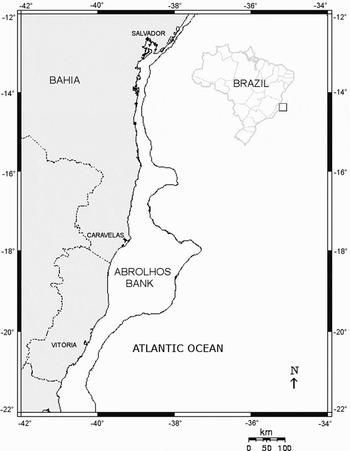
The study area comprises the Abrolhos Bank (16°40′–19°30′S), an extension of the Brazilian continental shelf located on the eastern coast of Brazil (Figure 1). The area is shallow (approximately 30 m depth), covering approximately 30,000 km2 (Fainstein & Summerhayes, Reference Fainstein and Summerhayes1982), with surface water temperatures ranging from 22° to 24°C during the winter (Castro & Miranda, Reference Castro, Miranda, Robinson and Brink1998).
Localization of study area: Abrolhos Bank.

Here we define ‘group’ as one or more individuals that remain together (<100 m between individuals) throughout the observation period, generally moving in the same direction in a coordinated way (Whitehead, Reference Whitehead1983; Mobley & Herman, Reference Mobley and Herman1985). A ‘calf’ was defined as an animal next to an adult whale, estimated at less than 50% of the total length of the associated animal (Chittleborough, Reference Chittleborough1965). An adult is defined as a non-calf of unknown sex.
Behavioural observations were conducted between the months of July and November during research cruises in the Abrolhos Bank from 1992 to 2003. These months correspond to the peak of abundance of humpback whales on Brazil's north-eastern coast (Martins et al., Reference Martins, Morete, Engel, Freitas, Secchi and Kinas2001; Morete et al., Reference Morete, Pace, Martins, Freitas and Engel2003b). Observations were conducted from 10–16 m wooden boats powered by a 6-cylinder diesel inboard engine. Cruises lasted from one to five days, with an average sampling of 391 ± 141 minutes/day. The search for humpback whales was made with the naked eye or with binoculars (7 × 50). For behavioural observations, we remained with each sighted group of whales for approximately 30 minutes, keeping an average distance of 100 m to the group. All distances were estimated subjectively. Observations were suspended in unfavourable weather or sea conditions (Beaufort sea state greater than 5, winds above 17 knots).
Based on previous studies (Tyack & Whitehead, Reference Tyack and Whitehead1983; Baker & Herman, Reference Baker and Herman1984; Clapham et al., Reference Clapham, Palsbøll, Mattila and Vasquez1992), social groups were classified according to eight possibilities: (1) mother and calf; (2) mother, calf and escort; (3) mother, calf and two escorts; (4) mother and calf and more than two escorts; (5) adult alone; (6) two adults; (7) three adults; and (8) more than three adults.
In this study a group is called a ‘competitive group’ if it comprises three or more adults, with or without calves. Behavioural states of focal groups were sampled following Altmann (Reference Altmann1974). Behaviour was classified into one or more of five possibilities: (1) travelling: diving or swimming (Corkeron, Reference Corkeron1995); (2) resting: motionless at the water surface (Corkeron, Reference Corkeron1995); (3) tail-up: at least one group member engaged in tail-up (Morete et al., Reference Morete, Freitas, Engel, Pace and Clapham2003a); (4) socializing: at least one group member breaching, tail breaching (Clapham, Reference Clapham, Mann, Connor, Tyack and Whitehead2000), lobtailing or flippering (Whitehead, Reference Whitehead1985); or (5) aggressive: agonistic behaviours, such as head-lunging (Baker & Herman, Reference Baker and Herman1984), trumpet (Corkeron, Reference Corkeron1995), bubblestreams and tail slapping (Tyack & Whitehead, Reference Tyack and Whitehead1983). Although aggressive behaviours represent a type of socializing we decided to create a new category named aggressive to provide a greater focus of such behaviours and what they may represent.
Statistical analyses
We used a Bayesian network approach to analyse behaviour in different group compositions. This type of analysis produces a graphical output that can represent a joint distribution of probabilities of a group of variables, considering the relation between them (Charniak, Reference Charniak1991). The analysis was carried out using the program NETICA in its 1.12 version (NETICA, 2004, Vancouver, Canada).
We used a logistic regression model (Wright, Reference Wright, Grimm and Yarnold1995) to investigate the relation between competitive groups and the occurrence of specific behaviours, and a Chi-square test (χ 2) to determine differences between competitive groups with and without calves.
RESULTS
Behavioural patterns and group composition
We monitored 3022 groups in 719 days of sampling, totaling 4678 hours of observation. According to the Bayesian network probability analysis, groups of two adults, mother and calf and adult alone had the highest occurrence probabilities, while mother and calf and two escorts and mother and calf and more than two escorts the lowest (Table 1).
Occurrence probabilities obtained from a Bayesian network of the conducts of humpback whales, in the Abrolhos Bank (1992–2003), as a function of the observed groups: adult whale alone (Alone); two adult whales (Dyad); three adult whales (Trio); more than three adult whales (Trio+ ); mother and calf (Moca); mother, calf and one escort (Moce); mother and calf and two escorts (Moces); mother and calf and more than two escorts (Moce+ ). The occurrence probabilities of the behaviours for each type of investigated group differ from 1 because it is possible to observe more than a single behavioural state during sampling. The sum of the occurrence probabilities and of the lack of occurrence probabilities of a determined behaviour equals 1.

Group compositions were inserted in one or more of the five conducts according to observations, and the Bayesian network model was used to determine the behavioural probabilities based upon the possible group compositions. When considering the social arrangement of the individuals in the group, mother and calf and mother and calf and one escort presented the highest probabilities of occurrence for resting conduct (37.7% and 32.8%, respectively), while the group composition adult alone showed the highest probabilities of the tail-up conduct (19.2%). Competitive groups with more than three adults, without calf and with calf presented greater probabilities of the socializing conduct (67.7% and 64%, respectively) and aggressive conduct (68.1% and 76%, respectively) (Table 1).
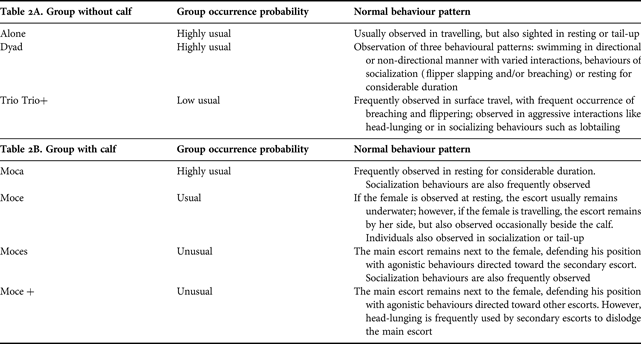
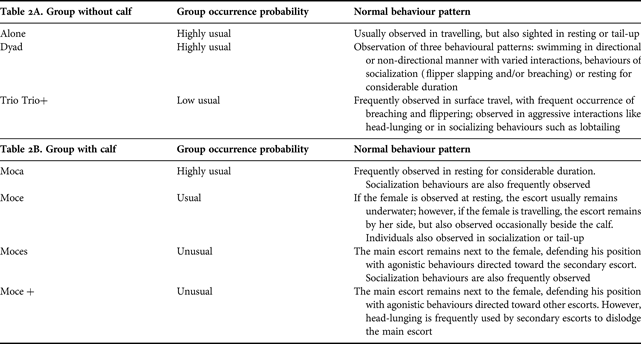
The behavioural characterizations for the eight group compositions (Table 2) were also identified according to the following sighting criteria: difference between greater and lesser probability values divided by number of categories chosen. We have four categories: Unusual (probabilities less than 7%), Low usual (probabilities between 7% and 12%), Usual (probabilities between 13% and 18%) and Highly usual (probabilities greater than 18%). Groups of up to two adults, with or without calves, were classified as Highly usual or Usual. Only the competitive groups with calves (mother and calf and two escorts and mother and calf and more than two escorts) were identified as Unusual (Table 2). For all group compositions, the most commonly observed conduct was travelling. However, competitive groups, with and without calves, were usually observed in aggressive interactions.
Characterization of the behaviour of humpback whales in the Abrolhos Bank (1992–2003) according to the probability of conducts occurrence. The following groups: adult whale alone (Alone), two adult whales (Dyad), three adult whales (Trio), more than three adult whales (Trio+ ) (Table 2A) and mother and calf (Moca), mother, calf and one escort (Moce), mother and calf and two escorts (Moces), mother and calf and more than two escorts (Moce+ ) (Table 2B) are classified according to the following occurrence criteria: difference between greater and lesser probability values divided by number of categories chosen. We include four categories: Unusual (probabilities <7%), Low usual (probabilities between 7%–12%), Usual (probabilities between 13%–18%) and Highly usual (probabilities >18%).
Association of males with females without calves
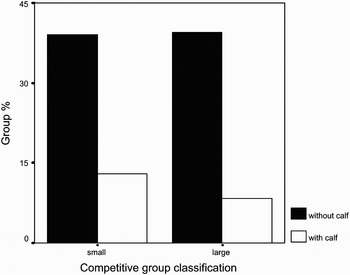
We analysed the preference of males for females with high reproductive potential by comparing competitive groups with and without calves. Smaller competitive groups (three adults) exhibited a relatively lower occurrence probability of 35.4% of the aggressive conduct, possibly for access to the female, as compared with competitive groups with more than three adults, which exhibited an occurrence probability of twice that much aggressive conduct (68.1%) (Table 1). When comparing the percentage occurrence of competitive groups with and without calves, we found a statistically significant predominance of the latter in both small (χ 2 = 74.25, P < 0.001) and large groups (χ 2 = 116.51, P < 0.001; Figure 2).
Percentage of small and large competitive groups of humpback whales in the Abrolhos Bank, Brazil (1992–2003) with respect to the presence or absence of calves. Values statistically significant for small groups (χ 2 = 74.25, P < 0.001, Nwithout calf = 224, Nwith calf = 75) and large groups (χ 2 = 116.51, P < 0.001, Nwithout calf = 227, Nwith calf = 48).

Relation between competitive groups and the occurrence of aggressive behaviours
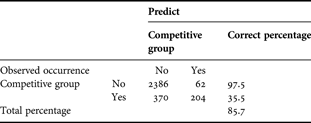
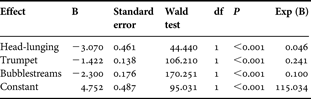
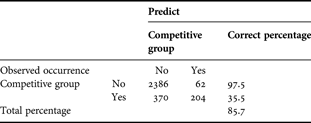
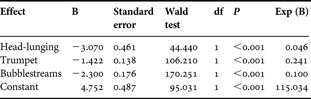
A binomial logistic regression model was used to predict competitive groups based upon the occurrence of conducts classified as socializing (tail breaching and lobtailing) and aggressive (head-lunging, trumpet, bubblestreams and tail slapping) (Table 3). Despite the impossibility of obtaining a statistically significant model that predicts competitive groups based upon the conduct socializing, the model, using this conduct, predicted 85.7% of competitive groups (variables and parameters in the equation are shown in Table 4). The only behaviour of the aggressive conduct type not included in the model was tail slapping.
Classification of the binomial logistic regression model based upon the occurrence of aggressive behaviours (head-lunging, bubblestreams and trumpet) in competitive and non-competitive groups of humpback whales in the Abrolhos Bank in the period 1992–2003.
Variables and parameters used in the binomial logistic regression equation according to the prediction model of aggressive behaviours (head-lunging, bubblestreams and trumpet) of humpback whales in competitive and non-competitive groups in the Abrolhos Bank in the period from 1992–2003. B, logarithmic variation of the dependent variable as a function of the independent variable; Exp (B), exponential of B, which is the linear variation of the dependent variable as a function of the independent variable.
DISCUSSION
Our results support the first hypothesis of the study, where we suggest that specific group compositions are associated with distinctive behavioural patterns. The Bayesian network supplied high probabilities of occurrence for conducts of the type travelling and socializing, irrespective of the social arrangement of individuals in the group. Possibly, the high occurrence probability of socializing reflects the importance of the use of habitat as a means for social interaction, through behaviours such as breaching and flippering. Due to the context where they usually occurred, these behaviours probably represent a rich repertoire of communication/interaction between individuals. Whitehead (Reference Whitehead1985), in his study concerning breaching behaviour, pointed out that it occurs more commonly in species that are more social and that tend to segregate in reproductive areas, strengthening, therefore, the interaction scenario.
Competitive groups with more than three adults (four or more whales together and mother and calf and more than two escorts) presented greater occurrence probabilities for socializing and aggressive conducts, suggesting that the high levels of aggressiveness in these groups can involve the conflict of males over access to females. Similar observations in humpback whales and other cetaceans also suggest this (Silverman & Dunbar, Reference Silverman and Dunbar1980; Tyack & Whitehead, Reference Tyack and Whitehead1983; Baker & Herman, Reference Baker and Herman1984; Clapham et al., Reference Clapham, Palsbøll, Mattila and Vasquez1992; Herman et al., Reference Herman, Herman, Pack, Marshall, Shepard and Bakhtiari2007). Escorts, in humpback whales, engage in agonistic interactions (aggressive conduct) more frequently in larger competitive groups (four or more whales together and mother and calf and more than two escorts) than in smaller competitive groups (three adult whales together and mother and calf and two escorts).
Groups of one and two adults, with or without calves (alone, two adult whales, mother and calf and mother and calf and one escort), were classified according to occurrence criteria adopted in this study as Highly usual or Usual. The predominance of groups of one and two adults without calves was also observed by Martins et al. (Reference Martins, Morete, Engel, Freitas, Secchi and Kinas2001) and Lunardi et al. (Reference Lunardi, Engel and Macedo2008) in the Abrolhos Bank and by Baker & Herman (Reference Baker and Herman1984) and Craig et al. (Reference Craig, Herman and Pack2002) in Hawaii. However, the present study had high occurrence probabilities of groups of mothers and calves, classified here as Highly usual. The prevalence of this type of group is probably due to the higher sampling conducted around Abrolhos Archipelago, a typical calving ground of the species (Martins et al., Reference Martins, Morete, Engel, Freitas, Secchi and Kinas2001; Morete et al., Reference Morete, Pace, Martins, Freitas and Engel2003b).
The second hypothesis we tested was the existence of an association of males with groups without calves as suggested by Craig et al. (Reference Craig, Herman and Pack2002). This hypothesis is based upon the concept of parental investment (sensu Trivers, Reference Trivers and Campbell1972) that suggests that when one of the sexes has a much higher level of parental investment, individuals of the sex investing less will compete among themselves to mate with the high investing members of the opposite sex. Studies with several other taxa have shown that, in the beginning of the courtship, males are frequently aggressive and females shy or reluctant (Cox & LeBoeuf, Reference Cox and LeBoeuf1977; Byers et al., Reference Byers, Moodie and Hall1994; Doutrelant & McGregor, Reference Doutrelant and McGregor2000) and it is assumed that one of the functions of courtship is to synchronize sexual receptivity between partners (Liley & Stacey, Reference Liley, Stacey, Hoar, Randal and Donaldson1983). However, males of promiscuous species may maximize their fitness by mating with several females, and may be subjected to limitations of their reproductive success through sperm competition, female choice, and costs and risks associated with searching for viable females (Danchin & Cézilly, Reference Danchin, Cézilly, Danchin, Giraldeau and Cézilly2008). As well, males of many species of vertebrates and invertebrates are limited with respect to the number of ejaculations they can produce due to the time necessary to replenish their reduced semen reserves (reviewed in Andersson, Reference Andersson1994), and this may be an additional constraining factor of the reproductive success that can be attained by males. Thus, it is expected that in some species males should be selective about how they distribute mating among females. There is ample evidence that males of some species can and do mate preferentially with some females (Dewsbury, Reference Dewsbury1982). Examples described in the literature include: rhesus monkeys Macaca mulatta (Herbert, Reference Herbert1968), fruit flies Drosophila melanogaster (Cook, Reference Cook1975) and crustaceans Asellus aquaticus and A. meridianus (Manning, Reference Manning1975).
Considering the high parental investment performed by humpback whale mothers, low availability of females for reproduction due to the long period of nursing the calves, high cost of producing a calf (Clapham & Mayo, Reference Clapham and Mayo1990) and long period that a male potentially has to wait to inseminate a female, males would be expected to be biased when choosing a mating partner. The results of this study confirmed this expectation. For the population of humpback whales in Abrolhos Bank, we found a higher number of competitive groups associated with females without calves and decreased probabilities of occurrence of competitive groups with calves (mother and calf and two escorts and mother and calf and more than two escorts). Similar patterns were obtained for other breeding grounds (Clapham et al., Reference Clapham, Palsbøll, Mattila and Vasquez1992; Craig et al., Reference Craig, Herman and Pack2002). Pack et al. (Reference Pack, Herman, Spitz, Hakala, Deakos and Herman2009) examined the relation of body size of the female in competitive groups with the number of attending escorts and determined the relation of a female's body size to the size of her calf and concluded that male humpback whales prefer to associate with larger females and that larger females produce larger calves.
Finally, in the last hypothesis we expected a relation between competitive groups and the occurrence of aggressive behaviours. The logistic model, in its totality, predicted the occurrence of approximately 86% of the competitive groups based upon behaviours of the type head-lunging, trumpet and bubblestreams. The only behaviour of the aggressive conduct type not included in the model was tail slapping. Although this behaviour has been described as a clear form of aggression (Tyack & Whitehead, Reference Tyack and Whitehead1983), the lack of its inclusion in the model for predicting competitive groups occurred because the behaviour was observed infrequently, as compared to other aggressive behaviours in the population.
Aggressive behaviour among humpback males has been widely described in several breeding grounds (Tyack & Whitehead, Reference Tyack and Whitehead1983; Baker & Herman, Reference Baker and Herman1984; Clapham et al., Reference Clapham, Palsbøll, Mattila and Vasquez1992; Craig et al., Reference Craig, Herman and Pack2002; Herman et al., Reference Herman, Herman, Pack, Marshall, Shepard and Bakhtiari2007). For instance, the death of a male in a competitive group due to aggressive attacks by other males was observed by Pack et al. (Reference Pack, Salden, Ferrari, Glockner-Ferrari, Herman, Stubbs and Straley1998). This underscores the potential cost of physical battle during encounters between males for access to females. Many aggressive behaviours are regularly observed within the context of male conflict, where secondary escorts try to displace the primary escort to approach the nuclear female (Tyack & Whitehead, Reference Tyack and Whitehead1983). Competitive groups regularly show periods of aggressive activity on the surface (Clapham et al., Reference Clapham, Palsbøll, Mattila and Vasquez1992). Some of these activities, like the bubblestreams and head-lunging, are more frequently observed in competitive groups without calves, when compared with other types of groups (Tyack & Whitehead, Reference Tyack and Whitehead1983).
In one study, aggressive conduct occurred for all sighted competitive groups, with head-lunging as the most common behaviour (Baker & Herman, Reference Baker and Herman1984). If aggression observed in these groups is primarily a function of competition among males for access to females, then its occurrence should be influenced by seasonal changes in the reproductive status of adult females and males (Baker & Herman, Reference Baker and Herman1984). According to these authors, the lower rates of behaviours of the aggressive type in feeding areas support the argument that aggression varies in relation to reproductive cycles and the hormonal changes involved in both sexes during the reproductive season.
ACKNOWLEDGEMENTS
We are very grateful to the Instituto Baleia Jubarte for the concession of data from 1992 to 2003 and A.N. Zerbini, J.S. Marinho-Filho, P.C. Simões-Lopes, V.F. Saracura and an anonymous referee for revision of the manuscript. We thank C. Freitas, M. Galiza, C.C.A. Martins, L. Pacheco, L.L. Wedekin, M.R. Rossi-Santos and all the trainees of the Instituto Baleia Jubarte for assistance with the field work. We thank the PETROBRAS (Petróleo Brasileiro SA) for sponsorship of the cruises and the Conselho Nacional de Desenvolvimento Científico e Tecnológico (CNPq) for the scholarship to D.G.L (Proc. No. 130062/2003–0) and a research fellowship to R.H.M.