Introduction
Forage cacti (Opuntia fícus-indica Mill. and Nopalea cochenillifera Salm-Dyck) are widely used to feed ruminants in semi-arid regions (Vilela et al., Reference Vilela, Ferreira, Azevedo, Modesto, Farias, Guimarães and Bispo2010; Saraiva et al., Reference Saraiva, Gonzaga Neto, Henriques, Queiroz, Saraiva, Albuquerque, Fonseca and Nascimento2015; Silva et al., Reference Silva, Ferreira, Oliveira, Santos, Gama, Chagas, Inácio, Silva and Pereira2018). These plant species are favoured due to their persistence under high diurnal temperatures and limited soil moisture content (Aguilar-Yáñez et al., Reference Aguilar-Yáñez, Hernández-Mendo, Guerrero-Legarreta, Ramírez–Bribiesca, Aranda-Osorio and Crosby-Galvan2011; Andrade-Montemayor et al., Reference Andrade-Montemayor, Cordova-Torres, García-Gasca and Kawas2011; Rodrigues et al., Reference Rodrigues, Pitacas, Reis and Blasco2016). Therefore, the use of spineless cacti (Opuntia spp.) is fundamental in the formulation of diets, whether in natura as a complete feed or ensiled, an alternative that has gained prominence among producers over the years (Çürek and Özen, Reference Çürek and Özen2004; Macêdo et al., Reference Macêdo, Santos, Araújo, Edvan, Oliveira, Perazzo, Sá and Pereira2018). Ensiling may be interesting for producers since it improves agronomic production, reduces the labour needed to cut and supply the cactus in natura, simplifies the agricultural practices required for this forage and maintains a nutritional value, which decreases over the dry season period. The use of forage cacti silage also favours the use of feedlots for animals.
Opuntia can be conserved as silage, despite its high moisture content, due to the formation of mucilage that can decrease the water activity, controlling the development of clostridia and enterobacteria, besides reducing effluent losses (Gusha et al., Reference Gusha, Katsande, Zvinorova and Ncube2013; Toit et al., Reference du Toit, de Wit and Hugo2018). However, the high concentration of water-soluble carbohydrates (WSC) present in Opuntia may favour yeast growth, resulting in alcoholic fermentation and, thereby, high dry matter (DM) loss (Gusha et al., Reference Gusha, Katsande, Zvinorova and Ncube2013, Reference Gusha, Halimani, Ngongoni and Ncube2015; Macêdo et al., Reference Macêdo, Santos, Araújo, Edvan, Oliveira, Perazzo, Sá and Pereira2018). Nevertheless, these characteristics may result in silage that is highly susceptible to deterioration after silo opening, which may compromise the use of Opuntia silage for animal feed.
Given the limitations mentioned above and aiming at the successful production of good-quality Opuntia silage, management strategies to limit silage deterioration should be adopted. Microbial inoculants are widely used for this purpose and have been efficient in promoting improvements throughout the fermentation profile and ensuring that the forage is adequately preserved (Kleinschmit and Kung Jr, Reference Kleinschmit and Kung2006; Schmidt et al., Reference Schmidt, Hu, Mills and Kung Junior2009; Carvalho et al., Reference Carvalho, Ávila, Pinto, Neri and Schwan2014; Silva et al., Reference Silva, Ferreira, Oliveira, Santos, Gama, Chagas, Inácio, Silva and Pereira2018). Muck (Reference Muck2008), Santos et al. (Reference Santos, Ávila, Pinto, Carvalho, Dias and Schwan2016) and Sifeeldein et al. (Reference Sifeeldein, Yuan, Dong, Li, Youns and Shao2018) found that inoculants produced from the strains of lactic acid bacteria (LAB) from Opuntia species, adapted to the specific conditions of the forage plant, can be used to improve the efficiency of silage fermentation.
However, no prior research has evaluated the potential of isolated LAB cultures from Opuntia as inoculants for silage. In the current study, it was hypothesized that the strains of LAB isolated from spineless cactus silage could improve the fermentation pattern and increase the aerobic stability of cactus silage. To test this theory, the strains of LAB isolated from forage cactus plants and silage were selected and assessed for their effects on silage fermentation and aerobic stability.
Materials and methods
Experiment 1: isolation and characterization of lactic acid bacteria from spineless cactus plants and silage
Location and silage preparation
The study was performed at the Forage Laboratory, Department of Animal Science, the Federal University of Paraíba (Campus II, Areia, Paraíba, Brazil), located in the Brejo Paraibano microregion (6°57′S, 35°41′W).
Samples of the whole Opuntia plant from the species N. cochenillifera Salm-Dyck cv. Miúda were obtained from the State Agricultural Research Agency of Paraíba (EMEPA-PB) in the municipality of Tacima, Paraíba, Brazil, located in the Agreste Paraibano mesoregion (6°29′S, 35°38′W), stocked with the stands of regrowth that was 2 years old. Thus, all cladodes were collected, preserving only the primary cladode per plant.
Forage cactus was chopped to a length of 2 cm using a JF-92 Z10 forage harvester (JF Agricultural Machinery, São Paulo, Brazil). Approximately 3 kg of fresh cactus palm were packed into polyvinyl chloride (PVC) silos (15 cm diameter and 40 cm length) to a density of 500 kg/m3 and sealed with PVC cap equipped with Bunsen's valve and closed using adhesive tape. Each PVC silo included 1.5 kg of sand that had been dried in an oven for 48 h, separated from the chopped forage by two layers of cheesecloth. The sand was used to measure effluent losses. The mini silos were stored at room temperature (22 ± 2.0°C) and opened at 60 days of ensiling. Three replicates were prepared for each sampling date (0 and 60 days).
Isolation and identification of lactic acid bacteria
The LAB were isolated from 25 g of the Opuntia fresh forage and silage that were homogenized with 225 ml of sterile quarter-strength Ringer's solution (Oxoid, Hampshire, UK) in an industrial blender for 1 min. Subsequently, serial tenfold dilutions were prepared in De Man, Rogosa and Sharpe (MRS) agar (Difco, São Paulo, Brazil) using pour plates and incubated at 37°C for 48 h before enumeration. Colonies were counted on plates that had 30–300 colony-forming units (cfu).
From MRS plates containing well-isolated colonies, these colonies were randomly identified in a total relative to the square root of the total count of colonies (Holt et al., Reference Holt, Krieg and Sneath1994). The isolates were further purified by streaking individual colonies onto MRS agar containing bromocresol purple and calcium carbonate (CaCO3) as indicators. All LAB were detected by a yellowish colony and a clear zone caused by the dissolution of CaCO3. The isolates were re-cultivated in MRS agar for further purification by streaking onto MRS agar. The pre-selected cells, grown in 5 ml of MRS broth at 37°C for 18 h, were used for 16S ribosomal DNA (rDNA) gene sequencing. First, the DNA was extracted using a commercial kit (Wizard® Genomic DNA Purification kit, Promega, Madison, WI, USA) with the following modifications: the samples were centrifuged (Mikro 200R, Sigma–Aldrich, São Paulo, Brazil) at 10 000 g for 5 min and washed with 0.85% saline solution. The cells were re-suspended in 480 μl of 50 mm ethylenediaminetetraacetic acid (EDTA) and 50 μl of 50 mg/ml lysozyme was added immediately. The genomic DNA concentration was evaluated in a Nanodrop 2000 spectrophotometer (Thermo Scientific, Waltham, MA, USA) and stored at −20°C until use. The 16S rDNA gene sequence coding region was amplified by polymerase chain reaction (PCR) in a PCR thermal cycler (Eppendorf®, Hamburg, Germany). The sequences of the PCR products were determined directly using a sequencing kit and the prokaryotic 16S rDNA universal primers P027F (5′ GAGAGTTTGATCCTGGCTCAG 3′) and 1492R (5′ TACGG(C/T)TACCTTGTTACGACTT 3′) (Heuer et al., Reference Heuer, Krsek, Baker, Smalla and Wellington1997). The PCR reaction was performed in microfuge tubes containing 50 μl of the following reaction mixture: DNA (approximately 60 ng); reaction buffer 10× (0.1 mol/l trisaminomethane hydrochloric acid [Tris–HCl], pH 8.0 and 0.5 mol/l potassium chloride [KCl]); magnesium chloride (MgCl2); 1.5 mmol/l, pH 8.0); deoxynucleoside triphosphate (dNTP) mix (Promega); GoTaq® DNA polymerase (Promega); primers (0.6 μmol/l of P027F and 1492R, respectively) and autoclaved milli-Q water. The reaction conditions were as follows: 94°C/5 min; 30 cycles (denaturation: 94°C/30 s; 60°C/30 s); polymerization: 72°C/2 min; final extension at 72°C/5 min. The PCR reaction mixture was checked by agarose gel (2%) electrophoresis with Tris–borate–EDTA buffer (Thermo Scientific). The bands were visualized under ultra-violet light after staining with 0.5 mg/ml ethidium bromide. The PCR product was sent to Macrogen© (Seoul, Korea) for purification and sequencing. Sequence similarity searches were performed using the GenBank DNA database and the basic local alignment search tool (BLAST) for nucleotides (http://www.ncbi.nlm.nih.gov/BLAST). The 16S rRNA gene sequences that showed a similarity >97% were considered as belonging to the same operational taxonomic unit (Altschul et al., Reference Altschul, Gish, Miller, Myers and Lipman1990).
Pre-selection of lactic acid bacteria strains based on metabolite production in De Man, Rogosa and Sharpe broth
Forty isolates – 20 from the plant and 20 from cactus silage – classified as LAB were isolated and evaluated for metabolite production. The isolates were also examined by Gram stain and catalase activity, to evaluate the production capacity of lactic acid (LA) and acetic acid (AA), the isolates were cultured in MRS broth at 37°C for 24 h. Afterwards, the inoculum was standardized to an optical density of 1.0 at 600 nm using a spectrophotometer. Subsequently, 0.1 ml of this inoculum was added to 50 ml MRS broth and then stored at 35°C for 24 h. After fermentation, samples of the cultures were taken to evaluate metabolite production by high-performance liquid chromatography (Siegfried et al., Reference Siegfried, Ruckemann and Stumpf1984).
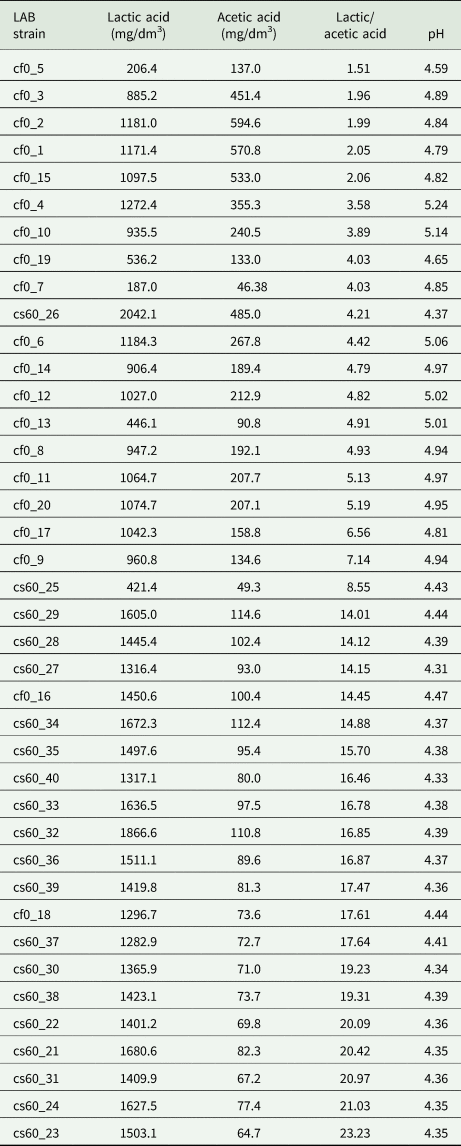
To evaluate the strains in experimental silos, ten strains of LAB were chosen based on their production capacity of LA and AA. The five strains with the highest ratio of LA to AA (GP21, GP22, GP23, GP24 and GP31) and the five with the lowest ratio of LA to AA (GP1, GP2, GP3, GP5 and GP15) were selected.
Experiment 2: strains evaluation in experimental silos
Location and silage preparation
Experiment 2 was conducted at the same location as described for Experiment 1. A forage cactus was chopped to a length of 2 cm using a JF-92 Z10 forage harvester (JF Agricultural Machinery). Approximately 3 kg of fresh cactus palm were packed into PVC silos (15 cm internal diameter and 40 cm long) at a density of 500 kg/m3 and sealed with PVC cap equipped with a Bunsen's valve and closed using adhesive tape. Each PVC silo was provided with an apparatus for effluent quantification, consisting of 1.5 kg of sand, dried previously in an oven for 48 h, placed in the bottom of the silo and separated from the chopped forage by two layers of cheesecloth. The mini silos were stored at room temperature (22 ± 2.0°C) and opened at 60 days of ensiling.
Silage was produced using ten selected LAB strains from the first experiment as inoculants. Silage without any inoculant was used as the control. For all treatments, the theoretical application rate was 1.0 × 10⁶ cfu/g of fresh forage. Microbial inoculants were first plated on MRS agar to confirm their viability, then appropriate amounts of the inoculants were used to achieve the desired application rate. All the inoculants were initially dissolved in 50 ml of pure distilled water and then sprayed uniformly onto each pile of forage, under constant mixing. The same quantity of water as used to dilute the inoculants was applied to the untreated piles. A separate sprayer was used for each treatment to avoid cross-contamination.
Sample collection
At the moment of ensiling and on the day of opening the silo, samples (3.5 kg) were removed from fresh forage and each PVC silo. The samples from fresh forage and silage were analysed for microbial populations, DM, ash, crude protein (CP), neutral detergent fibre (NDF), ether extract (EE), non-fibre carbohydrates (NFC), total carbohydrates (TC), WSC and ammonia nitrogen ratio to total nitrogen (NH3-N/TN).
For microbial populations, 25 g of the fresh forage and silage from Opuntia were homogenized with 225 ml of sterile quarter-strength Ringer's solution (Oxoid) in an industrial blender for 1 min. The pH of the water extract was measured. A portion of the water extract was filtered through a double layer of cheesecloth into a sterile tube, for microbial analysis. Another portion of the water extract was acidified with 50% sulphuric acid (H2SO4, pH < 2.0) and frozen at −20°C for further investigation. For the enumeration, isolation and identification, serial dilutions were made in sterile Ringer's solution. For the count of LAB, samples were plated in MRS using pour plates and incubated at 37°C for 48 h before counting. Enterobacteria were enumerated by pour-plating samples in violet red bile agar (Difco) and incubated as described above for LAB. Yeasts and moulds (Y&M) were quantified by pour-plating samples in potato dextrose agar (Difco) that had been acidified by the addition of 1.5% tartaric acid solution at the rate of 10% (w/v), and the plates were incubated at 25°C for 5 days. Colonies were counted from the plates of appropriate dilutions containing 30–300 cfu.
The concentrations of DM (method 934.01), ash (method 930.05), CP (method 984.13) and EE (method 920.85) were determined as described by the Association of Official Analytical Chemists (AOAC, 1990). Samples were analysed for NDF, according to Mertens (Reference Mertens2002) and WSC, as detailed by Nelson (Reference Nelson1944), respectively. Non-fibre carbohydrates (NFC; g/kg) was calculated as follows: NFC = 100 − (CP + NDF + EE + ash) and TC (g/kg) was calculated as follows: TC = 100 – (CP + EE + ash).
In addition, samples from silage were also assessed for pH and NH3-N/TN (Detmann et al., Reference Detmann, Souza, Valadares Filho, Queiroz, Berchielli, Saliba, Cabral, Pina, Ladeira and Azevedo2012), buffering capacity (Playne and McDonald, Reference Playne and McDonald1966), volatile fatty acids and LA (Siegfried et al., Reference Siegfried, Ruckemann and Stumpf1984). Apparent DM recovery, gas losses and effluent losses were calculated using the weight and DM content of the fresh forage and silage (Zanine et al., Reference Zanine, Santos, Dórea, Dantas, Silva and Pereira2010).
The aerobic stability of each silo was ascertained by returning 3 kg of the sample silage to its respective silo and exposing it to air at 22°C. Temperatures were measured every 10 min using data loggers (Escort Mini; Impac, São Paulo, Brazil) inserted into the silage mass at the geometric centre. Each silo was covered with a double layer of sterile cheesecloth to avoid contamination and drying of the silage but allowing air to infiltrate the silage mass. Aerobic stability was defined as the number of hours silage remained stable before a rise in temperature of 2°C above ambient (Kleinschmit and Kung Jr, Reference Kleinschmit and Kung2006). Silage weights were recorded before and at 7 days after aerobic exposure, to compute DM recovery. The aerobically exposed silage samples were analysed for chemical and microbial compositions as described above for fresh forages and silage.
Statistical analysis
All microbial data were transformed to log units and are presented on a wet weight basis. Chemical data are given on a DM basis. Normality of residues and homogeneity of variances were tested with the UNIVARIATE procedure. The experiment evaluating anaerobic fermentation was conducted in a completely randomized design with 11 treatments and three replicates. Each PVC silo was considered the experimental unit. Data were analysed using the following model:

where Yij = is the value of the dependent variable; μ = mean and eij = residual error.
Data were analysed using the PROC MIXED in SAS (9.4 version, SAS Institute, Inc., Cary, NC, USA 2012). The means were compared by the Scott–Knott test. Treatment effects were considered significant at P < 0.05.
Results
Experiment 1
Isolation, identification and pre-selection of lactic acid bacteria strains
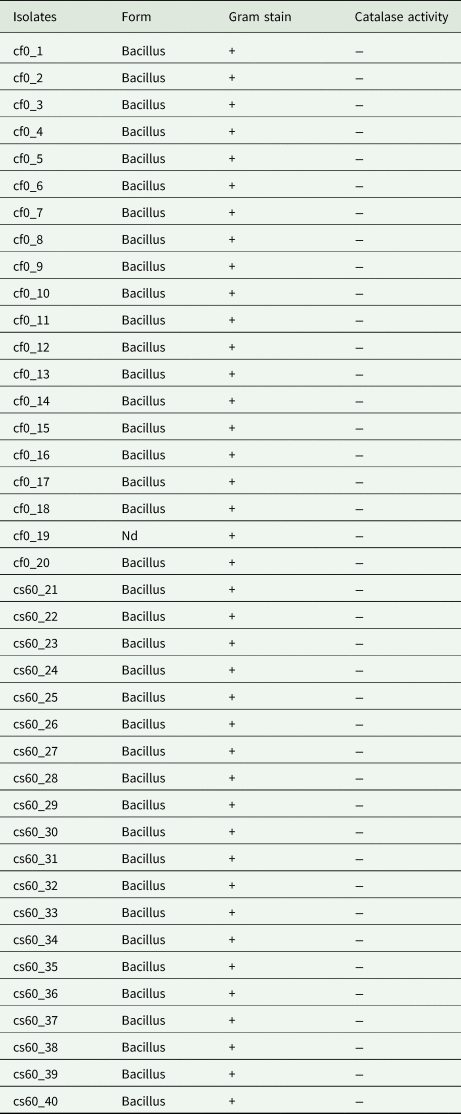
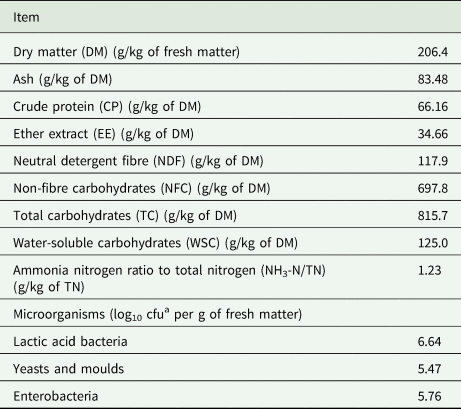
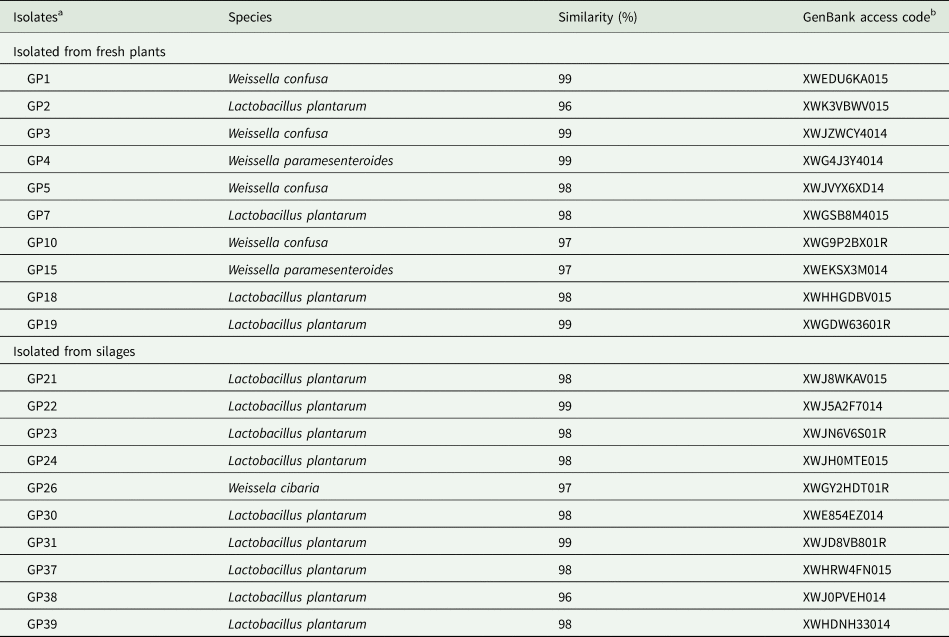
All strains isolated from the plant and silage were classified as Gram-positive and catalase-negative (Table 1). The cactus forage before ensiling had an amount of 6.64 log10 cfu1 per g of fresh matter of LAB (Table 2). The concentrations of LA and AA ranged from 186.98 to 2042.05 mg/dm3 and from 46.38 to 594.60 mg/dm3, respectively (Table 3). All strains showed sequence similarities ≥96% when compared with the GenBank database using the BLAST algorithm (National Centre for Biotechnology Information, Bethesda, MD, USA). The wild isolates were identified as Lactobacillus plantarum, Weissella cibaria, Weissella confusa and Weissella paramesenteroides. The most prevalent LAB species from forage cactus and silage was L. plantarum (65%) (Table 4).
Morphology and biochemical characteristics of the lactic acid bacteria (LAB) isolated from cactus forage and silages

Nd, not-detected; cf, cactus forage; cs, cactus silage.
Chemical composition and microbial populations in cactus forage before ensiling
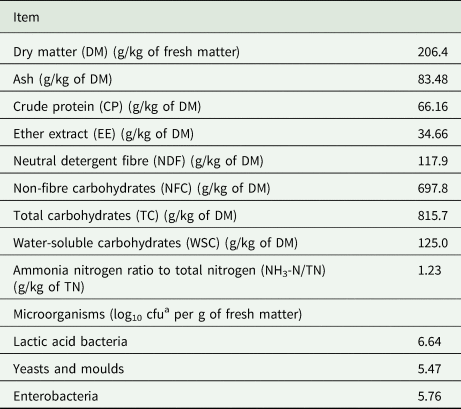
a Colony-forming units.
Contents of lactic acid, acetic acid, lactic acid/acetic acid ratio and pH by strains of lactic acid bacteria (LAB) in MRS broth

cf, cactus forage; cs, cactus silage.
Isolates, bacterial species similarity and GenBank access code of lactic acid bacteria (LAB) isolated from cactus forage and silages

a Strains with identification from GP1 to GP19 were isolated from cactus forage. Strains with identification from GP21 to GP39 were isolated from cactus silages.
b Identification based on ~1500 base pair gene that code for a portion of the 16S rDNA.
Experiment 2
Dry matter recovery and fermentative profile
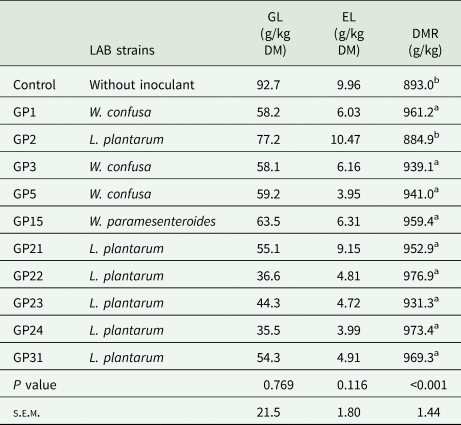
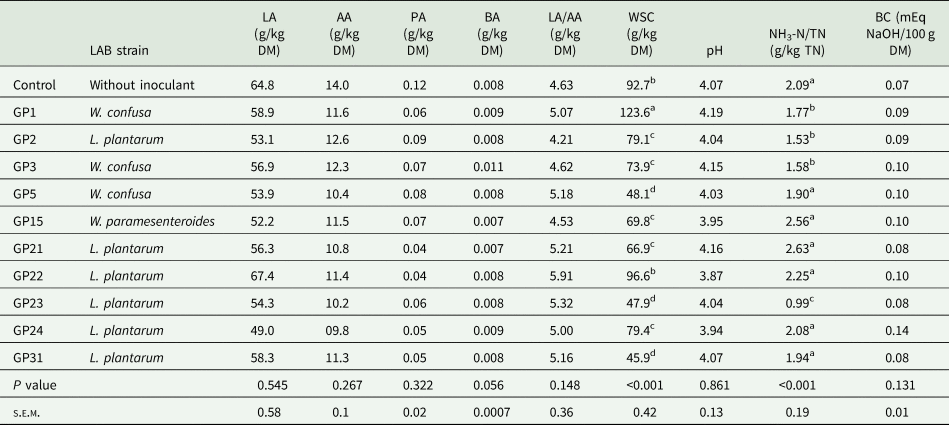
The use of inoculants did not influence the gas or effluent losses in forage cactus silage (Table 5). In the silage inoculated with strains GP1, GP3, GP5, GP15, GP21, GP22, GP23, GP23, GP24 and GP 31, higher DM recovery was found compared with the control, and the inoculants did not affect the LA, AA, propionic acid, butyric acid, pH or buffering capacity of the silage (Table 6). The WSC and NH3-N/TN differed (P < 0.001) among the silage. The silage inoculated with GP1 strain presented the highest WSC. The use of GP5, GP15, GP21, GP22, GP24 and GP 31 strains resulted in silage with a similar content of NH3-N/TN to the control and was higher than in the other silage (Table 6).
Effects of microbial inoculant on gas and effluent losses and dry matter recovery of cactus silage

LAB, lactic acid bacteria; GL, gas losses; EL, effluent losses; DMR, dry matter recovery; DM, dry matter.
The values within a column with different superscripts are significantly different.
Effects of microbial inoculant on the concentrations of lactic acid (LA), acetic acid (AA), propionic acid (PA), butyric acid (BA), lactic acid to acetic acid ratio (LA/AA), water-soluble carbohydrates (WSC), ammonia nitrogen ratio to total nitrogen (NH3-N/TN) and buffering capacity (BC) of cactus silage

LAB, lactic acid bacteria; DM, dry matter.
The values within a column with different superscripts are significantly different.
Chemical and microbiological characteristics of silage
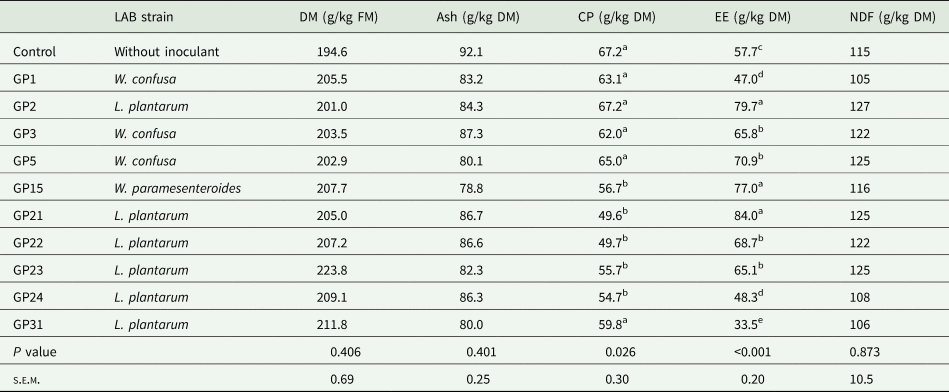
The inoculants did not affect DM, ash or NDF of the silage (Table 7). The CP and EE differed (P < 0.026) among the silage. The control silage and those inoculated with GP1, GP2, GP3, GP5 and GP31 strains showed the highest CP content (P = 0.026). The silage inoculated with GP2, GP15 and GP 21 strains showed the highest concentration of EE (P < 0.001).
Effects of microbial inoculant on the chemical composition of cactus silage

LAB, lactic acid bacteria; DM, dry matter; FM, fresh matter; CP, crude protein; EE, ether extract; NDF, neutral detergent fibre.
The values within a column with different superscripts are significantly different.
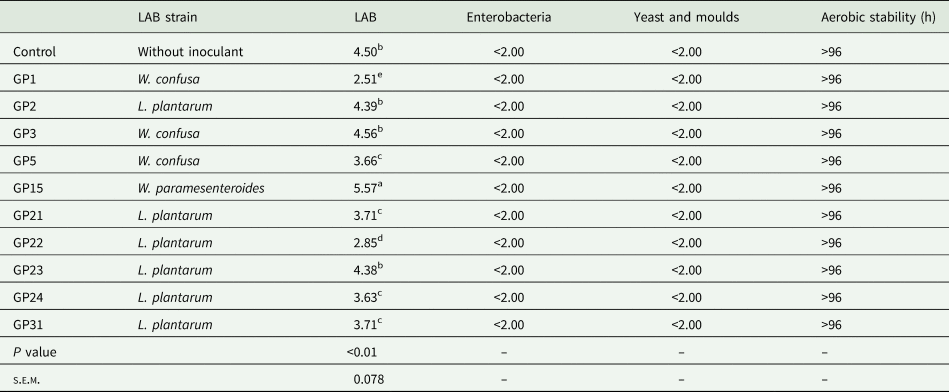
The LAB populations differed (P < 0.001) among the silage (Table 8): those inoculated with the GP15 strain showed the highest LAB population amount. The enterobacteria and Y&M populations were below the minimum detection limit (<2.0 log cfu/g silage) in all the silage studied. The inoculants did not affect the aerobic stability of forage cactus silage (Table 8).
Effects of microbial inoculant on microbial populations (log cfu/g silage) and aerobic stability of cactus silage

LAB, lactic acid bacteria.
The values within a column with different superscripts are significantly different.
Discussion
Lactic acid bacteria are Gram-positive, catalase-negative and non-spore-forming microorganisms, and their metabolism results in high production of LA (Asa et al., Reference Asa, Uehara, Shinzato, Toride, Usui, Hirakawa and Takahashi2010). Microbial inoculants produced from the strains of homofermentative LAB show the potential for converting WSC to lactate, thus decreasing the pH of the ensiled mass. However, some silage may favour the development of Y&M after the opening of the silo, deeming it necessary to use heterofermentative inoculants that produce not only LA but also AA since it has antifungal properties (Carvalho et al., Reference Carvalho, Ávila, Pinto, Neri and Schwan2014).
Lactobacillus plantarum, isolated from the plant, survives throughout the ensiling process and can be considered a potential inoculant, because it rapidly converts WSC into organic acids, promoting rapid acidification of the ensiled mass, inhibiting deleterious microorganisms (Xu et al., Reference Xu, He, Zhang and Kong2017). The present study verified that the strain GP26, identified as belonging to the W. cibaria species, a compulsory heterofermentative LAB, although not in the group of the largest producers of AA. Moreover, it is worth mentioning that W. cibaria is classified among the species with antimicrobial and antifungal activities (Ndagano et al., Reference Ndagano, Lamoureux, Dortu, Vandermoten and Thonart2011). The survival of this species in the acidic conditions of the silo may inhibit undesirable microorganisms in the ensiled material and improve aerobic stability. The identification of strains from the epiphytic microbiota and after the fermentation of the mass aims at the production of a microbial inoculant, capable of promoting an adequate fermentative profile and improving DM recovery of Opuntia silage, as well as increasing the aerobic stability of silage.
From the analysis of its chemical composition alone, Opuntia would be presumably considered as a plant prone to high losses, due mainly to its low DM content. In addition, the high sugar content could lead to excessive fermentation, predominantly carried out by yeasts. However, Opuntia releases a hydrophobic, viscous gel called mucilage when cut (a substance rich in polysaccharides: arabinose, galactose, xylose, rhamnose, glucose and uronic acid) (Felkai-Haddache et al., Reference Felkai-Haddache, Remini, Dulong, Mamou-Belhabib, Picton, Madani and Rihouey2016; Kalegowda et al., Reference Kalegowda, Chauhan and Urs2017), which helps to reduce the runoff of water in the plant, thereby helping to retain it within plant tissues which reduces the effluent losses (Toit et al., Reference du Toit, de Wit and Hugo2018).
Mucilage formation directly influences the retention of the liquids present in the ensiled mass, inhibiting fermentation losses, hence resulting in high DM recovery (Monrroy et al., Reference Monrroy, García, Ríos and García2017). Although effluent losses are minimized by the presence of mucilage, the excess of WSC in the mucilage can cause secondary fermentations such as alcoholic fermentation or even heterobacterial fermentation by enterobacteria. Inoculants are therefore used to prevent these undesirable fermentations and thus increase the recovery of DM (Gusha et al., Reference Gusha, Halimani, Ngongoni and Ncube2015).
According to Arriola et al. (Reference Arriola, Queiroz, Romero, Casper, Muniz, Hamie and Adesogan2015) and Pholsen et al. (Reference Pholsen, Khota, Pang, Higgs and Cai2016), a homofermentative inoculant should be used to improve the fermentation profile of the silage, since it decreases the pH rapidly due to high production of LA, resulting in the highest DM recovery. In contrast, the heterofermentative inoculant presents positive results after the opening of the silo, because of the production of AA that controls the proliferation of Y&M. In this context, an interesting characteristic of Opuntia silage is its high concentration of AA. This favours the growth of heterofermentative LAB through the slow decline of pH in the silage, owing to the presence of buffering substances, such as oxalic, malic, citric, malonic, succinic and tartaric acids resulting from crassulacean acid metabolism (Abidi et al., Reference Abidi, Ben Salem, Vasta and Priolo2009; Petera et al., Reference Petera, Delattre, Pierre, Wadouachi, Elboutachfaiti, Engel, Poughon, Michaud and Fenoradosoa2015; Isaac, Reference Isaac2016). Some of these acids may exert an antifungal action, which is associated with the high AA content that ensures high aerobic stability of the Opuntia silage. This was observed in the present study, since none of the evaluated silage lost aerobic stability during the 96 h of air exposure.
Opuntia shows a high amount of WSC in its composition (125.0 g/kg), favouring higher LA production relative to the other acids. Paradoxically, all the silage presented high concentrations of AA, which can be attributed to a lower reduction of the pH of silage, favouring the performance of heterofermentative LAB in the initial phase of the ensiling process. This fact is interesting because, considering that all silage showed the concentrations of AA close to or above 10 g/kg, they can be considered aerobically stable (Kung Jr and Ranjit, Reference Kung and Ranjit2001).
The NH3-NT content is related to proteolysis, which occurs during the fermentation process and results from the growth of undesirable microorganisms, such as clostridia and enterobacteria (Muck, Reference Muck2010). Costa et al. (Reference Costa, Pires, Moura, Sales, Rodrigues and Rigueira2016) state that well-fermented silage should present NH3-NT contents <100 g/kg of total nitrogen. Opuntia silage can, therefore, be considered to have an adequate fermentation profile since the NH3-N/NT contents were in the range of 0.99–2.63 g/kg. Protein hydrolysis occurs during fermentation of the ensiled mass, generating molecules such as soluble nitrogenous compounds, NH3, free amino acids and bioactive peptides, which have functions related to the probiotic characteristics of L. plantarum (Crowley et al., Reference Crowley, Mahony and van Sinderen2013; Li et al., Reference Li, Tian, Zhang, Jiang, Hou, Wu and Yu2018). Under limited nutrient conditions, LAB can derive the energy required for their metabolism from the catabolism of these amino acids. However, this system varies among the strains of the same species and among different species of LAB (Ke et al., Reference Ke, Ding, Xu, Shah, Zhang and Guo2018; Shah et al., Reference Shah, Xianjun, Zhihao, Junfeng and Sao2018). Reduced protein content might be indicative of the proteolytic activity of some strains used in the present study, which requires further investigation at the gene expression level to confirm the performance of proteolytic enzymes synthesized by these strains.
Lower amounts of LAB were found at the end of the fermentation period when compared to the fresh plant, as also found by several previous authors (Moon et al., Reference Moon, Ely and Sudweeks1981; Alli et al., Reference Alli, Fairbairn, Baker and Garcia1983; Pedroso et al., Reference Pedroso, Nussio, Paziani, Loures, Igarasi, Coelho, Packer, Hori and Gomes2005; Filya and Sucu, Reference Filya and Sucu2010). In general, LAB multiply rapidly in the first days of fermentation, coinciding with the period of intense acidification of silage (Li et al., Reference Li, Ni, Pang, Wang, Cai and Jin2015). The stabilization of the LAB population promotes intense acidification of the silage environment and can reduce the LAB population (Pedroso et al., Reference Pedroso, Nussio, Paziani, Loures, Igarasi, Coelho, Packer, Hori and Gomes2005; Ávila et al., Reference Ávila, Pinto, Figueiredo and Schwan2009; Filya and Sucu, Reference Filya and Sucu2010).
Conversely, a fascinating observation was the presence of enterobacteria and Y&M at the end of the fermentative process. These were present despite the final pH being below that recommended for enterobacteria (Weirich et al., Reference Weirich, Neres, Hunoff, Ströher, Nath, Sunahara, Sarto and Oldoni2018) and despite the amount of acetic fermentation, which would normally inhibit fungi and yeasts. Kung Jr et al. (Reference Kung, Shaver, Grant and Schmidt2018) mention that the silage will certainly be aerobically stable if there is effective control of yeasts throughout the fermentation period. Another fact to consider regarding Opuntia ensiling is its high density, obtained as a function of the presence of mucilage, which aggregates the plant particles and expels oxygen rapidly from the silo, thereby also contributing to the inhibition of fungal populations.
Analysis of the obtained results confirmed that the inoculation fulfilled its expected function of triggering lactic fermentation and minimizing fermentation losses, while the high content of AA contributed to ensuring the aerobic stability of the evaluated silage. It is evident that the high amount of WSC contributes to the acidification of the ensiled mass while the buffering delays acidification somewhat, leading to a high consumption of sugars and decreasing DM recovery. The inoculation probably accelerated acidification, thus ensuring high recovery of DM at the end of fermentation. Taking into account that there was no aerobic deterioration, the ensilage of Opuntia with inoculants of the autochthonous microbiota is shown as a highly efficient technique. Even so, further studies should be conducted to explore the potential of these microorganisms as inoculants, mainly to investigate their genomic constitution and other favourable characteristics that these strains can add to the silage process of Opuntia or even other forages used for ensiling.
Given the above, microbial diversity is observed in Opuntia silage, with a predominance of LAB from the genus Weissella in the plant and the genus Lactobacillus in Opuntia silage; the predominant action of inoculants was the maximized DM recovery of the silage, which could be the criterion adopted to select the strains of LAB for use as inoculants in Opuntia silage.
Financial support
This research was supported by the Coordination for the Improvement of Higher Education Personnel (CAPES-Brazil) and by the Maranhão State Research Foundation (FAPEMA-Brazil).
Conflict of interest
The authors declare there are no conflicts of interest.
Ethical standards
Not applicable.