Introduction
The argument that nutrition is an investment on par with any other productivity enhancing expenditures rather than simply a form of social spending that governments grant poor people to the degree that they prioritize equity is hardly new.Reference Berg and Muscat1 The data used to prove this point are. This study recapitulates some recent evidence brought to this argument by economists. When such data are tabulated they regularly show substantial contribution of improved nutrition to aggregate economic developmentReference Fogel2 or to substantial economic returns to specific investments in nutrition.Reference Behrman, Alderman and Hoddinott3–Reference Martínez and Fernández5 Details from such studies are presented below. Although the results of such studies can be applied to policy dialogue, a discussion of the approaches employed by economists to address the economic returns to nutrition can also be useful for strengthening the collaboration between economists and biomedical researchers.Reference Alderman, Behrman and Hoddinott6 Thus, the study begins with a short discussion of some of the obstacles to going from the available evidence to a fair estimate of the full economic benefits of improved nutrition. The following section indicates the means by which some of these obstacles have been overcome and some results on the economic benefits from improved nutrition. The study then concludes with a few thoughts on the public policy implications of these results.
Quantifying the economic benefits from improved child nutrition: principal challenges
Economic benefits from improved nutrition can be identified in at least six distinct categories:
(1) Reduced infant and child mortality.
(2) Reduced costs of health care for neonates, infants, and children.
(3) Productivity gain from improved physical capacity.
(4) Productivity gain from increased cognitive ability.
(5) Reduction in costs of chronic diseases.
(6) Intergenerational benefits through improved health of mothers.
Because these are diverse and it is useful for public policy to present the benefits of improved nutrition in a unit of measurement that is in common with other claims on public resources it is desirable to put these into dollar terms. This step, then, differs from the calculation of effectiveness of an intervention in terms of natural units (such as increases in life expectancy) or in terms of disability-adjusted life years (DALYs), a composite measure that combines the years lived with disability and the years lost to premature death in a single metric.Reference Jamison7 However, as DALYs themselves can be converted into dollar terms using some simplifying assumptions, many of the prioritizations using DALYs differ little from estimates that go directly to monetary consequences and benefits; the larger questions revolve around how one gets to these composites. Placing precise numbers on the economic value of any one of these six benefits, however, involves confronting a number of challenges, which, again, can be bundled into six categories.
(1) There is no universally accepted means to place a monetary value on a life saved. Indeed, there is diverse set of approaches to this estimation. One approach that is commonly employed is to use the expected earnings over the individual’s lifetime. Another approach – the statistical value of a life – is based on the differences in wages for risky occupations compared to wages elsewhere at similar levels of education and experience. Both of these methodologies generally place more value on a life in higher-income countries than in low-income settings. A third approach uses the ‘revealed’ behavior of governments: How much do they spend to reduce mortality? There are relatively few estimates that employ this approach and these give answers that are lower by one or even two orders of magnitude than those derived using either of the previous two approaches.
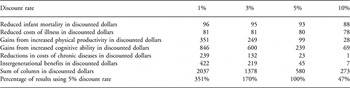
(2) While it is widely understood that there is a need to ‘discount’ future benefits since a dollar now – which can be invested and thus earn a positive rate of return – is worth more than a dollar at a later date, there is similarly no accepted value for such a discount rate. This is important for determining the economic return to investments in nutrition because improved productivity may come after 15 years and lasts for roughly 45 more years; benefits of reduced chronic disease may come even later. In contrast, reduced mortality or lower costs of neonatal care provide benefits close to possible interventions. Thus, both the total benefits from improving nutrition and the shares to each component are sensitive to assumed discount rates. This is illustrated in Table 1, adapted from Alderman and Behrman.Reference Alderman and Behrman8 The table shows the different in the total benefits of averting low birthweight (LBW – birthweights below 2500 g) estimated for a stylized low-income country – roughly the per capita income level of Bangladesh – by six categories of benefits and using a very conservative estimate of the value of an early death averted. Not only are the total benefits sensitive to the discount rate, the shares to different categories shift substantially. When the future is heavily discounted, the benefits are dominated by reduced mortality. Conversely, when discount rates are low, future streams of earnings have a greater share of the total. At any given rate of discount, the earlier the benefit occurs the greater the value. Thus, if chronic diseases have an early onset, averting them will have greater benefits than if the same illness occurs later in life, both due to the discount rate as well as the cumulative costs of disabilities and health care. Conversely, although there is accumulating evidence that early health affects the probability of dementia later in life,Reference Huang, Carlson, Fitzpatrick, Kuller, Fried and Zandi9, Reference Case and Paxson10 adding such consequences to calculations such as those in Table 1 would add little to the total given present value would be heavily discounted. This is an inherent limitation of discounting that affects a range of intergenerational calculations including environmental considerations as well as the health concerns that are the focus of this study.
Sensitivity of benefits from averting low birthweights to different discount rates

Source: Adapted from Alderman and Behrman.Reference Alderman and Behrman8
(3) It is a challenge to determine the causal impact of malnutrition on productivity for several reasons. For example, it is clearly difficult to separate causes of malnutrition from other causes of poor schooling which will also affect lifetime productivity; preschooler health and subsequent educational attainments both reflect household decisions regarding investments in children. Efforts to distinguish the distinct causal contribution are stymied by the fact that analyses of school-aged populations are often unable to examine long-term (adult) outcomes. Conversely, adult attainments usually have limited data on childhood conditions. Even with the increased availability of longitudinal data, there are many unobservable factors such as preferences and ability that may influence both nutrition as well as subsequent schooling as much, or more, than do measurable correlates of socioeconomic status and community infrastructure. Generally, to control for such behavioral determinants it is necessary that the data from earlier period of heightened nutritional vulnerability contain information on programs that are not correlated with household decisions and that affect nutrition or that there are economic or weather related shocks in that period that are of sufficient magnitude and persistence to affect a child’s nutritional status yet are sufficiently transitory not to affect subsequent schooling decisions directly.
Moreover, even when the data are adequate to distinguish the impact of severe deprivation, it is not clear that the outcome attributed to one cause has the same economic consequences as a similar outcome that is primarily due to a different cause. For example, does LBW reflecting maternal malaria have the same consequences on cognitive development or future risk of diabetes as does LBW primarily due to untreated sexually transmitted infections of the mother or caused by iron and folate deficiency anemia?
(4) The evidence used to assess the economic impact of improved nutrition generally comes from the average cost of malnutrition or from the average impact of programs aimed at reducing malnutrition. As discussed further below, this data, while extremely useful, has some limitations as well. For example, at times the evidence comes from categorical comparisons such as LBW or not or anemic versus non-anemic. This does not provide information on whether, and to what degree, economic consequences increase the greater the deviations from the cutoff.
Moreover, the costs of addressing malnutrition are not constant across a population. Exercises that attempt to determine the cost of scaling up a program to a wider population are particularly sensitive to this concern. This is particularly the case when the costs of a program are based on the unit costs of all inputs since this tacitly assumes away both program inefficiencies and the costs to the beneficiaries in terms of their time allocation. It is logical to assume that marginal costs also rise as the program expands to cover harder to reach populations. This may be due to the remoteness of a community that increases transportation costs or a low population density that increases the costs per patient served. Unfortunately, however, these costs of scaling up are harder to determine than the cost for the median client.
(5) Economists generally make a distinction between public and private costs and benefits. The former include economic externalities which occur when individual gains (costs) from an action are different than the benefits or costs to a wider population. An important form of positive externality is well known to public health professionals in its guise as herd immunity though there are negative externalities as well – for example, when one individual enjoys a good cigar in a public space. Such costs and benefits are at the core of determining the optimal investment in a service from the public perspective in contrast to determining what an individual considers his or her optimal, which is directly reflected in their personal preferences. There often are lively debates regarding which benefits are public and which are private and, thus, how much of costs for an investment should be passed on to beneficiaries.
Whatever the outcome of such debates, it is fairly well agreed that the cost to the state are greater than the nominal cost of a project since there are distortions to raising revenue in the sense that taxation policies can shift consumption, investment, and labor patterns. Thus, if it costs the government $100 to provide a service, a fair costing of the program would add the distortion costs to the nominal cost. As with many costs that are not directly observed, there are a range of estimates of the magnitude of such distortions, but many estimates are 25% or more. Moreover, the costs should be only the real resource costs – but not transfers, which are not considered a resource cost in economic analysis except in so far as they incur distortions or administrative costs. Such transfers loom large in some public programs, such as the rapidly spreading conditional cash transfer programs.
(6) Finally, externalities are not the only reason why the state may want to shift private investments – equity, including intergenerational equity is another. Societies, at least in their public rhetoric, generally agree that there is an equity weight for income increases by the poor such that a dollar transferred to a poor household or earned by a poor household has a higher value in assessing national priorities than a similar dollar for the average household. The view that transfers are often justified in the context of such equity weights, while generally valid, is not necessarily germane to the contention that investments in nutrition are important for their contribution to economic growth. However, to the degree that such investments assist low-income households in participation in overall economic growth, there is an additional justification to the core argument. Yet again, there is no directly observable means to ascertain these weights, although indirect estimates have been derived.
Quantifying the economic benefits from improved child nutrition: overcoming the hurdles
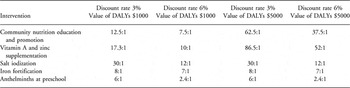
The first two of these six listed obstacles to providing a full picture of the economic costs to poor health in childhood (or the economic benefits from preventing malnutrition) can be finessed with sensitive analysis showing the degree to which conclusions may vary over plausible ranges. Table 2, adapted from Horton et al. Reference Horton, Alderman and Rivera Dommarco4 presents such a use of alternative discount rates as well as alternative dollar values for DALYs.
Sensitivity analysis–benefit–cost ratios for nutrition interventions

DALYs, disability-adjusted life years.
Source: Adapted from Horton et al.Reference Horton, Alderman and Rivera Dommarco4
Alternatively, it is possible to view the economic returns to investments in health in terms of saved resources for health care and productivity gains only. Plainly, a life saved has a positive, even if unknown, value, so the productivity gains are unambiguously an underestimation of the benefits from reducing malnutrition. The true economic returns will be larger than those reported.
As a step towards addressing the third obstacle, one can be cautious in ascribing causality to nutrition improvements. For example, Victora et al.Reference Victora, Adair, Fall, Hallal, Martorell, Richter and Sachdev11 state ‘Undernutrition was strongly associated, both in the review of published work and in new analyses, with shorter adult height, less schooling, reduced economic productivity…’ (emphasis added). But, of course, seldom does such a careful wording carry over to the next citation of reported results.
With a few notable exceptions, the evidence for the contribution of nutrition on economic productivity is based on indirect inferences, albeit with fair consistency and regularity of these results. There is, for example, extensive evidence that nutrition affects cognitive capacity of children and little doubt that cognitive (and non-cognitive) ability contributes to school performance. Additionally, economists have explored how wages respond to both years of school and learning. Yet, seldom do researchers follow these links for the same individual. In the remainder of this section I summarize some of the evidence on nutrition and schooling as well as that on cognition and wages and indicate that this evidence is in keeping with those few studies that have been able to follow individuals from childhood to their entry into the wage market.
One common way that malnutrition can affect future earnings is by leading to a delay in school initiation. Such a delay will either lead to reduced overall years of schooling or later entry into the labor force. In the former case, the expected loss of lifetime earning is straightforward; there is a large body of evidence that verifies that each additional year of schooling completed leads to increased earnings on average. For example, a review of 63 data sets from 42 developing countries found the average return in urban areas to be 8.3% and 7.5% in rural for each year of schooling completed.Reference Glewwe, Orazem and Patrinos12 In the latter case, the delayed entry into the labor force may influence overall years of earning, but even if it does not, it has a cost in terms of delaying earnings and thus the delay reduces the discounted future stream of earnings.
A growing body of longitudinal studies confirms the hypothesis that such delays are common consequences of nutritional shocks. For example, during droughts in Zimbabwe in 1982–1983 and 1983–1984 infants less than two years old – the period a child is most vulnerable to undernutrition – had higher undernutrition attributable to the weather shock. By 2000 these children had completed fewer grades of school and were shorter than siblings unaffected by drought. In this case, the economic costs of stunting were estimated as a 14 percent reduction in lifetime earnings.Reference Alderman, Hoddinott and Kinsey13 This estimate is based on the expected increase of earnings if the median height for age Z score was raised from the negative levels observed in the sample to 0 and, thus, the reported estimate is not specific to the costs of drought but to malnutrition overall. However, as mentioned, this allows for identification of the causal role of childhood stunting distinct from the overall poverty in the region. Similar results have been reported from droughts in Tanzania,Reference Alderman, Hoogeveen and Rossi14 or from changes in health policy in South AfricaReference Yamauchi15 and from changes in food prices in Pakistan.Reference Alderman, Behrman, Lavy and Menon16
Such schooling decisions may be mediated, in part, by schools or caregivers using size as a marker for school readiness. Additionally, a child’s stature relative to its age may be an observable (to the research) indicator of cognitive capacity. Household may use their own assessment of cognitive capacity when determining whether to start or continue an investment in schooling. Various studies have established that cognitive capacity will influence subsequent earnings not only by affecting the years of schooling an individual chooses and the amount of learning in each of those years but also by a third pathway to wages that is independent and additional to these two channels. One estimate of the impact of intelligent quotient (IQ) on earnings, conditional on years of schooling in the United States found that for men, the impact of a half standard deviation decline in IQ reduced wages by 5%, or slightly more than the impact of an additional year of post secondary schooling in the same setting.Reference Altonji and Dunn17 The net (full) impact of ability in this study was roughly twice the impact of ability controlling for years of schooling. This pattern is global; similar studies from Chile, Colombia, Ghana, Kenya, Pakistan, and Tanzania have also shown that wage offers reflect both an individual’s schooling attainment and his or her cognitive capacity.Reference Behrman, Alderman and Hoddinott3 Thus, to the degree that nutrition can be shown to account for a portion of differences in cognitive ability, these are distinct pathways to the productivity impact of improved nutrition.
Additionally, globally taller individuals are regularly shown to earn more than their counterparts. As this pattern occurs in workforces that have little or no link between physical strength and productivity, this is not necessarily a direct function but may be a reflection of self-esteem, social dominance, or discrimination. A recent study by two economists, however, argues that even for the United States and the United Kingdom, the wage premium to taller workers reflects, on average, greater cognitive capacity.Reference Case and Paxson18 This study was not designed to determine the relative contribution of genetics and environmental factors to the well known association of height and cognitive abilities but rather to ascertain how the labor market uses the former as a marker for less directly observable skills.
Two recent studies of twins provide some supportive evidence for the role of nutrition per se on earnings as opposed to family background. In one study,Reference Behrman and Rosenzweig19 a sample of adult identical twins in the United States for which birthweight was also available was used to control for genetic and other endowments shared by such twins and which would not be affected by programs to increase birthweight. This analysis found that the impact of LBW on schooling or wages is far larger than estimates without such controls; a 1-kg difference in birthweight (0.98 ounces a week fetal growth) implies a difference of 18.6% in wages for adults. A similar study from NorwayReference Black, Devereux and Salvanes20 also found a long run impact of birthweight on earnings, albeit somewhat smaller than observed from the US data and with no major difference in the estimates with sibling controls and without these.
But neither of these studies directly addresses the question of malleability to policy or of the programmatic implications; the changes of birthweight attributable to competition for resources in the womb may have a different impact on cognition and on family resources devoted to subsequent education than would a plausible public health intervention. However, a unique tracking of cohorts for a quarter of a century following a randomized nutritional intervention provides verification that the indirect inferences of the impact of nutrition on earnings are not misleading.Reference Hoddinott, Maluccio, Behrman, Flores and Martorell21 This study followed children that received nutritional supplements as children and also followed a randomized control group. When these individuals were between 25 and 42 years old, those men that had received the supplements prior to the age of 3 years earned on average 44% higher wages. This is on the higher end of the range derived indirectly or from studies that compare twins with different birthweights. There was not a significant increase of wages for women in this cohort – perhaps due to limited wage opportunities in the communities – but there were increases in schooling attainment for women. Moreover, both women and men had higher scores on cognitive tests.Reference Maluccio, Hoddinott, Behrman, Martorell, Quisumbing and Stein22
Thus, the collective body of evidence is persuasive. As an indication, consider the Copenhagen Consensus in which panels of economists assessed the expected rate of return to possible development investments in 2004 and again in 2008. These investments covered a broad range, including nutrition as well as a diverse set of interventions in education, water and sanitation, trade reform, and private sector deregulation. This list was selected from a wider set of issues identified by the United Nations as plausible priorities for investments in economic development. The assessment involved comparisons that went beyond a simple cost-effectiveness focus: by estimating benefit cost ratios using a common metric, the ranking permitted comparisons across different sectors with different outcomes.
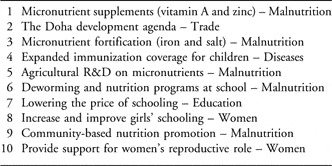
The 2004 panel of eight included three Nobel Laureates; another panel member received the prize subsequently. The one assembled in 2008 includes five laureates among its eight members. Both panels ranked programs to address malnutrition among those with the highest rates of economic returns. For example, as indicated in Table 3, all five of the proposed investments in nutrition were considered among the 10 most productive investments from a list of 30 possible investments in 2008.Reference Lomborg23
The ranking of the top ten investments in the 2008 Copenhagen Consensus

Source: Lomborg.Reference Lomborg23
Table 1, which is from a precursor of the 2004 study on nutrition for the Copenhagen Consensus, and Table 2, derived from the 2008 submission, provide additional perspective on the estimates of the benefits from improved nutrition. As indicated in the former table, productivity gains provided 58% of the benefits from averting LBW when future benefits are discounted with a 5% discount rate and 62% with a lower discount of 3%. This is, in part, a reflection of the conservative dollar value placed on averting early mortality although, as indicated above, many investments can be justified solely on economic productivity grounds without delving into the question of how to assess the benefit of survival in dollar terms. This is implied by Table 2 since the benefits from the iron and iodine fortification as well as from the provision of anthelminths do not include an assumed increase of survival (hence, the reason that the last two columns are the same as the previous for these two programs). The benefit cost ratios for these interventions imply that the substantial benefits exceed the moderate costs.
The benefit cost ratios for vitamin A and zinc supplementation as well as the community education and health promotion are also substantial, but are partially influenced by their contribution to mortality reduction. Hence, their sensitivity to assumptions on DALYs. It is intriguing that the panel ranking the interventions placed the community promotion somewhat lower in their ordering than other nutrition interventions including deworming, although the benefit cost estimates for this type of program appear much larger than some interventions higher on the ranking. Presumably, this reflects the panel’s assessment of capacity issues and different countries’ abilities to scale up the delivery of the requisite services. As discussed with reference to the fourth of the obstacles to estimating economic benefits from reducing malnutrition, costs are expected to increase as services are scaled up to reach the least malleable populations. However, while this might affect costs, benefits are often assumed to be fairly homogenous. Moreover, unit costs may actually decrease when going from pilot projects or proof of concept interventions given scale economies and fixed start up costs. Thus, the demotion to ninth place on this ranking does not indicate that promotion of breast feeding and proper weaning and the provision of complementary foods is not also an effective means to increase cognitive development and thus achieve higher-economic productivity as well as be a leading intervention in the reduction of infant and child mortality.
Concluding thoughts on public policy
There are many advocates for increased investment in nutrition, even among economists. Few, however, have got to that point after a conversion on the road to Davos. That is, it is hard to show investment priorities shifting on the basis of studies on rates of return for health related investments. Even in the more proscribed field of prioritization of economic research, Behrman et al.Reference Behrman, Behrman and Perez24 show a divergence of the number of studies in various categories compared to estimated DALYs from those categories. Human immunodeficiency virus (HIV)/acquired immune deficiency syndrome (AIDS) and injuries appear over represented while non-communicable disease as well as maternal and perinatal health and nutrition along with communicable disease exclusive of HIV/AIDS received relatively less research than their share in global DALYs.
It is not clear why economic investments often fail to follow from evidence similar to that discussed here and, unfortunately, that inquiry is beyond this review. Quite possibly, economists believe that rapid economic growth will, by itself, eliminate undernutrition. If so, they are mistaken in that belief. Data from household surveys as well as from cross-country comparisons regularly confirm that income growth, even when evenly distributed over a population, has only a modest impact on undernutrition rates.Reference Haddad, Alderman, Appleton, Song and Yohannes25 Overall anemia rates are even less responsive to income growth. Moreover, the evidence here suggests that nutrition investments are as good a means to achieve such growth as any other tool economists may want to employ. Good nutrition programs may themselves help reduce the need to invest in future nutrition programs.
Apart from its contribution to equity, however, nutrition is largely a private good; while knowledge about nutrition may be shared between neighbors, malnutrition is not contagious per se, although malnutrition may make individuals more liable to infections. Thus, in addition to the question of why public investment in nutrition is low, economists need to understand why private investment is also low. Possible reasons include the fact that credit markets are imperfect so that a cash constrained household cannot borrow on the future earnings of their child. Moreover, economists see underinvestment stemming from the possibility that households have incomplete information or misperceptions on the returns of human capital investments. For example, in the absence of information on correct child rearing practices there may be a public goods rationale for alleviating this informational constraint.
Another reason why nutrition may receive insufficient household resources is that the adults who make the household investments do not have perfect altruism. Men and women may differ in their preferences for investments in nutrition of their children or stepchildren. To the degree that these conditions hold, they provide a rational for public investment in nutrition in terms of economic efficiency beyond any equity motive.Reference Das, Do and Özler26
In summary, while the evidence on the average benefits from improved nutrition in terms of subsequent productivity can always be improved, it is fairly robust. There is, nevertheless, a need to understand the heterogeneity in both the returns to investments in nutrition and in the costs of service delivery. Finally, any means to lower the artificial barrier between investments in social welfare and investments in economic growth will assist in the application of such research to public policy.
Acknowledgments
The author thanks Jere Behrman for their comments on an earlier draft.
Statement of Interest
None.