Introduction
The acquisition of inflectional morphology is notoriously difficult for both adult and child second language (L2) learners. One of the longstanding questions in L2 acquisition studies with child and adult L2 learners has been whether or not non-target-like production of morphology reflects impaired grammatical representations (Hawkins & Chan, Reference Hawkins and Chan1997; Haznedar & Schwartz, Reference Haznedar, Schwartz, Hughes, Hughes and Greenhill1997; Vainikka & Young-Scholten, Reference Vainikka and Young-Scholten1996a). To address this question, we compared sequential bilingual children's acquisition of morphosyntax with that of monolingual (L1) typically developing (TD) children. More recently, studies have compared L2 children's performance with that of children with Specific Language Impairment (SLI) and have found similarities between the two groups in the production of French clitic pronouns and English tense morphemes (e.g., Paradis, Reference Paradis2005; Paradis, Rice, Crago & Marquis, Reference Paradis, Rice, Crago and Marquis2008). This line of research has focused primarily on production tasks and the L2 children in the above studies had less than three years of exposure. Very few recent studies have investigated the morphosyntactic abilities of L2 children with more than three years of exposure using production (Marinis & Chondrogianni, Reference Marinis and Chondrogianni2010), offline comprehension (Grüter, Reference Grüter2005; Marinis & Chondrogianni, Reference Marinis and Chondrogianni2011), and online comprehension tasks (Marinis, Reference Marinis, Belikova, Meroni and Umeda2007, Reference Marinis, Gavarró Algueró and Freitas2008). These have shown that L2 children with more than three years of exposure are less impaired in the production of tense morphology than previously reported (Marinis & Chondrogianni, Reference Marinis and Chondrogianni2010) and perform similarly to L1 children in the offline and online comprehension of two phenomena studied: (i) reflexive and non-reflexive pronouns (Marinis, Reference Marinis, Gavarró Algueró and Freitas2008; Marinis & Chondrogianni, Reference Marinis and Chondrogianni2011), and (ii) passives (Marinis, Reference Marinis, Belikova, Meroni and Umeda2007). However, there is no research to date investigating whether or not L2 children who omit tense morphemes in their production process the ungrammaticality induced by the omission of tense morphemes when they listen to sentences in real time.
The present article addresses this issue by examining the production and online processing of tense morphemes in six–to-nine-year-old L2 children acquiring English in comparison to age-matched L1 children and children with SLI from Montgomery and Leonard (Reference Montgomery and Leonard1998, Reference Montgomery and Leonard2006). The L2 children in the present article have three or more years of exposure to English and in this respect differ from previous studies which have investigated children with limited exposure, i.e., less than two years (Paradis et al., Reference Paradis, Rice, Crago and Marquis2008) or with a wide age range at the time of testing (Ionin & Wexler, Reference Ionin and Wexler2002). Furthermore, a production task is employed in conjunction with an online processing task to explore the relationship between production and online comprehension abilities of the L2 children. This enables us to address opposing L2 acquisition theories regarding the relationship between overt morphology and underlying syntax (Haznedar & Schwartz, Reference Haznedar, Schwartz, Hughes, Hughes and Greenhill1997; Vainikka & Young-Scholten, Reference Vainikka and Young-Scholten1996b, Reference Vainikka, Young-Scholten, Flynn, Martohardjono and O'Neil1998a, Reference Vainikka, Young-Scholten and Beckb, Reference Vainikka and Young-Scholten2010). In addition, it allows us to examine whether the low performance of the L2 children and the children with SLI in production tasks (Paradis, Reference Paradis2005) reflects similar processing systems and underlying grammatical representations.
Before we examine the literature on the acquisition of tense morphemes in English by child L2 learners, we will briefly describe the tense systems of English and Turkish, the languages spoken by the L2 children in our study.
Tense in English and in Turkish
English uses both bound (examples (1a) and (1b)) and unbound (examples (1c) and (1d)) morphemes to indicate tense and subject–verb agreement. Third person -s on lexical/thematic verbs marks person and number, as shown in (1a) and gives rise to a morphophonologically poor agreement paradigm, as only third person singular -s is overtly marked, with the other persons carrying zero morphology in both the plural and the singular. In this respect, third person -s in English encodes the features [−past], [3p] and [+sing]. Person and number are also marked on the suppletive forms of the copula and the auxiliary be and the dummy auxiliary do morphemes, as shown in (1c) and (1d). The feature [+past] is indicated by a consistent morphophonological marking of the regular suffix -ed in the case of regular past tense, as shown in (1b), which does not vary depending on the form of the subject, whereas irregular past tense consists of suppletive forms, as shown in (1e). The morpheme -ing marks progressive aspect, as shown in (1f).
- (1)
a. Peter walks to school.
b. Jane kicked the ball.
c. Mary is happy.
d. Do you like cakes?
e. Gerry threw the ball.
f. Peter is walking to school.
In contrast to the poor morphological paradigm in English, Turkish is an agglutinating language with a rich morphological paradigm. Turkish has separate suffixes indicating tense and agreement, which follow a strict order, i.e., tense preceding agreement marking. In addition, Turkish has a quite transparent one-to-one form–meaning mapping (Göksel & Kerslake, Reference Göksel and Kerslake2005). There are six different forms in the verbal paradigm marking person, and person is marked on both present and past tense, as in (2a) and (2b).
(2)


Important for the present study is that Turkish-speaking L2 children will need to move from a rich yet transparent morphological paradigm with strict suffixal order to a system where features corresponding to the Tense category have fusional or zero morphophonology.
L1 acquisition of English tense morphemes by typical and atypical children
English TD L1 children have been shown to acquire grammatical morphemes by their fourth year of age (Brown, Reference Brown1973). In relation to verbal morphemes, longitudinal and cross-sectional morpheme order studies have reported that the progressive suffix -ing is one of the first morphemes to be acquired, whereas auxiliary be, regular past tense -ed and third person -s are the last ones (Brown, Reference Brown1973; de Villiers & de Villiers, Reference de Villiers and de Villiers1973). Turning to the acquisition of tense marking morphemes, it is by now well documented that English TD L1 children pass through a stage up until their third year of age when they optionally produce tense morphemes, as in the examples (3a) to (3c):
- (3)
a. Everyday she bake(s) cakes.
b. He (is) happy.
c. Yesterday he paint(ed) the fence.
This stage has been called the Optional Infinitive (OI) stage and has been documented in non-null-subject languages (Wexler, Reference Wexler1998). The OI stage is marked by the optional production of tense related morphology, although children seem to know the morphosyntactic contingencies associated with the underlying functional categories for tense and no form choice errors are found (Wexler, Reference Wexler, Lightfoot and Hornstein1994). That is, L1 children rarely produce errors such as I eats instead of I eat. Additionally, L1 children produce an unmarked verb form with a correctly marked nominative subject pronoun, indicating that the subject has successfully moved to the specifier of the Tense Phrase (TP), and thus, the underlying Tense category is present in their syntactic representation.
The OI stage reported for the TD L1 children is also well documented in children with SLI, who exhibit a protracted or extended optional infinitive (EOI) stage and even by the age of nine years optionally produce tense marking morphology (Rice, Wexler, & Hershberger, Reference Rice, Wexler and Hershberger1998). At the same time, and similarly to TD children, children with SLI make limited form choice errors and do not exhibit problems with non-tense related morphology, such as progressive -ing or plural -s (Rice et al., Reference Rice, Wexler and Hershberger1998). These results suggest that grammatical morphemes are selectively affected in children with SLI, as tense marking morphology is impaired whereas non-tense morphemes are not.
This impairment seems to extend beyond production into comprehension for both younger (Rice, Wexler & Redmond, Reference Rice, Wexler and Redmond1999) and older children with SLI (Montgomery & Leonard, Reference Montgomery and Leonard1998, Reference Montgomery and Leonard2006). Rice et al. (Reference Rice, Wexler and Redmond1999) used a grammaticality judgment task with children aged 6;0 to 8;11 with SLI and two groups of language-matched (age range: 4;0–5;11) and age-matched unaffected L1 children to ascertain whether the difficulties that children with SLI face with production also reflect impaired representations. The TD language-matched controls who were at the end of the OI stage were likely to accept uninflected verbs as grammatical, but the group showed sharp progress towards the end of the OI stage (they moved from A-prime score = .65 to .90 during the testing period).Footnote 1 This was also confirmed by the age-matched group, whose performance was above .90 when testing began and reached ceiling at the end of the testing period. The SLI group's performance, on the other hand, improved over time, but failed to reach age-appropriate norms by the end of the testing period and averaged around .65 to .70 for ages six to seven years. Conversely, the children with SLI were sensitive at detecting the ungrammaticality in the case of a dropped progressive -ing marker, similarly to the language-matched and the age-matched children, and by the age of seven years they were at an A-prime score of .90 and above.
Furthermore, there was a strong similarity between the growth curves observed in the production (Rice et al., Reference Rice, Wexler and Hershberger1998) and the grammaticality judgment studies for both the TD children and the children with SLI, suggesting that in both impaired and unimpaired L1 acquisition, production and comprehension of grammatical morphemes develop in parallel.
These results from the grammaticality judgment task from Rice et al. (Reference Rice, Wexler and Redmond1999) were confirmed in two studies with older children with SLI and age-matched controls between the ages of 6;7 and 10;5 (mean age: 9;0) by Montgomery and Leonard (Reference Montgomery and Leonard1998, Reference Montgomery and Leonard2006). In these studies, children with SLI showed a significantly lower sensitivity to third person -s and past tense -ed (A-prime score = .87) compared to the age-matched children (A-prime score = .95), but the two groups did not differ in detecting the ungrammaticality in the case of the progressive -ing marker.
To ascertain whether SLI children's impaired production and judgment of grammatical morphology is also reflected in the way they process grammatical morphemes in real time, Montgomery and Leonard (Reference Montgomery and Leonard1998, Reference Montgomery and Leonard2006) carried out an online word-monitoring task. In this task, children saw a picture at the beginning of each trial and then they listened to a sentence containing the word that goes with the picture that they saw at the beginning, as in John's mother is a great baker. Most nights she bake(s) cakes for him and the whole family. The task of the participant was to press a button as fast as possible when they heard in the sentence the word corresponding to the picture they saw at the beginning of the trial. The word-monitoring task comprised sentences with present or omitted inflectional morphemes on a critical word (bake(s)), and the monitored word (cakes) appeared after the inflected or uninflected critical word. If children with SLI are sensitive to the ungrammaticality induced by the omission of grammatical morphemes, then their reaction times (RTs) should be longer in sentences containing omission of the grammatical morpheme vs. the ones with the grammatical morpheme present.
Results showed that the TD children exhibited longer RTs in sentences with omission of grammatical morphemes compared to sentences containing grammatical morphemes, and thus demonstrated sensitivity to the omission of grammatical morphemes. In contrast, children with SLI were sensitive to the omission of the progressive -ing, but not to the omission of third person -s, past tense -ed and possessive -s. Additionally, the children with SLI had significantly longer RTs than the TD children. According to Montgomery and Leonard (Reference Montgomery and Leonard1998, Reference Montgomery and Leonard2006), these findings suggest that children with SLI have difficulties with processing grammatical morphemes that have low phonetic substance.
Acquisition of tense morphology by child L2 learners
Studies with impaired and unimpaired L1 children have shown that tense morphemes are acquired after non-tense morphemes and that the production and comprehension of these morphemes exhibit parallel growth curves. In contrast, the findings from studies with L2 children indicate a somewhat different pattern. A variable production of tense vs. non-tense morphemes in L2 acquisition has been documented in various studies (Dulay & Burt, Reference Dulay and Burt1973; Dulay, Burt & Krashen, Reference Dulay, Burt and Krashen1982; Haznedar, Reference Haznedar2001; Jia & Fuse, Reference Jia and Fuse2007; Zobl & Liceras, Reference Zobl and Liceras1994). Progressive -ing is one of the first morphemes to be acquired in child L2 acquisition, similarly to L1 acquisition, but third person singular -s and regular past tense -ed have a protracted and uneven acquisition pattern and may not reach target-like production even after five years of exposure, as documented in the longitudinal study with Mandarin learners of English by Jia and Fuse (Reference Jia and Fuse2007). At the same time, L2 learners seem to be able to acquire the morphosyntactic contingencies related to the underlying syntactic category of Tense, such as nominative case marking on subject pronouns (Haznedar, Reference Haznedar2001; Prévost & White, Reference Prévost and White2000). For example, Haznedar (Reference Haznedar2001) studied a four-year-old Turkish boy who, after eighteen months of exposure to English, produced third person -s and past tense -ed in less than 80% and 60% of obligatory contexts respectively, indicating an asymmetry in the acquisition of the two morphemes, whereas correctly case marked pronominal subjects appeared after four months of exposure in most obligatory contexts, suggesting intact underlying functional categories related to Tense.
Given the observed low production of tense morphology, a central debate in the L2 acquisition research focuses on whether or not low or optional overt morphological marking reflects impaired underlying grammatical competence. Two main lines of thought have addressed this issue, suggesting a competing relationship between (overt) morphology and syntax (White, Reference White2003): (i) the syntax-before-morphology account, such as the Missing Surface Inflection Hypothesis (MSIH) (Haznedar, Reference Haznedar2001; Lardiere, Reference Lardiere1998a, Reference Lardiereb; Prévost & White, Reference Prévost and White2000), and (ii) the morphology-before-syntax accounts, encompassing theories such as the Failed Functional Features Hypothesis (FFFH) (Hawkins & Chan, Reference Hawkins and Chan1997; Hawkins & Hattori, Reference Hawkins and Hattori2006), the Interpretability Hypothesis (IH) (Tsimpli, Reference Tsimpli, Liceras, Zobl and Goodluck2003) and the Minimal Trees Hypothesis (MTH) (Vainikka & Young-Scholten, Reference Vainikka and Young-Scholten1996a, Reference Vainikka and Young-Scholtenb, Reference Vainikka, Young-Scholten, Flynn, Martohardjono and O'Neil1998a, Reference Vainikka, Young-Scholten and Beckb, Reference Vainikka and Young-Scholten2010).
The MSIH is articulated on the basis of a separation view of morphology (Halle & Marantz, Reference Halle, Marantz, Hale and Keyser1993), according to which a distinction should be made between the acquisition of morphology and the acquisition of syntax. This account argues that the optional use of overt morphological expression does not entail lack of underlying syntactic structure. Rather, there is a mapping problem between overt morphological expression and the underlying syntax (Haznedar & Schwartz, Reference Haznedar, Schwartz, Hughes, Hughes and Greenhill1997; Lardiere, Reference Lardiere1998a, Reference Lardiereb; Prévost & White, Reference Prévost and White2000). More recently, Lardiere (Reference Lardiere, Dekydtspotter, Sprouse and Liljestrand2005, Reference Lardiere2009) proposed that what may be problematic for L2 learners is not the mere presence of a functional category or a feature in the L1, but rather the way these categories and features are reassembled into the right lexical items in the L2. The task of the L2 learner is to successfully (re)assemble features (un)available in the L1 according to the L2 specifications. This account is also compatible with a separation view of morphology and it implies that feature (re)assembly applies at more abstract levels of representation and that missing or default surface inflection does not indicate (re)assembly problems, similarly to the MSIH (White, Reference White2009). In this respect, Lardiere's (Reference Lardiere, Dekydtspotter, Sprouse and Liljestrand2005, Reference Lardiere2009) account also postulates an asymmetry between production and the presence of underlying grammatical representations. Furthermore, this account takes into consideration the (re)assembly of the morphophonological expression of these formal features and their realization on vocabulary items (Lardiere, Reference Lardiere, Dekydtspotter, Sprouse and Liljestrand2005).
In terms of the present study, the Turkish-speaking English L2 children will need to figure out the feature specification of third person -s and past tense -ed in English and acquire their target-like morphophonological expression. More particularly, tense morphology in English is fusional, and third person -s encodes more features than past tense -ed on a single morpheme, contrary to the monomorphemic nature of the Turkish tense and agreement paradigm. Third person -s encodes [−past], [3p] and [+sing], whereas -ed encodes [+past]. This feature composition of tense morphemes in English, along with the different morphophonological paradigms of third person -s and past tense -ed, may lead to an asymmetry in the acquisition of the two morphemes. At the same time, given that both the MSIH and the feature (re)assembly account suggest that L2 learners can have target-like mappings of forms and features but have difficulties finding the correct form in their lexicon, we may ascertain that the L2 learners have intact underlying representations associated with tense morphemes.
On the opposite end lie theories of L2 acquisition which postulate an incompleteness or deficit with underlying functional categories and argue that absence of a consistent morphological paradigm indicates that the underlying representations are lacking or are deficient, temporarily or permanently. Permanent impairment of underlying categories due to post-puberty exposure to the L2 is claimed by the Failed Functional Features Hypothesis (Hawkins & Chan, Reference Hawkins and Chan1997; Hawkins & Hattori, Reference Hawkins and Hattori2006) and the Interpretability Hypothesis (Tsimpli, Reference Tsimpli, Liceras, Zobl and Goodluck2003). These theories argue that uninterpretable grammatical features, i.e., features void of semantic content (Chomsky, Reference Chomsky, Hale and Keyser1993), which are not present in the L1, are going to be problematic for L2 learners. These theories have primarily been articulated to account for adult L2 acquisition patterns, although they have recently been extended to child L2 acquisition (Tsimpli & Dimitrakopoulou, Reference Tsimpli and Dimitrakopoulou2007; Tsimpli & Mastropavlou, Reference Tsimpli, Mastropavlou, Goodluck, Liceras and Zobl2008), and primarily focus on language combinations in which the L1 does not contain the grammatical category available in the L2. Given that Turkish contains a syntactic category for Tense, the FFFH and the IH cannot be addressed in this study.Footnote 2
Another hypothesis arguing that optional production of grammatical morphemes indicates temporarily impaired or underspecified underlying syntactic categories related to these morphemes is the Minimal Trees Hypothesis by Vainikka and Young-Scholten (Reference Vainikka and Young-Scholten1996b; Reference Vainikka, Young-Scholten, Flynn, Martohardjono and O'Neil1998a, Reference Vainikka, Young-Scholten and Beckb, Reference Vainikka and Young-Scholten2010). According to this account, the L1 plays a less important role and what seems to guide L2 acquisition is the L2 morphological paradigm. In this theory, there is a strong link between target-like L2 overt morphology and underlying syntactic categories, with the former triggering the latter. In the case of L2 acquisition, the trigger is free morphology, such as auxiliary and copula be, and not bound morphemes, namely third person -s and past tense -ed, as is the case in L1 acquisition (Vainikka & Young-Scholten, Reference Vainikka, Young-Scholten and Beck1998b).
To date, only two studies have addressed this debate by comparing production with L2 children's judgments of grammatical morphemes. Ionin and Wexler (Reference Ionin and Wexler2002) report naturalistic and grammaticality judgment data from twenty Russian-speaking L2 children aged between 3;9 and 13;10 with less than three years of exposure to English. The L2 children omitted third person -s (78%) more than past tense -ed (58%) in the production task. However, the authors do not focus on the asymmetry within bound morphology and they do not provide an explanation for it. In the grammaticality judgment task, the L2 children were at chance level when they had to reject uninflected or wrongly inflected thematic verbs (A-prime scores = .47 and .56 respectively) and uninflected auxiliaries (A-prime score = .60), but they were better at rejecting wrongly inflected auxiliaries (A-prime score = .80) or dropped -ing items (A-prime score = .81).
In the Paradis, et al. (Reference Paradis, Rice, Crago and Marquis2008) study, twenty-four TD children acquiring English as L2 aged between 4;2 and 7;10 (mean age: 5;7) with a mean of 9.5 months of exposure (range: 2–18 months) were compared to twenty-four age-matched monolingual English-speaking children with SLI and twenty TD monolingual language controls. All children participated in the production and grammaticality judgment task from the Test for Early Grammatical Impairment (TEGI) (Rice & Wexler, Reference Rice and Wexler2001). The TD L2 children performed significantly worse than the TD monolingual children and the monolingual children with SLI on the production of inflectional morphemes (third person -s: L2 TD = 16%, L1 SLI = 52%, L1 TD = 42%; past tense -ed: L2 TD = 20%, L1 SLI = 47%, L1 TD = 46%). In the grammaticality judgment task, both L2 TD children and L1 children with SLI performed at chance level, and they did not differ from each other in their ability to detect ungrammatical use of inflectional morphemes (A-prime score: L2 = .46, SLI = .63).Footnote 3
Both Ionin and Wexler (Reference Ionin and Wexler2002) and Paradis et al. (Reference Paradis, Rice, Crago and Marquis2008) argue against an (E)OI stage in child L2 acquisition primarily on the basis of the asymmetry in the acquisition between bound and free morphology, which is not attested in L1 acquisition. This discrepancy between bound and free morphology has been explained in syntactic terms on the basis of the difference between “overt” vs. “covert” movement, the former operating in the case of copulas and auxiliaries, which overtly raise in English to check their tense features, and the latter in the case of lexical/thematic verbs, whose movement is not visible in the morphophonological spellout of the sentence (Ionin & Wexler, Reference Ionin and Wexler2002; Zobl & Liceras, Reference Zobl and Liceras1994). This discrepancy has also been explained in terms of input frequency and distributional consistency with be and do being more frequent and consistently distributed in the input than -s and -ed (Paradis et al., Reference Paradis, Rice, Crago and Marquis2008).
The second argument against an (E)OI stage in L2 acquisition stems from the attested production–processing asymmetry.Footnote 4 However, it should be noted that in both studies the grammaticality judgment scores of the L2 children were at chance level, indicating optionality in their underlying grammar and not a categorical and stable distinction between grammatical and ungrammatical sentences (Sorace, Reference Sorace2000), a pattern which is on a par with low or optional production.
A further important point is that so far the studies showing a high omission rate of tense morphology focus primarily on children with less than two years of exposure to English. An exception is a production study using TEGI with Turkish–English L2 children with exposure to English of more than three years (Marinis & Chondrogianni, Reference Marinis and Chondrogianni2010). In this study, Marinis and Chondrogianni found an asymmetry between the use of third person -s and past tense -ed, with the latter exhibiting higher accuracy compared to the former (78.3 vs. 92.3%), and suggested that the morphophonological paradigm of the L2 affects L2 acquisition. This discrepancy was developmental and disappeared in the group of children that had four or more years of exposure (YoE), at which point more than half of the children reached age-appropriate norms for both morphemes. In terms of the types of errors produced by the L2 children, the majority constituted errors of omission for third person -s and regular past tense -ed. Thus, this study showed that L2 children with more than three years of exposure are capable of acquiring tense and agreement morphemes in English. Furthermore, contrary to previous studies (Paradis et al., Reference Paradis, Rice, Crago and Marquis2008) this study revealed a significant strong correlation between YoE and mastery of tense morphemes.
Turning to L2 processing, to date only two studies have examined how L2 children process morphosyntax in real time (Marinis, Reference Marinis, Belikova, Meroni and Umeda2007, Reference Marinis, Gavarró Algueró and Freitas2008). These studies investigated how Turkish–English children process actives/passives and pronouns/reflexives in real time and reported that L2 children are capable of using morphophonological cues similarly to L1 children despite the fact that the L2 children had lower grammatical and lexical abilities than the monolingual L1 age-matched controls and exhibited longer RTs. L2 children have been shown to have poorer lexical abilities than their monolingual peers (Bialystok, Craik & Luk, Reference Bialystok, Craik and Luk2008; Golberg, Paradis & Crago, Reference Golberg, Paradis and Crago2008; Kohnert, Kan & Conboy, Reference Kohnert, Kan and Conboy2010), which may also affect their speed of processing of single-word vocabulary. In a study with simultaneous bilingual Spanish–English children, Marchman, Fernald and Hurtado (Reference Marchman, Fernald and Hurtado2010) found that children with larger vocabularies exhibited faster and more efficient lexical access during real-time processing. This entails that if the sequential bilingual children in the present study have smaller vocabularies than their monolingual peers, then they may exhibit longer reaction times in a real-time comprehension task.
Present study
The present study examines how L2 children with more than three years of exposure produce and process online tense morphemes in comparison to L1 age-matched control children and children with SLI from Montgomery and Leonard (Reference Montgomery and Leonard1998, Reference Montgomery and Leonard2006). Given L2 children's reported problems with bound morphemes, in this study we focus on third person -s and past tense -ed for the examination of tense morphemes, and progressive -ing and possessive -s for the examination of non-tense morphemes.
The main research questions we addressed are: (i) whether L2 children with more than three years of exposure reach age-appropriate scores in the production of tense morphemes; (ii) whether the same L2 children are sensitive to the ungrammaticality induced by the omission of tense and non-tense morphemes in an online processing task; and (iii) whether processing of L2 morphemes differs for the children who are below vs. above the age-appropriate norms for their age in the production of third person -s and past tense. Additionally, we indirectly examined whether or not the performance of the L2 children resembles that reported for the SLI children in Montgomery and Leonard (Reference Montgomery and Leonard1998, Reference Montgomery and Leonard2006).
Predictions for the present study
In the present study, it is not expected that Turkish–English child L2 learners will have impaired underlying representations due to the lack of the Tense category (Hawkins & Chan, Reference Hawkins and Chan1997; Tsimpli, Reference Tsimpli, Liceras, Zobl and Goodluck2003) given that Turkish contains a syntactic category for Tense. Non-target- like production may suggest impaired or underspecified syntactic categories (Vainikka & Young-Scholten, Reference Vainikka and Young-Scholten1996b, Reference Vainikka, Young-Scholten, Flynn, Martohardjono and O'Neil1998a, Reference Vainikka and Young-Scholten2010), which will be manifested as inability to make categorical distinctions between grammatical and ungrammatical sentences, and therefore, lack of sensitivity to the ungrammaticality related to the omission of these morphemes. If, on the other hand, the child L2 learners are sensitive to the ungrammaticality related to the omission of tense morphemes, then this would provide evidence for the MSIH (Haznedar & Schwartz, Reference Haznedar, Schwartz, Hughes, Hughes and Greenhill1997).
Method
Participants
Thirty-nine typically developing sequential bilingual Turkish-speaking children and twenty-eight TD monolingual English-speaking children participated in this study. The two groups were matched on age. The L2 children had a mean age of 7;7 (SD: 12 months; range: 6;2–9;7), and the L1 children a mean age of 7;3 (SD: 7 months; range: 6;0–8;4) (F(1,65) = 4.012, p > .05, η2 = .031). Both groups attended schools whose percentage of free school meals was well above the national average, indicating a low socio-economic status.
All L2 children were from the Turkish community in London and were recruited from schools with a high density of Turkish-speaking children. The monolingual children were recruited from schools in Reading. The selection criteria for the L2 children were that the language spoken at home should be Turkish, the onset of systematic exposure to English should be three years or older, as indicated by nursery attendance, and the children should not have any history of speech and/or language delay or impairment. Additional information about the L2 children's years of exposure, quantity and quality of input was collected through a parental and child questionnaire. This confirmed that none of the children had any history of speech and/or language delay or impairment, their parents were not concerned about their language development. Most L2 children had an age of onset (AoO) around three years (mean: 3;3; SD: 8 months; range: 12–60 months), and their mean exposure to English was 4;3 (SD: 16 months; range: 20–81 months). Children participated in a battery of standardized and non-standardized assessments and experimental tasks examining various linguistic phenomena.
Baseline language measures
The present article reports data from two background standardized tasks assessing comprehension of grammar, i.e., Test for Reception of Grammar 2 (TROG2) (Bishop, Reference Bishop2003), and single-word vocabulary, i.e., British Picture Vocabulary Scales II (BPVSII) (Dunn, Dunn, Whetton & Burley, Reference Dunn, Dunn, Whetton and Burley1997). In both tasks, children are presented with a four-picture panel and listen to a sentence or a word and are asked to indicate which picture matches the sentence or word they heard. The raw scores from both tasks are converted into standard scores on the basis of age appropriate norms for L1 children.
Experimental tasks
Production task
The screening task from the Test of Early Grammatical Impairment (Rice & Wexler, Reference Rice and Wexler2001) was used to elicit tense morphemes. The TEGI has been standardized with 393 TD children and 444 children known to have SLI, between the ages of four and nine years. The screening task from the TEGI elicits third person singular -s, regular and irregular past tense forms. For the elicitation of -s children are shown pictures of professionals engaging in various activities and are asked to produce a verb form following a probe such as “Here is a teacher. Tell me what she does”. The expected answer should be something like “A teacher teaches”. For the elicitation of past tense, children are shown two pictures, one with children engaged in an activity and one with the activity completed. Past tense forms are prompted by the following lead-in sentences: “Here the boy is painting the fence. Now [pointing to the other picture] he is done. Tell me what he did.” The expected answer is “The boy painted the fence”. The task includes ten trials for the production of -s and eighteen for the production of past tense, ten for regular and eight for irregular verbs.
Coding and scoring
Responses were transcribed during the testing session on the TEGI scoring form. In order to have an overview regarding the L2 children's performance on tense morphemes and comparable scores to the L1 and SLI norms available in the TEGI manual, the children's responses were scored according to the procedure described in the manual. According to this procedure, the scores on the individual elicitation probes are calculated in percentage correct. Responses that are irrelevant or do not attempt the target form (e.g., present continuous for third person -s or present tense for the past tense) are considered “unscorable” and are excluded from the denominator for the score. For both probes, target-like responses are coded as correct and omissions of -s or -ed as incorrect. For irregular past tense forms, overregularizations are coded as correctly inflected forms. This scoring procedure follows theoretical assumptions according to which overregularizations denote knowledge of tense inflection and past tense rule formation. According to the TEGI manual, and in the case of the past tense probe, when the children failed to produce the target verb, but still produced a verb of similar type, e.g., a regular verb, in the case of a target regular context, or an irregular verb, in the case of a target irregular context, then these were also included in the calculation.
Online processing task
To examine whether L2 children were sensitive to the omission of grammatical morphemes, we used an online word-monitoring task (Montgomery & Leonard, Reference Montgomery and Leonard1998, Reference Montgomery and Leonard2006) in which half of the stimuli were sentences which contained tense (third person -s, past tense -ed) and non-tense (progressive -ing and possessive ’s) morphemes, and the other half contained sentences in which these morphemes were omitted. At the beginning of each trial, a target word was presented auditorily in isolation and at the same time its picture was presented visually on a laptop screen. This was followed by a lead-in sentence and the critical sentence which contained the critical word and the target monitored word, as shown in (4):
(4) Mary really likes to bake. Every day she bake(s) cakes and sometimes cookies and muffins.
Here the critical word was bake(s) and the target word was cakes. Participants were asked to press a response button as soon as they heard the monitored word in the sentence. If children are sensitive at detecting the ungrammaticality, then their RTs should be longer when the monitored noun follows an uninflected word than when it follows a fully inflected word.
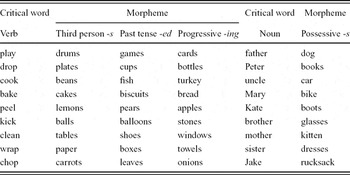
The task included overall eight experimental conditions involving tense (third person -s grammatical/ungrammatical, past tense -ed grammatical/ungrammatical) and non-tense morphemes (progressive -ing grammatical/ungrammatical, possessive ’s grammatical/ungrammatical). Each condition comprised nine sentences giving rise to seventy-two experimental sentences in total. In the six conditions containing verbs, the same nine verbs were used across conditions (bake, chop, clean, cook, drop, kick, peel, play, wrap), either inflected or uninflected. Each critical verb was followed by a different noun in each condition giving rise to a total of twenty-seven monitored nouns. Eighteen of the monitored nouns were in the plural form, four were mass nouns and five singular count nouns. The possessive ’s condition consisted of simple noun+noun combinations, e.g., Peter(’s) books. The possessors were proper names (n = 4) and kinship terms (n = 5). Table 1 presents the distribution of verbs and nouns across conditions.
Verbs and nouns per condition.

All monitored nouns were controlled and matched across conditions for lemma frequency according to the CELEX database (Baayen, Piepenbrock & Gulikers, Reference Baayen, Piepenbrock and Gulikers1995), imageability, position in sentence, and length measured in number of phonemes, syllables, vowel length within syllables, and age of acquisition of the lexical items (< six years of age). The pictures were also controlled for name agreement.
All verbs had to adhere to specific morphophonological and phonotactic criteria: (i) verbs in the past tense had to be regular; (ii) the phonotactics of the past tense formation had to be legal, namely they had to contain word-ending clusters that also occur in monomorphemic words, e.g., crossed (cf. frost, mist), dropped (cf. opt, apt) (Marshall & van der Lely, Reference Marshall and van der Lely2006);Footnote 5 and (iii) verbs that in the third person and past tense formation resulted in an extra syllable (e.g., wash-es, paint-ed) were excluded. In terms of allophones, for third person -s and possessive ’s, /s/ and/z/ allophones were selected. For past tense, /t/ and /d/ allophones were selected.
The monitored nouns began with voiced stop consonants (/p, t, k, g, b/, etc.) because in these contexts the physical onset of the target is easier to identify (Kilborn & Moss, Reference Kilborn and Moss1996). Co-articulation between the monitored noun and the preceding word was avoided.
The task included also eighteen filler items, nine grammatical and nine ungrammatical, and eighteen catch trials. In the catch trials, the monitored noun is not included in the critical sentence, and participants are not expected to press the response button. Half of the filler items included case errors in possessive constructions, as in (5), and catch trials involved omission of plural -s, as in (6):
(5) [DESK] Peter really likes his desk. He likes his/him desk by the window.
(6) [PEN] Jack tried to sleep late this morning. He piled two pillow, blankets, and towels all over him.
All experimental and filler sentences were controlled for length in number of words ranging from nine to fifteen words for the critical sentence. The position of the monitored word was manipulated to appear in the fifth, seventh or tenth position in the experimental sentences and in the fourth or eighth in the filler sentences. A comprehension question followed every third trial to ensure that participants were paying attention to the meaning of the sentences and were not only pressing the button to monitor words.
Two fifty-four-item lists were created, each containing twenty-seven experimental sentences, nine filler sentences and nine catch trials. The grammatical and ungrammatical version of each experimental and filler sentence was assigned to different lists. The sentences were presented in a semi-randomized order, ensuring that experimental sentences involving the same critical word never appeared consecutively. The administration of the lists followed a within-subjects design, in which each participant was presented with the two lists a week apart. The presentation of the lists was randomized in both the L1 and L2 groups in order to avoid any order of presentation effects.
Procedure
All L1 and L2 children participated in the baseline and the experimental tasks. The production task preceded the online processing task, in order to avoid raising the participants' awareness towards the phenomenon investigated by presenting them with ungrammatical sentences. The L1 and the L2 children were tested by the first author of this article and a Turkish research assistant, respectively, in a quiet room at their schools. The word monitoring task was preceded by a practice session with ten trials that could be repeated twice. The practice session intended to familiarize the children with the task. Children who completed the practice session successfully could continue participating in the experimental session. No child failed to complete the practice session or the experimental sessions. The administration of the production task lasted twenty minutes and each list of the word monitoring task lasted approximately twenty minutes.
Results
Baseline tasks
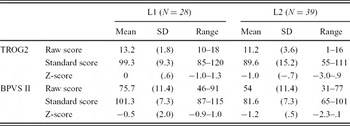
To examine whether the L2 children's overall comprehension of grammar and vocabulary differed from the L1 children's, we first analyzed the results from the TROG2 and the BPVSII, as shown in Table 2.
Results from the Test for Reception of Grammar 2 (TROG2) and the British Picture Vocabulary Scale II (BPVSII).

To examine differences between the two groups and the two tasks, we entered the standard scores of the two tasks into a repeated-measures ANOVA with Group (L1, L2) as a between-subjects and Task (TROG2, BPVS) as a within-subjects factor. This showed a main effect of Group (F(1,63) = 45.759, p < .001, η2 = .406), a main effect of Task (F(1,63) = 16.449, p < .05, η2 = .071), and an interaction between Group and Task (F(1,63) = 15.524, p < .001, η2 = .206). One-way ANOVAs showed that the L2 children were less accurate than the L1 children on both tasks (TROG2: F(1,64) = 9.992, p < .01, η2 = .134; BPVSII: F(1,64) = 120.558, p < .001, η2 = .653), with a greater effect size in the case of vocabulary compared to grammar. Pairwise comparisons using Bonferroni correction showed that L1 children were equally good on TROG2 and BPVSII, but L2 children were significantly worse on the BPVSII compared to the TROG2 (p < .001, η2 = .335).
Production of tense
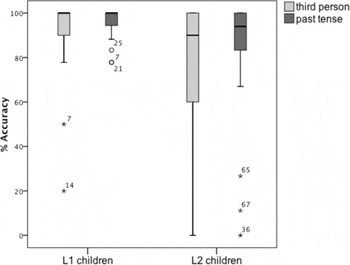
All children responded to more than half of the items and both groups produced mostly scorable utterances. Only 7% of the L1 children's responses and 7.4% of the L2 children's responses were marked as “unscorable” or “not attempted”, and there was no significant difference between the two groups in this respect. To address whether the L2 children in our study converge with L1 children in the production of tense marking, we calculated the children's accuracy for third person singular and past tense according to the scoring procedure of the TEGI, as shown in Figure 1.
Accuracy on the production of tense morphemes.

To examine differences between the two groups and the two morphemes, we entered the data into a repeated-measures ANOVA with Group (L1, L2) as a between-subjects and Morpheme (third person singular, past tense) as a within-subjects factor. This revealed a main effect of Group (F(1,63) = 6.102, p < .05, η2 = .066), a main effect of Morpheme (F(1,63) = 5.842, p < .05, η2 = .093), and no significant interaction between Group and Morpheme. One-way ANOVAs showed that the L2 children had a significantly lower accuracy (77.1%) than the L1 children (91.4%) in third person singular -s (F(1,64) = 3.861, p = .05, η2 = .081) and in past tense (L2: 86.2%; L1: 96%; (F(1,63) = 4.940, p < .05, η2 = .065). Paired samples t-tests revealed that L2 children were significantly less accurate on third person -s compared to past tense -ed (t(37) = −2.146, p < .05). This discrepancy was not attested in the group of L1 children.
To examine possible relationships between YoE and the accuracy in the two grammatical Morphemes, we conducted non-parametric correlations (Spearman's rho). These showed a moderate positive correlation between YoE and third person singular -s (r(39) = .413, p < .01) and no correlation between YoE and past tense (r(38) = .317, p > .05). To address whether the correlation between YoE and third person singular -s is a genuine effect of YoE and not an effect of AoO, we conducted a further correlation and partialled out the AoO. The correlation between YoE and third person singular -s remained significant (r(39) = .405, p < .05).
Word-monitoring task
Initially, we calculated L1 and L2 children's accuracy on the comprehension questions. This was 90.4% and 79.2% respectively and showed that the two groups differed significantly from each other in terms of their comprehension accuracy (F(1,64) = 8.211, p < .01, η2 = .406). Reaction-time data from all sentences were first examined for extreme values, which were identified using the SPSS boxplot procedure, and then for outliers defined as 2 SD above or below the mean per subject and item per condition. Extreme values were excluded from further analyses and outliers were replaced with the mean per subject and item per condition. This affected 9.3% of the L1 child data and 10.4% of the L2 child data and the two groups did not differ from each other in this respect.
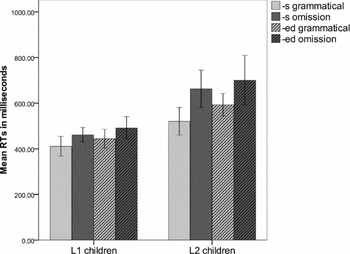
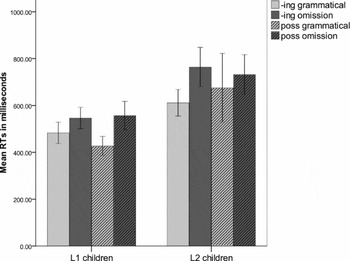
Figures 2 and 3 present the mean RTs of the L1 and the L2 children in processing tense and non-tense morphemes. To investigate differences between the two groups and between tense vs. non-tense morphemes and whether the L2 children were sensitive to the ungrammaticality induced by morpheme omission, we entered the RT data into a repeated measures ANOVA with Group (L1, L2) as the between-subjects factor and Morpheme type (tense, non-tense), Morpheme (third person -s, past tense -ed, progressive -ing and possessive ’s), and Grammaticality (grammatical, ungrammatical) as within-subjects factors in a per participant (F 1) and per item (F 2) analysis. This revealed a main effect of Group (F 1(1,64) = 20.037, p < .001, η2 = .238; F 2(1,16) = 75.968, p < .001, η2 = .826), reflecting longer RTs in the L2 compared to the L1 children; a main effect of Morpheme Type (F 1(1,64) = 33.868, p < .001, η2 = .346; F 2(1,16) = 10.807, p < .01, η2 = .403) due to longer RTs in non-tense compared with tense morphemes; and a main effect of Grammaticality (F 1(1,64) = 55.118, p < .001, η2 = .463; F 2(1,16) = 48.868, p < .001, η2 = .753), due to the longer RTs in the ungrammatical vs. the grammatical conditions. No other main effects or interactions were found to be significant, suggesting that the two groups were equally good at detecting the ungrammaticality induced by the omission of both tense and non-tense morphemes.Footnote 6
Reaction times in milliseconds for tense morphemes.

Reaction times in milliseconds for non-tense morphemes.

Production–processing (a)symmetries
To examine the relationship between production and processing, we assigned the L2 children to two groups according to whether or not they were able to reach the criterion scores for third person -s and past tense separately.Footnote 7 Then we calculated their mean RTs for each tense morpheme (third person -s and past tense -ed) in the grammatical and ungrammatical version of the sentence. Twenty out of the thirty-nine L2 children were not able to reach the criterion score for third person -s (below criterion: mean = 56.4%, SD = 23, range = 0–90%; above criterion: mean = 98.9%, SD = 3.2, range = 90–100%). The children below the criterion score were at chance level (t(19) = 1.229, p > .05), and differed significantly from the children who were able to reach criterion score (t(37) = −8.055, p < .001, η2 = .625). Fifteen out of thirty-eight L2 children were not able to reach the criterion score for past tense (below criterion: mean = 68.2%, SD = 29.8, range = 0–89%; above criterion: mean = 97.9%, SD = 2.9, range = 92.3–100%), had optional production of past tense (t(14) = 2.364, p < .05), and their production differed significantly from the children who were able to reach criterion score (t(36) = −3.838, p < .01, η2 = .398).
The L2 children who were below the criterion score for the third person -s differed from the children above the criterion score both in terms of YoE (below criterion: mean = 3;8, SD = 12 months, range = 1;8–6;9; above criterion: 4;8, SD = 13 months, range = 2;2–6;5; t(38) = .093, p < .05, η2 = .104) and chronological age (below criterion: mean: 7;2, SD = 8 months, range = 6;2–9;1; above criterion: 8;1, SD = 9 months, range = 6;3–9;7; t(38) = .687, p < .01, η2 = .056). That is, the children below criterion score for the third person -s were younger and with less years of exposure. Conversely, the L2 children who were below the criterion score for past tense were of the same age as the children above the criterion score (below criterion: mean: 7;4, SD = 14 months, range = 6;2–9;2; above criterion: 7;8, SD = 13 months, range = 6;3–9;7; t(36) = −1.428, p > .05, η2 = .098), but differed in terms of YoE (below criterion: mean: 3;8, SD = 8 months, range = 1;8–6;2; above criterion: 4;6, SD = 9 months, range = 3;2–6;9; t(36) = −2.047, p < .05, η2 = .104).
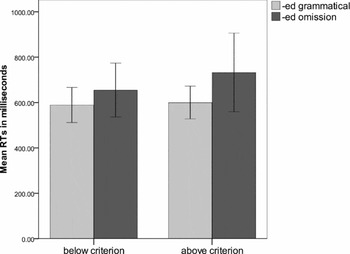
To compare the two groups in their ability to process the ungrammaticality due to omission of tense morphemes, we examined whether or not the children who were below the criterion score for third person -s and past tense differed from the L2 children above the criterion score in their performance in the word monitoring task, as shown in Figures 4 and 5.
Reaction times in milliseconds for the children below and above the criterion score for third person -s.

Reaction times in milliseconds for the children below and above the criterion for past tense.

The data for third person -s and past tense were entered separately into repeated-measures ANOVAs with Group (below criterion score, above criterion score) as a between-subjects factor and Grammaticality (grammatical, ungrammatical) as a within-subjects factor in a per participant (F 1) and per item (F 2) analysis. For the third person -s, there was a significant main effect of Grammaticality (F 1(1,37) = 9.897, p < .01, η2 = .302; F 2(1,16) = 9.030, p < .01, η2 = .361) but no main effect of Group and no interaction between Group and Grammaticality, suggesting that the groups above and below the criterion score were sensitive to the ungrammaticality caused by the omission of -s. For past tense -ed there was also a main effect of Grammaticality (F 1(1,36) = 5.091, p < .05, η2 = .124; F 2(1,16) = 6.225, p < .05, η2 = .280), no main effect of Group and no interaction between Group and Grammaticality. This shows that both groups of children were capable of detecting the ungrammaticality related to -ed omission.Footnote 8
Discussion
This is the first study to compare production with online comprehension of tense morphemes in the same L2 children and to examine whether they are capable of processing the ungrammaticality induced by the omission of tense and non-tense morphemes in English. The aim of the study was to find out: (i) whether L2 children with more than three years of exposure reach age-appropriate scores in the production of tense morphemes; (ii) whether the same L2 children are sensitive to the ungrammaticality induced by the omission of tense and non-tense morphemes in an online processing task; and (iii) whether processing of L2 morphemes differs for the children who are below and above the age-appropriate norms. Finally, we indirectly compared the performance of the L2 children to that reported for the SLI children in Montgomery and Leonard (Reference Montgomery and Leonard1998, Reference Montgomery and Leonard2006).
First, the majority of the L2 children did not reach age-appropriate norms for the comprehension of grammar and single-word vocabulary. This confirms previous findings in the literature that sequential bilingual children are less accurate than L1 children in standardized assessments (Crutchley, Conti-Ramsden & Botting, Reference Crutchley, Conti-Ramsden and Botting1997) and possess a smaller vocabulary than their monolingual peers (Mahon & Crutchley, Reference Mahon and Crutchley2006; Oller & Eilers, Reference Oller and Eilers2002).
Production of tense morphemes in child L2 English
The L2 children in the present study had significantly lower performance in the production of both third person -s and past tense -ed than the L1 children. However, the L2 children's production rates for third person -s and past tense -ed were higher than the ones reported in previous studies with child L2 learners, who had less than three years of exposure (Haznedar, Reference Haznedar2001; Ionin & Wexler, Reference Ionin and Wexler2002; Paradis et al., Reference Paradis, Rice, Crago and Marquis2008), and they were similar to the results from the L2 children reported in Marinis and Chondrogianni (Reference Marinis and Chondrogianni2010).
The L2 children also displayed an asymmetry in the acquisition of third person -s vs. past tense with nearly half of the children reaching age-appropriate norms for third person -s (20/39) and more than half for past tense (23/38). This asymmetry emerged also in the correlations between the two morphemes and the YoE. A moderate correlation was found between third person -s and YoE, suggesting that the L2 children's acquisition of the morphophonological paradigm of subject–verb agreement develops with exposure and that the L2 children are still in the developmental process. No correlation was found between past tense -ed and YoE, reflecting L2 children's high performance on this morpheme (86.2%) and the fact that the majority of the L2 children (23/38) had a score of 92.3% and above.
The question to ask at this point is why the L2 children display this asymmetry between third person -s and past tense -ed. Asymmetrical patterns in the L2 acquisition of tense morphemes have been addressed for free morphemes, such as auxiliary and copula be, compared to bound morphemes, such as third person -s and past tense -ed (Goldschneider & DeKeyser, Reference Goldschneider and DeKeyser2001; Ionin & Wexler, Reference Ionin and Wexler2002; Jia & Fuse, Reference Jia and Fuse2007; Paradis et al., Reference Paradis, Rice, Crago and Marquis2008; Zobl & Liceras, Reference Zobl and Liceras1994), but not within bound morphemes. Uneven acquisition of grammatical morphemes can be accommodated in the L2 acquisition theories entertained in the present article, namely the MSIH and the MTH. The MSIH accommodates uneven acquisition of grammatical morphemes by viewing variable use of morphology as a mapping problem of forms onto syntactic categories which remain intact (Haznedar & Schwartz, Reference Haznedar, Schwartz, Hughes, Hughes and Greenhill1997; Prévost & White, Reference Prévost and White2000). In this respect, the focus is on the presence of the underlying structure rather than on what triggers variable production. Additionally, in the feature reassembly account, Lardiere (Reference Lardiere, Dekydtspotter, Sprouse and Liljestrand2005) suggests that given that the spellout of the L2 morphophonological paradigm is a post-syntactic operation: the source of missing inflection lies in matching morphophonological features during this operation. The MTH, on the other hand, accounts for asymmetrical acquisition patterns by postulating a distinction between bound and free morphology for L2 acquisition (Vainikka & Young-Scholten, Reference Vainikka, Young-Scholten and Beck1998b). However, the two theories do not provide an explanation as to why certain morphemes are acquired before or after others. If a mapping problem is pursued following the MSIH, the question that arises is what affects the mapping of the correct morphophonological feature.
In the present study both third person singular -s and past tense -ed belong to the morphophonological paradigm of thematic verbs. However, the two morphemes differ both in terms of the formal features that they encode as well as with respect to the morphophonological spellout of these formal features and the distributional consistency of their paradigms. Third person -s in English is more complex in that it encodes [−past, 3p, +sing]. On the other hand, the regular suffix -ed encodes only [+past]. The asymmetry, thus, in the acquisition of third person -s and past tense -ed may derive from the more complex feature specification of third person -s compared to past tense -ed, which renders the former more costly to access during computation of the expression by L2 learners (Hawkins, Reference Hawkins and Radford2007).Footnote 9 This account is compatible with the Distributed Morphology framework (Halle & Marantz, Reference Halle, Marantz, Hale and Keyser1993), and thus with the MSIH. Additionally, whereas English past tense inflection has a consistent morphophonological form, the regular suffix -ed, for all persons and numbers, the agreement paradigm is morphophonologically poor with predominantly bare forms and with only third person singular -s being overtly marked. Finally, from a functional perspective, third person -s is the realization of the S–V agreement feature, which is required for grammatical reasons only and does not contribute to the meaning of the sentence. In contrast, past tense -ed carries important information for the interpretation of the sentence, i.e., temporal reference, and its omission may lead to communication breakdown (VanPatten, Reference VanPatten1996).Footnote 10 In the present study these factors affect L2 children's production of third person -s compared to past tense -ed, but not their ability to detect the ungrammaticality related to their omission in real time, as the processing data indicate that the L2 children were equally sensitive to the omission of third person -s and past tense -ed.
Production–processing (a)symmetries in child L2 acquisition
Turning now to the results from the word monitoring task, both the L1 and the L2 children showed longer RTs in the ungrammatical compared to the grammatical conditions for tense and non-tense morphemes. The results from the TD L1 children are in line with previous findings in Montgomery and Leonard (Reference Montgomery and Leonard1998, Reference Montgomery and Leonard2006), in which TD L1 children were sensitive to the ungrammaticality induced by morpheme omission and displayed no effect of morpheme type (tense vs. non-tense).
Focusing on the relationship between production and online comprehension of tense morphemes in L2 acquisition, the results from the processing task indicate that the L2 children are sensitive to the ungrammaticality related to morpheme omission regardless of their optional and non-target-like performance on the production of tense morphemes. This is particularly evident in the performance of the L2 children who failed to reach the criterion scores for third person -s and past tense -ed. The children below the criterion score for third person singular -s showed optional production rates (56.4%) and significantly differed from the children above the criterion score (98.9%). Furthermore, these children were younger and with less years of exposure than the children above the criterion score. However, they were able to process the ungrammaticality related to morpheme omission and did not differ from the children above the criterion score in their processing ability. The same results were found for past tense. The children below the criterion score were of equal age to the children above the criterion score, although they had less exposure. Despite the significantly lower production rates (68.2% vs. 97.9%) they were able to process the ungrammaticality related to the omission of the -ed. How can we explain this asymmetry between sensitivity to ungrammaticality and lower production rates?
These results are in line with findings from Paradis (Reference Paradis2010) and Paradis et al. (Reference Paradis, Rice, Crago and Marquis2008), who reported that simultaneous and sequential bilingual children performed better in a conscious judgment task compared to a production task. Paradis (Reference Paradis2010) suggested that better performance on a conscious judgment task compared to production may be explained by two factors: (i) superior control abilities in bilinguals (Bialystok, Reference Bialystok2007) that could affect their performance on a grammaticality task; and (ii) competition cost in speech production processes affecting their accuracy in production. The word monitoring task used in the present study is a dual task and requires good executive function abilities relating to working memory and control for children to be able to perform the task. Similarly to conscious grammaticality judgment tasks, this task involves grammatical and ungrammatical sentences. However, unlike conscious grammaticality judgment tasks, it is an implicit task that measures the children's unconscious reaction to ungrammaticality. Since the reaction to ungrammaticality is unconscious and automatic, the grammaticality effect cannot be claimed to result from superior control abilities. That is, good control abilities are a prerequisite for both L1 and L2 children to be able to perform the task, but the grammaticality effect does not require superior control abilities because it measures the children's automatic, and not their conscious, response to ungrammaticality. Further evidence that the grammaticality effect does not require superior control abilities comes from the fact that both L1 and L2 children showed this sensitivity, although L1 children are not supposed to have superior control abilities. In addition, L2 children had overall longer reaction times than L1 children, which provides further evidence that L2 children do not have better control abilities than L1 children. Therefore, we think that L1 and L2 children's sensitivity to ungrammaticality can better be explained as a reflection of their underlying grammatical competence and not as a result of superior control abilities. If this is true, the asymmetry between production and online processing could be caused by the L2 children's lower performance in the production task. Why should L2 children have a lower performance in the production task?
Their lower performance in production could be explained by competition cost (Paradis, Reference Paradis2010), but it could also be caused by the cost induced by output tasks related to spellout in terms of the phonological instantiation and articulation. Either way, this could affect the children's production and as such provide an inaccurate reflection of their underlying grammatical representations. This idea needs to be tested in future research by using tasks that can tap into each one of those processes separately.
Finally, returning to the L2 acquisition theories entertained in the present study, the online data indicate that despite optional non-target-like production, the underlying syntactic representations have been acquired by the L2 children. These findings are in line with the MSIH (Haznedar & Schwartz, Reference Haznedar, Schwartz, Hughes, Hughes and Greenhill1997; Lardiere, Reference Lardiere1998b; Prévost & White, Reference Prévost and White2000) and argue for a dissociation between overt morphological marking and underlying syntactic categories. Furthermore, the categorical distinction between grammatical and ungrammatical sentences in the online processing task provides evidence against the MTH (Vainikka & Young-Scholten, Reference Vainikka, Young-Scholten, Flynn, Martohardjono and O'Neil1998a, Reference Vainikka, Young-Scholten and Beckb, Reference Vainikka and Young-Scholten2010), since the MTH would predict no sensitivity to the ungrammaticality in the groups that are below the criterion score and display optional production of inflectional morphemes.
L2 children vs. children with SLI
The final aim of the present study revolved around whether or not the performance of the L2 children resembles the one reported for the children with SLI in Montgomery and Leonard (Reference Montgomery and Leonard1998, Reference Montgomery and Leonard2006). This can shed light on possible similarities and differences between the two populations.
First, the results from the L2 children contrast with the findings from the children with SLI in the Montgomery and Leonard studies. In Montgomery and Leonard (Reference Montgomery and Leonard1998, Reference Montgomery and Leonard2006) the children with SLI were not capable of processing the ungrammaticality related to the omission of tense morphemes, but were only sensitive to the omission of progressive -ing. In addition, they showed poorer performance in judging grammatical and ungrammatical sentences containing tense morphemes than the TD age-matched children, but their performance was relatively high (86.5% vs. 94.9%). Target-like performance in the grammaticality judgment task was restricted to the progressive -ing, indicating that children with SLI do not lack metalinguistic abilities altogether, but metalinguistic abilities affect grammatical structures differentially (Montgomery & Leonard, Reference Montgomery and Leonard1998, Reference Montgomery and Leonard2006; Rice & Wexler, Reference Rice and Wexler2001; Rice et al., Reference Rice, Wexler and Redmond1999).
The L2 children of the present study were capable of processing the ungrammaticality related to the omission of both tense and non-tense morphemes, including the group of L2 children that showed optionality in the production of tense morphemes. This was despite the fact that the L2 children in the present study were younger than the children with SLI in the previous studies.
A point of similarity between the two populations was that both the L2 children and the children with SLI exhibited overall longer RTs than their monolingual TD age-matched peers. However, longer RTs may be caused by different factors in the two groups. Children with SLI have been shown to have longer RTs in language and non-language tasks and have been claimed to be caused by limitations in the general processing capacity (Kail, Reference Kail1994). This slow processing and lack of automaticity (Paradis & Gopnik, Reference Paradis and Gopnik1997) may have an impact on their ability to detect grammaticality errors in real time, but may also reflect impaired underlying grammar. On the other hand, in L2 children, speed of processing could be related to vocabulary size affecting the speed of lexical retrieval due to their low proficiency (Bialystok et al., Reference Bialystok, Craik and Luk2008). The two background tasks assessing the children's comprehension of grammar and single-word vocabulary showed that the L2 children were less proficient than the L1 children, they failed to reach age-appropriate norms, and their performance on vocabulary was significantly lower than on grammar. In addition, the effect of speed of processing was reduced when we used the vocabulary scores as covariates, suggesting that speed of processing in L2 children is modulated by vocabulary size.
Therefore, the differences observed between the L2 children and the children with SLI with regards to their ability to process tense morphemes suggests differences between the two groups in the nature of their processing system and underlying grammatical representations. For children with SLI, non-target-like production seems to reflect impaired underlying representations. For the L2 children, on the other hand, non-target-like production does not entail impaired underlying representations, despite low general proficiency and inability to reach age-appropriate norms in the target structures.
Conclusions
The present study addressed the question whether or not English L2 children with more than three years of exposure are capable of reaching age-appropriate norms and explored the relationship between production and online processing of tense and non-tense morphemes in English. The L2 children's performance was compared with the performance of children with SLI from Montgomery and Leonard (Reference Montgomery and Leonard1998, Reference Montgomery and Leonard2006). The L2 children were less accurate than L1 children in the comprehension of grammar and single-word vocabulary and did not reach age-appropriate norms in the production of tense morphemes. Although they showed longer RTs than the L1 children, their pattern of performance was similar to the L1 children, i.e., they were sensitive to the ungrammaticality induced by the omission of tense and non-tense morphemes. The production and processing asymmetry of tense morphemes by the L2 children in the present study are more compatible with the MSIH than with the MTH because, despite their optional production of tense morphemes, the L2 children were sensitive to the ungrammaticality induced by the omission of third person singular -s and past tense -ed when processing sentences online. Finally, the L2 children in the present study differed from the children with SLI in that the latter were unable to detect the ungrammaticality induced by the omission of -s and -ed. This suggests that despite the low accuracy scores that both groups exhibit in the production of bound morphemes (Paradis, Reference Paradis2005), they differ in the nature of their processing system and their underlying grammatical representation.