Development Depends on the People
During the 2019 Spring Festival holiday (9–18 February), after consulting with Chen Shixiong, who did primary research for this article, Dong Guochen, along with William Huizhu Sun and Shen Liang, went to Quangang and neighboring Jinjiang near Quanzhou city in the province of Fujian to conduct further field research on folk theatre. We attended over a dozen Hokkien opera performances, a form that takes its name from the language used, the southern Fujian dialect that includes Quanzhou, Xiamen, Zhangzhou, and other local dialects. The practice of these grassroots professional troupes not only deepened our understanding of the Chinese rural theatre market but also enriched our understanding of theatre in general.Footnote 1
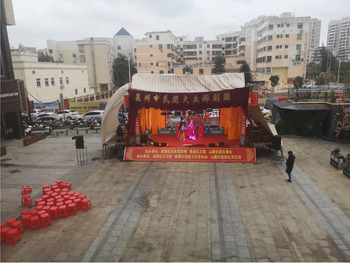
We arrived two days before the ninth day of the first month in the lunar calendar, the supposed birthday of the legendary Jade Emperor, for whom many villages in that area routinely hold celebrations that usually last for several days. We came on the first day of one village’s celebration and heard a great deal of firecrackers. In 2008 Lu Kou villagers bought a rice paddy facing their Jade Emperor’s Temple and built an opera stage there. There is no need for seats because audience members bring their own stools or chairs to sit on. Some also sit on their bikes, or in their cars.
The first opera we saw, Nvren xin (The Minds of Women), was also the first show of the opera series for Yuhuangdadi, their Jade Emperor birthday celebration, performed by a nearby professional Hokkien opera company at a total cost of 3,500 yuan (US$510) and open to all villagers. Its content, however, has nothing to do with the Jade Emperor whatsoever.
The Minds of Women begins with commanding general Yang’s triumphant return from the war. While it echoes Agamemnon’s homecoming from the Trojan War, it has one striking difference: Yang’s wife Du went with the general to the battlefield and greatly helped him. Back home, Yang indulges himself in drinking and womanizing. After Du finds out about Yang’s affair with the servant Caixia, the general sets up a residence for Caixia. When Caixia gets pregnant, Yang brings her back home as his second wife. Then Yang takes the prostitute Jinli as his third wife. The two concubines fight each other and eventually kill Yang. This leaves Du and her grown-up son as the only victors.
As the title suggests, this opera is mainly for female actors. In terms of the acting, we saw more intricate staging than straightforward fighting. Much of the action was carried forward by singing, gesturing, and subtle facial expressions like eyebrow moving. For example, when the two concubines reach a compromise and decide to kill their husband for his money, they make all their plans in front of Yang, taking advantage of his hubris and credulousness. The scene begins with Yang asking the two wives to give him back the embezzled money, which the emperor has ordered him to return. The more aggressive Caixia says no, then sings:
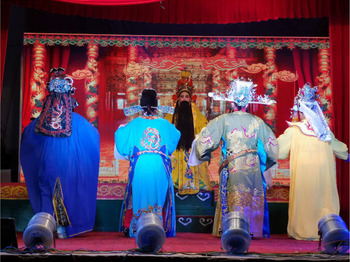
Nvren xin (The Minds of Women). Quangang Shiyan troupe on the stage in front of the Jade Emperor’s temple. Lu Kou village, Quangang district, Quanzhou city, Fujian, 11 February 2019. (Photo by Dong Guochen)

Yang sings back:
Then the more calculating third wife Jinli mediates, singing:
Then looking at Caixia, Jinli slyly sings:
As she sings, Jinli uses her eyebrows to indicate to Caixia that her meaning is in fact the opposite. While the love-blinded Yang believes Jinli has changed Caixia’s mind, the two women start a seemingly celebratory duet dance in which they exchange a signal to poison Yang. Then as one of them cuddles Yang to relax him, the other exits to make a noodle soup for him. Once Yang swallows the poisoned soup, the two women remind him of all his evil deeds before he dies.
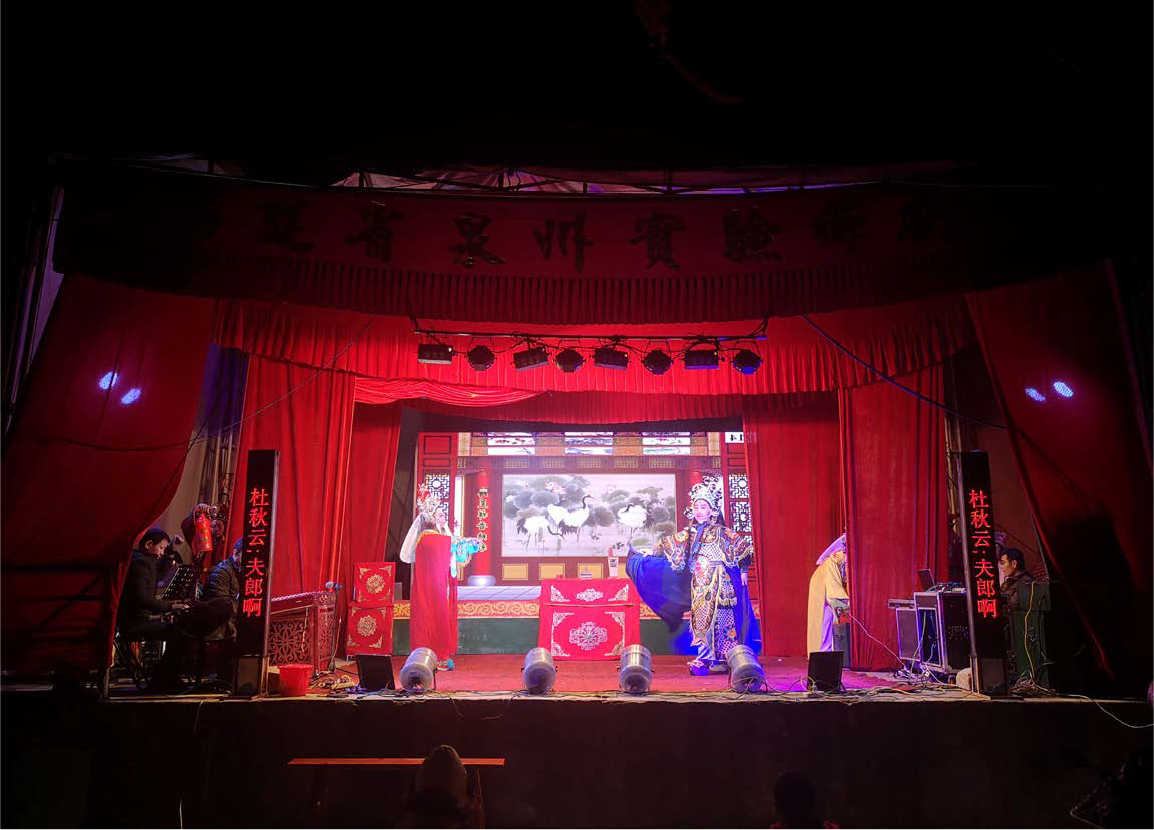
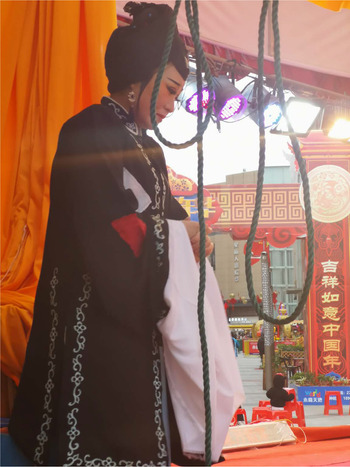
Nvren xin (The Minds of Women). Quangang Shiyan troupe on the stage in front of the Jade Emperor’s temple. Lu Kou village, Quangang district, Quanzhou city, Fujian, 11 February 2019. (Photo by Dong Guochen)

But this does not end the story. Most rural Chinese theatregoers would not accept such a distressing conclusion. When the two murderers pick up all the money and are about to run away, they bump into Junming, the son of the first wife Du, coming home triumphantly as the Zhuang Yuan (National Number One Scholar) after passing the imperial examinations. Holding in his hands the emperor’s edict, Junming quickly finds out about the crimes of the two women and his father. Junming tells his mother: “My father brewed his own poison. Don’t be too sad. Let us have a peaceful life from now on.” Du proclaims the final lines: “You are right. No need for glory and wealth. What’s important is health. Peace is our blessing.” This is the kind of ending the audience wants—and gets.
Performances like The Minds of Women are frequent in southern Fujian province. Within Quangang district there are about two dozen Hokkien opera companies, along with companies of other opera genres, that tour local villages. Unlike most companies headed by one major leader, or a family in some cases, the one presenting The Minds of Women is unique because it is a cooperative of five women who have worked together previously. Their family duties, especially the need to take care of their children, prevented them from full-time performing. But now that their children are all at school, they can devote more time to opera. They prefer plays with female characters, especially strong-willed women. This is not unique. Most companies, even those led by men, have more women actors because it is easier for men to find higher-paying jobs in factories. Also, often the majority of opera audiences are women.
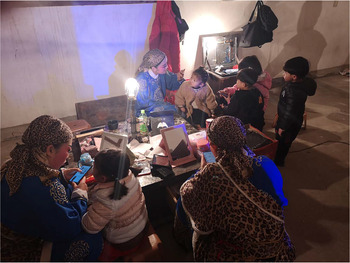
Actresses take care of their children backstage between performances of Liang dai yuan (The Fate of Two Generations). The stage of Biyun Temple in the village of Xiqian, the town of Banjiang, in the city of Shishi, 17 February 2019. (Photo by Dong Guochen)

The Quangang district, Fujian province, was established as a county-level administrative region in 1996. At 321 square kilometers and with a population of 370,000 people, the Quangang district has the authority and capacity to develop county-level publicly sponsored theatre companies, yet it does not have a single one. Instead, it is home to a large number of folk opera troupes that operate without government funding. Shanyao, a town in Quangang district, is a typical example. Folk operas were once nearly extinct there, but after the Cultural Revolution (1966–1976), the Shanyao Cultural Center organized a core group of master performers to help establish the Shanyao Folklore Music Association. This was the first step in saving and protecting beiguan, a local musical performance style. It was also a way to continue the tradition of folk operas in the region. Since the 1980s, Shanyao has invited Shao Qinghui, an influential figure in Hokkien opera, to direct and hold training seminars. He has not only taught ancient operas but modern plays as well. More than 200 students have studied with him, greatly increasing the artistic quality of seminar participants. The student-organized Shanyao Experimental Hokkien Opera Troupe has performed more than 20 plays in the past few years. It was labeled a model county-level folk opera group by the Hui’an County Cultural Bureau. Because of these efforts, the number of homegrown folk troupes has grown substantially.
Hokkien opera is the opera of Fujian province and “Hokkien” refers to the southern Fujian dialect of Chinese spoken widely in Taiwan. In fact, Hokkien opera, which is based on local folk ballads performed by itinerant storytellers, originated in Taiwan where it is still the most popular Chinese opera genre. It spread to southern Fujian in the 1920s. At the beginning of the 20th century, Hokkien opera flourished in Taiwan, and then spread to the Fujian cities of Xiamen and Zhangzhou. In 2007, Hokkien opera was deemed an “intangible cultural heritage” in Quanzhou. In his essay “The Practice and Consideration of Hokkien Opera in the Villages of South Fujian,” Zhuang Yuzong writes: “The development of folk operas in Shanyao should inspire us to revitalize our nation’s folk culture. Our hope lies in the hands of citizens and the work of private entities; in short, development depends on the people” (Reference Yuzong2010).
This shows that even if there is no state support, local theatre troupes can be successful through their own efforts and support from audiences. How this works is complicated. Troupes are divided into two major categories, publicly owned and privately run. In Fujian, atleast 80% of publicly funded troupes’ wages come directly from the government, with the rest earned at the box office. Publicly owned troupes are obligated to create new productions or to participate in opera festivals at the town, city, or national level. Privately run folk troupes can select what plays to stage, but must carefully meet the expectations of their audiences and local government cultural committees. Private troupes are completely self-financed and depend entirely on the market. If publicly funded troupes are remnants of the planned economy era, then privately run troupes are a product of the market economy era. Privately run troupes have spawned an entire network of middlemen who supply troupes with market information, potential clients, scheduling, performance fees, transportation, publicity, actor recruitment, and so on. These middlemen were once pejoratively called “theatre cock-roaches.” Much like cockroaches, they are almost everywhere, see almost everything, and reap rich economic benefits. Their presence is proof that folk opera troupes have created a considerable market.
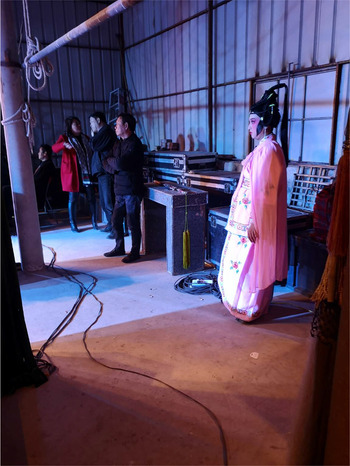
Qingwen of the Yingmei troupe, who is pregnant in this photo, waits to perform in Liang dai yuan (The Fate of Two Generations). Biyun Temple, Xiqian, Banjiang, Shishi, 17 February 2019. (Photo by Dong Guochen)

Folk Beliefs and the Local Theatre
The impetus for the development of folk theatre in Quangang district was the villagers’ beliefs in the gods they honor through burning incense, offering food, and building temples. For example, at temples honoring Lord Li, locals will gather to worship and watch a performance on the god’s birthday and ascension to heaven. The performances are considered a preeminent way to reward the gods. Of all local performances, 80% are held on Fo Shengri (Buddha’s birth-day) and other Buddhist celebrations. The remaining 20% are for weddings, funerals, and other private occasions. Therefore, a major reason for the continued proliferation of opera troupes is the local government’s tolerance of religious practice. In most of mainland China, folk religious beliefs and practices have been governed more strictly, but in southern Fujian, the local government has implemented uniquely tolerant policies regarding religion. Because performances in Quangang are so strongly tied to religious festivals, theatre has continued to thrive there. Southern Fujian has the most distinctive religious culture in China. Almost every village has multiple temples, each dedicated to one of the gods, for example, dedicated to the goddess Mazu, to the Jade Emperor, to Guanyu, and to Tudigong (village gods). Some villages even worship their own unique deity or deities. Due to the sheer variety and number of religious activities in the area, every village annually hosts numerous performances in each temple celebrating major religious festivals. A play will be staged for a deity’s birthday, day of enlightenment, and ascension day (the day of their death). What’s more, each holiday can last several days, meaning multiple days of performances—ten or more performances per year in each temple.
At these temple performances tickets are not sold. Instead, locals pool their money to hire troupes; watching is free. These “repay the gods” performances have helped the troupes flourish. In the 1990s, a folk professional troupe could charge a village 30,000 to 40,000 yuan for a single performance (in 1995, US$3,608–$4,810). The money paid not only for the show, but for costumes, props, musical instruments, and lighting equipment. A well-run theatre company can make tens or even hundreds of thousands in profits every year. In the northern part of Hui’an city, Fujian province, where the economy is not very developed, this was a reliable way to make money.
As noted, most performances are held on Buddhist holidays with a smaller percentage for entertainment only. For many villagers, paying for a performance is a way to earn blessings from the gods because the gods enjoy watching plays. These are community events that include all the peripheral activities surrounding the specific staged performance. During performances, most spectators do not attentively watch the plays. They walk around, eat, chat, smoke, and play cards, while children run around and play. Buddhist holiday performances are aimed primarily at the gods and ancestors, rather than at the audience. If the original impetus for the development of folk opera in Quangang was religion, the driving force for its continuation is the social life of the community. The government allows folk religions to be practiced, thereby providing a suitable environment for the development of local theatre.
Although most performances are for repaying gods, when visiting local theatre performances, we saw firsthand evidence of the value placed on entertaining the people, even if they often do not pay full attention to the play. The overwhelming majority of local performances are held in open-air theatres, both in the village center and outside the village. Performing at night in the wintertime when it is quite cold is difficult. If the performances were really aimed only at the gods, then why not protect the stage with wind screens so that the actors’ voices could be heard clearly by the gods? But in deep winter, keeping the spectators comfortable is the priority, so the available wind screens are erected around the seating area. Keeping the villagers warm is more important than making sure the gods hear what the actors sing.
Many troupes use various tools to enhance the experience of the spectacle. Private theatre troupes spend a lot of money on LED screens for their stages, a very useful tool. For example, when two characters onstage are fighting, a clip of clashing armies may appear on the screen behind them. This new technique is certainly more lively than traditional techniques. In traditional Chinese opera, fighting is often a stylized contest between two people without real physical contacts, similar to a dance of two people simulating fighting. Even if two armies are fighting, they would have only several actors waving weapons and walking around the stage a few times. In order to facilitate audience understanding, especially for those who may not understand the dialect, surtitles are always shown on nearby screens.
While there are still many traditional performance styles being performed in southern Fujian province by publicly run troupes, the audiences for these operas crave new content, a laborious task for playwrights who must keep turning out new scenarios. There are no resident playwrights in these professional troupes in southern Fujian. When a troupe needs to perform a new play, they buy a purportedly guarded and unique script, however they are commonly pirated scripts of a Hokkien opera. A script by a local folk artist costs about 24 –58 yuan (US$3–$7), which barely covers the cost of printing. However, there are specialized companies selling these cheap scripts and each troupe buys only one or two new plays a year to add to their largely stable repertories.
Many performances take place in the open air in town squares. Shuang gua shuai (Female Marshal). Yongjia Square, Quangang district, Jinjiang, Fujian province, 9 February 2019. (Photo by Dong Guochen)

Over time, Buddha’s birthday festivals have gradually been dominated by young people who are changing the festivals little by little. For example, instead of three days of theatre, festivals now often have one day of theatre, one day of dance, and one day of films. Most people do not watch the films, but they are still shown because the cost of three days of live performances is expensive, especially dance groups. Theatre is kept at the insistence of elders. It is difficult to know if they enjoy the dramas more, or if they consider “repaying gods” more important. For the young people, however, the festivals are a chance for amusement. Altogether, Buddha’s birthday festivals are clearly opportunities for people to satisfy spiritual, cultural, and social needs.
As for spiritual needs, as the economy of southern Fujian has developed and its society has urbanized, the prominence of religious practices in villages has gradually diminished. New means of entertainment have arisen. While the old rituals in Quangang district still exist, there has been a transition from religious performances to entertainment, resulting in the creation of new plays suited to contemporary tastes.Footnote 2
The Development of Folk Opera Troupes in Quangang District Over the Past 15 Years
In 2004, Quangang had 14 privately run troupes. Each one had 30 people per company on fixed salaries. The maximum monthly salary was 1,500 yuan (US$181), not including food and lodging, equivalent to the average wage in Quanzhou in 2004. About the same as that of working in a factory, it was not a high-income job, only a basic living. Apprentices received nothing but food and lodging. For example, the Xingyi Hokkien opera troupe had the only male trainees in the district, all unpaid except for room and board. Three companies paid actors per performance instead of a salary, but the fixed-wage model was more prevalent. Due to a shortage of qualified actors, the demand was high and the guaranteed salary was a means of keeping skilled performers. Training an actor requires one to two years of full-time instruction and practice, so the supply never meets the market demand.
From 2004 to 2019, Hokkien opera in Quangang district underwent profound changes. The number of companies increased from 14 to more than 30, while the number of actors in each troupe decreased from 30 to less than 20. Each troupe now performs a maximum of 330 performances per year and on average a minimum of around 250, with the lowest being 200. All performances are in open-air theatres funded by contributions from the villagers or wealthy local entrepreneurs. Since no individual tickets are sold, it is difficult to gauge accurate audience sizes.
The salary for actors has increased in recent years. In 2019, an actor in a leading role was paid 6,000 to 7,000 yuan per month (US$852–$994). Other actors are paid daily—some actors earn 350 to 400 yuan (US$49–$56) for a single three-hour performance, while others earn the same amount for two performances in a day (about six hours total).
The number of troupes in Quangang district never exceeds about 30. Each year several troupes dissolve due to poor management while new troupes form. Of the 7,500 to 9,000 performances put on per year, only about 1,000 are actually performed within Quangang district. The rest are performed in the surrounding areas, including Hui’an and Anxi. Yongchun county hosted almost 2,000 performances per year, while Xiamen, Jinjiang, Zhangzhou and other areas may have hosted 1,000 or more. This is a distinctive feature of opera in the Quangang district. In other areas the troupes work within their own districts.
More than 60% of performances in Quangang are not actually Hokkien opera, but Puxian opera. A classical performance style, it flourished 300 years ago, and is known as the “living fos-sil” among 300-plus Chinese opera genres. Hokkien opera has a history of only about 100 years. Developed from folk songs and dances, its performance and singing are free, flexible, and simple—less rigid than classical forms such as Peking opera. Hokkien opera uses southern Fujian dialects such as the Zhangzhou dialect whereas Putian dialect is used in Puxian opera. There is a great difference between the two dialects, yet Quangang district is very close to Putian so many in Quangang are familiar with Putian dialect. The music styles of the two dramas are also very different. The singing in Hokkien opera is modern and popular, while the singing in Puxian opera is the classical singing method that originated hundreds of years ago. Each year about 3,000 Puxian opera performances are held in Quangang, mainly by troupes from neighboring Putian city; Quangang does not have many registered local Puxian troupes. According to Zhuang Qingfeng, the head of the Fengsheng troupe, locals in Quangang prefer Puxian opera to their native Quangang Hokkien opera.
In recent years, the “theatre cockroaches” who connected theatre troupes with potential clients have been replaced by the internet—which is more efficient at giving market information. Also, transportation has become more convenient in the wake of widespread new highways. Overall, conditions have improved for local theatre companies, facilitating development. However, troupes are facing new problems. Fewer young people are willing to become actors due to the low wages opera troupes can offer. Troupes are also having trouble creating new repertories that attract audiences and at the same time satisfy those who want to “repay the gods.” This is the biggest challenge facing troupes today: transitioning from performing classic plays that “repay gods” at temple festivals to fresh dramas that entertain audiences and meet the expectations of modern viewers.
Troupe Operation and Management
Two of Quangang’s Hokkien troupes, Fengsheng and Xinyi—established in 1993 and 1994 respectively—are good examples of the general situation for folk theatre companies in the area. Zhuang Qingfeng, who heads two Hokkien opera troupes, proffers that an average troupe has 18 actors, 7 musicians, and a stage crew, totaling about 30 people (see Chen and Wu Reference Shixiong and Huiying2005). The standard price to hire an opera performance is about 1,000 yuan (US$120) in the off-season and more than 3,000 yuan (US$457) during the peak season. The troupes start performing the day after Chinese New Year. Each troupe earns around 300,000 yuan in gross income per year. After deducting wages and transportation expenses, a troupe that performs 250 times a year can earn 20,000 or 30,000 yuan (US$3,000–$4,500). A troupe that performs only 230 to 240 times might actually lose money. Most troupes have a repertory of about 14 or 15 plays, which are changed every so often. A typical troupe moves around frequently with the repertory determined by the market. Six to eight new plays are produced each year, each requiring about a week’s work to prepare. The actors are mainly locals and each troupe has its own most popular plays. A very popular play in Zhuang Qingfeng’s troupe is Shao Jianghai’s Suang feng ban jin long (Two Phoenixes Accompany Jin Long), in which Jin Long has a human wife and a fairy wife who has helped the former in childbirth but later thought the human wife had died and married Jin, only to find her alive and living happily with Jin. Other popular plays are San da wan hua dong (Attacking Wanhua Cave Thrice), a romantic spectacle full of fighting in which a female disciple and a son of the opposing side fall in love; Xue ran long feng huan (Blood-Stained Dragon-Phoenix Ring), in which two sisters avenge their murdered father by training for a decade and eventually killing his killer, the emperor. These plays are also adapted from Hokkien opera to the older Gaojia opera style. There are also plays adapted from Puxian opera for Hokkien opera, including Qin Xianglian, whose famous title-role character fatally punishes her husband who has married the emperor’s daughter and then tries to kill her after scoring the highest in the imperial examination; and San fu ren shen zi (Three Ladies’ Trial of a Child), in which three sisters-in-law win acquittal of a murder charge brought against one of their sons by skillful cross-examinations. Almost all the plays have “happy endings,” no matter how fierce the preceding conflicts are.
Initially, Quangang’s Fengsheng and Xinyi Hokkien opera troupes performed segments of longer plays to show off their performance abilities and advertise their new troupes to potential clients in a process called qingxi, meaning “invitation to perform.” Nowadays, both troupes are well known, so there is no need to promote themselves through qingxi. Indeed, the market for drama in Quangang has grown in step with the broader Chinese economy. In the past, most villages might have had up to three statues of Buddha, and Buddha’s birthday celebrations would last just one day. Nowadays however, many villages host several temples each, and each temple may have more than one statue of Buddha. The celebrations on Buddha’s birthday now generally last three days and are more elaborate than before.
The Fengsheng and Xinyi troupes travel to nearby Nan’an, Yongchun, and Anxi villages with great success. Yongchun customarily hosts opera performances to celebrate the planting of a new crop of rice in the spring. Each village invites the troupe for three days, after which the troupe moves on to a neighboring village. These celebrations can continue for two or three months from the third to the sixth month of the lunar calendar. Sometimes the festivities continue until the crop is almost ready to be harvested. The performances take place on open-air wooden stages. There are more than 2,000 stages in Jinjiang city, where a good theatre troupe can command a fee of 3,000– 4,000 yuan (US$459– $612 in December 2020) a night, while in Yongchun a troupe might only be paid a little over 1,000 yuan. However, there are many opportunities to perform in Yongchun so the area can still be profitable.
On the actor’s costume, the patches are stitched on to indicate the character is poor. Quangang Dazhong troupe in Shuang gua shuai (Female Marshal). Yongjia Square, Quangang district, Jinjiang city, Fujian province, 9 February 2019. (Photo by Dong Guochen)

Troupes can also receive “red envelopes” full of money during the rituals that precede a performance. Red envelopes are handed out by the host, with anywhere from 10s of yuan to as much as 200 yuan. These “open-ing curtain rituals” are mainly performed during Buddha’s birthdays and birthdays of village elders but can also be held during song haizi, the celebration of a child’s one-month birthday.
Recruiting and Training Actors
At the turn of the 21st century, when a private troupe was operating successfully, it was relatively easy to recruit apprentices. By the second year, apprentices could perform onstage for a salary of 400–500 yuan per month (US$48–$60 in 2000). This was good work, especially when compared with manual labor, which is much more physically taxing. Furthermore, with yearly contracts, the work was relatively stable. Back then many children of farmers preferred to learn how to act instead of working on a farm. Some recruits from this time became very accomplished.
Nowadays, new actors take a three-month basic training course before appearing onstage as an extra. After about a year’s work as an extra, actors take minor or secondary roles. After at least two or three more years, actors finally may play major roles.
Zhuang Xiali is an actress in the troupe headed by Zhuang Qingfeng. She joined the troupe in 1999 at the age of 16 and played young men’s roles and has performed for more than 20 years. She brought in four teenage actors around 2010, but none of them stayed. Zhuang Xiali says she is very happy with her work. Through her job as an actress she can bring her art-form to many people, and she enjoys playing the different male roles. However, she is sorry that most young people are not willing to join the rural traditional opera industry (Zhuang Q. and Zhuang X. Reference Qingfeng and Xiali2020).
Many of the actors currently active nowadays were trained 20 or more years ago. Since 2010, theatre troupes in Quangang district have not been able to recruit many new actors. Due to the new factories and improving economy in the region, young people have more job options than ever before; they are unwilling to go through the years of low-paying apprenticeship required for the theatre. But while there are few new young actors, the number of troupes is rising. This inevitably increases competition for actors. It used to be that every troupe had several excellent actors, but now the established troupes split up to form multiple new troupes because of the opportunity to earn money. As these professional actors move to the new troupes, untrained actors must join to fill the vacancies, leading to a decline in the quality of performances. Troupe directors might be only paid about 600 yuan for a performance, and only have two days to rehearse. Fewer and fewer actors are willing to put in the work to stage a high-quality performance; many will only practice for one day, starting at 10 o’clock in the morning for a show the same evening.
In this market, high demand does not improve quality. The new troupes with their inexperienced actors have to stage more plays more often in order to remain afloat economically. As performance quality continues to slide, villagers are not willing to pay more for performances. Despite the rising living standards and increased operating costs in recent years, wages for performers have hardly changed. Meanwhile in other industries, wages have greatly increased. In Quangang and neighboring Jinjiang, a relatively developed area, farmers spend almost no time on farming, choosing instead to work in factories where the pay is better. Thus the theatre market has entered a vicious cycle of decline, with greater demand but fewer quality actors, hence lowered expectations and quality—and actor salaries that have gone from being above to below average.
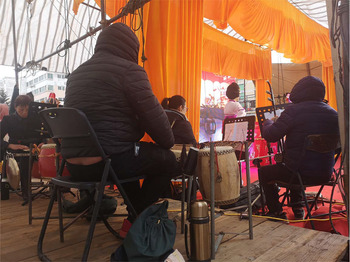
The Quangang Dazhong troupe cut costs by reducing the band to four members, down from eight a decade ago, for this production of Shuang gua shuai (Female Marshal). Yongjia Square, Quangang district, Jinjiang, Fujian province, 9 February 2019. (Photo by Dong Guochen)

Huang Jiahui, director of the cultural center of Quangang district, said that the government has taken notice of this decline and is also worried about the talent gap of Hokkien opera in Quangang (Reference Jiahui2020). The government is thinking of countermeasures to improve the performance level, pass on performing skills, and cultivate new talents for Hokkien opera. They want to set up an “Inheritance Center for Hokkien Opera,” led by the Opera Workers Association of Quangang district where senior artists will teach young actors (Huang Reference Jiahui2020). The government also plans to sponsor regular opera performances to promote mutual learning among troupes. Officials plan to promote an exchange between local opera troupes and the highly skilled Zhangzhou Hokkien Opera. These are plans and proposals; time will tell how many are put into practice.
Performance and Literature of Quanzhang Hokkien Opera
Hokkien opera has absorbed traditional stage styles and action patterns of the much older Beijing opera, Gaojia opera, and Puxian opera, but has simplified them so that actors without many years of rigorous training can perform. Shao Jianghai (1913–1980) is the most important person in the development of Hokkien opera in southern Fujian. Shao acted onstage for the first time at age 12. His performance footprints can be tracked all over southern Fujian. He devoted his whole life to the script reform, script creation, music development, and acting of Hokkien opera. Scholars call Shao the “master of a generation” of Hokkien opera.
Before the birth of Hokkien opera, Beijing opera and other Chinese operas had already developed and matured. Hokkien opera absorbed a lot of elements from them, including costumes, action patterns, and makeup. On the other hand, because Hokkien opera is a younger, more down-to-earth genre, its costumes, makeup, movement, and singing are not as exquisite and elegant as Beijing opera’s. The audiences of Hokkien opera are mainly less educated common people who prefer crowd scenes to solos and duets, which are usually the best means to show off actors’ virtuosity, as in the classical operas The Peony Pavilion (1598) and The West Chamber, of which there are many versions. Although it is a traditional Chinese opera, Hokkien opera’s lyrics are simple and easy to sing; the words are much easier to follow than those in classical operas.
Compared to older Chinese opera genres like Kun, Puxian, and Beijing operas, which focus on acting skills, Hokkien opera, without star actors comparable to those in the older genres, is more plot-oriented. For decades, many Chinese theatre scholars have been used to comparing Chinese opera with spoken drama, emphasizing the stylized acting as the most important feature of Chinese opera. Quangang Hokkien opera is an exception. For this genre, a strong plot is what counts with troupes and their prospective patrons. Spectators relish suspenseful plot twists; step-by-step plot development is very prominent in a three-hour performance.
Zhuang Qingfeng told us that the plays with the best stories are the most frequently performed. There are three types that are most popular. The first is drawn from legends in which the protagonist encounters misfortune and then triumphs because of unexpected help, such as meeting a fairy or discovering some treasure. The second is a crime story with a protagonist who is framed or wronged by a villain and seeks justice through the government, which is either incompetent or bribed by the villains. Even though the hero suffers more and more misfortunes, his strong will and eventual outside help lead to justice. The third is a palace play revolving around the emperor and his ministers, or his concubines. It often involves fighting for the throne and tricking treacherous officials. The palace play is full of intrigue, with many sudden changes of fortune. Several troupe directors observed that theatregoers focus on the plot because they are in the habit of watching suspenseful TV series.
Liang guo huang hou (A Queen of Two Kingdoms), which has been a favorite play for years, is an example of this kind of melodrama. Yulan, the queen of the title, has belonged to one king but when he is defeated in war he gives her up to the victor. Hence Yulan has two children, the boy Dragon and the girl Phoenix, living in two opposing kingdoms. When she is 18, Princess Phoenix goes to the defeated kingdom to collect tributes, and runs into her hostile half-brother Dragon, who has succeeded his late father as the king. Neither child knows their true relation. This play highlights two strong-willed women who, unlike most tradition-bound female characters in Chinese operas, are infused with some modern spirit. The play is also very comic. The half brother and sister begin as hateful enemies, mocking each other during a series of conflicts. They then turn to teasing, and then flirting. Just when they finally decide to forget about their opposing kingdoms and love each other wholeheartedly, they are stopped by Yulan who recognizes her lost son and tells them they cannot get married because they are brother and sister. But disappointment quickly turns into joy because they can still live together with their loving mother, the queen! At the two performances I (Dong Guochen) saw, every turn, whether obvious or subtle, always made the audience laugh.
The comic effect comes from the contrasting characters and the actors’ confidently stylized acting. Phoenix is prone to tears, whereas Dragon loves to laugh. The sister is serious, the brother is funny. Princess Phoenix urges Dragon to submit tributes dutifully, but the defiant king doesn’t want to comply. Then the angry Phoenix orders Dragon to put on a woman’s skirt to humiliate him. Dragon instead takes this as a fun thing to do. He puts on a skirt and mocks a woman’s steps exaggeratingly, which rocks the entire audience. In the next scene, when Phoenix asks Dragon’s courtiers where their cross-dressed king is, we hear from offstage his extremely shrill falsetto voice: “Don’t worry Princess. Your maid is coming right away.” Then he enters, with his hands holding up the skirt. After a funny curtsy, he loses his balance and falls into Phoenix’s arms. Phoenix pushes him away. He starts to dance, showing off his beautiful dress and asking how she knew his body measurements. She points her finger at him accusingly, but he bites it and then apologizes profusely. No matter how Phoenix refuses his various flirtations, he insists on showing off the dress. When she finally orders him to take the dress off and return it to her, he says she has to strip it from his body personally, which of course she won’t do. The more she cries, the more he laughs, but eventually he calms her down—like a big brother. The audience can’t get enough of these antics.
Quangang Hokkien opera gets strong responses from its audiences. Private opera troupes take survival as their most important task. To survive, they must meet the spiritual and cultural needs of the people—to give them works from the “theatre of cultivation” (Sun Reference Sun2021). Very few Hokkien operas have tragic endings. Still, not all of the Hokkien operas have a happy ending, yet they can still be considered theatre of cultivation. People don’t only want to see a happy ending. Take The Wind and Cloud of the Han Dynasty for example. The story concerns the marriage between Huo Guang and the emperor. In the end, Madame Huo Guang is sent into exile, and her daughter, originally an imperial concubine, is confined in the cold palace. But they are not killed. There is forgiveness, repentance, and reconciliation, the best one can hope for after a cruel coup d’etat. It is a satisfying ending, if not a happy one.
Conclusion
Hokkien opera is thriving in Quangang district for several distinct reasons. Firstly, previous government bans of local beliefs were completely lifted in the late 1970s allowing a flourishing of southern Fujian province’s diverse and complex cultural environment, which includes these local beliefs as well as more established religious practices such as Mazu (Matsu) and Baosheng Emperor worship. Millions of overseas Chinese or their families come from Fujian, so the government, in order to remain in the good graces of these overseas Chinese and their new countries of residence, has implemented a uniquely open religious policy, which helps these overseas Chinese maintain a strong connection with the homeland. Since the end of the Cultural Revolution in 1976, new temples and theatres have sprung up, contributing to the growth and prospering of folk opera. People from all walks of life participate in religious activities at their local temples, an increasingly rare phenomenon in most of modern China. It is worth noting that while religious performances make up a significant percentage of folk opera events every year, there are still plenty of nonreligious performances as well. About 80% are religious performances and 20% are secular in southern Fujian.
Secondly, the economy is booming. Even though it costs about 30 to 40 thousand yuan per year to run a troupe, the growing economy since the Reform and Opening Up period that began in the late 1970s has provided fertile ground for the development of profitable folk opera troupes. Thirdly, in following demand, the folk professional troupes are seldom bothered by ideology. The opera makers pay attention only to the melodramatic plots, the emotional resonance with the audience, and the people’s spiritual and cultural needs.
Despite relative success, especially compared to the theatre scenes in the cities, however, some serious issues need to be addressed. Fierce competition has led to a profusion of subpar troupes, which in turn has caused some qualified troupes to go bankrupt. The Qianhuang town troupe was once famous all over northern Hui’an, but due to poor management and a lack of member solidarity, it disbanded more than a decade ago. Four or five musicians and leading sheng (male), dan (female), and chou (clown) actors were lured away by other troupes. There needs to be a balance between business and art. Can there be a perfect middle ground between the two? Should there be some government subsidies where the theatre market seems to be working by itself? Nationwide in this unsubsidized market there are several hundreds of thousands of hard-working theatre people. In most places they work much harder but get much less than the employees of the heavily subsidized theatres in the cities. Privately run grassroots professional theatre is, in a sense, Chinese theatre’s best kept secret. More attention needs to be paid to those theatre workers, their artworks, and their audiences.