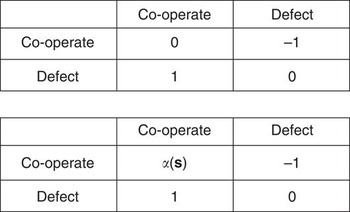
Under preference uncertainty, a leader cannot be sure that another leader is genuinely interested in international co-operation. Kydd defines this problem of reassurance as follows:
in the implementation stage actors are uncertain whether the other side will abide by the deal, or whether it will exploit any vulnerability that may arise in the implementation of the deal. If two sides mistrust each other they can engage in conflict because they believe that the other side will take advantage of them if they try to cooperate.Footnote 1
To achieve co-operation, each leader must credibly reveal information suggesting that she has no intention to defect or otherwise exploit the other leader at the implementation stage.
The conventional wisdom on reassurance is that a leader must send a ‘costly signal’ that she would not have been able to send had she not been trustworthy.Footnote 2 Beyond identifying the problem, however, international co-operation theory offers surprisingly few insights into reassurance. What mechanisms are available for leaders to reveal information? What are the conditions for them to be effective? Previous research has mostly focused on concrete actions, such as military demobilization and ‘audience costs’ generated by mass constituents.Footnote 3 This narrow range of information revelation mechanisms notwithstanding, the extant literature offers few insights into the logic of international reassurance.
In this article, I investigate whether costly adjustments by market actors can also facilitate international reassurance. For example, international trade liberalization and foreign direct investment cause transitional unemployment and require conversion of production facilities in previously protected industries.Footnote 4 For another example, international environmental co-operation requires installation of costly pollution-control equipment and imposes heavy costs on dirty industries.Footnote 5 In both cases, mutually profitable international co-operation prompts costly adjustments by investors and producers. However, leaders are not indifferent to these costly adjustments because the market actors condition their political support on profits.Footnote 6
In my formal model, two leaders engage in international co-operation.Footnote 7 Each leader may be ‘nice’ or ‘mean’, but uncertainty surrounds their preferences. While a nice leader is willing to co-operate if the other leader also co-operates (Stag Hunt preferences), a mean leader disingenuously pursues opportunities to exploit the other leader (Prisoner's Dilemma preferences).Footnote 8 For example, one interpretation is that a nice leader is supported by internationalist constituencies, while a mean leader is supported by isolationalist constituencies, but the relative influence of these constituencies in a country is uncertain.Footnote 9
I find that if market actors operate under intense competitive pressures and implement sufficiently costly adjustments, leaders can credibly reveal their preferences simply by announcing international co-operation. Leaders understand that if they announce international co-operation, domestic market actors respond by undergoing costly adjustments to maximize profits. Consequently, profit maximization by domestic market actors will impose a cost on any leader who falsely claims co-operation but actually defects, so that the costly adjustments are useless deadweight. If a mean leader attempts to exploit a nice leader by falsely claiming that she will co-operate, domestic market actors will undergo costly adjustments that are futile and thus harmful to the mean leader.
By contrast, imperfectly competitive markets have less potential for international reassurance. If there is no intense competition, so that a limited number of influential market actors have structural bargaining power vis-à-vis leaders, costly adjustments only enable credible information revelation when the market actors actually prefer international co-operation. If a market actor with structural bargaining power detests international co-operation, she can induce leaders to defect by refusing to undergo costly adjustments. Under imperfect competition, market actors strategically prevent information revelation unless they expect to benefit from international co-operation.
These findings show that while costly adjustments by market actors are not a panacea, they allow international reassurance in a notable range of empirically identifiable circumstances. First, in issue areas characterized by perfect markets that feature intense competition, international reassurance should be relatively easy. Second, under severe market imperfections, international reassurance is difficult unless market actors prefer international co-operation to the status quo. To my understanding, these hypotheses are new to the literature.
The theoretical argument differs from standard audience costs in three important ways.Footnote 10 First, conventional audience costs are an ex post punishment that a leader suffers if she breaks a promise, whereas my argument focuses on ex ante costs. Second, standard audience costs preclude fully efficient information revelation. As Kurizaki writes, ‘the gist of the tying-hands mechanism is a double-edged sword: generating audience costs by going public simultaneously facilitates separation of types of an informed state (informational effects) and escalates a risk of costly fighting (escalatory effects).’Footnote 11 Finally, the present theory does not depend on strong assumptions regarding mass voter behaviour, such as emotional responses to dovish foreign policyFootnote 12 or accurate evaluations of the overall competence of a leader.Footnote 13
The remainder of the article is organized as follows. First, I review the literature on information revelation in international politics. Second, I discuss the notion of costly adjustments by market actors. Third, I present and solve the model. Finally, I offer some concluding remarks. Throughout, I offer empirical examples and illustrations for the model and analysis.
Reassurance and Information Revelation
Reassurance, as defined in the introductory paragraph, is an important element of international co-operation theory.Footnote 14 Although leaders and countries can potentially benefit from international co-operation, they fear that the foreign partner could be opportunistic. Why should investors believe that they can safely invest in a developing country without expropriation?Footnote 15 Why should exporters and importers believe that a fragile democracy complies with international trade law?Footnote 16
Examples of reassurance are readily found in the empirical literature on international co-operation. When the Central and East European states underwent a transition from communist rule to democracy, their leaders regarded integration with Western Europe as a foreign policy priority. For example, the preamble to the Cracow Treaty between the Visegrad countries – Czechoslovakia, Hungary and Poland – on the establishment of the Central European Free Trade Agreement (CEFTA) explicitly notes that a primary goal of economic co-operation is to ‘participate actively in the process of integration in Europe’. By doing so, the Visegrad countries can ‘send the correct signals to the main Western organisations coveted by post-communist leaders’.Footnote 17 While CEFTA allowed the Visegrad countries to obtain immediate benefits from regional trade liberalization, it also helped reassure Western Europe of their interest in future political and economic integration. Or as Avery and Cameron put it, the European Union ‘strongly supports the Central European Free Trade Area (CEFTA) and its extension to all the associated states’.Footnote 18
In 2008 the European Union approved climate and energy legislation that commits it to unilaterally reducing European greenhouse gas emissions by one-fifth by the year 2020, while simultaneously increasing the share of renewable energy in the total energy mix to one-fifth.Footnote 19 As an analysis of European media by Uusi-Rauva shows, both policy makers and observers regarded the package as an integral element of European leadership in climate policy.Footnote 20 As the President of the European Commission, José Manuel Barroso, stated in a December 2008 press conference announcing the new legislation, ‘member states have reached unanimously agreement on the most ambitious proposals anywhere in the world … yes Europe has passed its credibility test.’Footnote 21 By acting unilaterally, the European Union was trying to convince other countries that it would be capable of credibly committing to climate co-operation in the future.
Early studies of information revelation in international politics focused on crisis bargaining. They emphasize uncertainty as a cause of war.Footnote 22 In a dispute under complete information, two leaders can agree on their relative bargaining power and, therefore, distribute gains in a way that reflects their relative strength on the battlefield. In contrast, if at least one leader has private information about her own resolve, she must credibly reveal that information to permit a mutually profitable settlement.
Costly signalling is an essential means to reveal information about resolve credibly.Footnote 23 The problem with cheap talk is that every leader declares tremendous resolve regardless of the truth, so it is not possible to distinguish between resolute and irresolute leaders. But if certain acts are too costly for an irresolute leader, a resolute leader can reveal her strength credibly simply by acting accordingly. These acts constitute a test of resolve that is less costly than warfare but equally useful.Footnote 24
A particularly insightful application of costly signalling can be found in the informational theory of economic interdependence and war. Gartzke, Li and Boehmer argue that economic interdependence prevents international conflict because international markets allow costly signalling.Footnote 25 Suppose a leader can distort international markets at some cost in the context of bargaining. This distortion is costly to all potential leaders, but only resolute leaders are willing to incur these costs in exchange for concessions. Further, a resolute leader can reveal information without undermining her own bargaining advantage because the distortion hurts both leaders under interdependence.
In reassurance, the purpose of information revelation is to achieve international co-operation, as opposed to avoiding international conflict. If a nice leader can do something that a mean leader cannot do, information revelation enables international co-operation. For example, when Kydd argues that nice leaders can reveal their preferences by accepting some risk, he assumes that the cost–benefit ratio is lower for nice than for mean leaders. In these circumstances, nice leaders can reveal their benign preferences by accepting some risk because they value successful co-operation more than do mean leaders.Footnote 26 Similarly, accession to international organizations could constitute a costly signal if only co-operative states are willing to pay that cost.Footnote 27 When Neumayer and Spess write that developing countries can signal preferences by forming bilateral investment treaties, they implicitly assume that the total cost of doing this is higher for defectors than for co-operators.Footnote 28 Thompson argues that the United States seeks multilateral authorization from the United Nations Security Council to reveal information to other countries regarding the consequences of a military intervention.Footnote 29
Most forms of costly signalling that previous research has identified are inefficient.Footnote 30 In theory, the cost of information revelation can be zero for a nice leader, so that only a mean leader pays a true cost. For example, if an East European country is really committed to political and economic reform, the net cost of accession to the European Union is negative. Information revelation is nevertheless possible because the cost is high for a leader who detests reform. Yet most examples in the literature are ‘second best’, or inferior, to complete information but superior to reassurance failure. In existing models, reassurance allows leaders to obtain higher payoffs than they would get without information revelation, yet they must pay a substantial cost for sending an informative signal. According to Kydd, a nice leader reveals information by accepting a real risk of being exploited by a mean leader.Footnote 31 Similarly, forming bilateral investment treaties is costly to developing countries.Footnote 32 Thompson provides evidence that multilateral authorization was costly to the United States in the Gulf War because it caused operational delay.Footnote 33
To be sure, leaders can sometimes substitute alternative instruments of statecraft for reassurance. Much of the literature emphasizes the importance of reputation as a means for leaders to commit to co-operation credibly and provides empirical evidence that reputational effects indeed exist.Footnote 34 If the reputational consequences of defection are severe enough, even mean leaders may choose to comply, and thus reassurance is not necessary. However, such reputational solutions are inapplicable if a leader's sensitivity to reputational loss is itself subject to uncertainty. This possibility is plausible, as states often possess ‘multiple reputations’, and interactions between them may be subject to uncertainty.Footnote 35 Thus, reassurance may be required to verify that leaders indeed care about reputation. In such circumstances, both reassurance and reputational incentives are needed.
Co-operation theorists have also examined the use of issue linkageFootnote 36 and reciprocity in repeated interactions.Footnote 37 By linking issues or agreeing on reciprocal commitments, leaders can often reduce their own incentives to comply and thus solve the mistrust problem without costly signalling. But again, these solutions require that uncertainty does not surround a leader's payoff from issue linkage or violating reciprocal commitments. Leaders may often be unsure as to how much foreign leaders value issue linkage or future gains from co-operation, and in such instances information revelation is needed for issue linkage and reciprocity to work. In other words, if such uncertainty exists, reassurance may be required for issue linkage or reciprocity to solve problems of credible commitment.
‘Generalized trust’, or ‘an ideological belief about the trustworthiness of others in general’, may similarly serve as a catalyst for co-operation.Footnote 38 Within groups of states characterized by generalized trust, reassurance may be unnecessary. Again, though, it seems plausible that states are sometimes uncertain as to the prevalence of this belief among other states. In this case, reassurance and other information revelation mechanisms can help states build co-operation while generalized trust continues to develop.
Costly Adjustment and Markets
I argue that a nice leader can reveal her benign intentions by preparing her country for international co-operation through costly adjustments. If these costly adjustments maximize the net payoff from international co-operation, they are a profitable investment even under complete information, regardless of the problem of reassurance. But a mean leader who does not intend to co-operate has to pay a price, because the adjustments are worthless and possibly harmful.
Are costly adjustments relevant for international co-operation? Compelling examples are readily available. Economists agree on the necessity of costly adjustment in international trade co-operation.Footnote 39 Mutually profitable trade liberalization increases competition and removes production and consumption distortions in the long run, but it is accompanied by transitional unemployment and costly conversion of production facilities in the short run. These changes are also costly for a leader because the losers withdraw their political support from her.Footnote 40
Similar problems are present in many other domains. In foreign direct investment, previously protected industries must adjust, and leaders are sensitive to these effects.Footnote 41 In international environmental co-operation, significant reductions in pollution or waste generation require technological development and structural changes in the economy.Footnote 42 Again, dirty industries withdraw their support from the government. These costly adjustments are necessary if international co-operation is forthcoming and counterproductive otherwise.
I argue that markets are a potentially powerful mechanism for information revelation through costly adjustments. For present purposes, I define them as a collection of individuals and organizations that form exchange relationships shaped by international co-operation. This definition is grounded in neoclassical economics. A long lineage of scholars from Adam Smith to Joseph Schumpeter and beyond have argued that market economies are characterized by relentless competition.Footnote 43 As a result, ideal markets can but adjust to political realities under intense competitive pressures.
Of course, the assumption of intense competition does not always apply. Major producers or consumers, such as transnational companies, can directly participate in political bargaining, so they might have structural power. Some markets are more perfect than others, with market perfection usually measured as the number of producers and consumers who interact with each other, and the extent of market imperfections may be expected to influence their ability to reveal information. My theoretical argument will characterize the ability of both relatively perfect and relatively imperfect markets to facilitate information revelation for international reassurance.
For generality, I remain agnostic as to exactly who the market actors are. In some contexts, the most plausible interpretation is that they are portfolio investors. In other settings, they could be industries affected by trade liberalization or environmental protection. For the analytical results, what matters is (i) the degree to which they must implement costly adjustments in anticipation of international co-operation and (ii) the severity of the competitive pressures that they face.
Model
Leaders i = A,B can initiate international co-operation but their true preferences are subject to uncertainty. The leaders interact in the shadow of ‘market actors’, such as international investors. International co-operation is potentially beneficial to both leaders. Each market actor must undergo a costly adjustment, such as capital reallocation, to maximize profits under international co-operation.
In the baseline model, the number of market actors is assumed to be so high that each of them is under intense competitive pressure. Thus, they are strategic players of the game in the limited sense of neoclassical economics: they maximize profits by responding to events but they are not trying to shape these events strategically. In other words, they are ‘price takers’ not ‘price makers’. However, I will also examine the case of fully strategic market actors with structural power below.
Sequence of Moves
The game is played as follows.
1. Each leader i simultaneously says ‘yes’ or ‘no’ to international co-operation.
2. All market actors simultaneously adjust or not.
3. Each leader i simultaneously sends an ‘extra signal’, xi.
4. Each leader i simultaneously co-operates or defects.
Payoffs
A market actor can profit under international co-operation only if he adjusts. The cost of adjustment is q > 0. If both leaders co-operate, market actor j profits πC if and only if he has adjusted, where  . If at least one leader defects, market actor j profits
 with or without adjustment.Footnote 44
Importantly, I do not assume anything about the relative value of non-cooperation and co-operation to the market actors, as  . It is possible that co-operation is profitable for the market actors, as is often true for exporters and trade liberalization, but it can equally well be quite harmful, as in the case of polluting industries and environmental protection. It is also possible that co-operation is profitable for the market actors, even without any costly adjustments at all. All that is needed for the results is that some costly adjustments are needed under co-operation to maximize profits. As long as this assumption holds, all proofs go through. If it fails, the main results obviously do not hold.
To reduce notation, the adjustment costs fall equally on market actors in both countries. Leaders internalize these costs at least partially, as costly adjustments carry negative political consequences for the leader. In other words, each leader is sensitive to the adjustment costs that businesses incur as a result of her policies and decisions. This is so for two reasons. First, costly adjustments carry an economic cost and thus reduce the popularity of the leader among the population. Second, the leader may expect that market actors reduce political support to leaders who limit the profitability of investment. Let s·c denote the resulting cost to a leader, where s∈[0,1] and c > 0 denote respectively the proportion of all market actors that adjust and the leader's political cost. This assumption captures the notion that under economic interdependence, economic distortions hurt all parties. In a symmetric model, the cost to the two leaders is identical. For generality, I do not assume a specific functional relationship between the adjustment cost q and the leader's political cost c. Intuitively, the most plausible relationship is that the leader's political cost c increases with the adjustment cost q.
In reality, adjustment costs differ both across market actors and leaders. Some market actors may expect high costs and few profits, while others will benefit greatly. Some leaders are more vulnerable to costly adjustments than are others, and the distribution of costs across countries may also be asymmetric. All analytical results hold as long as there are enough market actors in each country that must undergo costly adjustments, so that the total cost of adjustments by these market actors is high enough for the leader. It is not necessary that all of them adjust, and it is not necessary that they all expect similar net profits from co-operation. In other words, the total cost of the adjustments required for international co-operation must be high enough, whereas asymmetries and heterogeneity across market actors within each country are less important. The only reason why I assume symmetry, as opposed to variegated costs and benefits, is to reduce notation and maintain a sharp focus on the key incentive issues at hand.Footnote 45
Each leader can be ‘nice’ or ‘mean’.Footnote 46 As discussed in the introduction, nice leaders are genuinely interested in reciprocal co-operation while mean leaders search for opportunities to exploit the other leader by defecting at the implementation stage. For instance, this difference could stem from variation in domestic support coalitions. Suppose that a nice leader is someone who could build a support coalition among constituencies that expect to win from increased international integration, whereas a mean leader is someone whose core constituencies expect to lose. In such instances, both nice and mean types would be sensitive to adjustment costs because they are usually distributed across multiple constituencies. Similarly, they would consider the average effect of international co-operation on profits to businesses. Yet nice and mean types would ascribe different values to international co-operation, as nice (mean) types would emphasize the fact that their core constituencies obtain particularly large benefits (suffer heavy losses) from a treaty. For example, a nice leader could be somebody who expects large benefits from political support among exporters, whereas a mean leader would be someone who aims at building a constituency among import competitors.Footnote 47
A similar logic may apply to constituencies that are not motivated by economic profit. In the case of environmental co-operation, for instance, the difference between mean and nice types could be their willingness to cater to environmentalists.Footnote 48 While both types would internalize the economic costs and opportunities due to environmental co-operation, only nice types would value the political support from environmentalists enough to tip the balance in favour of co-operation. There is no reason to believe that such motivations could not complement economic considerations. For example, the nice type could also be more interested in profits in clean technology industries. Indeed, as Vasi shows, the environmental movement has played an important role as an advocate for the clean technology industries across different countries.Footnote 49
Dynamic changes in constituent preferences may also function as determinants of leader type. The opportunities that international co-operation offer may, for example, change business preferences over time.Footnote 50 If these changes benefit a certain leader, her type would be nice because she could increase her political support through international co-operation. For example, a leader who is generally interested in more stringent environmental regulations might also prefer to engage in environmental co-operation, so as to create markets for sustainable products and thus increase the political clout of businesses who benefit from stringent regulations.Footnote 51
Uncertainty surrounds their preferences, so assume each leader is nice with a commonly known prior probability ρ ∈ (0,1). The payoff from international co-operation to a leader is given in Figure 1 as a function of her type. The payoff from international co-operation to a nice type is denoted by α = α(s). It is strictly increasing in the proportion of market actors that adjust, s. For simplicity, the payoff from defection to a mean type does not depend on costly adjustments.
Payoffs to the leader who plays rowNote: Assume  . Above, the mean type plays a Prisoner's Dilemma. Below, the nice type plays a Stag Hunt.

A mean leader never prefers to co-operate, as in the Prisoner's Dilemma on the left, while a nice leader prefers to co-operate if and only if the other leader reciprocates, as in the Stag Hunt on the right. A mean leader benefits from exploiting the other side, so she prefers to defect even if market actors have already undergone the costly adjustments, but a nice leader is willing to co-operate conditional on costly adjustments. While both leaders partially internalize the costly adjustments, only a nice leader has an intrinsic interest in international co-operation. With α(1) > c, international co-operation is mutually profitable to two nice leaders even if costly adjustments are necessary. Without this assumption, international co-operation is never profitable, so reassurance is irrelevant.
For completeness, I assume each leader i can send an extra signal xi ∈ [0,∞). In addition to the ‘cheap talk’ message in the beginning of the game, the game therefore allows leaders to send a conventional costly signal. While my focus is on the possibility that the market adjustments make cheap talk informative, it is useful to permit an additional costly signal in order to understand the conditions under which full and efficient information revelation is possible without conventional costly signalling. Intuitively, the extra signal can be thought of as any policy measure that carries a higher cost for the mean than the nice leader. The modifier ‘extra’ reflects the idea that costly adjustments might reveal enough information, so that additional signals are unnecessary. The cost of the extra signal xi is xi if she is nice and z·xi if she is mean, where z is large enough. As z increases, the nice leader's ability to reveal her type through the extra signal increases. In conventional models of reassurance, this is often the only way for leaders to reveal information.Footnote 52
This simple formulation captures the conventional wisdom that nice types can somehow send a costly signal to reveal information. The exact nature of this signal depends on the context, but in general it is interpreted as some policy action that carries a different cost for nice and mean leaders. For example, Kydd demonstrates that if nice leaders are less vulnerable to exploitation than mean leaders, they can reveal information by accepting some risk of exploitation.Footnote 53 Similarly, Thompson argues that when the United States sought multilateral authorization from the United Nations for the Gulf War in 1991, it was a costly signal because it resulted in operational delays that benefited Saddam's military.Footnote 54 In the case of global climate policy, the European commitment to unilateral emission reductions by 2020 may also be regarded as a costly signal to developing countries that the European Union is genuinely willing to reduce emissions to mitigate global warming.Footnote 55
Equilibrium
For a game of incomplete information with sequential moves, the perfect Bayesian equilibrium is the appropriate solution concept. I focus on information revelation, so I only find ‘reassurance equilibria’. In these equilibria, a nice leader is able to reveal her type credibly to the other leader. The focus on such fully revealing equilibria is warranted because I am interested in characterizing the conditions under which reassurance through costly adjustments by market actors is possible. If a reassurance equilibrium exists, then such information revelation is possible. If it does not exist, leaders cannot rely on costly adjustments by market actors to overcome the problem of distrust. To be sure, any game-theoretic model with cheap talk always has uninteresting ‘babbling equilibria’.Footnote 56 In these equilibria, information revelation fails. Given my interest in the possibility of reassurance, an analysis of such equilibria is not useful.
In this game, a reassurance equilibrium meets the following criteria:
1. A leader says ‘yes’ if and only if she is nice.
2. All market actors undergo costly adjustment if and only if both leaders say ‘yes’.
3. The leader sends a minimal extra signal (possibly zero) x* if and only if both leaders say ‘yes’.
4. A leader co-operates if and only if both leaders send the minimal extra signal.
Reassurance equilibria are particularly plausible because they allow international co-operation if and only if both leaders are nice while minimizing the cost of information revelation. If reassurance equilibria exist, the ease of reassurance can be measured as the net cost of information revelation, or the minimal extra signal x*. If this equilibrium exists, all uncertainty disappears immediately after cheap talk and posterior beliefs correspond to the true leader types.Footnote 57
Central Results
To solve the model, I hypothesize that the equilibrium described above exists and verify that no player has an incentive to deviate. A formal equilibrium analysis and proofs for all propositions can be found in the Mathematical Appendix.
Costless Information Revelation
Consider first the most interesting possibility of costless information revelation, whereby both leaders send the costless extra signal x* = 0 in all circumstances. Begin with the international co-operation subgame. If at least one leader has said ‘no’, neither leader co-operates because a leader saying ‘no’ is mean and therefore defects, as shown in Figure 1. But if both leaders have said ‘yes’, they know in equilibrium that they both have Stag Hunt preferences. All market actors have adjusted, so that neither leader has an incentive to deviate.
What about the market actors? In equilibrium, a leader says ‘yes’ if and only if she is nice. Thus, a market actor adjusts if and only if both leaders say ‘yes’ because π c > q. If at least one leader says ‘no’, profits are πD even without costly adjustment.Footnote 58 Consequently, no individual market actor has an incentive to deviate.
Finally, consider the critical condition that only nice types say ‘yes’ while mean types say ‘no’. If a nice leader says ‘no’, there will be no costly adjustments or international co-operation, so her payoff is simply zero. If she says ‘yes’, all market actors undergo costly adjustments and international co-operation if and only if the other leader also says ‘yes’. As a result, her expected payoff is:

With probability (1−ρ) the other leader says ‘no’, so that both obtain a zero payoff. A necessary and sufficient condition for information revelation is:

Simply put, adjustment costs must not exceed the benefits from international co-operation. This condition is true by assumption.
What about a mean leader? If she says ‘no’, her payoff is zero. If she says ‘yes’, there will be costly adjustments and an opportunity to defect if and only if the other leader also says ‘yes’. As a result, her payoff is:

so a necessary and sufficient condition for truthful information revelation is:

If adjustment costs exceed the benefits from defection, a mean leader is better off simply confessing that she is mean, so that market actors do not undergo a costly adjustment in vain.
This analysis establishes a necessary and sufficient condition for fully efficient information revelation.
Proposition 1: If adjustment costs exceed the benefit from defection but not the benefit from international co-operation, reassurance does not require an extra signal.
Costly adjustments are useless if co-operation fails, so a leader who intends to co-operate must incur the adjustment costs while a leader who intends to defect does not gain anything from them. As long as international co-operation is profitable enough and defection is not too beneficial, undergoing costly adjustments reveals all necessary information.
The net cost of information revelation is zero to the leaders, so the outcome is efficient. If leader preferences were not uncertain, two nice leaders and all market actors would understand that international co-operation is possible. Yet market actors would undergo the costly adjustment because they expect international co-operation, so the payoffs to all players are unchanged by complete information. This result complements a narrow range of similar results in international politics. Membership in international organizations is perhaps the best understood situation in which costly signalling can be fully efficient, so that only mean leaders must pay a net cost.Footnote 59 A notable omission in this literature is the absence of empirical measures of the net cost of information revelation.
The finding also qualifies the argument of Gartzke, Li and Boehmer, who claim that the main advantages of international markets are credibility and the symmetric distribution of costs from economic distortions.Footnote 60 In their view, economic integration helps leaders credibly to reveal information without a bargaining disadvantage from incurring the artificial cost of signalling, but my results show that in reassurance problems markets produce additional benefits. Indeed, Gartzke, Li and Boehmer probably underestimate the benefits of functioning markets for international co-operation.Footnote 61
Surprisingly, markets need not have any informational capabilities unavailable to the leaders. A venerable tradition in Austrian and mainstream information economics highlights the informational advantages of price formation through the market mechanism.Footnote 62 However, it is less clear that markets have any real informational advantages in politics.Footnote 63 Thus, it is noteworthy that simply by undergoing costly adjustments, uninformed market actors can help leaders reveal information to each other for international reassurance.
Recent developments in the global market for renewable energy illustrate this proposition. Seemingly costless political statements by national leaders at a December 2007 climate summit encouraged markets to invest in renewable energy in 2008. But when another climate summit in December 2009 failed to reassure the markets, the value of the global renewable energy market failed to increase while other stock markets were growing.
Against all expectations, annual global investment in clean energy reached $120 billion.Footnote 64 In the United States and the European Union, renewable energy drew more investment than all other energy forms combined, as producers shifted the focus of energy investment to renewables in anticipation of future carbon constraints. Although the profitability of clean energy stands or falls with climate policies, leaders only declared international co-operation without actually committing to any concrete measures. At the 15th United Nations Climate Change Conference, leaders adopted the Bali Roadmap. Although it provides a timetable for international negotiations, it does not contain any concrete goals. The United States did not have a federal climate policy, and it was a presidential election year. The European Union only agreed on comprehensive energy and climate legislation in December 2008, with influential member states such as Italy and Poland vigorously resisting new commitments throughout the negotiations.
This is an issue area where the payoff to international co-operation materializes with delay, but costly adjustments in the form of capital investment and technology development are already necessary in the short run.Footnote 65 As Barrett writes, ‘[t]he technological changes needed to address climate change fundamentally will have to be pervasive; they will have to involve markets; and they will have to be global in scope.’Footnote 66 The primary cost of international co-operation also pertains to the structural transition. After the requisite clean technology is developed and installed in most major economies, it is hard to see why any government would suddenly dismantle it and undergo a reverse adjustment. Seen in this light, the renewable energy boom is indeed a prime example of the dynamics I have sought to capture. There are undoubtedly many leaders who are hostile or indifferent to international climate policy, but they do not have an incentive to mislead businesses into believing that they are environmentalists. For instance, the Bush Administration never tried to hide its aversion to binding emissions reductions.Footnote 67 This explicit rejection appears strategically sophisticated, as mixed signals would have made it difficult for American business interests to anticipate the position of the United States.
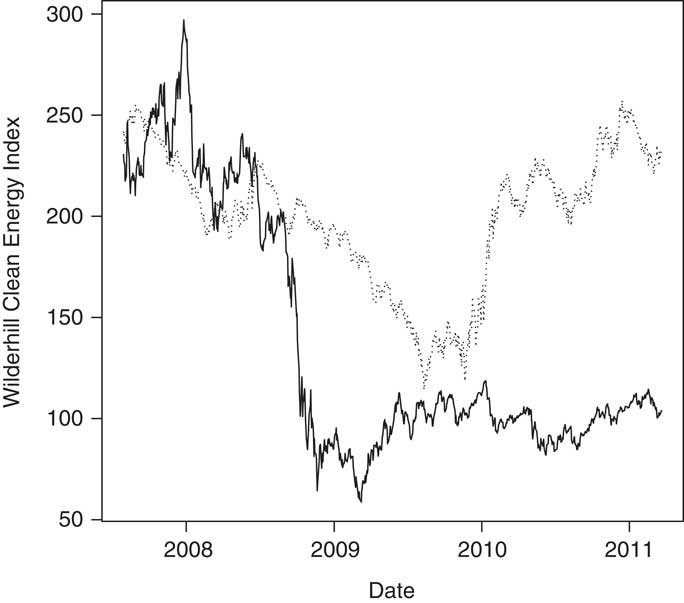
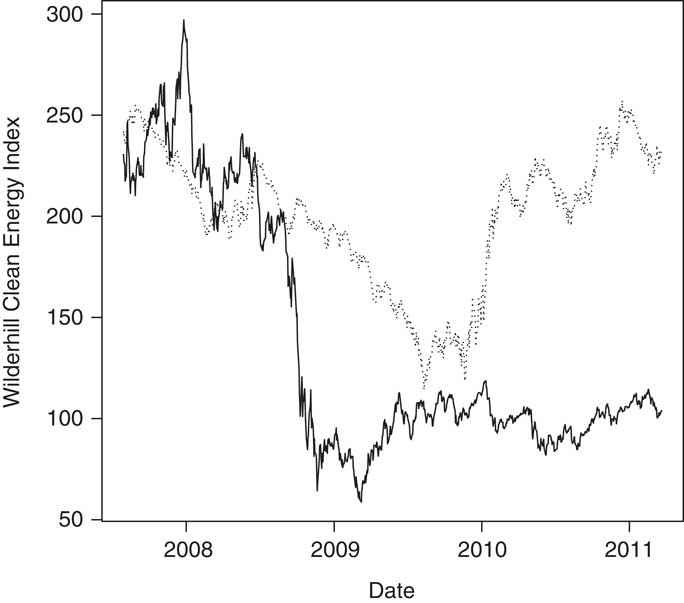
Empirical evidence also testifies to the importance of the causal mechanisms that the model highlights. While international oil prices were largely stable in the second half of 2007 – and far below the peak in the summer of 2008 – stock prices for clean energy companies reached their all-time high in December 2007. The development of the Wilderhill Clean Energy Index for clean energy companies – a widely used indicator of the global profitability of clean energy – is shown in Figure 2 from July 2007 to March 2011, along with the value of the NASDAQ composite index for comparison. Wilderhill closed at 288.21 points on 31 December 2007, whereas the value on 1 December 2007 was only 248.22.Footnote 68 At the same time, the value of the NASDAQ composite index was declining.Footnote 69
Value of the Wilderhill Clean Energy Index (line) and the NASDAQ composite index (dots), 30 July 2007 to 22 March 2011
Notes: Wilderhill is given as relative to the value of the index on the day of launch: 16 August 2004. The value of NASDAQ is normalized such that the value is identical to that of Wilderhill on 30 July 2007.
Qualitatively, both policy makers and clean energy advocates recognize the signalling value of the Bali Roadmap. Paul Dawson, head of environmental and regulatory affairs in the global commodities department of Citi, stated on 20 December 2007: ‘It's pretty encouraging, in that the process is in place for an overarching agreement … There's a great degree of confidence that there will be a more sustainable global framework going forward.’ Similarly, Dirk Forrister, managing director for the carbon asset manager Natsource in Washington, D.C., said: ‘The big picture signal about fairly aggresive global action in the future seemed to have markets at the centre. Almost everywhere we turned delegates had positive things to say about markets.’Footnote 70
By contrast, changing circumstances and the sudden global financial crisis created a very different setting for the Copenhagen climate summit in December 2009. After acrimonious negotiations, major powers failed to agree on a common course of action. Steve Sawyer, director of the Global Wind Energy Council, stated: ‘The voluntary approach taken in this declaration would fail to send clear confidence building signals to the market and to investors.’Footnote 71
Given that the expectations for Copenhagen were high, clean energy markets interpreted the outcome as failed reassurance. On 31 December 2009, the Wilderhill Clean Energy Index closed at 111.35. This is only seven points above 104.49, or the index value on 1 December 2009. On 22 March 2011, the index remained below this value at 103.77. At the same time, other stock markets had rebounded: the NASDAQ, for example, was at 204.2 on 31 December 2009 but had increased to 241.6 by 22 March 2011. Consistent with the theoretical expectation, the clean energy index has performed much more weakly than stock markets in general. These strong market responses to developments in international climate negotiations are consistent with model predictions, as summit outcomes in the absence of concrete adjustments produce powerful changes in the clean energy market.
A very different example can be found in Croatia's negotiations on accession to the European Union (EU), as documented by Julia Gray.Footnote 72 The spreads on Croatian Eurobonds against the German ‘gold standard’ – a commonly used measure of investor and credit risk in European bond markets – decreased from 170 to 28 points between October 2001 (Stabilization and Association Agreement) and October 2005 (association negotiations). According to two officials whom Gray interviewed at the Central Bank of Croatia, ‘yields were very much elastic towards positive signals from Brussels … Croatian bonds were almost junk bonds until the EU started taking us seriously.’ European investors interpreted positive statements from Brussels as informative communication, and this reassurance in turn reduced investor risk in Croatia. Thus, European investors were able to increase investment in the Croatian economy. The reduction in investor risk generated economic growth and increased the expected benefits from policy reform and thus allowed Croatia to implement the policy reforms that would allow it to deepen integration with the European Union. At the same time, such investments would have been very costly for European investors if Croatia's accession bid were to falter in the future. Consistent with Proposition 1, bond markets allowed the EU to communicate credibly with Croatia.
Costly Information Revelation
What if the necessary and sufficient condition for costless information revelation, c ≥ 1, does not hold? The equilibrium identified above cannot exist because a mean type would lie by saying ‘yes’, as the benefits from defection now exceed the adjustment cost. Declarations of international co-operation are no longer credible because the mean type has an incentive to misrepresent her preferences, so reassurance requires a sacrifice. This sacrifice should be minimized, so search for an equilibrium in which the extra signal that a mean type sends is as inexpensive as possible. Instead of simply sending an extra signal, a leader reveals her type by saying ‘yes’ and then validates it by sending the least costly extra signal x* > 0. The reason why cheap talk can be useful is that it induces markets to incur costly adjustments, which reduces the cost that a credible signal must carry.
Let us begin with the international co-operation subgame. In equilibrium, each leader co-operates if and only if both leaders have said ‘yes’ and sent the minimal extra signal, to be specified in detail below. If the equilibrium in focus exists, neither leader has an incentive to deviate because their types are common knowledge. What about the minimal extra signal? The issue is subtle because cheap talk has already fully separated the two types in equilibrium. At the extra signalling stage, there is no information to be revealed, but if adjustment costs fall below the benefits from defection, incentive compatibility requires an extra signal. When both leaders say ‘yes’, international co-operation must be forthcoming if and only if both leaders send the minimal extra signal necessary to ensure that a mean leader does not say ‘yes’.
To investigate this issue, suppose market actors adjust if and only if both leaders say ‘yes’. A nice leader says ‘yes’ if and only if:

where the left side is the effect of saying ‘yes’ on the expected payoff. A mean leader says ‘no’ if and only if:

We need:

With the mean type's unit cost z large enough, Inequality 6 holds for some extra signal x small enough for the nice type to be willing to pay the cost. Only the second inequality will be binding in equilibrium, so x* must meet:

Thus, the following proposition is proven.
Proposition 2: If adjustment costs do not exceed the benefits from defection, reassurance only requires such an extra signal so that the benefits from defection cancel out.
Even if fully efficient information revelation is not possible, adjustment costs are helpful. An extra signal is costly enough if it cancels the benefits from defection.
If an extra signal is necessary to achieve reassurance, the two leaders face a paradoxical situation. They have already revealed their true type by saying ‘yes’, so, as the leaders approach the extra signalling stage, they no longer have to reveal any information. Strictly speaking, the extra signal is unnecessary at that time, so the two leaders have a common incentive to avoid it by agreeing that they should engage in international co-operation even without an extra signal. But if they do this, mean types lie by saying ‘yes’, because they need not pay the deadweight cost of extra signalling, so reassurance fails. The two leaders must send an extra signal to ensure that mean types do not lie, so they must condition international co-operation on uninformative extra signals. Consequently, costly adjustments reduce the loss from costly signalling but only if the two leaders can somehow establish a credible collective commitment to a plan of action that they will regret. In technical jargon, the extra signals are ‘renegotiable’.Footnote 73
To summarize, if costly adjustments are a prerequisite for mutually profitable international co-operation, a nice leader can reveal her preferences by inducing market actors to incur the adjustment cost. As adjustment costs increase, a mean leader has less to gain from defection because she must trick market actors into undergoing the futile but costly adjustment. High enough adjustment costs remove the need to send any extra signals for reassurance, so information revelation is fully efficient.
Virtues of Intense Competitive Pressure
A notable feature of the basel-line model are the intense competitive pressures that follow from a high number of market actors. As I have argued above, this condition is characteristic of relatively perfect markets. To show that ideal markets are indeed particularly conducive to reassurance, I now consider several variations of the model. They show that as long as the market actors cannot manipulate information or hold bargaining power, costless information revelation is robust to seemingly intractable complications.
To begin with, consider the original model but suppose the true proportion of market actors that actually underwent a costly adjustment is unobservable to the two leaders. If the two leaders cannot ‘audit’ the costly adjustments in equilibrium, is reassurance nevertheless possible without extra signals? This question is important for empirical applications, because many costly adjustments are indeed unobservable. If companies are expected to install advanced equipment for pollution abatement, and the number of such companies is large, it may be very difficult for governments to verify that such installations indeed occurred. If companies adjust to prepare for trade liberalization, and these companies are heterogeneous, it may be difficult to verify that they have indeed adjusted. Thus, it is essential to examine the consequences of unobservability.
Surprisingly, unobservability turns out to be irrelevant. Simply investigate the reassurance equilibrium to see that, even if the costly adjustments cannot be verified, in equilibrium two nice leaders know for sure that all market actors have undergone them, s = 1, in the co-operation subgame. The logic is the following. No individual market actor can benefit from a deviation, so an equilibrium continues to exist such that all market actors undergo the costly adjustment and two nice leaders co-operate. Although neither leader can see the adjustments, they understand that no market actor would have an incentive to refrain from costly adjustments. Under rational expectations, then, each leader can be confident that such costly adjustments have indeed occurred. In spite of their unobservability, each leader is able to infer that no profitable deviation exists.
Proposition 3: The reassurance equilibrium identified above exists in the shadow of markets even if costly adjustments are unobservable.
This counterintuitive result highlights the virtues of competitive markets well. Leaders can trust each other without verifying the costly adjustments because the market actors autonomously implement them to maximize profits. In the model, the market actors only know whether the leaders have said ‘yes’ or ‘no’ to international co-operation, so in equilibrium they condition their behaviour on this announcement. Even if costly adjustments are unobservable, a mean leader does not dare say ‘yes’ because she knows that the market actors will undergo costly adjustments.
This finding appears paradoxical in that markets help leaders to reassure without extra signalling, but international co-operation does not ultimately even depend on these costly adjustments. This observation highlights the essential difference to crisis bargaining. The relevant question is not whether a nice leader prefers to undergo costly adjustments. She does so as long as international co-operation is profitable for some reason. Instead, the relevant question is whether the mean leader prefers to undergo costly adjustments. If costly adjustments are futile or harmful without international co-operation, a mean leader wants to avoid costly adjustments, so reassurance is easy.
A related possibility is that costly adjustments are simultaneous to international co-operation. To examine this possibility, consider the original game but suppose international market actors decide on costly adjustment only during the co-operation subgame. This extension is also important for empirical applications, because in reality the exact sequence of moves is virtually impossible to establish. Again, only nice leaders say ‘yes’, so delaying the costly adjustments until international co-operation does not have any effect on incentives to deviate.
Proposition 4: The reassurance equilibrium identified above exists in the shadow of markets even if market actors decide on costly adjustment while leaders decide on co-operation and defection.
Costly adjustments reveal information only indirectly. They are not implemented by the leaders, so the leaders cannot strategically manipulate the costly adjustments, except through the public announcement that international co-operation is forthcoming. This result is important for the robustness and generality of the result, as it is not always clear whether costly adjustments precede (prior) or accompany (simultaneous) international co-operation. Proposition 4 shows that, in either case, costly adjustments carry valuable information that enables reassurance. By contrast, postponing the costly adjustments until after international co-operation would remove the possibility of reassurance because a mean leader can ‘warn’ market actors by defecting.
Markets facilitate reassurance even if individual market actors do not benefit from international co-operation. This observation implies that markets could enable international co-operation against their own interests. There need not be an internationalist coalition supporting liberalization. Even if international co-operation is costly to market actors, they can play the role of information intermediaries. Instead, markets are useful simply because they can less plausibly engage in strategic manipulation of information. Competitive pressures ensure that an individual market actor can do little to prevent or promote international co-operation, so they are reactive actors who respond to a fixed external environment.
Market Imperfections
In reality, markets often fall short of the neoclassical ideal of perfect competition. To investigate this possibility, suppose the large number of market actors are replaced by one major ‘monopolist’ but retain all other features of the original model. Holding everything else constant, this simple formalism captures the idea that the monopolist has political power because he can potentially ‘hold out’ by not undergoing costly adjustments even if he knows that the two leaders are nice.
While the case of a single monopolist is arguably special, it has alternative substantive interpretations worth consideration. For example, suppose there are multiple market actors but they have formed an organized interest group that co-ordinates policies.Footnote 74 The analysis that follows can be applied to this case as well. All that matters is that the market actors can strategically decide not to implement costly adjustments if they can thus prevent harmful co-operation between the leaders.
Consider a reassurance equilibrium. We have already seen that the leaders have no incentive to deviate, so it suffices to verify that the monopolist cannot profit from a deliberate failure to adjust. First, if international co-operation increases the profits to the monopolist net of adjustment costs, he has no incentive to deviate:  . Second, if two nice leaders benefit from co-operation even without costly adjustments, so that

the monopolist cannot do anything to prevent two nice leaders from co-operating, as the decision to co-operate does not depend on international market reactions at all.
To see this, suppose both leaders say ‘yes’ but the monopolist deviates by refusing to adjust. The leaders have already revealed their mutual niceness, so they are sure ‘off the equilibrium path’ that international co-operation is mutually profitable. Since the deviation is unexpected, it is easy to verify they can send a zero extral signal to engage in international co-operation without violating incentive compatibility ‘on the equilibrium path’. Surprisingly, the monopolist cannot attempt to withhold information by deviating because information revelation is induced by a combination of cheap talk and the equilibrium expectation of costly adjustments. Should this expectation fail off the equilibrium path, both leaders have already proven their nice nature, so the monopolist deviates too late to influence beliefs.
If neither condition holds, the monopolist can profitably prevent international co-operation by simply choosing not to adjust as long as this behaviour is observable. Without costly adjustment, international co-operation is not profitable to the leaders. The leaders must defect even if they are nice, and the reassurance equilibrium unravels.
Proposition 5: A single strategic monopolist adjusts in expectation of international co-operation if and only if international co-operation is profitable to him or two nice leaders benefit from international co-operation even when markets fail to adjust.
This proposition summarizes the problems that a strategic player with bargaining power can cause. If it can prevent international co-operation by refusing to adjust, it has the power to prevent international co-operation even if it would be beneficial for the society as a whole. In contrast, if markets are characterized by intense competitive pressures, no individual market actor can do anything to prevent international co-operation.
Empirically, if market actors find international co-operation profitable, it does not matter for reassurance whether they have political power or not. Any player who stands to gain from international co-operation endorses reassurance and supports collaboration. Even if he has true political power, he will back leaders who seek international co-operation. But if a strategic player loses from international co-operation, he uses his political power to undermine it. Market imperfections pose a problem for reassurance if the relevant third parties are special interests that suffer from international co-operation.
An example can be found from the field of international security. Bechtel and Schneider show that declarations of deeper security and defence co-operation in the European Council increase the value of the European defence industry on average by €4 billion.Footnote 75 The European Council is usually seen as a ‘talking shop’ that does not have authority over national security policies, so it seems improbable that international investors could ‘elicit substance from hot air’. Yet international investors appear to hold such a strong belief in these declarations that they respond by promptly adjusting their asset portfolios.
These two factors appear important in the case of European defence industry.Footnote 76 The defence industry is certainly not unusually competitive, but the shares of the major defence companies are publicly traded in European stock markets, and deeper defence and security co-operation is profitable to them because the demand for their products increases. The theoretical analysis, therefore, provides a potential explanation for the ease with which European leaders can convince the industry and third parties that international co-operation is indeed forthcoming. The industry and the investors are eager to facilitate information revelation by the leaders because this is profitable for them.Footnote 77
Finally, reassurance through costly adjustments seems most precarious if a mean leader can secretly communicate with the market actors to abort costly adjustments. Such collusion is clearly harmless if costly adjustments are perfectly observable because the two leaders can condition international co-operation on verifiable costly adustments. But suppose instead that the costly adjustments are unobservable with probability π∈(0,1) and a mean leader can secretly say ‘do not adjust’ to the market actors. This announcement is credible because a nice leader would never say such a thing, so suppose it prevents costly adjustments.
Consider the following candidate for a modified reassurance equilibrium:
1. A leader says ‘yes’ if and only if she is nice.
2. A leader sends the minimal extra signal (possibly zero) if and only if both leaders say ‘yes’. This minimal extra signal can depend on whether the two leaders observed the costly adjustments.
3. A leader co-operates if and only if both leaders send the appropriate minimal extra signal.
If the costly adjustments are observed, we already know what the minimal extra signal is, so the resulting behaviour constitutes a subgame perfect equilibrium. In contrast, the minimal extra signal upon observation failure must be such that it separates the types even if there were no costly adjustments at all. To see why, note that without full separation, a mean leader would always say ‘yes’ and then secretly say ‘do not adjust’ to the market actors. Modifying Equation 7, the following condition characterizes the minimal extra signal upon observation failure:

With z large enough, such an extra signal always exists and is mutually profitable for two nice leaders. But then international co-operation again does not depend on the costly adjustments, so collusion is clearly irrelevant. The only problem is that the two leaders cannot use the costly adjustments if observability fails:
Proposition 6: If a mean leader can secretly collude with the market actors, reassurance is possible; but when the two nice leaders fail to observe the costly adjustments; they must send an extra signal that carries a higher cost than otherwise.
One might intuitively expect that reassurance is impossible if a mean leader can warn the market actors that the costly adjustments are in vain, but this reasoning fails even if the costly adjustments are difficult to monitor.
Importantly, collusion is identical to the case in which a leader can directly implement costly adjustments. This could characterize a socialist economy, but, as I have demonstrated above, adjustment costs can also be administrative or political. The proof is identical to that of the previous proposition; hence, it can be omitted.
Proposition 7: If the leaders implement the costly adjustments, reassurance is possible; however, when the two nice leaders fail to observe the costly adjustments, they must send an extra signal that carries a higher cost than otherwise.
Again, markets provide a strategic environment that is particularly conducive to reassurance.
In sum, Propositions 6 and 7 show that the main conclusion from Proposition 3 is relatively robust to changes in the information structure. Even if collusion or direct implementation of adjustments is possible, and costly adjustments are not perfectly transparent, reassurance remains feasible. The main difference is that, as the observability of costly adjustments decreases, the likelihood increases that a costly extra signal is actually needed. Empirically, collusion and direct implementation should weaken the effectiveness of reassurance, but the size of this effect is negatively associated with the observability of costly adjustments.
Discussion
A key modelling choice that I have made is to deliberately abstract away from the details of any given issue area. While this approach maximizes generality, it obviously complicates empirical applications of the model. To explain or predict behaviour in an issue area, it would be necessary to collect additional information on actor preferences and the relevance of costly adjustments for co-operation.
I have also refrained from modelling exactly how leaders use international co-operation to provide benefits to important domestic constituencies.Footnote 78 While this assumption greatly simplifies the analysis, it excludes the possibility, worth noting in passing, that leaders strategically engineer international agreements to decrease or increase adjustment costs to certain constituencies. On the one hand, a leader could deliberately ‘externalize’ adjustment costs to unsupportive constituencies. On the other hand, a leader could sometimes even increase adjustment costs, so as to reveal information that allows international co-operation in the first place. While the present model cannot capture this issue, it may provide insight into the relevant tradeoffs that leaders face in engineering the domestic distributional implications of co-operation, such as favouring supporters versus credible information revelation to foreign leaders.
Following Kydd and many others, I deliberately omit enforcement problems between nice leaders who are generally willing to co-operate.Footnote 79 While many international co-operation theorists have focused on repeated games to investigate the possibility of co-operation,Footnote 80 I assume that if two nice leaders meet they will be somehow able to enforce co-operation. While this assumption seems strong, all results would actually hold if the only difference between nice and mean leaders were their ability to commit to co-operation in an infinitely repeated game that follows information revelation and costly adjustments. My focus is on information revelation, so I omit this extension of the model.
In the model, there are only two countries. The results would extend to multilateral co-operation, as long as investors in each country only benefit from costly adjustments when their own leader also co-operates. By contrast, if the number of countries is so large that each country is individually irrelevant for international co-operation, the logic of reassurance fails because a leader's decision not to defect will have few if any impacts on the net benefit of costly adjustment.
I have not formally investigated how changes in a leader's time preferences, or ‘discount factor’, influence reassurance. Quite obviously, if leaders heavily discount future benefits, reassurance through costly adjustments is not possible: if a leader does not value future co-operation benefits, he or she is unwilling to allow costly adjustments to begin with. Thus, in line with the classical co-operation theory, leaders must be sufficiently patient to succeed in reassurance.Footnote 81
I have also refrained from explicitly comparing reassurance to alternative mechanisms of trust building, such as reputation or reciprocity. One may conjecture, for example, that if powerful reputational mechanisms are available, then the need for reassurance decreases. This is an empirically testable hypothesis that allows empirical scholarship to scrutinize the scope conditions of the argument. At the same time, the availability of powerful alternative mechanisms may create new demands for reassurance, as leaders must demonstrate that they are indeed sensitive to reputational loss or reciprocal punishment.
Conclusion
I have advanced two main propositions. First, reassurance is easy if international co-operation is accompanied by costly adjustments that market actors under intense competitive pressures must undergo. Leaders prefer not to mislead market actors by falsely claiming co-operation when they intend to defect, because futile costly adjustments follow. Second, market imperfections can complicate reassurance unless the market actors prefer international co-operation to the status quo. Strategic market actors with structural bargaining power can deliberately prevent international co-operation by refusing to undergo costly adjustments, so information revelation fails.
Many of the most important forms of international co-operation shape economic activities directly or indirectly, and these economic activities are now primarily governed through markets.Footnote 82 These interconnections are most visible in a wide range of salient issues where international co-operation prompts costly adjustments, such as foreign direct investment or trade liberalization. In these circumstances, the constellation of market imperfections and business preferences may prove to be the central determinant of whether international reassurance succeeds or fails.
Everyone seems to believe that markets and globalization are important, but we have very few detailed theoretical models of the way they shape international co-operation. The most important exception is Gartzke, who unfortunately focuses on highly specific questions of war and peace only.Footnote 83 My theoretical analysis shows that one important effect of markets is to facilitate reassurance when adjustment costs are high enough and competitive pressures intense enough. It highlights the importance of empirical work on the role of costly adjustments and markets in different issue areas and demonstrates that such work must build on rigorous theoretical analyses of international co-operation instead of relying on imported ideas, unless they can be shown to apply to international co-operation.
Mathematical Appendix
In this mathematical appendix, I provide a full characterization of the equilibrium and prove the propositions presented in the main text.
Equilibrium Analysis
The game that I analyse is in extensive form and features incomplete information. Thus, I use the perfect Bayesian equilibrium as my solution concept. In equilibrium, the strategy for each player-type must be optimal given her beliefs and the equilibrium strategies of other player-types. Additionally, all beliefs must be consistent with behaviour on the equilibrium path.
My focus is on the possibility of information revelation, so I examine the existence of the following ‘reassurance equilibria’:
1. Each leader i says ‘yes’ if and only if she is nice.
2. All market actors undergo costly adjustment if and only if both leaders say ‘no’.
3. Each leader i sends a minimal extra signal x* if and only if both leaders say ‘yes’.
4. Each leader i co-operates if and only if both leaders send the minimal extra signal x*.
In equilibrium, each leader i's initial statement fully reveals her type to all other players. Specifically, a nice leader says ‘yes’ and a mean leader says ‘no’. The market actors have no private information, so their actions are not informative. Next, consider how leader i updates beliefs if leader j deviates from the path of play by failing to send the minimal extra signal x*. By the usual freedom of choosing beliefs off the equilibrium path, I assume that any deviation from the minimal extra signal x* prompts leader i to infer that leader j is of the mean type. The co-operation decisions are simultaneous, so no belief updating is possible at the co-operation stage.
As usual, the game is solved by backward induction. By the definition of the perfect Bayesian equilibrium, I find the set of parameter values such that no player has an incentive to deviate from the equilibrium strategy given their equilibrium beliefs:
1. Consider the international co-operation subgames. In equilibrium, each leader i has previously revealed her type. Recall also that all market actors have adjusted if both leaders said ‘yes’, and otherwise no market actor has adjusted. If each leader i is nice and believes the other leader j is also nice, Figure 1 shows that neither leader has an incentive to deviate from her strategy, as α(1)>1. If leader i is mean, her optimal strategy is to defect in all circumstances, as Figure 1 shows that 1>0 and 0>−1. If leader i is nice but she believes leader j is mean, her optimal strategy is to defect. Thus, the reassurance equilibrium exists for these subgames.
2. Should leader i send the minimal extra signal x*? If at least one leader is mean, and has thus said ‘no’ previously in equilibrium, the payoff to leader i is strictly decreasing in the extra signal xi because the payoff from the co-operation subgame is zero. Thus, leader i fails to signal. Suppose now both leaders i are nice, and have thus said ‘yes’ previously in equilibrium. Now the expected payoff from sending the extra signal x* to leader i is α(1)−x*. Thus, we need
 for the reassurance equilibrium to exist.
3. Consider now the market actors. The adjustment cost is q. The profit with adjustment is πC whenever both leaders co-operate. It is π D otherwise regardless of adjustment. With πC−q>0, as is true by assumption, each market actor adjusts if and only if both leaders
say ‘yes’.4. Consider finally the initial cheap talk stage. Prior beliefs hold, so a nice leader says ‘yes’ if and only if
. Similarly, a mean leader says ‘no’ if and only if .
 for the reassurance equilibrium to exist.
 say ‘yes’.
 . Similarly, a mean leader says ‘no’ if and only if
 .
As long as all these conditions are met, the reassurance equilibrium exists. Next, we need to minimize the extra signal x*. With z large enough, the only binding constraint is that  . As long as this condition is met, it automatically follows that
 because α(1) > 1 and
 because
 with z assumed to be large enough. Simplifying, we need
 . This completes the equilibrium analysis.
Proofs
Here I prove the propositions presented in the main text. All proofs build on the equilibrium analysis provided above.
Proof of Proposition 1
To prove the proposition, it suffices to prove that the equilibrium characterized above exists for x* = 0. We obviously need  , and this is true by assumption. Given this assumption, of the three incentive compatibility conditions, only
 is binding in equilibrium, as the above equilibrium analysis shows. With x* = 0, the expression
 can be written as
 . Thus, it suffices that
 , as argued in the main text.▪
Proof of Proposition 2
Suppose 1 > c. For  , rearranging yields that we need
 . For large enough z, some minimal x* is guaranteed to exist such that this condition holds with equality.▪
Proof of Proposition 3
Suppose costly adjustments are unobservable. To prove the proposition, by the definition of the perfect Bayesian equilibrium it suffices to verify that following the costly adjustment stage, each of two nice leaders ascribes a probability 1 to being in such an information set that all market actors have undergone costly adjustments. After all, such beliefs are fully equivalent to observable costly adjustments. Since this outcome is on the equilibrium path of play, the claim immediately follows by Bayes’ rule.▪
Proof of Proposition 4
Consider a modified version of the game such that all market actors decide on costly adjustments only during the co-operation subgame. In equilibrium, all market actors undergo costly adjustments if and only if both leaders are nice. Thus, each leader's incentives in any co-operation subgame are completely unchanged given their updated beliefs. In equilibrium, only two nice leaders co-operate, so each market actor's incentives to undergo costly adjustments are also unchanged given their updated beliefs.
Consider now the extra signal x*. Such an extra signal is only sent if both leaders are nice, and thus given the correct equilibrium beliefs it suffices that  , as any deviation induces non-cooperation by both leaders and non-adjustment by all market actors. This condition holds automatically given that
 is assumed in Proposition 4.
Given that outcomes are identical to those obtained in the main model, each leader's incentives to send the extra signal x* also remain unchanged. Finally, incentives in the cheap talk stage are also unchanged given that the outcomes in each subgame induced by the message pair are identical to those in the main model.▪
Proof of Proposition 5
As shown in the main text, two scenarios must be considered. First, suppose  . Now the monopolist has no incentive to deviate from the equilibrium. Second, suppose
 . Now the monopolist prefers to deviate if it can, thus avoiding co-operation. This requires that a deviation would ultimately prevent international co-operation. Whenever
 , this does not occur as under a large enough z the extra signal x* can be chosen small enough such that both nice leaders send the extra signal x* and then co-operate. Whenever α(0) = 1, this requires that x* = 0. Whenever α(0) < 1, neither nice leader has an incentive to co-operate in the relevant subgame, and so the reassurance equilibrium implodes because the monopolist deviates.▪
Proof of Proposition 6
Consider the following formalization of secret communication. Begin with the model of probabilistically unobservable costly adjustments, but suppose now that simultaneously to transmitting a public message ‘nice’ or ‘mean’ at the cheap talk stage, a leader can also secretly send a similar message, ‘nice’ or ‘mean’, to the market actors. This message is not observed by the other leader. Suppose further that if the market actors see a message off the equilibrium path, and only one type of leader could possible benefit from changing the market actors’ equilibrium beliefs, the market actors infer that the message was sent by this type.
I now show that under this assumption, truthful information revelation at the beginning of the game requires that the extra signal meets z·x* = 1 conditional on unobservability. To see this, recall that we need to verify that the mean leader has no incentive to deviate from truthfully saying ‘mean’ in the beginning. We have already found that this is always the case without secret communication, so it suffices to focus on the possibility of secretly saying ‘mean’ to the market actors. Let us consider this deviation and verify that it is not profitable.
If z·x* = 1 conditional unobservability, truthful revelation is possible given that a ‘mean’ leader i cannot possibly obtain any net benefits regardless of whether the costly adjustments are observed. If they are, the other leader j learns that no costly adjustments were made, and thus it also learns that leader i is mean, co-operation fails. If they are not observed, the fact that z·x* = 1 implies that the expected payoff to leader i is nonetheless zero. Thus, the deviation is not profitable.
Suppose now z·x* < 1. If costly adjustments are observed, the other leader  again learns that leader i is mean. If costly adjustments are not observed, however, the conditional expected payoff to leader i is 1 − z·x* because it obtains an opportunity to defect without any adjustment costs. Thus, the reassurance equilibrium fails as mean leaders always say ‘nice’ but secretly communicate to the market actors their true preferences.▪
Proof of Proposition 7
Repeat the proof of Proposition 6 but replace secret communication with the possibility that each leader i can herself decide on costly adjustments.▪