Introduction
As a kind of metal fuels with high calorific value, aluminum powder owns a wide range of sources and low cost, and it has been widely used in kinds of explosive formulations. However, because of the dense oxide layer on its surface, the ignition threshold and reaction completeness of aluminum powder are seriously restricted [Reference Jayaraman, Anand, Bhatt, Chakravarthy and Sarathi1, Reference Jiang, Li, Zhao, Pei, Yin and Li2, Reference Ye, Zhang, Liu, Han and Chen3]. In order to improve the reaction completeness and promote energy release of aluminum powder in the detonation zone via rapid oxidation reaction, scientists from various countries have done some related work. One of the effective methods is combining the aluminum powder and the oxidant together. The reaction properties of thermobaric explosives with aluminum powder coated with nickel were researched [Reference Hwang, Kim and Cho4]. The results showed that nickel could reduce the ignition temperature of aluminum powder, enhance the combustion efficiency of fuel particles, and increase the impulse and temperature field during detonation. The reaction kinetics of fluoropolymer-aluminum composite particles were investigated by Pantoya et al. [Reference Pantoya and Dean5]. The reaction characteristics of the composite particles with different aluminum powder sizes were quite different. The reaction heat of the composite particles containing aluminum powders with a size of 15 nm was three times more than the composite particles containing 50 nm aluminum powders. Dolgoborodov et al. [Reference Dolgoborodov, Makhov, Kolbanev, Streletskioe and Fortov6] studied the detonation performance of Al-polytetrafluoroethylene (PTFE) composite particles experimentally, and it was found that the composite particles can reach steady state detonation. The detonation velocity depends on the composition and density of the composite particles. A series of aluminum-oxide composites with high reactivity and high energy density were prepared via ball milling [Reference Sehoenitz, Ward, Dreizin, Armstrong, Thadhani, Wilson, Gilman and Simpson7, Reference Sehoenitz, Ward and Dreizin8]. The reactive components in the composite particles could also be aluminum-oxide and other thermites, such as B–Ti or B–Zr. Tests showed that the composites have a high reaction rate. The above research provides a technical way to regulate the effective reaction and energy release of aluminum powder during explosive detonation. However, using explosives as oxidants to form composites with Al particles to enhance the reaction completeness of aluminum powders has rarely been reported.
In this paper, crystalline behaviors of cyclotetramethylenetetranitramine-aluminum (HMX-Al) composites in solvents have been researched. The modified attachment energy (AE) model was applied to predict morphologies of HMX-Al composites in dimethyl sulfoxide (DMSO) and ethanol. Then the morphologies HMX-Al composites with Al coated and noncoated were characterized. At last, the mechanism of the morphologies formed in solvents for HMX-Al composites was obtained. The results can provide guidance for the preparation and design of HMX-Al composites.
Results and discussion
Growth morphology of HMX in vacuum
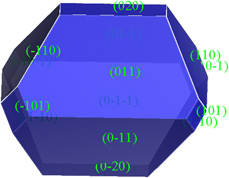
In order to study the morphology of HMX in solvents, the growth morphology of HMX in vacuum should be predicted first. The predicted morphology (by the AE model) in vacuum is displayed in Fig. 4. The shape of HMX in vacuum is a polyhedron, which is similar to a soccer ball. Table I lists the crystal habit parameters of (011), (110), (020),  $\left( {11\bar{1}} \right)$, and (101) faces, which are the main stable crystalline surfaces. (011), (110), (020),
 $\left( {11\bar{1}} \right)$, and (101) faces account for 59.4%, 31.0%, 6.4%, 1.9%, and 1.1% of the total surface area, respectively. (011) face has the strongest morphological importance for its largest d 011 and largest face area. (101) face has the weakest morphological importance, only accounting for 1.04% of the total face area (Fig. 1 and Table II).
The binding energies between HMX crystalline surfaces and ethanol.

Note: E total is the single-point energy of the equlibrium structure, E sur is the single-point energy of HMX, E solv is the single-point energy of solvent, E is the total energy of each structure, vdW is the energy of each structure obtained by van der Waals force, and Elec is the energy of each structure obtained by electrostatic force.
The predicted morphology of HMX in vacuum.

The crystal habit parameters of HMX in vacuum.

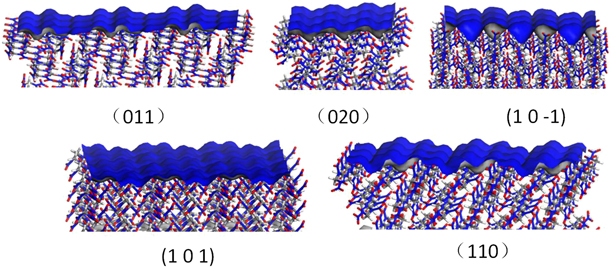
Before comprehending the interaction of HMX-DMSO and HMX-ethanol, studying the crystalline surface characteristics of HMX is necessary. The molecular arrangement of different HMX crystal faces represented by Connolly surfaces is displayed in Fig. 2. It can be seen that (020), (101), and (011) faces are flat, while (110) and  $\left( {10\bar{1}} \right)$ faces are rough. Parameter “S” is the ratio of solvent accessible area (A acc) and corresponding surface area (A hkl), and it is introduced to describe the crystalline surface characteristics. The bigger the S value is, the rougher the crystal face is. As displayed in Table III, there are differences among the “S” values of five faces. The “S” value of
 $\left( {10\bar{1}} \right)$ face is 1.49, which is the biggest one. It suggests that
 $\left( {10\bar{1}} \right)$ face is roughest, which can promote the adsorption of DMSO and ethanol molecules. Additionally, there are a lot of nitro groups exposed on all the five crystalline faces. It indicates that the polarity of the faces is very strong (Fig. 3).
The molecular arrangement of different HMX crystal faces represented by Connolly surfaces.

The “S” values for the crystal habit surfaces of HMX.

All areas are in Å2. A box is the total area of all faces of the cell.
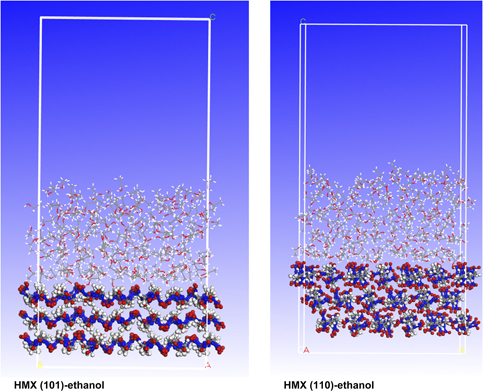
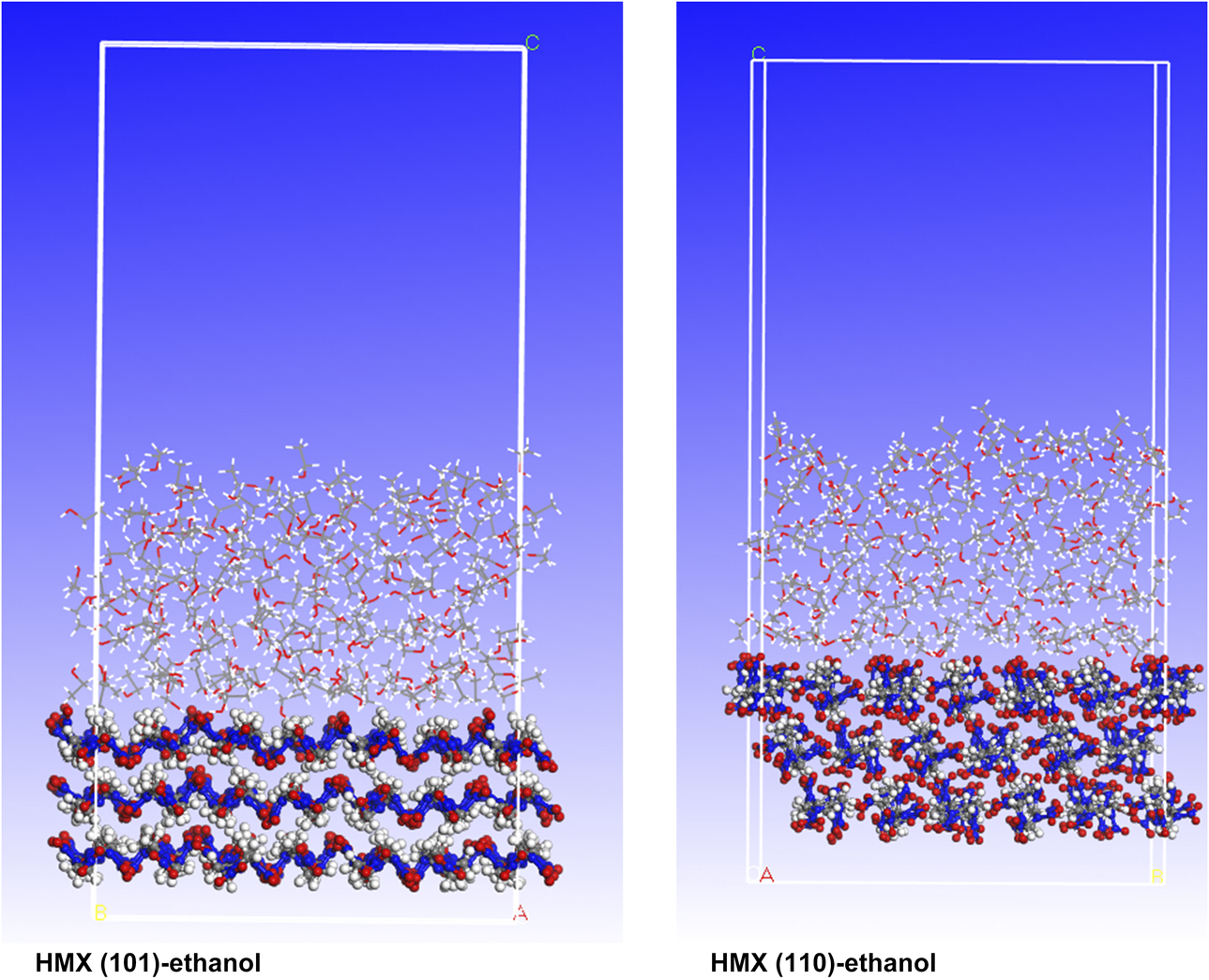
The equilibrium conformations of HMX faces-ethanol.
Growth morphologies of HMX in DMSO and ethanol
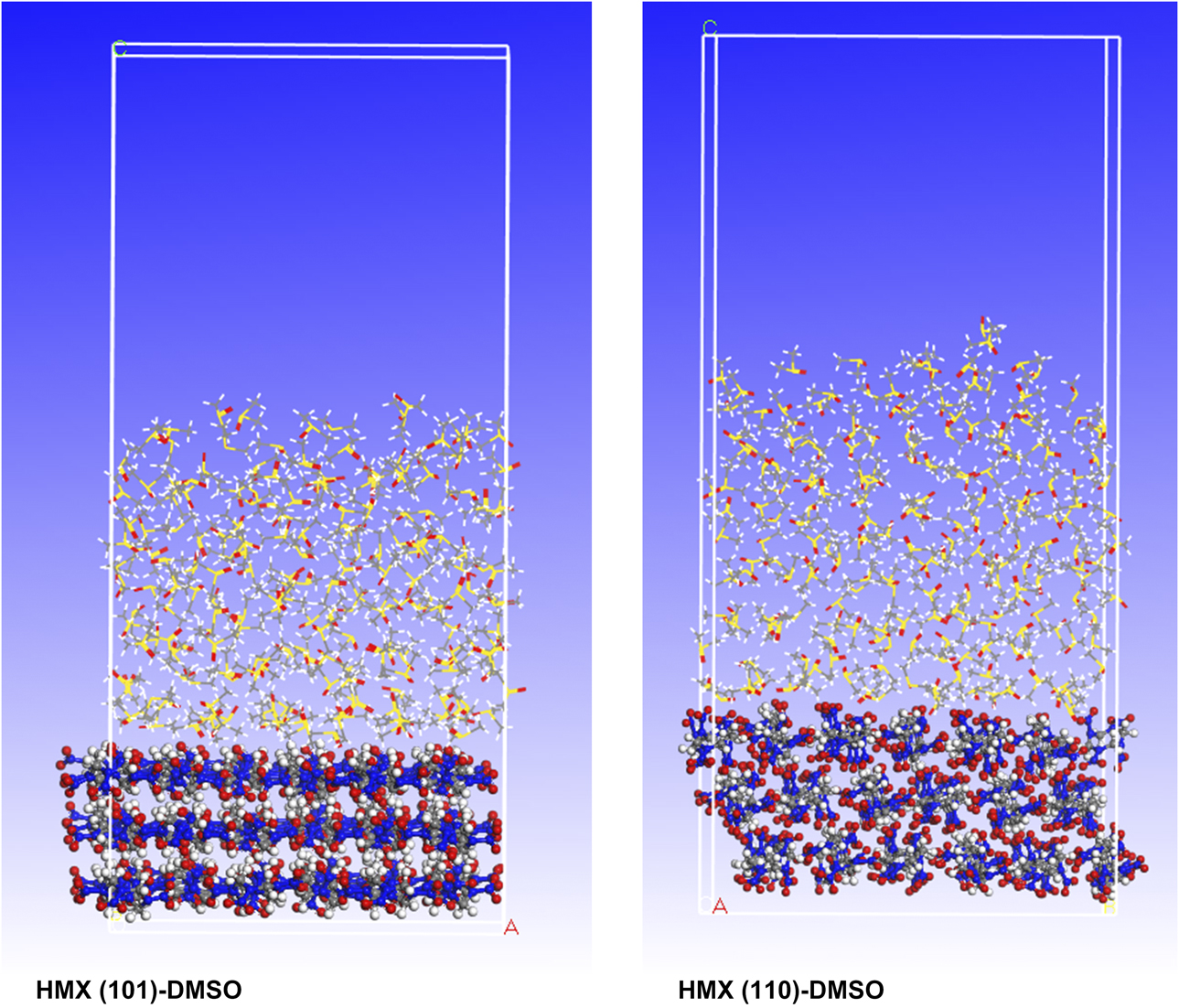
In order to understand the adsorption characteristics of DMSO and ethanol on different crystalline surfaces of HMX, the binding energies between HMX and two solvents were predicted, and the results are displayed in Fig. 4 and Table IV. Taking (110) face as an example, the binding energy between ethanol and HMX (110) face is 797.5 kJ/mol, which is positive. Meanwhile, the binding energy between DMSO and HMX  $\left( {10\bar{1}} \right)$ face is 742.4 kJ/mol, which suggests that DMSO can also adsorb on HMX
 $\left( {10\bar{1}} \right)$ face steadily. Further analysis indicated that the adsorption characteristics of two solvents on other HMX crystalline surfaces are similar to that of HMX (110) face. As shown in Table IV, the contributions of van der Waals force on the total binding energy of HMX (011), (110), (020),
 $\left( {11\bar{1}} \right)$, and (101) faces with ethanol layer are 41.9%, 41.4%, 38.5%, 47.3%, and 49.2%, respectively; the contributions of electrostatic force on the total binding energy of HMX (011), (110), (020),
 $\left( {11\bar{1}} \right)$, and (101) faces with ethanol layer are 37.7%, 39.7%, 33.9%, 36.4%, and 37.4%, respectively. Correspondingly, as shown in Table IV, the contributions of van der Waals force on the binding energy of HMX (011), (110), (020),
 $\left( {11\bar{1}} \right)$, and (101) faces with DMSO layer are 76.0%, 66.3%, 66.0%, 63.1%, and 70.3%, respectively; the contributions of electrostatic force on the total binding energy of HMX (011), (110), (020),
 $\left( {11\bar{1}} \right)$, and (101) faces with DMSO layer are 18.8%, 29.7%, 28.9%, 33.2%, and 26.6%, respectively. Therefore, HMX crystalline surfaces interact with DMSO layer and ethanol layer almost in the same way, mainly via van der Waals force and electrostatic force.
The equilibrium conformations of HMX faces-DMSO.
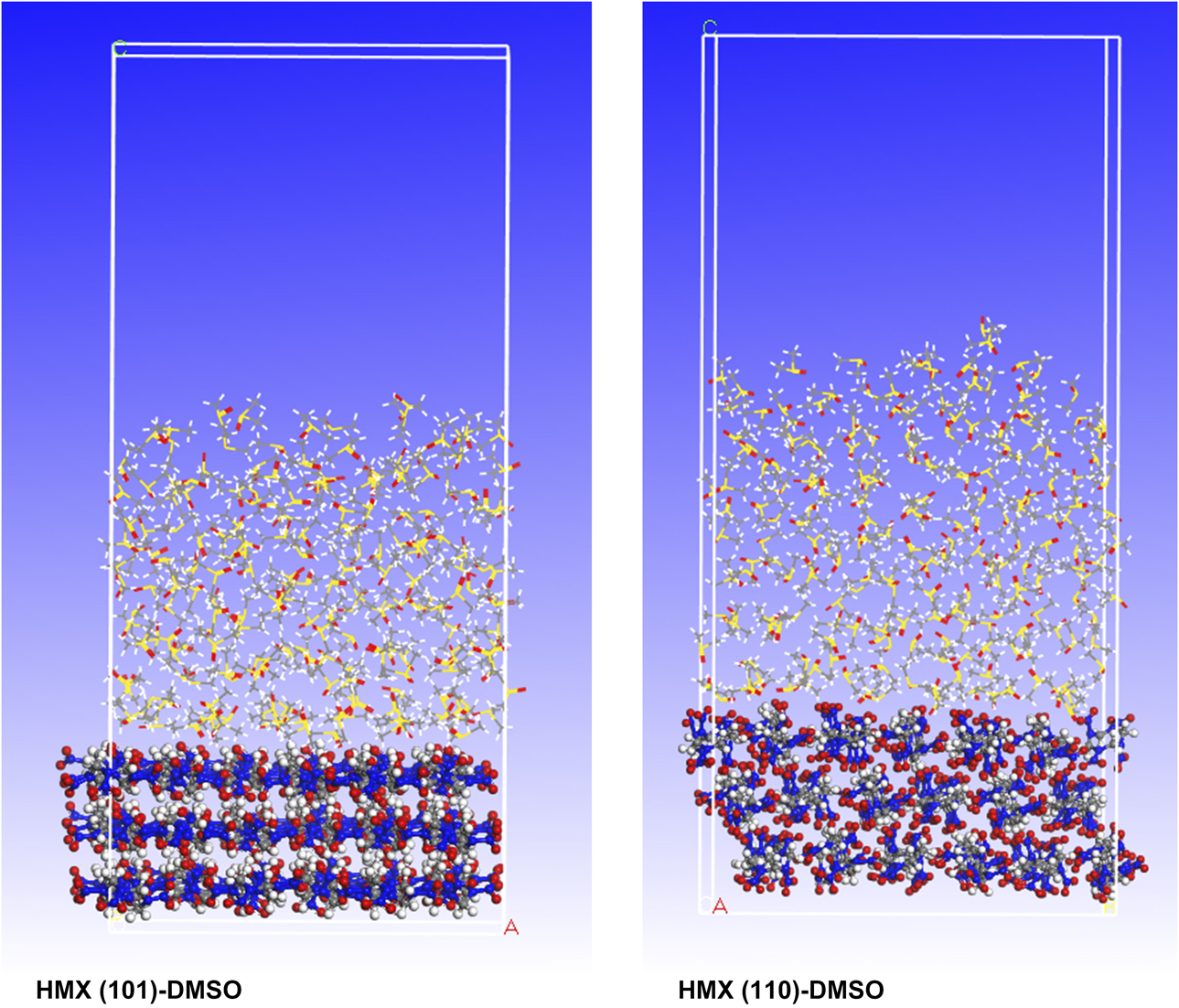
The binding energies between HMX crystalline surface and DMSO.

After the analysis of the roughness of HMX crystalline surfaces and the interaction between HMX and solvents, the crystal growth parameters for HMX in DMSO and ethanol have been calculated. For DMSO,  $\left( {10\bar{1}} \right)$ face has the greatest solvent AE E s (−1151.0 kJ/mol), and (020) face has the lowest solvent AE, only −573.3 kJ/mol. For ethanol, the order of the solvent AE for different crystalline surfaces is as follows:
 $\left( {10\bar{1}} \right)$ > (110) > (101) > (011) > (020). Therefore, the results suggest that the interaction intensities of the
 $\left( {10\bar{1}} \right)$ face with two solvents are greatest, and the solvent adsorption capability of
 $\left( {10\bar{1}} \right)$ face is strongest. However, the solvent adsorption capability of (020) face is weakest. Further, the adsorption capability is mainly decided by two factors, the first is the number of the exposed polar groups on the crystal surface; the second is the roughness of the crystal surface.
From the previous theory, the interaction of HMX with solvent layers will change the vacuum AE of HMX crystalline surfaces. Therefore, the modified AE was calculated by E′att = E att − E s. As shown in Table V, the order of modified AE for ethanol on different crystal surfaces is as follows:  $\left( {10\bar{1}} \right)$ > (110) > (101) > (011) > (020). Therefore, the (020) face has the greatest morphological importance for its slowest growth rate. Due to the fast growth rate, the area of
 $\left( {10\bar{1}} \right)$ and (110) faces will reduce in the final crystalline morphology of HMX.
Crystal growth paramaters of HMX crystalline surfaces in ethanol.

As shown in Table VI, the order of modified AE for DMSO on different crystalline surfaces is as follows:  $\left( {10\bar{1}} \right)$ > (110) > (101) > (011) > (020). Therefore, (020) face has the greatest morphological importance for its slowest growth rate. By contrast, the area of
 $\left( {10\bar{1}} \right)$ and (110) faces will reduce in the final crystalline morphology of HMX due to their fast growth rate.
Crystal growth parameters of HMX crystalline surfaces in DMSO.

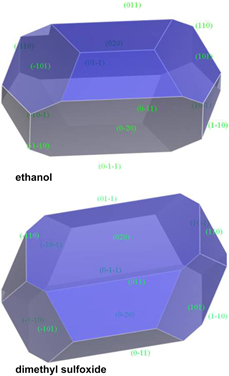
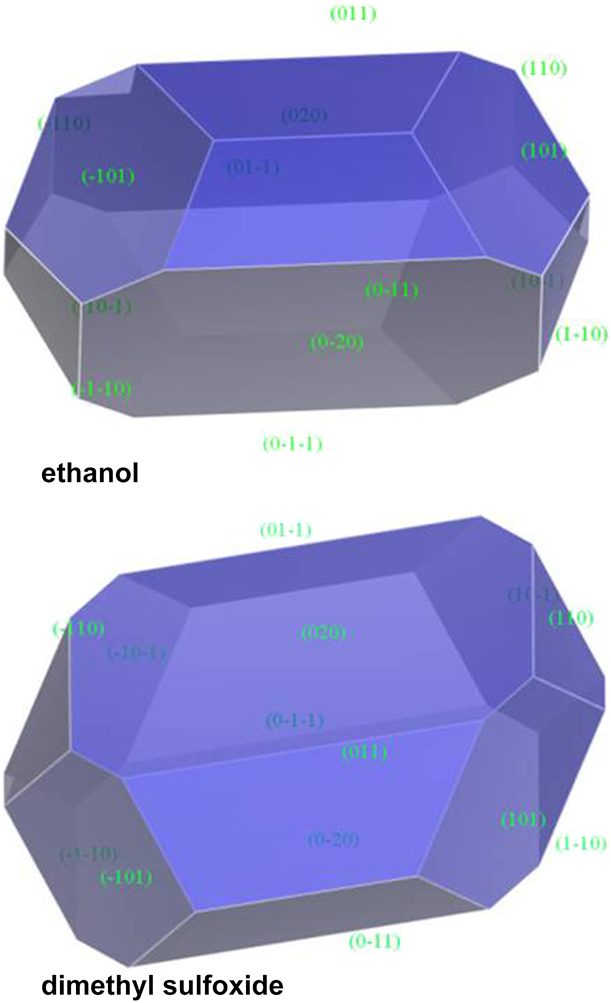
The morphologies of HMX predicted by the AE model in DMSO and ethanol were predicted. As displayed in Fig. 5, HMX will grow into polyhedrons in two solvents. However, the shape and the area distributions of each surface on polyhedrons are different for two solvents. It is because that there are differences between the binding energies of HMX faces-DMSO and HMX faces-ethanol.
The predicted morphology of HMX by the AE model in DMSO and ethanol.
Growth morphology of HMX-Al composite particles in DMSO and ethanol
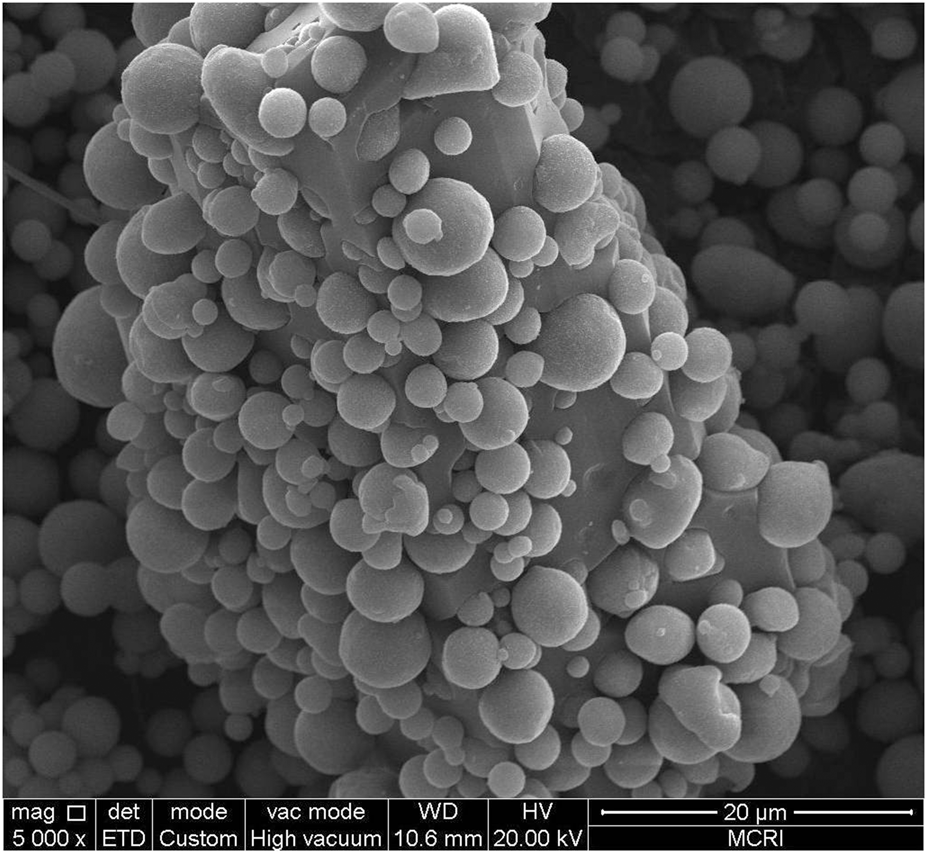
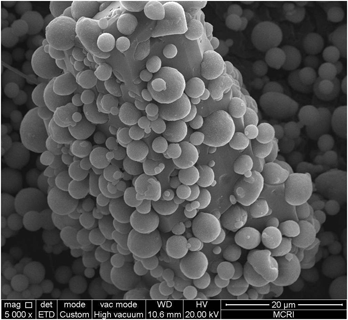
HMX-Al composite particles were prepared via solvent–nonsolvent method. In the process of preparation, DMSO was used as the solvent, and ethanol was used as the nonsolvent. Figure 6 shows the morphology of HMX-Al composite particles prepared by solvent–nonsolvent method. As displayed in Fig. 6, there are many aluminum particles embedded in a HMX crystal, and HMX crystal is tightly combined with aluminum particles. Comparing the morphology of HMX in the composite particles with the predicted morphologies of HMX in two solvents, the morphology of HMX in composite particles is neither similar to the predicted morphology of HMX in ethanol nor similar to the predicted morphology of HMX in DMSO. The morphology of HMX in composite particles is without any sharp corners. It is because those aluminum particles impacted HMX crystals under the action of mechanical energy during the growth process of HMX crystals. Then aluminum particles embedded in HMX crystals, which affected the integrity of HMX crystals. When HMX loses its edges and corners under the impact of Al particles, ellipsoidal crystals formed.
The morphology of HMX-Al composite particles prepared by solvent–nonsolvent method.

Effect of the addition of binder on the morphology of HMX-Al composite particles
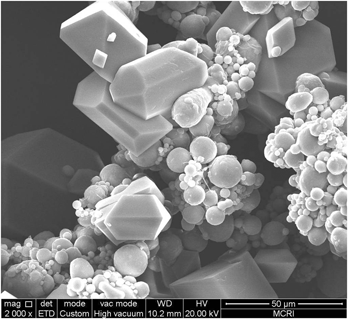
In order to research the effect of the addition of binder on the morphology of HMX-Al composite particles, Al particles were coated with fluoropolymer (FP-1) before solvent–nonsolvent preparation. Figure 7 displays the morphology of HMX-Al composite particles prepared by Al coated with FP-1. From Fig. 7, it can be seen that Al particles cannot be embedded in HMX crystals in the existence of FP-1. The surface of HMX is smooth, with no Al particles and no binders. In order to study the interaction of Al particle/FP-1 and HMX/FP-1, the binding energies of Al2O3(011)/FP-1 and HMX(011)/FP-1 were calculated. From Table VII, the binding energy of FP-1 on the unit area of Al2O3(011) face is 38.53 kJ/(mol nm2), while the binding energy of FP-1 on the unit area of HMX (011) face is 8.38 kJ/(mol nm2). The binding energy value of Al2O3(011)-FP-1 is four times more than that of HMX (011)/FP-1. Therefore, the adsorption of FP-1 on Al2O3(011) face is stronger than on HMX (011) face. FP-1 inclined to adsorb on Al2O3(011) face rather than on HMX (011) face. In the existence of FP-1, Al particles interact with it to form Al-FP-1 aggregates. The size of Al-FP-1 aggregates is greater than that of HMX crystals. Therefore, Al-FP-1 aggregates cannot be embedded in HMX crystals.
The morphology of HMX-Al composite particles prepared by Al coated with FP-1.

The binding energies between Al2O3(011) crystal surface and polymer.

Note: E total is the single-point energy of the equlibrium structure,  ${E_{{\rm{A}}{{\rm{l}}_{\rm{2}}}{{\rm{O}}_{\rm{3}}}}}$ is the single-point energy of Al2O3, and E polymer is the single-point energy of polymer.
In Fig. 7, the morphology of HMX crystals is polyhedral, which is more similar to the predicted morphology of HMX in ethanol. It is because that the amount of ethanol (nonsolvent) is two times more than DMSO (solvent) in the solvent–nonsolvent method. The crystal morphology and the area distribution of each crytsal face are consistent with the predicted morphology of HMX by AE model. The results of scanning electron microscope are in good agreement with the simulation results.
Conclusions
Molecular dynamics simulations and experiments were carried out to study the crystalline behaviors of HMX-Al composites in solvents. The binding energies of HMX with different solvents have been studied. The microscopic morphologies of HMX and HMX-Al composite particles have also been researched. Specific conclusions are as follows:
(1) The morphology of HMX crystal in vacuum is similar to a soccer ball, and the morphological importance of (011) is strongest.
(2) HMX interacts with DMSO and ethanol mainly via van der Waals force and electrostatic force. The order of modified AE for ethanol on different crystal surfaces is as follows:
 $\left( {10\bar{1}} \right)$ > (110) > (101) > (011) > (020), and it is for DMSO on different crystal surfaces is as follows: $\left( {10\bar{1}} \right)$ > (110) > (101) > (011) > (020).
(3) HMX grows into polyhedral crystals in DMSO and ethanol, and the shape and the area distributions of the polyhedrons are different for two solvents.
(4) There are many aluminum particles embedded in HMX crystal in HMX-Al composite particles prepared by solvent–nonsolvent method. The morphology of HMX in composite particles is without any sharp corners.
(5) Al particles cannot be embedded in HMX crystals in the existence of FP-1. The crystal morphology and the area distribution of each crystal face are consistent with the predicted morphology of HMX by the AE model.


Experimental and computational methods
Crystal morphologies predicted by AE model
Based on the periodic bond-chain (PBC) model, the AE model for crystal growth was established. The validity of AE model applied to the HMX-solvent system has been proved [Reference Tao and Wang9]. The PBC model assumes that (i) the time required for bonding to the crystalline surface is inversely proportional to the bonding energy, (ii) the growth rate of the crystal is proportional to the bonding energy, (iii) the crystal is composed of PBC, and (iv) the direction of the strongest bonds is according to the fastest crystal growth direction. In the AE model, the crystal morphology can be obtained by analyzing the distance between the center and the plane of the dominant crystal surface, and the distance between the center and the plane of the distribution is related to the relative growth rate. The AE (E att) is the energy released by adding a growth slice to a growing crystalline surface [Reference Tao and Wang9, Reference Liu, Li, Zeman, Shu, Wang, Zhou, Zhao and Wang10, Reference Liu, Wang, Shu, Wu, Zhou, Zhao and Wang11, Reference Berkovitch-Yellin12]. E att can be calculated as follows:
 $${E_{{\rm{att}}}} = {E_{{\rm{latt}}}} - {E_{{\rm{slice}}}}\quad ,$$
Here, the slice energy (E slice) is the energy released by growing a crystal slice with a thickness of d hkl, the AE (E att) being the energy released by attaching a slice to the crystal surface. The sum of the two is the lattice energy (E latt). R hkl is the growth rate of (hkl) face of HMX in vacuum and is proportional to the AE of the crystal,
 $${R_{hkl}} \propto {E_{{\rm{att}}}}\quad .$$
As the attachment energies for solvent molecules on the different growth faces are different, solvent is important in the crystal growth process. The stronger the adsorption, the easier the solvent layer is formed on the crystal–solvent interface. Solvent will limit the growth of the crystal. Defining E int as the crystal–solvent interaction energy, it can be calculated using the following formula:
 $${E_{{\rm{int}}}} = {E_{{\rm{tot}}}} - {E_{{\rm{surf}}}} - {E_{{\rm{solv}}}}\quad ,$$
Here, E tot is the sum of crystal surface energy and solvent layer energy, E surf is the energy of crystal surface, and E solv is the energy of the solvent layer.
Considering the influence of the solvent layer, the calibration factor E s for vacuum AE is introduced, which describes the binding energy of solvent on the (hkl) face of HMX crystal. It can be calculated as follows [Reference Jaidann, Abou-Rachid, Lafleur-Lambert and Brisson13]:
 $${E_{\rm{s}}} = {E_{{\rm{int}}}} \times {{{A_{{\rm{acc}}}}} \over {{A_{{\rm{cell}}}}}}\quad ,$$
Here, A acc is the solvent-accessible area of the crystal face in the unit cell [Reference Tao and Wang9, Reference Liu, Li, Zeman, Shu, Wang, Zhou, Zhao and Wang10]. A cell is the total crystal face area along the (hkl) plane.
The solvent AE can be described using the following formula (5):
 $${E'_{{\rm{att}}}} = {E_{{\rm{att}}}} - {E_{\rm{s}}}\quad .$$
The growth rate of each crystal face  $\left( {{{R'}_{hkl}}} \right)$ is proportional to the solvent AE
 $\left( {{{E'}_{{\rm{att}}}}} \right)$ of the crystal [as shown in formula (6)], which is raised by Hartman in the modified morphology theoretic,
 $${R'_{hkl}} \propto \left| {{{E'}_{{\rm{att}}}}} \right|\quad .$$
Molecular dynamics simulation
According to the results of single crystal X-ray diffraction [Reference Liu, Li, Zeman, Shu, Wang, Zhou, Zhao and Wang10], the β-HMX original cell was established, and the original structure was optimized by using the forfeit module [Reference Tao and Wang14, Reference Sun15]. Then the AE model was used to predict the growth morphology and the main growth faces (hkl) in vacuum. Based on the optimized original cell and cutting crystal along (011), (110), (020),  $\left( {11\bar{1}} \right)$, and (101) faces, 3 × 3 × 3 super cells were built.
The vacuum layer of 20 Å was added on each crystalline surface of β-HMX. Then, by using the Atom Volumes & Surfaces tool of the MS software [16], the solvent accessible area [Reference Lorenzo, Tocci, Gugliuzza and Drioli17] was predicted. For the Connolly task in the Atom Volumes & Surfaces tool, there is a field whose value at each point in the space corresponds to the depth in the nearest Connolly probe of a given radius, as it rolls on the Van Der Waals surface of the atomic structure [Reference Connolly18].
The amorphous cell module was applied to build layers containing 200 random DMSO molecules with a target density of 1.10 g/cm3 and 200 random ethanol molecules with a target density of 0.789 g/cm3, respectively. The bottom area of the periodic cell of the solvent layer must be the same as that of the HMX periodic unit. Only in this way a layered structure with perfect combination of HMX and solvent can be established. In addition, the Andersen thermostat [Reference Xu, Xiao, Huang, Li and Xiao19] was applied to carry out geometric optimization and molecular dynamics simulation in the constant-pressure and constant-temperature (NPT) ensembles for solvent molecules.
The adsorption models for HMX surface-DMSO and HMX surface-ethanol were built from HMX crystal layers and solvent layers. The solvent layer was placed along the c axis on the HMX surface and a 30 Å vacuum was built above the solvent layer. Optimizing the initial configurations of HMX surface-DMSO and HMX surface-ethanol, operating annealing (300–500 K, 100,000 steps) to the HMX surface-DMSO and HMX surface-ethanol configurations were used to eliminate unreasonable conformations. The configurations were taken after annealing to the molecular dynamics simulation in NPT ensemble at 298 K for 500 ps. Andersen thermostat was used [Reference Jaidann, Abou-Rachid, Lafleur-Lambert and Brisson13, Reference Palmer, Field and Huntley20].
Preparation of HMX-Al composites
Materials
Al powder is commercially available. The average particle sizes are from 4 to 5 μm, and the purity is greater than 99.97%. Field emission scanning electron microscope SU8010 (Hitachi Limited, Tokyo, Japan) is used to characterize the morphologies.
Preparation of HMX-Al composites via solvent–nonsolvent method
80 g HMX was added into DMSO until HMX completely dissolved, adding HMX solution to the drip funnel for later use. 20 g Aluminum with or without FP-1 coating was added into ethanol to form Al-ethanol suspension. The suspension was stirred, and the stirring speed was controlled at 300 RPM. HMX-DMSO solution was added into the Al-ethanol suspension, and it was dropped out within 1 h. The obtained suspension was filtered and dried to obtain HMX-Al composites.
Preparation of Al powder coated with FP-1
In order to study the effect of binder on the crystalline behavior of HMX-Al composites, aluminum powder was coated with a small amount of FP-1. Using direct method, first dissolving 0.5 g FP-1 in petroleum ether to form a solution, then adding 20 g aluminum powder into the solution, stirring, and evaporating the solvent in a water bath at 70 °C. Then sieving the materials with semi-dry state through a 20-mesh sieve granulation and drying to obtain Al powder coated with FP-1.