Implications
The demand for animal feed with ever increasing animal population necessitates the use of unconventional feed. One such feed is protein-rich karanja cake. The detoxified karanja cake was fed to ram lambs and its effect on reproductive performance was studied. A high level of protein replacement with karanja cake decreased testicular function and sperm concentration while feeding a lower level did not influence these factors by 140 days.
Introduction
Karanja (Pongamia spp.) is a forest tree grown in parts of humid tropical regions of India, Philippines, Malaysia, Australia, New Zealand, China and USA. The seed contains 27% to 39% oil, 20% to 30% protein and a group of furano-flavonoids that constitutes 5% to 6% by weight of the oil (Bringi and Mukerjee, Reference Bringi and Mukerjee1987). The seed kernel after extraction of oil is rich (around 30%) in crude protein (CP) and can be used in livestock and poultry feed as a protein source (Konwar et al., Reference Konwar, Banerjee and Mandal1987; Vinay and Sindhu Kanya, Reference Vinay and Sindhu Kanya2008). However, raw expeller karanja cake is not commonly used as a feed for livestock because of the presence of toxic karanjin, pongamol and certain other polyphenolic compounds and poor palatability (Bringi and Mukerjee, Reference Bringi and Mukerjee1987; Prabhu et al., Reference Prabhu, Deva Kumar, Sastry and Agarwal2002). These toxic factors can affect livestock performance and immune competence (Srivastava et al., Reference Srivastava, Gupta, Thakur and Verma1990; Panda et al., Reference Panda, Sastry, Mandal, Saha and Kumar2004; Nagalakshmi et al., Reference Nagalakshmi, Dhanalakshmi and Himabindu2011). Various methods, namely refluxing with 2% HCl (Mandal, Reference Mandal1985), solvent extraction, water leaching, autoclaving, acid and alkali treatment were adapted to detoxify karanja cake. Among all the methods, solvent extraction was found to remove karanjin efficiently (Prabhu et al., Reference Prabhu, Deva Kumar, Sastry and Agarwal2002) and is being widely used as a method to detoxify karanja cake. The information on the effect of feeding detoxified karanja cake (dKC) on testicular function were not reported in detail.
Long-term feeding of karanja cake affected growth and induced testicular degeneration in ram lambs (Singh et al., Reference Singh, Sastry, Garg, Sharma, Singh and Agrawal2006) and might affect spermatogenic process. The adverse effect on lambs growth was attributed to unpalatable nature of karanja cake resulting in lowered intake of CP and total digestible nutrients (TDN) (Singh et al., Reference Singh, Sastry, Garg, Sharma, Singh and Agrawal2006; Soren et al., Reference Soren, Sastry, Saha, Wankhade, Lade and Kumar2009). Expression of certain transcripts in testicular tissue would be important in assessing the effect of long-term feeding of karanja cake on testicular functions. The luteinizing hormone (LH) and insulin-like growth factor-I (IGF-I) are two of the most important factors regulating testosterone production from Leydig cells (Lin et al., Reference Lin, Haskell, Vinson and Terracio1986; De Kretser et al., Reference De Kretser, Risbridger and Kerr1995). Secretion of LH was controlled by testes through the secretion of testosterone and inhibin (De Kretser et al., Reference De Kretser, Risbridger and Kerr1995). In addition, feed composition and IGF-I influence sperm function in rams (Selvaraju et al., Reference Selvaraju, Sivasubramani, Raghavendra, Raju, Rao, Dineshkumar and Ravindra2012a). Therefore, changes in luteinizing hormone receptor (LHR) and IGF-I expressions in testicular tissue would be of paramount importance for assessing the effect of long-term feeding of any unconventional feedstuff on male reproduction. Results from such trials may provide useful information for recommending novel feedstuffs for long-term feeding of livestock raised for reproduction. Hence, the objectives of the present study were (i) to assess the effect of different levels of dKC replacing soybean meal (SBM) on iso-nitrogenous basis on sperm concentration, motility, velocity and plasmalemma integrity parameters and (ii) to find out the expressions of mRNAs encoding LHR and IGF-I in testes of ram lambs.
Material and methods
Source of dKC
Bulk production of detoxified meal required for feeding trial was carried out with the help of industrial partners (M/s Ayurvet Pvt. Limited, Baddi, Himachal Pradesh, India and M/s Ganesh Scientific Research Foundation, New Delhi, India). A process was developed to detoxify karanja seeds by crushing and removing the oil using a solvent. This process was followed by soaking the seeds in aqueous solvent mixture and drying.
Feed processing and diet formulation
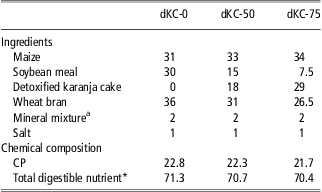
The requirements of CP and TDN suggested by Indian Council of Agricultural Research (ICAR, 1985) formed the guidelines for feeding lambs. The required quantities of feed ingredients like finger millet (Eleusine corocana) straw, maize (Zea mays) grain, soybean (Glycine max) meal, wheat (Triticum aestivum) bran, mineral mixture and salt were procured from a single source for the entire duration of the experiment. Three iso-nitrogenous and iso-caloric concentrate mixtures were prepared (Table 1). Maize grain and SBM were ground in hammer mill and mixed with wheat bran, mineral premix and salt in horizontal mixer to ensure proper mixing. The lambs were fed at the rate of 3.0% of BW in different groups comprising equal proportions of concentrate mixtures and chaffed finger millet straw.
Ingredient and chemical composition (%) of feeds
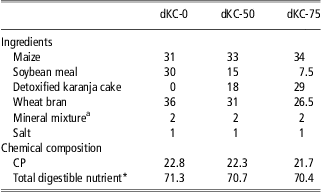
dKC-0, detoxified karanja cake 0% replacement with SBM; dKC-50, detoxified karanja cake 50% replacement with SBM and dKC-75, detoxified karanja cake 75% replacement with SBM.
aCommercial mineral mixture with the composition per kg: Cobalt 150 mg, copper 1200 mg, iodine 325 mg, iron 5000 mg, magnesium 6000 mg, potassium 1500 mg, selenium 100 mg, sodium 10 mg, sulphur 5.9 mg, zinc 0.942%, DL methinonine 9600 mg, L lysine, mono hydrochloride 4400 mg, calcium 24%, phosphorous 12% was used.
*Calculated from reference books and literature.
Experimental animals and feeding
The experiment was carried out in 18 native ram lambs (BW: 13.1 ± 0.5 kg; aged around 6 months) and lasted for a period of 140 days. The ram lambs were randomly divided into three groups (n = 6) and were fed concentrate mixture incorporating dKC as SBM replacement (0%, 50% and 75% replacement in control, dKC-50 and dKC-75 groups, respectively). This replacement level of dKC in the concentrate mixtures comprised 0%, 18% and 29% in control, dKC-50 and dKC-75 groups, respectively. Since CP content is low in dKC (37% in dKC as compared with 43.4% in SBM), accordingly the level of protein supplements (SBM plus dKC) varied among treatment groups. But the percentages of CP and TDN in the concentrate mixtures were similar among all the groups. The finger millet straw contains 4% CP.
The ram lambs were dewormed using broad spectrum anthelmintic (Alebendazole, at 10 mg/kg BW) twice at 21 days interval at the beginning of the trial and all the animals were confirmed to be parasite free by faecal examination. Then the animals were fed individually for 140 days and reared under uniform managerial conditions throughout the experiment.
Collection of semen samples and assessment of spermatozoa functional parameters
After 120 days of feeding, semen samples were collected on alternate days from the ram lambs with the aid of an electro-ejaculator (Bailey electroejaculator, Western Instrument Co, Colorado, USA). Out of six animals in each group, 6/6 (100%) in control, 4/6 (66.7%) in dKC-50 and 2/6 (33.3%) in dKC-75 ejaculated semen. In each of these animals, five ejaculates were collected and spermatozoa functional parameters were assessed and averaged as one observation. Immediately after collection, the semen was kept in the water bath (37°C) and the semen concentration, motility and velocity parameters were analyzed using a computer-assisted semen analyzer (Sperm Class Analyzer, Microptic, Barcelona, Spain) within 30 min of the ejaculation. The motility analysis was carried out in 5 μl of diluted semen samples (diluted appropriately to a concentration of 5 to 8 × 10⁶/ml in a phosphate buffered saline, pH-7.2) placed onto a prewarmed (37°C) microscopic slide covered with 18 mm × 18 mm coverslip (Blue star, Mumbai, India). The parameters set were cell size (range 5 to 70 μm2), motile cells (>10 μm/s at 37°C), slow (>10 μm/s to <45 μm/s at 37°C), medium (>45 μm/s to <75 μm/s at 37°C), progressive forward motility (>75% straightness index, STR), circular (<50% linearity index, LIN), the straight-line velocity (VSL, μm/s) curvilinear velocity (VCL, μm/s), lateral head displacement (ALH, μm), beat cross frequency (BCF, Hz), linearity (%), straightness (%) and type-A spermatozoa (%). A minimum of 500 spermatozoa from at least two different drops (at least five fields from each drop) were analysed for each sample. The final analysis was carried out after removing the objects incorrectly identified as spermatozoa.
The plasmalemma integrity was assessed using eosin and nigrosin staining procedure. The unstained spermatozoa were considered as plasmalemma intact whereas the spermatozoa with complete or partial purple colour on head were considered as plasmalemma lost. A minimum of 200 spermatozoa were counted and analysed for each sample.
Histopathology
After 140 days feeding, all the lambs were slaughtered and gross examination of testes was done. The representative testes tissues were immediately stored in the normal saline (0.9% NaCl) containing 10% formalin. The samples were dehydrated using alcohol and cleared in xylene. Then the samples were paraffin embedded, sectioned into 5-μm thickness and stained using hematoxylin and eosin stains as described by Bancroft and Steven (Reference Bancroft and Steven1996). The sections were selected from the middle and deep portion of the block and the selected sections were also confirmed to have tunica albuginea and mediastinum testis. The seminiferous tubules at two points in the same sections were observed under light microscopy.
Relative expressions of IGF-I and LHR transcripts in testes
For the study of relative expressions, portion of testes were collected, snap frozen in liquid nitrogen and preserved at −80°C for further analysis. Total RNA was isolated (RNA isolation kit, Chromous Biotech, Bangalore, India) from testes and the quality was checked using spectrophotometer (Nanodrop 1000, Thermoscientific, USA). The cDNA was synthesized in a reaction (20 μl) containing 2 μl total RNA (2.5 μg), 1 μl oligo-(dT) primer, 1 μl dNTP, 4 μl first stand buffer (5X), 2 μl DTT (0.1 mM), 1 μl Superscript-II reverse transcriptase (Invitrogen, USA) and 9 μl nuclease free water. The primers (Table 2) were designed using primer3 (http://frodo.wi.mit.edu/) and GAPDH was used as house keeping gene. Quantitative PCR was carried out using SYBR Green master mix (Fermentas life sciences, Maxima SYBR Green/Rox PCR Master mix, USA). It consists of 12.5 μl master mix (Buffer (2X), 10 mM dNTP (2.5 mM each) 200U, 25 mM MgCl2), 1 μl forward primers, 1 μl reverse primers, 2.0 μl cDNA and made upto 25 μl with nuclease free water. Relative expressions of these transcripts were calculated using 2−ΔΔCT after normalization with GAPDH (Livak and Schmittgen, Reference Livak and Schmittgen2001).
Sequence-specific primers designed for target genes

Concentration of serum testosterone and IGF-I
The blood samples were collected at the start and end of the experiment. The serum was separated within 30 min after collection and stored at −20°C. The hormonal concentrations were estimated using kits (Immunotech SAS, Marsille, France). The IGF-I kit was validated for estimating IGF-I in human serum/plasma samples. The human IGF-I kit was used for measuring sheep serum/seminal plasma IGF-I levels, since similarity between ovine and human IGF-I in structure and biological activity has been reported (Francis et al., Reference Francis, McNeil, Wallace, Ballard and Owens1989; Breier et al., Reference Breier, Gallaher and Gluckman1991). The hormonal assays were carried out at the same time in all samples and intra-assay coefficient of variation were 14.8% and 6.3% for testosterone and IGF-I, respectively.
Statistical analysis
Data from individual animals were averaged for each animal as well as for each parameter. All data in proportions were arcsine transformed before statistical analysis using SPSS 15. Statistical significance for semen parameters among groups was determined using one way ANOVA and Tukey's post-hoc test. Values are expressed as mean ± s.e.m. Differences were considered significant if P < 0.05.
Results
Live weight and dKC consumption
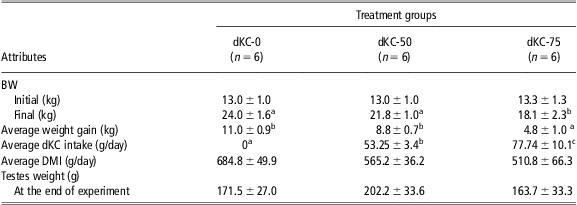
Initial BW (kg) at the start of the experiment was not different among groups (control: 13.0 ± 1.0, dKC-50: 13.0 ± 1.0 and dKC-75: 13.3 ± 1.3). The final BW recorded at the end of the experiment (140 days) was lower (P = 0.05) in dKC-75 (18.1 ± 2.3) as compared with control (24.0 ± 1.6). The BW changes (kg) during the course of the experiment were lower (P < 0.05) in dKC-75 as compared with control and dKC-50 groups (Table 3). At 18% and 29% inclusion of dKC in concentrate mixture, the dKC consumption (g/day) was (P < 0.001) higher in dKC-75 (77.7 ± 10.1) followed by dKC-50 (53.3 ± 3.4) compared with control (0). However, the average dry matter intake (DMI, g/day) was found to be similar among groups.
Changes in BW (kg) and testis weight (g) in ram lambs fed detoxified karanja cake as a replacement for SBM
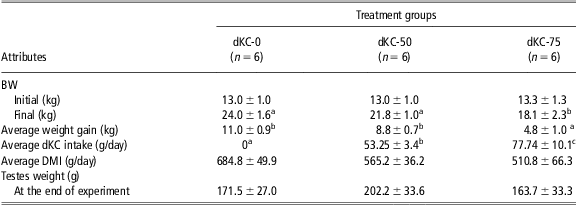
dKC-0, detoxified karanja cake 0% replacement with SBM; dKC-50, detoxified karanja cake 50% replacement with SBM and dKC-75, detoxified karanja cake 75% replacement with SBM.
Means with different superscripts a,b,cin a row differ significantly.
Testes weight
The feeding of dKC did not affect testes weight (g) in the experimental groups (171.5 ± 27.0, 202.2 ± 33.6 and 163.7 ± 33.3 in control, dKC-50 and dKC-75, respectively).
Spermatozoa parameters
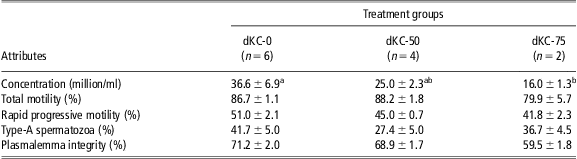
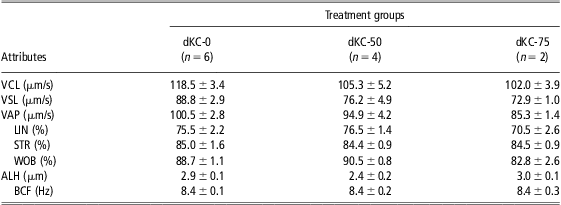
The number of animals that ejaculated semen samples were lower (P < 0.05) in dKC-75 (33%, 2/6 animals) as compared with control (100%, 6/6 animals) groups. The number of animals that produced semen samples in dKC-50 group (66%, 4/6 animals) did not differ with other two groups. The concentration (×106/ml) of spermatozoa was lower (P < 0.05) in dKC-75 (16.0 ± 1.3) than the control (36.6 ± 6.9) and dKC-50 (25.0 ± 2.2) groups. The feeding of dKC at both levels did not affect spermatozoa motility, velocity and plasmalemma integrity (Tables 4 and 5).
Spermatozoa concentration (million/ml), motility (%) and plasmalemma integrity in ram lambs fed detoxified karanja cake as a replacement for SBM
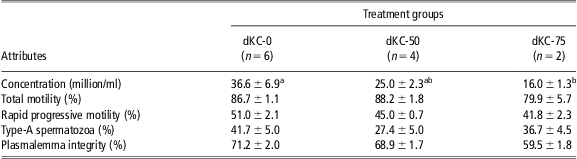
dKC-0, detoxified karanja cake 0% replacement with SBM; dKC-50, detoxified karanja cake 50% replacement with SBM and dKC-75, detoxified karanja cake 75% replacement with SBM.
(In dKC-0, dKC-50 and dKC-75 groups 6, 4 and 2 animals, respectively, gave semen samples).
Means with different superscripts a,bin a row differ significantly.
Spermatozoa velocity parameters in ram lambs fed detoxified karanja cake as a replacement for SBM
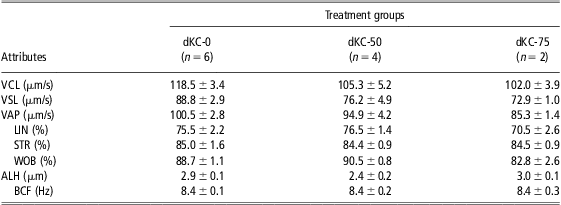
VCL = curvilinear velocity; VSL = straight-line velocity; VAP = average path velocity; LIN = linearity; STR = straightness; WOB = wobble; ALH = lateral head displacement; BCF = beat cross frequency.
dKC-0, detoxified karanja cake 0% replacement with SBM; dKC-50, detoxified karanja cake 50% replacement with SBM and dKC-75, detoxified karanja cake 75% replacement with SBM.
(In dKC-0, dKC-50 and dKC-75 groups 6, 4 and 2 animals ejaculated semen samples, respectively).
Histopathology
The testes showed no gross changes at collection. However, on histopathological examination, the testes of dKC-50 showed edema in intertubular space and moderate damage to the seminiferous tubular cells, whereas dKC-75 showed severe damage to seminiferous tubular epithelial cells and loss of interstitial cells. Further, intertubular space was widened and edematic fluid was accumulated in dKC-75 group (Supplementary Figure S1).
Relative expression of LHR and IGF-I in testes tissue
In testes, the expression of LHR was decreased (P < 0.05) in rams fed dKC-75 diet, but the expression did not differ between control and dKC-50 supplemented ram lambs. IGF-I expression, however, was decreased (P < 0.05) both in dKC-50 (0.5) and dKC-75 supplemented ram lambs as compared with control (Supplementary Figure S2).
Concentration of serum testosterone and IGF-I
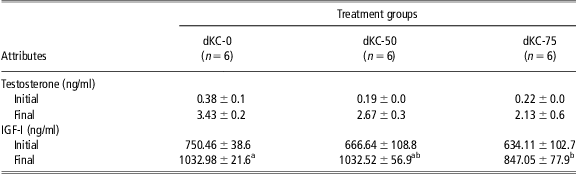
At the onset of the experiment, serum testosterone (ng/ml) and IGF-I (ng/ml) concentrations did not differ among groups. At the end of the experiment, though the testosterone concentrations did not differ among groups, the IGF-I concentrations in dKC-75 were lower (P < 0.05) as compared with control and dKC-50 groups (Table 6).
Serum testosterone and IGF -1 concentration (ng/ml) in ram lambs fed detoxified karanja cake as a replacement for SBM
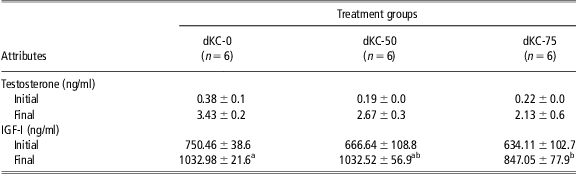
dKC-0, detoxified karanja cake 0% replacement with SBM; dKC-50, detoxified karanja cake 50% replacement with SBM and dKC-75, detoxified karanja cake 75% replacement with SBM.
Means with different superscripts a,bin a row differ significantly.
Discussion
It is a constant endeavor for animal nutritionists to explore the possibility of alternate feedstuffs for meeting the ever increasing demand of quality protein supplements. In the present study, karanja cake was tested for its use as protein-rich animal feed. The karanja cake as such is unpalatable and toxic because of the presence of furanoflavones like karanjin, pongamol, pongapin, pongaglabron, kanjone and isopongaflavone lanceolatin B (Rangaswami and Seshadri, Reference Rangaswami and Seshadri1940; Roy et al., Reference Roy, Sharma and Khanna1977). The karanja seeds contain 0.57% to 1.7% karanjin, 0.25% to 1.3% pongamol and 0.08% to 0.13% trypsin inhibitor activity (Dineshkumar et al., Reference Dineshkumar, NageswaraRao, Jash, Elangovan and Hemalatha2011). The dKC used in the present study had very low levels of karanjin (0.03% W/W), pongamol (0.005%W/W) and trypsin inhibitor activity (0.04% W/W).
The results indicated that 75% replacement of SBM with dKC in ram lambs affected growth and semen production capacity. Histopathological studies revealed that karanja cake feeding may affect testicular function because of edema formation in intertubular space and damage to the seminiferous tubular cells. The dKC-75 group had severe damage to the seminiferous tubular epithelial cells and loss of interstitial cells. Apart from these, widened intertubular space and accumulation of edematic fluid in intertubular space were also observed in this group. This might be because of the damage of seminiferous tubules by residual toxins in karanja cake and leakage of cellular fluid leading to edema formation. Similar to the present study, testicular degeneration was observed in lambs fed with karanja cake (Singh et al., Reference Singh, Sastry, Garg, Sharma, Singh and Agrawal2006).
It was observed that feeding dKC did not affect sperm motility, velocity and plasmalemma integrity. This might be probably because less number of animals produced semen in the groups. The number of animals that ejaculated semen sample and the concentration of spermatozoa per ml of the ejaculate were lower in dKC-75 than other two groups indicating the adverse effect of dKC feeding on testicular function. Similar to the present study, feeding of cotton seed or cotton seed meal resulted in extensive damage of germinal epithelium in rams and bulls because of the presence of gossypol (Randel et al., Reference Randel, Chase and Wyse1992). The observed harmful effects at higher levels of replacement were attributed to residual unknown factors in dKC but might not be because of karanjin, pongamol and trypsin inhibitors activity.
In this study, lower LHR transcript expression observed in testicular tissue might correspond to either damage or loss of LHR in Leydig cells. The histological findings indicated that karanja cake might also affect testicular structure along with intertubular edema. The damage to Leydig cells might have resulted in reduced LHR transcripts expression in testes of ram fed with dKC at higher levels. Various factors including balanced feeding (Selvaraju et al., Reference Selvaraju, Sivasubramani, Raghavendra, Raju, Rao, Dineshkumar and Ravindra2012a), type of nutrients (Selvaraju et al., Reference Selvaraju, Raju, Rao, Raghavendra, Nandi, Dineshkumar, Allen, Parthipan and Ravindra2012b), anti-nutritional factors (Randel et al., Reference Randel, Chase and Wyse1992), environmental chemicals (Akingbemi et al., Reference Akingbemi, Sottas, Koulova, Klinefelter and Hardy2004; Murugesan et al., Reference Murugesan, Muthusamy, Balasubramanian and Arunakaran2007), etc., may affect testicular steroidogenesis and spermatogenesis. Possibility of unknown compounds in karanja cake at higher level of feeding might have affected the intertubular space containing Leydig cells and semen quality.
The testosterone concentration in dKC supplemented group indicated that all the experimental lambs attained puberty. The loss of sperm production in dKC-75 diet supplemented animals might be because of dKC's effect on testicular function but not from delayed puberty. The slower growth rate in dKC-75 supplemented animals might be because of the decreased serum IGF-1 concentrations. Apart from metabolic effects (Zung et al., Reference Zung, Phillip, Chalew, Palese, Kowarski and Zadik1999), IGF-I is also involved in spermatogenesis (Hansson et al., Reference Hansson, Billig and Isgaard1989). The receptors for IGF-I are present in testes and spermatozoa of various developmental stages (Hansson et al., Reference Hansson, Billig and Isgaard1989). Since IGF-I influences the sperm function (Selvaraju et al., Reference Selvaraju, Nandi, Sivasubramani, Raghavendra, Rao and Ravindra2010), a reduction in IGF-I concentration and IGF-I transcript expression in dKC animals might have affected testicular function and semen quality. Though the present study did not establish the fact that the karanja feeding might reduce IGF-I levels by affecting liver function, the lower IGF-I transcript expression in testes suggested that feeding dKC might as well affect liver function and circulating IGF-I concentration. Future studies on the effect of karanja feeding on liver function tests and transcript expression studies may confirm such hypothesis.
Conclusions
In ram lambs, inclusion of dKC as a replacement of SBM affected growth and testicular function. However, a lower number of animals in the treatment groups delivered semen make conclusions on sperm parameters uncertain.
Acknowledgments
The authors thank Department of Biotechnology, Government of India for financial support for the project entitled ‘Detoxification and utilization of key agro forest based non-conventional oil cakes in the feeding of livestock’ and The Director, National Institute of Animal Nutrition and Physiology, Bangalore for providing necessary facilities.