INTRODUCTION
The activities of conservation non-governmental organisations (NGOs) have excited considerable scholarly attention in Africa and beyond. Conservation NGOs promote the needs and sustained existence of wildlife, biodiversity, habitat, wildlands and protected areas (such as national parks). They are widely known and trusted by northern publics as serving unproblematically good causes. However, within academia, opinions about their activities can be sharply divided. Indeed sometimes it is difficult to reconcile the diverging accounts about the same places, people and processes.
Some of this work has consisted of polemical, indeed stinging, critiques of the deficiencies of conservation NGOs. These critiques accuse the NGOs concerned of growing too powerful, concentrating funds and influence, and getting unhealthily close to larger corporations and oppressive states, while ignoring the grass-roots environmentalist groups who could be good allies in fights to protect places from dams or mines (Chapin Reference Chapin2004; Dowie Reference Dowie2005; Romero & Andrade Reference Romero and Andrade2004). They have been ridiculed as ‘Nature Lords’, as imperious and violent (Fairhead & Leach Reference Fairhead and Leach2000). They have been accused of incompetence in handling expensive projects (Dowie Reference Dowie2008), of grim efficiency in perpetuating visions of Africa that erase local history and belonging (Brockington Reference Brockington2002), and of imposing inequitable community-based conservation arrangements (Igoe & Croucher Reference Igoe and Croucher2007).
Other work offers more gentle comments, examining the wider systems of which NGOs are part. Mark Dowie's book Conservation Refugees (2009) examines the conflicts between conservationists and indigenous peoples, and refuses to condemn conservation for the problems it has caused indigenous peoples. Instead, it emphasises that this is a story about ‘good guys versus good guy’. Sachedina's (Reference Sachedina2008) examination of the failings of the African Wildlife Foundation (AWF) argues that the organisation was too successful (at fund-raising), and that the problems that emerged were also the responsibility of its funders. Adams (Reference Adams2004: 55) notes NGOs' powerful influence on the conservation movement in a century which has seen many conservation failures, but which owes many of its successes to their work. Brockington (Reference Brockington2009), examining the interaction of celebrity and conservation, observes that the rise in power of conservation NGOs reflects mutual desires of celebrities, media corporations and the NGOs themselves for public attention. Avant (Reference Avant2004) portrays two NGOs' struggles to conserve the northern white rhino as the outcome of complex struggles of political psychology and bureaucratic politics.
One collection of critiques questions the power of international NGOs over smaller conservation movements, and state conservation departments. Rodriguez and colleagues (2007) warn against domination of weaker local partners by international organisations. Lees (Reference Lees2007) observes a proliferation of international interest in conservation in Fiji, but no increase in effectiveness of conservation performance. Duffy (Reference Duffy2006) observes that larger conservation NGOs wield considerable influence through the donor council in Madagascar, and helped push for the establishment of more national parks in the country. Brockington (Reference Brockington2006) has argued that conservation NGO spending is implicated in the creation of an ‘environmental conservation complex’ in Tanzania.
A common theme in Africanist writings is that conservation NGOs have allowed themselves to be implicated too easily in heavy-handed state behaviour. Sunseri (Reference Sunseri2005) shows how alliances of local and international conservation NGOs are driving a new wave of evictions from forest reserves in Tanzania. Pearce (Reference Pearce2005a, Reference Pearce2005b) and others have written of the role of the African Parks Foundation in Ethiopia, which was implicated in the attempted clearance of the Guji from Nech-Sar National Park. Bonner (Reference Bonner1993) describes Prince Bernhard of the Netherlands channeling clandestine funds to the World Wide Fund for Nature (WWF) to support anti-poaching work in Africa. Sachedina (Reference Sachedina2008) argues that the AWF could have taken a more critical stance on the Tanzanian government's conservation policies.
Responses from conservationists to these critiques vary considerably. Some of the critics are conservationists themselves (e.g. Sachedina, Lees, Adams, Rodriguez and colleagues). There is much here which is part of an internal debate within the conservation movement. Others find these challenges a baffling denigration of decent hardworking groups. Chapin's (Reference Chapin2004) article ‘A challenge to conservationists’ provoked the greatest volume of letters to Worldwatch that the journal had ever seen. The more laudatory analyses of conservation NGO work are distinguished by their rather apolitical approach to understanding conservation struggles (Bergin Reference Bergin, Hulme and Murphree2001; Fraser et al. Reference Fraser, Wilkie, Wallace, Manfredo, Decker, Vaske and Brown2008). From these perspectives, conservation NGOs are basically forces for good doing their best in difficult circumstances.
We do not wish to endorse any particular perspective among these debates in this paper.Footnote 1 Rather we feel that it is necessary to take a step back, and ask some much more general questions about how the debates are framed. Currently we feel that their value for academics and practitioners is constrained in two respects, both of which limit the conclusions that can be drawn from them. First, there is only limited reference in the conservation NGO literature to the rich writing on development NGOs (and vice versa), despite their common interests (cf. Brockington et al. Reference Brockington, Duffy and Igoe2008). Second, debates on conservation NGOs are vitiated by a lack of good data on the nature and activities of the sector.
These deficiencies mean that examinations of the work of conservation NGOs are rather isolated and isolationist. They tend to be studies of individual organisations, with little understanding of how these reflect upon the sector as a whole, or the work of NGOs and civil society more broadly. This makes comparative statements difficult. Currently we have no idea of the collective reach or spending power of the larger NGOs, or of the scale or importance of the smaller. Writing about conservation NGOs lacks system and order.
In this paper we attempt to address both these deficiencies, and the result falls into two unequal parts. First, we briefly highlight the relevance of the development NGO literature to writings on conservation NGOs. We feel this is necessary because we have found that some readers still do not ‘get’ the basic similarity between conservation and development NGO work. Our goal here is simply to make the case that these two sectors could and should be considered as one, and that the bodies of literature that have risen around each separately need to be treated together. Second, we offer an outline of the work of the conservation NGO sector in sub-Saharan Africa, based on a large survey. We have focused on this region because we did not have the resources to attempt a larger study and felt that our knowledge of, and contacts in, the region would make this ambitious task more doable. It is also a region where the paucity of government expenditure makes conservation NGOs potentially much more significant players. We provide an account of the work of conservation NGOs in sub-Saharan Africa, including their geography and finances, based on an investigation of the most comprehensive list of NGOs that we could compile.
Our work is necessarily quite descriptive. However, it raises a number of questions about the influence of these organisations, not just in the African countries in which they work, but also in the countries from which they work. We believe these observations serve our main goal, which is to highlight future areas of enquiry that may be fruitful either because they are not based on a false dichotomy between conservation and development NGO work, and/or because they take a broader view of what the conservation NGO sector looks like in practice.
We proceed as follows. First, we examine the relevance of writings on development NGOs for conservation. Second, we explain our methods for undertaking the survey of NGOs and collecting data about their work and finances. Third, we offer a typology of the conservation NGOs that we encountered during the course of the survey. Fourth, we describe their history, outlining which countries they work in, and the geography of protected area support. We also examine the finances and structure of the sector. Finally we examine the implications of our findings for understanding the importance of different types of conservation NGO in different contexts.
DEVELOPMENT AND CONSERVATION NGOS
Writings on development NGOs are more numerous and older than the critique of conservation NGOs. Development NGOs grew in power and influence in the 1980s, fostered by neo-liberal policies which sought solutions to development problems beyond the state. With gradually increasing scepticism, writers began to question the idea that NGOs were the ‘magic bullet’ of development (Edwards & Hulme Reference Edwards and Hulme1992, Reference Edwards and Hulme1995; Hulme & Edwards Reference Hulme and Edwards1997), and to look askance at their proximity to state and donor interests. Some critical analyses questioned the practice and foundations of ‘the charitable impulse’ motivating the sector (Barrow & Jennings Reference Barrow, Jennings, Barrow and Jennings2001; Fisher Reference Fisher1997), others critiqued the participatory practices they tended to use (Cooke & Kothari Reference Cooke and Kothari2001), or castigated their impact on broader contracts between states and their citizens (De Waal Reference De Waal1997). The field continues to be a rich source of scholarship (Bebbington et al. Reference Bebbington, Hickey and Mitlin2008).
It is simply a curious fact that the development NGO literature does not mention conservation NGOs, and writings on conservation NGOs ignore their development counterparts.Footnote 2 There is no obvious reason for that. It would be wrong to suggest that the two groups of NGOs need to be treated differently, because one is concerned with conservation and the other with development. Conservation is a form of development, in both senses of the word – planned Development, which is orchestrated intentionally by states and international institutions, and immanent development, which describes more informal processes of change and adaptation that are a continual part of dynamic societies (Bebbington Reference Bebbington2004; Cowen & Shenton Reference Cowen and Shenton1996). As Development, conservation controls natural resource use, protected area development, and trade in timber and wildlife designed by states to promote prosperity. Conservation NGOs which support protected areas (sometimes established to mitigate development projects, e.g. Goldman Reference Goldman2001), and undertake research or environmental education, are perpetrating forms of planned Development. Some conservationists have complained that their cause is taking on too much Development (Oates Reference Oates1999; Sanderson & Redford Reference Sanderson and Redford2003). As development, conservation follows from the growth of eco-tourists demanding particular products or environments, or from demographic or market changes which induce changes in natural resource management. Conservation NGOs which facilitate and respond to eco-tourism, or help local groups form co-operatives to manufacture and sell curios, or produce in new markets or manage fish stocks, are part of the process of immanent development. Conversely, as we will explore below, many development NGOs are undertaking activities which look like conservation. Analyses of conservation NGOs logically belong with the analyses of development NGOs.
The similarity of the subject matter of conservation and development NGOs is also demonstrated by the proximity of the conclusions reported in the works examining development and conservation NGOs cited above. Critiques of both large-scale planned development projects and conservation projects have highlighted the problems they cause for the livelihoods of the poor. Each set of critics contends that each set of NGOs has lost its independent critical voice, and become too close to foundations, donor governments and their corporate influences, and to corporations themselves. Both literatures note similar anxieties about the role of NGOs in promoting democracy. A vibrant civil society can be part of a healthy democracy, but many observers find that NGOs can also be associated with democratic deficits. The criticisms of the power of international conservation NGOs explored above have their counterpart in the development NGO literature.
Some differences between work on conservation NGOs and development NGOs must also be acknowledged. Conservation Studies is clearly the poor relation of Development Studies. The work on conservation NGOs is generally smaller than the voluminous studies of development. Categorisations of development NGOs are more complex than those of conservation NGOs. Attempts have been made on several occasions to take on the task of classifying development NGOs according to their type, values, size and scale of activities (Bratton Reference Bratton1989; Brown Reference Brown1991; Korten Reference Korten1990). Vakil (Reference Vakil1997: 2058) identifies three ways in which scholars have addressed the classification problem: they have either ignored it; constructed classes according to their particular debate; or addressed the issue of classification separately. In cases where slightly more detailed typologies have been suggested, these can be fairly ‘one-dimensional’ and do not account for diversity within organisations (ibid.: 2062). Vakil suggests a classification system that defines an organisation's orientation (e.g. welfare, development, advocacy) and level of operation, as well as the sector in which it works (e.g. health) and evaluative factors (e.g. accountability, gender equality).
Development handles considerably more money and has more people studying it than Conservation. Studies of development benefit from a cohesiveness to the development NGO sector which is absent from conservation. There is no conservation equivalent to British Overseas NGOs for Development (BOND), nor is there a conservation equivalent to (or much conservation content in) the development trade journal Third Sector. The conservation sector is more fragmented and disparate than development work.
Some readers may feel that if conservation and development NGO sectors are so similar, why look at one sector on its own as we do here? Our main response to this challenge is a pragmatic one. The combined conservation and development NGO sectors are simply too large to explore. In our bid to pull studies of both together we must, paradoxically, begin with more detailed explorations of the sectors separately. This has begun with the work of volunteer eco-tourism organisations (Cousins Reference Cousins2007; Lorimer Reference Lorimer2009). We wish to continue the task. Ultimately our hope is that knowledge of the performance and reach of diverse subsectors will allow observers to do away with the distinction and just study networks of organisations of all sorts of pedigree.
SURVEYING CONSERVATION NGOS
Our first job was to devise as comprehensive a list as possible of conservation NGOs active in the region, for when we started this project none existed. Beginning in June 2006 we constructed a database of conservation NGOs from a variety of methods. We used Google searches and lists of NGOs available on the ‘Save Amboseli’ and ‘African Conservation Foundation’ websites. We identified additional organisations by following links on websites, and came across others through personal contacts and published literature. We gleaned more names by examining the lists of NGOs funded by large charities. Our most important method has been an extensive consultation process. We disseminated our growing list of organisations to members of the Environmental Anthropology and the Society for Conservation Biology's discussion fora. We also sent it to personal contacts within the field of conservation, including people who worked for various NGOs and academic contacts. At the end of 2007 we sent out our entire list, as well as a draft copy of our findings, to all the NGOs on the list and asked for comments on our work. This resulted in a few, but fortunately not many, other organisations being identified which we had not yet included, and others which we had listed being removed because they were not NGOs. In June 2008 we released our final report (in low memory format) on a web site,Footnote 3 and sent the link to our final list of NGOs, again inviting comment. The current list of 281 organisations appears at the end of this article (Appendix 1).
For each organisation on our list we read about the projects they conducted as described in their annual reports, websites and reports to the Charities Commission (if UK-based). We examined nearly 900 projects to establish more precisely where these organisations are active and in which protected areas they work. We have sought to find out how much money they spent in the years 2004–6, and on which countries they spent it, collecting financial data from websites, financial and annual reports, and from telephoning, emailing and meeting staff of the different NGOs. We have also collected financial data from the Charities Commission website for UK charities and the I-990 forms for US charities.Footnote 4 We were able to obtain financial data for 87 (31%) of our list of conservation organisations for some or all of the years 2004–6, including all the largest organisations.Footnote 5 We report patterns in expenditure with and without ‘overheads’ (fund-raising and administration costs reported in tax return forms). All financial figures are expressed in US$ at 2006 values, using exchange rates and the GDP deflator.Footnote 6 Finally for each organisation we have attempted to establish where their head office is located and when they were created, and we have recorded their patrons and board members and, where possible, their sponsors.
There are a number of pitfalls in these methods which require comment. The most serious is that we were initially limited to NGOs with a web presence, and this excludes the plethora of local and community-based conservation groups who are actively managing particular places and habitat, or lobbying for the same, without seeking to advertise their presence or activities through the internet. We have not searched the internet in French or Portuguese, and whilst a number of French-speaking organisations are included, representation of Francophone and Lusophone Africa may well be limited, potentially skewing our analysis of the geographical distribution of NGO activities. Finally, we failed to capture the diversity of South African conservation organisations. There are a plethora of smaller organisations, and many ‘friends of’ national parks and game reserves in that country, which we have not adequately listed. Fundamentally, the problem here is that this is a large-scale survey. While the 280 plus organisations we have is by far the largest list we, or those we sent it to, have come across, a much more detailed one would be possible if we had had the resources to undertake country-based research, and pick up the vibrancy of the (ever-changing) picture on the ground.
Second, how do we define a ‘conservation’ NGO? Or to put it differently, for the purposes of this list, what distinguishes a conservation NGO from a development NGO working in community-based conservation, or an environmental NGO promoting tree planting near a forest reserve? The definition of what constitutes conservation, and what actions can most efficiently meet diverse conservation goals, is hotly debated. The central aims of self-proclaimed conservation organisations, including all the largest, are not concordant. Some seek to support areas of high biodiversity, others threatened areas, others wild places (Brooks et al. Reference Brooks, Mittermeier and da Fonseca2006). Furthermore, on the margins of the conservation movement there is a proliferation of organisations which work for animal welfare, environmental management, environmental education and development, but whose projects advance numerous conservation goals.
Conservationists are sensitive about this issue because they fear that scarce resources are being directed to unsuitable activities which are not ‘really’ conservation. The problem of definition therefore is treacherous terrain filled with conflict, which we tackled with two strategies. We undertook a preliminary assessment ourselves, defining conservation to mean activities which conserved wildlife, habitat and protected areas. We then classified organisations according to our collective assessment of the projects they undertook. To name a few examples: with respect to animal welfare we included Born Free in our survey, as they are also very much concerned with protecting species in the wild; but not the Bridget Bardot Foundation whose work in Saharan Africa is centrally focused on animal welfare. We excluded environmental organisations concerned with general soil or water protection and management, but included those supporting forest conservation, or those specifically working on the edge of protected areas to reduce pressure on land. We included environmental education programmes where these were part of an NGO's larger conservation programme, but excluded NGOs whose sole focus was environmental education (however, we excluded Roots and Shoots of the Jane Goodall Institute which extends far beyond sub-Saharan Africa and, as a very separate stand alone education programme, is easy to differentiate from the other conservation work of the organisation). We excluded development organisations unless they had specific projects working on community-based wildlife management, and then included only those projects. We included an Africare project (Africare is a multi-million dollar US-based development organisation) because it was working on a community conservation programme in Tanzania for which we had precise expenditure data. However, we excluded CARE International because, although it spent about US$5 million yearly on aspects of biodiversity conservation,Footnote 7 we could not pin down precisely what the money was spent on or where, and including all of CARE's expenditure would have dramatically overestimated total spending on conservation. Our second strategy was to rely on our extensive peer review exercises to identify organisations which had been missed or erroneously included.
The definition of conservation matters, but it is also important to consider what sort of errors could creep in by being too inclusive. The conservation identity of the largest organisations which contribute the vast majority of conservation funds and projects is not questioned by the international conservation community. The more marginal organisations are also almost always the smallest and so do not make much difference to the final results. Ours was a broadbrush survey which will have missed many of the smaller organisations whose categorisation as conservation NGOs might be dubious. This is a much more serious issue for smaller-scale studies.
Third, there is the difficulty of obtaining and analysing financial data. There is a danger of double-counting funds because many of the conservation organisations on this list are funding each other. We have removed double counting from the analyses of expenditure wherever a donation between two organisations on our list is reported by either organisation. The data mix financial years (ending in different months) and calendar years. We have not tried to convert the former to the latter. Instead we have taken figures for financial years to refer to the calendar year in which most of the activities concerned fall. Where we did not have figures for all years, we have estimated missing data as the average of years for which we had data. We tried to calculate expenditure within each country, which was not straightforward where organisations work in more than one country. We relied upon NGO staffs' own estimates where country-level expenditure was not apparent in the accounts or in annual reports. If we were unable to determine how much money was spent in each country we assigned expenditure to a general ‘Africa-wide’ category.
This is therefore an incomplete, remote picture, researched from afar with little ground truthing and missing much of the detail and complexity which better local roots would provide. We have few illusions about it, but we believe that it is robust enough to deserve publishing. It provides a base on which to improve. Despite its flaws, we know of none like it with a similar scope or scale. The paucity of new organisations prompted by the consultation exercises suggests that it is good enough to enter the public domain.
HISTORY, GEOGRAPHY, EXPENDITURE AND VARIETY IN THE CONSERVATION NGO SECTOR
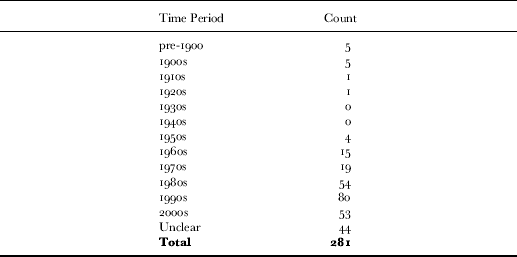
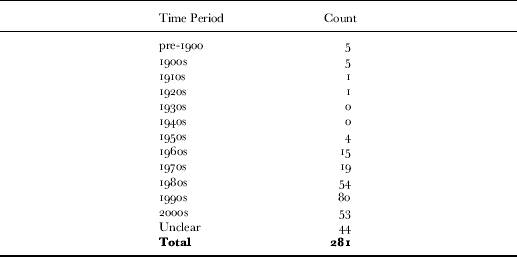
We recorded establishment dates for most organisations (Table 1). A few started early on, generally as domestic conservation organisations in Europe and the USA, with their overseas missions developing later. Growth of NGOs began in the 1960s with decolonisation, but NGOs really began to flourish in the 1980s and grew dramatically in the 1990s, with 34% of those for which we have data established in that decade. These growth patterns correspond clearly to the general global preference for working with NGOs, characteristic of neo-liberalism, which arose in the 1980s and 1990s.
The establishment dates of NGOs
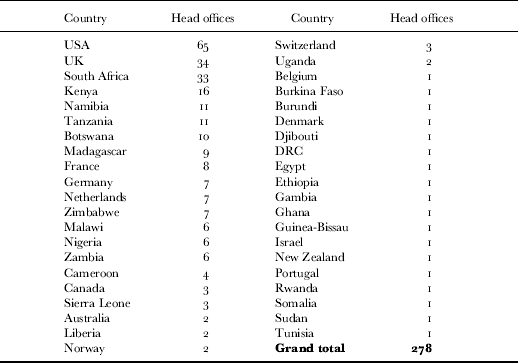
We identified the head office location of 278 conservation organisations. Table 2 shows that 65 (23%) of these have a head office in the USA. Altogether 48% of organisations were based in the North. South Africa dominates among the African-based NGOs, with probably a much larger total than we have shown here. Conservation NGOs working in Africa, and which are based in sub-Saharan Africa exclusive of South Africa, are a minority. They are concentrated in Kenya and Tanzania and Southern Africa. Note however that the limitations of our survey methods mean we are likely to miss many small NGOs based in Africa. Generally these data underline the predominance of northern-based organisations in African conservation, and by extension northern-based staff, funding and conservation thinking. But we will only be able to understand the nature of their influence and power with a better picture of how they interact, or fail to interact, with the plethora of smaller conservation NGOs and with states in different countries.
Location of head offices of conservation NGOs working in Africa
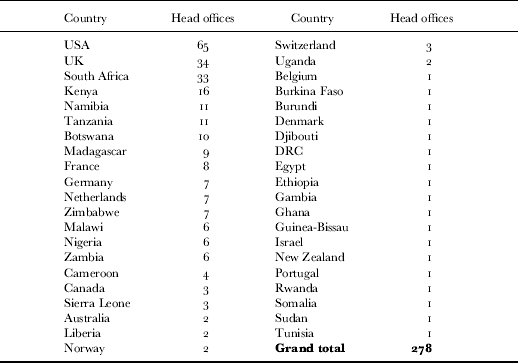
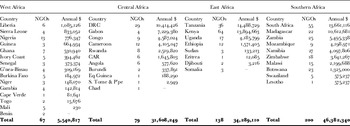
Table 3 gives the distribution of activity across sub-Saharan Africa, showing how many NGOs are working in each country, and how much we estimate they collectively spend in each country. Activity is generally low in West Africa, and in all the other regions it is highly uneven, with one country with many NGOs and others with less activity. Kenya and South Africa are the continent's dominant hubs in terms of numbers of NGOs. Eastern and southern Africa combined have far more conservation NGOs operating within them than central and western Africa. The organisation with the greatest geographical reach is the WWF, active in forty-four countries. The next largest are the Wildlife Conservation Society and AWF, active in nineteen and eleven respectively.
The geography of NGO activity

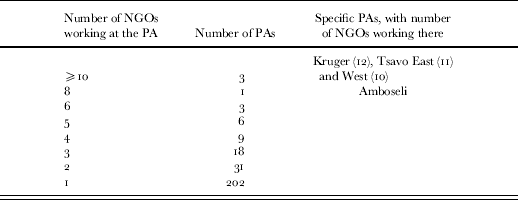
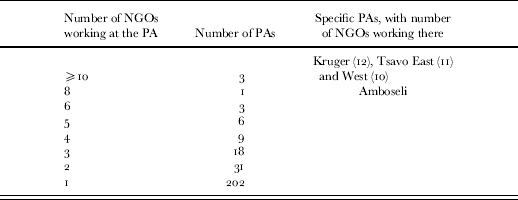
Overall help for protected areas by NGOs is rather slight. Just under 14% of the protected area estate (by area) receives some form of support from the conservation organisations we identified. Support favours the more strictly protected IUCN category 1–4 protected areas, 37% of which receive some form of support. These data must be interpreted with caution as any form of support, no matter how small, puts a protected area on the list. This is not a list of protected areas which are adequately sponsored by conservation NGOs. We do not have data on effective expenditure on protected areas per square kilometre. We could not glean these from the accounts and annual reports. The distribution of NGOs supporting different protected areas shows some tendency to focus on well-known areas, but is otherwise generally even (Table 4). Indeed it is more even than this table suggests, for where some protected areas are listed as having more than one NGO, this conceals the fact that these organisations may be closely related.
The distribution of NGO support for different protected areas
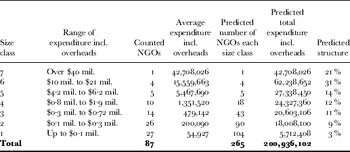
We found that the conservation NGOs for which we had data were spending, on average, a total of just under US$160 million per year, including overheads, or just under $130 million not including overheads. We predicted the budgets of the other organisations of whose existence we are aware, but for whom we do not have financial data, based on the geography of their activities (see Table 5). This exercise suggests that the total turnover of the listed conservation organisations active on the continent would be just over US$200 million (including overheads), or just over $160 million without overheads.
The structure of the conservation NGO sector in sub-Saharan Africa

We estimated expenditure for NGOs from which we could not obtain financial data on the basis of the number of countries where they worked. First we produced a table showing how many countries NGOs of different size class worked in. Generally speaking smaller NGOs tend to be active in fewer countries, larger NGOs in more countries. We used this distribution to predict the size class of NGOs for which we had no financial data but did know the countries where they worked. For example, we predicted that just under half of NGOs working in one country would be found in size class 1, with progressively smaller proportions of single-country NGOs in the larger size classes. The problem with this exercise is that it could predict the presence of NGOs with really large budgets, which are unlikely to exist at all as our survey and consultation exercise would have uncovered them. We therefore undertook the exercise twice limiting the upper size of NGOs that we could predict in different ways each time. The first time we assumed that there were no NGOs missing financial data that were larger than size class 3, and the second we assumed that there were none larger than size class 4. We then took the average of these two predictions. Further details of these calculations are available in Scholfield & Brockington Reference Scholfield and Brockington2008: 46.
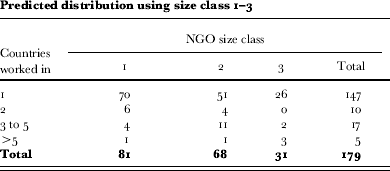
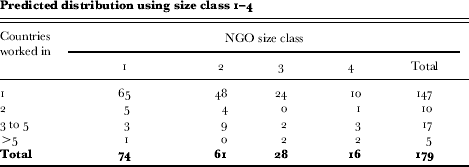
Resources in this sector are unequally distributed. It is dominated by a relatively few players. The largest, the WWF, is greater than the next largest two combined. The average annual expenditure of the ten largest organisations, nine of which are based in the North, account for over 80% of the observed expenditure. For the sector as a whole we predict that more than 50% of this expenditure will be accounted for by the top five organisations, 65% by the top ten (Table 5). The smallest and most numerous organisations will account for just 3% of the total conservation NGO budget. These findings emphasise the dominance and power of the major organisations, but also point to the presence of a significant minority of smaller organisations about which relatively little is known.
Existing classifications of conservation NGOs are restricted to dividing them into big international NGOs (‘BINGOs’) and ‘all the rest’. In some senses this is a meaningful dichotomy as the BINGOs do account for 50%, we predict, of conservation expenditure. But in other ways it is not particularly sophisticated for it does not capture the variety found in the other half. Our survey suggested the following typology, not all of whose categories are mutually exclusive. The letters designating each type are noted for each NGO in the Appendix.
Scale
A. The largest NGOs, known as BINGOs, normally comprise the WWF, Conservation International and Wildlife Conservation Society; in Africa the WWF stands out above the others, spending more than the next largest two combined.
B. We have split NGOs which are slightly smaller than the BINGOs, but still spend millions of dollars a year, into two categories. The leading group (‘Very large’) comprises AWF, the Peace Parks, Conservation International and the Wildlife Conservation Society, which all spend between US$7 and US$18 million a year.
Focus
C. Charismatic animal-orientated NGOs. These can range in size and origin. Examples include Save the Rhino International, the Mountain Gorilla Conservation Fund, and the Cheetah Conservation Fund Foundation.
D. Habitat-focused NGOs. These are NGOs that focus on various habitat types across Africa. Examples include Wetlands International, Rainforest Action Network, and African Mangrove Network.
E. Taxon-focused NGOs. These organisations focus on groups of animals, for instance, big cats, primates etc. Examples include Project Primate and CERCOPAN.
F. Bird-focused NGOs. These are a sub-group of the Taxon-focused NGOs, which focus their conservation activities on birds. Examples include the International Crane Foundation and the Peregrine Fund. A large network of country-based bird-focused NGOs with headquarters inside and outside Africa is co-ordinated by the Birdlife International Partnership.
G. Single protected area NGOs. These are usually smaller organisations and focus all their attention on one particular area. Examples include Project African Wilderness, Kasanka Trust and Ol Tukai Conservancy.
H. A number of organisations undertake conservation activities which are secondary to other objectives. Typically these are linked to hunting clubs or tourism organisations, for which, perhaps, conservation is a ‘secondary’ activity. Examples include Safari Club International Foundation, African Impact and African Fund for Endangered Wildlife.
I. Organisations which simply have a broad mandate to conserve biodiversity/wildlife in a particular country or taxon, the focus of which may vary considerably. Whilst many organisations could potentially fit under this category as well as others, there were some that only fell under this category. Examples include Nigerian Conservation Foundation, and the Rare and Endangered Species Trust.
J. Organisations which promote particularly community-based conservation/improving rural livelihoods/sustainable development as a route to conservation. Examples include Forests, Resources and People, and Living Earth Foundation.
K. Organisations which focus on a general geographical area that encompasses several habitats. This could be a mountain range or lake, or it could be larger. It may or may not include protected areas, but does not focus on them alone. Examples include Friends of Conservation (UK and US) and Kalahari Conservation Society.
L. Societies, usually member organisations, with projects carried out across a specific country. Examples include the newly named Namibian Environment and Wildlife Society and the Wildlife and Environment Society of Malawi.
Origin
M. Charismatic conservationist-centred NGOs. These are conservation organisations devoted to saving wildlife, but whose appeal is focused on charismatic individuals. Examples include Save the Elephants (started by Iain Douglas-Hamilton), the Jane Goodall Institute and the Wildlife Conservation Network.
N. There are several small conservation organisations that were set up by local groups in Africa. Examples include Mazingira Bora Karatu, Vokatry ny Ala and Amboseli Community Wildlife Tourism Project.
O. Another set of organisations have been set up by groups of friends, predominantly students who had previously travelled to the area, decided that they wanted to make a difference, and set up a conservation organisation. Examples are Tandroy Conservation Trust or Kesho Trust.
P. Memorial NGOs are named after deceased conservation figures. Examples include the David Sheldrick Wildlife Trust and the Dian Fossey Gorilla Fund International.
Q. Research-orientated NGOs have often grown out of, or been established alongside, research projects. Examples include the Brown Hyena Research Project, the Lion Conservation Fund and Lukuru Wildlife Research Project.
R. Volunteer and expedition-orientated organisations. These groups provide paying volunteers for projects and journeys. Examples include African Impact and the African Conservation Trust.
S. Finally there are networks and groups of NGOs. These are organisations that network other conservation organisations working in Africa, though not necessarily implementing their own projects. Examples include Wildlife Conservation Network and Global Communications for Conservation. Birdlife International belongs to this category in that it is an alliance of different bird-focused organisations.
Membership of some of these categories is likely to be temporary. Other types of NGO will arise according to funding contingencies, public sensibilities, the nature of environmental change, and academic pursuits. The main value of this classification for us is that it serves to highlight the diversity amongst organisations, and offers some indication of the many types of activities that conservation NGOs are involved in. What matters for future work is how this typology illuminates further analyses. One particular challenge will be to explore how different types of NGO combine in networks. For instance, Garland (Reference Garland2008) has suggested that there exists a ‘conservationist mode’ of production which turns the natural capital of wildlife into symbolic and ultimately financial capital. In a separate paper we have examined the roles of different types of NGO in that mode of production (Brockington & Scholfield, in review). However, there is much more work that could be done in exploring how different types of NGO (within and without the conservation realm) combine in NGO networks. Igoe's (Reference Igoe2004: 103–33) exploration of the growth of the NGO sector in Tanzania, and the links that development and conservation NGOs formed in the north of that country, demonstrate the value of this approach.
DISCUSSION
We are cautious about our survey. It is unique, and its scope prompted a generally enthusiastic response from those to whom we sent it. However, we are conscious that a much better survey, or perhaps series of smaller surveys, would be possible. We feel the value of this contribution can best be realised if it prompts more careful, detailed follow-ups in order that we can learn how much we have missed from our methods. Such work might usefully deliberately bridge across to cover development NGOs, the better to combine these literatures.
Despite the survey's flaws, some general conclusions are possible. First, conservation is not generally a well-funded player on the continent. The revenues we recorded were less than 1% of Overseas Development Assistance to Africa (including North Africa), which in 2004 was just under US$30 billion.Footnote 8 Further revelations of conservation expenditure are unlikely to change the magnitude of this discrepancy. While our data do not include expenditure by governments, or the revenues of the trophy-hunting industry (valued at US$200 million annually, Lindsey et al. Reference Lindsey, Roulet and Romanach2007), it is clear that conservation is a relatively insignificant player in the general scheme of things. Note however that the relative insignificance of conservation at a continental scale and compared to conventional development funding does not mean that conservation funds are not significant and powerful locally.
Second, as we have observed elsewhere (Brockington & Scholfield Reference Brockington, Scholfield and Clarke2009), it is important to recognise that the extent and influence of conservation NGOs is remarkably circumscribed. Money spent in each country is slight, influence over protected areas is limited. Instead it appears that, in the main, conservation in Africa is done by the state. It is possible that academic imagination has been captured by the exceptions where the NGOs dominate (the WCS in Gabon; APF in Ethiopia; the numerous organisations in Tanzania; and donor council in Madagascar with the WCS), rather than the more numerous places and regions where conservation is mediated by the state alone. As Ferguson (Reference Ferguson2006: 38–40) has observed, globalised interest in conservation in Africa may be characterised best by the way it hops over space to particular areas of interest, leaving out vast areas in between.
It may therefore be appropriate for studies of conservation to focus more on the activities of the state in the many parts of Africa which are not touched by conservation NGOs. As Ribot (Reference Ribot2009: 107) has observed in Senegal, ‘Anyone interested in studying environmental policy … must train their attention on the non-project zones in which the government treats people as if nobody from the outside was looking.’
A more determined focus on the work of the state in conservation might be more revealing of the politics of conservation than a focus on NGOs. There can be, for example, substantial differences in the character of conservation practice pursued by different states. South Africa has, uniquely, begun the fraught process of handing power over protected areas to displaced communities in co-management arrangements (Reid et al. Reference Reid, Fig, Magome and Leader-Williams2004). It is perhaps the only place on the continent where a tourist can enjoy spending time in a national park, confident that the grievances of the park's former residents are being redressed. Other states are embarking on community-based wildlife management arrangements with varying levels of enthusiasm and commitment (Igoe & Croucher Reference Igoe and Croucher2007; Murombedzi Reference Murombedzi, Adams and Mulligan2003; Swatuk Reference Swatuk2005). But there are some countries, such as Ethiopia, which are remarkable for appearing, until now, to have missed these progressive moves entirely.Footnote 9
One way forward may be to explore comparative studies of the character of conservation and natural resource management under regimes influenced by NGOs, compared with places where the state dominates. This could incorporate the influence of entities like International Finance Institutions (IFIs), which are neither state nor NGO, and substantially influence conservation through their support for large-scale development projects (and associated mitigation projects which can take the form of support for protected areas), or decentralisation policies (often affecting natural resource management) or forestry. Such comparative studies would make it possible to explore what difference NGO influence makes to the nature and implications of conservation policies. This in turn might reveal much about the nature of state sovereignty, and the way in which it is strategically used by state actors in their dealings with NGOs to pursue policies that normal resources would not allow (Mbembe Reference Mbembe2001). It is important to understand what happens to national and international conservation agendas in the absence of such negotiations. Similarly it may be possible to identify regional politics and patterns to nature conservation activity, both with NGOs (and IFIs) and without. While we now know something about the regional concentration of conservation NGO funding on the continent, we know nothing about regional variations in state funding, or how this compares with the diverse international conservation agendas on offer. The value of this comparative approach is already visible. For example, Nelson and Agrawal (Reference Nelson and Agrawal2008) compare outcomes of different community-based conservation activities in eastern and southern Africa, on the basis of their different revenue streams and governance, and offer novel and powerful explanations for the persistent patterns of success and failure which characterise broadly similar initiatives being pursued in different countries.
Finally, it is also important to realise that conservation NGOs are one of the main ways in which conservation concerns are communicated to the North, and Northern ambitions for conservation communicated to Africa. The continued dominance of large, wealthy conservation organisations with Northern roots is also clear from our survey, and unlikely to change with more detailed work. Perhaps the most pervasive influence of conservation NGOs is not in Africa at all, but belongs rather to the North. Conservation NGOs are most active in sustaining a vision for Africa, which is integral to their fund-raising (Brockington Reference Brockington2009). As Garland (Reference Garland2008: 53) has shown, there is a large Northern-based ‘conservationist mode of exploiting wildlife’, through which NGOs' activities can best be understood. The representation of wildlife, habitat and conservation concerns by NGOs is a major industry.
What are the implications of these findings for the debates that we parsed at the beginning of this survey, and for the future work we hope to stimulate? We hope that it will be easier to set findings about conservation NGOs in any particular region in the context of the broader group of NGOs (both development and conservation) that work there. It may be possible to move beyond crude categorisations of ‘BINGOs’ and all the rest, to look for richer typologies of organisations engaged in different aspects of conservation activity. When combined with Garland's theorisation of the productive economy of conservation work in Africa, it will be possible to see how these NGOs combine to realise and spend revenues on the continent.
In a recently published review of the politics of environmental NGOs, Raymond Bryant (Reference Bryant2009: 1552) suggested that environmental NGOs' time has passed, and that ‘the conditions that have long been propitious for the success of these organisations may be vanishing’. If he means that the nature of NGOs as a whole is changing, then he has a point. But if he means that conservation NGOs are on the decline then we could not disagree more. The data presented here on the numbers and variety of the NGO sector point to continual growth. Studies of individual NGOs show that they are thriving and expanding, and becoming increasingly adept at presenting what they do to sophisticated publics and donors (Brockington Reference Brockington2009; Igoe & Croucher Reference Igoe and Croucher2007; Sachedina, forthcoming). We cannot see how Bryant derived this conclusion, or what data prompted him to herald this new age. Tempting as such grand gestures are, we feel that the broad sketches of the outlines of NGO activity we offer here may offer a surer footing for more in-depth comparative work in the future.
APPENDIX: DATABASE OF CONSERVATION ORGANISATIONS WORKING IN SUB-SAHARAN AFRICA