Introduction
The present study explores spelling variations of translingual words of Korean origin which are used in the English context across the globe. Four sets of English-language databases including the Oxford English Dictionary (OED), the CNN website, Google Search and Google Trends were employed to locate and examine examples of such words. Variations in the spelling of Korean-origin words listed in the OED and on the CNN website were examined and compared with examples from the official Romanization of the Korean language published by the National Institute of Korean Language (NIKL). The popularity and frequency of use of these words was investigated using Google Search and Google Trends. The findings suggest that there are several English spelling variations of Korean-origin words and that amongst such variations, the OED spelling variation is the most overwhelmingly popular version used by Google and by the CNN website. This finding is discussed in the context of spreading popularity of Korean pop culture.
The Korean wave refers to the international popularity of Korean pop culture. As the term indicates, South Korea has enjoyed rapid global exposure and popularity over the last few decades (Lee, Reference Lee, Cutler and Røyneland2018; Ryoo, Reference Ryoo2009; Shim, Reference Shim2006) and different nations have given several names to describe the international popularity of the Korean pop culture phenomenon, the most popular being the Korean wave. Probably, the most well known name for the Korean wave would be Hallyu, which was coined in China (KOCIS, 2018). The boom in Korean pop culture is also referred to as the Hollywood of the East or Hallyuwood (Farrar, Reference Farrar2010). The highly transnational popularity of Korean pop culture has not only generated many nicknames but also familiarized English speakers with Korean words.
When a word is borrowed into a different country, a degree of localization naturally occurs. As a result, the meanings and forms of these words often change. Words used across different countries are called ‘translingual words’ (Kiaer, Reference Kiaer2018). In the case of translingual words of Korean originFootnote 1, their use by non-Koreans in an international context where English is often the lingua franca has led to their forms and meanings naturally becoming Englishized. For example, Psy's song Gangnam Style, released in 2012, has made the Korean word oppa international. The word oppa is a versatile term of address which in its native Korean context refers to several types of ‘older male, including a blood-related older brother, older male family member’, or as an intimate address term for ‘a close older male friend’ and also for ‘an older boyfriend’. However, according to Khedun–Burgoine and Kiaer (Reference Khedun–Burgoine and Kiaer2018), the spellings of the word oppa have several variants including obba, and its semantic meanings have expanded to refer to ‘sexy young Korean males, a beloved Korean boy’ and so on. In addition, a hybridized form of oppa, oppas, is also in use. The English pluralization suffix -s is attached to create a plural version of oppa, instead of the Korean pluralization suffix of deul. The spelling variations for oppa are not as great as those found in other Korean-origin words, probably owing to the overwhelming popularity of the song Gangnam Style which introduced this word as oppa to the world. However, the female equivalent term, eonni (older sister), has a different background. The word eonni can be spelt as unni, unnie and eonnie, and so on. In addition, this word has also experienced semantic expansion. In the Korean context, eonni mainly refers to ‘older females who are either siblings or friends’, while in an international context eonni can also refer to both ‘female and male K–pop idols’.
Lee (Reference Lee, Cutler and Røyneland2018) also discusses the hybridized use of Korean address terms in online media by fans of K–pop. For example, while Korean address terms in a native context are strictly determined by age differences between speakers and listeners, these rules are not applied to international usage. These Englishized Korean words have been created through contact with non-Korean speakers. A majority of previous studies of the Englishization of Korean words examine the formation of Englishized Korean words through Korean's intensive and consistent contact with the English language (Ahn, Reference Ahn2018; Kiaer, Reference Kiaer2014; Kim, Reference Kim2016). The work of Khedun–Burgoine and Kiaer (Reference Khedun–Burgoine and Kiaer2018) and Lee (Reference Lee, Cutler and Røyneland2018) is particularly noteworthy as they examine the role of non-Koreans in the Englishization of Korean words. With a surge in popularity of Korean pop (K–pop) and Korean television dramas (K–dramas) amongst English-speaking international fans worldwide, non-Koreans are becoming increasingly more familiar with Korean words, causing them to be adopted into the English language in various ways.
In addition to spelling variations and changes in the semantics of Korean words by international fans of K–pop, several revisions of the Korean Romanization system have also contributed to these spelling variations. For example, the names of two major Korean cities, where the two biggest international airports are located, are Busan and Incheon. However, before 2000, these two cities used to be called Pusan and Inchon. These changes have occurred as a result of the introduction of the Revised Romanization system (RR). However, the Korean government's promotion of RR to the world does not seem to have been effective. This is evident from one of the most popular online airline ticket websites, Skyscanner. The website uses the old spelling Pusan for Busan, yet uses the new spelling for Incheon. Having different spellings for the names of cities can cause serious confusion for international travelers, particularly when booking airline tickets.
Along with the immense popularity of Korean pop culture worldwide, the appearance of translingual words of Korean origin online, in the international context in particular, has become increasingly frequent. As a result, variations of these words have evolved, particularly in their spelling, which at times leads to their misinterpretation. Therefore, this paper aims to demonstrate how translingual English words of Korean origin are presented in the English-speaking context, including in the OED and on the CNN website and also to compare these with the official RR which was developed for non-Koreans as an easy reference for Korean words. It is natural and expected for there to be several variations and changes in words when they are being used in foreign contexts. However, such variations should be documented to inform not only linguists and language policy writers, but also international fans of K–pop, editors of English dictionaries and international newspapers. It is hoped that this study can offer the first step towards the empirical documentation of variations of highly internationalized translingual Korean words that are actively used in the English-speaking context. In the following section, a brief discussion of translingual words and a review of the three main Romanization systems of the Korean language are included.
Translingual words
Translingual words are defined as ‘those words that live across the borders of languages’ (Kiaer, Reference Kiaer2018: 1). These words are in use in their native context but also in foreign contexts. For example, many English words originating in European languages represent characteristics of translingual words. During their adaptation process into the English language, their forms and meanings were often modified. Linguists call this process nativization (Kachru, Reference Kachru, Quirk and Widdowson1985: 11-30). Since the English language has enjoyed the status of an international language for some time, English vocabulary has continuously included many foreign-born words and in recent years, the importation of words of East Asian origin has become evident. For example, the Japanese-origin word sushi is now widely considered part of English vocabulary, and similar to many translingual words the semantic meaning of the word sushi has also expanded in the English language to refer to ‘a type of Japanese food consisting of rice and raw fish, placed on top of rice or rolled within it’. The word also received its own gender in French and German. In the case of Korean-origin words, the word oppa can be considered as an example of a translingual word as it is not only used widely in its native context, but also in its international context. In addition, the Japanese word kawaii is listed in the OED and the equivalent Korean word aegyo has also entered English via the enthusiasm of K–pop fans. These two words collectively mean ‘cute’ and ‘cuteness’ yet their usages are notably different in the English context (Kiaer, Reference Kiaer2018).
Since Kachru's groundbreaking work in Reference Kachru1982, there has been a proliferation of scholarly interest and in-depth studies into the nativized features of local varieties of the English language in World Englishes, examining varieties of Englishes in different regions. However, there have been few empirical studies which document the hybridization processes of translingual English words of Asian origin such as oppa and sushi by English speakers. In addition, there are no empirical studies documenting spelling variations of these words as they are used across the globe. Thus, this present study fills this gap by examining the variations in the spelling of translingual words of Korean origin used in English.
Overview of the Korean Romanization system
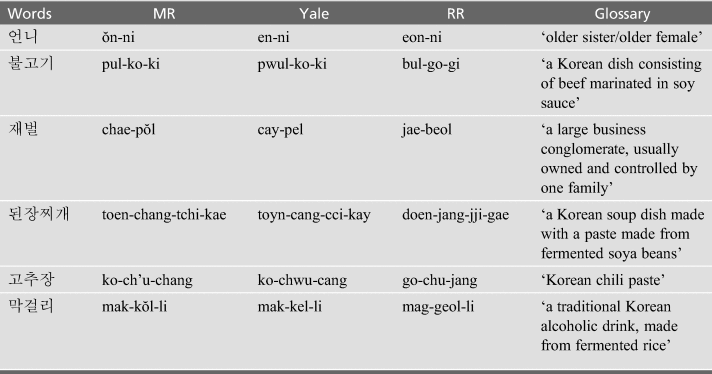
More than 20 different Romanization systems for the Korean language have so far appeared in print (Sohn, Reference Sohn2006). The three most widely used are the McCune–Reischauer (MR) system, the Yale system, and the RR system. The MR system was created by George McCune and Edwin Reischauer and its underlying principle is to effectively present the phonetic characteristics of the Korean language. MR is probably the most commonly used system by a wide variety of scholars. In linguistics, the Yale system is typically used. The Yale system was developed by Samuel Martin and is particularly suitable for the presentation of the morphophonemic structure of the Korean language. The RR system is the official South Korean language Romanization system and is produced by the NIKL. The RR is close to the MR system because in 1988, when the NIKL revised its previous Romanization system, it adopted the MR system in its place. Table 1 shows examples of Korean words presented according to the three different Romanization systems. For example, the Korean word 언니 ‘older sister’ can be spelt as ŏn-ni in MR, en-ni in Yale, and eon-ni in RR.
Romanization of Korean words according to the RR, MR and Yale systems

Since several Romanization systems are used to present Korean words, there has consequently been some confusion in deciding which system should be used. For example, the RR system is not expected to be used for Korean names. As a result, popular Korean surnames widely known as Kim, Lee, and Park can also be written as Gim, I, and Bak, respectively. Another Korean word, 정 (jeong) has also appeared as jung, jong and jeung, and with many other variations. In addition, largely due to RR's inadequate representation of the phonetic features of the Korean language, there has been resistance to adopting the RR system outside Korea. In short, although the RR system is the official Romanization system, in practice, there are various Romanization systems that have been employed by international publishers, dictionary editors, and scholars.
Data and results
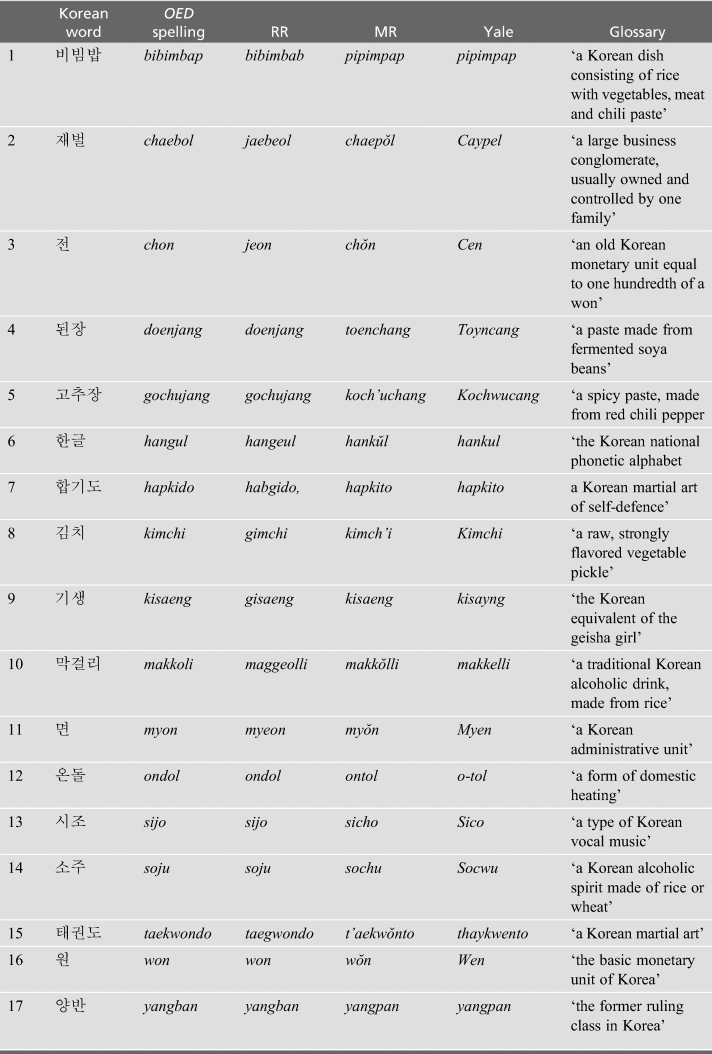
A total of 64 words related to the Korean language were extracted from the OED. Among these, 17 transliterations of Korean words are examined in the current paper. The 17 words selected from the OED are presented in Table 2 and also listed according to the three major Romanization systems of the Korean language, namely, the RR, MR and Yale systems. The frequency of use of these four variations was determined by searching the CNN website and one of the most popular search engines, Google Search and Google Trends, to determine which versions amongst the three Romanization systems is in most popular use. Google Trends is a website that analyzes the popularity of a subject across various regions and languages. The language setting for Google was English and the Google search was conducted in Singapore, on November 28, 2018.
Korean words as presented in the OED, RR, MR and Yale systems

Table 2 shows that the presentations of the Korean words are vastly different depending on the Romanization system. For example, the second word, 재벌, is presented as chaebol, jaebeol, chaepŏl, and caypel, respectively. However, the OED spellings for six words such as doenjang, gochujang, sijo, sijo, soju, won, and yangban are the same as those of the RR system. In addition, most of the words based in the MR and Yale systems have vastly different spellings from the OED spellings, except for two words, kimchi and hapkido.
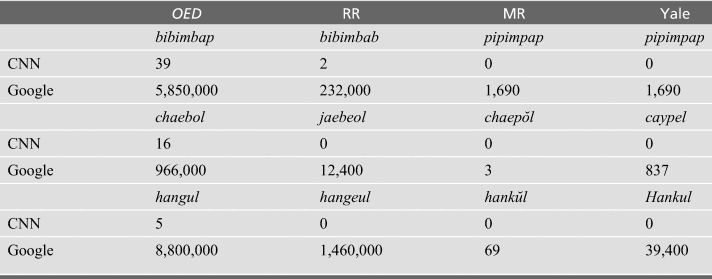
After the initial screening for the popularity of different spellings for these words, it became clear that the use of the MR and Yale system is much less popular in both the Google search engine and on the CNN website (see Table 3). For example, the Google frequency results for the OED spellings of bibimbap and caebeol are 5,850,000 and 966,000, respectively, while the CNN results are 16 and 5. However, significantly lower or minimal results were found for these words Romanized according to the MR and Yale systems. Therefore, the remaining part of the paper only shows results for a comparison between the OED spelling and the RR spelling from the CNN website and the Google search engine (see Tables 4 and 5). In addition, the frequency found in the Google results includes the usage of Korean words that are not related to their Korean meanings. In order to reduce the impact this has on the results, one-syllable words such as chon, myon, and won were excluded from the Google frequency test. This is because a one-syllable word is more likely to be used in a way not related to its Korean meaning rather than words of two or three syllables. For example, the Google result for won could include the past tense of the English word win. Despite this limitation, the present study focusses on the overall popularity of variations between OED spelling and RR spelling. It is assumed that using results from the Google search engine gives a meaningful indication of the popularity of spelling variations of translingual Korean words.
The frequency of usage Korean words found in CNN and Google

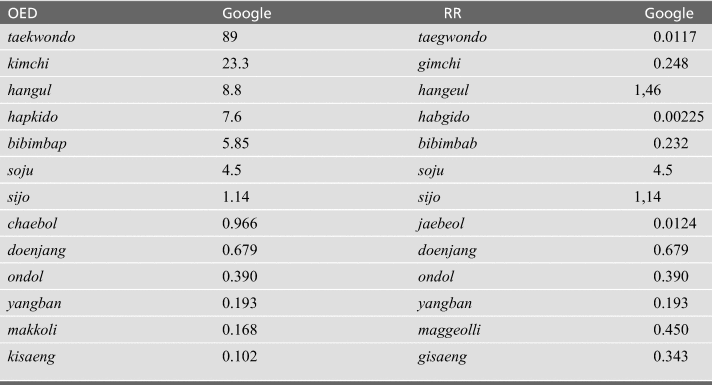
Google frequency results for OED spelling and RR spelling

*units are presented in millions
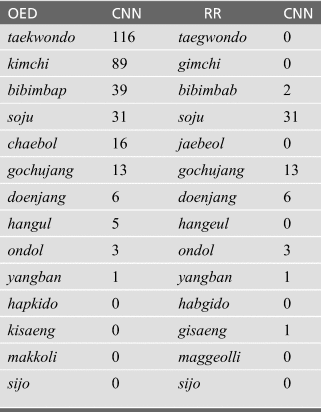
Frequency results from the CNN website

Results from the Google search engine
The results from the Google search engine, as shown in Table 4, show that OED spellings are overwhelmingly more popularly used than RR words and the five most popularly used words in Google are OED-spelt words including in order of occurrence taekwondo, kimchi, hangul, hapkido, and bibimbap. In total, 92% of the words found follow the OED spelling and only 8% follow the RR spelling.
Results from the CNN website
Similar to the Google results, words with OED spelling are overwhelmingly more frequently used on the CNN website. The five most popularly used words appearing on the CNN website, as shown on Table 5 in order of frequency, are the words taekwondo, kimchi, bibimbap, soju, and chaebol, all with the OED spelling. For example, while the OED spelling for taekwondo and kimchi is used 116 times and 89 times, respectively, their RR equivalents, taegwondo and gimchi, are not used at all on the CNN website.
Results from Google Trends
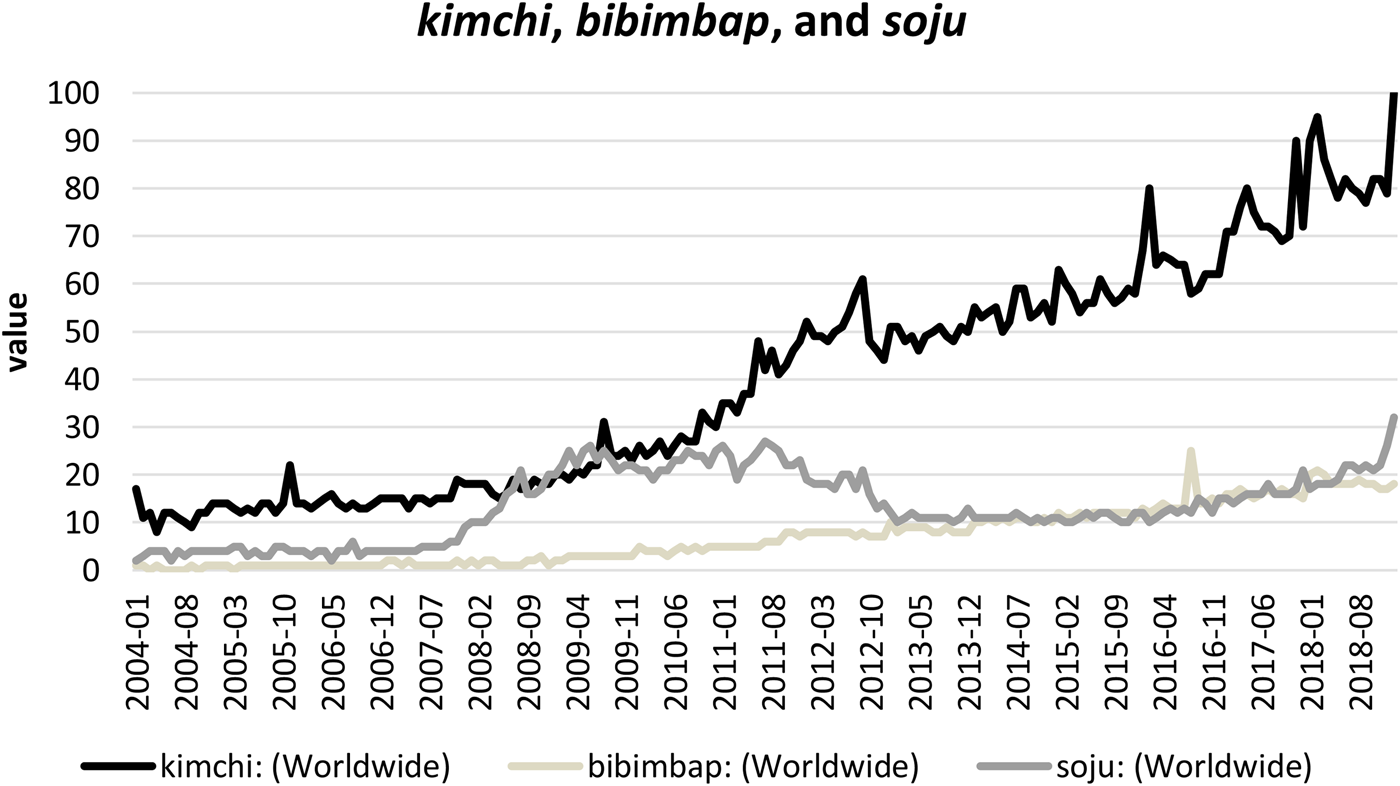
Finally, Google Trends is employed to investigate the trends in popularity of the listed Korean translingual words in the international context. The regional setting for Google Trends was set to worldwide to determine the worldwide popularity of these words and the search period was from 2004 to the present. Since the Google Trends results also indicate that RR spelling is hardly used compared to the OED versions, the popularity trend for only the top five most popularly used words based on the Google search engine and the CNN website are investigated in this section. The five OED-spelt words investigated in Google Trends include taekwondo, kimchi, bibimbap, soju, and chaebol. According to the results on the popularity of three words, kimchi, bibimbap, and soju, the words are on a steady increase in use, as shown in Figure 1. Numbers on the vertical axis in Figure 1 represent search interest relative to the highest point on the chart for the given region and time. A value of 100 is the peak popularity for the term. A value of 50 means that the term is half as popular. A score of 0 means that there was not enough data for this term.
Google Trends results (2004-present): kimchi, bibimbap, and soju

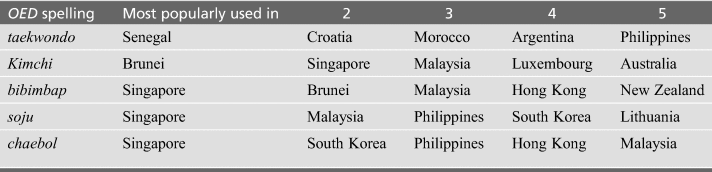
The results from Google Trends also offer information about the countries in which these words are most popularly used. Over the past 14 years, the word taekwondo was the most popularly used Korean word in Senegal, followed by Croatia, Morocco, Argentina, and the Philippines. Meanwhile, Brunei, Singapore, Malaysia, Luxembourg, and Australia used the word kimchi most frequently. Table 6 includes a list of the top five countries that use these words most frequently. The results suggest that these words are in popular use around the globe, not only in the Asian countries mentioned above, but also in African countries such as Senegal and Morocco. In addition, kimchi and soju are popularly used in European countries such as Luxembourg and Lithuania, while kimchi and bibimbap are particularly popularly used in Australia and New Zealand.
Countries that use OED spellings of Korean-origin words

Conclusion
As a result of the consistent and dynamic contact of English with other languages, several words from various languages have entered the English vocabulary. Along with the international boom of K–pop, the present study showcases that translingual words of Korean origin have prominence in the English language and their various spellings are in use globally. Amongst these variations, despite the fact that the RR system was developed as an easy reference for non-Korean users, it is the OED which has played an influential role in determining spelling conventions for these words. The spelling of dictionary words is determined by their usage in various sources (Landau, Reference Landau2001; Zgusta, Reference Zgusta1971). Khedun–Burgoine and Kiaer (Reference Khedun–Burgoine and Kiaer2018) point to the important and influential role of the worldwide cult of K–pop for promoting words of Korean origin, and the present study has shown that a language institution like the NIKL has little role in determining their spelling, which is, instead, determined by popular usage.
The present study offers the first step in the empirical documentation of spelling variations of highly hybridized translingual Korean words that are actively used in the international context. Although the present study is limited by only looking at the variations in spelling of Korean-origin words in English, more studies of translingual words of Asian origin are needed. These studies should include not only their semantic, morphosyntactic and phonological variations, but also examine their use in different phrases and speech styles in English. To conclude, the present study calls for further investigation into other linguistic modifications found in translingual English words of Asian language origin.
Acknowledgements
I am immensely grateful to Dr. Danica Salaza from the Oxford English Dictionary for her expert knowledge in contributing the OED words used in this manuscript and also for her careful and insightful comments on earlier versions of the manuscript. I would also like to thank Ms Susanna Carter for her editorial assistance which greatly improved the text. Any errors found in this manuscript are my own and they should not tarnish the reputations of these esteemed persons.
 Dr. Hyejeong Ahn works as a lecturer at the School of Humanities, Nanyang Technological University in Singapore. Her publications include Attitudes to World Englishes: Implications for Teaching English in South Korea (Routledge). Email: hjahn@ntu.edu.sg