Implications
The results from the present study provide information on dry-cow, calving and colostrum management practices used in spring-calving systems. It highlights the management areas that are similar to and the areas that are different from year-round calving systems. Practices such as grouped calving pens and short term colostrum storage are more common in spring-calving systems due to a large number of cows calving in a short space of time. Results also show that calving management practices such as hygiene in the maternity pen and colostrum management practices, such as colostrum storage are suboptimal according to international standards. The results also provide direction for future research to focus on the specific challenges facing farmers in spring-calving systems.
Introduction
Calves are born agammaglobulinemic and thus are extremely susceptible to infectious diseases, particularly in the first hours of life (McGuirk and Collins, Reference McGuirk and Collins2004). Consequently, it is essential to minimize the risk of disease to the newborn calf while maximizing development of immunity (Godden, Reference Godden2008). Care of the calf begins before birth. Appropriate feeding of the dry cow (Mulligan and Doherty, Reference Mulligan and Doherty2008), calving facilities and calving management are all essential to optimizing the health of newborn calves (Gulliksen et al., Reference Gulliksen, Lie, Løken and Østerås2009a). Over or under-feeding the dry cow influences her body condition score (BCS), changes in which may lead to a greater incidence of dystocia (Berry et al., Reference Berry, Lee, Macdonald and Roche2007) thus appropriate nutrition of the dry cow is crucial. In addition to dry cow nutrition, monitoring of the cow around calving is important for successful healthy calf births (Lombard et al., Reference Lombard, Garry, Tomlinson and Garber2007). Furthermore, management of hygiene in the calving area is attributable to the exposure of calves to pathogens and the associated impact on infection in the calf (Gulliksen et al., Reference Gulliksen, Lie, Løken and Østerås2009a).
To develop immunity against disease, calves must receive adequate volumes of good quality colostrum within the first 4 h of birth (Weaver et al., Reference Weaver, Tyler, VanMetre, Hostetler and Barrington2000; Godden, Reference Godden2008). Colostrum is the first milk secreted after parturition and provides neonates with essential elements including immunoglobulins (Ig) and other nutrients (McGuirk and Collins, Reference McGuirk and Collins2004). Colostrum quality is influenced by the cow directly, as well as on-farm management during collection, storage and feeding. Cows that produce greater milk volumes, as well as younger parity cows, tend to produce colostrum of reduced quality (Conneely et al., Reference Conneely, Berry, Sayers, Murphy, Lorenz, Doherty and Kennedy2013). In terms of management, a delay in collection of colostrum from the cow, pooling of colostrum, general poor hygiene, as well as warm storage conditions can result in poorer quality colostrum (Stewart et al., Reference Stewart, Godden, Bey, Rapnicki, Fetrow, Farnsworth, Scanlon, Arnold, Clow and Mueller2005; Godden, Reference Godden2008; Conneely et al., Reference Conneely, Berry, Sayers, Murphy, Lorenz, Doherty and Kennedy2013). Additionally, colostrum feeding management protocols such as inadequate volume of colostrum fed to the neonate and delayed timing of the calf’s first feed can adversely affect calf immunity (Weaver et al., Reference Weaver, Tyler, VanMetre, Hostetler and Barrington2000; Beam et al., Reference Beam, Lombard, Kopral, Garber, Winter, Hicks and Schlater2009; Conneely et al., Reference Conneely, Berry, Murphy, Lorenz, Doherty and Kennedy2014).
In countries such as Ireland and New Zealand, where compact calving pasture-based systems of dairy production prevail, there is a knowledge gap as to current prevailing dry cow, calving and colostrum management practices. Moreover, herd size is expected to increase in Ireland over the coming years (O’Donnell et al., Reference O’Donnell, Horan, Butler and Shalloo2011) which will inevitably place increased strain on existing resources, increasing any calf health risks currently facing dairy farmers (Gulliksen et al., Reference Gulliksen, Lie, Løken and Østerås2009a).
The aim of the present study therefore was to determine the dry cow, calving and colostrum management practices on commercial spring-calving dairy farms, and quantify their associations with both herd size and recent herd expansion status. Identifying these management practices provide a focus for future research with the ultimate aim to improve dairy calf health.
Material and methods
Sample selection
Herds were selected from HerdPlus®, the Irish breeding information decision support tool for farmers (n=7800) coordinated by the Irish Cattle Breeding Federation (ICBF). From a national total of ~18 000 dairy herds, and an expected response rate of 50% to 60%, 320 herds were invited to participate in the present study. This was deemed necessary (CL, 95%; CI, 5.0%) to ensure sufficient observations to cover the estimation of the coefficients for each response. Herd selection was random, stratified by herd size (small⩽65 cows, average⩾65 and ⩽100 cows, large⩾100 and ⩽150 cows, extra-large⩾150 cows) and geographical location. Strata were chosen to provide data representative of the Irish national average.
Survey development
A total of 104 questions relating to calf health and husbandry, were devised across three different management areas:
-
1. Cow management: pre-calving nutritional management;
-
2. Calving management: calving facilities and peri-parturient period management;
-
3. Colostrum management: colostrum collection, storage and feeding.
Questions were designed based on a full review of peer-reviewed international publications and on the knowledge of researchers based at Teagasc Moorepark Animal and Grassland Research and Innovation Centre, Co. Cork, Ireland.
Questions were predominantly close-ended, to obtain concise information. Questions were structured to prevent ambiguity, while making it easy for the farmer to understand and complete. A copy of the original questions is available in Supplementary material S1.
BCS was defined according to a 5-point scale where 1=emaciated and 5=extremely 5 (Edmonson et al., Reference Edmonson, Lean, Weaver, Farver and Webster1989).
Survey administration
To determine feasibility and comprehensiveness of the survey, the questionnaire was piloted using 30 farmers. Appropriate alterations were made before sending survey packs to the remaining famers. Survey packs contained the questionnaire, a cover letter, a return-addressed envelope, and were mailed to each participating farmer between 11 July and 15 August 2013. A reminder SMS message was issued 4 weeks post-mailing, followed by a reminder telephone call 2 weeks later, to which ~25% (n=70) of all respondents replied to. The cover letter outlined the purpose of the research, details of collaborating organizations, the time frame in which surveys were to be returned, and assurance that all surveys would be kept strictly confidential. Participation by farmers was completely voluntary and was not incentivized.
Ancillary information
In addition to the self-declared information collected from the questionnaire, data on a further 10 additional factors were obtained from the ICBF database for the years 2011, 2012 and 2013. These factors were considered for inclusion in the model of analysis as confounding variables. These included the total number of dairy cows on the farm for each of the 3 years, mean herd parity and average herd age (recorded for each cow at calving), percentage of heifers in the lactating herd, length of calving season, mean annual herd milk production (calculated from individual cow milk recordings; liters), milk fat and protein (kg), herd somatic cell count (SCC), herd economic breeding index values (EBI), and the predominant breed of cow in the herd. Calving season length refers to duration (weeks) for which ⩾85% cows are calving between January and June (O’Doherty et al., Reference O’Doherty, Sayers and O’Grady2013). The EBI value is a single figure profit index used to identify the most profitable bulls and cows for breeding dairy herd replacements (Berry et al., 2014). Nine herds were eliminated from the analyses as cow numbers and calving information were missing for either 1 or more years. Respondents did not answer every question in the survey and so the numbers of respondents with each variable differ.
Statistical determination of herd characteristics
Linear robust regression was fit to annual herd size over 3 years (2011, 2012, 2013) using PROC ROBUSTREG (SAS, 2011), as described by Jago and Berry (Reference Jago and Berry2011). The resulting intercept and linear regression coefficient was used to stratify herds on size and whether or not they were expanding. Herds were classified into one of four groups based on number of cows estimated from the regression for the year 2012 as, small (⩽65 cows; n=37), average (65 to 100 cows; n=81), large (101 to 150 cows; n=73), and extra-large (>150 cows; n=71). If the linear regression coefficient was not different (P>0.05) from zero, the herd was classified as not expanding (Jago and Berry, Reference Jago and Berry2011). Herds with a regression coefficient greater (P<0.05) than zero were classified as expanding (Jago and Berry, Reference Jago and Berry2011).
Statistical analysis
Dependent variables of interest were classified as binary, ordinal or nominal (data in the Tables 1, 3, 4 and 6). If <5% of respondents selected a response option, this option was merged with most appropriate alternative response option for example <5% used neighboring colostrum or colostrum replacers as an alternative colostrum source and thus these options were merged to create ‘other’ category. An initial univariate analysis was performed for each question to determine the association between each survey response and both herd size and expansion status. Regression models used were PROC GENOMD (binary and ordinal responses), or PROC CATMOD (nominal responses), performed using SAS (2011). Herd size and expansion status were forced into all models, but confounding factors were also included if associated (P<0.05) with the dependent variable. Once the number of tests were >5 a Bonferroini multiple test adjustment was applied. Odds ratios (OR) were calculated as the exponent of the model estimates.
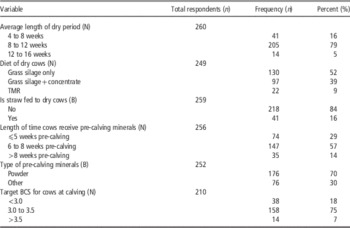
Summary of responses to each dry cow management survey question

N=nominal response; B=binary; BCS=body condition score.
Results
The survey response rate was 85%, of the 320 invited herds, 271 participated in the study and, after edits were applied (i.e. herds with missing data), 262 surveys were included in the final analysis. There was no association between the percentage of respondents, the strata and the geographical location and thus non-respondents were deemed to be missing at random. The average herd size across all respondents was 131 cows (median=107 cows); 14% of respondents had ⩽65 cows (‘small’ herds), 31% had between 65 and 100 cows (‘average’ herds), 28% had between 101 and 150 cows (‘large’ herds) and 27% had >150 cows (‘extra-large’ herds). Of all respondents, 20% were deemed as expanding, and this was not associated with any cow, calving or colostrum management practices investigated in the current study.
Dry cow management
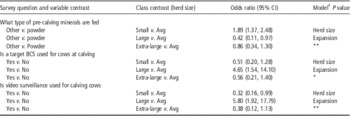
The majority of respondents (79%) imposed a dry period of 8 to 10 weeks and more than half of all respondents (i.e. 52%) fed only grass silage during this time (Table 1). Of respondents that fed minerals to cows during the dry period (>95% of respondents), 57% fed them for 6 to 8 weeks pre-calving. Powdered minerals were the most common form of minerals used (70% of respondents; Table 1). Compared to average-sized herds, small herds were almost twice as likely (P<0.05) to feed minerals in bolus/lick form rather than powdered form (Table 2).
Herd size odds ratios (95% confidence interval) with dry cow and calving management practices

CI=confidence interval; Avg=average-sized herds (reference herd size); BCS=body condition score.
1 Independent variable(s) included in the final logistic regression model.
*P<0.05, **P<0.01.
Eighty percent of respondents in the present study reported setting a target herd average BCS for calving (Table 1); of these, 75% set a target calving BCS of between 3.0 and 3.5 (5-point scale: 1=emaciated and 5=extremely fat). Large herds were five times more likely (P<0.05) to set a target BCS than average-sized herds. In contrast, the likelihood that extra-large and small herds set a target BCS for calving, compared to average-sized herds, was not different (Table 2).
Calving management
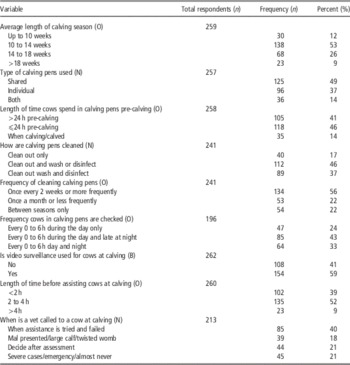
The majority of respondents (53%) had a 10 to 14 week calving season, while 35% had a longer season (Table 3). Shared pens were used for calving cows by 49% of respondents, while 14% used a combination of both shared and individual maternity pens; 37% of respondents used only individual maternity pens (Table 3). Of all respondents, 41% transferred cows to a maternity pen >24 h pre-calving (i.e. before the appearance of the amniotic sac), while 46% moved cows into maternity pens ⩽24 h pre-calving. The remaining 14% of respondents moved cows either during calving, or when they had calved. The most common bedding (93% of respondents) used in calving pens was straw (Table 3). Of the 92% of respondents that cleaned calving pens, 56% cleaned calving pens at least once every 2 weeks, while 22% of respondents cleaned calving pens no more than once per month, or between seasons only (Table 3). Calving pens were cleaned out (i.e. bedding completely removed), washed and disinfected during each cleaning event by 37% of respondents, while 46% removed bedding and either washed or disinfected pens (Table 2).
Summary of responses to each calving management practice survey question

N=nominal response; O=ordinal; B=binary.
Thirty-three percent of respondents inspected cows for calving events at least once every 6 h during the day or night, while 24% of respondents inspected cows for calving events during the day only (Table 3). Small herds, were less likely (P<0.05) to use video surveillance than average-sized herds, while large sized herds had a greater likelihood (P<0.01) of using a video surveillance than average-sized herds (Table 2). Of the sample population in the present study, 39% of respondents waited no more than 2 h from the time a calving event commenced (Table 3). Of respondents that stated when a veterinary surgeon is called to a calving (n=213), 40% wait until their own attempts at rectifying the difficult calving have failed (Table 3).
Colostrum selection, collection and storage
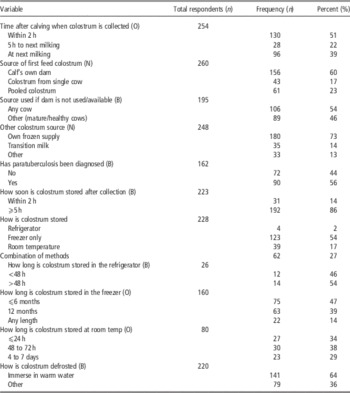
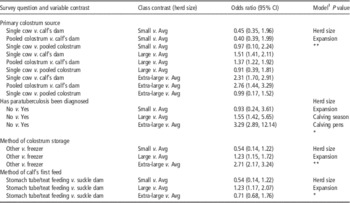
Of respondents that collected colostrum from freshly calved cows (98%), 51% collected colostrum within 2 h of calving, and 49% collected colostrum between 5 h post-calving and the next milking (Table 4). No respondent in the present study had a standard colostrum collection time of 2 to 5 h post-calving. In the present study, 54% of all respondents used any colostrum to feed calves (i.e. did not screen according to any criteria such as parity or disease status). The primary source of colostrum used by the majority of respondents (60%) was the calf’s own dam, while 23% pooled colostrum for feeding (Table 4). Compared to average-sized herds, small herds were more likely (P<0.05) to use the calf’s own dam, rather than a single cow or pooled colostrum, while large and extra-large herds were less likely (P<0.05) to use the calf’s own dam than average-sized herds. When choosing a cows’ colostrum to use other than the calf’s own dam, 54% of respondents used any cow (i.e. no selection criteria; Table 4).
Summary of responses to colostrum collection & storage practice questions

N=nominal response; O=ordinal; B=binary.
The number of respondents that answered the question regarding a substitute colostrum source included any respondents that used the calf’s own dam a single cow or pooled colostrum as their primary source, hence the number of responses to this question (n=248) was greater than the number of respondents that used a source other than the calf’s own dam (n=195). When a substitute supply of colostrum was needed, 14% of respondents offered newborn calves transition milk, while 13% offered a neighboring farm’s supply or colostrum replacer (Table 4). The majority of respondents (73%) stored frozen colostrum to use as a substitute to the primary colostrum source (Table 5). Of these, extra-large herds were least likely (P<0.01) to use frozen colostrum, compared to all other herds (Table 5). Additionally, of respondents that stored colostrum 17% stored it at room temperature and 4% used a refrigerator, rather than freezing it (Table 4). More than half of respondents stored colostrum in a refrigerator for >48 h, while 29% stored colostrum at room temperature for up to 1 week (Table 4).
Herd size odds ratios (95% confidence interval) with colostrum management practices

CI=confidence interval; Avg=average-sized herds (reference herd size); Calving season=length of calving season; Calving pens=if calving pens were cleaned or not.
1 Independent variable(s) included in the final logistic regression model.
*P<0.05, **P<0.01.
Sixty-five percent of respondents reported that paratuberculosis disease was tested for in milk, feces, blood, or a combination of methods. Of the respondents who tested for this disease, large and extra-large herds were more likely (P=0.05) to have a positive diagnosis, compared to average-sized herds (Table 5). Additionally, compared to respondents that cleaned calving pens, respondents that did not clean calving pens were 16 times more likely (P<0.01) to diagnose paratuberculosis. Moreover, paratuberculosis was more likely to be diagnosed in herds with longer calving seasons (P<0.05; Table 5).
Colostrum feeding
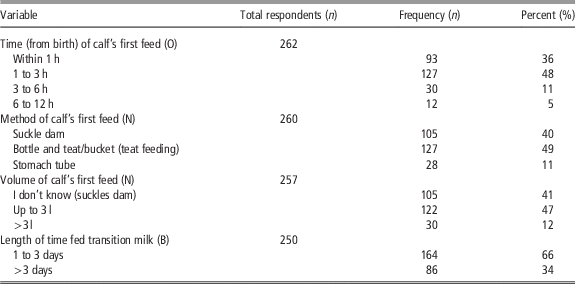
The majority of respondents (i.e. 84%) ensured calves were fed colostrum (artificially or suckling the dam) within 3 h of birth (Table 6). Colostrum was fed via bottle or bucket and teat by 49% of respondents, while 40% allowed the calf to suckle the dam (Table 6). Compared to average-sized herds, large herds were more likely (P<0.05) to use an artificial feeding method (i.e. bottle or stomach tube) rather than allowing the calf suckle the dam (Table 5). Of respondents that artificially fed calves (n=152), 5% fed <2 l to all calves and 42% fed between 2 and 3 l (Table 6). In the present study, 95% of all respondents offered transition milk subsequent to colostrum, the majority of which fed it for 2 to 4 days (62%; Table 6).
Summary of responses to each colostrum feeding survey question

N=nominal response; O=ordinal; B=binary.
Discussion
The high response rate (85%) may be partly due to the minimal time required by the farmer to fill in the survey, there was no requirement to collect any additional data. Furthermore, as calf health diseases were recently deemed as an animal health priority (More et al., 2010) it may have provided farmers with an additional incentive to participate in the survey. Alternatively, it may simply be due to the number of reminders the respondents received to complete the survey. There are no documented reasons for farmers opting out of responding to the survey and thus the response may be a random occurrence. The average size of herds in the present study (131 cows) was larger than the Irish national average, reported as 66 cows in 2013 (Teagasc, 2013). As expansion was not associated with management practices in the present study, it is deemed that the process of herd expansion is not expected to result in compromised herd management. This is similar to the findings of Jago and Berry (Reference Jago and Berry2011), who investigated the association between dairy herd expansion and reproduction, and calving performance (i.e. age at first calving, calving interval, dystocia).
Dry cow management
Accumulation of IgG in colostrum begins 5 weeks before parturition (Godden, Reference Godden2008). Thus the 16% of respondents that provide a short non-lactating period may have compromised colostrum quality (Rastani et al., Reference Rastani, Grummer, Bertics, Gümen, Wiltbank, Mashek and Schwab2005), and less time to increase cow BCS reserves. Extra-large farms were less likely to use a target BCS, possibly due to the increased time resources required to individually assess each cow. The greater likelihood of larger herds offering dry cows powdered minerals may be due to the convenience of incorporation into the dry cow diet compared to bolus minerals, which require individual cow administration.
Calving management
The use of shared maternity pens by 63% of respondents in the present study, is a management strategy which was previously been reported to increase the risk of the spread of infectious disease to the calf, compared to individual maternity pens (37% of respondents; Sweeney et al., Reference Sweeney, Collins, Koets, McGuirk and Roussel2012). According to previous research, respondents that provided individual pens for cows at calving, are not only more likely to have a reduced risk of spreading infection (Sweeney et al., Reference Sweeney, Collins, Koets, McGuirk and Roussel2012), but are also minimizing the risk of stress to the cow (Vasseur et al., Reference Vasseur, Borderas, Cue, Lefebvre, Pellerin, Rushen, Wade and De Passillé2010), which has been reportedly associated with a reduced risk of prolonged parturition and weaker calves at birth (Gulliksen et al., Reference Gulliksen, Lie, Løken and Østerås2009a). The timing of transferring cows to a calving pen pre-calving is a component of stress management for the periparturient cow; according to previous research the 87% of respondents that transfer cows >24 h before calving are minimizing stress on the cow (Bao and Giller, Reference Bao and Giller1991). The opposite can be said for the 14% of respondents that transferred cows to a calving pen once calving had commenced. This is particularly true for nervous cows and heifers (Mee, Reference Mee2008). Moving cows when they had already calved has been reported to increase the risk that the calf will contract infection (Gulliksen et al., Reference Gulliksen, Lie, Løken and Østerås2009a; Sweeney et al., Reference Sweeney, Collins, Koets, McGuirk and Roussel2012) as stress can increase the shedding of diseases that may be present such as Infectious Bovine Rhinotracheitis.
The most common bedding type, that is straw, used in the present study is a good insulator, but if not cleaned regularly it can quickly become damp and dirty, thus having unfavorable consequences for animal health (Tuyttens, Reference Tuyttens2005). Frequent cleaning of maternity pens reduces pathogen build-up and calf exposure to infectious disease (Gulliksen et al., Reference Gulliksen, Jor, Lie, Hamnes, Løken, Åkerstedt and Østerås2009b); but 22% of respondents in the present study cleaned maternity pens no more than once per month, or only between seasons. The method of cleaning may also affect calf health. If maternity pens are not washed or disinfected during cleaning (17% of respondents did not), the pathogenic load can accumulate and persist and the neonate can be exposed to a greater bacterial load compared to pens that are cleaned out and washed or disinfected (46% of respondents), or cleaned out, washed and disinfected (34% of respondents).
In the present study, respondents may be exposing themselves to increased risk of stillbirths and deaths in the 1st week of life (Wells et al., Reference Wells, Dargatz and Ott1996; Gulliksen et al., Reference Gulliksen, Lie, Løken and Østerås2009a) as 24% of respondents only inspected cows for calving events during the day. The use of video surveillance (59% of respondents), is an additional support that allows the farmer to view the cows without visiting the maternity house. Extra-large herds are likely to have more cows calving in a short space of time and thus rather than installing a video surveillance system, the farmer may have continuously observed the cows. Furthermore, as these larger farms have many more cows than small farms, more staff may be involved in monitoring cows when calving, but unfortunately this data was not attained in the present survey.
Colostrum selection, collection and storage
A key factor to ensure calves absorb maximum IgG levels from colostrum in the first hours after birth, is the source of colostrum (e.g. calf’s own dam) (McGuirk and Collins, Reference McGuirk and Collins2004). When selecting colostrum from a single cow, that is not the calf’s own dam, 22% of respondents selected a cow deemed to be healthy (i.e. free from paratuberculosis, mastitis or any clinical illness present at calving) which is important to minimize transmission of disease to the calf (McGuirk and Collins, Reference McGuirk and Collins2004). Feeding pooled colostrum (more likely on larger farms in the present study) is convenient, particularly in spring-calving systems when collecting colostrum from many different cows at the same time, but increases the risk of spreading diseases such as paratuberculosis throughout the herd (McGuirk and Collins, Reference McGuirk and Collins2004). As larger herds are less likely to feed colostrum from the calf’s own dam, the risk of spreading disease throughout the herd is greater.
Calves and young stock are most susceptible to paratuberculosis (Sweeney et al., Reference Sweeney, Collins, Koets, McGuirk and Roussel2012). More than 20% of Irish herds have diagnosed at least one positive paratuberculosis animal in their herd (Good et al., Reference Good, Clegg, Sheridan, Yearsely, O’Brien, Egan and Mullowney2009); however 35% of respondents in the present study had never tested for the disease. The greater likelihood of the disease being diagnosed in larger herds agrees with previous research (Kennedy et al., Reference Kennedy, O’Doherty, Byrne, O’Mahony, Kennedy and Sayers2014). It is evident in the present study that good hygiene is essential to minimize accumulation and spreading throughout the herd as failure to clean out maternity pens was associated with a positive diagnosis of the disease (Gulliksen et al., Reference Gulliksen, Lie, Løken and Østerås2009a).
Some substitute colostrum sources identified in the present study should never be used on a dairy farm; these include transition milk (used by 14% of respondents) as it does not contain adequate IgG to ensure adequate passive transfer of immunoglobulins, and a neighboring farms supply as this is a biosecurity hazard (McGuirk and Collins, Reference McGuirk and Collins2004), Although colostrum replacer (13% of all respondents), is a more favorable alternative than those previously mentioned, it is lower in quality than maternal colostrum and will not contain any specific immune factors cows develop from the environment (Godden, Reference Godden2008). Keeping stored supplies is a good alternative; early storage of colostrum post-collection (86% of respondents) minimizes bacterial growth, which is thought to affect the rate of passive transfer in the calf (James et al., Reference James, Polan and Cummins1981; Godden, Reference Godden2008). For the same reason, the duration of colostrum storage is also important when storing colostrum above 0°C, particularly at room temperature (17% of respondents), or in a refrigerator (4% of respondents) as longer storage durations result in significantly altered bacteria and pH levels (Stewart et al., Reference Stewart, Godden, Bey, Rapnicki, Fetrow, Farnsworth, Scanlon, Arnold, Clow and Mueller2005).
Colostrum feeding
Failure of passive transfer is a prominent issue in calves, and was reported in almost 60% of serum samples from sick or dead calves that were submitted to Irish regional veterinary laboratories in 2013 (Anonymous, 2014). The 40% of respondents that allowed the calf to suckle the dam, were creating an environment that increased exposure of pathogens to the calf due to direct contact with the dam (Sweeney et al., Reference Sweeney, Collins, Koets, McGuirk and Roussel2012). Furthermore, the volume of colostrum consumed is immeasurable when the calf suckles the dam and dairy calves typically do not voluntarily consume sufficient volumes of colostrum to ensure adequate IgG absorption (Brignole and Stott, Reference Brignole and Stott1980; Besser et al., Reference Besser, Gay and Pritchett1991). The likelihood that larger herds used an artificial colostrum feeding method, compared to average-sized herds, may be due to space limitations, which is of particular importance when the calving season is compact. Larger herds have more cows calving in a short space of time and may require the calving pens for other calving cows more quickly than smaller sized herds. To estimate the likelihood of sufficient absorption of IgG, it is essential to know the volume of colostrum ingested by the calf. The volume of colostrum fed to calves by 42% of respondents (<2 to 3 l) was not sufficient for an average 40 kg Holstein–Friesian dairy calf (Lorenz et al., 2011). This result, in addition to previous results regarding colostrum source create an interesting mutual dilemma between different herd size categories; Many herds that provide colostrum from the calf’s own dam are subjecting the calf to other health risks such as disease exposure directly from the dam, while respondents making efforts to artificially feed colostrum are using uncertain sources such as pooled colostrum.
Conclusion
Results from the present study suggest that the main calf perinatal management areas to focus on improving are calving and colostrum management practices. More specifically, the frequency of cleaning maternity pens, and the method of cleaning could be improved on many farms. Suboptimal colostrum management practices are particularly evident on large herds and should be improved; these herds were more likely to pool colostrum rather than using the calf’s own dam and were more likely to store colostrum at room temperature or in a fridge, rather than at freezing point. Although the majority of respondents fed calves within 3 h of birth, feeding practices that influence neonatal calf immunity such as the quality and volume of colostrum fed should be improved; most herds did not test colostrum for quality and 41% did not know the volume of colostrum consumed. Additional management practices identified in the current study such as storing colostrum at room temperature for >48 h may contribute to the failure of passive transfer occurring in Irish dairy calves due to bacterial growth, but further studies should be conducted to identify best colostrum storage practices.
Acknowledgements
The authors would like to acknowledge the funding supplied from the Teagasc, Walsh Fellowship funding scheme. The Authors would like to thank the farmers who participated in the survey and the Irish Cattle Breeding Federation, for providing the necessary information to complete the study.
Supplementary material
To view supplementary material for this article, please visit http://dx.doi.org/10.1017/S1751731116000124