Introduction
Although certified organic production still represents a small share of overall agricultural production in the United Sates, it has expanded dramatically in the past decade. Certified organic land increased from 935,000 acres in 1992 to 2.3 million acres in 2000. And retail sales of organic produce have risen over the past decade to nearsly $9 billionReference Greene and Kremen1. Because some of this expansion is the result of larger farmers and agribusinesses entering organic markets, social scientists like Guthman question whether the bifurcation of organic production represents an undermining of the ‘transformative potential of organic agriculture’ (p. 301)Reference Guthman2. Michelson has made similar claims about organic agriculture in EuropeReference Michelson3.
Conflicting claims about the transformative potential of organic production highlight the need to examine the values that motivate organic and conventional farmers. One assumption that is common in the United States Department of Agriculture (USDA) publications is that farmers are turning organic primarily for economic reasons. Organic produce tends to bring premium prices; and even without premium prices, organic farmers often benefit from reducing input costsReference Greene and Kremen1. While Greene and Kremen acknowledge the ecological benefits of reducing chemical inputs, their litany of reasons for adopting organic practices emphasizes economic benefits: ‘to lower inputs costs, conserve non-renewable resources, capture high-value markets, and boost farm income’ (p. iii)Reference Greene and Kremen4. Although economic issues probably influence all farmer decisions, some argue that organic agriculture is about more than increasing incomes because of the way it emerged in the 1940s as a challenge to the specialization, intensification and capitalization associated with industrial and ‘modern’ agricultural practices. Pfeffer contends that sustainable and organic agricultural movements emerged as a means of resisting industrial agricultural because the latter often led farmers to become dependent on purchasing agribusiness inputsReference Pfeffer5. Indeed, one of the early proponents of organic agriculture, Lord Northburn, claimed that small farmers needed to resist chemical inputs to persist in the face of economic consolidationReference Harwood, Edwards, Lal, Madden, Miller and House6. More recently, Guthman has argued that ‘organic agriculture has been positioned as the idealized alternative to industrial agriculture, both in social as well as ecological terms. And if the agent of agro-industrialization is profit-driven agribusiness, it is but a small step of logic to assume that organic farming is peopled by small-scale family farms’ (p. 115)Reference Guthman, Jansen and Vellema7. To those who see organic agriculture as an idealized alternative, it is ironic and contradictory when large agribusinesses venture into organic productionReference Greene and Kremen1, Reference Barham8.
If there is some validity to claims that organic farmers are adopting organic practices to establish an alternative system as much as to enhance their profitability, then it has relevance for policies that prohibit genetically modified (GM) crops in organic agriculture. GM crops are often associated with the conventional agribusiness-dominated system because most of the intellectual property related to GM crops is held by large agribusinesses, which enables them to gain greater profits from the farm production processReference Enriquez, Solbrig, Paarlberg and di Castri9–Reference Kloppenberg11. As a result, ‘biotechnology has come to symbolize the broad pattern of [dissatisfaction regarding] technological change within the food system for the broader public’ (p. 7)Reference Greene and Kremen4.
When the USDA established national organic standards in 1999, it banned the use of GM crops in organic production. The USDA had originally planned to allow at least some GM crops, but after receiving over 275,000 letters, most of which were opposed to allowing GM crops, the USDA changed its position. Proponents of GM crops claim that the USDA erred in its decision because GM crops could have many ecological benefits. They claim that GM crops have the potential to be a powerful tool in organic production. For example, Bt cotton, Bt corn and Roundup-ready soybeans reduce chemical usage or enable the use of more benign chemicals (glyphosate), reduce fossil fuel use and enable soil-conservation technologiesReference Nelson, DePinto and Nelson12. In contrast, farm and consumer groups offered three reasons for supporting the ban on GM crops: (1) Japanese and European markets expect organic produce to be GM free; (2) GM crops present ecological risks in addition to benefits; and (3) as Margaret Mellon of the Union of Concerned Scientists argued, GM-free organic agriculture would help small farmers to ‘flourish’Reference Burros13, Reference Kaufmann14. This third reason is important because it implies that farmers adopt organic practices to resist the concentration and consolidation of industrial agriculture.
It is difficult to distinguish between the economic and non-economic reasons why farmers may adopt organic practices because farmers adopt new production techniques and technologies for a variety of reasons. Furthermore, profitability and idealism are not necessarily mutually exclusive. Nevertheless, it is worthwhile to examine whether there are any significant differences between conventional and organic farmers because it may help to inject stakeholder perspectives into debates on the use of GM crops in organic agriculture. We seek to find whether such differences exist in data from a survey of Washington State farmers. If there is validity to the claims that organic farmers are interested in an alternative production system, we would expect to find attitudinal differences between organic and conventional farmers toward marketing and environmental practices in general, and GM crops in particular.
Framing the Analysis
A recent Council for Agricultural Science and Technology (CAST) paper claims that ethical conflicts often arise over how to evaluate the rightness or wrongness of an agricultural practice or regulatory policy, not because one side in the conflict is unethical and the other ethical, but because these perspectives represent different ethical traditions15. We believe that this observation is applicable to our efforts to understand different value orientations related to organic farming decisions and policies. By emphasizing the profitability of a farming practice, Greene and Kremen seem to assume farmers are primarily self-seeking economic actorsReference Greene and Kremen4. In contrast, Guthman's assertion that organic farmers are resisting trends in conventional agriculture suggests that organic farmers are motivated primarily by principles and concerns for social consequences beyond their economic interestsReference Guthman, Jansen and Vellema7.
To develop a method for distinguishing value orientations of organic and conventional farmers, we relied on the CAST description of the three main ethical traditions that are often applied to agriculture. The first is the rights-based tradition, which holds that people have fundamental rights that should not be compromised, no matter what the consequences might be. This description would apply to libertarian or egalitarian perspectives. The second ethical tradition is utilitarianism, which argues that the rightness of an action is determined by the consequences yielding the greatest good to the greatest number of people. Therefore, consequences, not fundamental rights, are the main criterion for consideration. And the third tradition is virtue theory, which holds that people's actions should be motivated by principles governing social interaction, such as justice or fairness15, Reference Thompson16.
Although it is difficult to determine subtle differences between these three ethical traditions in farmer responses to a mass survey, we believe that at least two general ethical categories may be discernable: a libertarian perspective versus a communal (communitarian or consequentialist) perspective. The libertarian perspective would be evident in farmer responses reflecting an emphasis on their own individual rights and economic interests over the social or environmental consequences of their actions. In contrast, a communal perspective would be evident in responses that reflect concerns for social consequences, social principles, consumer interests, or environmental well-being. For example, a farmer advocating for policies that enhance his profitability and for less public-sector intervention would be a libertarian on marketing and environmental issues. A farmer advocating for public-sector interventions to preserve something the farmer values or to accommodate consumer interests would be more consequentialist or communitarian than libertarian. We utilize this framework to compare conventional and organic farmers on their marketing and environmental practices and attitudes, with a particular emphasis on their willingness or unwillingness to try GM crops in their operations.
Data and Method of Analysis
The data analyzed in this paper were collected in a survey of agricultural producers throughout Washington State. Washington is second only to California in the United States in the number (548 as of 2001) of certified organic operationsReference Greene and Kremen1. To draw our sample, we used a list of agricultural property owners that is maintained by the National Agricultural Statistics Service. A minimum of 10% of all agricultural property owners in each county in the state was selected to receive a survey. Four counties (King, Skagit, Chelan and Grant) were over-sampled, because the project team was particularly interested in analyzing differences across specific regions of the state.
Questionnaires were sent out to 3718 addresses on March 29, 2002. Dillman's tailored design method for mail surveys was followedReference Dillman17. A reminder postcard was sent on April 12th, and a follow-up mailing was sent to non-respondents on April 26th. To maximize return rates, particularly by reaching producers who may have been too busy with farm tasks in spring and summer, a third mailing was sent to non-respondents on November 13th. One-thousand twenty-six completed questionnaires were received, although due to refusals to answer specific questions, not all of these questionnaires were used in our analysis. The sample was adjusted by removing respondents who indicated that they sold less than $1000.00 of commodities in 2001, as well as removing cases where the potential respondent had moved, passed away, or received more than one survey. Some farmers received more than one survey because they owned more than one registered agricultural policy. After these adjustments were made, the final completion rate was 44.96%.
Of the 1181 farmers who completed the survey, we focused on 598 crop farmers, in part because beef and dairy have unique characteristics that may need to be studied independently. Of the crop farmers in our sample, 109 described themselves as producing at least some organic crops, and 489 farmed conventionally. Our analysis consisted of a straightforward cross-tabulation of responses by conventional and organic farmers on a number of marketing and environmental issues. We then conducted a similar analysis of organic farmers who were willing or unwilling to use GM crops.
Our reliance on farmers to self-report their status as organic (certified, moving towards certified, or uncertified) requires comment here. We included farmers who call themselves organic, even if they are not certified, for two reasons. The first is that anecdotal reports suggest that fruit and vegetable farmers, particularly those that are small in size and who market much of their produce directly to consumers, increasingly follow organic practices without getting certified because the certification process is costly and time-consuming. They may also consider certification to be unnecessary because the direct-sales relationship between farmers and consumers tends to be based more on personal trust, and thus does not require the standardization of trust that is associated with federal certification. The second reason is that we are interested in determining values of organic farmers generally, rather than the legality of particular organic farmer practices. Because self-defined organic farmers may differ from conventional farmers in the marketing strategies they utilize, it is quite possible that a broader definition of what constitutes organic production will enable us to more accurately assess whether there are value differences between organic and conventional farmers.
Results
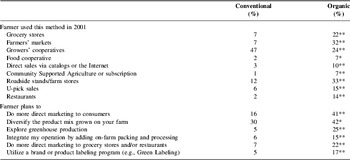
An analysis of the data from our survey indicates that organic farmers are exceptionally innovative in terms of adopting alternative production and marketing strategies (Table 1). Organic farmers are significantly more likely than conventional farmers to sell directly to grocery stores, roadside stands, and farmers' markets, and are less likely to be part of a growers' cooperative. In addition, although only a small portion of our sample is involved in direct sales, organic farmers are more likely than conventional farmers to do so. We also found that organic farmers were far more likely to indicate an interest in participating in such activities in the future. This suggests that organic crop farmers in our sample have a greater interest in departing from the conventional agribusiness-dominated input and marketing system. Organic farmers are at the cutting edge in diffusion of innovation models, which creates an irony because the adoption/diffusion paradigm was ‘developed at the height of the productivity paradigm,’ while organic production is ‘a challenge to this productivity paradigm’ (p. 40)Reference Padel18. However, since marketing innovation activities may indicate self-seeking economic interest as much as seeking to establish an idealized alternative to conventional marketing practices, we also compared responses to variables in addition to those indicating marketing practices.
Percentage of conventional and organic crop farmers who plan to take these following marketing actions (N=598, conventional=489, organic=109).

Cross-tabulations of conventional and organic farmers significantly different on these variables at P<0.05* and P<0.005**. To save space, only significantly different results were included in the table.
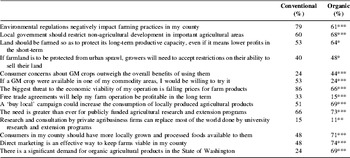
Responses indicate a difference in values between conventional and organic farmers (Table 2). Organic farmers are more likely to accept government regulations for environmental protection, more likely to be willing to sacrifice profits to conserve long-term productive capacity, and more likely to have concerns about the environmental effects of GM crops. This suggests that the organic farmers in our sample are more likely to evaluate environmental policies according to values that incorporate concerns beyond their individual economic interests. However, there are two exceptions. We found no significant difference on the variable related to compensation for wildlife habitat protection or the variable regarding compensation for restrictions on selling farmland.
Percentage of conventional and organic crop farmers who agree or strongly agree with the statement (N=598, conventional=489, organic=109).

Cross-tabulations of conventional and organic farmers significantly different on these variables at P<0.10*, P<0.05** and P<0.005***. To save space, only significantly different results were included in the table.
Questions answered on a scale of 1–5. 1=Strongly disagree, 2=disagree, 3=neutral, 4=agree and 5=strongly agree.
Conventional and organic farmers also show differences on attitudinal variables related to economic and marketing issues (Table 2). Organic farmers are significantly more likely than conventional farmers to favor a more local emphasis on production and marketing, and significantly less likely to favor free trade or to trust agribusiness to replace the public sector for research. Organic farmers also are more likely to see a need for more publicly funded research. And, especially notable is the different attitudes towards GM crops. Organic farmers are much more likely than conventional farmers to express an unwillingness to try GM crops and they are much more likely to say that consumer concerns about GM crops outweigh the overall benefits of using them. This finding could be interpreted in two ways. It could be seen as an indication that organic farmers are more concerned about the well-being of their consumers or it may reflect the recognition by these farmers of the importance of meeting consumer demands, even if the demands constrict farmer management choices. Regardless of the deeper significance of this interpretation, the result indicates that organic farmers are much more willing to recognize consumer concerns about GM crops and much less willing to accept policies that allow for the use of GM crops in organic production systems.
Although the differences between organic and conventional farmers may indicate a continuum rather than clear-cut categorical differences, we believe our findings validate the typology of libertarian versus communitarian. Conventional farmers' responses to the items from our questionnaire are more likely to fit in the libertarian market and libertarian environment types. In contrast, organic farmers are more likely to provide responses that place them in the communitarian or consequentialist category.
However, because not all organic (or conventional) farmers are alike, and because resistance to GM crops has been portrayed as a symbolic indicator of an idealized alternative to conventional agriculture, we deemed it important to examine in greater detail the differences between organic farmer responses to the variable that indicated a willingness to try GM crops. Among the 109 self-defined organic farmers in our survey, 23% replied that they were willing to try GM crops on their farms. It is important to clarify that we do not have any reason to think that these farmers are willing to violate the USDA ban on GM crops in organic production. Rather, we interpret it to mean that a small percentage of organic farmers might be in favor of reversing the USDA ban.
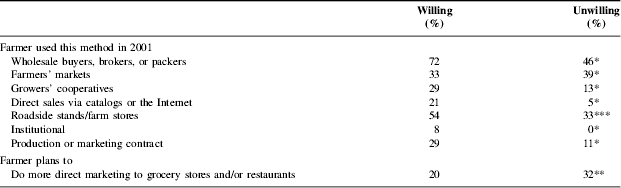
We did find some significant differences between organic farmers who were willing and unwilling to try GM crops on a number of practical and attitudinal issues (Table 3). The unwilling organic farmers are less likely than the willing organic farmers to take a libertarian position on the issue of payment for wildlife protection, but their positions are reversed on the issue of willingness to sacrifice short-term profits for long-term productive capacity. The only difference in the marketing activities variables we found between these organic farmers is that those unwilling to try GM crops are more likely to plan to do more direct marketing to grocery stores and restaurants.
Percentage of organic crop farmers who are willing to try GMOs who have used or plan to use one of these marketing methods compared to organic crop farmers unwilling to try GMOs who have used or plan to use one of these marketing methods (N=109, willing=25, unwilling=56, neutral=22).

Cross-tabulations of organic farmers willing to try GMOs and unwilling to try GMOs significantly different on these variables at P<0.10*, P<0.05** and P<0.005***. To save space, only significantly different results were included in the table.
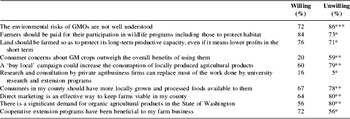
On the attitudinal variables, the unwilling organic farmers were more likely to think that the environmental risks of GM crops are not well understood (Table 4). They were also significantly different from the willing organic farmers on a number of economic and marketing variables. The unwilling seem to be skeptical of the notion that agribusinesses could take over public-sector research. But the most obvious distinction is that the unwilling organic farmers place a greater emphasis on consumer interests and direct marketing.
Percentage of organic crop farmers who are willing to try GMOs compared to organic crop farmers unwilling to try GMOs who agree or strongly agree with the statement (N=109, willing=25, unwilling=56, neutral=22).

Cross-tabulations of organic farmers willing to try GMOs and unwilling to try GMOs significantly different on these variables at P<0.10*, P<0.05** and P<0.005***. To save space, only significantly different results were included in the table.
Questions answered on a scale of 1–5. 1=Strongly disagree, 2=disagree, 3=neutral, 4=agree and 5=strongly agree.
Organic farmers who express an unwillingness to adopt GM crops are more likely than their willing counterparts to sell at farmers' markets and are more likely to plan to do more direct marketing to grocery stores and restaurants. However, it is difficult to make clear distinctions in this area because organic farmers in our sample who are willing to try GM crops are more likely than their unwilling counterparts to sell at roadside stands, to belong to grower cooperatives, to do direct sales via the Internet or catalogs, and to have production and marketing contracts.
It is also difficult to make clear distinctions on environmental and marketing attitudes between organic farmers who are willing or unwilling to try GM crops, because there were contradictory responses. The organic farmers who are willing to try GM crops were more likely to have a libertarian position on the question about getting paid to protect wildlife habitat, but less likely to have a libertarian position on the issue of forfeiting short-term profits for long-term conservation of production capacity.
What we found most curious is that 72% of the organic farmers who said that they are willing to try GM crops also said that the environmental risks of using these crops are not well understood. Combining this with the fact that only 20% agreed with the statement that the concerns of consumers regarding GM crops outweigh the benefits of using GM crops suggests that organic farmers who are unwilling to try GM crops have a greater communal orientation than those willing to try them. That may be because organic farmers who are willing to try GM crops have less direct interaction with consumers. This is supported by the result showing that organic farmers unwilling to try GM crops are more likely to support local production and marketing projects. Furthermore, organic farmers who are willing to try GM crops are more likely to say that agribusinesses could replace publicly funded research. This suggests that the organic farmers unwilling to try GM crops may have a slightly higher tendency to favor an alternative marketing approach. However, we would need a larger sample and more specific survey questions to move beyond this speculation.
Conclusion
Social scientists have yet to develop a consensus as to why farmers shift from conventional to organic agriculture. Some tend to portray the decision as one based primarily on economic considerations. Others point to the historical origins of organic agriculture as a form of resistance to agricultural industrialization and contend that organic agriculture is an idealized alternative. It is difficult to find overwhelming evidence that organic farmers place communal concerns and social and environmental consequences above their own economic interests, at least in part because organic agriculture offers many economic benefits. In an attempt to overcome this obstacle, we used definitions of ethical traditions to distinguish between libertarian, consequentialist and communitarian value orientations to determine if organic farmers are more likely than conventional farmers to be concerned about more than individual economic interests.
Although our results do not always fit neatly into our analytical categories, we did find some significant differences between conventional and organic farmers' marketing activities and attitudes toward marketing and the environment. Organic farmers are less likely to be libertarian than conventional farmers. Most importantly, organic farmers are less willing than conventional farmers to use GM crops. For the few organic farmers who did express a willingness to try GM crops, there was a tendency to be more like conventional farmers than non-willing organic farmers on a number of variables. Based on our analysis of conventional and self-reported organic farmers in Washington State, therefore, we believe that there is at least some validity to claims that organic farmers have a different value orientation from conventional farmers, even though perceived economic benefits are also important in their decision-making process.
Our results cannot be generalized outside of the state of Washington, but they are consistent with more general claims that organic agriculture in the United States and other parts of the world represent something more to farmers than economic viabilityReference Guthman, Jansen and Vellema7. Recently, the Organic Trade Association, which represents agribusiness firms including Kraft and Horizon, pressed the US Senate and the USDA to revise organic standards to allow synthetic substances like xanthan gum to be allowed in products with an organic labelReference Little19. The USDA may face similar requests to overturn the ban on GM crops in organic production. Our findings indicate that when requests to revise organic standards are raised, the USDA might consider how most organic farmers may be opposed to such revisions.