Der Einsame ist unfrei … der Gemeinsame frei.
Richard Wagner, The Artwork of the FutureRichard Wagner staked his claim to be Beethoven's only significant musical heir in numerous essays written over the course of several decades.Footnote 1 From the novella, A Pilgrimage to Beethoven (1840) to his centennial essay, ‘Beethoven’ (1870), Wagner's feeling of entitlement to Beethoven's artistic mantle developed alongside his own sense of purpose as a composer. The evolution in his musical style from The Flying Dutchman (1840) through music dramas of The Ring of the Nibelungs was accompanied by a growing conviction that his mature style began where Beethoven's had left off. A crucial moment in his evolution occurred in his treatise, The Artwork of the Future. Having fled the revolutionary battles in Dresden, Wagner wrote from Switzerland in late summer and autumn 1849. Because of his own recent experiences, it was no idle metaphor for him to portray Beethoven as a refugee, fleeing the barren territories of instrumental music by sea in search of a more fertile, word-rich, musical world:
With a will he flung out the anchor and this anchor was the word. Not the arbitrary, senseless word in the mouth of today's fashionable singer … but rather the necessary, all-powerful, all-uniting word into which the wide stream of most heartfelt emotion can pour … the word which the redeemed citizen of the world calls forth from the fullness of the world's heart, which Beethoven set as the crown on the head of his musical creation. This word was: ‘Joy!’ [Freude] … And this word will be the language of the artwork of the future.Footnote 2
In the 1840s and early 1850s Robert Schumann ceded no ground to Wagner about the proper course for the next generation of composers. He pursued his own path, all the while enduring Wagner's polemical prose in silence, even though Wagner criticized Schumann as well as Mendelssohn and other friends personally and derisively. One can only imagine Schumann's reaction to reading barbed passages in The Artwork of the Future such as this one, which has no need to mention Schumann by name to make it perfectly clear that he was talking about – and explicitly to – him:
You struggle in vain to placate your laughably selfish desire to ‘produce’ when you attempt to deny the obliteration of the world's history of music wrought by Beethoven's last symphony; save yourselves. But don't save your stupidity, which precludes you from ever understanding this work! Do what you will: walk straight past Beethoven, grope your way towards Mozart, gird yourself about with Bach, write symphonies with or without chorus, write masses, oratorios – those sexless embryonic operas! – make songs without words, operas without texts – you'll never create anything truly alive.Footnote 3
Certainly in the mid-1840s, when they both resided in Dresden, they had taken advantage of numerous occasions to meet. In my book Wagner, Schumann, and the Lessons of Beethoven's Ninth, I suggested that, influenced by the counterpoint in Beethoven's Ninth Symphony, these conversations must have contributed to the simultaneous shifts in their musical styles, to music that was more dependent on motives and motivic transformations than either of them had demonstrated in their earlier works.Footnote 4 Their musical styles in the years after 1845 show strong parallels in how musical ideas are presented and developed. And yet these similarities were easily overlooked for more than a century and a half, because in one crucial way they differed: Wagner believed that musical styles after Beethoven needed to combine poetry and music to create artworks that were theatrical; Schumann, however important poetry was to him as an inspiration for instrumental music, or as material for song, oratorio and Mass (and his one unsuccessful opera, Genoveva), believed that the path after Beethoven was sufficiently broad to allow for the composition of sonatas, string quartets, concertos and symphonies, as well as music with words. When Schumann was institutionalized in 1854, Johannes Brahms inherited both Schumann's aspirations for the future of German music and Wagner's scorn.
In the public battle for the rights to succeed Beethoven, Wagner's voice was by far the louder. On the one side, there were Wagner's essays, his music dramas, his ego and his success in building the Festspielhaus in Bayreuth; on the other side were Schumann's aversion to public display, his illness and early death. The one document that promoted Schumann's vision publicly was his final succinct essay, ‘Neue Bahnen’ (New Paths) for the Neue Zeitschrift für Musik, the article in which he singled out Brahms as a Messianic figure whose music would one day reveal ‘wonderful glimpses into the secrets of the spirit world’.Footnote 5 Written and published in the autumn of 1853, it was not quite 500 words long; in comparison, Wagner argued his ideas over 233 pages in The Artwork of the Future, and this was of course but one of several treatises. Drawing on notions of art in ancient Greece, he expounded on the need for the ‘three sisters’ of art – dance, music and poetry – to be rejoined in a complete work of art, a Gesamtkunstwerk. By bringing music and word together in the Ninth Symphony, Beethoven had shown the way, and in so doing, demonstrated (to Wagner) that all preceding instrumental music had been deficient. All contemporary composers, implicitly including Schumann and his followers, who continued to write music without words as if the Ninth Symphony had never happened, deserved contempt, because ‘Beethoven's final symphony is the redemption of music from its own inherent element into that of universal art. It is the human gospel of the art of the future. After it there can be no progress because the next step can only be the fulfilled artwork of the future: the universal drama to which Beethoven has forged the artistic key’.Footnote 6
The final chapter of The Artwork of the Future dealt with ‘The Artist of the Future’. Wagner began the section with a rhetorical series of questions and answers:
Who then will be the artist of the future?
Without a doubt the poet.
But who will be the poet?
Indisputably the performer.
But again: who will be the performer?
Necessarily the community of all artists …
The artwork of the future is a communal one and it can only arise from a communal yearning.Footnote 7
This was one assertion among many, I will argue, that inspired Robert Schumann and three young friends in the fall of 1853 to respond to Wagner in what was to be one of Schumann's last compositions, the collaborative – or communal – Sonata for Violin and Piano, known as the F.A.E. Sonata because it is based on the three notes that are implied by Joseph Joachim's motto, ‘Frei aber einsam’, (free but alone).Footnote 8 This sonata was composed jointly by Schumann (movements ii and iv), Albert Dietrich (movement 1) and Brahms (Scherzo), as a surprise for their friend, the violinist Joseph Joachim. I will first analyse this unusual work to identify unifying elements present in the four movements, particularly with regard to their treatment of the motto. Allusions play a role, especially regarding Beethoven. I'll conclude by explaining what I interpret as triangular connections between this sonata, Wagner's The Artwork of the Future and Schumann's article, ‘Neue Bahnen’. Wagner's treatise contains various passages that would have been easy for Schumann to construe as a personal attack on him and his music. I understand the F.A.E. Sonata as a pointed reply to Wagner. Since the sonata was not published until 1906, it was a reply that Wagner never received – at least not directly.Footnote 9 Brahms reworked certain ideas and techniques present in this Sonata later in his career, particularly the message contained in his Scherzo's allusion to Beethoven. While there is ample evidence that Schumann had long been aware of Wagner, it is worth acknowledging that no letter from this period indicates that Brahms was. Yet even if Brahms had arrived at the Schumann home ignorant of Wagner before fall 1853 (something I find implausible given the successes of The Flying Dutchman, Tannhäuser and Lohengrin, and the publication of full and vocal scores within a few years of their premiers, as well as Wagner's writings to that time), he had been living with the Schumanns for several weeks. Moreover, his friendship with Joachim, who was close to Franz Liszt and who had been present in Weimar for the premiere of Lohengrin, would have provided other opportunities for Brahms to form opinions about Wagner. And it is clear from the record discussed below, that Schumann had taken the lead in organizing the F.A.E. Sonata.
* * *
But first, for the sake of biographical context, a chronology of the four crucial weeks of October 1853: at his home in Düsseldorf on 30 September 1853, Schumann encountered his last and most important disciple, 20-year-old Johannes Brahms, who had been sent by their mutual friend Joachim. By 8 October Schumann was thoroughly persuaded of Brahms's genius, and said so in a letter to Joachim, calling him a ‘young eagle’, ‘a true apostle who will inscribe revelations that many Pharisees … will not unriddle for centuries to come’.Footnote 10 In the very next days, Schumann returned to these thoughts formally as he began writing ‘Neue Bahnen’ about Brahms for the Neue Zeitschrift für Musik. He finished this the day before Joachim turned up unexpectedly (this and other events are taken from Schumann's Household books).Footnote 11 The very next day, Schumann announced the plans for the F.A.E. Sonata. On 16 October he performed disastrously as conductor of the Gesangverein in a concert of a Mass by Moritz Hauptmann. Schumann was so removed from the musicians he was ‘leading’, that he failed to notice the final cadence of the last movement and continued to conduct into what must have been an increasingly bizarre silence. He was also preparing the Musikverein for their 27 October symphonic concert, an event that included Joachim's Hamlet Overture. That concert was evidently little better, with the result that the Board of the Musikverein decided to restrict Schumann to conducting his own works.Footnote 12 On 28 October ‘Neue Bahnen’ was published; on the twenty-ninth came the unveiling of the F.A.E. Sonata in a private musical evening at the Schumanns’. In rapid succession Schumann's circle experienced the completion of the F.A.E Sonata, the Musikverein concert, the publication of ‘Neue Bahnen’ and the presumably jovial performance of the F.A.E. Sonata for Joachim.
The idea and the execution of the F.A.E. Sonata involved more than a little gamesmanship. One of the stated goals of the composition had been to ask Joachim to identify which movements had been composed by which person, although it was quickly evident to him who had composed what. Then, too, while many of the statements of the principal three-note motive were instantly recognizable, others were presented transformed in one manner or another. Schumann provided a clue to the presence of retrograde presentations in the inscription he wrote on the title page: ‘In Erwartung der Ankunft des verehrten und geliebten Freundes Joseph Joachim schreiben diese Sonate Robert Schumann, Albert Dietrich und Joh. Brahms’ (In Expectation of the Arrival of the esteemed and beloved Friend Joseph Joachim, this sonata is written by Robert Schumann, Albert Dietrich and Johannes Brahms). The first letters of the first three nouns are E-A-F, a retrograde form of the motive that comes frequently in the sonata. And inversions of F-A-E occupy a special place; indeed, the inversion of the notes G#-E-A may predate the actual F-A-E motive because Joachim had at least since December 1852 used these notes to signal the name of his beloved, Gisela von Arnim, the daughter of Bettina von Arnim and the niece of Clemens Brentano.Footnote 13
For Schumann the creation of motives from names took him back to the very beginning of his career as a composer. The Abegg Variations, Op. 1, and the F.A.E. Sonata frame virtually all of his compositional output. Written in 1829–30, the Variations on the name Abegg translate the fictitious name of a friend into musical notes. He followed this with Carnaval, Op. 9, subtitled Scènes mignonnes sur quatre notes (1834–35). This set of 21 short pieces was based on three musical ‘sphinxes’ derived either from the musical letters of his name – S (E@), C, H (B$) and A – or from those of the hometown of the woman who was briefly his fiancée, A-S-C-H. John Daverio described Schumann's game as a form of romantic wit (Witz) practiced by his favoured author, Jean Paul. Daverio noted the freedom with which Schumann treated his musical sphinxes:
there is hardly a single piece in which the generating Sphinx is coterminous with a motive, let alone a theme. Often a Sphinx will head off an opening idea, but its frequent compression into a tiny space makes it barely recognizable … In other instances the Sphinx is hidden in the bass or the middle of a phrase’.Footnote 14
This motivic ubiquity is also a feature of the F.A.E. Sonata.
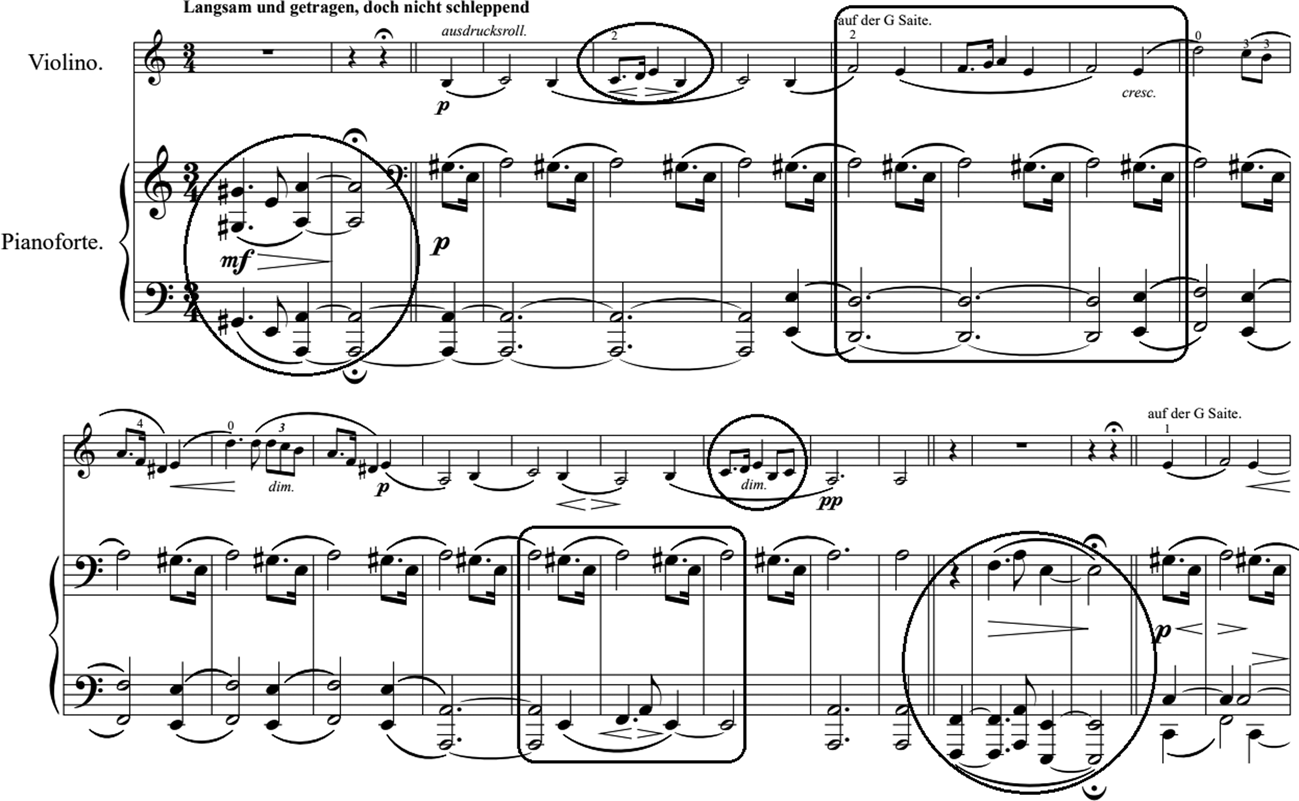
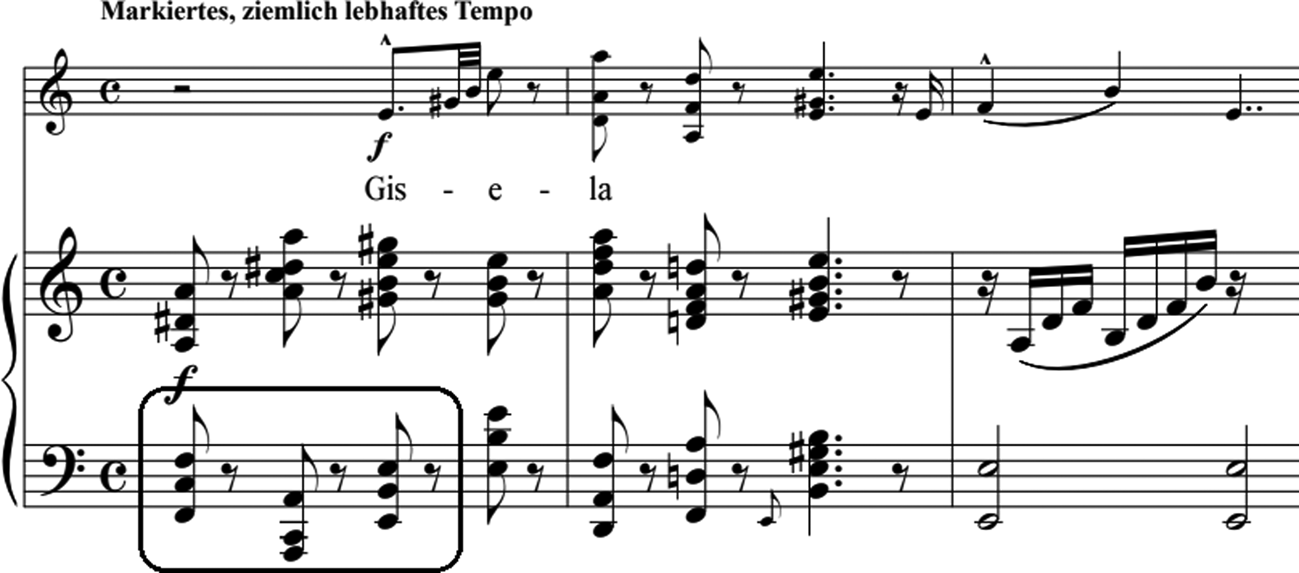
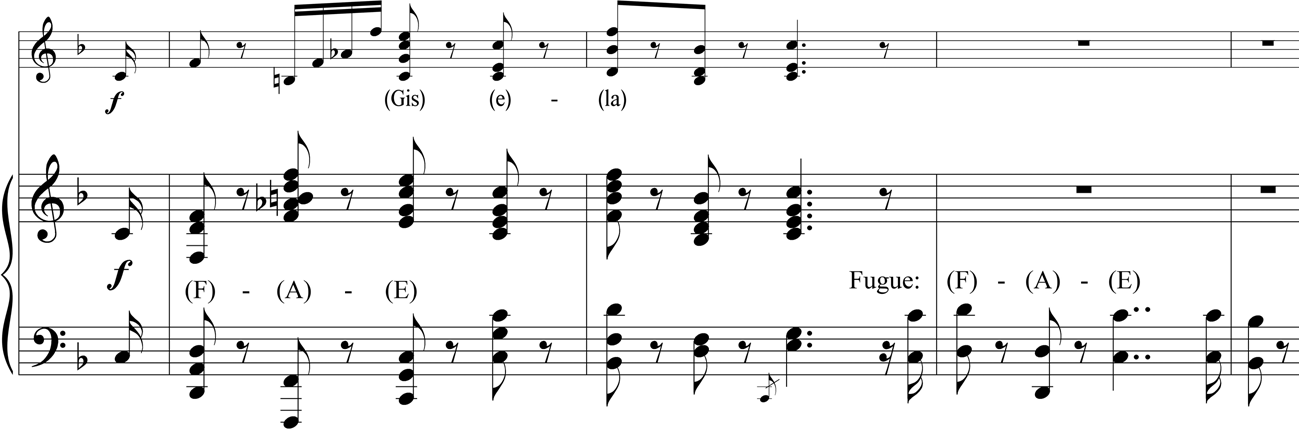
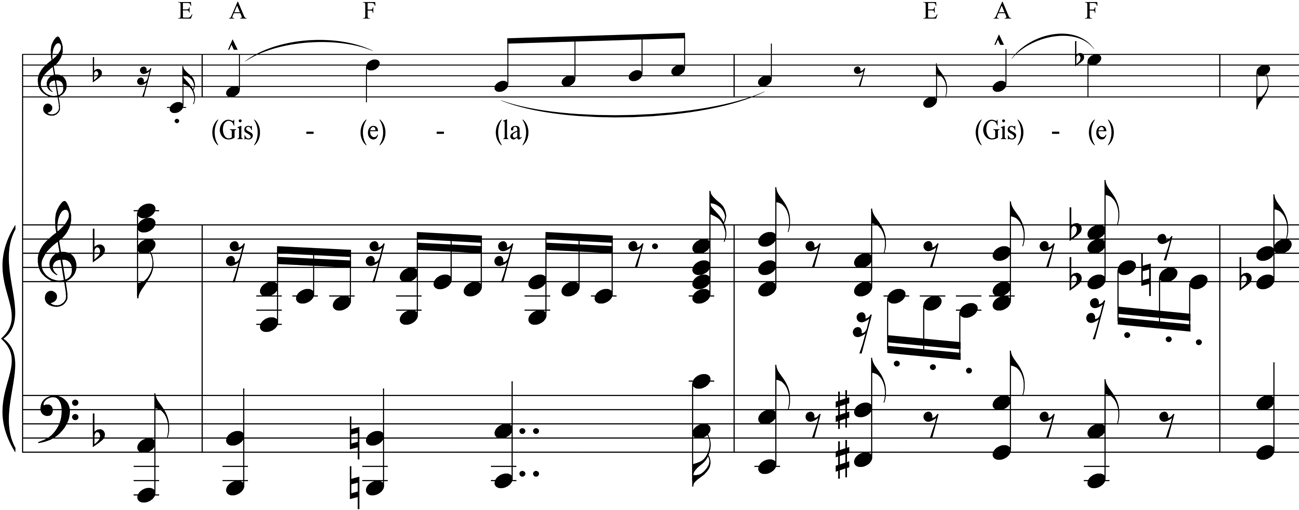
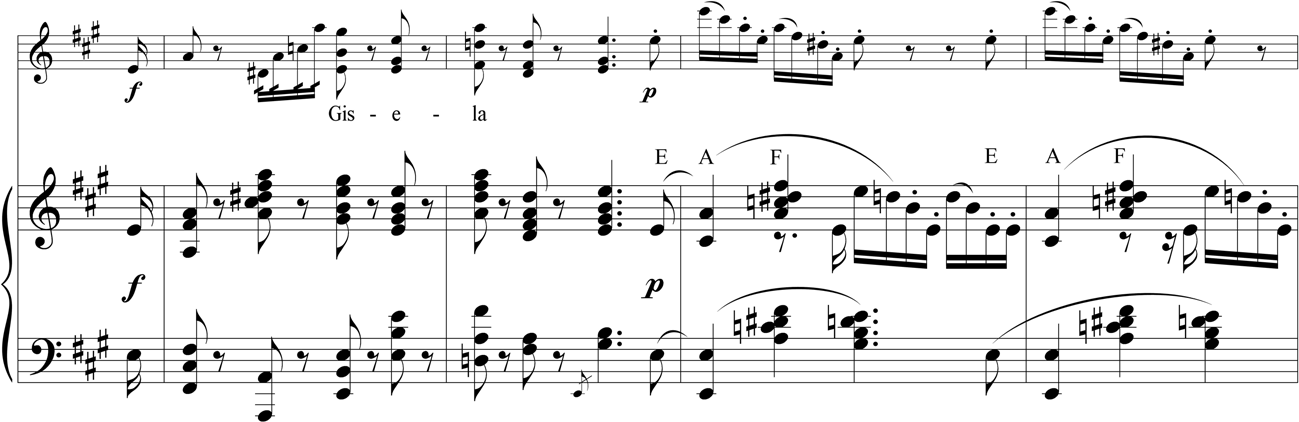
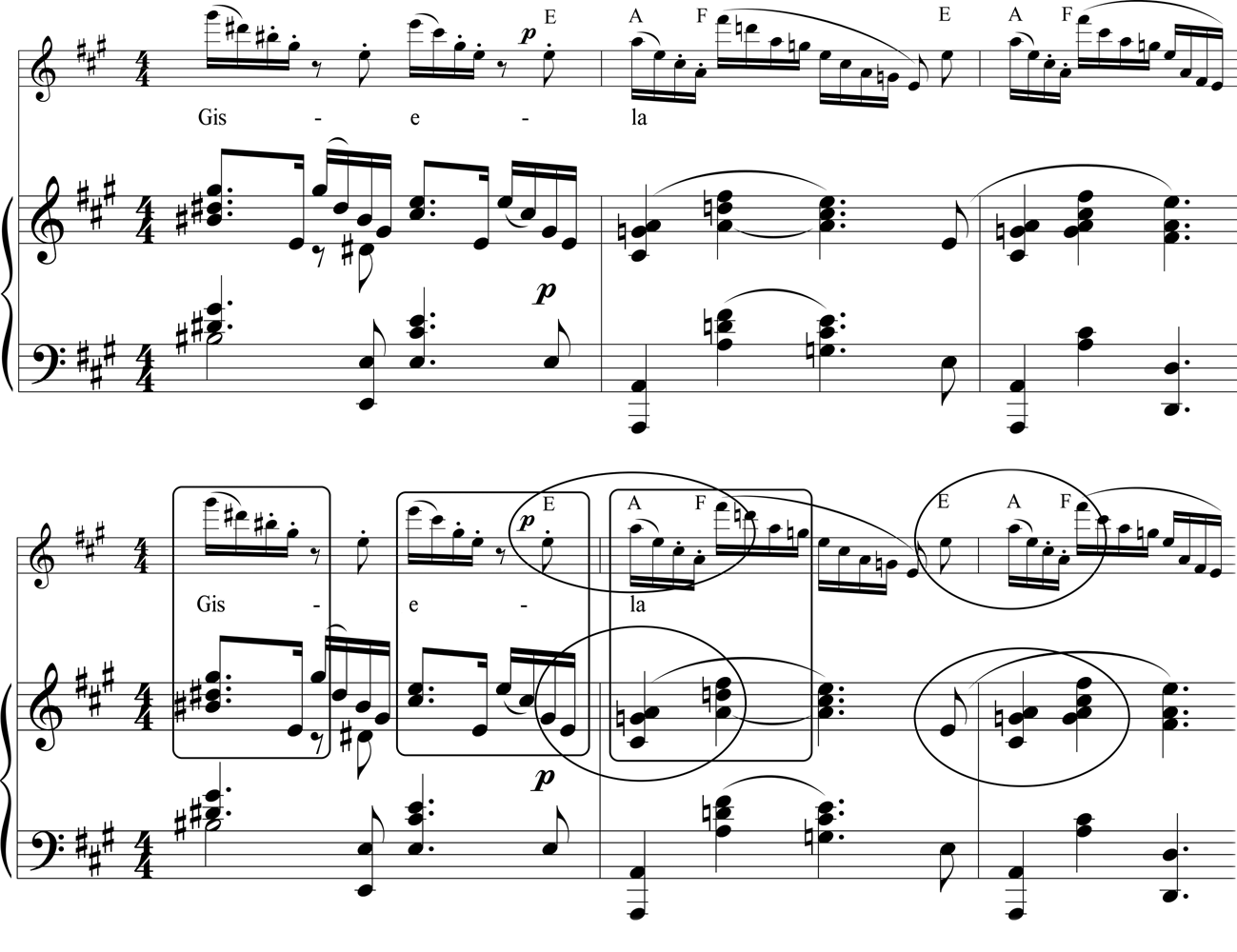
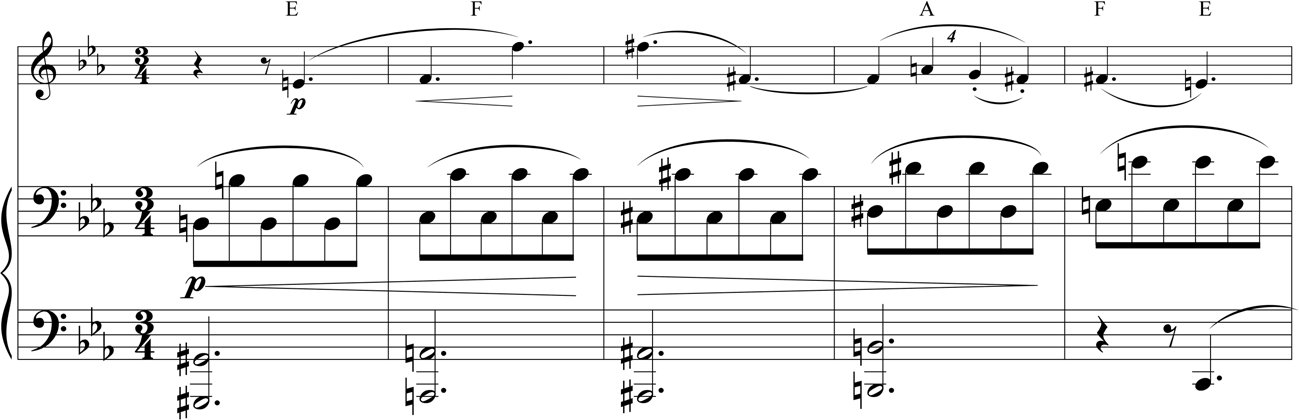
In November 1853, a few weeks after the F.A.E. Sonata had been composed, Joachim combined his motto and Gisela's in the second of his Drei Stücke, Op. 5, for violin and piano, the melancholic Abendglocken. ‘Gis-e-la’ recurs obsessively, regularly combined with F-A-E or transpositions.Footnote 15 Example 1 shows the opening phrases, with the two motives circled. Joachim applies a few techniques from the recently completed F.A.E. Sonata: the motives combine (shown in rectangles); the motives can be expanded with passing notes (violin, first rectangle); the pitches of the motive can occur in sets with repetitions of some but not all of the pitches, as in the first rectangle, where the violin has F-E-F-(G)-A-E-F-E; and motives may be transposed to other pitches (small circles). Indeed, the first appearance of the F-A-E motive appears in transposition rather than on the pitches that represent the words of the motto.
Joseph Joachim, Drei Stücke, Op. 5, no. 2, Abendglocken, bars 1–21

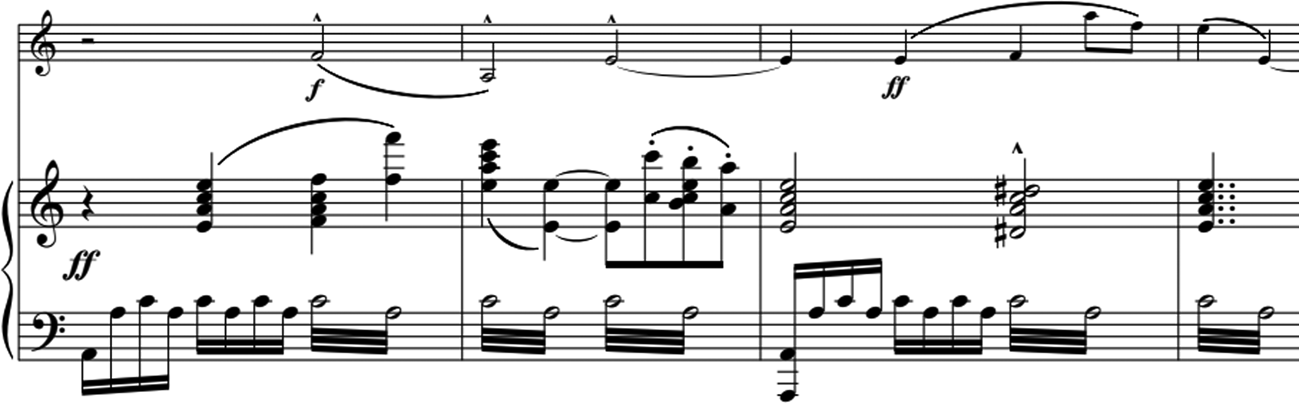
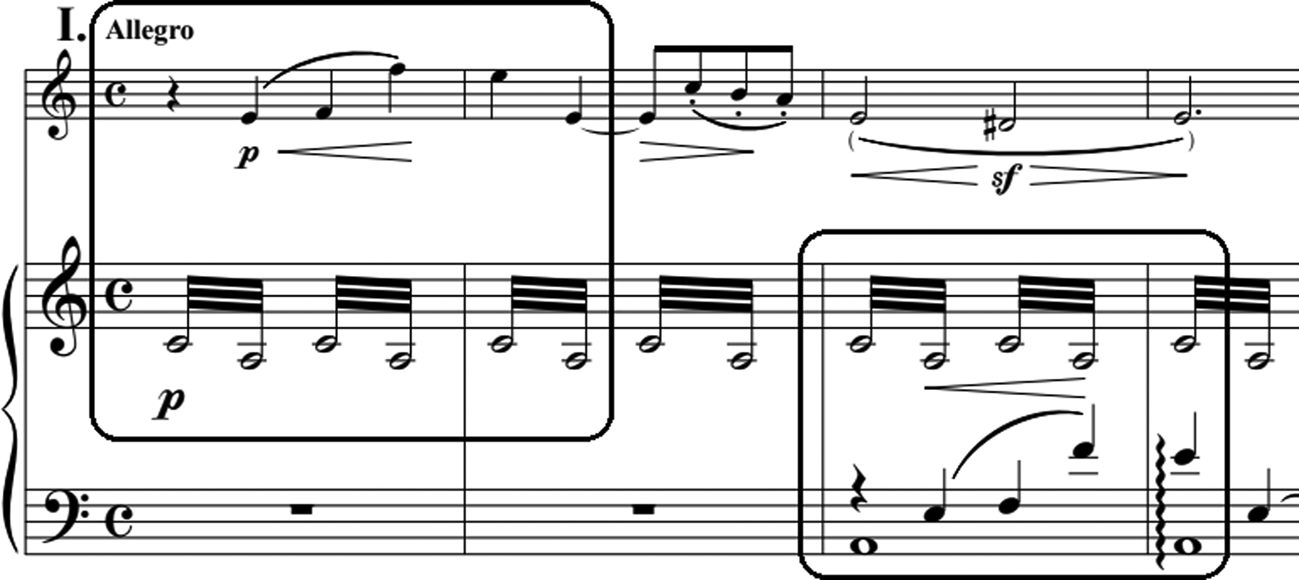
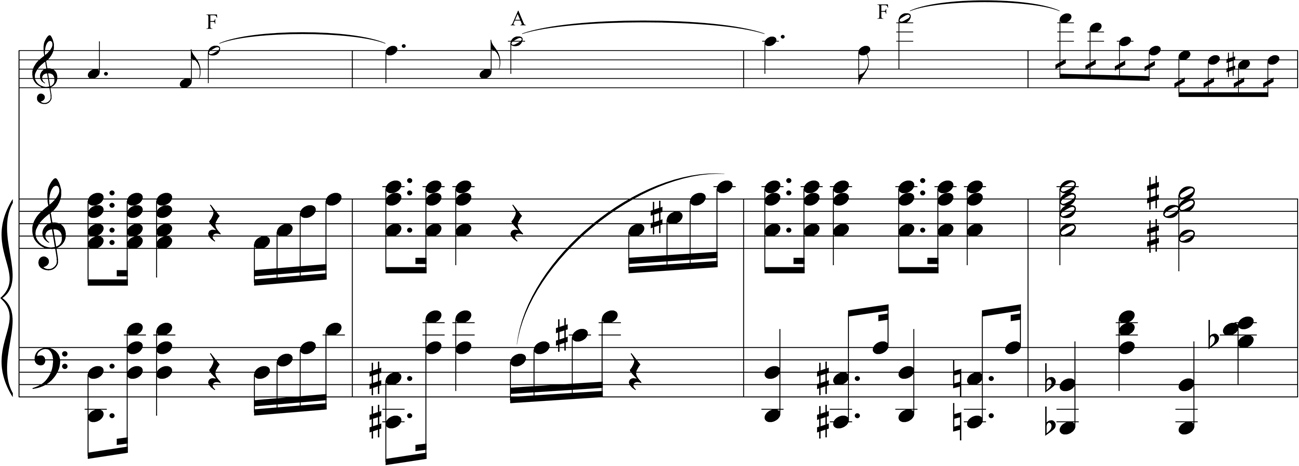
As the lead composer of the F.A.E. Sonata, Dietrich began the first movement contrapuntally, combining the F-A-E cypher with a motive that made a pointed allusion to Joachim. He avoided the Gisela motive altogether, and emphasized easily recognizable forms of F-A-E, beginning with the long form of F-A-E, with a falling sixth to the note A, rather than a rising third, which I'll call the short form (Ex. 2); the violin continues with the notes E-F-A-F-E, as if to say ‘einsam, frei, aber frei, einsam’.Footnote 16 But in Example 2 the right hand of the piano repeats the opening bars of the movement, now demonstrating its function as a counterpoint to F-A-E. Those first bars (Ex. 3) provide the symbolic notes, but in a different order, A-E-F; with this order Dietrich alludes to the opening of Joachim's first Violin Concerto in G Minor, Op. 3, a work Joachim had composed in 1851–52 but did not publish until 1854 (Ex. 4). The sequence of notes in the opening motives of the concerto and sonata is the same: a beginning bass note is followed a fifth higher, then a half-step and an octave. For the second theme Dietrich devised an elongated version of F-A-E with the notes separated (Ex. 5), providing the beginning, ending and pivot pitches of the theme. And the first use of retrograde occurs in the development, where a new theme incorporates two transposed statements of E-A-F (Ex. 6). The embedding of these notes in the middle of a theme is a technique Schumann had used with the musical letters of his name in Carnaval. This passage sounds to me as if Dietrich is imitating Brahms, with twos against threes and alternations between statements in minor and major. When this material returns in the coda, it does so with the proper pitches (Ex. 7).Footnote 17
Albert Dietrich, F.A.E. Sonata, mvt i, bars 19–22

Dietrich, F.A.E. Sonata, mvt i, bars 1–4

Joseph Joachim, Violin Concerto in G Minor, Op. 3, mvt i, bars 1–4

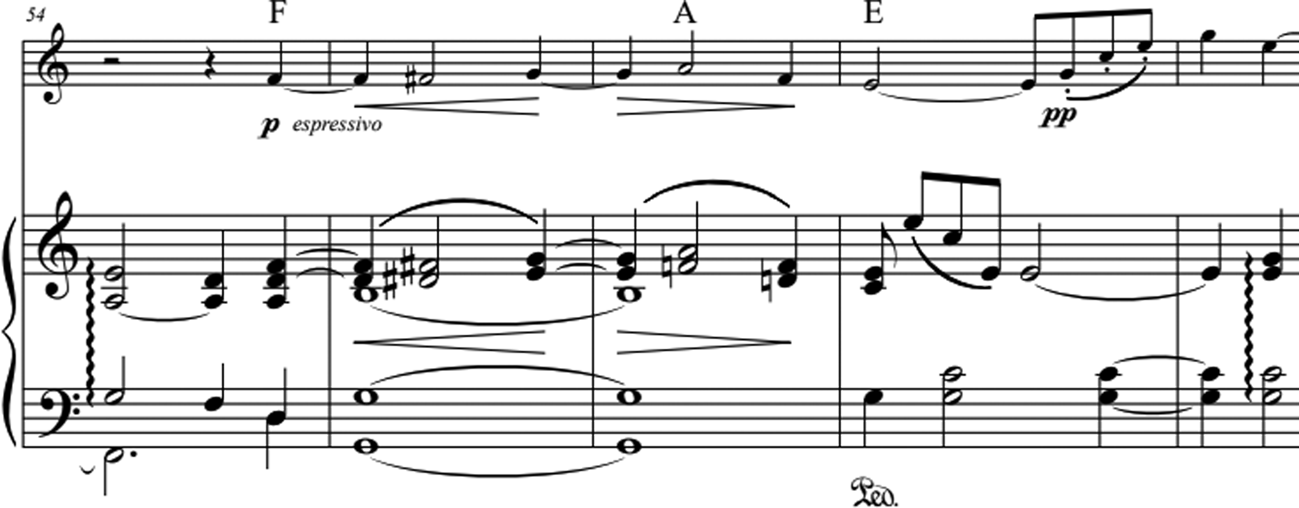
Dietrich, mvt i, bars 54–58

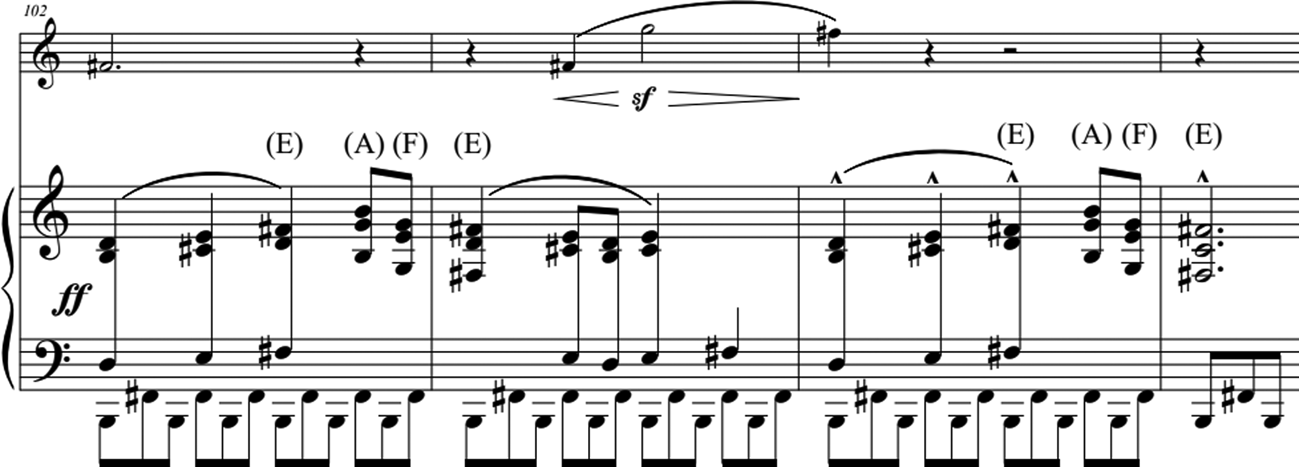
Dietrich, mvt i, bars 102–105

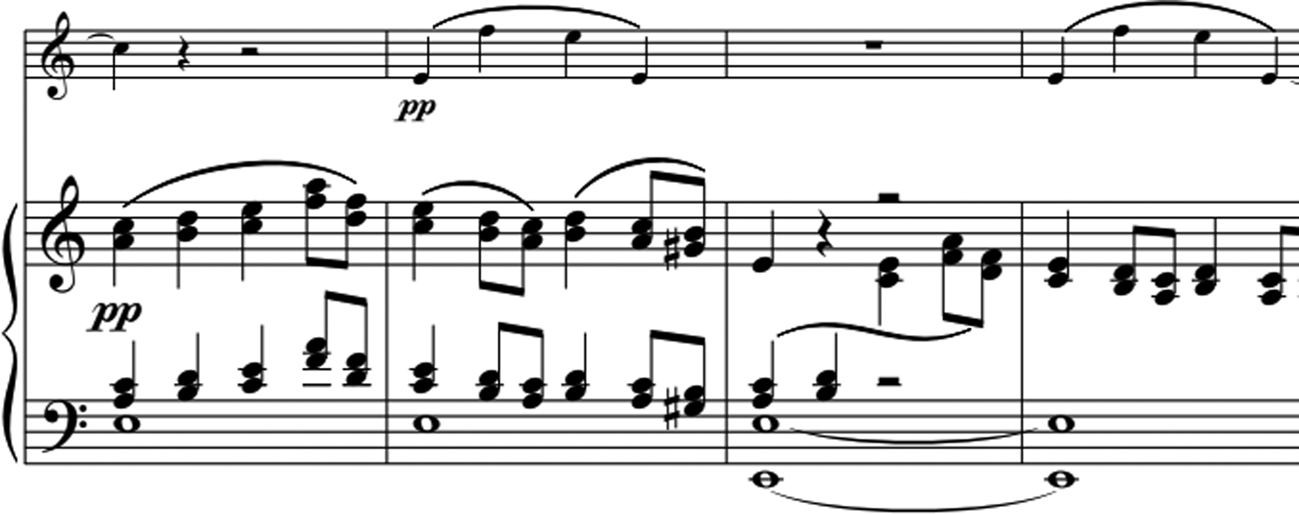
Dietrich, mvt i, bars 312–315

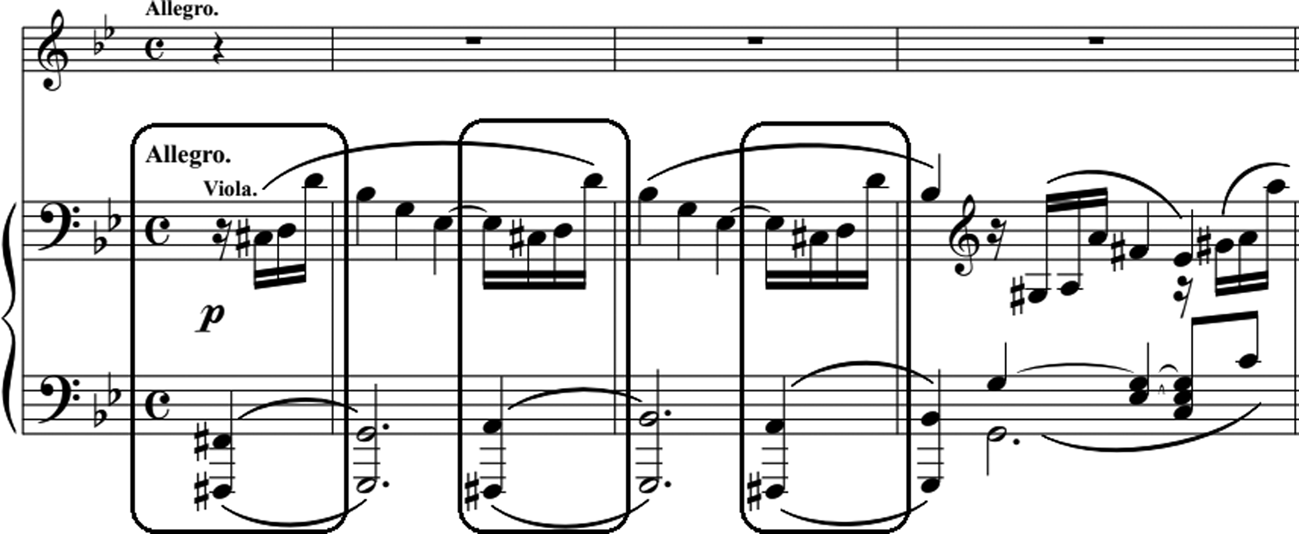
For his contribution, Schumann has different strategies in the second and fourth movements. In the slow second movement he begins with a straightforward iteration of the long form of F-A-E and then repeats it many times, on occasion with random orders of the three pitches that resemble those Dietrich had used (Ex. 8). He also has several transpositions, some of which transform the intervals, replacing the falling minor sixth with a major sixth, as in bars 9–10 when the motive appears down a step (E-G-D). In the finale Schumann combines F-A-E with its inversion, Gis-e-la (Ex. 9). There are also transpositions, as with one a minor third low on D-F-C (Ex. 10), which again alters the intervallic relationships between notes. This inexact version of the motive immediately becomes the subject of a fugue. From the end of the fugue Schumann repeats this motive at successively higher pitches, returning step-by-step to reach the ecstatic arrival in A major at bar 80 and the proper pitches. Similarly, Gis-e-la appears a step below its usual pitches on F-D-G (Ex. 11). But at the same time the pickup that had been introduced with the fugue now is given a pitch that allows for a double reading of these notes, with the pick-up beginning a new form of the retrograde motive E-A-F. Between this phrase and the conclusion of the sonata, this ascending ninth version of E-A-F returns many times. These double motives (E-A-F and Gis-e-la) repeat a step higher as Schumann elevates the motive on its way back up to its joyous return at its original pitch at bar 80 and again at bar 136 (Ex. 12); because this return is to A major, the F of F-A-E becomes F#. Here for the first time, the violin – that is, Joachim – gets to join in the sounding of Gis-e-la at its defining pitches. The repeat of this phrase leads to another seemingly ecstatic version of Gis-e-la, which is linked to the retrograde version of F-A-E (Ex. 13). The sonata thus culminates with a union of the two motives that allows the E-A of Gis-e-la to literally become one with the first two pitches of Joachim's retrograde motive. In both of these last two examples, the piano adds two statements of E-A-F in its new form.
Schumann, F.A.E. Sonata, mvt ii, bars 7–9

Schumann, mvt iv, bars 1–3

Schumann, mvt iv, bars 56–60

Schumann, mvt iv, bars 71–74

Schumann, mvt iv, bars 136–140

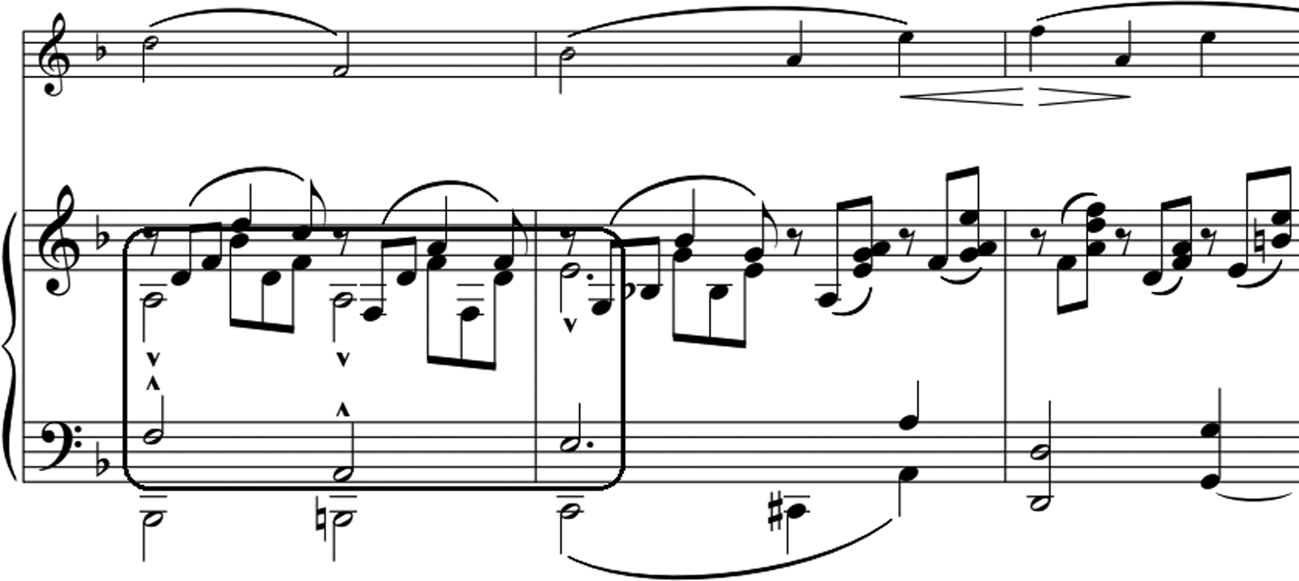
Schumann, mvt iv, bars 142–144

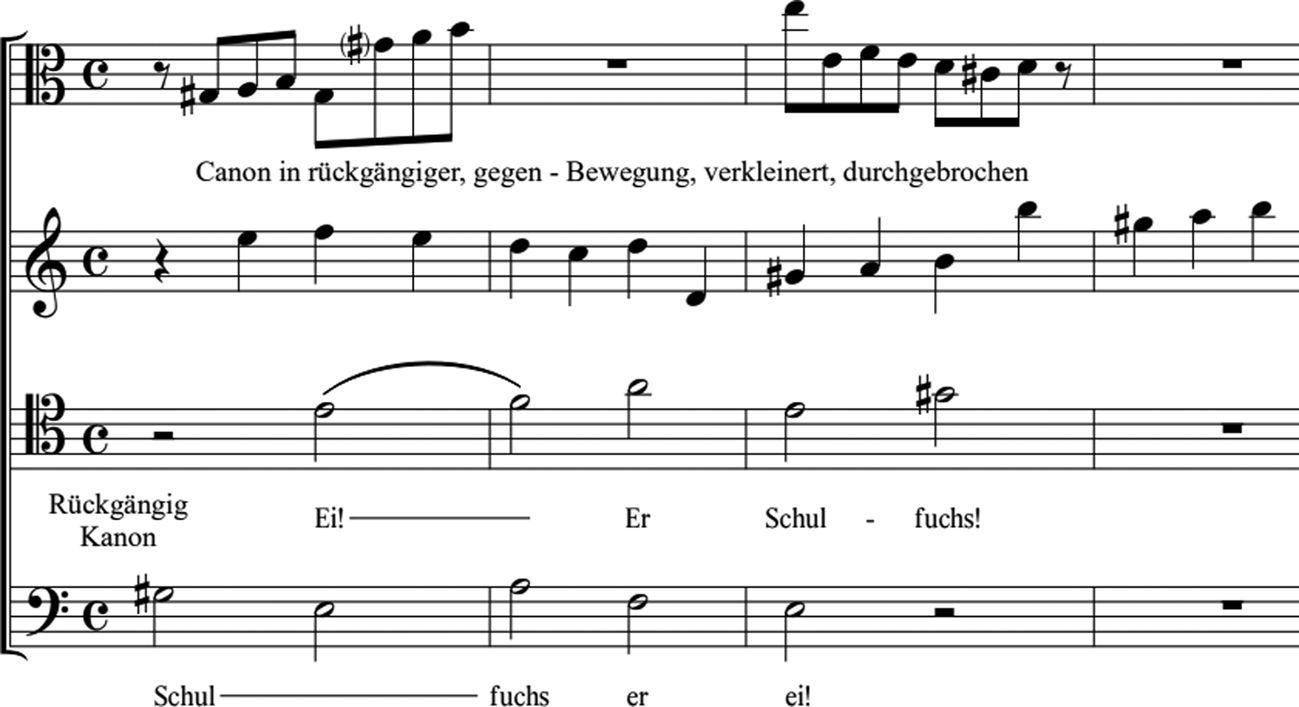
If the level of motivic complexity involved in creating a motive that combines a retrograde of F-A-E with its inversion seems improbable because it is beyond what we might expect from a composer in late 1853, it is actually child's play when compared to Joachim's treatment of the same three-note cells two-and-a-half years later (Ex. 14). In a counterpoint exercise that Joachim sent to Brahms, the bottom voice elides the last note of Gis-e-la with the first of A-F-E, while the contrapuntal voice above it sounds its retrograde (E-F-A/la-e-Gis). The third voice from the bottom is a free counterpoint accompanied in the voice above it by its retrograde inversion in diminution. And there are yet three other voices involved in this impressive display of contrapuntal pedantry.Footnote 18
Joseph Joachim counterpoint exercise sent to Brahms on 30 April 1856, lower four voices

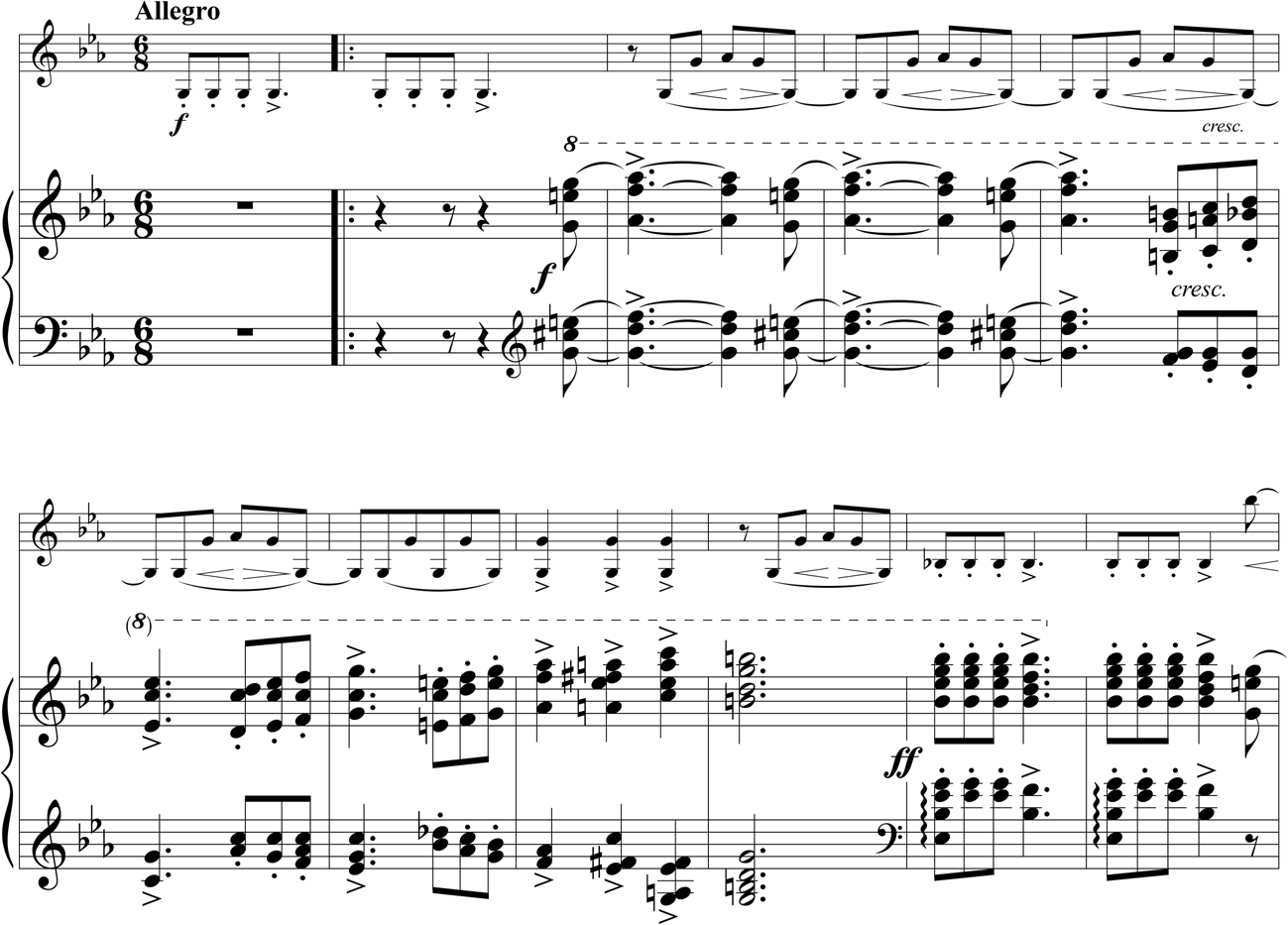
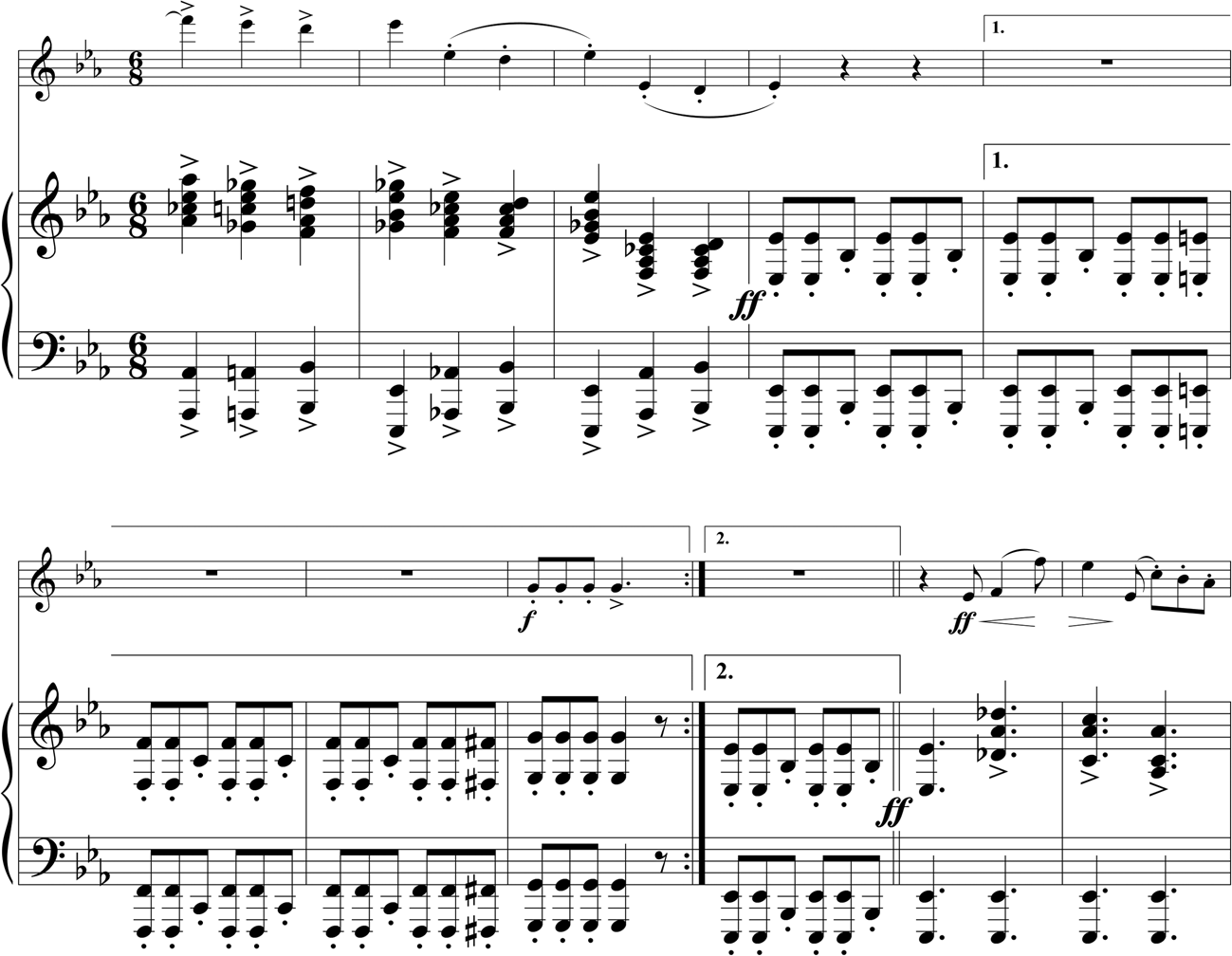
Brahms avoids the F-A-E motive in easily audible forms. In the absence of a clear F-A-E reference at the beginning, what has struck all who have written about this movement is the obvious tonal and rhythmic allusion to Beethoven's Fifth Symphony (Ex. 15).Footnote 19 In the first eight notes of this C-minor movement, and again in the last two bars of this example, Brahms recalls the opening rhythm of Beethoven, a recollection he would later return to in his Symphony No. 1 in C Minor. What is also striking about this movement is the metric tension between the violin and piano, which frequently play at cross purposes. Listeners perceive the downbeat of the violin to be in the middle of the bar, but then the piano enters with a contrasting emphasis on the notated downbeat. Ryan McClelland identifies several different types of rhythmic-metric dissonance in this movement.Footnote 20 Piano and violin join together in bar 7 with yet another pattern, a unifying hemiola before the piano briefly accepts the violin's mid-bar emphasis. By bar 12 the violin has shifted to the downbeat emphasis of the pianist's right hand, while the left hand takes up the off-beat accent. The hemiola soon returns extended over three bars (Ex. 16). McClelland also notes a tonal equivocation:
A striking tonal aspect of the F-A-E scherzo is its emphasis on dominant, rather than tonic, harmonies. The first phrase modulates away from C minor without ever prolonging a harmony built on C … in fact, the first background prolongation of C arrives only at the end of the scherzo proper.Footnote 21
Brahms, F.A.E. Sonata, mvt iii, bars 1–11

Brahms, mvt iii, bars 23–33

Brahms packs several allusions into this Scherzo. Many have observed the violin's quotation of Dietrich's first movement motive in the last two bars of Example 16, a motive we can now recognize as Dietrich's allusion to Joachim (Ex. 3). But Brahms, as he often would throughout his career, devised a double allusion in these two bars. Underneath this evocation of both Dietrich and Joachim, the piano has a reference of its own, a quotation of the opening notes of Schumann's Piano Quintet, Op. 44. Within a few bars of this, Brahms arrives at a possible F-A-E allusion (Ex. 17), referring again to Dietrich with the expanded version he had introduced in the development (Ex. 5), and the octave leap also invokes Dietrich's opening allusion to Joachim's violin concerto. There is more that could be said about Brahms's Scherzo, but for the moment, I'll observe only that his C major conclusion completes the trajectory of the allusion to Beethoven's Fifth that he began with, concluding grandiosely in the major mode, pounding on the tonic chord. McClelland considers this ending to be less than successful, noting that ‘tonal resolution and rhythmic consonance are never brought to the main thematic material of the F-A-E Scherzo; instead, thematic material derived from the trio provides the movement's victorious conclusion’.Footnote 22 Yet Brahms may have had an anti-Wagnerian intent in this semi-triumphal codetta.
Brahms, mvt iii, bars 54–58.

* * *
What could Wagner possibly have to do with any of this? In The Artwork of the Future, Wagner went on at some length about the communal character of artists of the future. Brahms's arrival on his doorstep at the end of September 1853 presented Schumann with a community of ambitious young artists – also including Albert Dietrich and Joseph Joachim – who were eager to learn from him. Wagner had described the inevitability and the potential of such a community in his essay:
The artwork of the future is a communal one and it can only arise from a communal yearning. This yearning … is necessarily at the core of the individual arts and is practically only thinkable in a community of all artists; and the coming together of all artists in time and place and for a particular purpose is what makes up this community.Footnote 23
The first and truest artistic drive is only revealed in the urge to step out of life into the artwork … The urge to communicate is what defines community. … Therefore it is only in communal life that the urge to communicate life coherently through art will arise; only the community of artists can express it, only communally can they meet it.Footnote 24
Once the artist, through the force of his passion, has raised his vision to a communal one, from then on the artistic project becomes a communal one: however, just as the focus for the action to be performed is the hero of the drama, so the focus for the communal artwork is the performer who will portray this hero: his fellow performers and other colleagues have the same relation to him in the artwork as those who played a part in the hero's story.Footnote 25
In the F.A.E. Sonata, Joachim is both the hero and the performer who portrays the hero. Gisela von Arnim was also present as a character in Joachim's story, and her presence is duly woven into the musical fabric of this communally composed sonata. His other colleagues are included through their compositional efforts, but also I think in specific musical gestures, whether through allusion or musical cipher. Dietrich, for example, in his coda makes a very straightforward statement of the F-A-F motive that Brahms's biographer Max Kalbeck identified as Brahms's motto, ‘Frei aber froh’, free but happy (Ex. 18). Dietrich had first introduced this motive at the beginning of the development section, down a step on the pitches E-G-E.Footnote 26
Wagner continues,
The free artistic community is therefore the basic prerequisite for the artwork itself. From here the performer steps forth, rises … to the level of poet who lays down the community's artistic rules only to step down again from this height and fully sink back into the community. The work of this rule-maker is therefore only temporary, extending to the one particular artistic case, inspired by him and his own personality, then raised up to a communal one. … The dictatorship of the performer poet comes to a natural end once he fulfills his vision, that very vision which he had raised to a communal one and with which he merged as soon as the community recognized it as such.Footnote 27 Thus nothing in this artistic alliance can become static and stuck: it comes together only for one day, only for one purpose, to celebrate this one particular hero.Footnote 28
Dietrich, mvt i, bars 277–280.

In my interpretation the ‘rule-maker’ was not Joachim but Schumann, the obvious inspiration for his young disciples, the poet who laid down ‘the community's artistic rules only to … sink back into the community’. That this was an alliance of composer-performers that came together for one purpose on one day is clear both from the dedication and the historical record.
If in banding together, Schumann, Brahms and Dietrich took their cue from Wagner, they likely did so only to take exception with numerous other passages in his essay. Wagner stresses that artworks in the future will be produced by a community of ‘free artists’ (my emphasis). Although no documentary evidence exists to draw on, there is a strong circumstantial argument to be made that Wagner's discussion of freedom inspired Joachim's motto as a witty retort. I will argue that Joachim coined ‘Frei aber einsam’ as a pointed contradiction of Wagner's statement: ‘Der Einsame ist unfrei, weil beschränkt und abhängig in der Unliebe; der Gemeinsame frei, weil unbeschränkt und unabhängig durch die Liebe’.Footnote 29 I render this in English as, ‘The isolated individual is not free (Der Einsame ist unfrei), because limited and dependent in lovelessness; a member of a community (der Gemeinsame) is free, because unlimited and independent through love’. But the contrast between Einsam and Gemeinsam is tricky to translate. William Ashton Ellis understood Wagner to say: ‘The solitary unit is unfree, because confined and fettered through un-Love; the associate is free, because unfettered and unconfined through love’.Footnote 30 The recent translation by Emma Warner translates this instead: ‘Alone we are not free because we are limited and dependent in the absence of love; together we are free because we are unlimited and independent through love’.Footnote 31 Warner's is more elegant, but since Wagner's philosophical German is hardly idiomatic, Ashton's laboured English has its own merits, including recognition that ‘der Einsame’ could refer to individual art forms (music, poetry, dance) as well as individual human beings. While I have offered a third reading of the original German, I do so not to pose mine as superior, but to say that the thoughts that it conveys are also encompassed in the range of meanings German readers could have understood as contained in Wagner's prose.
Wagner had employed the same contrast between ‘einsame’ and ‘gemeinsame’ a few pages earlier: ‘Nicht kann der einsame, nach seiner Erlösung in der Natur künstlerisch strebende Geist das Kunstwerk der Zukunft schaffen; nur der gemeinsame, durch das Leben befriedigte, vermag dieß’.Footnote 32 Ellis's translation of this sentence contrasts ‘lonely spirit’ with ‘spirit of fellowship: ‘It is not the lonely spirit, striving by Art for redemption into Nature, that can frame the Art-work of the Future; only the spirit of Fellowship, fulfilled by Life, can bring this work to pass’.Footnote 33 In her version, Warner instead pairs ‘solitary mind’ with ‘community spirit:’ ‘The solitary mind, searching for redemption in nature through art cannot create the artwork of the future; only community spirit satisfied by life can achieve this’.Footnote 34 Wagner elaborated on the connection between freedom and community, again with the same opposition: ‘there is a sad misunderstanding about freedom conceived by those who wish to be free in isolation, in solitude (Einsamkeit). The impulse to set yourself apart from the community (Gemeinsamkeit), to live for yourself, to be quite particularly free, to seek to be independent can lead only to the exact opposite of what you wilfully seek: to complete lack of independence’.Footnote 35
My interest in these passages is to explore how Schumann and his circle might have read them. Wagner's declaration that loners are not free evidently provided Joachim with a personal motto that was both a statement of allegiance to like-minded friends and a musical link to the name of the woman he was trying unsuccessfully to marry. My hypothesis is supported by several aspects of the F.A.E. Sonata that respond to other ideas in The Artwork of the Future. Wagner's opinionated criticisms of those who attempted to follow Beethoven by writing yet more instrumental music evidently sparked a sense of shared musical purpose based in part on contrast with Wagner. Soon after declaring loners to be ‘not free’, Wagner explains his social conception of freedom:
Now there is a sad misunderstanding about freedom conceived by those who wish to be free in isolation, in solitude (Einsamkeit) … In order to be different there must be something to be different from. In order to be yourself, you must first know what you are; yet you can only recognize this by contrast with what you are not.Footnote 36
I understand this to be a comment that Brahms and Joachim read as an invitation to define themselves against Wagner, an invitation they were patently happy to accept.
Wagner has much to say about music and counterpoint that may motivate particular aspects of the F.A.E. Sonata. In his blatant references to Beethoven's Fifth Symphony, his opening rhythmic motive as well as his progression from C minor to C major, Brahms responds to Wagner's dismissal of all who followed Beethoven in writing instrumental music. Brahms seemed proud to declare himself not only to be a member of the ‘thoughtless army’ of Beethoven imitators, but to be its leader. Wagner pontificates:
What inimitable art did Beethoven not deploy in his C minor Symphony in order to steer his ship out of the ocean of endless longing into the harbour of fulfilment? He succeeded in driving the expression of his music to the level almost of a moral resolution without ever expressing it directly; and after each intonation of the will we have the unsettling feeling that, without moral guidance, we might equally fall back into sorrow as be led onward to victory …
Yet who could feel less satisfied at such a victory than Beethoven himself? Did he desire another such victory? No doubt the thoughtless army of imitators did, foreseeing endless acclaim in the jubilant triumph of the major key after the tribulations of the minor – but not the master himself, who was destined to write the world history of music through his works.Footnote 37
Brahms – I think in response – flagrantly evokes the Fifth, rhythmically and tonally; indeed, the F.A.E. Sonata as a whole takes the minor-to-major mode trajectory as its plan, moving from A minor to major, celebrating the musical union of F-A-E and G#-E-A. His rhythmic allusion to Beethoven's Fifth replicates an allusion also evident in his Third Piano Sonata, Op. 5, and it lays the groundwork for what he did decades later in the first movement of his First Symphony. But by his perfunctory and unconventional C-major conclusion, Brahms may have acknowledged that, on this issue at least, Wagner had a point: one could not simply continue blindly reapplying Beethoven's narrative strategies. If the C-major conclusion of Brahms's F.A.E. Scherzo seems unconvincing compared to any number of Beethovenian exemplars, it is partly a question of dimensions – one cannot expect the same release of tension after one movement; but it also demonstrated that Wagner's critique was wrong: the minor to major modal shift could still be applied in new ways.
When years later Brahms succeeded in finishing a C-minor (to major) symphony, the first movement concluded with a similarly brief turn to major, one not in the least triumphal. McClelland's conclusion that ‘tonal resolution and rhythmic consonance [of the Scherzo] are never brought to the main thematic material’ measures this musical ending against compositions that had other poetic aims. He criticizes it for failing to be a composition that Brahms was specifically trying not to write. Brahms's strategy in this Scherzo foreshadows patterns applied more expertly in his First Symphony. As I have suggested, in the ending that he wrote for the first movement of his First Symphony, Brahms evidently had as a model not just Beethoven but also Wagner, in the conclusion to his early Faust Overture, a movement from 1840.Footnote 38 Mark Evan Bonds also noted the same strategy in the First Symphony Finale: ‘By incorporating an unmistakable paraphrase of the ‘Ode to Joy’ into the finale of his own First Symphony, Brahms created a musical response to Wagner and the New German School that at once challenged their claim on the Ninth and at the same time allowed him both to embrace and distance himself from that very work’.Footnote 39 This is easy to parse for the Scherzo: by incorporating an unmistakable paraphrase of the opening motive of the Fifth Symphony, Brahms created a musical response to Wagner that at once defied Wagner's scorn and allowed him both to embrace and distance himself from that very work.
In addition to motive and mode, another distinguishing trait of Brahms's Scherzo is rhythmic tension. In his discussion of dance, and the problems associated with its independence from the other arts, Wagner describes the importance of music, and particularly rhythm, which he thinks of as regular and predictable, observing that ‘the regular repetition [of the beat], contingent on the necessity of movement itself, insistently challenges the dancer, leading his movements in the regular repetition of sound’.Footnote 40 Brahms's rhythms begin simply with just the violin sounding the rhythms of Beethoven's Fifth on a single pitch: rhythm without melody. However regular the repetition of this well-known rhythm, it soon collides with an opposing rhythmic pattern in the piano, creating a counterpoint of rhythms that in 1853 would have struck listeners and dancers as contradictory and confusing. Wagner went on to identify the sources of dance's problems as harmony, music devised by intellect rather than spirit, and counterpoint.
rhythmic figures had to breathe life into harmony, vary, repeat, divide and reunite harmony's fluid expanse. … No inner necessity … lay at the root of this rhythmic stimulation; its driving force was not human feeling … but rather a necessity imposed from without by harmony's demand for selfish resolution. This rhythmic changing and shaping, unmoved by inner necessity, was thus inspired by wilful rules and inventions [willkürlichen Gesetzen und Erfindungen] alone; and these rules and inventions are those of counterpoint.Footnote 41
What McClelland rightfully noted as a ‘striking … emphasis on the dominant’, an emphasis not satisfactorily resolved until the final bars, is perhaps Brahms's demonstration of what Wagner meant when he lamented that ‘rhythmic stimulation’ was generated not by ‘inner necessity’, but rather by ‘harmony's selfish demand for resolution’. The changes in rhythm and phrasing evident in the Scherzo were thus not the result of ‘inner necessity’, but of ‘wilful rules’ generated by Wagner's bête noire … counterpoint.
In my reading of the F.A.E. Sonata, the density of contrapuntal writing responds to Wagner's withering dismissal of this technique. Wagner criticized the artificiality of counterpoint and the sense of art for art's sake that it conveys. He continues to bind it to rhythm and to speak of the wilfulness of counterpoint:
Counterpoint in its manifold incarnations and excrescences is the artificial gesture of art playing with itself, the mathematics of feeling, the mechanical rhythm of selfish harmony. The abstract art of music was so pleased with its invention that it proclaimed itself as the sole and absolute example of art for art's sake – art which owed nothing to human needs but only to itself, to its absolute god-like being, to its own existence. The wilfully arbitrary [Willkür] naturally also considers itself absolutely self-justified. Thus did music have only its own wilfulness to thank for its self-reliant posturing, for to meet the needs of the soul was way beyond the capabilities of those mechanical tones, those contrapuntal art pieces.Footnote 42
While counterpoint struck Wagner as ‘wilfully arbitrary’, Schumann and his young protégées did not attach the negative connotations of Willkür to either counterpoint or artifice. In October 1853, the very month of the F.A.E. Sonata, Joachim expressed himself on precisely this distinction, discussing the ways in which Beethoven transformed a theme: ‘Such a theme then returns in the most wonderful shapes – but it is not ‘Willkür’! One actually feels that it had experienced everything with the master, that it had been his constant friend and companion’.Footnote 43 In his movements of the F.A.E. Sonata, Schumann devised an extreme form of contrapuntal artifice, manufacturing themes out of a three-letter cell, its transpositions, its inversion and retrograde. The intellectual play extends to canonic passages, a fugue and an extensive variety of motivic combinations. After denouncing the efforts of those like Mendelssohn and Schumann (unnamed) who followed in Beethoven's footsteps, Wagner complained that ‘the uninitiated layperson stands baffled before the artificial works of art-music’. In his first letter to Joachim about Brahms (cited above), Schumann had lauded Brahms for his ability to create music that would not be ‘un-riddled’ for centuries. What Wagner decried because it excluded the uninitiated from understanding deeper levels of meaning, Schumann treasured for the very same reason.
Wagner singled out one particular technique as a device abused by younger composers: themes presented in counterpoint against each other. Speaking of the slow movement of Beethoven's Seventh Symphony, Wagner first offered praise, then blame:
As the solemn rhythm of the second movement approaches, a plangent secondary theme emerges, a yearning melody which attaches itself to the movement's ineluctable rhythm pacing with a sure step through the entire piece as ivy attaches itself to the oak, without which it would wind itself forlornly forth along the ground in a voluptuous, crumpled heap but which now, as the rich ornament of the rough oak trunk gains secure, solid stature from the pithy stature of the tree. How thoughtlessly has this deeply meaningful invention of Beethoven's been exploited by our modern instrumental composers and their endless ‘countertheming’!Footnote 44
Each composer in the F.A.E. Sonata committed this sin, eagerly and multiple times. Among the examples presented above, there is Dietrich's sonata-beginning combination of the F-A-E motive and his allusion to the opening of Joachim's Violin Concerto in G Minor (Ex. 2); Brahms's mix of Dietrich's allusion to Joachim with the opening motive of Schumann's Piano Quintet in E-flat Major, Op. 44 (Ex. 16); and Schumann's various combinations of F-A-E and Gis-e-la (one of them in Ex. 13).
Aside from Wagner's thoughts about Beethoven's Fifth, one of his comments on the Ninth Symphony is also potentially part of the context for the F.A.E. Sonata. The crucial moment for Wagner in all of the long history of music was Beethoven's addition of words to symphonic music. Returning to the lines quoted above at the outset of this study, Wagner identified not the ‘arbitrary, senseless’ [willkürliche, bedeutungslose] words sung by singers of the day, but a specific word as fundamental to artworks of the future,
the necessary, all-powerful, all-uniting word into which the wide stream of most heartfelt emotion can pour … the word which the redeemed citizen of the world calls forth from the fullness of the world's heart, which Beethoven set as the crown on the head of his musical creation. This word was: ‘Joy!’ [Freude] … And this word will be the language of the artwork of the future.Footnote 45
One of the points that Joachim and Brahms made in the choice of their mottos, ‘Frei aber einsam’ and ‘Frei aber froh’, was evidently to endorse a different ‘all-uniting’ word, ‘Frei’ (free) or possibly, ‘Freiheit’ (freedom). Katharina Uhde has argued convincingly that during his time in 1853 as a student at Georgia Augusta University in Goettingen, Joachim was influenced by the philosopher Heinrich Ritter (1791–1869). Ritter was concerned with questions of freedom, necessity and fatalism, opposing ‘freedom’ and the ‘wilfully arbitrary’ (Willkür): ‘Ritter … distinguished being from doing and argued that a free deed is one that accords with our inner nature: without our reason and morality’. Moreover, ‘for Ritter freedom and the free act were subject to special restrictions, arising from certain “inner necessities”’.Footnote 46 How different this is from Wagner's vision of a freedom that arises between people because of their connection to and love of other people, of individual arts that are free to the degree that they join with other arts. ‘Frei’ was the arbitrary word that Schumann and his co-creators chose, not as the ‘crown on the head’ of their communal musical creation, but as a sphinx, which would exclude the unworthy from participating in deeper layers of meaning. When in the weeks before writing the F.A.E. Sonata and ‘Neue Bahnen’ Schumann had described Brahms to Joachim as ‘a true apostle who will inscribe revelations that many Pharisees … will not unriddle for centuries to come’, Schumann may already have had the idea of this musical sphinx, knowing that it was a riddle that Wagner and other Pharisees would never fathom.Footnote 47
Sphinxes were appropriate for a work that included Gisela von Arnim in its symbolic orbit. Gisela was the daughter of one of the more fantastical of German Romantic writers, Ludwig Achim von Arnim, praised by Heine as a writer who ‘surpasses both [E. T A.] Hoffmann and Novalis’ in the art of fantasy.Footnote 48 The heroine of his supernatural novella Isabella von Ägypten could decipher unknown languages, which gave her ‘the power of invention, creation and prophecy’.Footnote 49 The plot ultimately turns on the ability of her suitor, Emperor Charles V, to break a spell by erasing the first two letters of the word ‘Aemeth’, that is, the syllable ‘AE’. Isabella and Karl then have a son, whom they name ‘Lrak’. The text takes pains, for all who did not immediately spot the mirroring, to explain this as ‘the reversed name of the father Karl’.Footnote 50 Since this novella had been written in 1812, Schumann's interest in cryptic syllables and retrograde names was as much a relic of the romantic past as a new path to the future.
* * *
Schumann actually began his rebuttal to Wagner's treatise a few days before the F.A.E. Sonata when he wrote his article ‘Neue Bahnen’. This brief essay should be understood as a companion piece to the sonata, one in which he replies publicly in a language that Wagner was sure to comprehend. Schumann described Brahms in terms that combine an overtly Christian vocabulary with references to Greek mythology, both of which were also employed by Wagner, who returns frequently to Hellenic precedents for his unified vision of the arts. Schumann explained how the arrival of Brahms had happened as he had anticipated:
I thought … that someone would and must suddenly appear who would be called to give voice to the highest expression of the times in an ideal way, one who would bring us mastery not in gradually unfolding steps, but rather, like Minerva, would spring already fully armoured from the forehead of Zeus [Kronos]. And he has come, a young blood [ein junges Blut], over whose cradle graces and heroes kept watch. He is called Johannes Brahms … Footnote 51
With this passage Schumann seemingly replies directly to two rhetorical questions that Wagner had posed as prompts for his denial that such a person would ever emerge:
all the members of musical guilds could put together in their workshops was a thing of threads and patches, a fantasy-man, no natural man of flesh and blood. … After Beethoven, who will it be? As Beethoven followed Haydn and Mozart, who will be the one to follow him in the realm of absolute music? The greatest genius would be powerless because the genius of absolute music no longer needs him.Footnote 52
Having named Brahms as one who would lead music into uncharted areas, Schumann recounted the pieces that Brahms had played for him and Clara in their home, enumerating several different genres:
There were sonatas, more veiled symphonies, – songs, whose poetry one would understand without knowing the words … individual piano pieces particular piano pieces, partly of a demonic nature of the most gracious form, – then sonatas for violin and piano – quartets for strings – and each so different from the other, that they all appeared to stream forth from different sources [Quelle, also ‘springs’].
In a passage near the diatribe that I quoted at the outset, in which Wagner had ridiculed composers whose ‘stupidity’ precluded them from ever understanding the Ninth Symphony, Wagner turned sarcastically to the futility of composers who explored the very genres that Schumann praised, comparing their efforts unfavourably to achievements of Beethoven (the master):
The forms the master's artistic, world-historical struggle took remained for the composers of his time and of posterity precisely that: mere forms, passing through mannerism into fashion and, although no instrumental composer was able to turn these forms to the least invention, not one felt discouraged from writing ever more symphonies and similar pieces without once stumbling across the idea that the last symphony had already been written.Footnote 53
Wagner then elaborated in a footnote that dismisses the attempts of Beethoven's successors to follow in his footsteps by continuing to compose instrumental music. He acknowledged that there had been some important achievements in the decades since Beethoven's death. But whatever the technical breakthroughs, they could never obscure the absence of a ‘living spirit’ in these works:
Yet, the more unmistakable the great quality revealed by such singular events may be, all the more strikingly they themselves prove, from the very barrenness of their entire artistic output, that within each particular art form there may be something still to discover on a technical level but not on the level of the living spirit [auf den lebendigen Geist] once each one has expressed what Beethoven has expressed in music.Footnote 54
Once Schumann had listed the kinds of works Brahms had already composed, he then expressed a wish aimed as much at Wagner as Brahms, one that accepts the challenge of spirit-filled music: ‘If he were to wave his magic wand where the massed powers of the chorus and orchestra lend him their force, even more wonderful glimpses into the mysteries of the spirit world would be in store for us’. While Wagner had commented on Beethoven's Fifth and also the Seventh, the bulk of his attention was of course devoted to the Ninth. Wagner scorns the folly of writing masses, oratorios, and choral symphonies; in the last instance he explicitly criticizes Mendelssohn and his Symphony-Cantata, the Lobgesang:
we have had to endure Beethoven's great voyage of world discovery – this unique, wholly unrepeatable fact that was his Symphony of Joy, this final risky act of genius – retraced foolishly and posthumously, and without the least trace of embarrassment or a single obstacle, to a successful conclusion. A new genre, the ‘choral symphony’ – people saw no more in it than that. Why should this or that composer not also be able to write a choral symphony? Why not praise ‘God the Lord’ at the end with full throttle, after he has, as skilfully as possible, helped pave the way with three instrumental movements?Footnote 55
A Jewish composer setting a Christian text in a work that attempted to build on Beethoven's greatest innovation of form and genre was a provocation that Wagner couldn't overlook.
At the conclusion of ‘Neue Bahnen’, Schumann addresses a small group of elite musical leaders, asking them to foster the ‘truth of art’ that would bring joy:
His comrades [Mitgenossen] greet him on his first passage through the world … There reigns in every era a secret alliance of kindred spirits. You who belong together, close your circle ever more tightly, so that the truth of art may shine more clearly, spreading joy [Freude] and blessings over all things.
While it is noteworthy that Schumann mentions ‘joy’ as one of the benefits of the ‘truth of art’ – remembering that Wagner had proclaimed that ‘this word will be the language of the artwork of the future’Footnote 56 – Schumann's conclusion is also important for his concern about ‘truth’. For Wagner, truth is also important. Representations of the ‘truth of life’ and art are bound together: ‘Yet what is … this representation of life perceived through knowledge, the image of the necessity and truth of life if not – art?’Footnote 57 Together, Schumann's belief in the ‘truth of art’ and Wagner's ‘truth of life = art’ lead us to what may be the central aesthetic difference between the two. Wagner's conception of art is the antithesis of Schumann's, not because his was operatic and Schumann's instrumental (or vocal but not theatrical). That difference is easily exaggerated; their late styles were in fact strikingly similar. Rather, their ideas of the source of art differed diametrically. Where Schumann boasts of a ‘secret alliance of kindred spirits’ – art that contains riddles that only the elect will understand – Wagner rails against musical guilds and instead advocates for art that is created by ‘the people’ (das Volk) for all of the people, and not by a small elite. In his discussion of counterpoint, Wagner criticized music that created distinctions between those in the guild and those on the outside:
The musician learns the rules of harmony, of counterpoint; the musician's body of knowledge, without which he can present no musical structure, is an abstract, scientific system; by acquiring skill in its use he joins the guild and from this guild-member's standpoint he sees into the world of things, which must now necessarily appear other than that which he perceived as a non-guild-member, as a child of the world – as a layman. The uninitiated layperson stands baffled before the artificial works of art-music.Footnote 58
Wagner wants music/poetry/dance to speak plainly to everyone; Schumann advocates music (also with poetry) that originates from a small elite, a closed circle of the initiated, a circle that consigns even Wagner to the role of ‘layperson’. Schumann's vision of music imagines an audience of people sensitive enough to create their own understandings. Wagner wants a crown (‘Joy’) that all can admire and appreciate, Schumann a sphinx that challenges listeners to discover meaning. While the titles of the two essays both speak to the future, they do so in opposed ways. The ‘Artwork of the Future’, dependent on communal artists, signals a break with the past – a revolution. ‘Neue Bahnen’ points to a new way forward, led by an individual of genius, that incorporates the past – an evolution.
* * *
In mid-October 1853, as Schumann's professional musical life was crumbling in Düsseldorf, he saw reason for hope in the future, and he expressed his optimism in prose and music, both of which can be understood to have originated in response to numerous passages in The Artwork of the Future. Brahms, then aged 20 and very much under Schumann's spell, was evidently happy to play along. By 1860 Brahms's attitude to Wagner had softened, perhaps in part because Wagner's musical style had grown nearer to Schumann's. As he, Joachim and two friends drafted a manifesto against Liszt and the New German School, Brahms insisted that Wagner should not be named.Footnote 59 Near the end of the decade Brahms wrote one of his most Wagnerian compositions, the Alto Rhapsody, Op. 53, completed in 1869 and influenced by Tristan and Isolde. I proposed several years ago that the Alto Rhapsody, a work about the tormented unhappiness of a solitary individual, was likely conceived by Brahms to lead into music that he ultimately published separately as his Schicksalslied, Op. 54, a work about the happiness of those who were members of a community.Footnote 60 This is to realize, then, that in composing the Alto Rhapsody Brahms adopted his most Wagnerian voice in order to admit that Wagner had been right all along: ‘Der Einsame ist unfrei, because limited and dependent in lovelessness; the member of a community is free, because unlimited and independent through love’. The text by Goethe that Brahms chose to set also expresses an opinion that endorses Wagner's description of the ear as a pathway to the heart: ‘Is there on Thy psaltery, Father of love, one tone That can reach his ear, So restore his heart!’Footnote 61 Wagner agreed: ‘Through our sense of hearing, tone carries the feelings of the heart to the fellow feeling heart’.Footnote 62 Ultimately, Brahms remained solitary. When as an older man in 1888 he wrote to Joachim, ‘F.A.E. for me has remained a symbol, and in spite of everything, I may well bless it’, the sense of the sentence speaks to the motto, the words and their continued significance, more than to the motive.Footnote 63
The stakes of the public dispute between Schumann and Wagner were high: a path into the future that best continued the line connecting both of them to Beethoven. Compared to almost any other composition of Schumann or Brahms, the F.A.E. Sonata was a modest undertaking, and yet it was ambitious. They invested in it their vision of how aspects of their lives could be represented in music. In ways that Schumann, Dietrich, Brahms and Joachim could never have imagined, the F.A.E. Sonata was indeed, if ironically, an artwork of the future. Generations later, Arnold Schoenberg dubbed Brahms a ‘progressive’ who had paved the way for his own compositional techniques.Footnote 64 The composers of the F.A.E. Sonata – a work conceived as a game about composing a four-movement work on a three-note motivic cell, employing inversions, retrogrades and even retrograde inversions – were several generations ahead of their time.