

In January 1834, Sir John Herschel and his family arrived in Table Bay aboard the Mountstuart Elphinstone. In reporting the safe arrival of the Herschels at the Cape, the Athenaeum magazine lauded Sir John as one so devoted to astronomical science that he had voluntarily chosen ‘self-expatriation in its cause’. The periodical also informed ‘friends of science’ in Britain that ‘instruments, whose magnitude and space-penetrating power have been so long duly appreciated in our own country [are] about to be directed at the splendid celestial canopy of the southern hemisphere’.Footnote 1 Sir John was destined to spend four years conducting astronomical observations in southern Africa. He was to have such success in his work that his friend, Sir Thomas Maclear, the Astronomer Royal at the Cape of Good Hope, wrote that ‘as Nelson swept the seas you sweep the skies, leaving little for those who may come after you’.Footnote 2
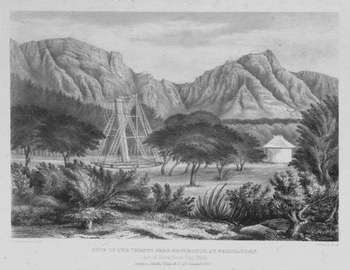
One of the objects used by Herschel was a twenty-foot telescope, part of which is now in the collection of the National Maritime Museum in Greenwich.Footnote 3 The frontispiece of Herschel's Results of Astronomical Observations made during the Years 1834, 5, 6, 7, 8, at the Cape of Good Hope, published in 1847 and depicting the ‘Site of the twenty feet reflector at Feldhausen’, highlights the work not only of Herschel but also of the instruments with which he did his observing (Figure 1). The print shows the orchard of the garden at Feldhausen, the Herschel family residence in South Africa, ‘a spot charmingly situated on the last gentle slope at the base of Table Mountain’.Footnote 4 But it also illustrates the telescope itself and a small building with a shuttered roof to the right in which the ‘equatorial’, the small ancillary refractor telescope, was housed.
George Henry Ford, after John Herschel, ‘Site of the twenty feet reflector at Feldhausen’, in Sir John Herschel, Results of Astronomical Observations made during the Years 1834, 5, 6, 7, 8, at the Cape of Good Hope, London: Smith, Elder & Co., 1847, frontispiece. (PAD1906, National Maritime Museum, Greenwich, London, Herschel Collection.)

This article attempts similarly to reposition telescopes and other observing instruments, the people who used them and the places in which they were housed at the heart of the interpretation of British imperial and colonial science in the first half of the nineteenth century. It argues that the study of scientific instruments, their transportation around the globe, and the personal and professional networks created by such exchanges are useful conceptual tools in exploring the role of science in the nineteenth-century British Empire. The shipping and assembly of instruments highlight the physical connections forged by imperial activity which bound the empire together in the period. The personal and political links formed as a result of these material exchanges demonstrate the role played by metropolitan centres in bringing science into the colonial field. But large, heavy and fragile objects, such as transit circles, were difficult to transport and repair. Therefore, examining the logistical achievements and difficulties associated with their movement also illustrates the limitations of Victorian colonial scientific enterprises and their reliance on European centres of patronage and production.
The establishment of the observatories in which telescopes and other instruments were housed and operated was one of the most tangible results of European expansion in the period. From the Cape of the Good Hope to St Helena and India, observatories (both official and private), and the practices of scientific enquiry that they facilitated, were part of a process of drawing diverse places into the world of European science and empirical observation. The networks sustained by astronomers illuminate the confluence of scientific practitioners working throughout the empire. At the Cape, for example, such developments were perceived and welcomed by colonists as connecting the region to a wider imperial network.Footnote 5 The Cape was drawn more closely into the British sphere of global influence partly through the efforts of astronomers, the equipment they used and the results they achieved. For example, Sir John Herschel sent a copy of his ‘Astronomical observations made at the Cape of Good Hope’ during the 1830s to the directors of the East India Company for placement in the company's library in London. He also forwarded copies for the libraries at Madras, Bombay and the Asiatic Society of Bengal.Footnote 6 But the physical objects that facilitated the acquisition and dissemination of such knowledge also travelled around the globe, tracing the routes of British political power and creating new networks of scientific connections.Footnote 7
Taken together, the scientific instruments and physical objects used by colonial astronomers, their movement and exchange, and the places in which they were stored and operated in Africa and India, offer unique perspectives on the complex and mutually reinforcing relationship between science and empire. The movement of instruments from London to the geographical peripheries of the empire; the reliance on the metropole for hardware, expertise and advice; and the uses attributed to the conducting of such science at the frontiers of empire provide further ways of interrogating and understanding debates about the applications of science, the development of colonial identities, and the consolidation of empire in the first half of the nineteenth century.Footnote 8 By tracing the travels of these instruments, and the arcs of patronage, cooperation and power that these trajectories inscribe, the role of science in forging global links and influencing the dynamics of the nineteenth-century British Empire is brought into greater focus. The physical movement of objects, and the logistical effort this required, illustrate the overlap between political and strategic considerations and purely scientific endeavours, powerfully demonstrating the mutual interdependence of, and symbiotic relationship between, science and empire in the period.
Telescopes and empire
The interpretation of telescopes, observatories and their astronomers as agents of empire is informed by recent scholarship on related subjects. Historians of empire have been asking for some time whether the flag followed the banner of trade or vice versa. More recently, there have been similar debates about the presence of the Christian cross. Likewise, the blurred boundaries between advancing science on the one hand and advancing empire on the other, and the permeation of scientific discourses and practices into European encounters with colonial peripheries and non-European spaces, have also been the subject of much scholarly discussion.Footnote 9 In the words of Roy MacLeod, science has become a ‘metonym for empire’.Footnote 10 While earlier analyses generally ignored issues of power and control, many recent studies have located the technological advances of late eighteenth- and early nineteenth-century Europe at the heart of the development and expansion of empire.Footnote 11 This draws on scholarship which foregrounds the role of knowledge, knowledge-gathering and its stewardship in the creation and maintaining of empire.Footnote 12 With their ability to name, order and classify disparate landscapes, people and phenomena, scientific practices, including astronomy and surveying, seemed particularly useful in acquiring knowledge about non-European spaces and environments. The contingent nature of European science, practised in ‘chaotic, improvisational contact zones’ in order to create knowledge, has also been foregrounded.Footnote 13 Furthermore, historians have highlighted the important role that scientific knowledge, and the ideas, institutions and systems associated with it, played in consolidating European colonial endeavours and identity formation in settler societies, such as the Cape of Good Hope.Footnote 14 It was both ‘a colonizing ideology and an agency of colonial self-identity’.Footnote 15
As a result of this, telescopes, and other scientific instruments, are increasingly understood and interpreted in their cultural, as well as scientific and technological, contexts.Footnote 16 Possession (and display) of such objects was long recognized as forming part of the accepted cultural accoutrements, as well as the scientific apparatus, that distinguished the gentleman. William Smyth remarked that ‘a well-mounted telescope ought to be an appropriate and desired article for every educated gentleman's establishment, both for amusement and expansion of mind’.Footnote 17 In the context of empire, and the expansion of British scientific endeavour that went with it, observing instruments played a vital role. The range and nature of instruments moving across the globe highlights the extremely heterogeneous nature of the science which they facilitated. They were integral to such activities as making astronomical observations, taking terrestrial measurements, acquiring and tabulating data, and producing maps and drawings – all vital to the maintenance and extension of European power in non-European spaces, and situating scientific ventures at the heart of nineteenth-century British overseas activities. As well as assisting astronomical and surveying work, they also connected people scattered across the British Empire. The transportation of these objects, instructions for their use and maintenance, and exchange of the observations and readings made with them connected a range of figures around the world. The analysis of their movement; of the logistical successes, achievements, difficulties and failures associated with them; and of the colonial observatories where many were housed and operated gives unparallelled insight into how the practice of science both facilitated and frustrated the development and extension of empire.
The networks established and nurtured through the demand and use of instruments facilitated greater global connections and exchanges of information. The wider dissemination of knowledge permitted by traffic in such objects offered the prospect of international cooperation and recognition for colonial astronomers. ‘We shall no longer have to complain of our labours being “hid in a corner”’, trumpeted the Reverend Fearon Fallows, the first Astronomer Royal at the Cape of Good Hope. He contemplated such collaborations as a boon to the astronomer working in the far-flung corners of the empire:
The observer will necessarily find that mental energy combined with the incessant fatigue attending his labours will be amply repaid by the information he will receive in return from others. It is this consideration that gives a stimulus to our exertions and imparts that kind feeling towards our brother observers which never fails to add lustre to the cause in which we are all (I trust) so heartily engaged.Footnote 18
As Fallows realized, the connections forged and sustained through the transportation of instruments drew these regions into a close relationship with centres of imperial science.
The travels and astronomical endeavours of people like Fallows and Herschel would almost certainly have been impossible without the communications, political and military apparatus of the nineteenth-century British Empire. Conversely, the extension and consolidation of empire was undoubtedly one result of greater European scientific experimentation and investigation in non-European spaces; there were others too, however. For example, astronomers and observatories relied on access to scientific patronage, objects and expertise in Europe. The sheer physical and logistical difficulty of getting instruments to the furthest reaches of the empire foregrounds the very limitations of colonial science. More than other sciences, astronomical endeavour in the colonial world was therefore tied to and dependent upon metropolitan capabilities, concerns and priorities. This dependency highlights the fragile foothold occupied by these institutions and practices in non-European spaces.
In a similar way, some astronomical centres at the so-called periphery of empire became local hubs of scientific endeavour in their own right. Through the use of telescopes and the dissemination of expertise, observatories such as that at the Cape of Good Hope forged local networks of scientific knowledge, which bypassed metropolitan institutions in London. And it is important to remember that the development of ‘British’ observatories in non-European spaces took place in the specific contexts of pre-existing local conditions and circumstances. The establishment of such observatories and the use of telescopes often occurred in the wake of previous European settlement and scientific endeavour (such as the Dutch at the Cape), or in tandem with long-established indigenous networks of scientific activity and patronage (at various places in India, for example).Footnote 19 In light of these issues, the discussion below does not assert that the movement of telescopes, the establishment of observatories or the activities of those working with them were always successfully or even consistently ‘imperial’ in character. Rather, it suggests that a more complex relationship existed between the exchange of information and the movement of objects on the one hand, and maritime routes of trade and political power on the other. Scientific endeavour was not necessarily always, or even primarily, related to imperial or political concerns. But the effect of the movement of astronomical observing instruments must be seen in the context, and partially as a function, of terrestrial political concerns as well as interest in heavenly bodies and celestial phenomena.
‘Instruments from England’: the movement of scientific instruments in the nineteenth-century British Empire
The movement of observing instruments from Britain to places around the globe highlights connections but also significant disjunctions between metropole and periphery.Footnote 20 Quite apart from any effect they may have had when they arrived, and to whatever use they were put, the transportation of large, heavy and fragile instruments is – at its most basic level – evidence of imperial and global connections, of surmounting logistical difficulties and of overcoming physical distances.
The transportation of precision instruments over long distances on board ships was not a new phenomenon. Scientific expeditions, such as those commanded by James Cook in the eighteenth century, had taken scientific instruments and used them to perform all manner of observations and experiments.Footnote 21 There had been a burst of astronomical activity to coincide with the transit of Venus in 1769, with the East India Company sending reflecting telescopes, clocks and astronomical quadrants to record the event in India, for example.Footnote 22 But the growing number of permanent, fixed observatories in the nineteenth century led to a dramatic rise in the demand for observing instruments and hardware.Footnote 23 In the 1840s, for example, the observatory at Bombay received ‘a set of instruments intended for an Observatory at Aden, uniform in design with fifty or sixty others then being brought into existence in other parts of the world’.Footnote 24 Many of these observatories relied on British-made instruments. In Lucknow, where the padshah (king) of Awadh founded an observatory to demonstrate his ‘liberality’, Lieutenant James Paton noted that ‘instruments are, I believe, to be commissioned from England’.Footnote 25 An extensive range of telescopes and other scientific instruments was sent to Bombay for the use of the East India Company's astronomer there, John Curnin. Two cases left London on the Minstrel carrying ‘a transit instrument; an Achromatic telescope; 2 mountain barometers; 6 Thermometers; Russell's Map of the Moon; 2 quire of Wedgewood's prepared paper’. The Company reminded Curnin that ‘the above have been provided at considerable cost, and we must enjoin the greatest care in their preservation by the Company's Astronomer’.Footnote 26 As this list demonstrates, a diverse range of scientific instruments were required for different observing projects. For example, large and cumbersome meridian instruments, intended for stellar cartographic purposes, were constructed for stability rather than portability. The physical size of such instruments helps to explain Fearon Fallows's comment, before he embarked for southern Africa in April 1821, that ‘the packages now on board the Sappho are estimated at nearly ten tons’.Footnote 27 Before the advent of steam-powered vessels, and the development of advanced loading technology, the transportation of large-scale and delicate scientific instruments was one of the most logistically demanding tasks for those involved in shipping.
The mechanics of getting material from London to outlying areas of the empire, such as the Cape of Good Hope, also illustrates the reliance of these places on metropolitan objects and expertise. The Lords Commissioners charged Captain William Ronald, Fearon Fallows's new assistant, with ‘the conveyance of a large Mural Circle and several other valuable instruments for the use of the Cape Observatory’ when taking his passage in the merchant ship the Susanna.Footnote 28 Ronald fulfilled his task, taking instruments from a number of London instrument-makers, including Robert Molyneux and George Dollond. Dollond's consignment, for example, included
2 solid wood barometers
6 thermometers sorted
A 4-feet brass standard scale
4 reading lamps and 4 extra burners
Pair of 12-inch globes
Russell's Map of the Moon
Small thermometer for mountain barometer
Journeyman Clock
Bathang & Watts copying machine with
2 Reams of paper & 12 spare ink powders in 2 cases.Footnote 29
Thomas Jones, optician to the Admiralty, sent an extensive list of items too. On 2 August 1826, a six-foot mural circle was received on board the Susanna from Jones ‘for HM's Observatory at the Cape of Good Hope’. In just a single journey, therefore, the Susanna carried twenty cases of instruments to the Cape.Footnote 30
Astronomers in southern Africa continued to rely on a mixture of official support and the good favour of contacts in Britain to furnish their observatory. As the Cape Observatory was founded by the Board of Longitude, and funded by the Admiralty, to establish a southern hemisphere twin for the observatory at Greenwich, it had a particularly close relationship with London. Recent scholarship has highlighted the importance of practitioners of science and the networks they forged in understanding the relationships between non-European spaces and imperial centres.Footnote 31 Under one of Fallows's successors, Thomas Maclear, the Cape Observatory was at the centre of a web of contacts that stretched across the globe, enmeshing the knowledge generated by the use of telescopes at the Cape in a broader, global context. Arriving in Table Bay nine days before Herschel, Maclear was destined to play a leading role in the consolidation of astronomy in southern Africa. Although he qualified as a physician, indefatigable curiosity led to his reading and experimenting in astronomy, chemistry and electricity; in 1829 he built a small observatory in which he made such precise observations that he was elected fellow of the Royal Astronomical Society in 1831.Footnote 32 Having applied unsuccessfully for the post of Astronomer Royal at the Cape once, Maclear was finally appointed in 1833.
At the Cape, Maclear formed an immediate friendship with Herschel, with whom he would remain in contact for the rest of his life. Their friendship proved to be of use as Herschel's influence, when he returned to Britain, was ‘likely to remove various difficulties with official people’.Footnote 33 Maclear was also successful in establishing and nurturing networks further afield in order to assist the work of the Royal Observatory by garnering information, exchanging material and sharing data. His ability to mobilize and sustain such contacts illustrates the possibility of developing a collaborative and international approach to positional and navigational astronomy, which the establishment of observatories around the globe promised. He received a steady stream of astronomers at the Cape, both amateur and professional, which helped to extend his matrix of scientific colleagues and contacts. In July 1851, for example, Captain Blackwood aboard the Victory wrote to Maclear,
Permit me to introduce to your acquaintance the Revd Mr Jenkins the new chaplain of Simon's Bay and a worshipper of Urania. You will I have no doubt find him as I have a very amiable, modest, and agreeable person – and one to whom knowledge is delightful.Footnote 34
Conversely, for acquaintances returning to Britain from India or Africa, Maclear provided introductions to British scientific circles. He wrote to Francis Baily,
I beg leave to introduce to you the Revd Dr Adamson, a friend of mine, who on his way to Scotland intends to stop a few days in London and to visit Sir John Herschel with whom he is acquainted. He is a man of no ordinary attainment in every branch of science particularly in mathematics and physics.Footnote 35
Through his correspondence with John Lee, who operated an observatory at his residence, Hartwell House in Buckinghamshire, Maclear kept abreast of developments in the astronomical community in Britain.Footnote 36
Maclear used these networks of personal contacts to facilitate his work and to acquire scientific instruments. He requested instruments from Lee for Mr Bailey of the East India Company who was ‘an amateur astronomer and a frequent visitor to the [Cape] Observatory’. This gentleman was currently ‘residing at the Cape on sick leave’.Footnote 37 Maclear also used contacts at Greenwich to acquire instruments for the Cape. He thanked George Biddell Airy, Astronomer Royal at Greenwich, for his ‘liberality and help to this establishment’.Footnote 38 In 1839, Airy, Maclear and the Lords Commissioners of the Admiralty corresponded on the transfer of a mural circle by Jones from Greenwich to the Cape, with another mural circle going in the opposite direction. Maclear wrote to Airy thanking him for his acquiescence in allowing the exchange, an arrangement which was ‘by far the least expensive in money and time’. The organization of the shipment, and the physical risk to which long sea voyages exposed these delicate objects, were also of concern. His predecessor, Fearon Fallows, described the necessity of supervising Royal Navy crew members while loading and unloading instruments because ‘sailors are such rough hands that they would make no difference between a case of herrings and the cases containing the circle and clocks’.Footnote 39 For his part, Maclear assured Airy that ‘the packing cushions of the Cape Circle have been carefully preserved, they are of horse hair’, and that they would be used in ensuring a safe passage for the instrument back to Greenwich.Footnote 40 When the instrument was placed on the Stratheden under the care of Captain Cheap, Maclear wrote to Airy from the ship to inform him that the mural circle had been placed ‘on the poop in a cabin by itself’: ‘Pray do not let it be removed from its berth except under the superintendence of some one from the obs[ervator]y. I write this on board’.Footnote 41
This pattern of exchange and cooperation continued throughout Maclear's tenure at the Cape, and shows evidence of his ability to tap into existing scientific networks and to forge new contacts in Britain. On 24 December 1849, Maclear parcelled up Bradley's zenith sector in the same packing case in which it had arrived from Greenwich some twelve years earlier: ‘Box No. 1, containing the arch, micrometer, and object glass, and some other pieces, has been most carefully fixed within the larger box which contains the tube and spindle. It is hoped that greater security is thus provided for’.Footnote 42 As well as the physical mechanics of getting things to the Cape, legal and economic hurdles occasionally needed to be negotiated too in order to facilitate the transfer of material. In relation to a transit circle being shipped out from England on board the Boyne in 1854, the Weekly Register records,
An official application has been made to the Collector of Customs to let the instrument be landed and the case removed to the Observatory without being opened. The contents of such case as given by Mr Mann's Memorandum book were made to the Collector.Footnote 43
As these examples show, the instruments employed in scientific ventures in colonial contexts materially linked nodes of empire. However, they also highlight the logistical difficulties that had to be overcome in order to conduct such science and, consequently, the contingent nature of European scientific endeavour in non-European spaces.
‘I must go on as well as I am able.’
In all of these examples, there is an awareness of the dependence of Cape astronomy and surveying on London for both parts and expertise. Science at the colonial periphery was predicated on the ability to stay in touch with London, not just on ideological or political levels but also on a practical one. While relying on London, where instruments were produced by specialists, may be obvious, it necessarily led to a drawing together of people and places. Of course, dependence on London should not blind us to the fact that indigenous labour and knowledge also played a significant role in assisting European scientific endeavours.Footnote 44 When William Ronald eventually arrived at Table Bay, for example, Fallows proposed to have the mural circle which Ronald had brought with him ‘borne by relays of Coolies’ to the observatory.Footnote 45 When another mural circle arrived from Greenwich in 1839, Maclear recorded that ‘by 3 o'clock the circle was safe on terra firma and by 4.30 was at the obs[ervator]y, where it was carried by 25 coolies on long poles – without the slightest shake or accident’.Footnote 46 Nevertheless, the use of scientific instruments on the colonial frontier very much depended upon, and was defined by, open and free channels of communication with London.
This is highlighted by the experiences of John Curnin, who was directed to superintend the construction of the Bombay Observatory in the 1820s. There had been earlier attempts to set up an observatory there. Despite the support of the local Literary Society, difficulties had been encountered in acquiring the necessary instruments. None of those promised in 1810, for example, had arrived by 1815 and ‘the only Instrument which has hitherto been in use (a Transit Instrument) was the private property of Mr [William Taylor] Money late Superintendent of [the East India Company's Bombay] Marine which has recently been presented by him to the Literary Society’.Footnote 47 When Curnin took over with official sanction, he did not just rely on the shipment of telescopes but actively canvassed for objects to be sent out from Britain in order to facilitate his work. He lobbied the Company for an equatorial telescope, citing compelling reasons for its acquisition, including public opinion. He alluded to the embarrassment that would be caused if a comet should present itself and go unnoticed due to deficient instruments: ‘Many individuals would not be slow in expressing their surprise that the Company's Astronomer did not observe it’. Curnin helpfully reminded them that a ready-made solution was at hand – the Company could buy the king's telescope for him and have it sent to India:
The instrument fit for this purpose is an Equatorial and an excellent one belonging to the late King [George III] is likely to be disposed of in consequence of the demolition of the King's Palace and observatory at Kew. I trust it will be pleasing to the Honourable Governor in Council to permit me to commission its being purchased for the use of the Honourable Company's Observatory. The price of it may be about Rupees 3,500.Footnote 48
It was not just in the matter of instruments that the observatory relied on London. In October 1827, on considering ‘the expense, the weight, and the durability of the different kinds of materials’, Curnin made the case for roofing the new building with ‘pure tin’. He calculated that 7,750 square feet of tin would be required in order to make each square foot of roofing twenty ounces in weight or one inch in thickness. He also estimated that 25,000 nails, ‘of equal properties as those used for fixing on sheet copper on ships’, would be required. The only catch was that, although ‘tin is sufficiently abundant here … a difficulty would be experienced in getting it rolled into plates’.Footnote 49 Curnin seems to have won this particular argument because, in a public letter of 5 January 1828, the Bombay Presidency lobbied the Court of Directors in London: ‘[We] beg to recommend to your Honourable Court the expediency of sending out Tin and Nails of the description and to the extent particularized by Mr Curnin’.Footnote 50 Ultimately, however, Curnin's time in Bombay proved unsuccessful. When the observatory was established at ‘Colabah’ in 1827, ‘about half a lakh of rupees [£5,000] having been expended on the house and enclosures of the compound, instruments were sent out by the Court, of such quality that Mr Curnin reported them unserviceable for Astronomical purposes, and had them sent home’.Footnote 51 When he died, at Calcutta, on 2 July 1848, the Bombay Times lamented that Curnin might ‘have been to the hour of his death the Company's Astronomer at Bombay’ had he not been ‘required here to perform the duties of astronomer with instruments jobbed into his hands such as an astronomer could not approve of’.Footnote 52
At the Cape Observatory, meanwhile, there was further evidence of the reliance of colonial outposts on London. Fearon Fallows remarked to Francis Baily, ‘My sphere of usefulness is, at present, very confined and must continue so till the Obs[ervator]y is built and the instruments which I expect soon from England prepared for work’.Footnote 53 Informing John Wilson Croker, first secretary to the Admiralty, of the arrangements with regard to the Cape Observatory, Thomas Young, secretary to the Board of Longitude, highlighted the control exerted by the authorities in London over the supply of instruments to Fallows in southern Africa: ‘With respect to Mr Fallows’ letter of 21 March I have ordered such of the instruments mentioned by Mr Fallows as the committee has thought absolutely and immediately necessary; and the rest remain still under their consideration’.Footnote 54 Some eight years later, Fallows was apparently still operating at less than full capacity. Writing to Baily again, he pointed out dejectedly,
It would be tiresome to enter into any long detail of our proceedings since the period when our instruments were first placed upon their piers of support, but I cannot forbear alluding to the very great difficulties I had to encounter from the simple circumstances of not having a Troughton or Dollond at hand … You in London can send for an eminent artist at once – I must go on as well as I am able.Footnote 55
As Fallows's remarks make clear, even when one had instruments in situ, their maintenance and repair required extensive instructions from specialists in London. Before William Ronald left for the Cape, Robert Molyneux, a watchmaker from Devonshire Street, gave him extensive instructions in relation to a large clock that Ronald was transporting to the Cape:
Enclosed in this box is a small bottle of oil to apply to the crotch of the pendulum when you put up the clock at any place. Take a piece of clean soft leather or linen cloth and wipe the crotch of the pendulum and also that part of the pendulum that acts in the crotch. When you have suspended the pendulum take a piece of small wire and apply a small drop of oil to each side of the pendulum where it acts. If the drop of oil is too large it will run away. You may preserve this oil a long time by keeping it in a moderate temperature and away from the light. There is a mark on the glass cylinder at the height which the quicksilver is to come up to in case there should be any lost.Footnote 56
Due to a dearth of skilled craftsmen and even manual labourers, Thomas Maclear, one of Fallows's successors, was forced to carry out a lot of taxing physical work himself. He wrote to George Airy about his struggles:
The Cape pier is of such hard stone that no tool except of the best steel has any effect upon it and then with much labour, while most of the work is done by myself … You can get any species of workmen. I cannot & such as are procurable perhaps are forthcoming a month after they are told to attend.Footnote 57
In 1837, with correspondence well under way between Airy, Maclear and Sir Francis Beaufort about transferring Bradley's zenith sector from Greenwich to the Cape, there was much doubt in London about the ability to obtain even the most basic necessities at the Cape.Footnote 58 For scientific ventures that relied upon the precision, accuracy and successful operation of large instruments, the availability of materials for their maintenance and preservation was a vital consideration. The expression of lingering doubts about these further emphasizes how dependent astronomical scientific endeavour was on London, its suppliers and its instrument-makers. For example, Airy asked Beaufort if he thought it ‘desirable to consider about making a tent for it in England, or to trust to procuring one from stores at the Cape? You will know (what a civilian cannot know) the mixture of stores procurable there’.Footnote 59 To be fair, an ordinary tent was insufficient; it needed to be reasonably ‘lofty’, as the object glass was nearly fifteen feet above the ground. In reply, Beaufort counselled Airy not to trust to local supply. Indeed, remarking that there ‘might be great difficulty in having [even] the alterations perfectly made abroad’, he advised Airy to have one sent out with the instrument.Footnote 60
There were the inevitable repairs and breakages too, which also highlighted the dependence of these ventures on London. In late September 1854, Maclear noted that some chronometers were packed up and ready to return to Britain, including one at the expense of Mr Morton, an assistant at the observatory. According to Maclear's notes it was in Morton's charge when it ‘fell on the flag stone floor on the 21st June last’. Morton proceeded to give it to a Mr Wagner in Cape Town to diagnose the problem. Maclear continued, ‘Mr Wagner took the instrument to pieces, but did not restore the whole’. When Morton brought it to Maclear and ‘informed him of the accident a few days back, there was a fragment loose in the mahogany box, seemingly a fragment of the lever spring piece’. Maclear instructed Morton to report to him ‘without delay … any accident that may hereafter happen to a government instrument in his charge’, adding the acerbic addendum, ‘Mr Wagner is not a watchmaker’.Footnote 61 The unfortunate Mr Morton seems to have been somewhat accident-prone when it came to handling important, expensive and difficult-to-repair objects. Barely four months later, on 18 January 1855, Maclear reported ‘the fracture of the minimum thermometer (a terrestrial radiation thermometer) by a fall from his hands’. Fortunately, in this instance, there was one in-store to replace it.Footnote 62
The strenuous manual labour undertaken by Maclear and the strict regime that he enforced during his tenure at the Cape, so much so that he was known as ‘the Emperor’ among his staff, highlight the strains, shortages and pressures endured by colonial observatories and their astronomers.Footnote 63 While instruments may have travelled across the empire, observatories in which they were housed often struggled for greater recognition and resources. Far away from the metropolitan centres of attention and often underresourced, they were engaged in a constant battle to remain relevant and recognized. They needed to produce tangible and useful results, using whatever resources, personnel and instruments they had to hand, in order to justify their continued existence. The relationship between observatories as physical locations for instruments and their roles as agents of imperial connection makes these institutions a crucial part of early nineteenth-century British colonial science.
‘A great mass of valuable knowledge’: colonial observatories, scientific instruments and the British Empire
Colonial observatories were sites where science and empire converged in the nineteenth century. Using the kinds of observing instruments supplied from London discussed above, they were engaged in a range of pursuits which emphasize the variety of activity encompassed by colonial science, and which may be described under the broad headings of ‘observatory sciences’ and ‘observatory techniques’. Assisting navigation was a core function. So too was collecting accurate stellar cartographic data on which double-star, asteroidal, cometary orbital and all manner of gravitational researches could be founded. But, while astronomy was a key justification for these observatories, it was not the only one. It belonged to a larger group of ‘observatory sciences’ that also included mapping, geodesy, meteorology and geomagnetism, all of which relied on precision instruments. Chronometer regulation and meteorological and geomagnetic observations were crucial elements of the ‘empire of knowledge’ celebrated by contemporaries and actively promulgated at these observatories. ‘Observatory techniques’ included the calibration and coordination of instruments for making observations and taking measurements; data acquisition and tabulation; and the production of maps, drawings and photographs.Footnote 64 As a result, colonial observatories and their instruments were of vital importance to the technological, military, political and colonial undertakings of nineteenth-century European empires.
Notwithstanding the variety of uses to which colonial observatories and their instruments were put, there was debate about the importance and usefulness of these observation stations. In response to such perceptions, Fearon Fallows wrote to Francis Baily from the Cape in 1822, strongly defending the idea of having a chain of observatories around the globe and asserting, ‘By a comparison of results obtained in different parts of the Globe, a great mass of valuable knowledge must be brought to light’.Footnote 65 However, the wide-ranging impact made by such institutions was not always appreciated in Britain. Doubts were still being expressed in the mid-nineteenth century. On 9 April 1850, The Times reported the intervention of Joseph Hume in a debate in the House of Commons the previous day. Hume, the member for Montrose Burghs, regarded himself as a guardian of the public purse. On this occasion, he was reported as asking ‘what advantage was derived to science from keeping up the Observatory at the Cape of Good Hope, for which there was a charge of 1,489 l?’Footnote 66 The report made its way to Thomas Maclear at the Cape, who acknowledged the fact that it was difficult to convince politicians many thousands of miles away of the value of colonial observatories:
This question is exceedingly painful, for if the observatory had been so fortunate as to have discovered Neptune, or had made any discovery worth being talked of; or had perhaps been managed so as to keep its name ringing in the ears of the public, there would not have been such a question.Footnote 67
As Maclear recognized, but as many in Britain seemed reluctant to acknowledge, colonial observatories fulfilled many important functions which often went unheralded. At a basic level, they were repositories for instruments and for the performance of crucial, if unspectacular, activities such as chronometer regulation. George Buist, a Scottish newspaper editor and scientist who was inspector of the observatory at Bombay from 1842 until 1845, remarked that observatories invariably became
the store-house for all scientific instruments belonging to Government, (those excepted directly connected with surgical or medical practice,) for whatever department of the public service they were designed: it does not follow that the Military, Medical, or Marine Storekeeper, though able men and excellent officers, should be accomplished opticians, or able to report on the quality of the instruments entrusted to their charge.Footnote 68
As well as this practical function, they were also seen, even at the time, as having a more abstract but no less powerful role in spreading knowledge in non-European spaces. In places like South Africa, India and St Helena, observatories and their instruments facilitated the conducting of British and European science and, in consequence, they were also involved in drawing these regions into an imperial nexus. Colonial observatories not only provided physical accommodation for the observing instruments used by astronomers, they also provided an institutional anchor for nineteenth-century colonial science.
Notwithstanding the logistical difficulties involved in moving them, telescopes and their placement in observatories around the globe led to the development of new networks of scientific endeavour. Some of the sites connected by these networks were not only linked to London but became loci of expertise in themselves. For example, Lieutenant Manuel Johnson visited the Cape in connection with the proposed construction of an observatory at St Helena in 1826–1827.Footnote 69 He was charged with obtaining a list of all the instruments sent out to or intended for the Cape Observatory and acquiring a ‘practical knowledge of their different uses, methods of fixing them, of adjusting them, the position in the building best suited to each etc.’.Footnote 70 Fearon Fallows proved to be very helpful in the fulfilment of this task, as Johnson later acknowledged: ‘He immediately supplied a plan for a small observatory, recommended suitable instruments, and from that period to the time of his death continued to extend to the establishment the powerful aid of his talents and judgement.’Footnote 71 Fallows clearly found the company and conversation of someone equally interested in science congenial as he commented that Johnson had been ‘a very agreeable addition to our small society’.Footnote 72 Similarly, he enjoyed the company of Commander Henry Foster when the latter's ship, HMS Chanticleer, called at the Cape of Good Hope in 1829 as part of its scientific voyage to the South Atlantic. Fallows wrote that it was ‘a treat in this quarter of the Globe to be visited by a scientific man’.Footnote 73 Before Captain Owen's surveying expedition set off up the East African coast, Fearon Fallows inspected its equipment at Simonstown. After this, the Cape Observatory frequently supplied instruments to expeditions travelling into the African interior. One of these expeditions was that of Andrew Smith, which departed from the Royal Observatory in July 1834 for the eastern reaches of the Cape Colony.Footnote 74 David Livingstone also spent time at the observatory in 1852, learning techniques for determining his geographical position from Maclear, who had a lifelong interest in geographical exploration.Footnote 75 Ten years later, the observatory supplied Livingstone with equipment. In 1862, ‘the theodolite supplied by Lt Bintton whom the Admiral has appointed to the Zambesee Expedition is to replace their only one lost in the “Ma Robert”’. In addition, other instruments, such as a theodolite, a sextant, an artificial horizon and an astronomical telescope, were noted by the surveyor at Simonstown as being supplied to Livingstone.Footnote 76 In the context of these developments, the Cape Observatory seemed to confirm Sir John Herschel's belief, expressed to the British Association for the Advancement of Science in 1845, that an active astronomical observatory – one which published observations and demonstrated its value to the wider global scientific community – became ‘a nucleus for the formation around it of a school of exact practice’.Footnote 77
Colonial observatories were not only linked with other establishments overseas; their scientific instruments and staff often had a significant impact on the immediate surroundings. Thomas Maclear, for example, connected astronomy, telescopes and the observatory with other sciences at the Cape, exemplifying how scientific instruments and expertise could contribute to the consolidation and extension of imperial power in the region. In his report to the secretary of the Admiralty, he averred that he considered it ‘to be my duty to forward geographical research by any means within my power’.Footnote 78 Maclear actively participated in endeavours in his adopted country to facilitate scientific knowledge and geographical exploration. He ensured that books on exploration were acquired for the library in the Royal Observatory and was an active member of the South African Literary and Scientific Institution (the forerunner of the Royal Society of South Africa), to which he was elected seven months after his arrival at the Cape and on the same day as Herschel. Elected a fellow of the Royal Geographical Society in 1859, Maclear became a committee member for the Association for Exploring South Africa and was later on the Committee of Management for the Expedition for Exploring Central Africa. The publication of his survey work led to the awarding of the Lalande Medal of the French Institute in 1867 and a Gold Medal from the Royal Society in 1869.Footnote 79
Instruments housed in observatories provided a foothold, as it were, for land-based surveys. One of the most important ways in which telescopes, observatories and astronomers segued into other scientific endeavours was through geodesy and maritime surveying. Michael Topping, superintendent of the Madras Observatory, described astronomy as ‘the parent and nurse of navigation’. He hoped to see ‘the charts of these eastern seas in a more correct state than those even of Europe; or at least a regular system established for the perfection of Indian geography’.Footnote 80 Topping made a direct link between scientific pursuits and the East India Company's commercial concerns. It was in their best interests to support ‘a science to which they are indebted for the sovereignty of a rich and extensive empire’.Footnote 81
In a similar way, Thomas Maclear hoped that ‘the topography of the Cape Colony will be placed on a respectable footing, and that the coast survey may not be interrupted’.Footnote 82 He was involved in using scientific instruments in the surveying and measuring of physical terrain at the Cape which, in turn, helped to consolidate British control in southern Africa. He wrote to George Cathcart, the governor of the colony, in order further to promote surveying work. Maclear sought ‘your Excellency's powerful influence and resources, in favour of promoting the topography of this Colony: particularly of those localities near the coast, where geographical points are needed while surveying for an accurate chart’.Footnote 83 In reply, there was an acknowledgement of the need for further mapping:
His Excellency is fully alive to the importance of the proposition you have submitted, and that few objects can be of greater value, than accurately establishing such Geographical Points as may facilitate hereafter a correct mapping of the Colony, nor can he fail to appreciate the advantage to be derived from conducting this service in conjunction with the present Admiralty Coast Survey.
In pursuit of this objective, Maclear was assured that Cathcart would prepare a bill to lay before Parliament allocating £1,200 ‘to be employed under the directions of the Astronomer Royal in extending the chain of Triangles along the coast from L'Agulhas to East London’.Footnote 84 Quite apart from his astronomical observing duties, therefore, one of the most important outlets for Maclear's expertise and his telescopes was the completion of a major land survey stretching from Cape Agulhas in the south to a point close to the Orange River at the very northern extremity of the colony. In executing this, Maclear – and the scientific instruments that he used – laid the foundations for all future mapping in South Africa.Footnote 85
Beyond their usefulness as places to house instruments, learn and practise observing techniques or promote scientific knowledge, colonial observatories, by partaking in such activities, were seen to be fulfilling other functions. In the nineteenth century, science was rapidly becoming a badge of national achievement. Fearon Fallows equated scientific accomplishment with national glory in commenting on the nineteenth-century Royal Society:
Many are the names in the list of the society which adorn the age in which we live and which will be handed down to posterity as the ornaments of the most noble science and the glory of the country that gave them birth.Footnote 86
By virtue of practising ‘science’ and being the first to overlay European standards of rationality on non-European terrain, British travellers distinguished themselves from both indigenous inhabitants and competing European powers. Matthew Edney has shown that because ‘the British did science and the natives did not’, the practice of empirical investigation itself became ‘a quintessentially scientific and British activity’.Footnote 87 These activities were predicated on the transportation and use of telescopes, and their maintenance in local centres of calculation such as colonial observatories.
This rationale, that the spreading and consolidation of European civilization was symbolized and promoted through the practice of science, was deployed in discussions relating to the establishment of observatories and the conducting of research overseas. Observatories and their telescopes quickly acquired symbolic meanings in addition to their practical functions. The campaign to establish an observatory in Bombay is an example of this. In 1806, the ‘upper part of the office in the Marines [Dock] Yard, [i.e.] the apartment over the Mould Loft’ was ‘fitted up as an observatory for the reception of a transit instrument’. Even this makeshift solution was regarded as ‘promoting useful and professional knowledge among the officers of the Marine, and of extending the utility of an observatory to the nautical community of this Port’.Footnote 88 Less than a decade later, however, the Bombay Literary Society identified ‘the want of a suitable observatory for making and recording astronomical observations wherein chronometers might also be deposited while ships were refitting at the Port’. The vice-president of the society maintained that the current location for making observations was unsuitable, because it was situated in a dockyard where excessive wind, too much shaking, and too much smoke from saluting guns had detrimental effects on observation work.Footnote 89 Members interpreted the establishment of an observatory as part of a wider programme of ‘improvement’; they were ‘desirous of promoting the object of science’.Footnote 90 However, due to an existing commitment to the building of apartments for a library and museum in the Town Hall, the society was unable to raise the two thousand rupees required.Footnote 91 It appealed to the government for assistance because it felt that ‘any matter in which the security or prosperity of the British Trade to this Port are at all concerned, cannot fail to be attended to’. It also posited the notion of national pride in arguing that ‘it may perhaps appear like a national reflection that the Chief Naval Port and the greatest mart in British India, should not possess a place for making astronomical observations’.Footnote 92 When it was eventually established, the observatory aimed to inculcate such values by training young East India Company officers in ‘habits of observation, and of study, to impress on them the mischievousness of idleness, and the degradingness [that] the stimulants tobacco and brandy supply’.Footnote 93
Of course, it was not only British people who would feel these perceived benefits. The extension of European forms of science was assumed to have an uplifting effect on ‘the Character’ of indigenous populations too, as Major James Dowling Herbert termed it in announcing his acceptance of the role of Astronomer to the Court at Lucknow in 1831.Footnote 94 These ideas fed into notions of self-improvement, self-advancement and imperial trusteeship that characterized nineteenth-century British views about its wider imperial roles and responsibilities. At Lucknow, the local ruler recognized the prestige conferred on those who supported such ventures. According to a British observer there,
the object … is twofold: to establish an observatory upon a liberal scale worthy of the wealth and importance of the Government as well as for the advancement of that noble science by new discoveries as for the defusion [sic] of its principles amongst the inhabitants of India.
While furthering local knowledge was envisaged through translations into regional dialects and the delivery of lectures, the ruler ‘appear[ed] desirous that the observatory in all its branches should do credit to the Government of Oudh, and assuredly such an establishment on a liberal scale would do great credit to the Oudh Administration’.Footnote 95
In allowing Lieutenant Manuel Johnson to retain a £90 subvention for his work in advancing astronomical research, the authorities at St Helena hoped that such a gesture would ‘promote that taste for science which has lately begun to manifest in this community, a taste which in proportion as it prevails, the less Room will be left for a disposition in favor of inferior pursuits’.Footnote 96 When the Board of Longitude in Britain approved the establishment of a Royal Observatory in the Cape Colony in October 1820, it envisaged the institution providing a parallel to the work done by the Royal Observatory, Greenwich, in the northern hemisphere. It was understood that ‘nothing could more essentially promote the glory of the British name, than that this Nation should be the foremost in such an undertaking’.Footnote 97 Eventually erected four miles from Cape Town between the Liesbeck and Salt rivers, the observatory which facilitated the work and housed the telescopes of Fallows and Maclear became ‘the Greenwich of the Southern Hemisphere’.Footnote 98 The establishment and maintenance of an observatory was closely bound up with the maritime, navigational and political requirements that had precipitated British acquisition of the Cape in the first place.Footnote 99
Drawing on a long tradition of amateur science in Britain, national pride could be ascribed to private, non-official observatories. Following his four-year sojourn in southern Africa, John Herschel was feted on his return to Britain with a dinner held in his honour at the Athenaeum Club in 1838. Successive speakers equated his scientific achievements in the southern hemisphere with those of the explorers of the past. The Marquis of Lansdowne, the chancellor of Cambridge University, compared Herschel's role in ‘annexing’ a new scientific hemisphere to the ‘empire of knowledge’ with the strengthening of British rule at the Cape.Footnote 100 The movement of telescopes around the burgeoning empire and their use in various projects of astronomical, maritime and terrestrial surveying were understood as part of a process of consolidating empire around the globe. Although Herschel did not want to give it the ‘slightest tincture of an official character’ and consistently refused passage in a naval vessel (because he felt that the Royal Navy should have ‘other fish to fry than landing stargazers at the world's end’), this has not deterred either contemporaries or later historians from reading imperial agendas and aspirations into his expedition.Footnote 101 One has remarked, for example, that in sailing for ‘the Cape of Good Hope to observe the nebulae of the southern hemisphere, [he] sailed into apotheosis’.Footnote 102 For these reasons, Agnes Clerke considered the Cape to have ‘furnished the virtual starting-point of austral astronomy’.Footnote 103
As a consequence, the foundation of observatories at the Cape was perceived as having a direct connection with the rise of British imperial power in the region. In facilitating a great variety of scientific tasks in their immediate vicinity – many connected with mapping and charting the landscape of the region – as well as providing links with other establishments, Cape observatories, their astronomers and their telescopes offered evidence of how an ‘empire of knowledge’ could coexist with a political and territorial one. According to Clerke, ‘in proportion as England's colonial sphere became consolidated, the need of a supplementary establishment to that at Greenwich was rendered more and more imperative’. For her, the placement of observatories at the Cape and Greenwich ‘fitly represents the worldwide dominion of which it [astronomical research] is the corollary’: ‘British empire on the seas led directly to British empire over the skies, the one gaining completeness as the inevitable consequence of the expansion of the other’.Footnote 104 The establishment of observation posts in the physical territory of the Cape and the peregrinations of European scientists and observers in the landscape of the colony were vital to the consolidation and advancement of political power in the region. But instruments also facilitated that ‘empire of knowledge’ celebrated by Lord Lansdowne – a motivation higher than simply the drive for territorial possession. Located at the intersection of Victorian ideals of scientific utility and good government, astronomical establishments could spread the benefits of civilization widely and deeply. For people in Britain, as well as those working on the geographical peripheries of the empire, scientific endeavours had the power to motivate and inspire in the period.
These examples also relate to questions about colonial British identities being forged at the time. The negotiations, tensions and slippages that occurred in transposing British identities from metropole to periphery have received much scholarly attention.Footnote 105 Nevertheless, in the early part of the nineteenth century, there was a general trend towards a process of increased anglicization. This was evident in a number of spheres in South African society in particular, a region only added to the British Empire at the beginning of the century. In law, politics and education, British practices began to supersede all others.Footnote 106 This extended to the cultural sphere too and recently more attention has been paid by scholars to the importance of the establishment of institutions, such as museums, in the consolidation of empire.Footnote 107 As we have seen, in addition to supporting the building of an observatory, the Bombay Literary Society financed a museum and library.Footnote 108
The appreciation of sciences, such as astronomy, was regarded as an indicator of cultural progressiveness among Britons living abroad. Comparisons with Britain were constantly being made. When James Prinsep took over the editorship of Gleanings in Science from Major Herbert in 1831, he gave it a new intellectual direction and was glad to remark that the journal was ‘brought at last to such a condition as to rival publications of the same character in Europe’.Footnote 109 The acknowledgement of the practitioners of such sciences was a practical way of illustrating a commitment to the values of civilization and development. As Saul Dubow has highlighted, the self-image of settlers in southern Africa was enhanced by claims to scientific knowledge. As much as helping to dominate or subjugate the African landscape or its inhabitants, science was useful in ‘promoting colonial dignity and status in the eyes of the European metropole’.Footnote 110 This was manifest in various ways, such as holding international scientific conferences, sponsoring exhibitions and supporting expeditions and publications. When Thomas Maclear died in July 1879, the House of Assembly of the newly self-governing Cape Colony passed a resolution expressing ‘its deep sense of the signal services’ rendered by him to
the general cause of astronomical and geographical science while in charge of the R[oyal] O[bservatory], C[ape] T[own], and also to the material interests of the Colony in the practical application of his researches; and furthermore, its high appreciation of his devotion for so long a period of years to the cause of South African exploration and civilization.Footnote 111
In acknowledging Maclear's contributions, assembly members anticipated the ways in which scientific practice, once so closely bound up with European notions of civilization and progress, came increasingly to be claimed by colonial territories themselves.
Conclusion
Richard Dunn has argued that the history of the telescope is not just about ‘technical developments and their scientific application, but also about how people view themselves, others and the universe that surrounds them’.Footnote 112 In 1839, apparently anxious to draw attention to the fact, Thomas Maclear wrote to George Biddell Airy in Greenwich asking him if he thought that ‘the Astronomical Society should be informed that the people of the Cape have subscribed £190 for the purpose of erecting a monument on the site of Sir J[ohn] Herschel's 20 foot reflector’.Footnote 113 The iconic situation of the proposed monument draws together many of the themes explored in this article. It clearly foregrounds the practical and symbolic roles of scientific instruments connecting the empire as they moved around the globe. By the same token, the marking of the site of the telescope was not only a commemoration of Herschel's time in southern Africa or of the local respect for his work, but also a clear statement of the settlers’ determination to be seen as part of a scientific community that spanned the British Empire. Herschel acknowledged the connection:
The record of its [i.e. the twenty-foot reflector's] site is preserved on the spot by a granite column erected after our departure by the kindness of friends, to whom, as to the locality itself and to the colony, every member of my family had become, and will remain, attached by a thousand pleasing and grateful recollections of years spent in agreeable society, cheerful occupation, and unalloyed happiness.Footnote 114
In addition to their roles in studying the heavens or mapping the land, the transportation and use of observing instruments in non-European spaces, together with the development of colonial observatories and the strengthening of scientific networks that this facilitated, further elucidate the constellations of people, places and political rhetoric that comprised the British Empire in the first half of the nineteenth century. The careers of Herschel, Maclear and other ‘stargazers at the world's end’ highlight the role played by scientific instruments.Footnote 115 The movement of those instruments, their use in imperial and colonial contexts, and their impact on the development and maintenance of empire combine to bring the nineteenth-century British Empire into sharper focus. Almost paradoxically, as they trained their sights and their telescopes on the heavens, astronomers and observers helped to draw diverse regions of the earth beneath closer together.