Implications
Satisfying the nutritional requirements of high-producing dairy cows can be a challenge. Feed intake may decrease as much as 30% during the week before calving (Bertics et al., Reference Bertics, Grummer, Cadorniga-Valino and Stoddard1992) and cows often continue to be in a negative energy balance during at least the first 5 weeks of lactation (DeFrain et al., Reference DeFrain, Hippen, Kalscheur and Jardon2004). Because of our inability to overcome the low dry matter intake during transition period, dairy producers often use oral drenches and pastes to provide glucose precursors to prevent ketosis and other metabolic disorders. Propylene glycol (PG) is a glucogenic precursor that is either rapidly absorbed from the rumen and converted to glucose, or partially metabolized to propionate in the rumen before being absorbed (Nielsen and Ingvartsen, Reference Nielsen and Ingvartsen2004). PG has been used in the treatment of ketosis since the 1950s and is still used today. Most previous studies differ in quantity, timeframe and method of delivery of PG. However, little is known about effects of PG in early lactation period on health, milk production, blood metabolic profiles and energy balance. The aim of this work was to evaluate whether PG can be supplemented in dairy cow diet to improve feed intake, milk yield and composition, and energy balance in early lactation Holstein dairy cows.
Introduction
Satisfying the nutritional requirements of high-producing dairy cows can be a challenge. Feed intake may decrease as much as 30% during the week before calving (Bertics et al., Reference Bertics, Grummer, Cadorniga-Valino and Stoddard1992) and cows often continue to be in a negative energy balance during at least the first 5 weeks of lactation (DeFrain et al., Reference DeFrain, Hippen, Kalscheur and Jardon2004). The negative energy balance stimulates lipid mobilization from adipose tissues followed by a rise of non-esterified fatty acids (NEFA) concentrations in blood and an increased uptake of NEFA by the liver. Extreme lipid mobilization exceeds the metabolizing capacity of the liver, leading to an increased triglyceride accumulation and formation of ketone bodies (Herdt, Reference Herdt1988). Associations between NEFA concentrations and incidence of ketosis, displaced abomasum and retained fetal membranes have been described (Grummer et al., Reference Grummer, Winkler, Bertics and Studer1994). Because of our inability to overcome the low dry matter (DM) intake during the transition period, dairy producers often use oral drenches and pastes to provide glucose precursors to prevent ketosis and other metabolic disorders (Van Knegsel et al., Reference Van Knegsel, Van Den Brand, Dijkstra, Van Straalen, Jorritsma, Tamminga and Kemp2007).
Propylene glycol (PG) is a glucogenic precursor that is either rapidly absorbed from the rumen and converted to glucose, or partially metabolized to propionate in the rumen before being absorbed (Nielsen and Ingvartsen, Reference Nielsen and Ingvartsen2004). PG has been used in the treatment of ketosis since the 1950s (Johnson, Reference Johnson1954; Maplesden, Reference Maplesden1954) and is still used today (McClanahan et al., Reference McClanahan, Hunter, Murphy and Valberg1998). PG has been shown to alleviate the minus effect of decreased DM intake on negative energy balance (Studer et al., Reference Studer, Grummer and Bertics1993; Formigoni et al., Reference Formigoni, Cornil, Prandi, Mordenti, Rossi, Portetelle and Renaville1996) and to lower the risk of ketosis and fatty liver syndrome (Studer et al., Reference Studer, Grummer and Bertics1993). However, results on effects of PG supplementation are not consistent in the literature. Short-term experiments using non-lactating cattle showed that administration of PG as an oral drench decreased concentrations of NEFA and beta-hydroxybutyrate (BHBA) in plasma (Grummer et al., Reference Grummer, Winkler, Bertics and Studer1994; Christensen et al., Reference Christensen, Grummer, Rasmussen and Bertics1997). Studer et al. (Reference Studer, Grummer and Bertics1993) determined that 1 l of PG administered during the last 10 days before parturition increased concentrations of glucose and decreased concentrations of NEFA and BHBA in plasma before parturition. Burhans et al. (Reference Burhans, Briggs, Rathmacher and Bell1997) reported no effect of PG on plasma NEFA and BHBA concentrations prior to parturition, whereas after parturition, PG drenches resulted in significantly decreased concentrations of NEFA and BHBA in plasma. Butler et al. (Reference Butler, Pelton and Butler2006) reported the improved energy balance and milk lactose content of cows drenched daily with either 500 ml of water or PG from day 10 before parturition until day 25 postpartum, but this effect was not observed in other studies (Pickett et al., Reference Pickett, Piepenbrink and Overton2003; Moallem et al., Reference Moallem, Katz, Lehrer, Livshitz and Yakoby2007). Those inconsistencies may be due to differences in quantity, timeframe and method of delivery of PG. Furthermore, the information on the effects of PG supplementation in early lactation period on feed intake, milk production, blood metabolic profiles and energy balance is limited. We hypothesize that supplementation of PG will provide additional glucogenic substrates to dairy cows in early lactation, thus improve energy balance, milk production and blood metabolites. The aim of this work was to evaluate effects of PG supplementation on feed intake, milk yield and milk composition, blood metabolic profiles and energy balance in early lactation Holstein dairy cows from 1 to 63 days in milk (DIM).
Material and methods
Animals and experimental design
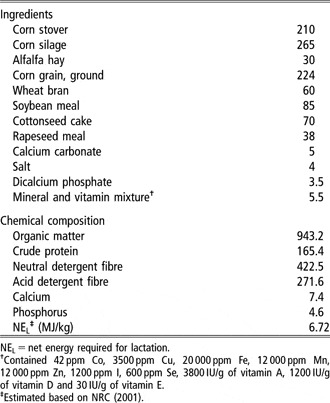
Thirty-two multiparous (mean parity: 2.4 ± 0.25) Holstein dairy cows, averaged 617 ± 16.2 of body weight (BW) and 7921 ± 345.6 kg of milk per 305 days from the previous lactation, were used during days 1 to 63 of lactation. Cows were blocked by lactation number, previous 305-day milk production and expected calving date and were arranged into four groups in a randomized block design. Treatments were: control, low PG, medium PG and high PG with 0, 150, 300 and 450 ml PG fed per cow per day, respectively. The supplement of food grade PG (0.998 g/g PG; The Dow Chemical Company, Midland, USA) was purchased commercially and hand-mixed into the top one-third of the daily ration. Cows were housed in a naturally ventilated tie-stall barn after calving and allowed to exercise for 2 h in an open dry lot before each milking. Cows were milked three times daily at 0600, 1400 and 2100 h and were fed after each milking ad libitum a total mixed ration (TMR). The diet was formulated based on NRC (2001) recommendations for a 620 kg cow producing 26 kg/day of milk containing 3.4% of milk fat and 3.2% protein (Table 1). The amount of PG fed was determined from the work by Kim et al. (Reference Kim, Choi and Myung2005) who found that PG (2.5 ml/kg BW0.75) supplemented to the ration decreased blood NEFA. PG fed in the current study was used as a glucogenic supplement to provide additional glucogenic substrates to dairy cows in early lactation, and no adjustment in net energy (NEI) concentration was made in the control diet to mimic practical feeding conditions. The experimental protocol was approved by the Animal Care and Use Committee of the Shanxi Agriculture University (Taigu County, Jinzhong City, Shanxi Province, China).
Ingredient and chemical composition of the basal diet (g/kg dry matter)

NEL = net energy required for lactation.
†Contained 42 ppm Co, 3500 ppm Cu, 20 000 ppm Fe, 12 000 ppm Mn, 12 000 ppm Zn, 1200 ppm I, 600 ppm Se, 3800 IU/g of vitamin A, 1200 IU/g of vitamin D and 30 IU/g of vitamin E.
‡Estimated based on NRC (2001).
Measurements and collection of samples
Feed offered and refusals were measured for each cow and recorded daily through the experimental period to calculate daily DM intake. Milk yield were recorded daily from parturition through 63 DIM. Samples of TMR were collected weekly to determine DM content and then composited for later chemical analysis. BWs were recorded on two consecutive days at parturition and at 21, 42 and 63 DIM after the 1400 h milking. Milk samples from each cow were collected weekly from each milking on three consecutive milkings within a day. Milk samples were preserved with 2-bromo-2-nitropropane-1,3-diol and pooled by day (weighed to milk yield of each milking) for each cow before chemical analysis. Urine samples were collected using urine collection aprons (Hobbs et al., Reference Hobbs, Hansard and Barrick1950; Liu et al., Reference Liu, Wang, Huang, Dong, Yang and Wang2008) from 3 days during 7, 14 and 21 DIM. Concentrations of urine acetoacetate were measured from a midstream urine sample using Ketostix reagent strips (Ketostix; Bayer Corporation Diagnostics Division, Elkhart, USA) (Chung et al., Reference Chung, Rico, Martinez, Cassidy, Noirot, Ames and Varga2007). Blood samples were obtained from three consecutive days on days 6, 7, 8; 13, 14, 15 and 20, 21, 22 of parturition, 2 h after the morning feeding, from the coccygeal vein into 7 ml vacuum tubes (Vacutainer®; Becton Dickinson, Rutherford, NJ, USA) containing potassium oxalate and 4 g/100 ml sodium fluoride for glucose analysis; 10 ml tubes containing sodium heparin for analyses of BHBA and NEFA; and 13 ml tubes (serum separator tubes) containing clot activator were used to collect serum for analysis of insulin concentration. Blood tubes were immediately placed on ice and transported to the laboratory. Plasma was separated from whole blood by centrifuging at 2000 × g for 15 min in a refrigerated centrifuge at 4°C. Blood tubes for serum collection were allowed to sit for approximately 0.5 h and centrifuged at room temperature at 1000 × g for 15 min to separate serum. All plasma and serum samples were stored frozen at −20°C until further analyses.
Chemical analyses
Samples of TMR and refusals were dried in an oven at 55°C for 48 h, and ground to pass a 1-mm screen with a mill (FZ102; Shanghai Hong Ji instrument Co., Ltd, Shanghai, China) for chemical analysis. Analytical DM content of oven-dried samples was determined by drying at 135°C for 3 h (Association of Official Analytical Chemists, 1990; method 930.15). The neutral detergent fiber (aNDF) and acid detergent fiber (ADF) contents were determined using the methods described by Van Soest et al. (Reference Van Soest, Robertson and Lewis1991) with heat stable alpha amylase and sodium sulfite used in the aNDF procedure, with both aNDF and ADF expressed inclusive of residual ash. The content of N in the samples was determined by a Kjeldahl method (AOAC, 1990; method 976.05). Milk samples were analyzed for fat, true protein and lactose using infrared spectrophotometry (Foss 120 Milko-Scan; Foss Electric, Hillerød, Denmark) according to AOAC (1997, method 975.16) procedures.
Concentrations of glucose in plasma were determined using glucose oxidase (Sigma kit 315; Sigma Diagnostics, St. Louis, MO, USA) based on the method of Trinder (Reference Trinder1969). Concentrations of BHBA were determined (Sigma kit 310-A; Sigma Diagnostics) following the method of Williamson et al. (Reference Williamson, Mellanby and Krebs1962). Concentrations of NEFA were determined using a colorimetric assay (NEFA C Assay Kit; Nanjing Jian Cheng Institute of Bio-Engineering, Nanjing, China) with the modifications of Johnson and Peters (Reference Johnson and Peters1993). Serum samples were analyzed for concentrations of insulin by using a radioimmunoassay (Insulin Assay Kit; Jian Cheng Institute of Bio-Engineering, Nanjing, China).
Calculations and statistical analyses
Net energy intake (MJ/day) was calculated by multiplying the DM intake by the NE density of the diet from the ingredient (Feng et al., Reference Feng, Mo and Lu2000). The energy for lactation (NEL) of PG, assumed to be 16.73 MJ/kg (Miyoshi et al., Reference Miyoshi, Pate and Palmquist2001), was included in NE intake. The NE required for maintenance (NEM; MJ/day) was calculated as BW0.75 × 0.08 × 4.184 (NRC, 2001). Net energy required for lactation (NEL; MJ/day) was calculated as milk yield (kg) × ((0.00929 × fat) + (0.00563 × protein) + (0.00395 × lactose)) (g/kg) × 4.184 (NRC, 2001). Energy balance was calculated as NEI − (NEM + NEL) and expressed in MJ/day.
Milk yield data collected on the first 3 days of lactation was not included to avoid sampling colostrum, and corresponding DM intake were also excluded. Data were summarized by period for BW and blood metabolites, and for the overall experiment. The data were then analyzed using the mixed model procedure of SAS (2000) as a completely randomized block experiment with treatment as a fixed effect, cows within treatment and block as random effects. Data for DM intake, milk yield and milk composition were averaged weekly and analyzed using the same model, but with week considered as a repeated measure using compound symmetry as the variance–covariance error structure. Specific pre-planned contrasts were used to assess the effects of PG (0 v. all levels of PG), and to determine the linear or quadratic response to increasing PG dose. Treatment effects were declared significant at P < 0.05, and trends were discussed at 0.05 < P < 0.10, unless otherwise stated.
Results
Intake, milk yield and milk components
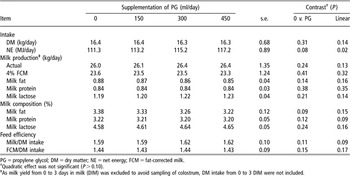
Dry matter intake was not affected by PG supplementation, but intake of NE linearly increased (P = 0.04) with increasing PG supplementation (Table 2). Milk yield (actual and 4% fat-corrected milk) and yields of milk components were similar among the treatments. Whereas milk fat content tended (P = 0.09) to be lower with PG supplementation (3.27%; average of three PG dosages) than with control diet (3.38%). Milk protein content tended (P = 0.09) to linearly decrease with increasing PG supplementation with no differences in milk lactose content. Milk efficiency (kg of milk/kg DM intake) tended (P < 0.09) to be linearly improved with increasing PG supplementation.
Effects of propylene glycol supplementation on dry matter intake, milk yield and milk components in early lactating dairy cows

PG = propylene glycol; DM = dry matter; NE = net energy; FCM = fat-corrected milk.
†Quadratic effect was not significant (P > 0.10).
‡As milk yield from 0 to 3 days in milk (DIM) was excluded to avoid sampling of colostrum, DM intake from 0 to 3 DIM were not included.
Body weights, changes in body weights and energy balance
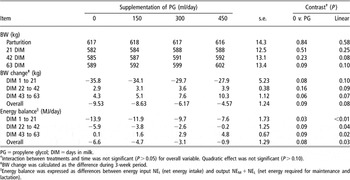
Cows had approximately 5% to 6% BW loss during the 21 DIM, and then slightly gained at 42 and 63 DIM, respectively, compared with the previous weighing day (Table 3). Consequently, BW changes were considerably negative during the period of 21 DIM, but greatly improved overall due to positive BW changes during period of 22 to 42 DIM or 43 to 63 DIM. BW was similar at the parturition and at 21 DIM among the treatments, whereas it tended to linearly increase at the 42 (P = 0.08) and the 63 DIM (P = 0.10) with increasing PG supplementation. In consequence, the BW changes were consistently improved (P < 0.10) overall and each period with PG supplementation.
Effects of propylene glycol supplementation on body weight changes and energy balance in early lactating dairy cows

PG = propylene glycol; DIM = days in milk.
†Interaction between treatments and time was not significant (P > 0.05) for overall variable. Quadratic effect was not significant (P > 0.10).
‡BW change was calculated as the difference during 3-week period.
§Energy balance was expressed as differences between energy input NEI (net energy intake) and output NEM + NEL (net energy required for maintenance and lactation).
Energy balance was negative during the first 42 DIM and overall experimental period (Table 3). Increasing PG supplementation linearly improved energy balance from calving till 63 DIM.
Blood metabolic profiles
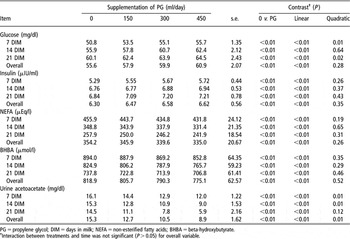
Concentrations of glucose in plasma and insulin in serum linearly (P < 0.01) increased with increasing PG supplementation on day 7, 14 and 21 postpartum (Table 4). Cows supplemented with PG (average of three PG levels) had overall 6% higher blood glucose relative to control cows. In contrast, blood concentrations of NEFA and BHBA linearly (P < 0.01) decreased with increasing PG supplementation on day 7, 14 and 21. Overall, supplementation of PG in the dairy cow diets reduced blood NEFA by 3.9% (average of the three PG groups) and BHBA by 3.4% (average of the three PG groups) compared with control. Similarly, concentrations of urine acetoacetate linearly decreased (P < 0.01) with increasing PG supplementation. Supplementation of PG reduced urine acetoacetate (average of the three PG groups) by 17%, 31% and 42% at day 7, 14 and 21, respectively.
Effects of propylene glycol supplementation on plasma metabolites and urine ketone in dairy cows

PG = propylene glycol; DIM = days in milk; NEFA = non-esterified fatty acids; BHBA = beta-hydroxybutyrate.
†Interaction between treatments and time was not significant (P > 0.05) for overall variable.
Discussion
Increasing supplementation of PG in the dairy cow diets did not affect DM intake and milk production, whereas linearly increased intake of NE due to addition of PG, and numerically reduced the contents of milk fat and protein with increasing PG supplementation. Feeding PG particularly reduced BW loss and improved energy balance during the first 21 DIM. In addition, supplementation of PG linearly increased concentrations of glucose and decreased concentrations of NEFA and BHBA in plasma for the first 3 weeks of lactation.
Dry matter intake
Inconsistency of NE intake with DM intake due to PG supplementation was resulted from adding PG in the estimation of dietary NE. Thus, energy intake would be similar if the PG portion was removed from the calculation. Lack of the effect of PG supplementation on DM intake in this study is consistent with some results (Pickett et al., Reference Pickett, Piepenbrink and Overton2003; Rukkwamsuk et al., Reference Rukkwamsuk, Rungruangb, Choothesaa and Wensing2005; Moallem et al., Reference Moallem, Katz, Lehrer, Livshitz and Yakoby2007), but contrasts to other report (Miyoshi et al., Reference Miyoshi, Pate and Palmquist2001). The last researchers reported decreased feed intake after 2 days of top-dressing 518 g PG per day and suggested that the decrease of DM intake was due to the low palatability of PG. We suggest that the similar DM intake among the treatments in the present study could be due to an opposite effect that, on one hand, high energy of PG has potential to increase DM intake, and on the other hand, PG is an unpalatable additive. Furthermore, Nielsen and Ingvartsen (Reference Nielsen and Ingvartsen2004) explained in a review article that lack of PG stimulation on DM intake of early lactating cows fed up to 518 g of PG per day was due to the dosage of PG used that did not increase the energy density of the feed sufficiently to induce an increase in DM intake. In addition, feed intake in early lactating cows can be influenced by metabolic factors such as the increase in insulin triggered by PG may stimulate negative feedback signals that reduce DM intake (Ingvartsen and Andersen, Reference Ingvartsen and Andersen2000). However, this effect was not observed in the present study even though blood insulin concentration linearly increased with increasing PG supplementation, indicating that DM intake could be affected by multifactors.
Milk yield and milk components
Even though intake of energy linearly increased with increasing supplementation of PG, there was no effect of PG supplementation on milk yield. The results are consistent with the similar DM intake among treatments in this study. Increasing energy supply may not be necessary to increase milk production but reduce BW loss (Table 3). The mechanism by which the energy from PG supplementation contributed to the BW deposit rather than milk production is not clear. Nevertheless, fail to increase milk production with increasing PG supplementation is in agreement with previous studies (Formigoni et al., Reference Formigoni, Cornil, Prandi, Mordenti, Rossi, Portetelle and Renaville1996; Miyoshi et al., Reference Miyoshi, Pate and Palmquist2001; Pickett et al., Reference Pickett, Piepenbrink and Overton2003; Rukkwamsuk et al., Reference Rukkwamsuk, Rungruangb, Choothesaa and Wensing2005). In contrast, Miettinen (Reference Miettinen1995) reported higher milk yield on the second test day in the treated group than in the control group. Stokes and Goff (Reference Stokes and Goff2001) reported that milk yield of cows on a commercial dairy farm was increased by administration of PG on the first 2 days postpartum. Nevertheless, these studies only monitored milk production for a very short period in lactation (ranged from 2 to 25 DIM).
Numerical reduction of milk fat content with PG supplementation is in agreement with the most published work as reviewed by Nielsen and Ingvartsen (Reference Nielsen and Ingvartsen2004). Those authors suggested that reduced milk fat content could be due to, first, the decrease in plasma NEFA since lowered NEFA concentrations lead to decreased NEFA-uptake by the mammary gland (Emery and Herdt, Reference Emery and Herdt1991; Nielsen and Riis, Reference Nielsen and Riis1993); and second, PG could lower proportion of acetate in the rumen (Grummer et al., Reference Grummer, Winkler, Bertics and Studer1994; Shingfield et al., Reference Shingfield, Jaakkola and Huhtanen2002) which may reduce the amount of acetate available for de novo fatty acid synthesis in the mammary gland. The linear reduction of plasma NEFA with increasing PG supplementation is consistent with numerical (P < 0.15) linear decrease of milk fat content in the present study. The trends towards linearly decreased milk protein content with increasing PG supplementation, although the decrease was biologically subtle, is not expected, due to the assumption that supplementation of PG would decrease amino acid requirements for gluconeogenesis, and thus there would not be a shortage of the spared amino acids for the milk protein synthesis. Furthermore, an increase in energy content of the feed by adding PG would stimulate an increase in milk protein percentage (Sutton, Reference Sutton1989). However, this assumption is not supported by the present results as well as the published results as reviewed by Nielsen and Ingvartsen (Reference Nielsen and Ingvartsen2004). It suggests that the relatively small doses of PG have not been able to increase the energy content of the diet sufficiently and/or there has not been a shortage of the spared amino acids for the milk protein synthesis. Thus, it has been argued that reductions in the catabolism of glutamine, glutamate and aspartate will not directly increase the supply of limiting amino acids (Reynolds et al., Reference Reynolds, Sutton and Beever1997).
Body weight changes and energy balance
Cows fed PG tended to increase BW at a higher rate relative to those fed the control diet. This response is similar to Formigoni et al. (Reference Formigoni, Cornil, Prandi, Mordenti, Rossi, Portetelle and Renaville1996) who reported that cows in early lactation supplied with PG tended to have less body condition lose than control cows. However, it contrasts to other reports (Studer et al., Reference Studer, Grummer and Bertics1993; Pickett et al., Reference Pickett, Piepenbrink and Overton2003; Moallem et al., Reference Moallem, Katz, Lehrer, Livshitz and Yakoby2007) that no effect of PG supplementation on BW or body condition score was found. The reduced BW loss during the first 21 DIM was paralleled by lower concentrations of plasma NEFA for cows supplemented with PG.
The improvement of energy balance due to PG supplementation in this study is consistent with the report of Miyoshi et al. (Reference Miyoshi, Pate and Palmquist2001) and Butler et al. (Reference Butler, Pelton and Butler2006). Miyoshi et al. (Reference Miyoshi, Pate and Palmquist2001) found a tendency towards a higher energy balance in multiparous cows drenched with 518 g PG daily from 7 to 42 DIM compared to control cows. Butler et al. (Reference Butler, Pelton and Butler2006) reported that energy balance was improved with adding 500 ml of PG (2 Mcal) to the dairy cow diet. However, Moallem et al. (Reference Moallem, Katz, Lehrer, Livshitz and Yakoby2007) reported no differences in energy balance due to PG supplementation. The difference between the present study and that of Moallem et al. (Reference Moallem, Katz, Lehrer, Livshitz and Yakoby2007) might be due to the quality or dose of the PG product used, or the ratio of concentrate to forage and the quality of forage in the diets. Perhaps the glucogenic potential of PG may be most effective during early lactation. Linearly improved energy balance and reduced BW loss with increasing PG supplementation suggest that the PG supplemented in dairy cow diet could be efficiently used for improving energy balance and minimizing body mobilization in early lactating cows without reducing milk production under the current feeding conditions. Furthermore, failure to observe the quadratic effect on BW change and energy balance indicates that there may be potential to improve energy balance with higher dosage of PG supplementation than that used in the current study.
Metabolites
The linear increase in plasma glucose due to increasing PG supplementation demonstrates the glucogenic capacity of this compound as reported previously (Studer et al., Reference Studer, Grummer and Bertics1993; Grummer et al., Reference Grummer, Winkler, Bertics and Studer1994). The present results are consistent with previous studies (Grummer et al., Reference Grummer, Winkler, Bertics and Studer1994; Butler et al., Reference Butler, Pelton and Butler2006; Kristensen and Raun, Reference Kristensen and Raun2007), but contrast to other findings. Moallem et al. (Reference Moallem, Katz, Lehrer, Livshitz and Yakoby2007) reported no differences in plasma glucose, and insulin concentrations between the control and PG groups. Concentrations of NEFA and BHBA in plasma concur with the relatively minimal mobilization of body fat, as indicated by less reduction in BW by PG supplementation in the present study. Canfield and Butler (Reference Canfield and Butler1991) reported that plasma NEFA correlate negatively with energy balance in early lactating cows and NEFA can be used as an indicator of energy balance and body mobilization. This finding is confirmed with the present results of linearly reduced plasma NEFA and linearly improved energy balance as well as increasing BW gain with increasing PG. The linear decrease in plasma concentrations of NEFA or BHBA with increasing PG is consistent with linear reduction of BW loss and linear improvement of energy balance. These results are also in agreement with other studies (Grummer et al., Reference Grummer, Winkler, Bertics and Studer1994; Butler et al., Reference Butler, Pelton and Butler2006; Kristensen and Raun, Reference Kristensen and Raun2007). Butler et al. (Reference Butler, Pelton and Butler2006) observed that NEFA was decreased in response to a PG drench postpartum. Kristensen and Raun (Reference Kristensen and Raun2007) reported that infusion of 650 g PG into rumen decreased the plasma concentrations of BHBA. However, Moallem et al. (Reference Moallem, Katz, Lehrer, Livshitz and Yakoby2007) found no differences in plasma NEFA, and BHBA concentrations between the control and PG groups. Those researchers suggested that the lack of effect of PG on blood metabolites might have been caused by the long interval between PG administration and blood sampling (15 h). Nielsen and Ingvartsen (Reference Nielsen and Ingvartsen2004) reported that the effect of PG on plasma glucose and insulin occurs shortly after consumption, and the time of blood sampling is a crucial factor in determining the effects of PG. Linearly reduced urine acetoacetate might be due to linearly decreased concentration of plasma BHBA and that of plasma NEFA with increasing PG supplementation. The linear positive effects but with lack of quadratic effect of increasing PG on blood metabolites indicates the potential benefits to further increase the dosage of PG in the present experimental conditions.
Conclusion
Supplementation of multiparous Holstein dairy cow diets with up to daily 450 ml of PG did not affect DM intake and milk production with only a subtle decrease of milk fat and milk protein contents during the first 63 days of lactation. However, increasing supplementation of PG reduced BW loss and improved energy status of early lactating cows. The present results indicate that the PG can be used as an effective glucogenic precursor to improve the metabolic status of transition dairy cows. The PG supplementation in dairy cow diet was beneficial to improve the energy status and blood metabolites, and the potential benefits to further increase the dosage of PG over 450 ml per day in the present experimental conditions were suggested.
Acknowledgements
This work was supported by a grant from 11th Five-Year key projects of National Scientific Research Foundation of China (2007BAD56B04). The authors thank the staff of Shanxi Agriculture University dairy cow unit for care of the animals.