Participation is an essential component of representative democracy. Citizens influence government through elections, lobbying, protest and other forms of political participation, and empirical research confirms that differentials in participation translate directly into differential policy outcomes.Footnote 1 Political participation is an indicator of governmental legitimacy, citizens’ acceptance of a democratic form of government, and the sense of collective responsibility and civic duty that are associated with consolidated and stable democracies.
Differential rates of participation for any subgroup deserve attention, but gender differences are particularly worthy of attention. Historically, women have been deliberately excluded from political power and participation in democracies, and differentials in participation have often persisted even with the removal of formal barriers to voting and holding office. Yet in the developed world, gender differentials have faded or even reversed, with women voting at higher rates than men.Footnote 2 However, we know very little about the determinants and extent of the gender gap in other countries. There are only a handful of multicountry studies of gender and participation.Footnote 3
The main theoretical model for these cross-cultural analyses is one of economic development: as incomes rise, women gain in economic resources, and sex roles and cultural values change. While this is an important result, it leaves a rich diversity of questions untested. For example, what features of transitional societies affect gender and participation differentials? Does religion imprison or empower women? Is education the great equalizer, as in the developed world, or are its effects constrained? And perhaps most importantly, how does the gender gap vary as a function of context – not just individual factors, but also broader societal institutions?
In this article, we offer some preliminary answers to these questions through a region-wide exploration of the gender gap in Latin America. We construct two measures of participation, and examine women–men differentials in seventeen countries. We build a multilevel model that explains the gender gap as a function of individual and contextual factors. We find a substantial gender gap in almost every Latin American country, a gap that is partly explained by individuals’ characteristics but also varies contextually with the presence of female elites and the level of political liberties. Surprisingly, we find no evidence that economic development per se affects gender differences in participation rates. Instead, it appears that employment experiences in labour markets may reduce gender inequality, but without any spillover or contextual effects.
The analysis of Latin America is useful for two primary reasons. First, the seventeen countries in our study are important in their own right and deserve examination. These countries are home to several hundred million citizens and are young or re-emerging democracies facing major economic and social challenges. Secondly, Latin American countries provide variance in both political and economic variables. These countries’ political histories contain patterns of political exclusion, oppression and cultural barriers to women’s full equality of citizenship. They provide dramatic variance in economic development, including industrialized and urban cases as well as agricultural and rural societies. These differences provide an environment where we can simultaneously explore individual and contextual explanations for participation patterns, which cannot be done in single-country studies.
Given the varied experiences with democracy and civil liberties, our analysis considers both conventional and unconventional participation. The first includes typical and familiar electoral politics – i.e., turnout and campaign involvement – as well as awareness and interest in politics, participation in discourse and traditional efforts to influence government policy. The second form is ‘unconventional participation’, which encompasses protest activity such as demonstrations, boycotts and occupations. We include this form of participation to account for the variety of recent democratic histories and to increase generalizability to cases that are less than fully consolidated democracies. In the developed world, only a small percentage of citizens engage in such actions. But many developing countries are also young democracies. Under authoritarian rule, protest and civil disobedience were frequently the only forms of mass participation in politics. Elections in non-democracies, if held, are almost always meaningless, and discussion and persuasion have no effects without an electoral process and free press. In such contexts, unconventional participation is effectively the only way for most citizens to influence state decision making. As many Latin Americans have lived under authoritarian rule, this may affect post-democratization behaviour as well. This design choice is especially appropriate given the widespread histories of women’s involvement in protest movements in Latin America.Footnote 4
We shall proceed in several steps. In the next section, we develop two measures of political participation and examine the gender gap on each in Latin America. Subsequently, we build a multi-level model to explain differences within and across countries. We then report results and consider implications for future research.
An Overview Of The Gender Gap In Latin America
The first tasks are to define measures of participation and the gender gap. For any measure of participation, we define the gender gap, following previous work, as:

We explore the gender gap using two measures: conventional participation and unconventional participation. Our measure of conventional political activity combines three survey questions:
How frequently do you do each of the following things? Very frequently, fairly frequently, occasionally, or never?
1. Follow political news
2. Talk about politics with friends
3. Try to convince others of your political opinion.
Using the 1998 Latinobarometro survey, we created an index of conventional participation by adding respondents’ scores (1–4) on each of these three questions. These types of questions are typically included in participation scales in cross-national studies.Footnote 5 All items are on the same four-point scales and are highly correlated: Cronbach’s alpha for a scale of these three items is 0.762, well within the standard range for such scales.Footnote 6 The direction of the scale was coded such that a high score indicates a higher level of involvement in conventional political activities.
For unconventional participation, we examined responses to the following three questions. Because actual involvement in unconventional political tactics is often a rare event, most measures of these activities include both actual involvement and a willingness to engage in such activities,Footnote 7 as does ours.
I’m going to read out a variety of political activities. I would like you to tell me for each one, if you have ever done any of them, if you would ever do any of them, or if you would never do any of them?
1. Take part in a demonstration
2. Block traffic
3. Occupy land, buildings or factories.
Cronbach’s alpha for this scale of unconventional tactics is 0.708. The three items were added together and the direction of the final scale coded such that a high score indicates a greater willingness to engage in unconventional political tactics.
There are many alternative measures of political participation; our investigation of women’s and men’s political involvement is far from exhaustive. The most obvious and widely-studied alternative is turnout. Recent work also suggests a number of alternative forms of participation that are especially important for women’s political power and action. For example, scholars have found higher levels of involvement by women in community groups and social movements,Footnote 8 though some researchers report continuing gender gaps in these areas as well.Footnote 9
We limit our analysis to conventional and unconventional participation, however, for several reasons. First, they are objective and easily comparable with similar measures from other countries and contexts. Secondly, they are important components of political participation, though narrowly focused. Further, both types of participation directly affect political influence in terms of policy making and government action. There are many other power spheres that deserve study, but certainly we should also pay attention to the conventional dimensions. Finally, we are constrained by our data sources. Not all countries had major elections in 1998, the year our survey was taken, so cross-country comparisons of turnout are impossible.
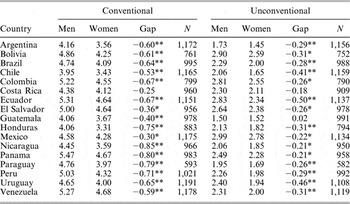
Table 1 shows mean participation rates for both indices by gender, and the gender gap, for all countries. Several patterns are immediately apparent. First, there is a consistent and significant negative gender gap for almost every country on both conventional and unconventional participation. For conventional participation, men’s participation rates are higher than women’s for every country. Mean participation rates are similar across all countries, but the gender gap varies with the largest differentials in Nicaragua (−0.85), Panama (−0.80) and Paraguay (−0.79), and the smallest in Mexico (−0.30), and El Salvador (−0.36). In Costa Rica the gender gap is not significant. While Inglehart and Norris argue that the size of the gender gap in participation is smaller in more developed countries and larger in more agrarian countries,Footnote 10 the pattern for these Latin American countries does not fit this explanation. The estimated correlation between the size of the gender gap and economic development for these countries is 0.23 and is not statistically significant (p = 0.37).
The Gender Gap by Measure and Country

**p ≤ 0.01, *p ≤ 0.05.
For unconventional participation, mean participation rates range from about 1.5 to 3.0 across all countries. The gender gap for unconventional participation is largest in Ecuador (−0.50) and Uruguay (−0.46), and smallest in Nicaragua and Panama (both −0.21). Results are significant for all countries except Costa Rica and Guatemala, with all unconventional participation rates being very low in the latter country. Nevertheless, the pattern of the gender gap in these Latin American countries suggests a societal-level relationship between levels of political freedom and gender differences in protest activities. The size of the gender gap in unconventional activities varies with the level of political freedom (r = 0.40; p = 0.12), a pattern that will become stronger in our multivariate models that control for individual-level variables. The political histories of these Latin American countries, where women often were active in protests against authoritarian regimes, apparently narrow the gender gap in unconventional political activities in countries that remain the least politically free.
Modelling The Gender Gap
A rich literature explores the gender gap in the developed world, especially in the United States. From that literature emerges a series of consistent findings regarding the impact of individual covariates on participation, and on gender differentials in particular. Not surprisingly, education, income and employment status are consistent predictors of women’s participation, and tend to reduce any gender differentials. These conclusions, however, may not extend directly to Latin America or the rest of the developing world.
One possibility is that the developing world will follow a very similar trajectory to that of the United States and the other post-industrial countries. In those countries, a number of cohort effects reduced conventional political participation for older women through the 1960s and 1970s. These cohort effects gradually faded due to generational replacement and economic transformation. Similar transformations could occur in Latin America, though they may be constrained by the later enactment of female suffrage laws, slower economic growth and fewer employment opportunities. Alternatively, the unique features of Latin America and other regions may point towards entirely different patterns of participation. For example, middle-aged women in the United States and Western Europe are unlikely to participate in unconventional political actions.Footnote 11 But given the important role Latin American women played in the pro-democracy movements in the 1970s, 1980s and 1990s, it may be that gender and age have the opposite effect in Latin America. How gender and participation will relate is unclear for the developing world, so we spend this section considering how to adapt models of participation from the developed to the developing world.
We pay particular attention to the impact of context. Most previous work ignores contextual effects and focuses on individual covariates. But gender differences in participation rates can arise from three different sources: differential resources, differential effects and differential context. First, men and women have differential access to resources and opportunities that affect political mobilization. For example, where women have fewer employment or educational opportunities, the lack of these resources may depress participation in aggregate when compared with that of men. Secondly, men and women may respond differently to the same factors; education may mobilize women more than men, or vice versa. Thirdly, gender differentials may reflect broader cultural contexts. For example, Inglehart and Norris contend that gender has different patterns with participation in industrial versus agrarian societies, with more traditional sex roles depressing women’s political participation in the latter cases.Footnote 12
Contextual effects, however, cannot be measured in single country studies. Instead, we need a multi-country, two-level interactive model, where participation may vary as a function of basic demographics, as an interaction of demographics and gender, and as a function of the interaction of context and gender. If only baseline demographic variables predict participation, then the gender gap is caused by inequality of access to resources and opportunities (such as education, religion, employment, income). If individual demographics interact with gender, then the gender gap reflects an inequality of impact. For example, poverty might depress women’s turnout more than men’s, and education might mobilize women more than men. Finally, if the gender differential varies between countries, then it can be seen as a function of cultural and contextual variables. Our study includes a very diverse set of countries that allow us to test for each type of mechanism.
In the following paragraphs, we review findings from the existing literature on individual and contextual covariates that affect gender differentials in participation. We then consider how each factor might work differently in the developing world, and the specific context of Latin America.
Individual-Level Influences
At the individual level, previous research has identified a number of factors that have consistent effects on participation and the gender gap. Numerous studies point to the importance of education, socio-economic status, age, marriage and employment on participation in general. Differences between men and women on these traits also are commonly held to account for any gender gap in political participation, so we incorporate all these variables into our analysis. To this list we add religion, given the important role of the Catholic and Protestant churches in Latin America. Expected relationships and previous findings are discussed below.
Education and Socio-economic Status
Education is one of strongest individual-level determinants of voting and other forms of political activity.Footnote 13 Education provides skills that help voters overcome bureaucratic elements of voting and increase the ability to make abstract decisions. Education also shapes civic attitudes. Even in developing countries, increased education is associated with higher levels of civic duty and efficacy.Footnote 14
Previous research suggests that education contributes to the gender gap both through differences in access and differences in impact. Differing educational levels between men and women are often cited as a significant reason for gender differences in participation.Footnote 15 Education may also have differing effects for men and women: some researchers have noted a stronger influence for education on the participation rates of women.Footnote 16
We predict similar patterns in Latin America: education should increase participation for all, but its impact should be greater for women. There continue to be differences in educational rates for men and women in Latin American countries, though these differences are small for younger generations. In addition, education’s influence on economic opportunity and mobility should be more transformative for women than men, as found in other contexts.
Previous work also finds that socio-economic status (henceforth SES) affects participation. A minimal level of resources is necessary for some forms of participation – making campaign contributions, for example. Higher SES individuals may also have a greater sense of being ‘stakeholders’ in the political process and may have more access to political information. Social class also can be related to attitudes towards sex roles, with more traditional gender roles continuing for a longer period of time among working-class than among middle-class families.Footnote 17
In Latin America, we expect SES to have a similar pattern in conventional politics, but not in unconventional participation. In conventional politics, we expect participation to increase with SES. Further, as found previously, higher SES should be associated with changing attitudes about gender roles. With respect to unconventional politics, we do not have a strong expectation. Previous work has found no relationship between class and protest activity.Footnote 18 In addition, during Latin American transitions to democracy, all sectors of women were represented in the protest movements, suggesting a limited relationship between class and unconventional participation.
Employment Status
Holding a job outside of the home is often linked to increased political participation for women.Footnote 19 Jobs provide skills and avenues for political discussions, and increase and diversify individuals’ economic interests. Political mobilization efforts also might be matched to workforce participation, such as union efforts to mobilize members to vote. However, the effects of employment might be less transformative for women in Latin America, where women are less likely to be in the workforce and their work experiences are less likely to be politicizing.Footnote 20 The types of employment available to Latin American women lead us to expect workforce participation to have a lesser effect on women’s than men’s political involvement in these countries.
Age and Generations
We predict a fundamentally different relationship between age and participation in Latin America than in the United States and Western Europe, reflecting recent transformations in Latin American society. The direction and nature of the effects vary further by the type of participation: conventional or unconventional.
Research on conventional participation in the developed world finds that age is a major determinant of increased political activity.Footnote 21 The life-cycle explanation of political participation describes younger citizens as politically inactive as other commitments, such as school, work or social lives, crowd out political interests. As individuals age, they become more connected with their communities through long-term residency, which increases their interest in local politics. Increased connectivity is driven by increased use of public services, including schools, increased awareness of community problems and a growing interest in solving such problems, driven by an expectation of long-term residency. These broader interests produce higher levels of participation and create habits of participation. Participation levels are often highest for those in their fifties and sixties, with slight declines for those older, connected with deteriorating health.
However, a key difference between the developed world and Latin America is in political socialization: individuals’ propensities to participate in politics may be set in their late twenties or early thirties and continues at that level throughout most of their lives.Footnote 22 Many generations of Latin American women were socialized under non-democratic political systems, and some under systems that explicitly excluded women. Consequently, we expect a large gender gap for older cohorts, but a small or non-existent gap for the youngest post-democratization cohorts. This is comparable with earlier work on the gender gap in the United States, which found that those coming of age before the enfranchisement of women maintained consistently lower participation rates than post-enfranchisement generations. These cohort effects are largest for forms of participation other than voting – including conventional and unconventional participation.Footnote 23
For unconventional participation, the findings are reversed. Ageing tends to reduce levels of unconventional participation in the United States and Europe.Footnote 24 The economic and social costs of such participation tend to be higher for middle-aged and older citizens with more personal and professional responsibilities, and their expectations regarding the payoffs of protest activity are on average lower. Inglehart and Norris find in a cross-national study that those over 60 are the least likely to engage in protest activity and gender differences are especially large for this age cohort.Footnote 25 This pattern is especially strong in agrarian societies. For Latin America this pattern might be attenuated by older women’s experiences and active involvement in protest during the transitions to democracy, suggesting that in Latin America the unconventional gender gap will decline with age.
Marriage
Recent work from post-industrial countries finds that marriage tends to decrease the gender gap. Traditional tasks associated with raising children have been altered by technology or transferred to the state or societal institutions.Footnote 26 Under such circumstances, marriage has similar effects for both men and women.Footnote 27 However, older analyses of the influence of marriage on participation often found that marriage reduced women’s participation. Household obligations, child care and traditional sex roles prevented women from becoming involved in politics and isolated women from organizations and communications associated with political interest and involvement.Footnote 28 And marriage tends to decrease involvement in protest activities, at least among women.Footnote 29
Family structures in some Latin American countries remain closer to the traditional model, with less employment outside the home and fewer women being members of groups. We predict a negative effect in Latin America – marriage will decrease participation, especially for women.Footnote 30
Religion and Religiosity
In the developed world, research on the effects of religion on participation suggests that it can have both positive and negative effects on women’s participation rates. On the one hand, religious institutions often provide avenues for women’s activity outside the home and help build civic skills. Churches also are one avenue that provides civic skills to a wide range of individuals from varying social classes and diverse racial and ethnic groups. On the other hand, some religious denominations reinforce traditional gender roles, including less political activity on the part of women. In addition, churches with a more hierarchical structure, such as the Catholic Church, provide fewer opportunities for their members to attain civic skills through church-related activities.Footnote 31
In Latin America, the potential effects of religion are similarly complex, especially given the participation of religious organizations in politics and in the democratization movements. On the one hand, Latin America remains predominantly Catholic, and the Catholic Church often is noted for advocating conservative sex roles that could limit women’s political participation, even opposing women’s suffrage in some cases.Footnote 32 Further, the growing Protestant church includes very conservative elements that take similar positions on gender roles and leadership, and often advocate avoiding the political world.
At the same time, both the Catholic and Protestant churches have empowering and mobilizing roles in Latin America. Catholic priests and lay workers have been involved in progressive social programmes, political mobilization and movements for democratization. Further, in many Protestant churches, women participate in leadership positions, providing experiences and demonstrative effects that may increase political participation.Footnote 33 In some Latin American countries, religious leaders (Catholic priests and Protestant ministers) run for political office under the banner of a religious party, and use religious affiliation to mobilize voters. All of these imply that religion might increase attention to and involvement in politics.
We also expect religiosity, rather than specific doctrines or denominational membership, to be an additional mechanism influencing political activity. Religiosity and its accompanying involvement with church activities help to build civic skills that can translate into greater involvement in conventional political activities. In contrast, high religiosity is negatively related to protest activities.Footnote 34 Because women are more religious than men, and this is true in these Latin American countries as well, we expect that religiosity will increase the conventional participation levels and decrease the unconventional protest activity of women.
Contextual Factors
Institutional and developmental factors help to explain variations in turnout worldwideFootnote 35 and for countries in Latin America.Footnote 36 Such factors also should influence other types of political participation, though their effects may differ by type of participation activity and by gender. For example, women’s suffrage laws should influence the political actions of women but not men. We identify three contextual variables as especially important in Latin America, and test for their impact: (1) democratic governance and political freedom, (2) economic development, and (3) women officeholders.Footnote 37
Democratic Governance and Political Freedom
Generally, higher levels of participation are associated with higher levels of political freedom, as democratization makes voting meaningful and fosters interest broadly in political activities. Indeed, the extent of political freedom in Latin American countries does influence the overall level of turnout.Footnote 38 However, the influence of political freedom on gender and participation in Latin America is not obvious. One might argue that gender gaps are minimized under authoritarian rule. Women often played a significant role in protests against authoritarian regimes in these countries.Footnote 39 Under authoritarian regimes, women may have been more able than men to engage in protest activities because predominant gender-role attitudes result in women’s protest activities being seen as less political, and therefore less in need of repression.Footnote 40 Women also may be disadvantaged by a return to democracy and mass party politics. Parties often subdivide the population into different interests and, thus, coalitions of women present under the authoritarian regimes may be broken apart. Additionally, party politics may replace the social movements in which women were active.Footnote 41
Yet, with a return to democracy and greater political freedom, larger numbers of women may feel reassured that political participation is acceptable and that such participation would have fewer personal ramifications.Footnote 42 In addition, by the 1990s, coalitions between social movements, NGOs, government agencies and the political parties worked together on policies confronting domestic violence and implementing gender quota laws in Argentina, Chile, the Dominican Republic, Mexico and Peru.Footnote 43 We test for both possibilities by including a control for political freedoms and allowing it to interact with gender.
Economic Development
Scholars frequently argue that lower levels of economic development reduce women’s participation rates and produce a negative gender gap. Independent of individual economic status and educational achievement, development is purported to have important contextual effects. Economic development may lead to a broader societal change in the values and gender roles that increase women’s participation, even among individuals with low education and low income. In other words, development may lead to a general shift in attitudes, with less disapproval of mobilized women and stronger expectations of equal participation.
The empirical evidence for this hypothesis, however, is limited. The mechanism by which economic development shapes the participation rates of women and men has not been stringently tested. Many of the explanations actually focus on individual-level mechanisms: increased education and economic resources for women and a concomitant reduction in traditional gender roles for these individuals.Footnote 44 Others find that development increases participation, but without examining differential effects of gender.Footnote 45 Our Latin American cases offer an opportunity to separate individual and contextual effects of development; half fall within the industrial category (as defined by Inglehart and Norris),Footnote 46 while the remainder fit the agrarian category. We include a measure of per capita income, and let it interact with gender to capture any effects of development on participation differentials.
Women Officeholders
A number of recent studies find that women react to the presence of female officeholders and candidacies in ways that men do not. Women’s political engagement,Footnote 47 political knowledge and efficacy,Footnote 48 and trust in legislaturesFootnote 49 increase when more women seek and hold political office. However, Lawless presents null findings, or positive effects for men rather than women, between female officeholders and civic attitudes and participation.Footnote 50
Latin American countries vary in their percentage of female representatives in the lower chamber of their national legislatures, from over 30 per cent in Argentina and Costa Rica to less than 10 per cent in Venezuela, Brazil, Guatemala and Honduras. A number of the Latin American countries have quotas requiring parties to nominate women, dramatically increasing the number of female legislators.Footnote 51 With a wide variation in levels of women officeholders in Latin American countries, we expect that women’s involvement in politics will be greatest in the countries with a large number of female politicians. As we do not expect this to influence the participation of men, we hypothesize that the interaction between female officeholders and the gender of the survey respondent will be positive.
Model and Results
To incorporate both individual and contextual variables, we explored a multi-level model, following Steenbergen and Jones.Footnote 52 Our model has two levels. The first, or lowest, level is that of the individual respondent; the second level is the country. We model respondents’ propensity to participate incorporating the standard individual covariates, as described above (details on variables are in the Appendix). At the second level, that of each country, we model variance in the gender gap as a function of country-specific contextual variables. In other words, we explicitly model the size of the gender gap as varying across the political-social contexts of each country.
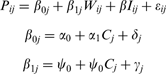
where Pij is the percentage participation rate of subject i in country j; Wij is an indicator variable coded 1 for women and 0 for men; Iij is a matrix of all the other individual covariates and their interactions; Cj is a matrix of contextual covariates specific to country j; εij, δj and γj are each independent and identically normally distributed random errors, with mean 0 and unknown variance.
The model reduces to a single equation with a series of contextual variables, included individually and allowed to interact with W, and three error terms. This is a standard multi-level model where the magnitude of the gender gap varies with the interaction of gender and individual covariates, as well as with the interaction of contextual variables and gender. The variance of γj was never significantly different from 0 in any of the models, so we eliminated that random effect, just retaining the random intercepts component.
Note that our model is quite constrained by a relatively small number of level-two categories. We only have seventeen countries, which greatly restricts our leverage on the country-level predictors. To control for the possibility of instability in the models, we ran two other kinds of models (not shown). One was a simple interactive model without the random effect at the country level. The second was a fixed-effects model, with indicator variables for countries. In the first case, the coefficients on all variables barely moved, in most cases just improving the significance of the estimates. In the second case, we could only estimate individual-level covariates, or country variables that interact with individual covariates. Again, the coefficients barely moved, and in most cases had larger t-values than the random effects models we report.
Conventional Participation
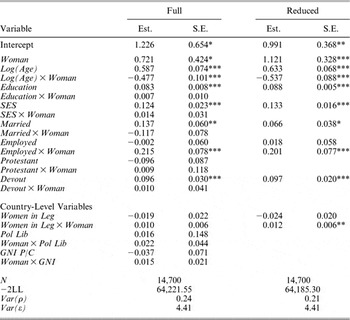
Table 2 shows results for models of conventional participation rates, and links the gender gap to both individual and contextual variables. Most of the usual suspects have expected patterns with participation: age increases conventional participation, as does education, marriage, socio-economic status and religiosity. In addition, several variables have differential effects for men and women. Most important at the individual level are differential effects for age and employment. Employment increases women’s participation, but age has a strong negative effect on female conventional participation. Finally, at the country level, the presence of women among political elites (Women in Leg) also has differential effects, reducing the gender gap.
Conventional Participation Models

***p ≤ 0.01, **p ≤ 0.05; *p ≤ 0.10.
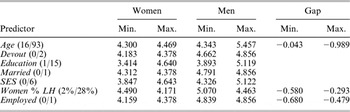
Table 3 shows predicted values for men and women, and the resulting gender gap, when varying individual predictors from their minimum to maximum, with all other variables set at their medians.Footnote 53
Impact of Covariates on Conventional Participation

†Gap not shown when interaction with Woman is not significant.
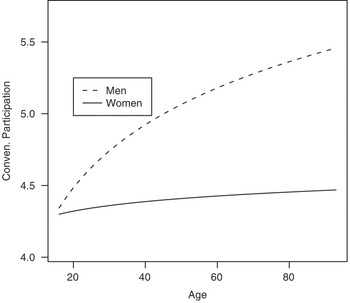
Age has the largest substantive impact on participation rates, but only for men. The negative interactive effect (Women × Age) effectively cancels out the increases in participation observed in men. The net result is that the gender gap increases dramatically with age. Figure 1 compares predicted participation rates as a function of gender and age. Men’s scores rise quickly with age, while women’s are virtually unaffected. The gender gap grows – from just −0.04 for a 16-year old voter to −0.99 for the oldest cohorts.Footnote 54
Predicted conventional participation by gender and age

We suspect that the impact of age reflects dramatically different patterns of socialization for previous generations of women and men in Latin America. Some of the older generations began voting before women had the right to vote and women may have been culturally discouraged from paying attention to politics. Other women came of age during the military dictatorships of the 1960s, 1970s and 1980s, and they had limited experiences with democratic politics that could challenge traditional cultural norms. Thus, a generational effect appears to be governing the relationship between age and political participation for women, while men’s participation rates more closely mirror the life-cycle explanation. While we cannot predict the future, we believe that the relationship between age and the participation gap will fade out over the next generation, such that, for both men and women, increases in age will be associated with increases in conventional political activities.
The only other individual variable whose influence varies with gender is employment. The coefficient for the main effect is small and insignificant: men’s participation is unaffected by their employment status. For women, however, employment outside the home boosts participation substantially. Previous work on women’s mobilization has found that employment outside the home is a powerful transformative experience, mobilizing and liberating women from traditional roles and empowering them as economic and political agents.Footnote 55 However, gendered patterns of employment in Latin America lead us to suspect that employment might not have the same effect for women in these countries. In fact, the opposite occurred. The importance of building resources and communication channels through employment is thus confirmed in a wide variety of countries and employment settings.Footnote 56
Other individual variables influence participation, but without gender differentials. Higher levels of education increase conventional participation for both men and women. The substantive effect is large and positive, but does not vary with gender. The lack of an interaction effect contradicts prior research which found a stronger influence for education on women’s participation rates. Instead, employment – rather than education – has the differential influence on men’s and women’s participation rates in Latin America.
Marriage and SES also had non-gendered impacts, with equal effects for men and women. This result is contrary to our prediction; we had thought that both could have differential effects across gender. The pattern for marriage, with equal effects for both sexes, matches the current pattern found for more developed democracies rather than a more traditional pattern of depressed turnout for married women. Social class could have a differential influence for women if lower class status also contained viewpoints on more traditional gender roles. As an interactive pattern was not significant, we conclude that social class (or at least our measure of it) measures resources for participation rather than attitudes towards women’s political roles. Class-differentiated political norms do not appear to be a cause of the gender gap in participation in Latin America. Other researchers have found citizens of Latin American countries to have a relatively high level of support for equal roles in politics, falling just behind levels found in the United States and Western Europe.Footnote 57
The last of the individual-level components measures the effect of religion. For conventional political participation, the new Protestant movement in Latin America appears to have no effect for either men or women. Rather, as is often the case, religiosity, rather than denominational distinctions, matters. Religiosity often entails significant participation in church activities which foster the civic skills that translate into increased political participation.Footnote 58 As women in Latin America are more religious than are men, religiosity gives a boost to the participation rates of a larger number of women and thus reduces the overall gender gap in conventional participation rates.
Our second-level analysis shows that one important contextual component is the level of women’s involvement at the elite level. Increasing the percentage of women in politics significantly reduces the participation differential. Comparing the predicted impact on identical voters in different contexts, the gender gap should reach −0.58 in a country with just 2.5 per cent of the seats held by women, and fall to −0.29 where women’s participation in elite politics reaches 28 per cent. Interestingly, the model predicts that the gap will disappear entirely when the distribution of legislative seats is roughly equal in a legislature, though parity (50 per cent) is well outside the range of the data. The estimated overall effect of women elites, however, is negative and not significant. In other words, there is a significant difference between men and women’s responses to the presence of women elites, but the overall impact is ambiguous.
Unconventional Participation
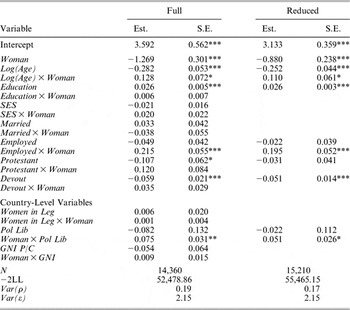
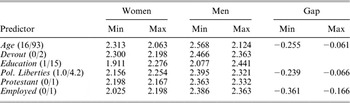
Table 4 shows estimates for a model of unconventional participation. As with conventional participation, predictors include both individual-level and contextual explanations, though the direction and significance of some variables change from Table 2. Table 5 shows predicted participation and gender gaps for each covariate’s minimum and maximum, with other variables set to median values. In general, the magnitude of effects for all covariates are reduced compared with conventional participation. This partly reflects less variance in the dependent variable; nearly all respondents have much lower unconventional participation scores than conventional scores.
Unconventional Participation Models

***p ≤ 0.01, **p ≤ 0.05; *p ≤ 0.10.
Impact of Covariates on Unconventional Participation

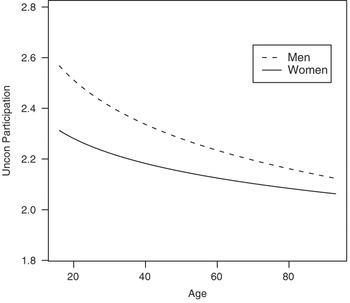
As with conventional participation, age and employment have gender-differentiated effects. For both men and women, increasing age reduces unconventional participation. This is not unexpected, as prior research shows unconventional protests are the activities of the young.Footnote 59 However, the decline in women’s participation is slower than that of men, reducing the overall gender gap. Figure 2 traces the unconventional participation rates for men and women by age. The larger gender gap among the youngest cohort appears to be related to the higher level of unconventional behaviour by men in this group, while protest activities are lower but more equal across the sexes for older residents. The larger gender gap among the youngest cohort contradicts the findings of Inglehart and Norris that gender differences in protest activities are smallest among this age group.Footnote 60 The political histories of the Latin American countries may have shaped a more similar pattern of protest propensity among men and women in the generations that experienced more of the authoritarian governments.
Predicted unconventional participation by gender and age

Employment has a powerful and significant mobilizing effect on women, with no effect on men. This finding is contrary to our original hypotheses. Again, employment appears to be key for women’s political participation, of all kinds, in Latin America. The movement of women from the home to the workforce opens up new communication channels, fosters political organizational efforts, and provides women with their own economic resources.
Other variables have expected effects on unconventional participation, but without gender differentiation. Education increases participation for all, with no differential between men and women. Meanwhile, class and marriage have no relationship with unconventional actions, though both were influential in fostering conventional activities. Religiosity decreases participation through unconventional avenues, while it increased conventional political actions. On the one hand, religiosity apparently provides civic skills that foster conventional actions, but, on the other hand, the religious beliefs of frequent attenders at church may dissuade them from unconventional protest.
As with conventional forms of participation, context matters for unconventional politics. In particular, we found that the gender gap has an unexpected relationship with political freedoms: men’s and women’s participation rates equalize under authoritarian rule.Footnote 61As predicted values in Table 5 show, women have slightly higher rates of unconventional political participation under repressive than under more open political regimes. Men’s rates of unconventional activities are lower under repressive regimes and greater with increased political freedom. This result is not entirely unexpected given the literature showing women’s involvement in political protest during the authoritarian regimes.Footnote 62 In countries with fewer political freedoms, women’s protest activities may be less threatening to such regimes, though such activity may still risk severe punishment.
Conclusion
Gender differentials in political participation translate directly into political power, resource access and policy outputs. Unequal participation rates imply less representative and less legitimate government. Latin American governments face declining rates of trust and legitimacy from their citizens; ensuring equal participation for all will strengthen these regimes in the face of ongoing political storms. Political equality of women remains a concern in the most stable democracies, and it is at least as important in young democracies with major developmental challenges. Nevertheless, we had a consistent gender gap in conventional and unconventional participation across nearly all seventeen Latin American countries in this study. The effects can be attributed partly to opportunity and belief differences between men and women, partly to the differential effects of individual covariates, and partly to context.
The first type of effects are factors that affect men and women equally, but differences in the distribution of covariates lead to a gender gap. In our models, these do little to explain the participation gap. For example, education has a strongly positive relationship with participation in all models, implying a need to increase women’s access to education. But in many ways, this process is already well under way as younger generations of Latin American women do enjoy much more equal access to education. Religiosity also has equal effects for men and women, but differential treatments: Latin American women are on average more religious than men. Religiosity increases conventional and decreases unconventional political actions. Thus, belief differentials help reduce the conventional participation gender gap and increase the gap in unconventional participation.
Two individual factors influence participation rates differently for men and women: employment and age. In Latin America, employment status has a greater influence on women’s than men’s participation, both for conventional and unconventional activities. Moving beyond traditional household roles, women in the workforce are exposed to new communication channels and gain skills. This exposure increases participation, though it has effectively no influence on men’s participation.
Age has surprisingly different patterns for men and women. For conventional participation, men’s participation increases with age, but age has no impact on women. The net effect is that the gender gap increases dramatically with age. Conversely, for unconventional participation, the gender gap decreases with age – women’s participation rates in protest activities decline more slowly than those of men. Both, we hypothesize, reflect recent Latin American experiences with authoritarianism and democratization, which restricted women’s conventional participation, but gave them an important role in unconventional participation. Regardless, we expect that with generational replacement, these differences should fade.
Finally, contextual variables also shape the magnitude of the gender gap, but not without some unexpected results. As others have demonstrated, the presence of women among a country’s elected officeholders increases the political involvement of women. One potential implication is that electoral systems that increase the proportion of women serving in elected offices may help reduce the gender gap and equalize participation rates. The gender quota laws in place in a number of Latin American countries may simultaneously help to equalize participation among the masses as well as increase women’s presence among the political elite. Regime type also influences the participation rates of men and women, but in this case it is for unconventional politics. Women’s participation rates in protest behaviour are higher in societies with fewer political freedoms, while the pattern for men is that there are higher levels of protest activity with more political freedom. This pattern appears to reflect the protest role of women under authoritarian regimes.Footnote 63
Most surprisingly, economic development appears not to matter at the societal level. We found no evidence suggesting that economic development leads to more universal changes in political attitudes or behaviour. Rather, we find evidence that only at the individual level do changes in women’s employment, education and economic resources matter. Theories of gender differences that rest heavily on economic development need to recognize that the influences of economic development also play out at the individual level, and that this process is the same for more developed and less developed economies. The sole difference is that in developed economies more women have greater educational status and employment outside the home and, in less developed countries, fewer women possess these resources.
There are several important next steps to the better understanding of gender and politics in Latin America, and more broadly across the developing world. Most obviously, other measures of participation need to be studied. The most important is turnout. For lack of data, we were unable to include that variable, but recent election cycles may change that. From November 2005 to December 2006, most Latin American countries held presidential or legislative elections, or both. Although Latin American countries operate on different electoral calendars with different term lengths, every thirty years or so, most elections are scheduled for the same year. This will provide cross-country turnout data with which to study gender and participation. This is particularly important because turnout is the one area where the gender gap has disappeared in the developing world, and even reversed. Since the early 1980s women have participated at slightly higher rates than men in the United States and Western Europe, and in the 1990s gender differences in turnout disappeared in a wide variety of countries.Footnote 64
The other obvious next step is to expand the study of gender and participation to other regions. We found that some lessons from research on the developed West did apply to Latin America – but others clearly did not. Other regions of the world have their own particularities that may lead to still other findings. Like Latin America, the postcommunist countries of Eastern Europe have shared authoritarian legacies. Yet, the social and political roles of women in the former communist regimes and in the social movements leading up to the current governments were quite different from that found in Latin America.Footnote 65 Thus, the gender patterns documented in this research on Latin America may not apply to the people of Eastern Europe. In other areas of the world, diversity in economic development, social roles and religious traditions could produce further differences in results; see for example Chhibber’s work on India.Footnote 66 Ultimately, we will not know what the common versus country-specific or region-specific elements of gender patterns in participation are until more cross-national and cross-cultural studies are completed.
In this article we have offered a first look at the nature and extent of the gender gap in participation in Latin America. We have partly explained the magnitude of the gap as a function of individual and contextual factors. But, like many previous efforts in other countries, we have failed to explain the gender gap fully. For both of our models, a small gap in participation persists even under ‘ideal’ circumstances.Footnote 67 This finding is consistent with work on the developed world, where, however, in many forms of political participation, gender differences continue to persist. Even in post-industrial countries with stable democratic governments, a small negative gender gap continues in many conventional and unconventional forms of participation.Footnote 68 Future work in more diverse settings should help us close this explanatory gap and build more general models of political participation.
Appendix: Details On Data And Variables
For all individual covariates, we used the 1998 Latinobarometro survey from seventeen Latin American countries.Footnote 69 The specific variable codings used are as follows:
— Conventional Participation and Unconventional Participation are coded as described in the text.
— Woman is coded 1 for female respondents and 0 for male respondents.
— Log(age) is the natural log of respondents’ age in years.
— Education is the number of years of education.
— SES is a measure of socioeconomic status. To make the variable easily comparable across countries, our measure counts the number of goods owned by a respondent from the following list: freezer, house, television, telephone and health insurance.
— Married is coded 1 for married respondents and 0 for unmarried respondents.
— Employed is coded 1 for employed respondents and 0 for unemployed respondents.
— Protestant is coded 1 for those self-identifying as one of the Protestant Christian faiths, and 0 otherwise.
— Devout is coded 4 for very practising, 3 for practising, 2 for not very practising, and 1 for not practising.
Contextual variables came from multiple sources, as follows:
— Women in Legislature reports the percentage of members of the lower house of Congress (if bicameral) that are women.Footnote 70
— Political Rights: This is the average political rights score assigned to a country during the 1990s. Rankings vary from 1 to 7, with 1 representing the highest level of political rights and 7 representing the lowest level of political rights.Footnote 71 Using the Civil Liberties rating instead of the Political Rights rating had virtually no impact on the models, and only increased the significance of the interaction with gender.
— GNI P/C is the World Bank’s reported Gross National Income per capita for these countries for 1998.