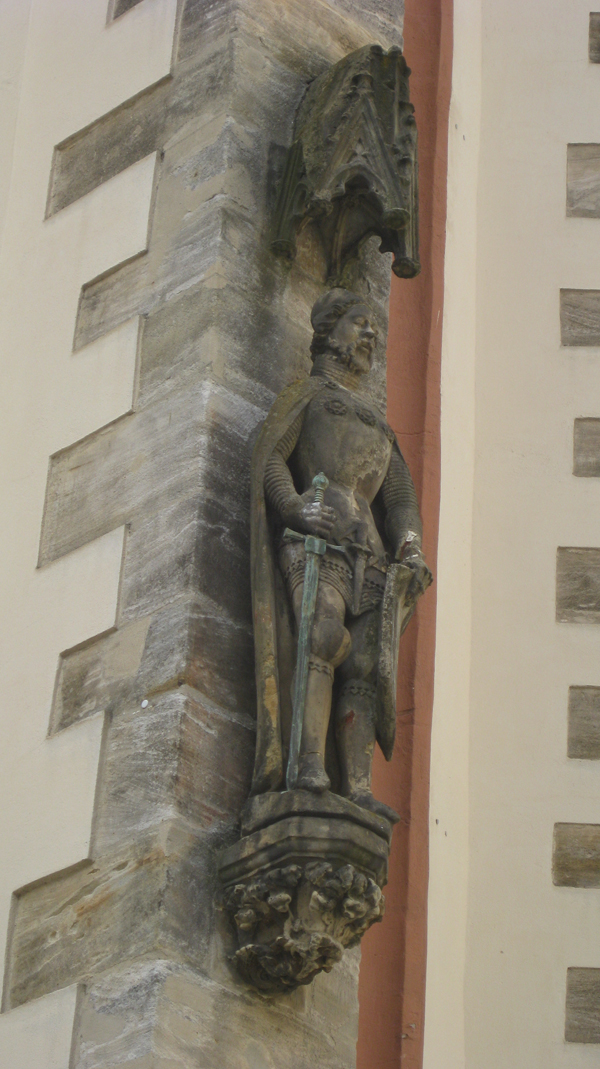
An armed and armored man gazes out in life-sized stone effigy from an exterior choir buttress on the Church of St. Mary in the medieval mining town of Sulzbach in northeast Bavaria (Fig. 1). He wears the fashionable, narrow-waisted armor of the later fourteenth century, with a broad cloak around his shoulders and a courtly dagger at his richly worked belt clasp. Over the centuries, the figure has been ascribed various identities; but why he came to be there appears more readily explicable. His presence seems unmistakably to relate to the time, after mid-century, when Sulzbach and the surrounding lands fell under the lordship of the king of Bohemia, the energetic and image-conscious Charles IV (r. 1346/47–1378): the time when, no doubt partly in response to Charles's own actions, the church choir was rebuilt in the contemporary Gothic style.Footnote 1
Statue of St. Wenceslas, Church of St. Mary, Sulzbach, choir. Source: Photograph by author.

Sulzbach's well-armed, petrified knight stands as a troubling reminder of an age in which, across Europe, the symbols of new lordship arrived in the train of companies of stylishly dressed fighting men. The Swiss chronicler Diebold Schilling, writing in the century after the Sulzbach effigy, had no doubt about the purpose of the rich banners and devices that the contemporary dukes of Burgundy bore with them: it was to “put the common people into terror and fear” in the lands that they entered.Footnote 2 Late-medieval people learned to read with trepidation the visible signs of princely power. A notary engaged by the monks of Christ Church Canterbury, in dispute with the English king at the end of the thirteenth century, recounted how the community's granaries had been sealed by royal agents, who had placed on them the king's device, “as if of a predatory lion.”Footnote 3 Above all else, it seems, the visible signs of monarchy encoded the formative, compelling power of the monarch himself. In the kingdom of France, to damage or disrespect them was treason.Footnote 4
Through their signs, princes conquered, and in those same signs subjects daily read their subjection. Such is the conclusion of much recent scholarship on the late-medieval period, in which war and the building of extended dynastic polities are seen as drawing support from strategies of visual representation and legitimation, disseminated from princely court centers.Footnote 5 Such studies focus mostly on western Europe, rather than on the far-flung, loosely-knit territories of the Holy Roman Empire. Just one late-medieval emperor bucks the trend, to attain the front rank of image-making monarchs, alongside a Charles V of France, a Richard II of England, or a Philip the Good of Burgundy: Charles IV of Luxemburg. Charles, who combined the elective imperial crown with his hereditary kingdom of Bohemia, resembled other late-medieval monarchs in ruling over a large and complex, composite patrimony that—at least in the portion pertaining to the Bohemian crown—he worked tirelessly to extend. In pursuit of this goal, the current historiographical consensus seems clear, he relied heavily upon a visual culture of power rooted in a rich and settled court.Footnote 6 It is this—partially defensible, but unduly one-sided—perspective that the present article will challenge, primarily by examining local influences upon and responses to Caroline visual culture. To this end, we will need later to return to our enigmatic armed man on his pedestal outside St. Mary's, Sulzbach.
Charles IV's current, almost universally high esteem is of fairly recent origin. Only in Czech historiography, which concentrated on his rule in Bohemia, is his reputation as a great medieval monarch long established. There, a bourgeois nationalist tradition rooted in the nineteenth century, which lauded the king as a wise state-builder and benevolent father to the Czech people, was perpetuated under the state Marxism of the Czechoslovak Socialist Republic (ČSSR).Footnote 7 That Charles's face currently adorns the hundred-koruna banknote of the Czech Republic reflects this long tradition. Elsewhere, however, perspectives on the king were either different or hardly existed at all. Charles always commanded considerable attention in German historical scholarship, but judgments of a monarch whose main concern seemed to be for his Bohemian dynastic kingdom were, for a long time, ambivalent at best.Footnote 8 Set beside the perceived imperial glories of the preceding high-medieval Kaiserzeit, the Caroline era appeared, from German-nationalist perspectives, as an age of decline under a monarch who, to some, hardly seemed German at all.Footnote 9 When it took note of late-medieval Central Europe, Anglophone scholarship in Britain and North America was mainly interested in the (“proto-Protestant”) Hussite era in Bohemia, whose origins lay in the generation after Charles's death.Footnote 10
Things began to change during the final decades of the twentieth century. In part, the explanation lay in a shift in values among Charles's students. As a result, qualities previously regretted in some quarters—his perceived internationalism and cultural cosmopolitanism, for example—now attracted warm praise.Footnote 11 In an era of postwar reconciliation, rejection of strident nationalism, and East-West détente, the time seemed ripe to applaud, in the words of his most influential modern biographer, “an emperor in Europe.”Footnote 12 But what did more than anything to launch Charles's modern career as a preeminent, fourteenth-century “image” politician—a “statesman and artistic patron,” in one telling formulation—is the succession of high-profile exhibitions that he has enjoyed, beginning with those staged to mark the anniversary of his death in 1978.Footnote 13 The appetite for showcasing the splendors of Caroline court culture was boosted by the fall of the Iron Curtain, which made gathering up the treasures scattered across his vast Central European domains both practicable and politically attractive. The (usually beautifully produced and sumptuously illustrated) catalogues and essay volumes accompanying these shows have included and summarized much of the immense recent research that the exhibition boom helped to stimulate. Their often unwitting effect has been to foster an assumption that the emperor's contemporaries were necessarily as enthralled by the glittering artifacts of his court as modern art historians and exhibition visitors are. Tenacious, older views of Charles as a subtle arch-manipulator and Bohemian architect of state—a monarch with a political blueprint realized in gold, gems, and soaring masonry—have fed that very assumption. The goal of this article is to qualify this interpretation significantly.
The current consensus is firm. “Art,” for Charles, was above all an “instrument of rule,” a medium for “propaganda.”Footnote 14 His actions exemplify, a recent general history explains, how, in the late Middle Ages, “artwork propagated the ideology of states.”Footnote 15 Caroline politics was a “politics of presentation.”Footnote 16 Charles's own directive role takes center stage. He was the “visionary and founder” who instigated a full-blown “artistic policy” as a central element in his “strategy of rule” in the service of “state power.”Footnote 17 He closely controlled all aspects: the king “was a master of political-dynastic stage-management; he had a virtuoso command of the whole score.”Footnote 18 Caroline monarchy became its own “trademark”: a distinctive visual brand, expressive and constitutive of political unity across his far-flung, diverse, and expanding territories.Footnote 19 It was encountered most intensely at the main centers of ritual political theater in his realms, in Aachen and Nuremberg, and, above all, in and around Prague. But its distinctive products were also systematically exported from Charles's Bohemian capital as visible assertions of power and as a standing call for allegiance in the provinces.Footnote 20
This article aims to disrupt and complicate this narrative and to decenter Caroline visual culture, by viewing it not from the court but rather from the perspective of provincial society. It concentrates upon the territories in northeastern Bavaria—sometimes known collectively by their postmedieval appellations as the Upper Palatinate (Oberpfalz) or Neuböhmen—which were incorporated, though only briefly, for the most part, into the Bohemian crown lands during the 1350s and 1360s. They have been seen as the subject of particularly intensive efforts to impose the visible presence of the new regime. But what are we to make of the tangible traces left by the fleeting Caroline era in the region? Did the ubiquitous heraldic lion of Bohemia appear as menacing, from local perspectives, as that of the Plantagenets sometimes did to the English king's recalcitrant subjects? Was it greeted as an unwelcome foreign predator? Did local people have any constitutive role in making and interpreting images that are usually understood almost entirely as impositions from above?Footnote 21
Recent historians seem often to have been blinded to such questions by a series of assumptions about the character, origins, objectives, and consequences of Caroline visual culture—which is why this must be interrogated first. Praise for Charles's politics of symbolism usually rests upon the (generally undemonstrated and often unexamined) assumption that it was “successful.” But was it? Did it advance his aims, for himself and his dynasty? Can we glean enough about Charles's intentions and his involvement from the scattered, sometimes enigmatic artifacts made in his name to judge what “success” might entail in his terms, rather than in those of his modern admirers? The implications of such questions go beyond the specific case of Caroline visual culture: they encourage us also to look afresh at the aims and achievements of “propagandist” princes elsewhere in late-medieval Europe.
Charles IV: The Grand Design
The view of Charles IV as the author of a “master plan” for dynastic and regnal aggrandizement, into which all elements of his rule were systematically drawn, can appear compelling.Footnote 22 An annalist of the Cistercian monastery of Altzella, recording the death of “the cunning Charles, emperor and king of Bohemia,” reflected that he had “achieved many marvels by means of his cunning.”Footnote 23 From a perspective closer to the court, it seemed clear what these comprised. Heinrich von Wildenstein declared in a funeral oration that the emperor had “augmented the state [rem publicam], and set far and wide the bounds of the kingdom of Bohemia.”Footnote 24 His main aim, and here he enjoyed spectacular though fleeting success, was to assemble across central and east-central Europe a vast dynastic patrimony, founded both upon his titles as Roman king and emperor and upon a much enlarged Bohemia.Footnote 25 His marriage diplomacy on behalf of his offspring included bids for the Polish and Hungarian crowns (only the second was successful). By strengthening his influence over the process of election to the imperial throne, he hoped to settle the Empire permanently on his Luxemburg heirs. In expanding his Bohemian kingdom, Charles continued a process begun under his father, King John (r. 1310–1346), who, in turn, had followed the example of the later Přemyslid kings, notably Otakar II (r. 1253–1278).Footnote 26 Already at Charles's accession, much of Silesia, to the northeast, stood under the Bohemian crown, as did Upper Lusatia in the north. The first westward steps had also been taken. On all these fronts, Charles would continue to make gains.Footnote 27 But possession of the imperial crown gave him an immense advantage over previous Bohemian kings. It allowed him to formulate ambitious new plans, to incorporate Bohemia into a great composite polity, binding it to the Empire's mainly German-speaking territories north of the Alps, and ultimately establishing a land bridge to his family's ancestral patrimony on the western imperial frontier.Footnote 28 In the pursuit of these goals, the imperial territories bordering Bohemia in the north and west, with northeast Bavaria among them, attained particular importance.
Charles's long occupancy of his two thrones stands out especially from the turbulent, under-resourced reigns of most of his immediate predecessors and successors in the Empire. He traveled his wide realms and the lands beyond as no emperor had done in two centuries, crisscrossing Europe from Paris to Cracow, from Rome to Lübeck. Over the course of his reign, he made at least 1,227 attested stays at 438 different locations.Footnote 29 In his practice of tireless government from the saddle, Charles resembled the greatest figures of an earlier imperial age, but, in other respects, his activities as king and emperor pointed in new directions. Towns had a particular importance as a foundation for Caroline rule, as well as for its legitimation through display.Footnote 30 Charles drew upon the financial resources and expertise of urban mercantile elites, and he took a keen interest in the economic development of his realms.Footnote 31 Towns, both in the Bohemian crown lands and in the Empire at large, were favored—but also heavily taxed to support the king's ambitious and costly projects.
Charles's visibility to his subjects shows clear geographical patterns, though with shifts of emphasis over his long reign. Particularly important were the towns and castles strung out along an extended east-west axis, running from Breslau in his Silesian dynastic lands to the imperial city of Frankfurt am Main, where he spent around half his reign.Footnote 32 He was to be found, above all, at major centers in the middle portion of this route: his dynastic capital of Prague, where he spent around 30 percent of his time as king and emperor, and the major imperial center of Nuremberg (some 10 percent).Footnote 33 The block of lands that Charles acquired in Bavaria straddled and controlled the communications arteries between these two key sites. He justified their acquisition to the electors, whose formal assent to the act he required, by arguing that they enabled the king of Bohemia to attend more easily imperial elections in Frankfurt and assemblies in Nuremberg.Footnote 34 That they should have become a major focus of his attention seems, then, only natural.
Charles IV undoubtedly also possessed the means to give visible form to his expanding lordship: it is hard to think of another late-medieval ruler so well qualified to devise and direct a Kunstpolitik (“artistic policy”). He was unusually well-educated for a late-medieval monarch, having spent his youth at the French royal court—an intellectual formation later reflected in the university that he established in Prague in 1348.Footnote 35 His linguistic powers inspired contemporary wonder.Footnote 36 Charles's learned interests, which embraced theology, history, liturgy, and law, all found reflection in his own Latin writings, which reveal a strong concern with the doctrinal foundations of his rule as king and emperor, and include, in addition to his autobiography, a coronation ordo, a new life of St. Wenceslas, and a preface and arengae (formulaic, ideological introductions) to the chapters of his Bohemian law code, the Maiestas Carolina.Footnote 37 Charles's close knowledge of the lands under his rule did not depend only upon his own wide travels: the concentration of imperial government in Prague encouraged greater sophistication in written communications and record-keeping as well. Clear evidence exists for Charles's keen personal interest in the visual representation of his monarchy.Footnote 38 And, besides his own actions, the prestige of his court ensured that the distinctive styles of Caroline visual culture were widely disseminated and imitated—and, no doubt, widely recognizable, at least among the political classes of the kingdom and Empire.
Accounts emphasizing the ideological, centrally-directed, and coordinated character of Caroline visual culture are able to show how it was concentrated at the main centers of royal and imperial rule. The heavy focus of art-historical studies upon sites in and around Prague, and on the topography of the city itself, draws justification from the fact that it was in Prague that Charles's image as ruler attained the fullest articulation.Footnote 39 It is there, and at the nearby castle of Karlstein, that his own initiative role in giving his monarchy visible form is most evident. Karlstein came to house the imperial regalia, with their relics of Christ's Passion, whereas Prague became the site of their annual public veneration.Footnote 40 Both at the castle and within the city, elaborate visual programs exalted the Bohemian and imperial monarchies and situated the monarch and his dynasty in relation to sacral, legitimizing, regnal and imperial pasts. It was at Prague and Karlstein that most of the known portraits and crypto-portraits of Charles were found.Footnote 41 Processional routes linking key sites within the city allowed participants to journey symbolically through sacral-regnal time as they moved through urban space.Footnote 42
In Prague, the pictorial and ritual symbolisms of dynastic realm and elective Empire were visibly combined in mutual affirmation, just as Charles's Bohemian-regnal and imperial powers reinforced each other in the practice of rule. Through his own projects for reshaping urban topography—most notably, his founding in 1348 of the New Town, which tripled the city's size—Charles demonstrated how entire landscapes might be refashioned for ideological no less than material ends.Footnote 43 It was in Prague that the king exploited the broad vistas afforded by his imperial rule to recruit and gather together workers in various media of the visual arts from diverse corners of his realms.Footnote 44 And, besides drawing in the living to enrich his capital, Charles transformed Prague into a sacred treasury for the bones of saints, which he gathered from throughout the Empire and beyond.Footnote 45 A hub for far-reaching distribution networks, the city acted not only as a treasure house but also as a clearing house for his relic collection, just as it did for other material symbols of his monarchy.
The cults of saints especially important to Charles as king and emperor were systematically translocated between the principal sites of his rule. He established an altar to the Bohemian patron (and his maternal ancestor) St. Wenceslas at Aachen, which was the main cult-center of the emperor-saint Charlemagne, Charles's paternal ancestor.Footnote 46 Charlemagne's cult was, in turn, introduced to his New Town foundation in Prague, where the church of the Augustinian convent of Karlshof was dedicated to the Frank and probably modelled architecturally on his minster-church at Aachen. Charlemagne's memory was celebrated at Karlstein as well, through the presence there of his relics—not least, the items of imperial regalia associated with him.Footnote 47
Charles also sought to reproduce elements of the symbolic programs of Prague and Karlstein at other ideologically important sites in his realms, such as Aachen and Nuremberg, as well as at the palace that he founded at Tangermünde in the Mark Brandenburg.Footnote 48 More broadly, he established numerous and diverse ties to himself and his court through his many gifts of relics to selected churches, in the Empire at large but particularly within his dynastic territories and at sites that he was in the process of binding to his rule. The Bavarian town of Sulzbach was, as we will see, among the centers to benefit in this way from the munificence of its new lord. Yet, how far the monarch and his court were responsible for fashioning, in art and architecture, the local material settings for such gifts at these far-flung provincial locations is generally far from clear. The extant indications seem, on occasion, to point instead to the work of local hands.Footnote 49
The Limits of Central Direction
The view of Charles IV as master-impresario of the visual, who fashioned a symbolic empire of images and artifacts as a central resource of rule, is now commonplace. It is a view easily justified and, it seems, richly supported. But it does not represent the full picture, and it is potentially misleading. Habitual reference to Caroline visual culture as “propaganda” oversimplifies the impulses that called it into being, and it encourages overly optimistic assumptions about its political consequences.Footnote 50 Within the Empire at large, there are relatively few indications that visual invocations of Charles's rule did much to raise awareness of him, still less that they swayed contemporary judgments in his favor. Even in his dynastic territories, where exposure to the royal image was greater, there are signs that it met, on occasion, with indifference or even open hostility.
The negative verdicts on Charles in some of the older historiography relied, in part, on the judgments of contemporary chroniclers, particularly ones from the Empire's German lands.Footnote 51 In these accounts (which, it should be acknowledged, often concentrate on his troubled early years on the throne), Charles commonly appears as lacking in the qualities of majesty.Footnote 52 Even in chronicles recounting the apogee of his reign as emperor, tales of unforeseen, humiliating incidents suddenly befalling him are strikingly at odds with the transcendent dignity of his visual imagery.Footnote 53 In chronicles from the imperial towns, where visible reference to monarchy was always close at hand, it was the burden of Charles's taxation, and the vexatious means by which he levied it, that tended to be remembered.Footnote 54 His development of Prague is mentioned by some German writers, one of whom claimed that he had transferred to the city the seat of Empire, which had previously been located at Rome and Constantinople.Footnote 55 His devotion to the cult of saints and his avid accumulation of relics are noted as well. But such references often accompany laments about the emperor's excessive favor for his Bohemian kingdom, where he supposedly spent too much time and where he hoarded the Empire's treasures, both sacred and profane.Footnote 56
Even in his Bohemian kingdom, the persuasive power of Caroline image-making was evidently modest. It certainly did little to win over the native nobility, who forced their king ignominiously to withdraw his legal reform for the kingdom, the Maiestas Carolina, and then to claim (implausibly) that the text had been accidentally destroyed.Footnote 57 A chronicle written by Johannes von Guben, the town scribe of Zittau in Upper Lusatia, provides glimpses of the local reception of Charles's royal image in his dynastic lands. These are particularly interesting because they concern the small-town landscape of a largely German-speaking province of the Bohemian crown, one crossed by major communications routes and thus, it seems, broadly comparable to eastern Bavaria. Johannes was unusual in engaging explicitly with the visual symbolism of Caroline rule, describing closely the iconography of a Bohemian silver Heller, with crowned bust and armorial lion.Footnote 58 Regnal imagery, even at its most “banal,” could evidently catch the attentive local eye.Footnote 59 That did not prove, however, to be of much help to the royal subject. Charles, fulminated Johannes, was an “oppressive lord” who encouraged disputes among Zittau's burghers in order to amerce them.Footnote 60 A recurrent theme here is the king's demands for military manpower and especially monetary payments. That Johannes knew (and specifically mentions) that some of the latter had gone to fund the rebuilding of St. Vitus's Cathedral did nothing to lessen his resentment.Footnote 61 Charles, who had “enserfed” the town, is implicitly contrasted unfavorably with an earlier Bohemian king, Otakar II, its founder, whose wise measures and generous grants of liberties and trading privileges had formed the basis of Zittau's prosperity.Footnote 62 Yet, elsewhere in his domains, as we shall see in the next section, it was Charles himself who appeared as a founder and benefactor of towns, and not merely as their exploiter. Where that was the case, the visible signs of his rule enjoyed a different reception—as the following discussion of northeastern Bavaria makes clear.
Charles IV and the Upper Palatinate
The surviving traces of Charles's involvement with Bavaria predictably indicate wide ambition and ceaseless activity.Footnote 63 They also seem to disclose, viewed from a local perspective, royal government at its most tangible and burdensome. The nature of the Bavarian territories and their particular importance for the king encouraged a firm and busy hand and a keen eye for gain. In the complete absence of contemporary texts providing local voices from Bohemia's Bavarian lands, it is tempting to fill the void with Johannes von Guben's pungent response to Caroline lordship in Upper Lusatia. Yet, circumstances in Bavaria were, in some ways, different, resulting in different local experiences of Bohemian rule. This, in turn, was reflected in visual representation and memory.
Charles's properties in the region fell into his hands over a period of years, by various means. Bohemian footholds west of the frontier had already existed when he came to the throne, the result of imperial pledges granted to King John by the Wittelsbach emperor Ludwig IV (r. 1314–1347). A substantial parcel of Wittelsbach castles and settlements fell to Charles himself in 1349, as the dowry of his second queen, Anna of the Palatinate, only to be lost briefly upon her death four years later. The real foundation for Charles's Bavarian territory was laid in 1353, when, in settlement of the Palatinate Wittelsbachs’ debts, Anna's dowry properties returned to him, substantially augmented by new gains, including the valuable and growing town of Sulzbach. Piecemeal acquisitions continued under various terms throughout most of the 1350s and 1360s.Footnote 64
In a diploma dated April 5, 1355, the day of his imperial coronation in Rome, Charles legally incorporated his Bavarian acquisitions into the ambit of the Bohemian crown, thereby affirming their central importance to his wider territorial plans.Footnote 65 The corona regni Bohemiae, a transpersonal constitutional concept that attained particular importance under Charles, took on visible form in the new Bohemian crown that he had commissioned and that usually resided upon a bust reliquary of St. Wenceslas in St. Vitus's Cathedral.Footnote 66 The burghers of Sulzbach accordingly swore fealty, in November 1353, “to our lord the king as king of Bohemia, to his heirs and successors as kings of Bohemia, and to the crown of the same kingdom [der Kronen dez selben Künckreichs], as our natural, perpetual lords.”Footnote 67 The adherence of territories to the Bohemian crown had implications for the ways in which royal power was represented visually, as we shall see. It also, in principle, endowed Charles's acquisitions with constitutional permanence, thus prohibiting their future alienation—from local perspectives, an important consideration.
By the late 1360s, however, the king's priorities were changing, as his eyes turned toward the still richer prize of Brandenburg, with its electoral vote and routes into northern and northeastern Europe.Footnote 68 In 1373, as part of his measures to raise the staggering sums needed to purchase the Mark, Charles handed back the—more important—southern portion of his Bavarian lands, including the town of Sulzbach, to the Wittelsbachs. Although this act took the form of redeemable pledges, the surrender proved permanent. The remaining Bohemian lands “beyond the forest” were then mostly lost under Charles's luckless heir Wenceslas (r. 1363/76–1400/19). In its full extent, the Bavarian lordship of the king of Bohemia had existed for barely twenty years.
For most of that time, however, the king was building for the long term. It was not only the region's importance to Charles's wider goals that encouraged heavy intervention. The Bavarian lands lacked natural and historic unity: properties that had recently stood under different lords were now to be brought under a single administration. The potential gains were high, since the region was crossed by busy trade routes, running eastward from Nuremberg toward Prague and beyond, and northeastward to Eger (Cheb), and northward from Regensburg into Thuringia and Saxony.Footnote 69 The lands were rich in natural resources, including deposits of iron ore, along with abundant timber and fast-flowing streams to support metalworking industries. The character of regional settlement also encouraged intervention. Towns were few and small at the start of Charles's reign, but an abundance of proto-urban market centers located on or close to long-distance highways signaled rich potential for growth.Footnote 70 Such growth appeared well worth fostering to a monarch with an inexhaustible appetite for taxes and dues, and with a keen sense of the potential benefits of direct royal intervention, particularly in regions bordering his Bohemian kingdom.Footnote 71
Bohemian government quickly gained a firm grip on the new lands. “For who doubts that castles are truly necessary?” the Maiestas Carolina asks in a passage that may have originated with Charles himself.Footnote 72 And castles were indeed duly acquired, rebuilt, and extended throughout the territory, with some now gaining substantial permanent garrisons.Footnote 73 Institutions of justice and written administration were developed, centralized on Sulzbach.Footnote 74 A captain, drawn from the Bohemian nobility, was placed in overall charge of the land, although many of the numerous lesser offices went to members of the regional nobility—important, for local perceptions of the new regime.Footnote 75 A detailed register of dues and renders owed to the crown, similar to those compiled for other Luxemburg dependencies, was drawn up for use by the Sulzbach administration.Footnote 76 This included a full account of the arrangements for collecting tolls and providing armed escorts to travelers between specified points on the main east-west highway. The solid infrastructure of rule depended, in turn, upon heavy, though varying, dues and renders owed by individual communities.Footnote 77 The Bohemian lion stalking the land was hungry indeed. Yet, the nature of the new territories invited royal behaviors that were more complex than mere rapacity—and the surviving visual deposit of Bohemian rule suggests that local responses were complex as well.
Uncertain Signs: Looking for Bohemia in the Provinces
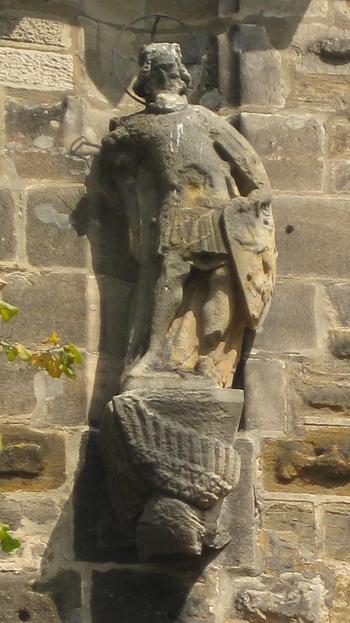
Charles's efforts in the visual field in Bavaria are also highly rated in recent scholarship.Footnote 78 But their main fruits are far from easy to interpret. The most substantial of these is the castle at Lauf, around eighteen kilometers east of Nuremberg on the road toward Bohemia.Footnote 79 Built during the later 1350s on the site of an earlier fortress, it served as a toll station, but it was clearly also designed to provide a visually magnificent representation of Bohemian lordship—though to whom and to precisely what end remain uncertain. It fulfils no defensive function, but it is richly decorated, including a first-floor chamber with walls incised with more than 120 armorials. These portray the political structure of the Bohemian kingdom with its component territories, major towns, and churches, but emphasize, in particular, the secular nobility.Footnote 80 The Bohemian patron St. Wenceslas is twice represented: in a low-relief carving in the armorial hall and in a full-length statue on the gatehouse exterior (Fig. 2). Both images show the saint bearing a shield displaying the Bohemian lion, which also adorns a keystone and the gatehouse façade.Footnote 81
Statue of St. Wenceslas, Lauf Castle, gatehouse. Source: Photograph by author.

That the project and its decoration were linked to the Caroline court is beyond doubt. Architectural details show affinities with Karlstein and with the choir of St. Vitus—both works in progress when the castle at Lauf was under construction.Footnote 82 The armorials’ identifying inscriptions signal the involvement of Czech speakers.Footnote 83 Much less clear, however, are the purpose and meaning of its rich—and, among Charles's buildings, unique—iconography.Footnote 84 Lauf's common identification as a “residence” is misleading: although the king stayed there several times, all his visits were brief, and he spent more time at nearby Sulzbach, as well as in Nuremberg.Footnote 85 Indeed, the castle is too small to have supported more than the shortest stays.Footnote 86 It is possible that the imagery at Lauf, which stood close to the westernmost limit of Bohemian lordship, was aimed particularly at high-status travelers entering the newly established territory.Footnote 87 The armorial display may even represent a visualization of the promise expressed in Charles's 1355 incorporation diploma, which invoked the powers of the Bohemian kingdom as guarantor of the security of those passing through its Bavarian lands.Footnote 88 But it can never have reached or influenced a numerically large public. The works of the master-propagandist on the throne of Prague raise a surprising number of unresolved questions regarding their origin and communicative purpose.
In the challenges that it poses for familiar accounts of Caroline image-policy, the castle at Lauf has a striking counterpart in another major building project dating from just a few years later, and also located toward the edge of the expanding Bohemian patrimony. In the mid-1360s, work began on an ambitious complex of buildings, combining a palace and a Celestine monastery, situated on a clifftop in a remote spot at Oybin, not far from Zittau in Upper Lusatia.Footnote 89 Here, too, masons with links to the Bohemian court appear to have been employed, and a surviving armorial fragment from the (now ruinous) church confirms it as a royal project. It was paid for, in part, by dues extracted from the nearby town.Footnote 90 Yet, the purpose of the palace-monastery complex remains obscure, as does the intended public for its prestigious architecture and decoration.Footnote 91 Charles himself hardly ever stayed there, and the nature of the site ensured that few of the travelers taking the nearby highway to and from Bohemia would have encountered it close up.Footnote 92 The precise objectives of the “state-propaganda power play,” with which the king is now credited, can prove surprisingly elusive at times—particularly for works located far from his Prague court.Footnote 93
One difficulty with Caroline image-politics concerns the narrow bounds of its demonstrable success, then, and another the uncertain communicative purpose of some of the ruler's prestige projects. But there is a further one: the question of where control over the making and meaning of the visible signs of rule actually lay. Other studies of monarchical imagery in the lands of the Empire have shown how established narratives of top-down direction are prone to break down when the images in question are inspected closely in their local settings.Footnote 94 For Charles IV, too, the evidence, where richest, often discloses a picture more complex than the familiar one of control from on high, with urban elites, in particular, active alongside the monarch as patrons.Footnote 95 Caroline image-making emerges recurrently as a collaborative, perhaps negotiated, venture involving various interested parties, local as well as courtly.
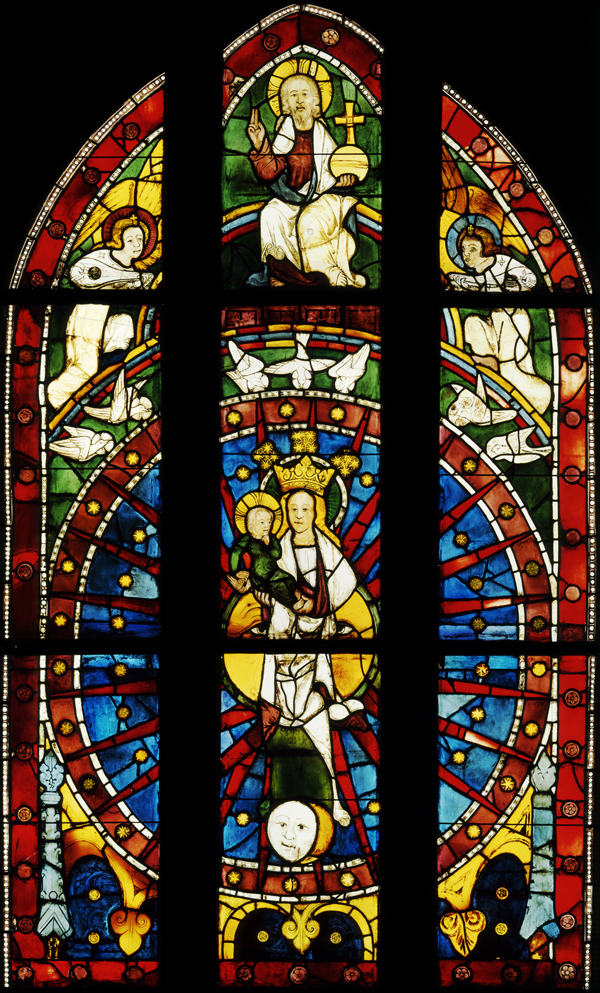
Complex interactions of this kind are suggested by a smaller cluster of images evoking Bohemian rule in Bavaria: the fragments of painted glass preserved in the parish church at Hersbruck, some fourteen kilometres east of Lauf on the east-west highway. These include a roundel with the Bohemian armorial and a window depicting the Virgin (to whom the church was dedicated) as the apocalyptic Woman Clothed with the Sun (Fig. 3).Footnote 96 The latter image, in particular, signals a connection to the Caroline court, where this exotic form of Marian devotion was in vogue. The painting style, too, finds parallels in the Bohemian heartlands. Yet, other indicators point westward and hint at possible local involvement.
Painted glass showing the Virgin as the apocalyptic Woman Clothed with the Sun, Church of St. Mary, Hersbruck. Source: Photograph by permission of Corpus Vitrearum Deutschland/Freiburg i.Br. (photo: Jean Jeras).

It is unclear why the king would have acted alone to establish these splendid (and, in his Bavarian lands, unique) images at a modest settlement where he probably never lodged.Footnote 97 But, for the local population, their potential value seems more evident.Footnote 98 Hersbruck had done well as a result of Bohemian rule, which, in rapid succession, brought the market community grants of urban status and valuable privileges.Footnote 99 Symbolically placing the new town's welfare in the protective hands of the courtly Virgin and setting the Bohemian lion to stand guard in the most sacred urban space may have seemed prudent. Who could say, after all, when their generous, demanding, and restless king would next be in town—or what his future plans were for the region? Under such circumstances, the visible and lasting symbolic presence of Bohemian lordship was a potentially powerful reassurance. The involvement of local figures seems more likely if, as recent scholarship has tentatively proposed, the glass painters came not from Prague but from nearby Nuremberg.Footnote 100 Hersbruck's elders could have found there a model in the magnificent Church of the Virgin (Frauenkirche), founded by Charles but with wealthy burghers as copatrons. That church also had a Madonna in Sole window.Footnote 101
Just how closely the king and his court were engaged, as is often claimed, in a comprehensive ideological branding exercise merits closer scrutiny than it tends to receive. The evidence from the Upper Palatinate offers little support for such a view. It is noteworthy that the Caroline administration never evolved a unifying documentary vocabulary for the new acquisitions, which instead appeared under a varied array of titles, such as “Bavaria beyond the Bohemian forest,” “the king's lordship in Bavaria,” “the Bavarian land,” and “the land of Sulzbach.”Footnote 102 Charles's own actions to establish a personal symbolic presence were, moreover, remarkably few. It seems that there were no unambiguous images of him there, as there were elsewhere, especially in and near Prague. At most, his portrait circulated via small coins struck at the mint that he had established in the newly-founded town of Lauf.Footnote 103 It is impossible to say whether local people were as alert to their iconography (about which we lack complete knowledge) as Johannes von Guben was. He also did not seek, as he recurrently did in the Bohemian core lands, to have castles or towns named after himself.Footnote 104 Neither Lauf nor the main military strongpoint in Bavaria, nearby Rothenberg, was identified as such. Just one Caroline castle was linked by name with the new masters: the fortress above the town of Pegnitz, which Charles purchased in 1357, and which gained (at whose instigation is unknown) the tellingly impersonal appellation of Böheimstein.Footnote 105
Lordship, Legitimacy, Locality: St. Wenceslas
This depersonalized conception of Bohemian lordship found material form in a figure recurrently encountered wherever Caroline rule in Bavaria was concentrated: St. Wenceslas.Footnote 106 The saint was present in royal chapel dedications at Lauf and at Rothenberg.Footnote 107 He was the dedicatee of the hospital that Charles patronized, and may have founded, at Sulzbach, his regional administrative center.Footnote 108 Visual representations of Wenceslas at key locations were doubtless more numerous than surviving indications allow us to tell. A Wenceslas-figure once adorned the portal of the Sulzbach hospital-church, and mention of a St. Wenceslas bridge at Rothenberg indicates the likely presence there of an image of the saint. There were also references on coins minted locally.Footnote 109
All this suggests a cult imposed by the new regime as the sacral legitimation and visual embodiment of its rule. Charles's own devotion to St. Wenceslas, whose name he received at baptism and whom a court historian termed his “principal aid and protector,” was profound.Footnote 110 The westward extension of Wenceslas's cult has been viewed as a manifestation of Charles's “state piety” (Staatsfrömmigkeit), i.e., the projection of personal religiosity as an instrument of rule.Footnote 111 It afforded a means of conceptualizing and visualizing Bohemian lordship in abstract, constitutional terms—particularly necessary, perhaps, in lands never previously subject to the Bohemian king. Wenceslas gave visual articulation to the concept of the “Bohemian crown,” which was repeatedly invoked in diplomas for the Bavarian territories. The saint's image codified in Bavaria the same Bohemian regnal order that was articulated in detail in the armorial chamber at Lauf—where Wenceslas was also recurrently present.
The question of Wenceslas's acceptability to his Bavarian subjects is not only a constitutional one. Late-medieval saints were understood to be the protectors and embodiments of regnal communities, i.e., communities of identification and sentiment also imaginable as unities of blood and descent.Footnote 112 Wenceslas's reputation in Bohemia was as the supernatural champion of a historical kingdom and its people, under kings who, like Charles IV, were his descendants.Footnote 113 But, by Charles's day, there were signs that the Bohemian kingdom was, in some quarters, coming increasingly to be identified with its Czech-speaking majority population, defined particularly against their German-speaking western neighbors.Footnote 114 Germans were also now a prominent, sometimes resented, element at court and among Bohemia's urban elites. On occasion, Wenceslas himself was drawn into the fray, reputedly deploying his supernatural powers in order to teach Germans respect for his cult and his people.Footnote 115
Was the saint viewed in the king's Bavarian lands as anything more than a symbol of foreign rule, imposed by the new master in Prague and his local agents? In fact, Wenceslas's cult had roots in the region long antedating the new lordship: his feast-day is recorded in Bamberg calendars already in the eleventh and twelfth centuries.Footnote 116 In the surrounding German-speaking regions, evidence of his cult goes back even further.Footnote 117 In the late Middle Ages, too, local veneration of Wenceslas in northeastern Bavaria flourished independently of royal actions, as is indicated by parish-church dedications and devotional images.Footnote 118 It did reflect, however, to a degree, the ties that already bound both secular and spiritual lords in the region to the monarch and his court. To such men, and indeed to the inhabitants of eastern Bavaria more broadly, Bohemia was no remote or alien world.Footnote 119 Within regional society, we find little trace of the sentiments of cultural difference from, and antagonism toward, Czech-speakers, of which the nationalist historiographies of the nineteenth and twentieth centuries made so much—and which did indeed find expression during the Hussite conflict in the fifteenth century.Footnote 120 When the Czech reformer Jan Hus traveled the road from Bohemia to Nuremberg in October 1414, bound for Constance, he had only praise for the warm hospitality and attentive audiences he encountered in the German towns along the way.Footnote 121 The Bohemian Wenceslas was a supernatural champion to whom local populations might also look.
The complex relationship between royal agency and local interest, perception, and response, and St. Wenceslas's role as mediator in that relationship, are most clearly observable in the town of Sulzbach. As the main center of Bohemian rule in Bavaria, Sulzbach had a special importance for Charles IV. It was by far his most frequent place of stay in the new territories, with his presence there attested on eighty-nine days.Footnote 122 Sulzbach was the point of departure (on the feast of St. Wenceslas in 1354) on his journey to Rome for coronation, and it was his first place of lodging on Bohemian soil upon his return; he had probably also participated in the Corpus Christi procession there the previous year.Footnote 123 The town's importance for Charles is evident from its role as a site of royal diplomacy.Footnote 124 But the townspeople also benefited from their visible and active new lord. Charles quickly perceived Sulzbach's economic and fiscal potential, confirming and extending the mining rights conceded to the burghers by his Wittelsbach predecessor, and granting far-reaching trade privileges that included toll freedoms throughout Bohemia and the Empire.Footnote 125 Under Caroline rule, Sulzbach more than doubled in size, reaching an extent not surpassed before the nineteenth century.Footnote 126 And it was characteristic of the king that he coupled economic with religious favors, donating relics to the town's church: a finger joint of St. Burkhard and, a particular treasure, a fragment of the skull of John the Baptist.Footnote 127 It was probably these gifts that, in 1355, occasioned the church's rebuilding, starting with the choir—upon which would shortly afterward be set the enigmatic armed man encountered at the start of this article (Fig. 1), and to whom we now return.Footnote 128
The several identities ascribed to the figure at various times help to illuminate his complex local significance. In the seventeenth century, he was claimed to represent Charles IV's son Wenceslas, whom his father had invested as count of Sulzbach and who was mistakenly credited with building the church.Footnote 129 More recently, the statue was believed to portray Charles himself.Footnote 130 There can be little doubt today, however, that it was intended to represent (primarily, at least) the Bohemian patron St. Wenceslas.Footnote 131 The statue adheres closely to the established late-medieval iconography of the saint, showing him as a courtly knight wearing a ducal cap and holding a shield in his left hand—the lance that he probably once held in his right was long ago lost. The rosettes on his breastplate signify martyrdom.Footnote 132 In stylistic terms, however, the statue does not display the flowing forms of the Wenceslas-figure outside the castle at Lauf, which has been (perhaps erroneously) associated with Charles's court artists, the Parlers. It shows affinities instead with late fourteenth-century Nuremberg sculpture, and probably dates from shortly after the end of Bohemian rule in the town—raising the important questions of who commissioned its making, and why.Footnote 133
The statue's significance and purpose are not immediately obvious. The church is dedicated to the Virgin, though it is thought to have contained a Wenceslas-altar.Footnote 134 In any case, the figure stands not within the sacred structure but outside, isolated and exposed, facing onto urban space. This location also invites closer reflection.Footnote 135 The saint gazes directly across the market place toward the town hall. That building, symbolizing Sulzbach's corporate existence and the municipal rights that Charles had confirmed and extended, was likewise constructed in the second half of the fourteenth century, and it shares architectural details with the adjacent church.Footnote 136 Who sponsored the making of the Wenceslas statue—the court, local royal agents, Sulzbach burghers, or some mix of these groups—is unknown, though its probable late date points strongly to local initiative. In the seventeenth century, in fact, it was believed to have been made at the townspeople's behest.Footnote 137 That is significant, because the claim may reflect a local tradition of late-medieval origin.
That the saint occupies an exterior location, one relating to his urban surroundings, fits a broader pattern: Wenceslas is recurrently found outdoors, where he had a particular affinity with bridges.Footnote 138 A famous statue of the saint, now in the Wenceslas chapel of St. Vitus, previously occupied a niche on the cathedral's south façade. From there, it has been proposed, Wenceslas directed his approving gaze toward the nearby royal palace, the abode of his descendants and successors on the throne.Footnote 139 But, if St. Wenceslas could thus shed legitimacy upon Charles IV in his capital, might he not also be coopted to provide visible and permanent endorsement of the king's precious but vulnerable grants to his new subjects? Wenceslas stood for the perpetual endurance of the Bohemian crown and its subject lands, of which each king was regarded as a mere temporary trustee.Footnote 140 Such symbolic affirmation, placing the town's privileges under the saint's inalienable protective lordship, must have seemed all the more welcome when it became clear that Bohemian rule might not prove so permanent after all.Footnote 141 But the possibility cannot be dismissed that the statue was also intended as a crypto-portrait of Charles IV (who was, of course, Wenceslas's blood descendant)—or that it quickly came to be understood as such by the townspeople.Footnote 142 After all, Charles is also to be found gazing benevolently down from exterior church fabric over urban space and its privileged occupants.
Embodying Urban Privilege
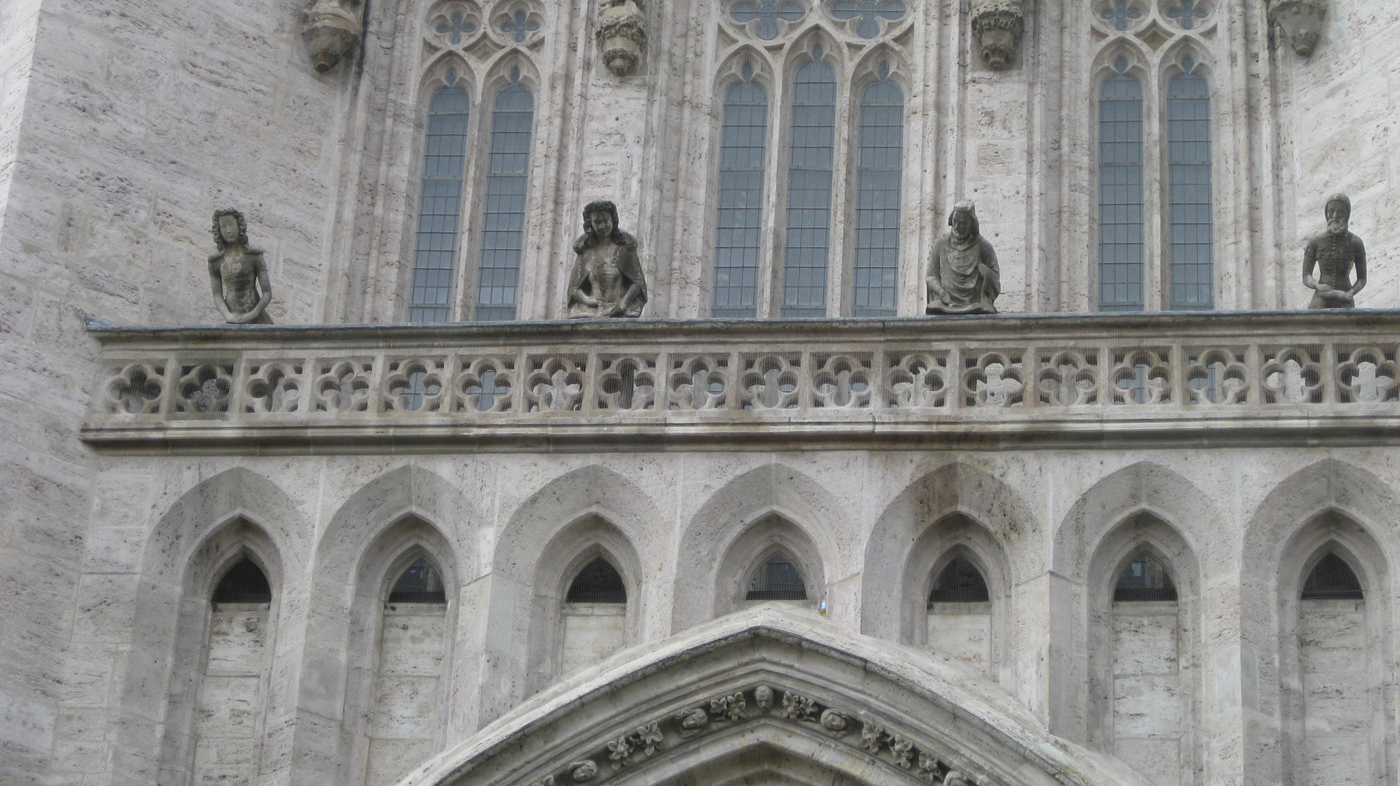
In the imperial town of Mühlhausen in Thuringia, the emperor peers down in greater than life-sized effigy from above the south portal of the principal church, the Marienkirche, in company with his queen and two courtiers (Fig. 4).Footnote 143 The figures are roughly contemporary with the Sulzbach Wenceslas, though there are no grounds to suppose a connection. In later tradition at least, the emperor's effigy participated directly in the town's constitutional life, as the council was annually sworn in under his gaze.Footnote 144 In Mühlhausen, too, the figure faces toward the Rathaus. And while little is known about why or at whose initiative these images came to be made, there are good grounds for thinking that the petrified emperor was understood as a guarantor of urban liberties—specifically, of Mühlhausen's continued enjoyment of direct imperial lordship, safe from the otherwise ever-present danger of pledging to a neighboring prince.Footnote 145 For communities with much to lose, the perpetual symbolic presence of the ruler on whom their rights depended had obvious attractions.Footnote 146
Statue of Charles IV with queen and courtiers, Church of St. Mary, Mühlhausen, south portal. Source: Photograph by author.

German towns were capable of invoking for themselves the monarch's talismanic presence in symbolically charged locations. In certain cases, such as the monumental carved figure of Ludwig IV in the town hall at Nuremberg, the direct purpose seems to have been to embody the freedoms granted to the town under that emperor's seal.Footnote 147 The town hall front, the market place in its shadow, adjacent church portals and façades, as well as standing structures such as fountains, all came to be adorned with cycles of figure-sculpture and heraldry, which constructed the town's relationship with royal authority—usually on terms that visibly suited the burgher elite.Footnote 148 In late medieval England, James Masschaele has written, “markets created an audience for the state, and the state gradually realized that it made sense to perform before it.”Footnote 149 But, in Germany, urban audiences were also performers, with meanings of their own to inscribe upon the visible signs of power. Local symbols of lordship might thus become the subject of changing interpretations, rewritten over time as champions of urban liberties even against the town's lord.Footnote 150 The monumental figures of Charlemagne's paladin Roland, widespread in towns across northern Germany in the late Middle Ages, came over time to symbolize the collective defense of urban privileges—in particular, trading privileges—that were understood as imperial grants.Footnote 151 The militantly sentinel Roland (a warrior-martyr in late-medieval estimation) invites at least broad comparison with the Sulzbach Wenceslas.
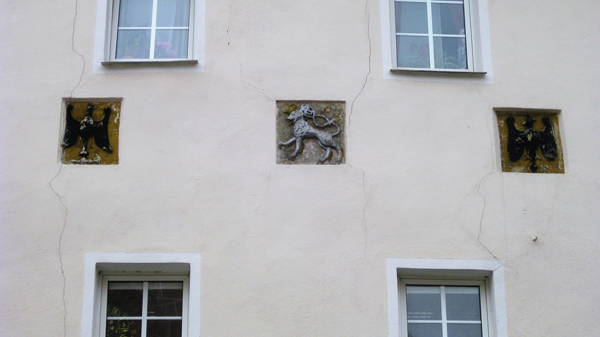
The saint was not, however, the only symbol of Bohemian rule facing Sulzbach's town hall across the market. Three carved armorials are still visible on the façade of the adjacent house “Zur Krone”: the Bohemian lion and two eagles—one of the Empire, the other perhaps the customary device of St. Wenceslas (Fig. 5).Footnote 152 Their significance has generally been regarded as straightforward: marking the monarch's lodgings with his arms was common practice.Footnote 153 The former patrician house may indeed have been Charles IV's occasional place of stay—though modern archaeological work on the palace outside the town has undermined the earlier belief that the house “Zur Krone” was his regular lodging.Footnote 154 Yet, the armorials’ permanent sculpted form, their location facing the Rathaus, and the apparent invocation of St. Wenceslas alongside the king, all seem to suggest a more substantial purpose, as do the deliberate steps that were taken locally to preserve them.Footnote 155 They were, moreover, not unique in Caroline Bavaria. A carved Bohemian armorial of similar style survives on a house front in Hirschau, again (and again perhaps significantly) adjacent to the Rathaus. Hirschau, still more than the larger Sulzbach, owed its late-medieval success to Charles IV, who not only granted the settlement urban status but, in 1367, ordered the rerouting of the east-west highway to pass through the new town.Footnote 156 In eastern Bavaria, Bohemian lions long stood guard over a landscape transformed to the benefit of nascent burgher communities. It was clearly not only the supposedly all-controlling Charles who might have perceived an advantage in their presence.Footnote 157
Armorials of Bohemia, the Empire, St. Wenceslas (?) on façade of house “Zur Krone,” Sulzbach. Source: Photograph by author.

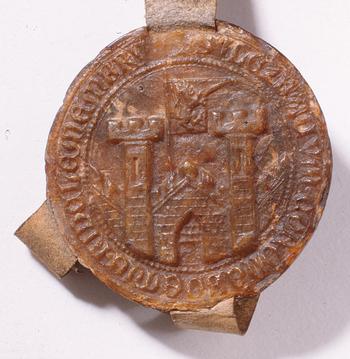
Studies of Bohemian “state-making” in Bavaria tend to be particularly impressed by the fulsome language of allegiance spoken by the symbols and inscriptions on seals from the new, or newly privileged, towns.Footnote 158 “Hersbruck obediently faithful to Bohemia,” declares that town's seal, first attested in 1364. At Neustadt an der Waldnaab, a preexisting seal featuring St. Martin came to include the Bohemian arms, with the words “Neustadt faithfully bound to the kingdom of Bohemia.” Sulzbach's new seal (Fig. 6) showed a fortified town gate topped by a banner displaying the double-tailed lion, with the legend “Sulzbach, faithful member of the crown of Bohemia.”Footnote 159 Yet, while the new government doubtless made clear via local agents the expectation that towns symbolically declared their loyalty, what is striking about these seals is the absence of any standardization that might indicate close direction from above. Much was evidently left to local initiative. Nor can the sentiments expressed be dismissed as merely formal or coerced. Seen through local eyes, the banner flying above Sulzbach's stylized walls did not guard the king's rights alone. Who set it there—and at whose initiative other signs of Caroline lordship were established and maintained—cannot be known with certainty.
Seal of the town of Sulzbach, from a document dated 1364. Source: Photograph by permission of Stadtarchiv Sulzbach-Rosenberg.

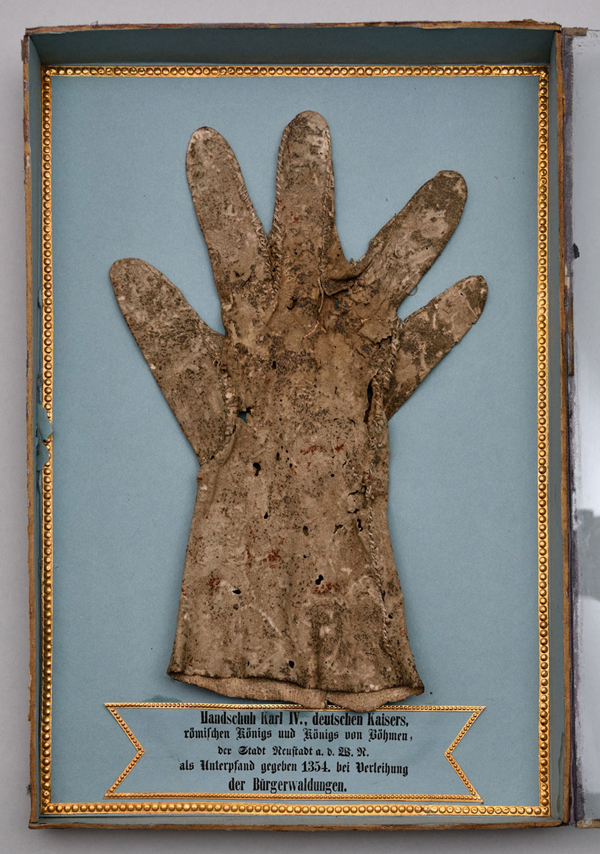
Suggestive here is nevertheless the tenacity with which some local communities clung to the tangible legacy of Bohemian rule many years after its ending. References to the Caroline era on town seals survived far into the post-medieval period.Footnote 160 In Weiden, where Bohemian lordship ceased in 1406, the armorial lion still adorned the town gate in 1533, when someone was fined for breaking off a leg—though whether as vandalism or to secure a portion of its imagined tutelary power is unknown.Footnote 161 Only in 1586, did the painter's brush finally transform it into the golden, single-tailed beast of the Palatinate. The survival of Caroline-era artifacts that encoded enduring local privileges could indeed be long. The town of Neustadt an der Waldnaab preserves today a glove of Charles IV, delivered to the town in 1354, in token of a grant of wood-cutting rights in the adjacent royal forests (Fig. 7).Footnote 162 Other major grants for Neustadt followed before the Caroline era closed (though the town would remain, exceptionally, under Bohemian lords down to the early nineteenth century).Footnote 163 The Caroline glove—seemingly made specially for such an occasion—was still being handed over in the late seventeenth century to each incoming Bürgermeister, along with the town keys and seals, as proof of the community's inviolable privilege.Footnote 164 It offers a key to contemporary understandings of other visible deposits of Bohemian lordship in Bavaria—not only as tokens of a power enforced from above, but as material warrant for rights gained and guarded locally.
Glove of Charles IV, presented to Neustadt an der Waldnaab, 1354. Case and inscription modern. Source: Photograph by permission of Stadtmuseum Neustadt an der Waldnaab.

Conclusions
The surviving artifacts of Caroline visual culture are very numerous. The more portable ones alone would fill any exhibition space many times over. There are then the castles, churches, monastic sites, and entire townscapes created in Charles's name. And his visual style also, of course, had innumerable more fleeting, today largely irrecoverable, manifestations, in both ritual and performance. His realms were also very large, however, and many of the most striking, ambitious, and ideologically eloquent works commissioned by the monarch and by members of his court were concentrated at just a few prestigious locations. They were often clearly destined for few eyes, sometimes almost solely for Charles's own. This is not an art that, for much of the time, looks outward onto public spaces to address the emperor's passing subjects. The annual relic-showings in Prague, which drew large crowds of pilgrims and in which Charles himself played a prominent part, were an important but rare exception.Footnote 165
Yet, with increasing distance from the center, the picture changes. The purpose and meaning of some surviving works become less obvious, and they were perhaps less obvious to people at the time. The limits of the capacity of Caroline image-culture to impress and persuade are occasionally starkly revealed when far from court and metropolis. But also occasionally discernible, though almost never in detail, are the multiple and complex transactions between monarchy and locality, between agents of the center and local elites, through which diverse signs of Caroline rule came into being and were inscribed, and re-inscribed, with meaning. If such processes seem to be particularly in play in Charles's Bavarian lands west of the Bohemian forest, that is perhaps a reflection of how much was at stake there for both sides: for the monarch and his agents, intent on drawing maximum benefit from a strategically-located territory; and for the local populations, for whom that same strategic situation promised rich but possibly impermanent rewards.
Accounts of Charles IV's Kunstpolitik would benefit, on occasion, from a more cautious assessment of its character and aims and from a less relentlessly optimistic (or, at least, more nuanced) estimate of its results. They might also usefully linger a little longer in the provinces. St. Wenceslas looked out upon an array of diverse social and political landscapes, and where his gaze was favorably met was often the result of local needs as much as of central direction. The same principle might usefully be extended, moreover, to other late-medieval European polities. “Looking for the state” (in John Watts's phrase) can never mean looking only for the visible symbols of power projected downward, even if these were what sometimes caught the shocked contemporary eye.Footnote 166 It must also involve seeking out the often elusive signs of negotiation and compromise, as well as the constitutive power of locality.