Introduction
Schizophrenia is a potentially devastating mental disorder in terms of human suffering and societal expenditure (van Os & Kapur, Reference van Os and Kapur2009). Although schizophrenia occurs worldwide, studies are mainly limited to Western-language patients. Our study investigates processes that may limit recovery in Mandarin-speaking Chinese immigrants to New York City, as a means of optimizing delivery of psychiatric services both for these individuals and potentially as a model for Mandarin-speakers worldwide. This population was also selected because of the unexplained worse disability and symptomatic outcomes for schizophrenia in Chinese-speaking native populations (Ran et al. Reference Ran, Xiang, Huang and Shan2001; Hopper et al. Reference Hopper, Harrison, Janca and Sartorius2007; Cohen et al. Reference Cohen, Patel, Thara and Gureje2008). While we have previously examined psychosocial factors impacting course (Yang et al. Reference Yang, Phillips, Licht and Hooley2004, Reference Yang, Phelan and Link2008, Reference Yang, Phillips, Lo, Chou, Zhang and Hopper2010), the present study investigates a novel mechanism – an interaction between neuropsychology and language – which might account for poorer social functioning.
In schizophrenia, outcome is driven primarily by persistent cognitive impairments (Javitt, Reference Javitt2009; van Os & Kapur, Reference van Os and Kapur2009). Such impairments were at one time considered to affect primarily higher-order processes such as executive function or working memory. More recently, however, deficits have been shown to involve basic sensory processes as well, consistent with underlying glutamatergic models (Javitt & Zukin, Reference Javitt and Zukin1991; Javitt, Reference Javitt2009). In particular, in the auditory system, patients show significant deficits in ability to match tones following a brief delay, which is associated with impaired structure (Sweet et al. Reference Sweet, Bergen, Sun, Marcsisin, Sampson and Lewis2007) and function (Javitt, Reference Javitt2000; Javitt et al. Reference Javitt, Spencer, Thaker, Winterer and Hajos2008) at the level of primary auditory cortex.
In Western languages, tonal deficits lead to impaired ability to interpret speech intonations (‘prosody’) that convey emotion and other supralinguistic information (Leitman et al. Reference Leitman, Foxe, Butler, Saperstein, Revheim and Javitt2005, Reference Leitman, Hoptman, Foxe, Saccente, Wylie, Nierenberg, Jalbrzikowski, Lim and Javitt2007, Reference Leitman, Laukka, Juslin, Saccente, Butler and Javitt2010). Emotion identification deficits, in turn, contribute to impairments in social cognition (i.e. ability to interact with others), which are primary determinants of impaired functional outcome in schizophrenia (Green, Reference Green2006; van Os & Kapur, Reference van Os and Kapur2009). Notably, Western languages do not typically use tone and emphasis to convey meaning. Thus, while English-speaking schizophrenia patients are impaired in ability to distinguish isolated syllabically similar but prosodically different words (e.g. ‘dessert’ versus ‘desert’) (Leitman et al. Reference Leitman, Hoptman, Foxe, Saccente, Wylie, Nierenberg, Jalbrzikowski, Lim and Javitt2007), overall language comprehension is minimally affected (de Gelder et al. Reference de Gelder, Vroomen, Annen, Masthof and Hodiamont2003; Ross et al. Reference Ross, Saint-Amour, Leavitt, Molholm, Javitt and Foxe2007).
While yet to be empirically investigated among Chinese groups with schizophrenia, emotion recognition (social cognition) might also be expected to mediate the effects of auditory processing deficits on functional outcomes. However, in addition to the effects of these emotion processing deficits, there may also be a culture-specific effect of language impairment among Mandarin speakers because, in tonal languages such as Mandarin, syllables are routinely pronounced in a number of tones, with word meaning varying accordingly. Chinese characters are represented in English by the Pinyin system (Chen et al. Reference Chen, Fu, Iversen, Smith and Matthews2002), which uses the English alphabet to represent 417 separate syllables [e.g. (mao)]. Different meanings are attributed to syllables by adding one of four tones, which are represented by adding a number. For example, (mao1), (mao2), (mao3) and (mao4) would have the same syllabic basis but would be pronounced with a different tone, thereby conveying different meanings, with (mao1) meaning ‘cat’ and (mao4) meaning ‘hat’.
Based upon our recent auditory findings, Mandarin-speaking schizophrenia patients would be expected to show deficits not only in tonal perception, but also in language comprehension for syllabically similar but tonally different words. Because these tonal impairments are also essential for language comprehension, they might also predict social and occupational functioning among Mandarin-speaking schizophrenia patients. Initial studies indicate that tone matching has also been associated with impaired level of community function among Western schizophrenia samples. Thus, in one study, tone matching ability was more predictive of need for continued hospitalization than either clinical symptoms or demographic variables (Rabinowicz et al. Reference Rabinowicz, Silipo, Goldman and Javitt2000). Similarly, both tone matching (Revheim et al. Reference Revheim, Butler, Schechter, Jalbrzikowski, Silipo and Javitt2006) and verbal prosodic function (Leitman et al. Reference Leitman, Foxe, Butler, Saperstein, Revheim and Javitt2005, Reference Leitman, Hoptman, Foxe, Saccente, Wylie, Nierenberg, Jalbrzikowski, Lim and Javitt2007, Reference Leitman, Laukka, Juslin, Saccente, Butler and Javitt2010) predict ‘functionally meaningful cognition’ (Green et al. Reference Green, Schooler, Kern, Frese, Granberry, Harvey, Karson, Peters, Stewart, Seidman, Sonnenberg, Stone, Walling, Stover and Marder2011) as measured using the Independent Living Scale (Revheim & Medalia, Reference Revheim and Medalia2004). Similarly, impaired mismatch negativity generation has been linked to impaired social cognition and functional outcome measures (Leitman et al. Reference Leitman, Laukka, Juslin, Saccente, Butler and Javitt2010), suggesting a link between pre-attentive auditory function and day-to-day functional ability. We thus expect tonal impairments to be even more important in relation to social and functional outcomes among Mandarin-speaking schizophrenia patients, where language deficits might play a particularly pronounced role in everyday role functioning due to greater demands on tonality.
For this study, we developed novel Mandarin word discrimination and identification paradigms to evaluate consequences of early sensory processing deficits in schizophrenia within the context of tonal language. We hypothesized that Mandarin-speaking schizophrenia patients will exhibit similar deficits in underlying basic auditory processing that, unlike in Western groups, would also relate to deficits in word recognition. We further hypothesized that these impairments will be associated with social-occupational function within this population, thus evaluating the degree to which tonal deficits may lead to persistently poor outcome among Chinese schizophrenia patients.
Method
Procedure/subjects
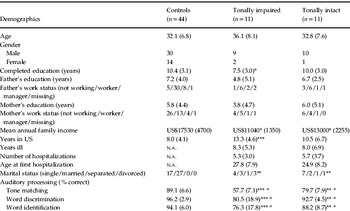
We recruited 22 schizophrenia patients (consecutive admissions) from a Chinese bilingual psychiatric in-patient unit in New York City from 2008–2010 and 44 control subjects from comparable socio-economic circumstances (i.e. poor, low acculturated and limited education) via a bilingual Chinese Church servicing the same area. This sample size is comparable to studies that have examined tonal deficit in Western samples (Revheim et al. Reference Revheim, Butler, Schechter, Jalbrzikowski, Silipo and Javitt2006; Leitman et al. Reference Leitman, Laukka, Juslin, Saccente, Butler and Javitt2010). The patient sample for this study was recruited as part of a larger parent study examining psychosocial predictors of relapse among Chinese immigrants with psychotic disorders (Yang & Singla, Reference Yang and Singla2011). Detailed sociodemographic data were collected (Table 1); the study sample appears comparable to the larger parent study in patient and family member characteristics, thus suggesting that it is typical of recent Chinese immigrants with psychosis in New York City. Diagnosis was established by one of two bilingual psychologists, who had each demonstrated good reliability (κ>0.8) on the Structured Clinical Interview for DSM-IV-TR Diagnosis (SCID; First et al. Reference First, Spitzer, Gibbon and Williams1997). To assess outcome by tone matching ability, the patient group was divided into those falling within the range demonstrated by control subjects on the tone matching task (TMT) (⩾70% correct, n=11) versus those falling below (<70%, n=11; see Table 1).
Demographic and auditory processing measures by tonal ability (values in parentheses are standard deviations)

a p<0.005 tonally impaired versus tonally intact patients.
* p<0.05 versus controls, ** p<0.001 versus controls, *** p<0.0001 versus controls.
Eligibility criteria included: (1) China-born; (2) native Mandarin speaking; (3) 18–50 years old; (4) no reported hearing impairment; (5) diagnosed with schizophrenia via the SCID-Chinese Version (Kam, Reference Kam2000; Yang & Link, Reference Yang and Link2009) for patients or negative for psychiatric disorders (SCID Screening Module; First et al. Reference First, Spitzer, Gibbon and Williams1994) for controls. Listening tasks were administered in a quiet room (hospital or church). Written informed consent was obtained from all subjects. Protocols were approved by the Institutional Review Boards at Columbia and New York University.
Measures
Auditory processing measures
Four auditory tasks were administered to all participants: (1) tonal matching test; (2) word discrimination; (3) word identification; (4) distorted tunes. While the tone matching test was administered in its standard form (Leitman et al. Reference Leitman, Hoptman, Foxe, Saccente, Wylie, Nierenberg, Jalbrzikowski, Lim and Javitt2007), the other three tasks underwent adaptation and pilot testing to Chinese language and culture [see Supplemental Materials (online) for details]. Of note, the word discrimination, word identification and distorted tunes tasks were designed to be ‘naturalistically valid’; i.e. if a person speaks in a clear tone of voice, then the subject should readily comprehend it. We therefore designed these tasks to not be difficult for controls, but instead to be sensitive to deficits in patients. From prior experience in developing the tone matching test (Leitman et al. Reference Leitman, Hoptman, Foxe, Saccente, Wylie, Nierenberg, Jalbrzikowski, Lim and Javitt2007), control subjects are typically near ceiling for deficits in patients to be assessed sensitively.
(1) Tone matching test: In this task, pairs of tones are presented in which the first is either the same frequency as the second or differs by a specific percentage (%Δf). Altogether, 20 pairs of tones were presented in blocks of five levels of difficulty. Within each block, half of the tones were ‘same’ and half ‘different’. Order of block presentation was counterbalanced across subjects. English-speaking schizophrenia patients require, on average, approximately 20% Δf to obtain 80% correct responses on this task (Strous et al. Reference Strous, Cowan, Ritter and Javitt1995; Rabinowicz et al. Reference Rabinowicz, Silipo, Goldman and Javitt2000; Leitman et al. Reference Leitman, Hoptman, Foxe, Saccente, Wylie, Nierenberg, Jalbrzikowski, Lim and Javitt2007) versus 3% Δf for controls.
(2) Word discrimination: Altogether, 40 pairs of syllabically similar (i.e. identical Pinyin/English spelling) words were presented via standardized voice recording. In each pair, words were either identical or differed only in tone [e.g. (mao1) ‘cat’ versus (mao4) ‘hat’]. Subjects were asked if words were the same or different, but were not required to identify the word's meaning.
(3) Word identification: Altogether, 20 individual words were administered via standardized voice recording. Subjects were asked to identify a word's meaning [e.g. (ya), which might mean ‘duck’ (ya1) or ‘tooth’ (ya2) depending on tone; see Supplemental Materials—Link to Audiofiles] by pointing to an appropriate picture on a scoresheet. On each scoresheet, two of the pictures depicted words that were syllabically related but tonally different (e.g. duck and tooth) while the remaining two pictures depicted unrelated words.
For each scoresheet, half of the subjects were given one of the two tonally related words [e.g. (ya1), meaning ‘duck’] and an answer corresponding to the other word (e.g. ‘tooth’) was considered a tonal error. The other half of the subjects were given the alternative word [e.g. (ya2), meaning ‘tooth’], in which case the alternative word (e.g. duck) was considered a tonal error. All other errors were considered random errors. The 20 tonally discordant pairs of words chosen for this task were selected based upon ease with which correct meanings could be represented pictorially, as determined by pilot testing in native Mandarin-speaking subjects.
(4) Distorted Chinese tunes: The distorted tunes task (DTT) is a validated assessment of auditory ability in Western subjects (Drayna et al. Reference Drayna, Manichaikul, de Lange, Snieder and Spector2001). For this adaptation, 10 s of the most popular melody from each of 15 well-known Chinese songs was provided. In 10 songs, several tones were altered; whereas in the other five, the tune was unaltered. Subjects were first asked to rate if they were ‘familiar’ or ‘unfamiliar’ with the tune. Subjects were then asked to identify if a song was ‘the same’ or ‘different from’ the original tune.
Although formal reliability assessments were not performed in this sample, we have previously observed intraclass correlation (ICC) of 0.94 in a sample of 66 patients on the tone matching test (F=15.5, df=66, 66, p<0.0001, unpublished observations). Furthermore, within this dataset there was high ICC between the word discrimination and word identification tests in patients (ICC=0.79, F=4.66, df=21, 21, p<0.0001), suggesting that the two tests measure related constructs. Because a large number of control subjects, as expected, performed at ceiling on the word discrimination and identification tests, formal reliability statistics could not be computed.
Social adaptation measures
Data on social adaptation were defined based upon marital status (see Table 1), employment status (0=unemployed; 1=part-time or full-time employment or student status) and most recent employment type. To capture the complexity of immigrant adaptation in the most recent job held, two coders with extensive knowledge of this group (L.Y. and S.C.) created three categories (Lai et al. unpublished observations). Being employed, although desirable, is not perceived as this group's only priority. Successful adaptation to the US includes achieving other important statuses such as obtaining higher-status jobs, educational opportunities and material resources to enable individuals to fulfil valued social roles (i.e. child-carer). Two coders, blind to all patient information except for most recent employment type, thus independently grouped participants into three a priori categories: (1) ‘menial job status’, categorized by purely unskilled and strenuous labor, which indicates the lowest status. These jobs provide little advancement opportunities and frequently take place in exploitative conditions; (2) ‘child carers’, which represents intermediate status whether or not subjects are presently employed; (3) ‘high-status job’, including either skilled (e.g. chef) or white collar (e.g. minister) job or ‘student status’, which indicates superior social adaptation in this population. For unemployed individuals, nature of most recent job was considered. Inter-rater agreement was excellent (ICC=0.94). Subjects were compared across these three categories using multi-nomial regression analyses (for more detailed information, see Supplementary material, online).
Statistical analysis
Between-group performance for continuous measures was analysed using a z-transformed Mann–Whitney U test. For categorical analyses and multinomial regression, between-group differences were determined using log-likelihood ratio (LR) χ2 analyses. Other parametric [t test, analysis of variance (ANOVA)] or non-parametric (χ2, Spearman's r) statistics were also performed as appropriate. The preset α level for significance was p<0.05.
Results
Auditory sensory processing
Auditory sensory processing was evaluated using the tone matching and distorted Chinese tunes tasks.
Tone matching task
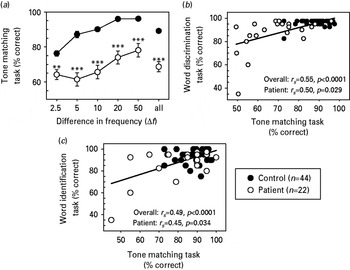
Patients showed a highly significant impairment in tone matching ability versus controls across difficulty levels (F 1,64=68.9, p<0.0001) (see Fig. 1). Nevertheless, they showed the expected progressive improvement in performance across level of difficulty. On average, patients needed a 20% difference in pitch (Δf) to perform equivalently to controls in the 2.5% Δf condition. All controls performed >70% correct versus 50% of patients. A value of 70% correct was thus used as the cut-off between tonally impaired and tonally intact patient subgroups.
Tone matching, word discrimination and word identification outcomes. ** p<0.001, *** p<0.0001.

Distorted Chinese tunes
Both groups rated close to 50% of the tunes as ‘familiar’ (controls: 40.8±3.3%; patients: 46.8±5.5%; t=1.00, n.s.). Nevertheless, patients were significantly poorer in determining whether or not tunes had been altered (z=4.38, p<0.0001). Across groups, deficits in distorted Chinese tunes performance correlated significantly with impaired tone matching ability (r=0.48, p<0.0001).
Word processing
Word processing was evaluated using word discrimination and word identification.
Word discrimination
Patients showed significant word discrimination impairments versus controls (z=4.87, p<0.0001). When rates of hits and misses were analysed using signal detection theory, patients showed a significant deficit in sensitivity (d') (controls: 3.74±0.06; Sz: 2.69±0.25, z=4.55, p<0.0001) with no significant difference in bias (controls: 0.08±0.01; Sz: 0.03±0.04; z=1.75, p=0.08), suggesting primarily impaired ability to detect differences when present.
Word identification
Patients showed significantly worse identification accuracy versus controls (z=3.96, p<0.0001), reflecting a significant increase in number of tonal errors (z=4.01, p<0.0001) with no significant difference in rates of random errors (z=1.80, p=0.07). The group×deficit-type interaction was highly significant (F 1,64=18.0, p<0.0001), suggesting a differential deficit with regard to tonal versus random errors.
Correlation among auditory measures
Across our sample (n=66), both word discrimination (Spearman r or r s=0.55, p<0.0001, Fig. 1b) and word identification (r s=0.49, p<0.0001, Fig. 1c) correlated significantly with tone matching ability. Correlations were also seen with rate of phonological (r s=–0.54, p<0.0001) but not random (r s=–0.09, p=0.5) errors on the word identification task. Education also correlated positively with tone matching (r s=0.35, p=0.004), word discrimination (r s=0.36, p=0.04) and word identification (r=0.51, p<0.0001) across groups. However, correlations between tone matching and both word discrimination (partial r=0.49, p<0.0001) and identification (partial r=0.32, p=0.009) remained significant even following covariation for education and group status. Finally, correlations between word discrimination (r s=0.50, p=0.019) and word identification (r s=0.45, p=0.034) and tone matching were significant even within patients alone (n=22). Tone matching (r s=0.51, p<0.0001), word discrimination (r s=0.39, p=0.001) and identification (r s=0.28, p=0.023) also correlated significantly with DTT performance across, although not within, group.
Similar results were obtained using a categorical approach comparing tonally impaired (i.e. <70% correct on TMT) versus tonally intact (i.e. >70% correct) patients versus controls using a one-way ANOVA and post-hoc (Tukey least significant difference) tests. There was significant across-group variance for both word discrimination (F=16.6, df=2,63, p<0.0001) and word identification (F=16.2, df=2, 63, p<0.0001), with significant post-hoc differences between tonally impaired patients and both controls (both p<0.0001) and tonally intact patients (both p<0.002) on both the word discrimination and identification tests.
Relationship with social and occupational outcome
Social adaptation was defined based upon marital status, current employment and most recent employment type. As a group, schizophrenia patients showed worse social adaptation versus controls. Thus, 27 of 44 (61.4%) of controls but only five of 22 patients (22.7%) were presently married (LR χ2=18.8, p<0.0001). With current employment, 28 of 44 (77.3%) had jobs at time of testing compared with only six of 22 patients (27.3%) (LR χ2=8.0, p<0.005). Finally, 27 of 44 (61.4%) controls had held ‘high-status job’ or ‘student status’ versus only five of 22 (22.7%) patients (LR χ2=15.2, p<0.0001).
Tonally impaired patients (i.e. those falling below the range shown by control subjects on the TMT) had, on average, completed fewer years of education than controls (p<0.02), although difference from tonally intact patients was not significant (p=0.2). The two schizophrenia subgroups did not differ significantly on other relevant demographic or clinical factors, including years ill, age first hospitalized or number of hospitalizations (Table 1).
Tonally impaired and intact patients had similar rates of marriage. Yet tonally impaired patients (5/11, 45.5%) were significantly more likely than tonally intact patients (1/11, 9.1%) to be working at the time of testing (LR χ2=5.66, p=0.02). Strikingly, however, the nature of present and prior employment was significantly different across schizophrenia groups. None of the patients with impaired tonal ability (0/11, 0%) had ever held a high status job versus 5/11 (45.4%) tonally intact patients. Conversely, 11/11(100%) of the tonally impaired patients fell into the ‘menial’ job or unemployed group versus six of 11 (54.5%) tonally intact patients (LR χ2=8.42, p=0.004). Thus, tonally impaired patients differed significantly in nature in type of employment from controls (LR χ2=21.9, p<0.0001), whereas tonally intact patients did not (LR χ2=3.61, p=0.17).
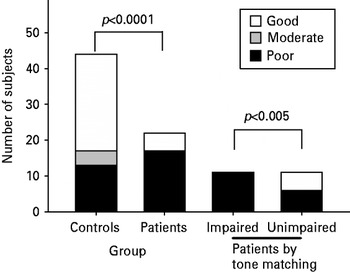
In multinomial regression versus most recent employment outcome (poor, medium, good, all df=2) similar relationships were observed (Fig. 2). Thus, tone matching (LR χ2=12.4, p=0.002), word discrimination (LR χ2=9.19, p=0.01), and word identification (LR χ2=9.96, p=0.007) all correlated significantly with most recent employment across groups. Correlations with tone matching (LR χ2=7.51, p=0.023) and word discrimination (LR χ2=6.96, p=0.031) remained significant even when education level was included as a covariate. A significant correlation between employment status outcome and tone matching (LR χ2=14.8, p=0.001) was also observed in the patient group independently and remained strongly significant even following covariation for education status (LR χ2=14.0, p=0.001). Correlations between outcome and tone matching (LR χ2=11.9, p=0.003), word discrimination (LR χ2=9.40, p=0.003) and word identification (LR χ2=10.1, p=0.006) all remained strongly significant even following control for gender.
Relationship between tonal matching and most recent employment status.

Discussion
Approximately 20% of schizophrenia patients worldwide speak tonal languages, such as Mandarin. Despite extensive recent findings of impaired early auditory processing in schizophrenia (Javitt, Reference Javitt2009), the potential consequences of these deficits to language function in tonal language patients remains to be determined. In this study, we developed novel Mandarin word discrimination and word identification tasks potentially sensitive to tonal impairments. Our results suggest that presumably universal neuropsychological deficits might differentially disadvantage schizophrenia patients depending on culture and may, in part, explain the worse social disability found in Chinese-speaking patients (Ran et al. Reference Ran, Xiang, Huang and Shan2001; Hopper et al. Reference Hopper, Harrison, Janca and Sartorius2007; Cohen et al. Reference Cohen, Patel, Thara and Gureje2008).
As predicted, Mandarin-speaking patients showed highly significant (p<0.0001) deficits in tone-matching ability similar to those observed in Western language-speaking patients, with 11/22 patients (50%) falling outside the control range (p<0.0001). On our novel tasks, patients showed highly significant deficits in both word discrimination and identification, which correlated significantly with deficits in tone matching ability both across and within group and remained significant even after controlling for between-group differences in education. Word identification deficits were selective to words that differed in tone, but not syllable, such as ya1=duck versus ya2=tooth.
The present study also took advantage of employment status outcome measures available from an ongoing psychosocial investigation in this group. Not surprisingly, we noted significantly lower rates of employment (p<0.005) as well as high status employment, such as skilled worker, among schizophrenia patients as a whole versus controls and higher rates of menial labor (p<0.0001). When the schizophrenia group was subdivided according to tonal processing ability, tonally impaired patients were more likely to be working at time of interview than tonally intact patients. However, poor employment status (i.e. menial job status) was strikingly and disproportionately observed among schizophrenia patients with impaired tone matching ability (p<0.0001 versus controls), whereas patients with intact tonal ability were relatively unimpaired (p=0.2) (Fig. 2). Tonally impaired patients were also significantly different from those with intact tonal function (p<0.005). Relationships remained significant even following covariation for differences in educational achievement.
While being employed is typically considered an important indicator of outcome, for this particular cultural group, type of employment might be considered to be even more salient. The relationship between local social factors and employment for people with schizophrenia is complex and must consider the opportunities available within a local economy (Salkever et al. Reference Salkever, Karakus, Slade, Harding, Hough, Rosenheck, Swartz, Barrio and Yamada2007). Because of the structural conditions faced by this frequently illegal immigrant group (i.e. numerous job opportunities but which occur in menial and exploitative conditions), employment in these types of jobs are more readily available. This was found in a separate study, where the most recent wave of illegal Chinese immigrants in New York City who were diagnosed with psychotic disorders (similar to our sample) had been found to work more regularly than more established Chinese immigrant groups diagnosed with psychosis, but without higher incomes (Law et al. Reference Law, Hutton and Chan2003). Accordingly, upward mobility in terms of other forms of employment or student status for this Chinese immigrant group, while greatly desired, is relatively rare. This leads us, in this particular immigrant group, to emphasize being confined to menial and exploitative jobs as a relatively ‘poor’ outcome, over being employed or not. This approach is not unlike other studies of employment among schizophrenia patients, which have emphasized type of work as being equally important as merely being employed (Marwaha et al. Reference Marwaha, Johnson and Bebbington2007).
The above differences were also not attributable to differential time in the US, since tonally impaired patients had, on average, been in the US for longer than either tonally intact patients or controls. Although replication in larger samples with more detailed neuropsychological and functional assessment batteries are required (Leitman et al. Reference Leitman, Foxe, Butler, Saperstein, Revheim and Javitt2006; Revheim et al. Reference Revheim, Butler, Schechter, Jalbrzikowski, Silipo and Javitt2006), these findings suggest that very basic deficits in sensory processing may contribute disproportionately to marginalized employment outcomes in tonal language patients. This study builds upon prior initial studies suggesting a relationship between tonal deficit and impaired community function in Western schizophrenia samples (Revheim et al. Reference Revheim, Butler, Schechter, Jalbrzikowski, Silipo and Javitt2006; Leitman et al. Reference Leitman, Laukka, Juslin, Saccente, Butler and Javitt2010) and suggests that basic neuropsychological deficits may differentially affect outcome depending upon cultural and linguistic factors. Sensory processing deficits in schizophrenia are not limited to the auditory system, but affect visual processing as well, leading to impairments in such processes as face emotion recognition or reading in Western patients (Revheim et al. Reference Revheim, Butler, Schechter, Jalbrzikowski, Silipo and Javitt2006; Javitt, Reference Javitt2009). Given the greater complexity of Chinese ideograms when compared with alphabetic systems (Liu et al. Reference Liu, Zhang, Tang, Mai, Chen, Tardif and Luo2008), potential differential effects of early visual impairments on function in schizophrenia should also be investigated.
Despite the limited battery in this study, we are able to rule out many potential confounds. For example, our results are not easily attributable to impaired attention or cooperation, as shown, first, by the normal increase in performance with increasing level of Δf in the TMT (Fig. 1a) and, second, by the differential pattern of tonal versus random errors in word identification. Further, because this is the first study to utilize word identification and word discrimination tasks to examine these processes either in normal or schizophrenic Mandarin-speaking individuals, these tasks might be further refined for future studies. As noted earlier, the tasks were not meant to be difficult for most normal people to perform, thus leading a good proportion of controls to perform at ceiling (for word discrimination, particularly). However, because the percentage of items responded to correctly is generally quite high (unsurprisingly for the controls but also for the schizophrenia patients), this may lead to less-than-ideal estimates of reliability for these tasks. In future versions, more difficult items (e.g. sensory manipulation such as white noise mask or less well-enunciated words) might be added to improve psychometric properties. Nonetheless, if one uses non-parametric statistics (which better accounts for the lack of variation among controls' responses to these tasks) to compute between group differences, the primary findings remain extremely robust (all z>3.96, all p<0.0001) and random errors on word identification are still not significant between groups. Thus, even without ideal psychometric properties, the newly developed tasks still yielded predicted findings with other constructs.
Despite the strength of the findings with these newly developed tasks, several additional limitations should be noted. First, all schizophrenia subjects were receiving antipsychotic medications, although tonally impaired and intact patients did not differ on medication type or dose. Second, in this initial study, only restricted measures of cognitive and social/occupational functioning were available. Other tone-dependent processes such as emotional prosody were not measured and might serve as additional mediators between sensory-level impairment and poor employment status function. At present, there are no scales for assessment of prosody or emotional recognition in Mandarin speakers. The present study suggests that such scales need to be developed. Further, additional measures of attention and cognitive functioning, such as the recently developed Mandarin version of the MATRICS battery (Matrics Assessment Inc., USA), should be included in future studies to control for any potential mediating effects. Additionally, despite our accounting for this wide array of sociodemographic and clinical variables, it remains possible that the tonally impaired and non-impaired patients may differ in some other unexamined variable that might account for the difference in employment status between these two groups. Future studies might specifically account for English-speaking ability, as this might affect immigrants' ability to obtain high-status jobs. Finally, while classification of ‘menial’ versus ‘skilled’ labour showed high inter-rater reliability among two coders with extensive knowledge of this immigrant group, this classification system might benefit from further independent validation. However, such definitions are pertinent within the milieu of the population studied (Lai et al. unpublished observations) and supported by the differences found between the patient and control groups.
The study, while small, in part due to the tenuous legal status of many participants, is comparable in size with other Western studies examining tonal deficit and its impacts upon functioning (Revheim et al. Reference Revheim, Butler, Schechter, Jalbrzikowski, Silipo and Javitt2006; Leitman et al. Reference Leitman, Laukka, Juslin, Saccente, Butler and Javitt2010). Further, our current study sample does not appear to differ in clinical profile from our larger parent study (Yang & Singla, Reference Yang and Singla2011) nor does this most recent Chinese immigrant group appear to differ substantially in basic illness characteristics from the more established Chinese immigrant groups in New York City (Law et al. Reference Law, Hutton and Chan2003). However, these findings need to be replicated and extended in larger native-speaking and immigrant samples. Critically, however, these findings are the first to suggest that tonal deficits might have an especially prominent role in social and employment functioning among tonal language speaking schizophrenia patients. Our data substantively build upon other studies of how contextual factors, including immigration (Weiser et al. Reference Weiser, Werbeloff, Vishna, Yoffe, Lubin, Shmushkevitch and Davidson2008) and social adversity (Hjern et al. Reference Hjern, Wicks and Dalman2004), contribute to the development and course of schizophrenia and further suggests a need for culturally sensitive investigations into determinants of outcome in non-Western patients with schizophrenia. Recently, auditory remediation in schizophrenia among Western groups has shown to improve not only basic auditory function, but also higher auditory function such as verbal memory, along with global cognition (Fisher et al. Reference Fisher, Holland, Merzenich and Vinogradov2009). To optimize recovery and reintegration (Opler et al. Reference Opler, Yang, Caleo and Alberti2007; Link et al. Reference Link, Epperson, Castille and Yang2011), the present findings suggest that auditory deficits may be even more critical among tonal language subjects. Overall, the present findings highlight processes by which basic neuropsychological deficits may interact with culture to disproportionately affect outcome and suggest particular vulnerability to specific manifestations of schizophrenia in Chinese and other tonal language cultures.
Note
Supplementary information accompanies this paper on the Journal's website (http://journals.cambridge.org).
Acknowledgements
This study was supported in part by NIMH grant K01-MH73034–01 to Dr Yang, the Asian American Centre on Disparities Research (National Institute of Mental Health grant: P50MH073511), grants R37 MH49334 and R24 MH82790 to D.C.J. and the Columbia Conte Centre on Schizophrenia Research (P50 MH086385). We also wish to acknowledge Dr Yuwen Chou and Dr Guilin Zhou, Dr Angelina Decastro and Ms Diana Han at Bellevue Hospital for their aid in data collection. We would like to thank Dr Michael Phillips for his helpful suggestions and edits to an earlier manuscript.
Declaration of Interest
None.