INTRODUCTION
In nature, a transition occurs in cold-hardiness of woody plant species that are adapted to cold climates. While temperatures of a few degrees below 0°C during periods of active growth can kill most plant tissues by mid-winter, many temperate-zone woody plants can typically survive at temperatures from −30 to −60°C (Arora & Lim Reference Arora and Lim2005). This is probably because temperate-zone woody plants have evolved mechanisms whereby exposure to a period of low but non-freezing temperatures increases the ability to withstand the subsequent freezing temperatures. This process is called cold-acclimation (Levitt Reference Levitt1980; Travert et al. Reference Travert, Valerio, Fourasté, Boudet and Teuliéres1997), a complex process involving many biochemical and physiological changes during which almost every cellular process is altered (Browse & Xin Reference Browse and Xin2001).
Cold-acclimation (cold-acclimated (CA)) requires the accumulation of proteins including dehydrins (Arora & Wisniewski Reference Arora and Wisniewski1994; Close Reference Close1997; Wisniewski et al. Reference Wisniewski, Webb, Balsamo, Close, Yu and Griffith1999; Marian et al. Reference Marian, Krebs and Arora2003; Kalberer et al. Reference Kalberer, Leyva-Estrada, Krebs and Arora2007), cryoprotective proteins (Griffith & Antikainen Reference Griffith and Antikainen1996; Griffith et al. Reference Griffith, Antikainen, Hon, Pihakaski-Maunsbach, Yu, Chun and Yang1997) and antioxidative enzymes such as catalase (CAT), ascorbate peroxidase (APX) and nicotinamide adenine dinucleotide phosphate (NADPH) oxidase (Janda et al. Reference Janda, Szalai, Rios-Gonzalez, Veisz and Páldi2003; Kuk et al. Reference Kuk, Lee, Kim, Chung, Chung, Guh, Lee and Burgos2003; Suzuki & Mittler Reference Suzuki and Mittler2006; Johnston et al. Reference Johnston, Harding and Benson2007). It has been stated in all these reports that the functional characteristics of these specific proteins and enzymes are the protection of intracellular proteins and plasma membrane during the low temperatures.
Olive (Olea europaea L.) is one of the most cultivated woody plants, due to its adaptability to different environmental conditions and also to the nutritional value of its fruit (Bartolini et al. Reference Bartolini, Di Monte, Rea and Toponi1999). The olive tree is an evergreen plant that grows mostly between latitudes of 30 and 45° in both hemispheres. However, in recent years the increasing demand for olive oil has seen the cultivation of olive trees expand into geographical zones at higher latitudes than those of its origin in the Mediterranean basin. In olive trees, as in other evergreen species, cold resistance is closely correlated with the hardening process, which depends on cold-acclimation (Palliotti & Bongi Reference Pallıottı and Bongı1996).
Although some active and passive cultivation techniques have been commonly used to reduce or limit the frost damage in olive orchards, these are not effective enough at commercial levels to protect the yield. Selection and use of cold-hardy cultivars are the most effective ways of avoiding frost damage. Currently, knowledge of frost resistance in olive trees is based mostly on field observations after frost damage. Several methods such as stomatal density (Roselli et al. Reference Roselli, Benelli and Morelli1989), photosynthetic activity (Antognozzi et al. Reference Antognozzi, Pilli, Proietti and Romani1990), stomatal size (Roselli & Venora Reference Roselli and Venora1990), phenolic compounds (Roselli et al. Reference Roselli, La Porta and Morelli1992), differential thermal analysis (Martin et al. Reference Martin, Denney, Ketchie, Osgood, Connel, Sibbett, Kammereck, Krueger and Nour1993) and ionic leakage (La Porta et al. Reference La Porta, Zacchini, Bartolini, Viti and Roselli1994; Barranco et al. Reference Barranco, Ruiz and Campo2005) have been proposed for selecting frost-tolerant genotypes in olive species. In addition, determination of carbohydrate and starch differentiation (Lavee Reference Lavee1989; Bartolozzi et al. Reference Bartolozzi, Rocchi, Camerini and Fontanazza1999, Reference Bartolozzi, Mencuccini and Fontanazza2001) and total soluble proteins (TSP; Bartolozzi et al. Reference Bartolozzi, Rocchi, Camerini and Fontanazza1999; Eris et al. Reference Eris, Gulen, Barut and Cansev2007) have also been considered in cold-hardiness of genotypes. Recently, Eris et al. (Reference Eris, Gulen, Barut and Cansev2007) reported a seasonal fluctuation of 66 and 43 kDa leaf proteins of olive cvar ‘Gemlik’ related to cold-hardiness and discussed the potential role of these proteins because of their accumulation during cold-hardiness. However, to the present authors' knowledge, none of the studies so far have compared olive cultivars with respect to the antioxidative enzymes and/or protein metabolism related to cold-hardiness on cultivar basis.
Changes in reactive oxygen species (ROS), scavenging enzymes (CAT, APX and NADPH oxidase) and protein metabolism (TSP and their immunoblot) under CA and non-acclimated (NA) stages in nine olive cultivars with contrasting levels of cold-hardiness were assessed in the present study. Changes associated with cold stress were analysed for a better understanding of the general genotypic differences and for providing a basis for further analyses. Ultimately, physiological identification of cold stress related responses of olive cultivars may provide markers for selection for breeding programmes or genes for improvement through transgenic technology.
MATERIALS AND METHODS
Plant material
Fully expanded, uniformly sized leaves from 2-year-old shoots of nine local and introduced olive (O. europaea L.) cultivars (Ascolona, Domat, Gemlik, Hojoblanca, Lecquest, Manzanilla Meski, Samanli and Uslu) were collected from 20-year-old trees in the Atatürk Central Horticultural Research Institute in Yalova, Turkey (29°04′E, 40°39′N) in CA and NA stages. CA leaves were field-collected during winter (in January), while NA leaves were collected from the same individual olive trees during summer (in July). In January, the average temperature was 7·3°C (range 0·4–18·3°C). In July, the average temperature was 24·9°C (range 14·5–33·2°C). Leaf samples were collected randomly from three or four trees of each cultivar, packed on ice and taken to the laboratory. Parts of leaves from each treatment group were then processed for cold-hardiness determination. The remaining leaves were frozen in liquid nitrogen and kept at −80°C until further enzyme and protein analyses.
Controlled freezing test
Leaves from each cultivar were wrapped (10 leaves per temperature in each replication) in aluminium foil along with moistened paper and placed in a manually controlled low-temperature freezer. Plant tissue temperature was monitored with a copper-constant thermocouple (Testo 925, Omni Inst., Scotland, UK) inserted in the foil pouch. The temperature was decreased stepwise, at c. 1·5°C/h, down to −5°C and then at 5°C/h thereafter, down to −20°C. Samples were exposed to low temperatures of 4, −5, −10 or −20°C for 12 h. Samples in the latter three groups were removed from the freezer at each treatment temperature, and were placed at 4°C overnight for slow thawing.
Cold-hardiness determination
At each temperature, cold-hardiness of leaf tissues was estimated by assaying freezing injury using the electrolyte leakage method of Arora et al. (Reference Arora, Wisniewski and Scorza1992) with the modifications of Eris et al. (Reference Eris, Gulen, Barut and Cansev2007) for olive plants. Briefly, leaf discs (10 mm diameter) were cut from the leaves; they were then lightly rinsed in distilled water, gently blotted with paper and placed in test tubes (one disc per tube). Distilled water (10 ml) was added to the test tubes, which were then vacuum-infiltrated to allow uniform diffusion of electrolytes. Tubes were shaken on a gyratory shaker (250 rpm) for 4 h at room temperature. The electrical conductivity of each sample was measured using a WTW TetraCon 325 conductivity meter (InoLab Cond Level 1, Weilheim, Germany). Electrical conductivity was measured once more after the tubes were autoclaved (0·12 MPa, 120°C, 20 min) and cooled. Proportional injury at each temperature was calculated from ion leakage data using the following equation:
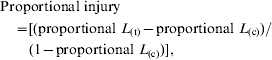
where proportional L (t) and proportional L (c) are the proportional ion leakage data for the treatments and control samples, respectively (Arora et al. Reference Arora, Wisniewski and Scorza1992). Cold-hardiness (LT50) was defined as the subzero temperature at which 0·5 injury occurred. All measurements were replicated three times.
Antioxidative enzyme activities
Leaf tissues were ground in liquid nitrogen using a mortar and pestle previously chilled with liquid nitrogen and the frozen powder was immediately used for the enzyme extractions. Enzymes were extracted at 0–4°C from 0·2 g of ground leaves, by grinding with mortar and pestle in 10 mg/ml polyvinylpolypyrrolidone (PVPP) and 2 ml of the following optimal media (Moran et al. Reference Moran, Becana, Iturbe-Ormaetxe, Frechilla, Klucas and Aparicio-Tejo1994); for CAT (EC 1·11·1·6) and NADPH oxidase: 100 mm K-PO4 buffer, pH 7·0, 0·1 mm EDTA, 1 mg/ml Triton; for APX (EC 1·11·1·11): 50 mm K-PO4 buffer, pH 7·8, 50 mm ascorbate. The homogenate was centrifuged at 760 g for 10 min for CAT, at 5 800 g for 10 min for NADPH oxidase and at 10 000 g for 15 min for APX at 4°C. The supernatants were used for enzymatic assays. CAT was assayed by monitoring the consumption of hydrogen peroxide (H2O2) in a Beckman UV-DU 520 spectrophotometer (Beckman Coulter, Inc., Fullerton, CA, USA) at 240 nm (Rao et al. Reference Rao, Paliyath and Ormrod1996). Its activity was calculated using the extinction coefficient of 3·94 mm/mm for H2O2. APX activity was determined by measuring the decrease in absorbance of the oxidized ascorbate at 290 nm, as defined by Nakano & Asada (Reference Nakano and Asada1980). The concentration of oxidized ascorbate was calculated using extinction coefficient (ε=0·28 mm/mm); one unit of APX was defined as 1 mmol/ml ascorbate oxidized per minute. NADPH oxidase was assayed by oxidation of NADPH at 340 nm and calculated using the extinction coefficient of 0·62 mm/mm (Cakmak & Marschner Reference Cakmak and Marschner1988).
TSP extraction
The TSP extraction procedure was based on Arora et al. (Reference Arora, Wisniewski and Scorza1992) with the modifications of Eris et al. (Reference Eris, Gulen, Barut and Cansev2007) for olive plants. Leaf tissue samples were ground using a mortar and pestle under liquid nitrogen to give a fine powder. Ground leaf tissues (1 g) were homogenized in borate buffer (50 mm sodium tetraborate, 50 mm ascorbic acid, 10 μl/ml β-mercaptoethanol, 1 mm phenylmethylsulphonylfluoride (PMSF), pH 9·0) and insoluble PVPP paste made with borate buffer using a 1:5:2 (tissue: buffer: PVPP paste) extraction ratio at 4°C. Samples were shaken on a gyratory shaker for 15 min at 4°C followed by centrifugation at 26 000 g for 1·5 h at 4°C. The resulting supernatant was collected and filtered through 0·4 and 0·2 μm filters (Millex; Millipore Co., Bedford, MA, USA). Protein content was measured using the Bradford assay method described by Arora & Wisniewski (Reference Arora and Wisniewski1994).
Sample preparation, SDS-PAGE and immunoblotting
Proteins were precipitated according to the method described by Lim et al. (Reference Lim, Krebs and Arora1999), by adding trichloroacetic acid (TCA, 100 μl/ml) to 1 ml of sample from the supernatant. Samples were centrifuged at 16 000 g for 30 min at 4°C, after 30 min incubation at 4°C. Protein pellets were washed three times with cold acetone and centrifuged at 16 000 g for 30 min at 4°C. After the first acetone wash, pellets were broken physically using a sealed pipette tip. Dried pellets were resuspended in SDS-PAGE sample buffer (65 mm Tris-HCl, 100 μl/ml (v/v) glycerol, 20 mg/ml (w/v) SDS, pH 6·8 and 50 μl/ml β-mercaptoethanol with Bromphenol Blue). Discontinuous SDS-PAGE was performed with a PROTEAN III vertical electrophoresis unit (Bio-Rad, Hercules, CA, USA) using 0·04 stacking gel and 0·125 separating gel. An equal amount of total protein (30 μg) was loaded for each sample and gels were stained with Coomassie Brilliant Blue G-250.
For immunoblotting, separated proteins (15 μg) from unstained gels were transferred onto polyvinylidene fluoride (PVDF) membranes (Immobilon-P, Millipore, Billerica, MA, USA). The remaining binding sites were blocked with 0·03 gelatine dissolved in Tris-buffered saline Tween-20 (TBST) for 30 min. Membranes were then rinsed five times in TBST buffer (containing 0·01 gelatine) and immersed in TBST solution containing a 1:1000 dilution of a polyclonal dehydrin antibody (kindly provided by Dr Timothy Close) directed against a synthetic peptide of the 15 amino acid consensus region (EKKGIMDKIKEKLPG) of dehydrin family of proteins. Following overnight incubation and five rinses in TBST buffer, blots were incubated for 1 h with the appropriate peroxidase-linked secondary antibody. Blots were then rinsed in TBST buffer (containing 10 mg/ml gelatine) five times and protein-antibody complexes were detected and visualized using the enhanced chemiluminescence (ECL) system (Amersham Biosciences, Piscataway, NJ, USA) and Kodak X-AR film. Films were digitized using a Supervista S-12 scanner with a transparency adapter (UMAX Technologies, Freemont, CA, USA). Immunoreactive bands were compared densitometrically by using the Public Domain NIH Image program (available on the internet at http://rsb.info.NIH.gov/nih-image/ (verified 28 July 2008)). Areas under the absorbance curve were expressed as arbitrary units.
Statistical analysis
The experiment was arranged in a randomized block design with three replications. Data were tested using SPSS 13.0 software for Windows and mean separation was accomplished by Tukey test at P<0·05.
RESULTS
Seasonal pattern of cold-hardiness
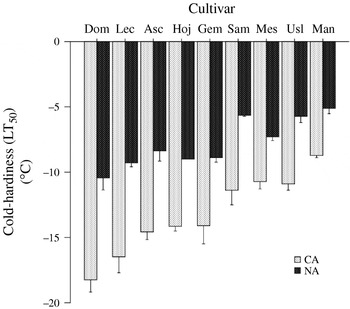
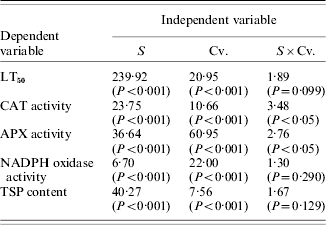
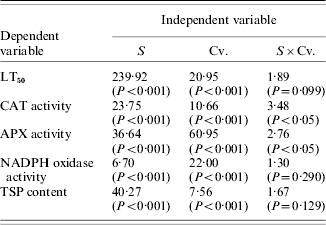
Cold-hardiness (as indicated by LT50) of nine olive cultivars increased (average LT50 −13·6°C) in winter (cold-acclimated=CA stage; samples were obtained in January) and decreased (average LT50 of −7·6°C) in summer (non-acclimated=NA stage; samples were obtained in July; Fig. 1). Cold-acclimation produced an increase in freezing tolerance of all cultivars (by lowering LT50), which was the highest in Domat (−18·24°C) and Lecquest (−16·48°C). While Domat and Lecquest were considerably more freezing tolerant before the CA stage, their freezing tolerance increased during the cold acclimation to a greater extent than the other cultivars. In contrast, Manzanilla had the lowest cold-hardiness during both CA (−8·72°C) and NA stages (−5·11°C). Cultivars Ascolona, Gemlik and Hojoblanca have moderate cold-hardiness, while Samanli, Meski, and Uslu are more sensitive than these three genotypes to cold temperatures, with values close to those obtained for Manzanilla. Two-way ANOVA revealed a significant effect of sampling stage and cultivars but not the interaction of sampling stage and cultivars on cold hardiness (LT50; Table 1).
Cold-hardiness (LT50) of nine olive cultivars in the cold-acclimated (CA, in January) and non-acclimated (NA, in July) leaf tissues. LT50 was assessed by electrolyte leakage. Dom: Domat, Lec: Lecquest, Asc: Ascolona, Hoj: Hojoblanca, Gem: Gemlik, Sam: Samanli, Mes: Meski, Usl: Uslu, Man: Manzanilla. Data are presented as means ±s.e.m. of three replicates.

Results of analyses of variance (ANOVA) of sampling stages (S), cultivar (Cv.), and their interactions for cold-hardiness (LT50), catalase (CAT) activity, ascorbate peroxidase (APX) activity, NADPH oxidase activity and total soluble protein (TSP) content. Numbers represent F values at 0·05 level
Seasonal pattern of antioxidative enzyme activities
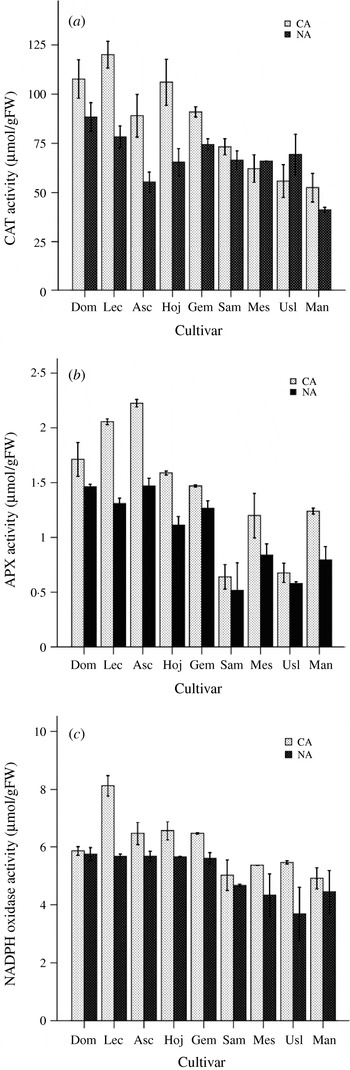
In general, average CAT activity in the CA stage (82·89 μmol/g fresh weight (FW)) was significantly higher compared with that in the NA stage (67·24 μmol/gFW; Fig. 2a). When data from the two stages were averaged, the highest and the lowest CAT activities were detected in Lecquest (99·18 μmol/gFW) and Manzanilla (46·83 μmol/gFW), respectively. Cultivars Lecquest, Ascolona, Hojoblanca, Domat, Gemlik, and Manzanilla cultivars exhibited higher CAT activities in CA stage compared with those in NA stage while CAT activities did not change significantly in Meski, Uslu and Samanli in both stages (Fig. 1 and 2a). The highest and the lowest increases in CAT activity were observed in Hojoblanca (62%) and Samanli (10%), respectively. CAT activity did not decrease significantly in Uslu and Meski. Two-way ANOVA revealed a significant effect of sampling stage, cultivars and the interaction of sampling stage and cultivars on CAT activity (Table 1).
Catalase (CAT; A), ascorbate peroxidase (APX; B) and NADPH oxidase (C) activities in the CA (in January) and NA (in July) leaf tissues of nine olive cultivars. Cultivars; Dom: Domat, Lec: Lecquest, Asc: Ascolona, Hoj: Hojoblanca, Gem: Gemlik, Sam: Samanli, Mes: Meski, Usl: Uslu, Man: Manzanilla. Data are presented as means±s.e.m. of three replicates.

Average APX activity in the CA stage (1·42 μmol/gFW) was higher compared with that in the NA stage (1·04 μmol/gFW; Fig. 2b). When data from the two stages were averaged, the highest and the lowest APX activities were detected in Ascolona (1·85 μmol/gFW) and Samanli (0·58 μmol/gFW), respectively. In the CA stage, the highest and the lowest APX activities were detected in Ascolona (2·23 μmol/gFW) and Samanli (0·640 μmol/gFW), respectively. In the NA stage, Lecquest, Ascolona, Hojoblanca and Gemlik cultivars exhibited high APX activities compared with those of Manzanilla, Meski, Uslu and Samanli cultivars. Compared with the NA stage, APX activity was increased significantly in such cultivars as Ascolona and Lecquest in CA stage (53 and 43%, respectively), while there was no significant increase in APX activity in Uslu. Two-way ANOVA revealed a significant effect of sampling stage, cultivars and the interaction of sampling stage and cultivars on APX activity (Table 1).
Average NADPH oxidase activity in the CA stage (6·03 μmol/gFW) was significantly higher compared with that in the NA stage (5·06 μmol/gFW; Fig. 2c). The highest average NADPH oxidase activity was detected in Lecquest (6·90 μmol/gFW). Compared with the NA stage, the highest increases in NADPH oxidase activity were detected in Uslu (48%) and Lecquest (43%) in the CA stage. No significant changes between the CA and NA stages were detected in terms of NADPH oxidase activity in Domat and Manzanilla. Two-way ANOVA revealed a significant effect of sampling stage and cultivars but not the interaction of sampling stage and cultivars on NADPH oxidase activity (Table 1).
Seasonal pattern of TSP and their anti-dehydrin immunoblot
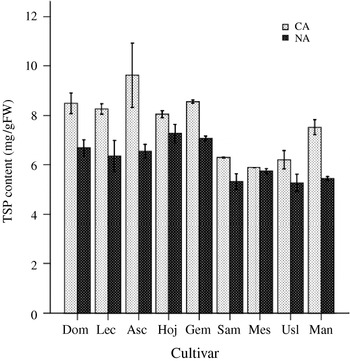
In general, TSP content in the leaf tissues of all cultivars except Meski increased significantly in the CA stage (Fig. 3). When data from the two sampling stages were averaged, TSP contents of Lecquest, Ascolona, Hojoblanca, Domat and Gemlik (7·31–8·08 mg/gFW; Fig. 1) were higher compared with those of others such as Manzanilla, Meski, Uslu and Samanli (5·64–6·27 mg/gFW). Ascolona (9·62 mg/gFW) and Meski (5·89 mg/gFW) had the highest and the lowest TSP content in the CA stage, respectively, while Hojoblanca (7·62 mg/gFW) and Samanli (5·32 mg/gFW) had the highest and the lowest TSP content in the NA stage, respectively. Two-way ANOVA revealed a significant effect of sampling stage and cultivar, but no interaction of sampling stage and cultivar, on TSP content (Table 1).
Leaf total soluble protein (TSP) contents in CA (in January) and NA (in July) stages of nine olive cultivars. Cultivars; Dom: Domat, Lec: Lecquest, Asc: Ascolona, Hoj: Hojoblanca, Gem: Gemlik, Sam: Samanli, Mes: Meski, Usl: Uslu, Man: Manzanilla. Data are presented as means±s.e.m. of three replicates.

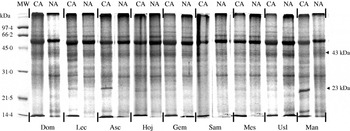
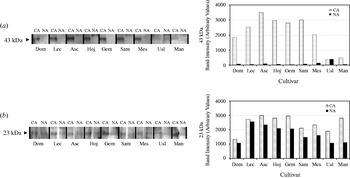
SDS-PAGE indicated that seasonal pattern of leaf proteins were generally similar in all cultivars (Fig. 4). Therefore, no accumulation of major polypeptide was detected either in CA or NA samples. Only the protein band estimated at 23 kDa was considered, because of its seasonal fluctuation. However, anti-dehydrin immunoblots revealed that the 43 and 23 kDa polypeptides were evident in cold-acclimation of olive cultivars (Fig. 5). The 43 kDa dehydrin-like protein was visible with different band intensity in the CA leaf samples of all cultivars. Only a faint band was visible in the NA samples and so the band intensity was significantly lower than in CA samples of all cultivars except Uslu (Fig. 5a). Band intensity of the 43 kDa dehydrin-like protein was the lowest in Uslu and Manzanilla cultivars compared with its accumulation in other cultivars in the CA stage. The 23 kDa dehydrin (Fig. 5b) accumulated at significantly higher levels in the CA stage than that in the NA stage in all cultivars. Unlike 43 kDa dehydrin, the band intensity of 23 kDa dehydrin in the CA stage was maximum and minimum in Manzanilla and Domat, respectively.
SDS-PAGE protein profiles obtained from of CA (in January) and NA (in July) leaf tissues of nine olive cultivars. A total of 30 μg protein was loaded in each lane. Molecular weight markers (MW) and their molecular masses (kDa) are shown on the left-hand side. Arrows to the right mark indicate the position of the 43 and 23 kDa proteins. Cultivars; Dom: Domat, Lec: Lecquest, Asc: Ascolona, Hoj: Hojoblanca, Gem: Gemlik, Sam: Samanli, Mes: Meski, Usl: Uslu, Man: Manzanilla.

Anti-dehydrin immunoblots of the 43 (a) and 23 kDa (b) leaf proteins from CA (in January) and NA (in July) stages of nine olive cultivars and their band intensities based on the quantitative measurements. For immunoblotting, 15 μg protein was loaded in each lane. Cultivars; Dom: Domat, Lec: Lecquest, Asc: Ascolona, Hoj: Hojoblanca, Gem: Gemlik, Sam: Samanli, Mes: Meski, Usl: Uslu, Man: Manzanilla.

DISCUSSION
Seasonal pattern of cold-hardiness
It is commonly accepted that olive genotypes should be tested at a minimum of two test temperatures for cold-hardiness so that moderately resistant genotypes, which may be perfectly acceptable for some environments, are not discarded (La Porta et al. Reference La Porta, Zacchini, Bartolini, Viti and Roselli1994). In the present study, cold-hardiness responses of nine olive genotypes were tested at four test temperatures (i.e. control, +4, −5, −10 and −20°C).
Evidence suggests that, like some other woody species, the olive plant undergoes deep supercooling, indicating that it has a freeze-avoidance mechanism (Bongi & Palliotti Reference Bongi, Palliotti, Schaffer and Andersen1994; Eris et al. Reference Eris, Gulen, Barut and Cansev2007). Although olive, as a species, is the most frost-hardy among the subtropical fruit trees, olive cultivars may differ in frost-hardiness (Bartolozzi & Fontanazza Reference Bartolozzi and Fontanazza1999). In the present study, a substantial increase in cold-hardiness was observed in leaf tissues of nine olive cultivars with decreasing temperatures during winter (Fig. 1). Similar patterns of cold-hardiness have been reported previously in various olive cultivars (Bartolozzi et al. Reference Bartolozzi, Mencuccini and Fontanazza2001; Barranco et al. Reference Barranco, Ruiz and Campo2005; Eris et al. Reference Eris, Gulen, Barut and Cansev2007).
According to field observations, Burak et al. (Reference Burak, Sütçü, Büyükyilmaz, Eris, Turk and Barut2000) reported that cvar Domat had the highest resistance to cold while Uslu and Manzanilla had the lowest and Gemlik and Samanli were intermediate. Manzanilla was consistently reported among cultivars sensitive to cold temperatures by Barranco et al. (Reference Barranco, Ruiz and Campo2005), with Hojoblanca intermediate. In some studies (Fiorino & Mancuso Reference Fiorino and Mancuso2000; Mancuso Reference Mancuso2000), Ascolona has been found to have high resistance, whereas Bartolozzi & Fontanazza (Reference Bartolozzi and Fontanazza1999) reported this cultivar to be of intermediate resistance. The present study confirms the results of Burak et al. (Reference Burak, Sütçü, Büyükyilmaz, Eris, Turk and Barut2000) and Mancuso (Reference Mancuso2000) that Domat and Lecquest have the highest cold-hardiness among the nine cultivars investigated. Ascolona, Gemlik, Hojoblanca were found to have moderate cold-hardiness, while Samanli, Meski, and Uslu were found to be more sensitive, with values close to those obtained for Manzanilla. To the best of the present authors' knowledge, this is the first study to report data regarding the cold-hardiness of Lecquest and Meski.
Seasonal pattern of antioxidative enzyme activities
Higher concentrations of ROS (H2O2) led to increased activity of CAT among other antioxidative enzymes during cold stress (Renaut et al. Reference Renaut, Lutts, Hoffmann and Hausman2004, Reference Renaut, Hausman and Wisniewski2006). CAT, found predominantly in peroxisomes, converts H2O2 into H2O and O2 (Sudhakar et al. Reference Sudhakar, Lakshmi and Giridarakumar2001). The significant increase in CAT activity during cold-acclimation observed here suggests a more efficient scavenging of H2O2, which may result in better protection against peroxidation. Moreover, CAT activity was not higher in the less cold-hardy cultivars, Meski and Uslu, in the CA stage compared with that in the NA stage. These data suggest that CAT activation is directly correlated with the degree of cold-hardiness in olive leaf tissue. This CAT activation profile is in good agreement with the data for CAT enzyme activity in CA wheat leaves (Baek & Skinner Reference Baek and Skinner2003; Janda et al. Reference Janda, Szalai, Rios-Gonzalez, Veisz and Páldi2003).
APX is one of the key enzymes of the ascorbate-glutathione cycle and is involved in scavenging H2O2. APX eliminates H2O2 by converting ascorbic acid to dehydroascorbate (Prasad et al. Reference Prasad, Anderson, Martin and Stewart1994). It was consistently reported that APX activity in freeze-hardened cereal plants was significantly higher in the tolerant group than in the sensitive group (Janda et al. Reference Janda, Szalai, Rios-Gonzalez, Veisz and Páldi2003). Moreover, the association of APX with cold-tolerance found in the present study is in good accord with several previous studies that have shown the important role of APX in relation to increasing oxidative tolerance in plant tissues (Feierabend et al. Reference Feierabend, Schaan and Hertwig1992; Sen Gupta et al. Reference Sen Gupta, Webb, Hpladay and Allen1993). Interestingly, however, Manzanilla, which has the lowest cold-hardiness in the present study, exhibited higher APX activity than that of Samanli and Uslu. Likewise, Domat and Lecquest, the two genotypes having the highest cold-hardiness, exhibited slightly lower APX activities than that of Ascolona. These data suggest that, although involved in cold-tolerance of olive genotypes, APX may not be correlated with the degree of cold-hardiness. This finding is contrary to what has been found in cereal species including wheat, barley, rye, durum wheat and oat varieties which were cold-hardened at low, gradually decreasing temperatures for 7 weeks (Janda et al. Reference Janda, Szalai, Rios-Gonzalez, Veisz and Páldi2003). Those authors reported the highest correlation between APX activity and frost tolerance of hardened leaves.
In the present study, in order to examine the association of ROS formation with cold-hardiness, the activity of NADPH oxidase, the enzyme which generates superoxide by transferring electrons from NADPH inside the cell across the membrane and coupling these to molecular oxygen to produce superoxide (Suzuki & Mittler Reference Suzuki and Mittler2006), was investigated. As might be expected, increased NADPH oxidase activity was found in the CA stage compared with that in the NA stage in leaves of all cultivars studied except Domat, Samanli and Manzanilla (Fig. 2c). Domat, Lecquest, Ascolona, Hojoblanca and Gemlik, the cultivars having high levels of cold-hardiness, exhibited higher NADPH oxidase activities compared with those of the cultivars with the lowest cold-hardiness such as Samanli, Meski, Uslu and Manzanilla in both CA and NA stages (Figs 1 and 2c). Moreover, Lecquest, the cultivar with the highest cold-hardiness, exhibited the highest NADPH oxidase activity, while Manzanilla, the cultivar with the lowest cold-hardiness, exhibited the lowest NADPH oxidase activity both in the CA stage and on average. These data strongly suggest that, during cold-acclimation, the activation of NADPH oxidase and, hence, the magnitude of superoxide production was directly correlated with the degree of tolerance to cold. This finding confirms the fact that the level of tolerance to cold is dependent on the magnitude of signals stimulating the mechanisms that lead to protection.
To summarize, the activities of CAT, APX and NADPH oxidase varied significantly depending on the cold-acclimation and the cold-hardiness level of the cultivars (Table 1, Fig. 2). Cold-tolerant plants showed increased activities of these three enzymes when exposed to low temperatures, in agreement with Chen et al. (Reference Chen, Zhang, Chen, Zhang and An2006) in studies on evergreen woody plants of Sabina species. Several other studies on woody plants have also correlated cold-tolerance with induced antioxidants (Bowler et al. Reference Bowler, Van Montagu and Inze1992; Walker & McKersie Reference Walker and McKersie1993; Saruyama & Tanida Reference Saruyama and Tanida1995). More recently, Johnston et al. (Reference Johnston, Harding and Benson2007) reported differential genotypic responses in antioxidant status of cold-sensitive and cold-tolerant Ribes genotypes during cold-acclimation. Those authors indicated that elevated antioxidant levels persisted through recovery in the more tolerant genotype, while no changes in oxidative stress marker were found in the sensitive genotype.
Seasonal pattern of TSP and their anti-dehydrin immunoblot
An accumulation of soluble and specific proteins may help to avoid the alteration of the permeability of the cell membranes, caused by dehydration during the formation of extracellular ice (Levitt Reference Levitt1980; Guy Reference Guy1990). Although qualitative and quantitative differences in TSP content between the NA and CA stages have been reported in various evergreen woody plants (Arora et al. Reference Arora, Wisniewski and Scorza1992, Reference Arora, Wisniewski and Rowland1996; Arora & Wisniewski Reference Arora and Wisniewski1994; Marian et al. Reference Marian, Eris, Krebs and Arora2004) and recently in olive cvar Gemlik (Eris et al. Reference Eris, Gulen, Barut and Cansev2007), the present authors believe this is the first study investigating TSP and dehydrins related to cold-hardiness of olive on the cultivar basis.
The results showed that all cultivars accumulated TSP in the CA stage more than that observed in the NA stage (Fig. 3). The cultivars having high level of cold-hardiness had significantly higher TSP content than those having low level of cold-hardiness in both CA and NA stages. Thus, higher TSP content was associated with greater cold-hardiness of the cultivars. Similarly, Jacobsen et al. (Reference Jacobsen, Monteros, Christiansen, Bravo, Corcuera and Mujica2005) reported that the variation in tolerance to freezing in two quinoa cultivars was due to increased content of TSP.
A number of studies in different plants have established a positive correlation between the accumulation of various types of dehydrin proteins and the tolerance to freezing (Danyluk et al. Reference Danyluk, Kane, Breton, Lımın, Fowler and Sarhan2003; Puhakáinen et al. Reference Puhakáinen, Hess, Mäkela, Svenson, Heino and Palva2004; Rorat et al. Reference Rorat, Szabala, Grygorowıcz, Wojtowıcz, Yın and Rey2006). Freeze-induced injuries in membranes are prevented by cold-acclimation (Steponkus et al. Reference Steponkus, Uemura, Webb and Steponkus1993) and dehydrins have been shown to be related to the composition of plasma membrane proteins as cold-acclimation induced changes (Puhakáinen et al. Reference Puhakáinen, Hess, Mäkela, Svenson, Heino and Palva2004). It has also been suggested that the physiological functions of dehydrins during stress are in part related to the localization of dehydrins at the plasma membrane/subcellular membranes and that dehydrins initially protect the membranes from lethal freezing damage (Puhakáinen et al. Reference Puhakáinen, Hess, Mäkela, Svenson, Heino and Palva2004). In this respect several studies have demonstrated seasonal variation in dehydrin gene expression and protein content in various woody plants, the level being high during winter and low during the active growth period (Arora et al. Reference Arora, Wisniewski and Scorza1992, Reference Arora, Wisniewski and Rowland1996; Arora & Wisniewski Reference Arora and Wisniewski1994; Sarnighausen et al. Reference Sarnighausen, Karlson and Ashworth2002; Karlson et al. Reference Karlson, Fujino, Kimura, Baba, Itoh and Ashworth2003; Dhanaraj et al. Reference Dhanaraj, Slovın and Rowland2005; Eris et al. Reference Eris, Gulen, Barut and Cansev2007). Regarding the olive plant, Bartolozzi et al. (Reference Bartolozzi, Rocchi, Camerini and Fontanazza1999) indicated the leaf protein bands between 43 and 20 kDa that were intense during the winter in olive cvar Bonteillan. More recently, Eris et al. (Reference Eris, Gulen, Barut and Cansev2007) reported a seasonal fluctuation in the levels of 66 and 43 kDa leaf proteins that appeared to be related to cold-acclimation in olive cvar Gemlik. Data from the present study indicate that the 43 and 23 kDa leaf proteins are immunologically related to the dehydrin-like family of proteins (Fig. 5). Unlike 43 kDa dehydrin, 23 kDa dehydrin accumulated at the highest level in CA leaves of cvar Manzanilla, the cultivars with the lowest cold-hardiness, and cvar Domat, the cultivar with the highest cold-hardiness, had the lowest accumulation of 23 kDa dehydrin. Consequently, accumulation of 43 kDa dehydrin was mostly correlated with the cold-hardiness of the cultivars while 23 kDa dehydrin might be considered as cultivar-dependent since its accumulation was not parallel to the LT50 values of the cultivars. Nevertheless, the data strongly support the conclusion that these leaf dehydrins exhibit seasonal fluctuations related to cold-hardiness in olive.
The main conclusions from the present work are that various antioxidative enzymes and dehydrin proteins are associated with cold-acclimation or freezing tolerance in olive leaf tissues and that the nine olive cultivars investigated respond differently to cold-hardiness, probably due to different antioxidant activities and accumulation of cold specific proteins. Immunoblot analysis showed two dehydrins with molecular weights of 43 and 23 kDa relevant to cold-acclimation in olive leaf tissues. The 43 kDa dehydrin was more closely related to cold-hardiness compared with 23 kDa dehydrin, since accumulation of 43 kDa dehydrin correlated very well with cold-hardiness properties of the cultivars. Data indicated that the accumulation of, in particular, the 43 kDa dehydrin together with CAT, APX and NADPH oxidase activities in CA leaf tissues was associated with LT50 values. Indeed, additive action of these three antioxidative enzymes and 43 kDa dehydrin was more effective in relatively more tolerant olive cultivars such as Domat, Lecquest, Ascolona, Hojoblanca and Gemlik. This additive action seems to protect and stabilize cell membrane and structures to make the plant hardier. To the best of our knowledge, this is the first report indicating that various antioxidative enzymes and dehydrin proteins are associated with cold-acclimation or freezing tolerance in olive leaf tissues on a cultivar basis. Consequently, these results would allow us to screen olive genotypes for cold-hardiness and improving cold-hardy olive cultivars using dehydrin markers effectively in future breeding works.
This research was supported by grant from Turkish Republic Prime Ministry State Planning Organization and the Committee of Scientific Research Projects of Uludag University, under project no. 2002/1. We thank Professor Timothy Close (University of California, Riverside, USA) for providing the dehydrin antibody; Dr Erol Yalcinkaya and Nesrin Aktepe Tangu (Yalova Atatürk Central Horticultural Research Institute, Turkey) for supplying plant material. We are grateful to Professor Richard Wurtman (Brain and Cognitive Science, MIT, MA, USA) for making his laboratory available for immunoblot analysis.