Political scientists tend to shy away from claiming that there are laws of politics. Footnote 1 I submit that this diffidence is unwarranted. There are laws of politics that encompass both democracies and dictatorships. Drawing on the behavior of more than 36 regimes from around the world, two-thirds of which are democracies and the remainder autocracies, this article presents five such laws. First, however, I explain what is meant by a law of politics, define democracy and dictatorship, and discuss the data.
By a “law” of politics, I mean an invariant or almost invariant empirical regularity that is descriptive of intrinsic properties of politics and the state. By democracy, I understand a regime in which members of the legislature and the executive—the policy-making arms of the state—are chosen by a broad electorate from among competing political parties or candidates who are free to take their message to the public by whatever means available. This necessarily requires a political climate characterized by freedom of speech, press, and assembly, as well as a procedure for honestly counting votes that is acceptable to competing parties and the public. A presidential democracy is one in which the executive is independently elected; in a parliamentary democracy, it is selected by and typically from within the legislature. Finally, by autocracy, I mean any regime in which free competition among parties to fill the policy-making offices of the state is either absent or highly restricted; at best, a domesticated opposition is allowed to occupy a few seats in a “rubber-stamp” legislature. There are varieties of dictatorship (Geddes, Wright, and Frantz Reference Geddes, Wright and Frantz2014; Przeworski et al. Reference Przeworski, Alvarez, Cheibub and Limongi2000) but in none is the ruling elite chosen in competitive elections.
The data include more than 400 elections in 23 democracies and more than 100 controlled “elections” in 15 dictatorships. The regimes hail from large and small countries and different times and cultures. Thus, there is sufficient variation in the data to enable one to generalize with confidence. All data were obtained from Wikipedia. Footnote 2 The initial election in each democracy depends on context. I chose the earliest election for which there was voting data, the electorate was comparatively inclusive (e.g., universal male suffrage), and the outcome was relatively straightforward. In parliamentary democracies, the prime minister’s party almost always is treated as the incumbent. However, in some cases in which a coalition of several small-to medium-sized parties held together for more than one term (e.g., Sweden), the combined vote of the coalition was used. Also, it was not possible to determine the percentage of the vote to attribute to parties that were members of a coalition that disintegrated before the election. In those instances, only the outcome was entered. Furthermore, a few elections were omitted because they resulted in hung parliaments. In summary, there is a certain amount of “noise” or “dross” in the data; other scholars may filter it out somewhat differently than I did. Therefore, with publication, all data is available in an Excel file on my web page. Footnote 3
LAW #1: THE LAW OF MINORITY RULE
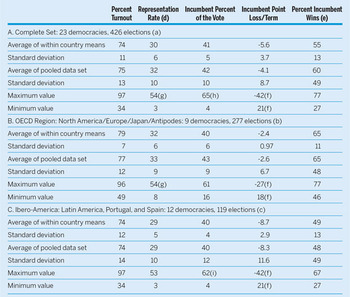
All governments are minority governments. Footnote 4 Few would doubt that this generalization applies to autocracies, in which a single or dominant party or organization, controlled by a dictator or an oligarchy, uses force and fraud to control the state. However, the rule also applies to democracies, as shown in table 1. (Henceforth, all data references are to this table.) The average turnout is approximately three quarters of the electorate, whereas the mean percentage of the vote going to the governing party—that is, the incumbents—is in the low forties. These facts mean two things: (1) typically, more than half of those who show up at the polls—the “selectorate” Footnote 5 —cast their ballots for a party other than the governing party; and (2) those that do back the incumbents constitute only about one third of the electorate. This pattern holds across cultural regions and constitutional types, variables which in this study are almost perfectly coterminous: all democracies from Ibero-America except Spain and Portugal (a mixed regime) are presidential, whereas parliamentary democracies populate everywhere else except in the United States and France (the latter, like Portugal, is a mixed regime).
Election Outcomes for Governing Parties in Democracies: Summary Statistics, Total and by Region

Notes: In presidential democracies that include a runoff, as well as in French legislative elections, the vote entered is that of the first or only round.
(a) All democracies listed in B and C plus India (1951–2014) and Barbados (1951–2013).
(b) Australia (1901–2013), Canada (1872–2011), France (presidential, 1965–2012), France (legislative, 1958–2012), Germany (1949–2013), Japan (1958–2012), New Zealand (1914–2014), Sweden (1932–2014), United Kingdom (1922–2010), United States (1828–2012).
(c) Argentina (1983–2011), Brazil (1989–2014), Chile (1938–1970), Chile (1989–2013), Colombia (1974–2014), Costa Rica (1953–2014), Cuba (1940–1948), Dominican Republic (1966–2012), Mexico (1988–2012), Portugal (parliamentary, 1976–2011), Portugal (presidential, 1986–2011), Spain (1976–2011), Uruguay (1984–2014), Venezuela (1958–1993).
(d) The representation rate is the percent of the total electorate that voted for the incumbents.
(e) This variable is scored 1 if the incumbent party (although not necessarily its same leader) retained the presidency or premiership; 0 otherwise.
(f) Typically, the incumbent loses votes from one election to the next but sometimes it gains votes. The maximum value refers to the largest loss in one election and the minimum refers to the largest gain. That is, the minimum loss is the maximum gain.
(g) Australia (1966). In only nine elections (2.1% of the total) did this variable exceed 50%; all but two were in Australia.
(h) Barbados, 1999. Presidential elections in Portugal (1991) and Dominican Republic (1974) excluded. See text.
(i) Colombia, 2006. Presidential elections in Portugal (1991) and Dominican Republic (1974) excluded. See text.
LAW #2: THE LAW OF INCUMBENT ADVANTAGE
In democracies, the governing party or coalition is returned to office more often than not. Notwithstanding Law #1, across all countries, the incumbent reelection rate, on average, is 60%. (There is substantial variation across regions—that is, two-thirds in the well-established democracies of the Organization for Economic Co-operation and Development (OECD) versus slightly less than half in Ibero-America.) This is because the opposition can be badly divided. Additionally, in parliamentary governments there is a certain disproportionality between seats and votes, and votes are wasted on parties that do not win any seats; or the plurality winner strikes deals with minority parties and independents on a case-by-case basis or forms a “minority government” (in the parliamentary sense) for a brief period (Lijphart Reference Lijphart and Hadenius1997). Also, the selectorate may be somewhat biased in favor of the “devil” they know (Hibbs Reference Hibbs2000).
That democracies are characterized by minority governments ruled by parties that enjoy an electoral advantage over their competitors does not necessarily render them unrepresentative. For one thing, because incumbents lose elections about 40% of the time, over the long run roughly two-thirds of the electorate is included among the supporters of one administration (i.e., “government” in the parliamentary sense) or another. Moreover, governing parties usually pursue moderate policies (McDonald and Budge Reference McDonald and Budge2005, 171–80), and alternation in office ensures that policy targets are periodically reoriented in the direction of moving median or modal voter preferences (Budge et al. Reference Budge, Keman, McDonald and Pennings2012, 251–3).
LAW #3: THE LAW OF SHRINKING SUPPORT
All incumbents face growing opposition during their tenure; or, as Nannestad and Paldam (Reference Nannestad and Paldam1999) stated, “It costs votes to rule.” Note that in table 1, on average the incumbents lose four to six percentage points of their share of the vote per term. Again, there is great variation across cultural regions. In the OECD countries (excluding members from Ibero-America), the average loss across 277 elections (many of them dating from the nineteenth century) is between 2.4 and 2.6 percentage points. This estimate is almost identical to those of Nannestad and Paldam( 2.25%) and Budge et al. ( 2.33%), respectively calculated for more than 282 and 215 post–World War II elections in 18 European countries, plus the United States, and in the former’s case, Japan. Footnote 6 Nannestad and Paldam called this phenomenon a “solid stone,” something that is “remarkably constant” in established democracies operating under normal conditions. Yet, they added, “It is generally not well known how robust the fact actually is” (Nannestad and Paldam Reference Nannestad and Paldam1999, 3, 21).
Note that I found their article (and my attention was called to Budge et al.’s book) only after I had made most of the initial calculations displayed in table 1. Thus, although their findings were reported earlier, I obtained approximately the same results in ignorance of their prior discovery. The fact that sets of developed democracies varying in the number and timing of their elections yield similar estimates of the “cost of ruling” well may strengthen the discipline’s confidence in “the law of shrinking support.”
The erosion of support is not uniform across the ruling party’s spell in office. In fact, in some cases, the incumbent party’s vote share rises, even substantially, in their first reelection—especially if in the prior election, when it was elevated to office, the electorate had fractured in the midst of an economic or political crisis. This also may happen when a new democracy is experiencing a period of electoral sorting and consolidation, as Germany did in the 1950s. Also, within the same period in office, there are occasional small upticks in the governing party’s vote. However, these are offset by larger downturns in subsequent elections; sooner or later, the “dam breaks” and the proverbial “rascals” are “kicked out.”
However, these are offset by larger downturns in subsequent elections; sooner or later, the “dam breaks” and the proverbial “rascals” are “kicked out.”
There is no reason to believe that dictatorships are exempted from this law. In political rituals crafted as acclamations or affirmations of the dictatorship of a person or a ruling party, 15 dictatorships that vary in type, ideological cast, culture, region, and period each held about eight elections-cum-referendums on average, claiming more than 90% support. Footnote 7 Yet, the moment when an actual election was held, all of the ruling parties crashed and most disappeared from the political stage. Among communist dictatorships, perhaps the signal event took place in Poland. In 1989, the “Solidarity Citizens’ Committee” captured all but 10 of the 261 seats in the Sejm (i.e., the Lower House of Parliament) and all but one of the Senate seats for which it was allowed to compete. Thus, “In the first free voting . . . support for the Communists was shown to lie somewhere between three and four percent” (Davies Reference Davies2005, 503). Sister parties in Czechoslovakia, East Germany (GDR), and Hungary suffered similar fates the following year.
A more gradual decline occurred in Mexico. For more than a half-century, the Institutional Revolutionary Party (PRI by its Spanish initials) routinely claimed nearly universal support for its presidential candidate. As late as 1976, the PRI’s standard bearer ran without opposition. In the next two decades, having loosened electoral controls and suffered a scission when the son of a former president bolted to make an independent run, its share of the vote contracted with every presidential election: 74% in 1982, 51% in 1988, 49% in 1994, and 36% in 2000, when it was ousted. Unlike most other ruling parties, however, the PRI survived; in 2012, it recaptured the presidency with a 39% plurality.
LAW #4: THE 60% INCUMBENT MAXIMUM IN DEMOCRACIES
It is rare for the governing party in a democracy to be reelected with more than 60% of the vote, and it never happens more than once within the same spell in office. Generally, incumbents in a parliamentary system are reelected with no more than 50% of the vote; in a presidential system, 60% is the typical limit (in the first round of voting, if there is more than one round). In fact, the average maximum incumbent share of the vote is nearly identical across cultural groups: 53.4% (s.d.=4.3) in the OECD democracies and 53.1% (s.d.=4.6) in Ibero-America. In only a few genuine cases from three democracies did the incumbents garner more than a few points above 60%: Barbados, 65% (1999); Colombia, 62% (2006); and the United States, 61% (1936, 1964, 1972). In all, these exceptions total 1.2% of all elections.
Two apparent exceptions merit comment. The first is the 1991 Portuguese presidential election. Portugal has a mixed regime, with a president who exercises limited executive powers and a strong prime minister who is in charge of the government. That year, the Socialist Mário Soares—a genuine democratic hero who previously had served as prime minister—soared to a record reelection victory, taking 70% of the vote. What made this possible was the support of the major right-of-center party, the Social Democratic Party (PSD by its Portuguese initials), and its leader and prime minister, Aníbal Cavaco Silva. Without a major-party challenge, Soares won, we might say, by acclamation.
The second apparent exception took place in the Dominican Republic in 1974, when Joaquín Balaguer was reelected with 85% of the vote amid an opposition boycott and charges of fraud. Indeed, the artificiality of Balaguer’s victory was exposed in the next election, which he lost by almost 10 percentage points. Thus, the inflated percentages in these two cases are accounted for by opposition abstention—one amicable, the other not. In summary, the 60% rule serves as a boundary between all democracies and most dictatorships. Footnote 8
No one party or coalition of parties, much less a “Führer,” “Duce,” or “maximum leader,” can encompass the entire range and variety of interests and ideas that comprise a political community.
LAW #5: THE LAW OF PARTIALS
No one party or coalition of parties, much less a “Führer,” “Duce,” or “maximum leader,” can encompass the entire range and variety of interests and ideas that comprise a political community.
This law is rooted in the very nature of politics and the state, and it serves as the foundation of the previous four. As Aristotle taught long ago: “the nature of the state is to be a plurality” (Jowett Reference Jowett1885). The “‘organic’ common will,” whether of a nation, Volk, or class, is a “fiction” (Kelsen Reference Kelsen2013, 33). The moment an electorate is free to choose among candidates and parties espousing a variety of programs, personalities, and styles of governing, what Wittfogel (Reference Wittfogel1957, 430) calls “the germs of a multicentered society” are released and multiply. Thus, the “will of society emerges from competing parties” (Kelsen Reference Kelsen2013, 33) the principal object of which, other than ruling per se, is to win sufficient votes or seats in elections, legislatures, and judicial bodies to steer government policy in the direction desired by its cadre and supporters. However, success—if and when it comes—is short-lived: the law of shrinking support soon kicks in, inexorably eroding the size of the incumbent’s electoral coalition until it is driven from office. In the democracies, incumbents serve on average two to three terms in spells lasting nine years. Thus, over time, various fractions of the electorate combine into alternate winning coalitions—a modern, reduced version of Aristotle’s principle of citizens taking turns at ruling and being ruled—and the state is governed with a minimum of political coercion (Przeworski Reference Przeworski2009).
SUMMARY AND CONCLUSION
This article presents evidence attesting to what appear to be five laws of politics. They do not strike me as controversial. All governments, certainly autocracies but also democracies, can count on the votes of only a minority of the electorate—even if in the latter that minority represents a plurality. That incumbents enjoy an advantage over opposition parties and candidates—probably derived at least in part from their exploitation of state resources for partisan gain—should come as no surprise. Notwithstanding this advantage, the fact that, on average, incumbents lose support from term to term—with some exceptions, usually early in their tenure that are offset in subsequent elections—is “one of the few obvious regularities observed in political science” (Budge et al. Reference Budge, Keman, McDonald and Pennings2012, 255). Finally, the fact that vigorous competition among political parties limits the incumbents in almost all cases to no more than 60% of the vote, and usually considerably less, is readily observable. The conclusion is inescapable: the state is a plurality, and no organic conception captures its essence.
If, on reflection, these laws appear elemental—describing properties and patterns inherent in the very nature of politics and the state—the question then becomes: Why are they not presented in every course of political science? I submit that we, as a discipline, have been too diffident about professing what we know about our subject. Of course, to proclaim these laws (or “laws,” if the reader prefers) is not to explain them. That is a separate task requiring additional space and, frankly, hard thinking. However, the natural sciences have not hesitated in announcing the operation of laws before they were fully understood (Feynman Reference Feynman1995). Be that as it may, I conclude with the hope that—in true Popperian fashion—others will take up the challenge to falsify these laws. Footnote 9 My guess is that they will survive all empirical assaults.
ACKNOWLEDGMENTS
I am grateful to The University of West Florida for its generous support. Also, for their encouragement, suggestions, or constructive criticisms, I thank Ian Budge, John M. Carey, Cal Clark, Josep Colomer, Erica Frantz, Andrew Gelman, Jane Greene, Richard J. Heggen, Douglas Hibbs, Kenneth Janda, William Jennings, Randall J. Jones Jr., Arend Lijphart, Scott J. Morgenstern, Vello Pettai, Larry Sabato, Rein Taagepera, William B. Tankersley, and the editors and reviewers of this journal. Thanks, as well, go to Megan Morrison and Daniel Dorman, graduate assistants in the department of government at UWF, for their help. The usual disclaimer applies: any errors of fact or interpretation, or deficiencies in presentation, are my own.