It is a serious public health challenge to design services that are effective for preventing child maltreatment but are also engaging and palatable to caregivers. A formidable challenge to prevention and intervention efforts is that some forms of maltreatment, such as physical assault and sexual exploitation, are as serious as they are rare and are difficult to detect early to prevent harm to the child. Severe forms of abuse and maltreatment clearly reflect distorted caregiver cognitions (e.g., Bugental, Reference Bugental1989) and often emerge from adults' own abusive childhoods and familial experiences (Knutson & Mehm, Reference Knutson, Mehm and Russell1988; Widom, Reference Widom1989). It is therefore useful to consider maltreatment from a developmental psychopathology perspective, with a focus on the emergence of maltreatment in families and a specific emphasis on the interface of normative and psychopathological development (Cicchetti, Reference Cicchetti1990). Within this framework, it is critical to study subclinical forms of maltreatment, such as neglect, that are both a precursor to and the foundation of more extreme forms of maltreatment (Dubowitz, Reference Dubowitz2013). One strategy is to prevent the daily conditions and interactions that give rise to a neglecting caregiver environment from which more serious maltreatment events emerge.
Considerable developmental evidence supports this transactional perspective on child maltreatment (Belsky, Reference Belsky1993; Cicchetti & Lynch, Reference Cicchetti and Lynch1993; Fergusson, Boden, & Horwood, Reference Fergusson, Boden and Horwood2008). However, this perspective has not been fully translated to the design of palatable and realistic prevention services (Kellam & Van Horn, Reference Kellam and Van Horn1997; Sameroff & Fiese, Reference Sameroff and Fiese1987). Our study examined whether the Family Check-Up (FCU; Dishion & Kavanagh, Reference Dishion and Kavanagh2003; Shaw, Dishion Supplee, Gardner, & Arnds, Reference Shaw, Dishion, Supplee, Gardner and Arnds2006), a brief, periodic intervention, can effectively promote caregivers' use of positive behavior support strategies with young children (ages 2–3 years), which in turn prevent core dimensions of child neglect by age 4. The study included direct observations of caregiver–child transactions at ages 2–3 years and longitudinal assessment of macrolevel measures of caregiver neglect at age 4 among an ethnically diverse group of high-risk families (N = 731) engaged in Women, Infants, and Children (WIC) nutritional supplement services. In addition, a family adversity index was considered as a potential moderator of intervention effects. When the children were age 2, the families were recruited, assessed, and randomly assigned to be offered the FCU (Dishion & Kavanagh, Reference Dishion and Kavanagh2003; Shaw et al., Reference Shaw, Dishion, Supplee, Gardner and Arnds2006) or to receive the usual WIC services.
The vast majority of interventions that target child maltreatment address the consequences, such as posttraumatic stress disorder (Cohen, Mannarino, Murray, & Igelman, Reference Cohen, Mannarino, Murray and Igelman2006; Tremblay & Peterson, Reference Tremblay and Peterson1999). The focus on the consequences of maltreatment is critical in that long-term mental health is seriously undermined (Cicchetti & Lynch, Reference Cicchetti and Lynch1993) and development of normative milestones is compromised (Pears & Fisher, Reference Pears and Fisher2005). Problematic emotional and social development in childhood often persists to emotional maladjustment in early adulthood (e.g., depression, anxiety, or traumatic stress) and suicide attempts (Crowell et al., Reference Crowell, Beauchaine, McCauley, Smith, Vasilev and Stevens2008; Fergusson et al., Reference Fergusson, Boden and Horwood2008). Harsh and maltreating early experiences, coupled with genetic vulnerability, are prognostic of serious antisocial behavior (Odgers et al., Reference Odgers, Moffitt, Broadbent, Dickson, Hancox and Harrington2008), especially for males (Caspi et al., Reference Caspi, McClay, Moffitt, Mill, Craig and Taylor2002).
It is not surprising that antisocial behavior is more prevalent among children and adolescents who have a history of maltreatment. From an evolutionary perspective, youths who have experienced low levels of nurturance and high levels of harshness in childhood are likely to adapt at multiple levels, including the ways in which they view and think about the world (Figueredo, Vásquez, Brumbach, & Schneider, Reference Figueredo, Vásquez, Brumbach and Schneider2004; Frankenhuis & de Weerth, Reference Frankenhuis and de Weerth2013). Even more problematic is the tendency to self-organization into groups in early adolescence that promote amplification of antisocial tendencies and promiscuous sexual practices (Dishion, Reference Dishion, Dishion and Snyderin press; Dishion, Ha, & Véronneau, Reference Dishion, Ha and Véronneau2012). These adaptations, known as a fast life history strategy, frequently culminate in having more children earlier in development, when caregivers are less mature and less committed to family life, which potentiates the cross-generation perpetuation of child maltreatment (Belsky, Reference Belsky1993; Knutson, Reference Knutson1995).
Effective reduction and prevention of child maltreatment entails an integrated, multilevel strategy (see Biglan, Reference Biglan2015), including the provision of support services to children and families who experience and perpetuate maltreatment. In conditions of severe maltreatment, it is often necessary to remove the child from the home. During the past 10 years, remarkable progress has been made in the design of nurturing and safe treatment foster care that emphasizes skilled and compassionate behavior management strategies (Chamberlain et al., Reference Chamberlain, Price, Leve, Laurent, Landsverk and Reid2008; Price & Landsverk, Reference Price and Landsverk1998). Careful study of the physiological and psychological adaptation of children who have been removed from maltreating environments and placed in sane and safe treatment foster care suggests that safe and sane environments support recovery of the basic human stress response (i.e., diurnal cortisol patterns), improved DNA integrity (i.e., telomere length), and improved child behavior and emotional regulation (Asok, Bernark, Roth, Rosen, & Dozier, Reference Asok, Bernark, Roth, Rosen and Dozier2013; Dozier et al., Reference Dozier, Manni, Gordon, Peloso, Gunnar and Stovall-McClough2006; Fisher, Burraston, & Pears, Reference Fisher, Burraston and Pears2005; Fisher, Stoolmiller, Gunnar, & Burraston, Reference Fisher, Stoolmiller, Gunnar and Burraston2007). Treatment foster care is rapidly becoming the mainstay of child welfare agency efforts to ensure safe and nurturing environments for children who have endured maltreatment in the family of origin.
Proactively providing treatment for families that show early signs of maltreatment may help prevent escalation of problematic parenting and the occurrence of abusive events and eventual removal from the home. For example, it is often the case that the mandated reporters (e.g., teachers, social workers, psychologists, doctors, and nurses) will report suspected child abuse (physical, neglect, or sexual) to child protective agencies. In the absence of sexual abuse, the optimal strategy is to work directly with the parents and to emphasize nonpunitive, supportive parenting strategies (Zisser & Eyberg, Reference Zisser, Eyberg, Weisz and Kazdin2010). In general, efforts to promote adult engagement in the caregiving role and to support positive parenting have generally been successful worldwide (see Knerr, Gardner, & Cluver, Reference Knerr, Gardner and Cluver2013, for a review).
Engaging and providing support to parents with a documented history of maltreatment of their child, however, is clinically challenging not only because of established patterns of interaction but also because of the lack of trust for service providers (see Reid & Kavanagh, Reference Reid and Kavanagh1985). As community-based research suggests (see Belsky, Reference Belsky1993; Cicchetti & Lynch, Reference Cicchetti and Lynch1993), families characterized by officially documented maltreatment also often experience several family adversities, with unique, disruptive constellations of difficulty specific to each family, including unemployment, substance abuse, daily frustrations, caregiver depression, and legal difficulties (Belsky, Reference Belsky1993). Despite adversities and the many clinical challenges facing maltreating parents, interventions designed to reduce maltreatment have been effective (Skowron & Reinemann, Reference Skowron and Reinemann2005). Perhaps the most successful among them is parent–child interaction therapy, which provides intensive support to caregivers in the form of videotaped feedback and in vivo coaching (Zisser & Eyberg, Reference Zisser, Eyberg, Weisz and Kazdin2010). Randomized studies suggest improvement in observed parenting, especially for those who complete the intensive intervention regimen (Thomas & Zimmer-Gembeck, Reference Thomas and Zimmer-Gembeck2011).
In a key study of child neglect and abuse prevention that used the Triple P parenting program (Sanders, Reference Sanders1999), participating families in 18 counties in the southeastern United States were assigned to a control or an intervention condition. This multilevel approach to supporting empirically validated child management strategies was offered at the universal level to all families in a general community. Universal support included media and education for all professionals providing services to children and families, and for the families themselves. These supports promoted caregiver strategies to reinforce positive child behavior and nonpunitive approaches to limit setting with children's problem behavior (e.g., Forgatch & Patterson, Reference Forgatch, Patterson, Weisz and Kazdin2010; Webster-Stratton & Reid, Reference Webster-Stratton, Reid, Weisz and Kazdin2010; Zisser & Eyberg, Reference Zisser, Eyberg, Weisz and Kazdin2010). This large-scale community promotion of positive parenting practices has shown modest reductions in the prevalence of officially reported maltreatment cases across the intervention communities (Prinz, Sanders, Shapiro, Whitaker, & Lutzker, Reference Prinz, Sanders, Shapiro, Whitaker and Lutzker2009).
A preventive approach to child maltreatment is critical, because after the fact interventions for child maltreatment may not be effective for all caregivers and in some cases may be iatrogenic. Emotional sequelae may be associated with a family's experience with child protective services. For example, parents may show hostility to the child (Bugental, Reference Bugental1989) and find it challenging to engage positively in the caregiving process and intervention protocols (Giuliano, Skowron, & Berkman, Reference Giuliano, Skowron and Berkman2015). From a transactional perspective, daily stressful interactions with a young child may undermine the parental investment in long-term, sensitive, and involved caregiving. Parenting requires self-regulation, and having several competing demands on time and energy while caregiving young children will certainly undermine the formation and development of positive caregiver–child interaction. Maltreatment often occurs in an impoverished family context in which adults are suffering mental health and substance use challenges, and their engagement in positive parenting may be further undermined by single-parent status and neighborhood factors. The disruptive effect of these factors has been studied individually, but considerable evidence suggests the value of considering an overall index of family adversity (Rutter, Reference Rutter, Garmezy and Rutter1983). Although it is clear that family adversity is correlated with child maltreatment, it is possible that families living in adverse circumstances may benefit from nonstigmatizing and motivating preventive family services.
A critical challenge in stressed families is isolation and insularity brought about by an inability to seek support services simply because family members lack access to transportation (Wahler, Reference Wahler1980). Efforts to prevent maltreatment, therefore, have increasingly focused on home visiting interventions to circumvent barriers to engagement in services secondary to family adversity. The nurse home visiting program designed and tested by Olds et al. (Reference Olds, Eckenrode, Henderson, Kitzman, Powers and Cole1997) has provided the most compelling evidence of the benefits of very early intervention efforts for young families living in high-risk contexts. In this program, young expectant mothers are assigned a home visiting nurse who initially attends to the woman's prenatal health (e.g., smoking, diet, and physical exams) and to the postnatal caregiving environment in the home. Several studies have documented striking long-term benefits of the program to the children from birth through adolescence (e.g., Olds, Hill, Robinson, Song, & Little, Reference Olds, Hill, Robinson, Song and Little2000). The early study also found significant benefits (46% reduction) in terms of child abuse and neglect in childhood (Olds et al., Reference Olds, Eckenrode, Henderson, Kitzman, Powers and Cole1997). The nurse home visiting program assumes a strong developmental focus on the parent and restricts the services to young mothers with their first child, with the idea that mothers with more children may have already habituated into caregiving patterns that may be difficult to change and that “lessons learned” with the first child will be transferrable to the parenting of younger siblings.
Attachment theory suggests that early, sensitive caregiver interactions promote the child's sense of security and increase parental investment in future parenting. Sensitive caregiving often involves reading young children's emotional state and adjusting parenting to nurture and support the development of emotion and behavior regulation. Techniques that successfully promote parent sensitivity are inherently strengths based in that they identify and label caregiver competencies. Parent motivation may also be enhanced through the use of feedback about videotaped caregiver proficiencies. Randomized interventions that promote sensitive parenting reveal moderate effect sizes (see Bakermans-Kranenburg, van IJzendoorn, & Juffer, Reference Bakermans-Kranenburg, van IJzendoorn and Juffer2003, for a review). Moss et al. (Reference Moss, DuBois-Comtois, Cyr, Tarabuls, St.-Laurent and Bernier2011) used a randomized design to test the effectiveness of eight weekly videotaped home visits followed by feedback, which proved to be a critical part of the effort to promote sensitive parenting. Results showed increases in sensitive parenting, improvements in child attachment security, and reductions in child behavior problems.
Of particular importance to a transactional perspective on the prevention of child maltreatment is research that examines the specific mediating and moderating mechanisms that link prevention strategies to reduced risk of child maltreatment. Identification of mediators and moderators advances the causal knowledge needed to understand how an intervention works and for whom it will be effective (MacKinnon & Fairchild, Reference MacKinnon and Fairchild2009). Analysis of mediation entails disentangling the unique effects of an intervention on maltreating processes by changing patterns of daily parent–child transactions while controlling for other possible covariates of change. We know that interventions are generally effective for promoting positive and sensitive parenting and reducing hostile attributions (Bugental et al., Reference Bugental, Ellerson, Lin, Rainey, Kokotovic and O'Hara2002). However, it is yet unclear whether intervention effects on the core dimensions of maltreatment are mediated through changes in daily transactions between caregivers and children.
The goal of this study was to model the processes through which effects on the core dimensions of maltreatment are mediated. The study involved a randomized examination of the FCU adapted to the specific needs of families with young children seeking support from WIC. The initial study of the FCU among WIC parents revealed the three-session intervention effectively reduced child behavior problems from age 2 through 4 (Shaw et al., Reference Shaw, Dishion, Supplee, Gardner and Arnds2006). The FCU also resulted in observed maintenance of caregiver involvement with the child, which was greater than that observed among the control group. However, changes in parent involvement did not mediate reductions in children's problem behavior, perhaps because the FCU had been limited to one dose when children were age 2 (Shaw et al., Reference Shaw, Dishion, Supplee, Gardner and Arnds2006). Findings from a later study with a large multiethnic sample (N = 731) and FCUs carried out at child ages 2 and 3 showed that reductions in parent-reported behavior problems between ages 2 and 4 were mediated by changes in directly observed parents' positive behavior support practices (Dishion et al., Reference Dishion, Shaw, Connell, Gardner, Weaver and Wilson2008). Later it was found that these short-term changes translated to long-term improvements in children's outcome in that teachers rated the children as less oppositional at age 7.5 (Dishion et al., Reference Dishion, Brennan, Shaw, McEachern, Wilson and Jo2014), and measures of self-regulation and academic achievement showed the children to be more school ready (Brennan et al., Reference Brennan, Shelleby, Shaw, Dishion, Gardner and Wilson2013; Lunkenheimer et al., Reference Lunkenheimer, Dishion, Shaw, Connell, Gardner and Wilson2008).
Positive behavior support reflects a set of strategies known to promote growth in competence and prosocial behavior in children and adolescents (Lucyshyn, Dunlap, & Albin, Reference Lucyshyn, Dunlap and Albin2002; Sugai & Horner, Reference Sugai and Horner2002). The integrative framework suggests that relationship-enhancing (e.g., sensitivity) and behavioral (e.g., clear prompts or reinforcement) strategies are mutually nurturing and effective for promoting youth well-being and competence. Direct observations of parenting practices in early childhood (Dishion et al., Reference Dishion, Shaw, Connell, Gardner, Weaver and Wilson2008; Sitnick et al., Reference Sitnick, Shaw, Gill, Dishion, Winter and Waller2014) and adolescence (Dishion, Forgatch, Van Ryzin, & Winter, Reference Dishion, Forgatch, Van Ryzin and Winter2012) suggest that the average duration of dyadic positive engagement is a critical index of positive behavior support. Longer dyadic positive engagement episodes with a child suggest the exchange of more words, proactive management of conflict, and mutuality in the interpersonal relationship.
This longitudinal study addressed the hypothesis that increases in directly observed dyadic positive engagement in early childhood (ages 2 to 3) mediates the benefits of the FCU in terms of reducing core dimensions of child maltreatment at age 4, that is, affection neglect, caregiving neglect, and monitoring neglect. We also tested the hypothesis that family adversity, in general, undermines dyadic positive engagement and directly leads to the emergence of neglect of the child. Finally, we explored the moderating role of family adversity in responding to FCU services, with respect to improvement in caregiver–child interaction and subsequent neglect.
Method
Participants
Between 2002 and 2003, 731 families were recruited from WIC programs in Eugene, Oregon; Pittsburgh, Pennsylvania; and Charlottesville, Virginia. WIC services offer nutritional assistance to indigent families with children between ages 0 and 5 years across the United States. This randomized trial was based on a previous prevention trial that involved 120 WIC families and similar recruitment strategies that tested the viability of the FCU in early childhood (Shaw et al., Reference Shaw, Dishion, Supplee, Gardner and Arnds2006). Families engaged in WIC services were invited to participate in our study on the basis of the following inclusion criteria: (a) they had a child between ages 2 years 0 months and 2 years 11 months, and (b) they reported family, socioeconomic, and/or child risk factors for child's future behavior problems; more specifically, families had to score at least 1 SD above the normative mean in two of the three domains of risk: familial (i.e., maternal depression, daily parenting challenges, substance use problems, or teen parent status); child (i.e., conduct problems and high-conflict relationships with adults); and sociodemographic (i.e., low education achievement and income relevant to WIC criterion). Child maltreatment was not a criterion for selecting families into the study.
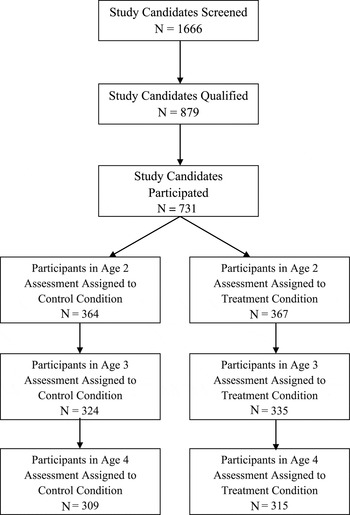
A total of 1,666 families were approached at WIC sites for inclusion in the study. Among them, 879 families met the eligibility requirements and 731 families consented to participate in the study. Of the families who consented, 272 families (37%) were recruited in Pittsburgh, 271 (37%) in Eugene, and 188 (26%) in Charlottesville. At the time of the initial assessment, the children (49% female) had a mean age of 29.9 months (SD = 3.2). Primary caregivers were ethnically diverse across sites: 46.6% European American, 27.6% African American, 13.4% Hispanic, 9.8% biracial, and 2.4% other groups (e.g., American Indian and Native Hawaiian). More than two-thirds of the families had an annual income of less than $20,000, and the average number of family members per household was 4.5 (SD = 1.63). In terms of primary caregivers' education level, 23.6% of the caregivers had less than a high school education, 41% had a high school diploma or general education diploma, and 35.4% had post high school training.
The flow of participant recruitment, assessment, and randomization procedures in our study is shown in Figure 1. The longitudinal retention rate was high overall between ages 2 and 4: 659 (90%) families from the baseline sample (N = 731) were retained at the age 3 follow-up and 624 (85%) families at the age 4 follow-up assessments.
A summary of the recruitment, assessment, and randomization protocol.

Procedure
Home assessment procedure
All home assessments were conducted with families, including a primary caregiver (PC) and a target child. Alternate caregivers were also assessed when available. Home assessment procedures were identical for participants in the control and the intervention groups. The assessment involved both structured and unstructured play activities for the target child and PC. The specific task procedure was as follows: the target child was involved in a free-play task (15 min); afterward, the PC and child participated in a cleanup task (5 min), a delay of gratification task (5 min), and four teaching tasks (3 min each). Then, a second free-play task (4 min) was given to the target child, followed by the child and PC doing a second cleanup task (4 min). Finally, there was the presentation of inhibition-inducing toys (2 min) followed by a meal preparation/lunch task (20 min). The same home assessment procedures were repeated at ages 3 and 4 for the control and the intervention groups. All PC–target child interactions were videotaped during the assessment session for later coding. A more detailed description of the home assessment protocol is available in Dishion et al. (Reference Dishion, Shaw, Connell, Gardner, Weaver and Wilson2008).
Before randomly assigning participants to the control or intervention group, initial home assessments at age 2 were completed, and to increase internal validity of our study, assessment staff remained unaware of the family's group assignment. After the initial assessment (at age 2), home assessments were conducted annually. For families in the FCU intervention group, the annual home assessments were carried out prior to the intervention sessions.
Families participating in the project received financial incentives: $100 for participating in the initial assessment at age 2, $120 for the age 3 assessment, and $140 for the age 4 assessment. Each home assessment lasted approximately 3 hr. Written consent was obtained from all participants prior to participation in the study. In addition, ethical clearance was obtained independently from the institutional review boards at three universities. Those in the control condition were paid only for assessments and otherwise received WIC services as usual. They were not offered the FCU; however, as a courtesy, all control and intervention participants received a list of local mental health and developmental disability services.
The FCU procedure
The FCU is a brief, three-session intervention that is offered annually and includes information about available and relevant evidence-based parenting support services. The FCU service model is individually tailored to each family on the basis of home assessment results. The three sessions include (a) a home-based, observational assessment session that is multi-informant and ecological, (b) an initial intake session, and (c) a feedback session (see Dishion & Stormshak, Reference Dishion and Stormshak2007, for a review). To ensure that the observational assessments were not biased, families in our study were involved in the observational assessment session and then were invited to engage in the initial interview session and feedback. During the interview session, a trained consultant examined a PC's concerns, particularly about family issues that are important to the well-being of the child. The feedback session focused on observed parenting and family strengths but also included a discussion about possible areas of change in the family and in parenting practices. A motivational interviewing approach was used to elevate the PC's motivation to change his or her key parenting weaknesses.
The FCU is designed to assess the need for follow-up evidence-based parenting support services articulated in the Everyday Parenting curriculum (Dishion, Stormshak, & Kavanagh, Reference Dishion, Stormshak and Kavanagh2011). Everyday Parenting sessions are consistent with other proven approaches to parent management training, particularly the Oregon model for parent training (Forgatch & Patterson, Reference Forgatch, Patterson, Weisz and Kazdin2010). A direct observation of videotapes of provider services was developed to assess the need for follow-up sessions (Dishion, Knutson, Brauer, Gill, & Risso, Reference Dishion, Knutson, Brauer, Gill and Risso2010). A recent study of service provider fidelity revealed adequate fidelity. In addition, it was found that variation in provider competent adherence to the FCU model was prognostic of caregiver engagement in the FCU feedback session, which in turn was associated with improvements in parenting and in children's problematic behaviors between ages 2 and 4 (Smith et al., Reference Smith, Dishion, Shaw, Wilson, Winter and Patterson2014).
Measures
Observed dyadic positive engagement
A critical advantage of using observed caregiver–child interaction as both a mediator and an outcome is that coders are blind to the intervention condition of the family. The Relationship Affect Coding System (RACS; Peterson, Winter, Jabson, & Dishion, Reference Peterson, Winter, Jabson and Dishion2008) is a microsocial coding system that captures the topography of relationship behaviors and the affect in PC–child interactions (e.g., emotional displays or lack thereof). This system was used to code the videotaped PC–child interaction tasks at ages 2, 3, 4, and 5. We used data only from ages 2 and 3 in our study. The RACS reflects three simultaneous dimensions of behavior (verbal, physical, and affect) for each target child and PC. Each of the three dimensions of behavior is coded into three categories: positive, negative, and neutral. The behavioral cues that are used for coding are based on participants' facial expressions, tone of voice, and nonverbal cues (e.g., body posture and/or orientation).
Noldus Observer XT, Version 11.0 (Noldus Information Technology, 2012) was used to record RACS codes. The software allows for continuous coding of an interaction between the child and PC, simultaneously. Because there were three simultaneous data streams for each participant in the interaction tasks, six behavior clusters were created that represent the three data streams for each person (PC and child) in the interaction. The six behavior clusters are positive, neutral, directives, negative, no talk, and ignore. For instance, the positive behavior cluster included behaviors such as positive verbal, structure, affect or physical, and validation. The negative behavior cluster included behaviors that are associated with anger and disgust, negative verbal statements, and negative physical interaction. Decision rules were created to determine which behavior stream wins out in the event that two different behavior streams were present simultaneously. The order of trumping was as follows: ignore, negative, positive, directive, no talk, and neutral behavior. For example, if a PC made a negative verbal statement to the target child and then showed positive affect at the same time, the negative behavior stream would trump the positive behavior stream. Based on the six behavior clusters, dyadic states were derived by coding both the parent's and the child's state at every second of the videotaped observation. As such, the durations and frequencies of behavior clusters could be calculated not only for the PC and the child, respectively, but also for the aforementioned dyadic states and interaction dynamics within families (both PC and child).
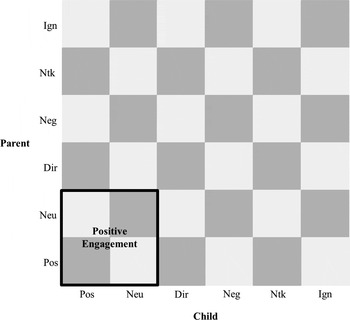
Observing both parent and child interaction in real time enables the ability to quantify dyadic states (Granic & Hollenstein, Reference Granic and Hollenstein2003; Hollenstein, Reference Hollenstein2007). In previous work with this coding system (Dishion, Forgatch, et al., 2012), we examined the validity of four dyadic states: positive engagement, neutral engagement (e.g., mostly verbal conversation), coercive engagement, and noninteractive. Of interest to this research is the duration of positive engagement between the caregiver and child. Dyadic positive engagement (DPE) is a summary score and reflects the duration of positive and neutral behavior engagement between the PC and the child. Thus, the DPE included 4 out of 36 possible cells on the grid shown in Figure 2.
Summary score of positive engagement for parent and child derived from Relationship Affect Coding System coding. Pos, Positive engagement; Neu, neutral engagement; Dir, directive; Neg, negative engagement; Ntk, no talk; and Ign, ignore. Primary caregiver is shown on the y-axis and the target child is on the x-axis.

A duration-proportion score was then calculated for the four dyadic states by dividing the total duration of each caregiver–child dyad observed in the region by the overall session time. Reliability coefficients were in good to excellent range, with an overall κ = 0.93 at each age and coder agreement of 93% and 94% at age 2 and 3, respectively. Kappa coefficients were computed by Noldus Observer and were based on the duration and sequencing of coded behavior.
Child neglect at age 4
Child neglect at age 4 was conceptualized and measured with three coder ratings. Coders completed the Coder Impressions Inventory (COIMP; Dishion, Hogansen, Winter, & Jabson, Reference Dishion, Hogansen, Winter and Jabson2004) on the basis of the observed videotaped interactions of a PC and child at ages 2, 3, 4, and 5. However, our study used only age 2 and age 4 COIMP data. The COIMP was developed to measure various dimensions of family management processes, such as PC–child relationship quality, negative PC–child interaction, and family problem-solving skills. Coders rated each construct on a 9-point response scale in which 1 = not at all, 5 = somewhat, and 9 = very much. Two outcome variables were created from these COIMP items. Affection neglect was derived from the mean of two COIMP items: “The parent shows affection and/or love for the child during the observation session” (reverse coded) and “The parent hugs, kisses, cuddles, tickles, or otherwise touches the target child in a positive way during the session” (reverse coded).
The second dimension of neglect, monitoring neglect, was formed from the mean of three COIMP items: “The parent seems to be mindful of the child's behavior, whereabouts, activities, and feelings” (reverse coded); “The parent seems to have clearly established routines that are well understood and practiced by the child” (reverse coded); and “The parent seems ‘tired-out,’ depressed, or inattentive to the child during the task.” The Spearman–Brown coefficient, for reliability of a two-item scale (Eisinga, te Grotenhuis, & Pelzer, Reference Eisinga, te Grotenhuis and Pelzer2013), was 0.86 and 0.85 for the affection neglect variable at ages 2 and 4, respectively. The Cronbach α coefficients for the three-item monitoring neglect were 0.70 to 0.68 for ages 2 and 4, respectively.
The third dimension, caregiving neglect, was measured using the original Home Observation for Measurement of Environment (HOME; Caldwell & Bradley, Reference Caldwell and Bradley2003). This measure includes 36 items used to assess the quality and quantity of support and stimulation in the home environment. HOME uses naturalistic observation to measure the parenting context (Caldwell & Bradley, Reference Caldwell and Bradley2003). The examiners visited each participant's home for 3 hr, which enabled them to observe PC–child interactions and parental warmth and support. The lead examiner completed the HOME at the end of the visit. Among the observationally based HOME items, one item (“basic hygiene appears to be observed”) was selected to measure caregiving neglect in our study. This item was rated on a 4-point Likert scale in which 1 = not at all true, 2 = hardly true, 3 = somewhat true, and 4 = very true, and was reverse coded for our analyses.
Family adversity index
The family adversity index at age 2 was generated by the sum of eight indicators as follows: (a) PC income below the national poverty line; (b) low PC education level (i.e., less than high school education); (c) single parenthood; (d) household overcrowding (i.e., four or more children in home and more family members than the number of rooms); (e) household member with legal conviction (i.e., someone in the home convicted of crime); (f) PC with drug or alcohol problems (i.e., used at least one hard drug or marijuana once per month or more; PC drank every day and three or four drinks more than half of the time); (g) neighborhood dangerousness (i.e., scored 1 SD above the mean of the current sample); and (h) PC with depression (i.e., scored greater than the standard clinical cutoff core of 16 on the Center for Epidemiological Studies on Depression Scale; Radloff, Reference Radloff1977). Families received a score of 1 for each indicator if an adversity was present or a score of 0 if an adversity was absent. Possible scores on the family adversity index ranged from 0 to 8.
Data analysis plan
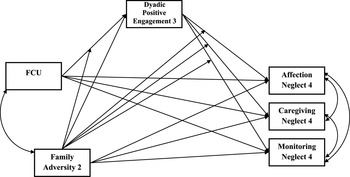
Descriptive statistics and bivariate correlations were examined for all study variables, including covariates. Multivariate outlier analyses, using Cook's (Reference Cook1977) distance as criteria, were conducted for the prediction of the mediator (i.e., DPE) and outcome variables. Attrition analyses were conducted on key demographic variables, diversity variables, and outcome variables at baseline. Mplus 7 software (Muthén & Muthén, Reference Muthén and Muthén2012) was used to investigate the hypothesized mediation model (see Figure 3). Full information maximum likelihood (Arbuckle, Reference Arbuckle, Marcoulides and Schumacker1996) estimation was used to handle missing data. Although the paths are not shown in Figure 2, the FCU treatment effect on dyadic positive engagement at age 3 controlled for the baseline score of DPE and child gender. In addition, all the effects on outcome variables at age 4 (i.e., affection, monitoring, and caregiving neglect) controlled for their baseline scores at age 2 and for child gender. Family adversity at age 2 was included as a moderator for the intervention effects on the mediator and from the mediator to the outcome variables. Family adversity was centered prior to moderation analysis. To assess mediated effects in the study model, the percentile bootstrapping method was used (Taylor, Mackinnon, & Tein, Reference Taylor, MacKinnon and Tein2008).
Hypothesized mediation path model. The following covariates were included in the analyses but are not shown in the figure for parsimony: baseline score of dyadic positive engagement; and baseline scores of all outcome variables. FCU, Family Check-Up; 2, age 2; 3, age 3; 4, age 4.

Results
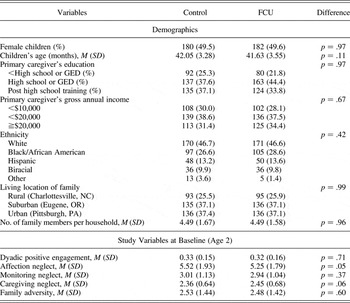
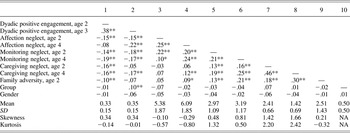
Table 1 shows comparisons of demographic and baseline study variables by group assignment. Chi-square test and t test results indicate that there were no significant differences in demographic and baseline study variables between the control and FCU intervention groups except affection and caregiving neglect (i.e., they were marginally significant). Affection neglect was slightly higher in the control group than in the FCU intervention group, whereas caregiving neglect was slightly higher in the FCU intervention group. Multivariate outlier analyses revealed one influential case, which was excluded from the analysis. No noticeable differences were found between the results of the analyses with the influential case included and excluded. Attrition analysis demonstrated no significant Group × Attrition interactions in any demographic variables and outcome variables at baseline. However, it was found that families with low education and gross income level were less likely to be retained in the study from age 2 through 4 (both p < .01), regardless of the group assignment. Table 2 shows bivariate Pearson correlations and descriptive statistics of all the variables that were used in our study. Correlations between the dyadic positive engagement at age 3 and all outcome variables at age 4 were negatively significant. Family adversity was also significantly associated with all outcome variables at age 4 in the expected direction. Child gender as a covariate was not significantly correlated with any mediator or outcome variables and was therefore excluded from the mediation model for parsimony. Skewness and kurtosis of all variables also fell within the acceptable range (skewness cutoff = 2.0 and kurtosis cutoff = 7.0; West, Finch, & Curran, Reference West, Finch, Curran and Hoyle1995).
Demographics and study variables at baseline

Bivariate Pearson's correlations, means, standard deviations, skewness, and kurtosis of study variables

*p < .05. **p < .01.
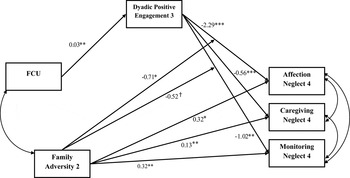
The overall model tested is shown in Figure 4. To test mediation and moderation, it is necessary to control for prior levels of each of the key constructs in the model. The stability paths are not shown in Figure 4, yet all were statistically significant. The model fit adequately to the data, χ2 (df = 16) = 45.37, p < .001, comparative fit index = 0.93, standard root mean square residual = 0.03, root mean square error of approximation = 0.05 (90% confidence interval [CI] = 0.03–0.07). Note that the missing data-handling procedures are improved by inclusion of auxiliary variables in a model either by reducing bias or by increasing power in estimating missing information (Enders, Reference Enders2010). The results were nearly identical (i.e., no noticeable changes in p values were observed) between the models with and without the inclusion of education and income as auxiliary variables in the model.
Summary of the final path model. Unstandardized β coefficients for only significant paths were indicated. The following covariates were included in the analyses but are not shown in the figure for parsimony: baseline score of dyadic positive engagement, and baseline scores of all outcome variables. FCU, Family Check-Up; 2, age 2; 3, age 3; 4, age 4. †p < .10, *p < .05, **p < .01, ***p < .001.

As hypothesized and consistent with previous studies that used slightly different measures (Dishion et al., Reference Dishion, Shaw, Connell, Gardner, Weaver and Wilson2008), participants in the FCU intervention group indicated significantly higher DPE than did those in the control group at age 3, while controlling for the baseline measure of DPE (B = 0.03, SE = 0.01, p < .01). Age 3 DPE significantly predicted less affection neglect (B = −2.29, SE = 0.51, p < .001), caregiver neglect (B = −0.56, SE = 0.15, p < .001), and monitoring neglect (B = −1.02, SE = 0.36, p < .01) at age 4, controlling for the same baseline measures at age 2, family adversity, and FCU direct effect. However, no significant FCU direct effects on age 4 neglect outcome variables were observed, contrary to our expectation. Even when a separate model was computed without the DPE variable as mediator, the FCU did not significantly predict any of the age 4 neglect variables. Thus, this study reflects indirect effects of FCU on neglect at age 4 through DPE.
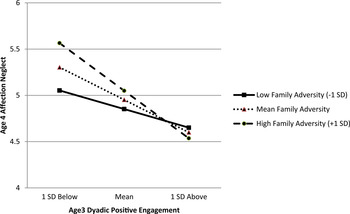
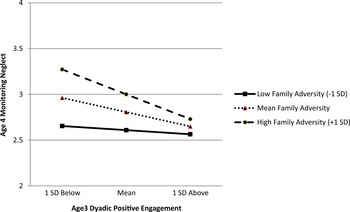
As expected, family adversity at age 2 was significantly associated with affection neglect (B = 0.32, SE = 0.12, p < .05), caregiving neglect (B = 0.13, SE = 0.04, p < .01), and monitoring neglect (B = 0.32, SE = 0.10, p < .01) at age 4 but not with DPE at age 3 (B = −0.08, SE = 0.01, p = .14). It was also found that family adversity significantly moderated the association between DPE and affection neglect (B = −0.71, SE = 0.33, p < .05), and monitoring neglect (B = −0.52, SE = 0.27, p = .05). To facilitate the interpretation of these moderation effects, simple slope analyses (Aiken & West, Reference Aiken and West1991) of affection neglect and monitoring neglect at age 4 on DPE at age 3 were conducted at high (i.e., +1 SD), mean, and low (i.e., −1 SD) scores of family adversity (see Figures 5 and 6). As the family adversity index increased, the negative association between DPE at age 3 and affection or monitoring neglect at age 4 became stronger. For instance, families with high adversity scores showed much steeper decreases in affection neglect as DPE increases, compared with families with low adversity scores.
(Color online) Interaction between dyadic positive engagement and family adversity on affection neglect.

(Color online) Interaction between dyadic positive engagement and family adversity on monitoring neglect.

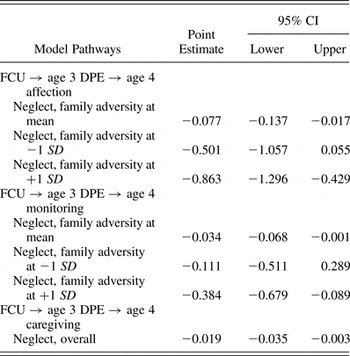
The percentile bootstrapping method with a total of 1,000 bootstrapped samples was used to test the overall mediated effect for caregiving neglect and to test the simple mediated effects (Tein, Sandler, MacKinnon, & Wolchik, Reference Tein, Sandler, MacKinnon and Wolchik2004) for affection neglect and monitoring neglect. Point estimates and the 95% confidence intervals for the overall and the simple mediating effects of DPE on the association between FCU intervention and maltreatment outcome variables are presented in Table 3. Increases of DPE at age 3 mediated the effect of the FCU intervention on reduction of caregiving neglect across all participants (95% CI = −0.035, −0.003). In addition, participants in the FCU intervention group showed an increase of DPE at age 3, which in turn was negatively associated with affection neglect at age 4. Significant indirect effects were found for families at the mean level and at a high level of family adversity scores (95% CI = −0.137, −0.017 and −1.296, −0.429, respectively, for the simple mediation effects) but not at a low level (95% CI = −1.057, 0.055). Similarly, an increase of DPE at age 3 was negatively associated with PCs' monitoring neglect at age 4 for families at the mean level and a high level of adversity scores (95% CI = −0.068, −0.001 and −0.679, −0.089, respectively, for the simple mediation effects) but not at a low level (95% CI = −0.511, 0.289).
Percentile bootstrapping indirect effects and 95% confidence interval for the final model

Note: FCU, Family Check-up; DPE, dyadic positive engagement.
Discussion
A tendency to neglect children's physical, social, and emotional needs in early childhood is a critical precursor and context for other, more severe forms of maltreatment, such as physical and sexual abuse (Dubowitz, Reference Dubowitz2013). In our study sample, the prevalence of these more severe forms of child maltreatment was relatively rare (<5% for ages 2, 3, and 4 with contact with child protective services). Given the relatively high prevalence of maternal depression, however, there was considerable variation in various forms of neglect.
The findings from this study suggest two primary conclusions in the study of parenting neglect. First, the dynamics of an attentive caregiver can be readily observed. Specifically, the average duration (in seconds) of caregiver–child positive engagement episodes in a 20-min videotaped interaction was reliably coded, and this simple dynamic as measured at age 3 predicts multiple forms of neglect. Second, and perhaps most important, a relatively brief home visiting service increases the duration of positive caregiver–child interactions, which in turn reduces several forms of parental neglect in early childhood.
The moderation of intervention effects on childhood neglect by family adversity was noteworthy. Although family adversity was directly correlated with caregiving neglect, it also moderated the impact of the FCU on child neglect. Families with multiple risk factors (i.e., maternal depression, substance use, or poverty) were more responsive to the FCU intervention. Specifically, the associations between caregiver–child positive engagement at age 3 and two of the parenting indices of neglect were strongest among the families with the highest level of adversity. This finding suggests that engaging high-risk families in a public health framework is a promising public health strategy, and the families most in need are most likely to find home visiting services helpful. These findings, and the literature in general, suggest that strengths-based, nonstigmatizing home visiting services are useful for engaging and motivating families to be more involved in nurturing their young child. The FCU strategy enables caregivers to step back and look at their child's development, their situation (marital, neighborhood, and social support), and their parenting. The vast majority of caregivers enjoy the FCU sessions, and many of the participating mothers in particular become less depressed over time (Shaw, Connell, Dishion, Wilson, & Gardner, Reference Shaw, Connell, Dishion, Wilson and Gardner2009). The FCU provider is trained to emphasize parenting strengths and to increase the caregivers' motivation to attend to the needs and well-being of their child.
In this study, the measure of caregiving neglect was primarily the physical surroundings of the household. Many of the families in this study lived in poor contexts, some in rural and others in high-density urban housing. The physical surroundings of the home may be challenging to change without a change in income. Moreover, some of the young families resided in homes owned and led by grandparents or other extended family. It is not surprising, then, that we did not observe the same level of mediation between increases in caregiver–child positive engagement and the physical surroundings as we did with affection and monitoring, because these coder ratings are more linked to the relationship dynamics in the family.
One of the challenges of preventing child maltreatment before it occurs is the low base rate of the behavior. Families in this study were not selected because of risk for maltreatment. Moreover, videotaped home visits are unlikely to uncover more serious forms of maltreatment, especially given ample warning associated with informed consent protocols. However, three critical aspects of neglect are readily observable in the context of a videotaped home visit. Caregivers typically are on their best behavior during the home visits, and physical maltreatment is rarely observed; nevertheless, neglect suggests that caregivers are preoccupied with their own needs and wants, and this is difficult to hide even with home visitors. Without criticizing or judging the caregiver's orientation toward self, the process can be changed. For example, while providing videotaped feedback to caregivers, we emphasize parenting strengths. The videotaped session itself is undoubtedly stressful, but it also recognizes the caregiver's efforts. The best way to build positive, effortful parenting is to elicit the practice, attend and reinforce, and answer the inevitable questions from parents about other skills and positive parenting practices. When caregivers and children spend more time in positive interactions, a relationship is fortified that prevents drift into neglect, which in turn leads to reductions in accidents, problem behaviors, or potential opportunities for other adults to take advantage of the unmonitored young child.
Strengths and limitations
This study has a number of strengths. We used longitudinal data from early childhood to report on the influence of a brief parenting intervention on objective observer ratings of caregiver neglect both in caregiver–child interactions and in the home environment. Although many studies report only on low base rate and extreme cases of maltreatment, this report adds to the literature by investigating more prevalent, everyday occurrences of neglect that may promote later, more severe instances of maltreatment.
This study, however, is not without limitations. First, our analyses include only a 2-year period of change. Our results did show a significant influence of the FCU at age 2 on neglect at age 4, but it is not understood how long these effects on neglect would last into later childhood. To date, the FCU has been associated with 5-year reductions in child behavior problems (Dishion et al., Reference Dishion, Brennan, Shaw, McEachern, Wilson and Jo2014) and improvement in school readiness (Brennan et al., Reference Brennan, Shelleby, Shaw, Dishion, Gardner and Wilson2013). However, future research will focus on the connection between changes in early childhood neglect and later exposure to traumatic events in childhood and adolescence, including maltreatment. A second limitation is that measures of neglect are a snapshot of a brief home visit and may have been biased, in that a study staff member was present. Because the interactions did exhibit instances of neglect and our results did show influences of the FCU on neglect through positive engagement, we argue that these measures were valid indices of neglect.
It would nevertheless be useful to further develop an observation protocol that would assess the more complex construct of caregiver neglect. In the past, we were able to develop a direct observation of parental monitoring in the home by structuring a discussion between an adolescent and a friend that evoked information about the youths' involvement with peers when they were unsupervised. A similar strategy could be designed for early childhood that focuses on the caregiver's ability to detect and attend to the child's emotional and physical needs when they conflict with their own needs. In the FCU model, there is a tight link between assessment and intervention, and a measurement tool such as this would also be useful for motivating change and tailoring follow-up services for neglecting caregivers. We suspect that with the current measures, exemplars of neglect may have been underrepresented because of the close scrutiny of the staff, but more important, because the tasks themselves pulled for caregiver–child engagement.
In summary, this research provides evidence for a public health approach to reducing instances of maltreatment in the larger community. Our results showed that a brief family-based intervention could influence everyday occurrences of neglect through caregiver–child positive engagement. Future research should investigate further to ascertain the longevity of such effects into later childhood and whether these indices of daily neglect predict consequential, extreme cases of maltreatment.