Introduction
Isoodon macrourus (Gould) (Peramelidae Gray), the northern brown bandicoot, is common along the northern and eastern coasts of Australia, including many coastal islands (Gordon Reference Gordon, Van Dyck and Strahan2008). An omnivorous animal, the diet of the northern brown bandicoot includes insects and other invertebrates such as earthworms. Food is taken mainly from the ground surface or by digging with its forepaws (Gordon Reference Gordon, Van Dyck and Strahan2008).
Spratt and Beveridge (Reference Spratt and Beveridge2016) included all the published records of parasites from I. macrourus in their annotated list of the helminth parasites of Australian monotremes and marsupials, recording 34 species, together with some incompletely identified material. Most of the specimens relating to those records are held in the Australian Helminthological Collection (AHC) of the South Australian Museum (SAMA) with the museum holding 235 registered lots.
The aim of this project was to reexamine all the nematode parasites collected from I. macrourus and registered in the AHC to confirm, correct or provide an identification (to at least genus) for each lot and to describe any species new to science that were revealed in the process. The composition of the nematode assemblage of I. macrourus was determined and comparisons were made between the nematode assemblages of the southern long nosed bandicoot, Perameles nasuta Geoffroy, with a geographic distribution along the east coast south of Townsville and the northern long nosed bandicoot, P. pallescens Thomas, with a geographic distribution along the east coast from Townsville north and I. macrourus, which has a geographic distribution across the north coast and down the east coast as far south as Sydney, New South Wales. Consequently I. macrourus is sympatric with P. pallescens and P. nasuta along the east coast of Australia (Van Dyck and Strahan Reference Van Dyck and Strahan2008).
Materials and methods
All of the nematode parasites collected from the Australian northern brown bandicoot, I. macrourus, held in the AHC (235 vials) were examined. Information recorded in the AHC database was analysed to estimate the number of hosts and the localities from which they had been collected (see Figure 1, Table 1). Comparative data for Perameles nasuta (54 individuals) and P. pallescens (19 individuals) were taken from Smales et al. (Reference Smales, Wood and Chisholm2023). All the specimens were stored in 70% ethanol, but the collection and fixation history of most of this material was unknown. Specimens were processed for microscopical examination by clearing in lactophenol as temporary wet mounts then examined using an Olympus BH2 microscope with differential interference contrast optics (Tokyo, Japan). Measurements, in micrometers unless otherwise stated, were taken with the aid of an ocular micrometer and presented as the range, followed by the mean in parentheses where three or more measurements were taken. Spicules were mounted in Hoyer’s medium for further study, and transverse sections were prepared by hand cutting with a cataract scalpel and mounted in polyvinyl lactophenol. Figures were drawn with the aid of a drawing tube. Species identifications were confirmed by comparisons with published diagnoses and descriptions. Material within the family Capillariidae that could be identified as fitting the descriptions of either of the genera Capillaria sensu stricto or Eucoleus is listed as such, and material that could not be so identified is listed as Capillaria s. l. (see Moravec Reference Moravec1982; Spratt Reference Spratt2006). Ecological terminology follows Bush et al. (Reference Bush, Lafferty, Lotz and Shostak1997), host identification follows Jackson and Groves (Reference Jackson and Groves2015), the description of the bursa follows Durette-Desset and Digiani (Reference Durette-Desset and Digiani2012) and that of the synlophe Durette-Desset and Digiani (Reference Durette-Desset and Digiani2015). Sorensen’s index of similarity (Magurran Reference Magurran1988) was used to compare the nematode community of I. macrourus with those of P. nasuta and P. pallescens.
Map of Australia showing the localities of the nematodes found in I. macrourus. Abbreviations: NSW = New South Wales, NT = Northern Territory, Qld = Queensland, SA = South Australia, Tas = Tasmania, Vic = Victoria, WA = Western Australia.

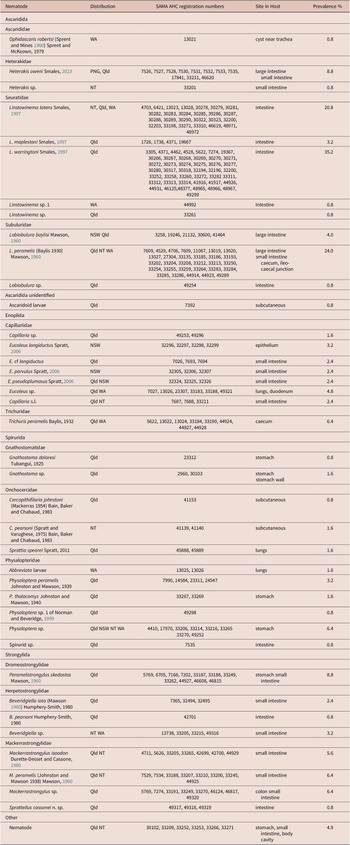
Collection localities and numbers of 125 individuals of I. macrourus collected from Australia and Papua New Guinea up to 2018. Queensland north = from Townsville northwards; Queensland central = North of Noosa to south of Townsville; Queensland south = Noosa to the New South Wales border

All data generated or analysed during this study are included in this published article.
Results
The nematode fauna of an estimated 125 northern brown bandicoots was examined and representatives of 12 families, comprising 16 genera containing 23 fully identified species, were recovered (see Table 2). Of these the nematode fauna included Heterakis oweni described from a single host from Papua New Guinea (PNG) and 11 hosts from Queensland. The genera Beveridgiella, Cercopithifilaria, Heterakis, Labiobulura, Linstowinema, Mackerrastrongylus and Physaloptera as well as Capillaria s. l., with five identified species, were recovered from 12 hosts from the Northern Territory and seven genera, Beveridgiella, Eucoleus, Labiobulura, Linstowinema, Ophidascaris, Physaloptera and Trichuris, with four identified species from 11 hosts from Western Australia (see Table 2). In addition, nematodes that could not be identified beyond family or genus because either the material was poorly fixed, or there were insufficient specimens or only females were found are also listed (see Table 2).
Nematode community of 125 individuals of I. macrourus collected from New South Wales (NSW), Northern Territory (NT), Queensland (Qld), Western Australia (WA), Australia and Papua New Guinea (PNG)

The nematode assemblage of I. macrourus was dominated by the Seuratidae, Linstowinema warringtoni, prevalence 35.2 %, L. latens 20.8 % and the Subuluridae Labiobulura peramelis 24.0 %. The heterakid Heterakis oweni (8.8%) and the dromeostrongylid Peramelistrongylus skedastos (8.8%) were the only other species to reach a prevalence greater than 8%. Of the Mackerrastrongylidae, the genus Mackerrastrongylus, including M. isoodon, M. peramelis and Mackerrastrongylus sp., had a combined total prevalence of 18.4%.
A female Physaloptera sp. comparable to P. peramelis listed as AHC 33290, from an animal identified only as a bandicoot, collected from the Emu Park Road, Queensland, was also examined. From the locality of the collection this host could have been either I. macrourus or P. nasuta. Physaloptera peramelis has been reported from each of these hosts, so the finding is not included in any analysis.
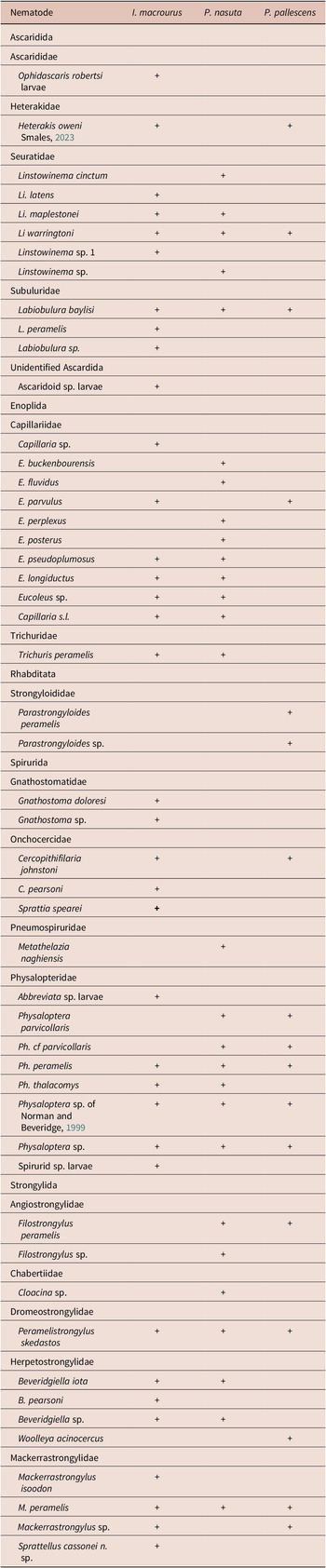
Comparisons between the nematode community of I. macrourus with that of P. nasuta and P. pallescens which are sympatric with I. macrourus in Queensland and northern New South Wales are given in Table 3. The community of I. macrourus, 23 species, was more speciose than those of P. nasuta (20 species) and P. pallescens (12 species). Each host’s nematode community, however, had a different species profile comprising species shared between the two or three hosts as well as unique species (see Table 3). Sorensen’s index of similarity was 0.558 for I. macrourus and P. nasuta and 0.514 for I. macrourus and P. pallescens (index = 0 for communities with no species in common and 1 for identical communities), indicating no more than 51 and 56 % commonality of species between I. macrourus and each of the Perameles spp. Perameles nasuta had the most speciose enoplid fauna while I. macrourus had the most speciose ascaridid and spirurid faunas. The genera Abbreviata, Parastrongyloides, Metathelazia, Sprattia, Sprattellus and Woolleya occurred in only one of the host species. These differences between each of the nematode assemblages, although indicative, may have been due to the smaller number of hosts surveyed for P. nasuta (54) and P. pallescens (19) compared with I. macrourus (125). The Cloacina sp., recovered by Smales et al. (Reference Smales, Wood and Chisholm2023) only from P. nasuta, would have been an accidental infection because the genus is usually found in macropodid marsupials. The new species of Sprattellus and a Linstowinema sp. are described below.
Comparison of the nematode communities present (+) in the Australian bandicoots I. macrourus, P. nasuta and P. pallescens; data from Smales Reference Smales2023, Smales et al. Reference Smales, Wood and Chisholm2023 and this study

Remarks
The number of I. macrourus sampled in this study, based on the SAMA database information, is a conservative estimate due to some of the AHC records lacking the complete collection details required for accuracy. Moreover, the recovery of nematode species at sites other than the gastrointestinal tract is problematic. The dissection techniques used to recover helminths from these sites are difficult, time consuming and only successful in freshly killed animals. Consequently, they are not used for routine necropsies. Two studies reported by Spratt (Reference Spratt1980, Reference Spratt2006), which included the examination of bandicoot species, were designed to facilitate the recovery of parasites from all the tissues and organs of animals from the anterior tip of the nose to the anal/cloacal apertures. Hence, the reporting of the pneumospirurid Metathelazia naghiensis from the lungs of P. nasuta and capillariids from species of Perameles and Isoodon are almost exclusively from Spratt’s studies (Spratt 1980, 2006). Therefore, the prevalence of infection of the nematodes of I. macrourus (see Table 2) is an estimate which is biased towards nematodes inhabiting the gastrointestinal tract and comparisons of the nematode assemblages of the bandicoots is limited by the number of individuals of each host species which were examined.
Although the AHC holds a substantial collection of bandicoot parasites, material has also been deposited elsewhere (Spratt and Beveridge Reference Spratt and Beveridge2016). Eight species: Parastrongyloides australis Mackerras, 1960; Strongyloides thylacis Mackerras, 1959; Asymmetracantha tasmaniensis Mawson, Reference Mawson1960; Mackerrastrongylus mawsonae Inglis, Reference Inglis1968; Filostrongylus peramelis Mackerras, 1955; Marsupostrongylus bronchialis Mackerras and Sandars, 1953 and two species of Breinlia (Breinlia), that were listed by Spratt and Beveridge (Reference Spratt and Beveridge2016) as being from I. macrourus were not found in the AHC. Of those eight species, only F. peramelis was listed in the AHC database, being recorded from both P. nasuta and P. pallescens.
Taxonomic summary
Mackerrastrongylidae (Inglis, Reference Inglis1968 subfamily) Durette-Desset and Chabaud, 1981
Sprattellus Durette-Desset and Cassone, Reference Durette-Desset and Cassone1980
Sprattellus cassonei n. sp. ex Isoodon macrourus
Type host: Isoodon macrourus (Gould) (Marsupialia: Peramelidae).
Type locality: Jolly’s Lookout, Mount Nebo Road, Queensland (27° 26’ S 152° 47’E).
Site in host: Intestine.
Type specimens deposited: Holotype male, AHC 49317; allotype female, AHC 49318; paratypes 6 males, 12 females, 8 pieces of worm, AHC 49319.
Material examined. From Isoodon macrourus: types 6 males, 12 females, 8 pieces of worms. Jolly’s Lookout, Mount Nebo Road, Queensland.
Prevalence and intensity. 0.8%, 1 of 125 animals examined. Intensity of infection 26.
Zoobank Registration number urn:lsid:zoobank.org:act:7E1F8BAD-E565-4201-9959-E3E3E8C4A186 TBA
Etymology: This species is named after J. Cassone in recognition of his work in describing the genus.
Description
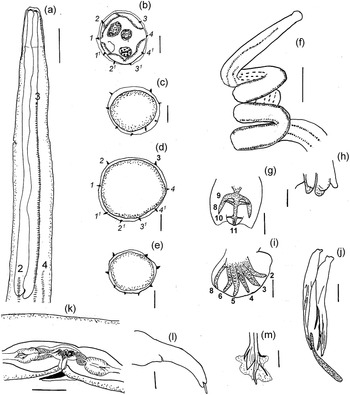
General (Figure 2). Small nematodes, some females coiled anteriorly. Cephalic vesicle not prominent, symmetrical, with about 18 annuli. Mouth opening triangular; buccal capsule vestigial; sub median and labial papillae and lateral amphids not seen. Oesophagus slender, slightly claviform, nerve ring and deirids not seen, excretory pore in mid region of oesophagus.
Sprattellus cassonei n. sp. (a) female anterior end, left lateral view, (b) female post oesophageal region anterior end, transverse section, (c) female posterior region mid body, transverse section (d) male mid body, transverse section, (e) male posterior end, transverse section, (f) female anterior end coiled, showing interrupted ventral ridges of synlophe, (g) male dorsal ray of bursa, (h) male genital cone, lateral view, (i) male bursa, lateral view, bursal rays numbered, (j) male spicules and gubernaculum, lateral view, (k) female ovejector, lateral view, (l) female tail, lateral view, (m) male spicule tips, ventral view, right spicule tip with three branches. In all illustrations of the synlophe in transverse section the dorsal aspect is oriented to the top of the page and the left side of the nematode to the left of the page. Scale bars: (a) 50 μm; (b–e) 25 μm; (f) 100 μm; (g–j) 25 μm; (k) 100 μm; (l, m) 25 μm.

Synlophe. Comprising 7–8 small ridges in mid body of male and female, two left dorsal, two right dorsal, four ventral ridges without size gradient; ridges absent dorsally. Axis of orientation from right ventral to left dorsal field. Ridges 2’, 3’, 4’ discontinuous anteriorly; ridge 3’ arises posterior to cervical vesicle, ridges 2’ and 4’ arise at about level of excretory pore extending to level of proximal end of spicule male, ovejector female.
Male (measurements of six worms). Length 3.0–6.6 (4.0) mm; maximum width 66–87 (77); cephalic vesicle 53–63 (57) long; oesophagus 333–462 (399) long; excretory pore 182–205 (201) from anterior end. Bursa symmetrical, dorsal lobe reduced; bursal formula 2-1-2; rays 2, 3 reaching margin of bursa, deviated ventrally; rays 4 not reaching margin of bursa, rays 5, 6 reaching margin of bursa, deviated dorsally; rays 8 diverge at root of dorsal trunk, not reaching margin of bursa; rays 9 diverge from dorsal ray posterior to rays 8, not reaching margin of bursa; rays 10 diverge from dorsal ray at about two thirds its length, at same level as rays 11; rays 11 parallel, rays 10, 11 reaching margin of bursa. Genital cone not prominent, not sclerotised; ventral lip conical. Spicules equal, short, 106–172 (138) long, spicule tips complex, branched. Gubernaculum slender, undulating, 80–100 (90) long.
Female (measurements of six worms). Length 5.3–6.2 (5.5) mm; maximum width 67–102 (87); cephalic vesicle 50–66 (48) long; excretory pore 218–248 (238) from anterior end; oesophagus 310–469 (374) long. Tail short, conical 99–132 (114) long, tip bilobed with terminal spike 8.5–14 (12) long. Vulva 643–800 (711) from posterior end, vulval flap with cuticular support 60, 60 long; ovejector didelphic, infundibulum longest element, vagina very short, 20–30 (22.5), vestibule 40–50 (42.5), anterior sphincter 60–110 (77.5), posterior sphincter 70–75 (73), anterior infundibulum 80, 100 (n=2), posterior infundibulum 100 (n=1). Eggs, 4–6 in anterior uterus, 7–9 in posterior uterus, thin shelled, ellipsoidal 50–59 (54.9) long, 33–46 (36) wide.
Remarks
The species described here belongs to the Mackerrastrongylidae, Mackerrastrongylinae Inglis, Reference Inglis1968 because it possesses a buccal capsule reduced to an annulus, a synlophe with ridges oriented perpendicular to the body, a bursa of type 2-1-2 and a didelphic ovejector (Beveridge, Spratt and Durette-Desset Reference Beveridge, Spratt, Durette-Desset, Helmcke, Starck, Wermuth and Schmidt-Rhaes2014). The specimens can be placed in the genus Sprattellus because they lack lips and teeth, have a small buccal annulus, a cervical vesicle, the dorsal ray with extra divisions, spicules divided into 2–3 branches, a small number of eggs and a spike on the end of the female tail (Durette-Desset and Cassone Reference Durette-Desset and Cassone1980). In the descriptions of Sprattellus spp., Durett-Desset and Cassone (Reference Durette-Desset and Cassone1980) stated that each spicule had three branches. In their figures, either two or three branches were drawn depending on the orientation (Durette-Desset and Cassone, Reference Durette-Desset and Cassone1980, Figures 3IJ, 4GHI). The same may be the case for S. oweni where the spicule tips appeared to be dissimilar. Attempts to view the spicules from all sides were unsuccessful, but observation of the tips from a dorsal orientation suggests that both spicule tips have three branches.
Linstowinema sp. 1. Male (a) anterior end, lateral view, (b) body hooks, dorsal and lateral views, (c) posterior end, lateral view, (d) ventro-posterior scale-like spines, (e) tail, lateral view. Scale bars: (a) 200 μm; (b) 25 μm; (c) 200 μm; (d) 25 μm; (e) 200 μm.

Sprattellus cassonei n. sp. can be distinguished from its three congeners S. harrigani Durette-Desset and Cassone, Reference Durette-Desset and Cassone1980; S. woolleyae Durette-Desset and Cassone, Reference Durette-Desset and Cassone1980 and the type species S. waringi (Inglis Reference Inglis1968) based on the features of the synlophe. Sprattellus cassonei has a synlophe of eight ridges, four ridges placed dorsolaterally, ridges 1, 2 left dorsal, 3, 4 right dorsal and four ridges ventrally, ventral ridges 2’–4’ being interrupted anteriorly. In the three known species, the synlophe ridges are exclusively ventral (Durette-Desset and Cassone Reference Durette-Desset and Cassone1980). The synlophe of S. harrigani comprises nine ridges, placed ventrally or ventro laterally, the ventral ridges being larger, and that of S. woolleyae comprises seven ridges also restricted to the ventro lateral and ventral quadrants, the left ventral ridges being the largest (Durette-Desset and Cassone Reference Durette-Desset and Cassone1980). The synlophe of S. waringi has only six ridges, four right ventro lateral and two left ventro lateral. The morphology of the dorsal rays 9, 10 and 11 as well as the branching of the spicules is unique in each of the four species (Inglis Reference Inglis1968 Figures 27, 33–35; Durette-Desset and Cassone Reference Durette-Desset and Cassone1980 Figure 3 H–J, Figure 4 F–I). The proportions of the ovejector differ in each of the four species, and only S. cassonei has a vulval flap.
Sprattellus cassonei is found in a peramelid host from Queensland, S. harrigani and S. woolleyae in dasyurids from Victoria and S. waringi in a dasyurid from Western Australia (Inglis Reference Inglis1968; Durette-Desset and Cassone Reference Durette-Desset and Cassone1980).
Taxonomic summary
Mackerrastrongylidae (Inglis, Reference Inglis1968 subfamily) Durette-Desset and Chabaud, 1981
Mackerrastrongylus Mawson, Reference Mawson1960
Mackerrastrongylus spp. ex Isoodon macrourus
Locality: Northern Territory, Queensland.
Material examined: Mackerrastrongylus isoodon syntypes AHC 42699, 42770, Qld; vouchers AHC 4711, 33205, 36 females, 14 males NT; AHC 5626, 33265, 44929, 15 females, 9 males Qld. M. peramelis AHC 33207, 33210, 22 males, 29 females, NT; AHC 7529, 7534, 33138, 33200, 33245, 44925, 21 males, 18 females, Qld. Mackerrastrongylus sp. AHC 7274, 5769, 33191, 33249, 33270, 46124, 46817, 49320, 18 females, Qld.
Remarks
Two species of Mackerrastrongylus have been described from I. macrourus; M. isoodon Durette-Desset and Cassone, Reference Durette-Desset and Cassone1980 and M. perameles (Johnston and Mawson 1938) and then M. peramelis reported from P. nasuta (see Mawson Reference Mawson1960). The differentiation between the two species is based on both morphological differences (including the three branched structure of the spicule tips, the proportions of the branchlets of the dorsal trunk and the shape of the gubernaculum) and the following morphometric differences; M. isoodon has 10 synlophe ridges at the midbody, female tail spike 13 long, 60 eggs in utero, eggs 60 long and spicules 165 long compared with M. peramelis which has 9 synolphe ridges, female tail spike 18 long, 70–80 eggs in utero, eggs 70 long and spicules 240 long (Durette-Desset and Cassone Reference Durette-Desset and Cassone1980). These authors gave only a single measurement for each of the morphometrics in their descriptions of the species. The material in the AHC included specimens labelled M. isoodon, M. peramelis and Mackerrastrongylus sp. (see Table 2). On examination, it proved to be difficult to either confirm the identifications or allocate all of these worms to species. The fine detail of the morphological characters differentiating the two species could not always be seen on microscopical examination. For example, the dorsal ray branchlets, ray 9 of the male bursa is relatively stout in P. isoodon and tiny in P. peramelis (Durette-Desset and Cassone Reference Durette-Desset and Cassone1980; Beveridge et al. Reference Beveridge, Spratt, Durette-Desset, Helmcke, Starck, Wermuth and Schmidt-Rhaes2014). In order to determine the size and placement of the branches of the dorsal trunk, however, the dorsal aspect of the bursa must be examined microscopically, and it is not always possible to roll a specimen into the correct orientation. Similarly, specimens need to be manipulated into the correct orientation before the very fine detail of spicule tip structure can be resolved. Coiled or inadequately fixed males will either not roll or be damaged when the procedure is attempted. Moreover, key identification morphometrics were not always decisive. For example, the spicule measurements of 15 specimens labelled M. isoodon, taken for this study, had a range of 115–241 and mean of 162, compared to the single measurement, 165, recorded in Durette-Desset and Cassone (Reference Durette-Desset and Cassone1980). Similarly, the spicule measurements of 22 specimens labelled M. peramelis, taken for this study, had a range of 165–264 and mean of 218 compared to the single measurement, 240, recorded in Durette-Desset and Cassone (Reference Durette-Desset and Cassone1980). As a result, the assignment of individual males to a species could not always be made with confidence. Similarly, neither measurements of the female tail spike, 10, 11, this study compared to 13 recorded in Durette-Desset and Cassone (Reference Durette-Desset and Cassone1980) for M. isoodon and 13, this study, compared to 18 in Durette-Desset and Cassone (Reference Durette-Desset and Cassone1980) for M. peramelis nor counting large numbers of eggs in utero, 60 eggs in each uterine branch for M. isoodon and 70–80 for M. perameles (Durette-Desset and Cassone Reference Durette-Desset and Cassone1980) were helpful in assigning species identification for females. Therefore, the identification to species of the material that was not examined by Durette-Desset and Cassone (Reference Durette-Desset and Cassone1980) could not be confirmed.
Taxonomic summary
Seuratidae Railliet, 1916
Linstowinema Smales, Reference Smales1997
Linstowinema sp. 1 ex Isoodon macrourus
Locality: Kimberly Division, Western Australia.
Material examined: 1 male SAMA AHC 44992.
Description
General (Figure 3). Robust medium-sized worm 15 mm long 204 wide. Cephalic bulb 420 long, 350 wide, with three circles of 14 rows of hooks; hooks circle 1, 115; 2, 162; 3, 99 long. Neck with about five circles of tiny spines; cuticular dilation of oesophageal region bearing seven circles of 14 rows of body hooks, first and seventh circles small, hooks circles 3, 4, 5 largest. Roots of hooks without undulating edges; remainder of body with small spines at each annulation extending over 10.5 mm, 70.0%, of body surface. Posterior 3.0 mm of ventral surface with robust, scale-like spines terminating about 300 anterior to cloaca. Oesophagus simple, club shaped, terminating at about level of seventh circle of body hooks, at posterior end of cuticular dilation, 1360 long. Nerve ring not seen, deirids at level of first circle of body hooks, 596 from anterior end, excretory pore not seen. Spicules equal, similar, 1650 long, 9.1% body length. Gubernaculum not seen. Full complement of caudal papillae not seen; two pairs lateral precloacal and at least three pairs papillae, one pair phasmids well posterior, near tail tip. Cloacal region with small cuticular bosses, ala-like expansions absent. Tail 375 long.
Remarks
The posterior end of the male was coiled too tightly to allow examination of the ventral surface of the caudal region to determine the number and placement of all the caudal papillae without damaging the specimen. Without that information, the species cannot be completely characterised. Enough information was gathered, however, to determine that the male represented a new species. Following the key of Smales (Reference Smales1997) Linstowinema sp. 1 falls closest to L. peramelis. Linstowinema sp. 1 differs in being a larger worm (15 mm compared with 9 mm) with a larger cephalic bulb (420 compared with 235, 325 long), longer oesophagus (1360 compared with 790, 795), longer spicules (1650 compared with 950, 1050) and longer tail (375 compared with 210, 240). Further, Linstowinema sp. 1 has fewer circles of body hooks (7 compared with 11–12) and robust scale-like posterior ventral body spines which L. peramelis does not. Linstowinema sp. 1 occurs in I. macrourus from Western Australia while L. peramelis occurs in Peramelis bougainville Quoy and Gaimard from South Australia (Smales Reference Smales1997). Linstowinema sp. 1 can be distinguished from L. latens which is also found in I. macrourus from Western Australia by having seven rows of body hooks with the oesophagus terminating at about the level of the seventh circle of body hooks not 8–10 rows of body hooks, with the oesophagus terminating posteriorly to the most posterior circle of body hooks. Linstowinema sp. 1 has longer spicules (1650 compared with 830–1100), and a longer tail (375 compared with 230 –240) than L. latens. Nor does L. latens have the robust scale-like posterior ventral body spines described for Linstowinema sp. 1 (see Smales Reference Smales1997).
Discussion
Isoodon macrourus is a resilient generalist, capable of surviving in disturbed urban landscapes, although abundance and distribution have been affected by increasing urbanisation, predation and competition for resources (Gordon Reference Gordon, Van Dyck and Strahan2008; Fitzgibbon et al. Reference Fitzgibbon, Wilson and Goldizen2011). This resilience is reflected in the fact that the northern brown bandicoot is listed as being common and abundant with an IUCN conservation status of least concern (Lunney et al. Reference Lunney, Dickman and Woinarski2016). For that reason, it is unlikely that the species richness of the helminth assembly of I. macrourus has declined since European settlement. Along the east coast of Australia, in New South Wales and Queensland, where I. macrourus has successfully inhabited fragmented urban landscapes (Gordon Reference Gordon, Van Dyck and Strahan2008), at least 101 host individuals have been listed in the AHC. In the less accessible wet-dry tropics of the Northern Territory, only 12 host animals were listed and from the Kimberly District of Western Australia only 11. The differences between the more speciose helminth community of the east coast (24 species) and the relatively depauperate helminth communities of the two northern tropical populations (five species in each) is likely due to lack of sampling effort. Cercopithifilaria pearsoni from the Northern Territory, the only species unique to that region and a single new species, Linstowinema sp. 1, recovered from the Kimberly Western Australia population of bandicoots, support the idea that geographic isolation may have driven allopatric speciation.
The nematodes collected from the PNG locality were not Heterakis balamukensis Smales, Reference Smales2023 described from the Papua New Guinea bandicoot Echymipera kabulu Lesson but an Australian species, H. oweni Smales, Reference Smales2023, described from Queensland bandicoots, indicating a past link between Australian and Papua New Guinea bandicoot populations (Smales Reference Smales2023; Smales et al. Reference Smales, Wood and Chisholm2023).
Comparison of the species composition of the nematode communities of I. macrourus, P. nasuta and P. pallescens (see Table 3) revealed that of the 33 species of nematode identified in this study only seven were found in all three hosts. These data together with Sorenson’s indices of similarity of 0.558 and 0.514 (comparisons between I. macrourus, and P. pallescens and I. macrourus, and P. nasuta) showed that only about half of the species were shared, thereby demonstrating differences in the species composition of the nematode assemblage in each of the three hosts. When genera are considered, however, a total of 16 genera were recorded from the genera Isoodon and Perameles, and of these, six occurred in both host genera and four only in Isoodon. Within each nematode genus, however, there were differences in included species. For example, of the five species of Linstowinema, one was found in all three hosts, one in two hosts and three in one host species.
The overall similarities of the helminth assemblages are consistent with the shared relationships and general behaviour of the three host species. The differences in species composition of their helminth assemblages may reflect their differences in habitat choices, feeding behaviour patterns and food choices. Habitat choices and feeding behaviour patterns may determine which species of the Rhabdita and Strongylida, all having direct life cycles, infect which bandicoot host species. The Trichuridae and some of the Capillariidae (Enoplida) also have direct life cycles; other capillariids, such as some Eucoleus spp., use earthworms as intermediate hosts (Anderson Reference Anderson2000) and accordingly could infect those bandicoots that include earthworms in their diet. The food choices of I. macrourus, including insects and earthworms, will also likely be a factor in determining infection with species of the Ascaridida and the Spirurida, taxa that have indirect life cycles (Anderson Reference Anderson2000). The families of the Ascaridida recorded from bandicoots usually use insects as intermediate hosts or involve earthworms (Anderson Reference Anderson2000). The most dominant species in the assemblage of I. macrourus, Linstowinema and Labiobulura spp. are Ascaridida, and this is as could be expected because infected insects, the intermediate hosts, are common dietary items of I. macrourus. The differences in food choices between bandicoot species may also influence the species composition of their helminth assemblages. However, not enough detail is known about bandicoot diets and their helminth parasite life cycles to predict presence or absence of a particular species. For example, earthworms are listed as being eaten by I. macrourus but not P. nasuta (see Van Dyck and Strahan Reference Van Dyck and Strahan2008). Second stage larvae of Ophidascaris robertsi are found in earthworms (Anderson Reference Anderson2000), third stage larvae in both I. macrourus and P. nasuta (present study; Spratt and Beveridge Reference Spratt and Beveridge2016) and adults in the carpet python Morelia spilota Lacépède (see Sprent and Mines Reference Sprent and Mines1960). Therefore, predicting the presence or absence of an infection, such as O. robertsi, based only on general information about life cycle hosts and host feeding choices may lead to error.
Likely, the records from this study together with those of Spratt and Beveridge (Reference Spratt and Beveridge2016) make up a comprehensive listing of the helminth assemblages of the east coast bandicoots, I. macrourus and P. nasuta. More sampling north of Townsville and the less accessible localities of northern western Australia and the Northern Territory is needed before the helminth assemblages of all three bandicoot populations can be documented.
Acknowledgements
Thanks are due to the staff of the South Australian Museum for providing access to specimens.
Financial support
None.
Competing interest
The authors declare none.
Ethical standard
The specimens examined were taken from museum collections.