



A patient, debilitated by the bulbous, blood-bloated ghosts swarming through her body, sits in an unlit igloo.Footnote 1 She is joined by an angakok – a magician and medicine man – who crouches in the corner, his body draped in a caribou skin.
The angakok is unlike himself: One of his helper spirits has possessed him, and it speaks in a rapid, strange language through his mouth. The illness-causing ghosts respond with fright, abandoning the sick person's body before hiding outside of the igloo. The angakok sends his spirit helpers in pursuit, while members of the onlooking audience coax the evil ghosts back with half-lies: “Come in, come in,” they say, “somebody here is waiting for you.”
The evil ghosts return and are slaughtered. The angakok attacks them with his snow knife, slaying as many as he can. When he's finished, blood covers his hands, unadorned proof of the killing.
In the days afterward, the patient slowly recovers.
Or, in the days afterward, the patient dies. The shaman expresses a fatalistic regret: In the end, the ghosts were too numerous. One man can kill only so many ghosts when a person has broken so many taboos.
1. Introduction
The Inuit angakok, like the Mentawai sikerei (Loeb Reference Loeb1929), the Korean mu (Kendall Reference Kendall1985), the Azande boro ngua (Evans-Pritchard Reference Evans-Pritchard1937), the !Kung n/um k”ausi (Katz Reference Katz1982), and the Quaker founder George Fox (Thomas Reference Thomas1971a), is a shaman. I here define shamans as practitioners who enter trance to provide services. Because my objective is to identify the social and cognitive foundations of a more general, cross-cultural suite of practices and beliefs, I follow authors who prefer a broad definition of shamanism (e.g., Peters & Price-Williams Reference Peters and Price-Williams1980; Samuel Reference Samuel1990; Wallace Reference Wallace1966; Wright Reference Wright2009). This usage contrasts with more specific definitions, such as reserving shamanism for the practices of Siberian peoples (see discussion in Price Reference Price and Price2001) or using restrictive criteria such as death-and-rebirth initiations, soul journey trances, and animal helper spirits (Winkelman Reference Winkelman1990). Although many of these traits appeared in societies outside of Siberia and Central Asia (Eliade Reference Eliade1964), they lack generality and exclude the trance-healing practices of many societies, including ones commonly referred to as shamanic (e.g., Kendall Reference Kendall1985; Loeb Reference Loeb1929; Nadel Reference Nadel1946). The ensuing discussion therefore includes not only the trancing witch doctors of hunter-gatherer societies, but also the ecstatic prophets of religious movements, the mediums of chiefdoms, and the marginal cultists of contemporary states.
Cross-cultural analyses of shamanism aim to recognize the particular cultural traits that are universally associated with this institution. This research has converged on a set of practices and beliefs that nearly always characterizes shamanic traditions (Charles Reference Charles1953; Eliade Reference Eliade1964; Harner Reference Harner1990; Peters & Price-Williams Reference Peters and Price-Williams1980; Vitebsky Reference Vitebsky1995a; Winkelman Reference Winkelman1986a; Reference Winkelman1986b; Reference Winkelman1990):
1. The practitioner enjoys jurisdiction over the treatment and diagnosis of a select set of problems, most frequently serving as a healer and diviner.
2. The practitioner is believed to have special powers that normal individuals either possess to a less developed degree or lack completely. These always include some means of seeing or interacting with invisible forces. But they also can include flight, invisibility, immunity to fire, and control of weather and animals.
3. The practitioner engages in a temporary trance state for at least some of his or her interventions. Definitions of trance vary considerably in the anthropological literature, from those that claim universal neurological states (Harner Reference Harner1990; Winkelman Reference Winkelman2000) to those that emphasize social conceptions of special powers (Rouget Reference Rouget1985). Nevertheless, most usages concur that trance represents a temporary state that appears psychologically and behaviorally distinct from normal human functioning. The behavioral manifestations of trance differ within and across populations but include “trembling, shuddering, horripilation, swooning, falling to the ground, yawning, lethargy, convulsions, foaming at the mouth, protruding eyes, large extrusions of the tongue, paralysis of a limb, [etc.]” (Rouget Reference Rouget1985, p. 13). The cultural interpretation of this trance state is also variable and can include spirit possession (reviewed in Lewis Reference Lewis2003) and soul journeying (reviewed in Eliade Reference Eliade1964), as well as special sight (e.g., Azande: Evans-Pritchard Reference Evans-Pritchard1937), boiling healing energy (e.g., !Kung: Katz Reference Katz1982), or several of these changes simultaneously (e.g., Akawaio: Wavell et al. Reference Wavell, Butt and Epton1988).
4. Entrance into the practitioner class is restricted, typically by ritualistic initiations (e.g., death and rebirth, ritual surgery, magical treatment of body parts) or dramatic experiences (e.g., violent illness, epileptic fits, asceticism). Communities often regard individuals with some innate peculiarity, such as perennial illness (Lebra Reference Lebra1966; Schefold Reference Schefold1988), an extra finger (Bernstein Reference Bernstein2008), epilepsy (Nadel Reference Nadel1946), or ambiguous sexual identity (Coleman et al. Reference Coleman, Colgan and Gooren1992; Peletz Reference Peletz2006), as more capable of becoming shamans.
A final important characteristic is that shamans represent a profession, often the only such group in many small-scale societies (La Barre Reference La Barre1970; Rogers Reference Rogers1982). By profession, I mean a class of individuals with entry requirements whose unique expertise or abilities provide them jurisdiction over the treatment or diagnosis of some problems. For shamans, entry requirements can include prolonged training from other shamans, special initiations, or spontaneous events, such as serious illness (Eliade Reference Eliade1964). This usage of profession is based on definitions in the sociological literature, such as those by Abbott (Reference Abbott1988, p. 8) and MacDonald (Reference Macdonald1995, p. 1), who respectively described professions as “exclusive occupational groups applying somewhat abstract knowledge to particular cases” and “occupations based on advanced, or complex, or esoteric, or arcane knowledge.”
Shamanism has existed in most documented human societies, including the majority of hunter-gatherers. Eliade (Reference Eliade1964) famously reviewed ethnographic descriptions of shamans around the world, documenting similarities in practice and mythology between Siberian shamanism, on the one hand, and practitioners in Asia, the Americas, and Oceania, on the other. Winkelman (Reference Winkelman1986a; Reference Winkelman1986b; Reference Winkelman1990) coded a modified subsample of the Standard Cross-Cultural Sample and found trance practitioners in 43 of 47 societies surveyed. A recent review of hunter-gatherer religion found shamans in 29 of 33 hunter-gatherer societies examined (Peoples et al. Reference Peoples, Duda and Marlowe2016)Footnote 2; of the remaining 4 societies, the recent ancestors of one (the Siriono) likely had shamans (Walker et al. Reference Walker, Wichmann, Mailund and Atkisson2012; see also sect. 6.2), whereas an ethnographer noted that members of another (the Mbuti) visited “the local witch doctor” of nearby farmers (Putnam Reference Putnam and Coon1948, p. 340). Importantly, shamanism is not restricted to small-scale societies; see, for example, the benandati cult of medieval Italy (Eliade Reference Eliade1975); Romanian folkloric traditions (Eliade Reference Eliade1975); Neolithic China (Chang Reference Chang, Loewe and Shaughnessy1999); Tibetan Buddhism (Samuel Reference Samuel1993); contemporary Korea (Kendall Reference Kendall1985); founders of religious sects in 20th-century Japan (Blacker Reference Blacker1975); trance channeling in the contemporary United States (Hughes Reference Hughes1991); Hebrew prophets (Newsom Reference Newsom1984); early religious leaders of the Camisards (Knox Reference Knox1950), Quakers (Thomas Reference Thomas1971a), and American spiritualists (Albanese Reference Albanese1992); and neo-shamans in Sweden (Lindquist Reference Lindquist1997) and the United States (Braun Reference Braun2010).
That shamanism appears so regularly in human societies, especially among hunter-gatherers, suggests that it characterized the lives of many ancestral humans as well. Inferring the existence of shamanistic practice from archaeological findings is notoriously tenuous (Dubois Reference Dubois2009), but researchers nevertheless have argued prehistoric shamanism from burial sites (Grosman et al. Reference Grosman, Munro and Belfer-Cohen2008) and art (Dowson & Porr Reference Dowson, Porr and Price2001; Lewis-Williams & Dawson Reference Lewis-Williams and Dawson1988).
The recurrence and similarity of shamanic traditions highlight several puzzles: (1) Why do these particular beliefs and practices so frequently develop in concert? (2) Why do shamans constitute the only professional class in many societies? (3) Which conditions determine the existence or collapse of shamanism? These questions have remained largely absent from the evolutionary and psychological literatures, despite considerable progress in the study of religion (for exceptions, see Rossano Reference Rossano2007; Winkelman Reference Winkelman2002; Wright Reference Wright2009). Meanwhile, the puzzle of shamanism has attracted the attention of major anthropological theorists since the discipline's inception (e.g., Evans-Pritchard Reference Evans-Pritchard1937; Frazer Reference Frazer1922; Lévi-Strauss Reference Lévi-Strauss1963a; Reference Lévi-Strauss1963b; Malinowski Reference Malinowski1948; Mauss Reference Mauss1902/2001; Tylor Reference Tylor1883), but as Narby and Francis (2001, p. 8) concluded in their collection of writings on the topic from the last half-millennium, “even after five hundred years of reports on shamanism, its core remains a mystery.”
This article presents a novel theory of shamanism based in universal cognitive dispositions and cultural evolutionary processes. The theory proposes that shamanism is a suite of practices developed through cultural evolution that adapts to people's intuitions to convince observers that a practitioner can influence otherwise uncontrollable events. The shaman does this by transforming in the eyes of the community, during both initiation and trance, assuring group members that he or she can interact with the invisible forces that control unpredictable, significant outcomes.
The article is structured as follows. I begin by reviewing alternate theories of shamanism in section 2. In section 3, I elaborate on the logic of the proposed theory, providing empirical and theoretical support from psychology and cultural evolution. I use section 4 to explain three central features of shamanic traditions: the jurisdiction, trance, and what I call transformative practices. Section 5 concerns why shamanism professionalizes in the absence of other specialization, and section 6 concludes with predictions for how shifting social conditions should mediate the transformative practices and, in some instances, contribute to shamanism's collapse.
2. Alternate theories of shamanism
The most salient features of shamanism to early Western observers were practitioners' use of sleight of hand and their ostensible psychological pathology (Krippner Reference Krippner2002; Narby & Huxley Reference Narby and Huxley2001). These led authors to frequently describe the practice as either a form of charlatanism (Diderot Reference Diderot, Narby and Huxley1765/2001; Gmelin Reference Gmelin, Narby and Huxley1751/2001) or psychopathology (Devereux Reference Devereux1961b; Novakovsky Reference Novakovsky1924; Silverman Reference Silverman1967). Although both perspectives explain some features of shamanism, ethnographic observations challenge their simplicity. That shamans seem to believe in their and others' powers undermines a basic charlatan hypothesis (Elkin Reference Elkin1977; Evans-Pritchard Reference Evans-Pritchard1937; Métraux Reference Métraux1944). Meanwhile, shamans in many societies do not suffer from an abnormal psychology, yet these traditions exhibit the same patterns in practice and mythology (e.g., Australia: Elkin Reference Elkin1977; Bhutan: van Ommeren et al. Reference van Ommeren, Komproe, Cardeña, Thapa, Prasain, de Jong and Sharma2004; Akawaio: Wavell et al. Reference Wavell, Butt and Epton1988). Furthermore, neither charlatanism nor psychosis can explain the jurisdiction of shamans or the use of trance for problem-solving. A comprehensive theory of shamanism should explain these inconsistencies.
Many authors have proposed that shamanism and related practices provide benefits to clients or the group (Achterberg Reference Achterberg1985; Sax Reference Sax2014), such as through ritually induced social cohesion (Frecska & Kulcsar Reference Frecska and Kulcsar1989), therapeutic effects mediated by placebo or hypnosis (Kaptchuk Reference Kaptchuk2002, Reference Kaptchuk2011; McClenon Reference McClenon1997), and the psychological comfort that comes from addressing uncertainty (Achterberg Reference Achterberg1985; for a more general discussion of magic, see Malinowski Reference Malinowski1948). As with charlatan or psychosis hypotheses, accounts emphasizing benefits do not explain many cross-cultural patterns, including the early professionalization of the practice or the reasons certain practices are considered effective. Moreover, aside from mixed results from psychology (Calin-Jageman & Caldwell Reference Calin-Jageman and Caldwell2014; Damisch et al. Reference Damisch, Stoberock and Mussweiler2010), studies and ethnographies finding support for ritual efficacy tend to rely on reported outcomes by clients or other community members (e.g., Kleinman & Sung Reference Kleinman and Sung1979; Raguram et al. Reference Raguram, Venkateswaran, Ramakrishna and Weiss2002; Sax Reference Sax2009). Thus, it appears that most evidence of ritual efficacy concerns the community perception of outcomes. This does not invalidate accounts emphasizing benefits, but it suggests that shamanism may be sustained because of a perception of results.
Many approaches examine how patterns in human social and cultural life, such as incest taboos (Fessler & Navarrete Reference Fessler and Navarrete2004; Lieberman et al. Reference Lieberman, Tooby and Cosmides2003) and folk biology (Atran Reference Atran1998), reflect universal proclivities resulting from evolved psychological mechanisms (Sperber Reference Sperber1985; Reference Sperber1996a; Sperber & Hirschfeld Reference Sperber and Hirschfeld2004). Winkelman's (Reference Winkelman2000; Reference Winkelman2002) neurotheological theory of shamanism adopts this approach. The theory attributes the recurrent emergence of shamanism to (1) psychological effects of universal trance states and (2) the benefits that the shaman provides. According to this theory, trance states elicited by dancing, hallucinogens, and other triggers have an “integrative” effect on cognition, allowing crosstalk among modules evolved for theory of mind, social intelligence, and natural history. This integration enhances practitioners' social abilities, allowing them to provide useful services to the group and individual clients. Invoking cultural traditions that leverage aspects of our core psychology to produce group-level benefits, the neurotheological theory resembles recent theorizing on the cultural evolution of prosocial religion (Atran & Henrich Reference Atran and Henrich2010; Norenzayan Reference Norenzayan2013; Norenzayan et al. Reference Norenzayan, Shariff, Gervais, Willard, McNamara, Slingerland and Henrich2016; Purzycki et al. Reference Purzycki, Apicella, Atkinson, Cohen, McNamara, Willard, Xygalatas, Norenzayan and Henrich2016).
The neurotheological theory, although ambitious, suffers from important shortcomings. Especially problematic is the central argument that shamanism involves a cross-culturally consistent trance state that integrates various aspects of cognition. First, it is unclear what an “integrated” mode of consciousness is, considering that normal human cognition involves communication and cooperation among functionally differentiated regions (Hagmann et al. Reference Hagmann, Cammoun, Gigandet, Meuli, Honey, Wedeen and Sporns2008; Sporns Reference Sporns2011). Second, research on altered states of consciousness suggests that different trance states involve nonanalogous changes in physiology and cognition (Farthing Reference Farthing1992; Vaitl et al. Reference Vaitl, Birbaumer, Gruzelier, Jamieson, Kotchoubey, Kübler, Lehmann, Miltner, Ott, Pütz, Sammer, Strauch, Strehl, Wackermann and Weiss2005). Altered states induced by sensory deprivation, for example, disengage the individual from her surroundings, broaden attention, promote cognitive flexibility, and stimulate sensory dynamics (richness, vividness, synesthesia, hallucinations) (Barabasz & Barabasz Reference Barabasz and Barabasz1993; Suedfeld Reference Suedfeld1980; Vaitl et al. Reference Vaitl, Birbaumer, Gruzelier, Jamieson, Kotchoubey, Kübler, Lehmann, Miltner, Ott, Pütz, Sammer, Strauch, Strehl, Wackermann and Weiss2005). By contrast, research conducted with pathologically starving patients suggests that extreme dieting produces the opposite effects (Ben-Tovim & Walker Reference Ben-Tovim and Walker1991; Grunwald et al. Reference Grunwald, Ettrich, Assmann, Dähne, Krause, Busse and Gertz2001; Roberts et al. Reference Roberts, Tchaturia, Stahl, Southgate and Treasure2007; Vaitl et al. Reference Vaitl, Birbaumer, Gruzelier, Jamieson, Kotchoubey, Kübler, Lehmann, Miltner, Ott, Pütz, Sammer, Strauch, Strehl, Wackermann and Weiss2005). The contrasting effects of different trance states challenge the neurotheological theory, because, not only do trance states vary considerably around the world, but also there even exists within-culture variation or variation among otherwise similar traditions. For example, the trance state of the Japanese miko, which involves “violent shaking of the clasped hands” and “stertorous breathing or roaring,” differs in all of its manifestations from that of the ascetic, who enters a “deep, comatose state of suspended animation,” his body remaining “an empty husk” (Blacker Reference Blacker1975, pp. 22–23). Relatedly, although their shamanic institutions share many features, the Warao's musically induced meditative trance contrasts starkly with the narcotic trance of the Yanomamö, which includes yelling, rolling on the ground, and a seeming loss of physical control (Olsen Reference Olsen1975; Reference Olsen, Olsen and Sheehy1998).
To sum up, explanations of shamanism have focused on features including charlatanism, the practitioner's ostensible psychopathology, and clients' belief in the effectiveness of interventions. No account, however, sufficiently explains the entire suite of features, including dramatic initiations, trance states, professionalization, and the jurisdiction of the shaman (healing and divination). Additionally, many accounts have been critiqued for failing to incorporate the role of social interactions and recent historical processes in shaping shamanism (Atkinson Reference Atkinson1992).
3. Proposing the cultural evolutionary theory of shamanism
I propose that shamanism is a suite of practices developed through cultural evolution to convince observers that an individual can influence otherwise uncontrollable outcomes. In particular, the shaman is an individual who violates intuitions of humanness to convince group members that he or she can interact with the invisible forces who control unpredictable, important events.
In this section, I present this theory in full, organizing it into several sections before synthesizing them and discussing how this theory generates hypotheses for the constituent features of shamanism. The sections consider (1) the psychology of superstition; (2) the cultural evolution of plausible-seeming interventions; (3a) the importance of interacting with invisible agents; and (3b) the practice of violating notions of humanness to support claims of superhuman abilities.
The theory as proposed in this section is rooted in two conceptual foundations. Research in the cognitive underpinnings of magic and religion has revealed how built-in, adaptive components of human psychology predispose us to adopt certain false beliefs and engage in magical thinking (Atran & Henrich Reference Atran and Henrich2010; Boyer Reference Boyer2001; Guthrie Reference Guthrie1995; Kirkpatrick Reference Kirkpatrick1999; Legare & Souza Reference Legare and Souza2012). The primary psychological mechanisms invoked in the proposed theory are those involved in (and presumably evolved for) adopting beliefs (error management: Johnson et al. Reference Johnson, Blumstein, Fowler and Haselton2013), mentalizing (Frith & Frith Reference Frith and Frith2003), developing causal explanations (Keil Reference Keil2006; Lombrozo Reference Lombrozo2006), and ascribing and inferring human characteristics (“humanness”) to and from other individuals (Haslam et al. Reference Haslam, Loughnan and Holland2013). Cultural evolutionary theory, on the other hand, describes how the differential transmission and adoption of cultural traits lead some beliefs, practices, and institutions to propagate at the expense of others, giving rise to adaptive culture like igloos and spears, as well as magical interventions and seemingly maladaptive practices (Boyd & Richerson Reference Boyd and Richerson1985; Claidière et al. Reference Claidière, Scott-Phillips and Sperber2014; Mesoudi Reference Mesoudi2016; Sperber Reference Sperber1996a; Sperber & Hirschfeld Reference Sperber and Hirschfeld2004).
Note that many aspects of the cultural evolutionary theory of shamanism have been previously articulated, including the shaman's role in dealing with uncertainty (Buyandelgeriyn Reference Buyandelgeriyn2007; Wright Reference Wright2009), the function of initiation practices in delineating shamans from the rest of the group (or in supernaturalizing them) (Eliade Reference Eliade1964), and the dramatic nature of trance (Rouget Reference Rouget1985; see references in Peters & Price-Williams Reference Peters and Price-Williams1980). However, no account has synthesized these observations into a coherent framework or illustrated how they develop from core psychological dispositions or cultural evolutionary processes. Thus, it remains unknown why humans seem to so reliably produce this particular constellation of practices and beliefs.
3.1. Individuals adopt superstitions to influence significant outcomes that are random and uncontrollable
Humans choose solutions to deal with problems, such as denying a pregnant woman smelly meat to protect her child or rubbing a rock to win a baseball game. The cognitive mechanisms for choosing among solutions must contend with the uncertainty of whether a strategy actually works. For example, denying a pregnant woman smelly meat may seem to guarantee a healthy child sometimes but not always; similarly, rubbing a rock may appear to ensure victory in a baseball game sometimes but not always. Individuals therefore rely on psychological heuristics to select among strategies and beliefs. Systematic errors by these heuristics lead individuals to adopt interventions that have no causal relationship to their intended outcome (Foster & Kokko Reference Foster and Kokko2009; Johnson et al. Reference Johnson, Blumstein, Fowler and Haselton2013; McKay & Dennett Reference McKay and Dennett2009; Vyse Reference Vyse2014); following previous authors, I refer to these causally innocuous actions as superstitions Footnote 3 (Foster & Kokko Reference Foster and Kokko2009; Ono Reference Ono1987; Skinner Reference Skinner1948; Vyse Reference Vyse2014). That similar behaviors can be induced in other species (e.g., Skinner Reference Skinner1948) suggests that these cognitive mechanisms have deep evolutionary histories.
Individuals are most likely to adopt superstitions when (1) the potential benefit of that intervention working is high, and (2) the intervention is followed by a successful outcome some proportion of the time (Beck & Forstmeier Reference Beck and Forstmeier2007; Foster & Kokko Reference Foster and Kokko2009; Johnson Reference Johnson2015; Ono Reference Ono1987; Vyse Reference Vyse2014). Thus, superstitions can be thought of as bet-hedging strategies: As long as the outcome sometimes occurs after the intervention (e.g., the baseball team wins sometimes after rubbing the rock), and the cost of the intervention is sufficiently low compared with the potential benefit, an individual will benefit on average from adopting those strategies (see error management: Johnson et al. Reference Johnson, Blumstein, Fowler and Haselton2013; McKay & Efferson Reference McKay and Efferson2010).Footnote 4 Consequently, contexts in which people are not fully able to control fitness-relevant outcomes and in which success occurs randomly are most amenable to superstitious thinking (Greenaway et al. Reference Greenaway, Louis and Hornsey2013; Keinan Reference Keinan1994; Legare & Souza Reference Legare and Souza2014; Whitson & Galinsky Reference Whitson and Galinsky2008). This accounts for, among other things, (1) the use of magic for catching wild game and inviting rain; (2) the profusion of magic in the wake of deadly epidemics (e.g., Ashforth Reference Ashforth2011); and (3) the prevalence of superstitions in Western societies, such as those surrounding gambling and sports (Burger & Lynn Reference Burger and Lynn2005; Henslin Reference Henslin1967). Moreover, within these domains, those activities with the most uncertainty and the largest benefit invite the most superstition. For example, Trobriand Islanders use magic for open-sea fishing, where “the yield varies greatly,” but not for inner lagoon fishing, which promises “abundant results without danger and uncertainty” (Malinowski Reference Malinowski1948, p. 30). Because it sustains beliefs in ineffective interventions, the psychology of superstition provides the basis for shamanic traditions.
Hereafter, I refer to those outcomes most susceptible to superstition (uncontrollable, fitness relevant, and random) as uncertain outcomes (see Fig. 1). Examples of uncertain outcomes include illness healing, crops failing, and famine ending. These differ from outcomes that are controllable (e.g., the production of fire), outcomes that are uncontrollable but unimportant (e.g., a butterfly landing on one's arm), and outcomes that are uncontrollable and important, yet never occur (e.g., winter never coming).
Kinds of outcomes. Individuals will develop superstitions to influence or learn about the timing of uncertain outcomes (uncontrollable, important, and random). The importance of the outcome to the individual's perceived welfare and the frequency with which it occurs after an event are both continuous variables, but they are presented in this diagram as binary for simplification.

3.2. People's adoption strategies drive the selective retention of effective-seeming interventions
Cultural evolution occurs as some cultural variants are adopted and transmitted more than others (Blackmore Reference Blackmore1999; Boyd & Richerson Reference Boyd and Richerson1985; Sperber Reference Sperber1996a).Footnote 5 The direction of cultural evolution, and whether its products are adaptive, thus are often consequences of individuals' adoption strategies (Henrich Reference Henrich2015; Richerson & Boyd Reference Richerson and Boyd2008). When outcomes are observable, immediate, and predictable, individuals easily can choose innovations based on their effectiveness (Rogers Reference Rogers2003). For example, an individual can gauge whether some tweak to a spear allows it to fly farther, deciding to retain the successful tweaks. As people repeat this adoption strategy over time, technology will become more effective at ensuring outcomes. In short, cultural evolution can produce efficient technologies, such as spears, when the outcomes of innovations are immediate, observable, and predictable.
In the case of superstitions, cultural evolution cannot produce efficient technologies because the practices are, by definition, ineffective. But some innovations will still seem more effective because of innate or cultural intuitions about causality. Consequently, individuals will retain and transmit those practices that seem most plausible, driving the cultural evolution of practices adapted to our intuitions about efficacy. For example, Legare and Souza (Reference Legare and Souza2012) showed that individuals regard magical procedures with more steps and specific times as more efficacious, likely biasing which magical practices spread. Similarly, innate intuitions about how substances spread through contact perpetuate beliefs in contagious magic (Nemeroff & Rozin Reference Nemeroff, Rozin, Rosengren, Johnson and Harris2000; Rozin et al. Reference Rozin, Millman and Nemeroff1986).
Note that the cultural evolution of plausible-seeming practices should be accelerated once shamans exist and compete for clients. Some shamans find techniques that better convince onlookers of their superior efficacy; these techniques are expected to be maintained over time as other shamans copy them (Boyd & Richerson Reference Boyd and Richerson1985; Henrich & Gil-White Reference Henrich and Gil-White2001; Schlag Reference Schlag1998, Reference Schlag1999) or as successful practitioners train more initiates. Many ethnographers have observed intense competition among shamans that should drive this cultural selection. Among the Azande, practitioners amassed prestige as effective doctors and were “envious of the encroachment” of rivals who threatened their wealth and reputation (Evans-Pritchard Reference Evans-Pritchard1937, p. 245). Ona shamans of Tierra del Fuego faced off in public: Practitioners attained states of magical trance, and observers judged them according to the intensity and duration of trance, among other characteristics (Chapman Reference Chapman1982). Similar competitive displays occurred among the Tlingit and the Netsilik (Balikci Reference Balikci1963; De Laguna Reference De Laguna1972). In postsocialist Mongolia, Buyandelgeriyn (Reference Buyandelgeriyn2007, p. 132) observed that “clients [chose] a shaman on the basis of a careful search with diviners, lamas, and clients about an individual's power, disposition, and the level of satisfaction with that individual's service.” In all of these instances, clients choose practitioners according to their credibility and perceived ability, selecting for practices that promote these metrics.
The autobiography of the Kwakwaka'wakw shaman Quesalid (see Boas Reference Boas1930; Lévi-Strauss Reference Lévi-Strauss1963a) provided a telling example of how competition among shamans could drive the cultural selection of plausible-seeming interventions. Quesalid described learning how to duplicitously produce a bloody tuft of down as a purported physical embodiment of illness. He then discovered, however, that the nearby Koskimo shamans lacked this method, and in performing it before them and their audiences, attracted much more credibility while disgracing his rivals. Although Quesalid did not describe the subsequent diffusion of the technique, he recounted how other shamans implored him to share his secrets; one presumably even used his virgin daughter to tempt Quesalid.
In summary, individuals' preferences for effective superstitions fuel the cultural evolution of plausible-seeming magical practices. Once shamans exist, the competition among them should accelerate this process.
3.3. Violating notions of humanness to apparently influence uncontrollable outcomes
In this section, I argue that the cultural selection for plausible superstitions leads to people claiming to engage with the invisible entities (e.g., deities, spirits) who control unpredictable events. To convince potential clients that they have these special powers, these practitioners must ostensibly transform into entities distinct from normal humans.
3.3.1. People explain unpredictable outcomes with invisible, agentic forces
Outcomes that seemingly occur randomly, such as winning the lottery, being struck by lightning, or recovering from illness, cannot be accounted for by predictive theories, because the causal forces escape human perception. To explain these events, individuals invoke causal, agentic forces, including God, fate, witchcraft, spirits, and moral justice (Baumard & Chevallier Reference Baumard and Chevallier2012; Gorsuch & Smith Reference Gorsuch and Smith1983; Gray & Wegner Reference Gray and Wegner2010; Harris & Giménez Reference Harris and Giménez2005; Legare et al. Reference Legare, Evans, Rosengren and Harris2012; Legare & Gelman Reference Legare and Gelman2008; Lerner Reference Lerner1980; Lupfer et al. Reference Lupfer, Tolliver and Jackson1996; Pepitone & Saffiotti Reference Pepitone and Saffiotti1997; Woolley et al. Reference Woolley, Cornelius and Lacy2011). These agents are usually invisible (e.g., gods, spirits), although sometimes visible actors intervene through invisible means (e.g., witches); nevertheless, I refer to them here as invisible forces or invisible agents. Researchers have found that the tendency to attribute rare events to invisible forces occurs across cultures and throughout development (Banerjee & Bloom Reference Banerjee and Bloom2015; Heywood & Bering Reference Heywood and Bering2014; Swanson Reference Swanson1964; Wright Reference Wright2009), although both age and cultural context mediate it (Norenzayan & Lee Reference Norenzayan and Lee2010; Woolley et al. Reference Woolley, Cornelius and Lacy2011). Moreover, ethnological studies have identified the pervasive human tendency to attribute illness and (mis)fortune to the whims of invisible agents (Murdock Reference Murdock1980; Swanson Reference Swanson1964).
There remains a lack of consensus among psychological researchers on why humans explain anomalous outcomes with invisible agents, but growing research suggests that sociocognitive biases and cultural transmission both play crucial roles (Banerjee & Bloom Reference Banerjee and Bloom2014b; Gorsuch & Smith Reference Gorsuch and Smith1983; Heywood & Bering Reference Heywood and Bering2014; Norenzayan & Lee Reference Norenzayan and Lee2010). Humans possess cognitive adaptations for attributing mental states (Frith & Frith Reference Frith and Frith2003), which seem to predispose individuals to recognize intention and purpose in the world (Guthrie Reference Guthrie1995). For example, Banerjee and Bloom (Reference Banerjee and Bloom2014a) found that individuals with a greater tendency to think about mental states (highly paranoid people and highly empathetic people) are more likely to infer purpose and intention in life events. This tendency then becomes reinforced with socialization and related cultural beliefs (Norenzayan & Lee Reference Norenzayan and Lee2010; Woolley et al. Reference Woolley, Cornelius and Lacy2011).
The relevance of unseen causality for shamanism is that, to be considered most effective as superstitious problem-solvers, practitioners should observe and manipulate the otherwise invisible causal forces. This would mean, for example, talking to spirits, identifying sorcery-caused illness, or being possessed by deities who can then converse with other community members. Doing any of these requires convincing others that the practitioner has abilities that normal humans lack or otherwise possess to a less developed degree.
3.3.2. People more readily attribute superhuman abilities to strange individuals
The psychological foundations of supernaturalness have been less thoroughly investigated than superstition or explanations for rare outcomes. However, research suggests that attributions of special powers derive, in part, from a perception that an actor violates basic notions of folk biology or psychology.Footnote 6 For example, Catholicism has long used the occurrence of unexplainable events (or “miracles”) to infer whether an individual has a relationship with the supernatural. A well-known class of miracles is healing otherwise incurable illness (Vidal Reference Vidal2007), a criterion that continues to be used today (Duffin Reference Duffin2016). But communities also use other signs of non-ordinariness to infer a relationship with demons or divinities, including unexplained pregnancies, perennial illness, and even apparently psychotic behavior (Keitt Reference Keitt2005a; Kleinberg Reference Kleinberg1992).
Research into dehumanization provides further preliminary evidence for a connection between supernaturalization and deviating from conceptions of humanness. Among North Americans, white subjects tend to dehumanize black targets, attributing to them fewer human-unique emotions (such as sympathy) and implicitly associating them with apes (Costello & Hodson Reference Costello and Hodson2014; Goff et al. Reference Goff, Eberhardt, Williams and Jackson2008). Relatedly, white subjects preferentially ascribe superhuman qualities, for example, super-strength and heightened pain tolerance, to black people as relative to other whites (Dore et al. Reference Dore, Hoffman, Lillard and Trawalter2014; Hoffman & Trawalter Reference Hoffman and Trawalter2016; Trawalter et al. Reference Trawalter, Hoffman and Waytz2012; Waytz et al. Reference Waytz, Hoffman and Trawalter2015). More work in the psychology of humanness will elucidate whether and how these observations are linked (although see below for some proposed mechanisms).
Lastly, stories of individuals with superpowers illustrate how the ascription of non-normal abilities requires that a person be different from other humans, either at birth or through some transformation. This is best exhibited in superhero narratives, of which “the origin story is certainly a prominent and popular trope” (Hatfield et al. Reference Hatfield, Heer and Worcester2013, p. 3). Whether they concern a bite from a radioactive spider (Spiderman), extraterrestrial heritage (Superman), or underlying genetic mutations (the X-Men), origin stories involve “transformative events that set the protagonist apart from ordinary humanity” (Hatfield et al. Reference Hatfield, Heer and Worcester2013, p. 3), justifying the character's non-human abilities. Although fictional, these stories reveal people's conceptions of what is required for one to possess supernatural powers.
The mechanisms by which people attribute supernatural abilities to biologically or psychologically strange individuals have yet to be understood, but existing work suggests at least three possible psychological pathways. First, observers may have have cognitive human templates (Boyer Reference Boyer2001) or concepts (Carey Reference Carey2009) that delineate what is possible for a normal person; claiming abilities beyond these therefore requires departing from these conceptualizations. By this mechanism, deviating from humanness is a prerequisite for supernaturalness; people would need to use other behaviors or displays to convince observers of special abilities. Second, people's thinking about aberrant behavior may be similar to how they think about anomalous events; that is, supernatural involvement may be the most salient or plausible explanation they have to decipher these occurrences (Gopnik Reference Gopnik1998; Keil Reference Keil2006). Finally, people may have existing mental models of supernatural agents which designate how those agents think or how their bodies work. By defying notions of humanness in patterned ways, practitioners move towards these models of supernaturalness. In line with this hypothesis, psychologists have found that Western people conceive of supernatural agents as differing fundamentally from humans, most often in possessing human-unique capabilities, such as thought and self-control, while lacking those shared with animals, such as hunger and pain (Demoulin et al. Reference Demoulin, Saroglou and Van Pachterbeke2008; Gray et al. Reference Gray, Gray and Wegner2007; Haslam et al. Reference Haslam, Kashima, Loughnan, Shi and Suitner2008). The supernaturalization of black targets by white subjects, as well as many ethnographic descriptions of shamans being more animal-like (Ojamaa Reference Ojamaa1997), indicate that perceptions of individuals as being more bestial similarly promote ascriptions of special (animal) powers.
Regardless of the mechanism, converging lines of evidence suggest that people attribute supernatural connections or powers to individuals who deviate from conceptions of humanness. Therefore, for an individual to convince her group mates that she possesses the special ability to commune with invisible forces, she must transform in the eyes of the community or otherwise assure them that she is different from normal humans.
I propose that many features of shamanism, including trance, peculiarity, initiation practices, and self-denial, are selectively retained because they serve to transform the practitioner. By this hypothesis, trance is a drama of strangeness, comprising displays of foreign behavior that bolster the practitioner's invocations of supernatural powers. Meanwhile, the initiation practices, self-denial, and peculiarity of practitioners appear to convince the community that the practitioner is more stably biologically and psychologically strange. Individuals claim to have a new skeleton, to have died and come back to life, and to have been operated on by spirits (Eliade Reference Eliade1964), because doing so assures the community that the person has transformed into an entity different from normal humans, capable of abilities inaccessible to normal bodies. I review the ethnographic support for these hypotheses in section 4 and relate them to the professionalization of shamanism in section 5.
3.4. Synthesis: The cultural evolutionary theory of shamanism
Some highly important outcomes are uncontrollable and random (Fig. 1). Cognitive mechanisms for decision-making and developing explanations predispose people to (1) adopt causally innocuous interventions (superstitions) to influence these events, and (2) believe in unseen causal forces that control these uncertain outcomes.
Individuals prefer to use those interventions that appear the most effective, selecting for practices that are adapted to intuitions of causality and efficacy (Fig. 2). The most successful-appearing practices involve practitioners claiming to recognize and interact with the invisible causal agents that determine whether these outcomes occur. These practitioners must convince group mates of their non-normal powers while warding off constant invasion from others aiming to invade their jurisdiction. This selects for transformation- practices and mythologies (e.g., asceticism, claims of death and rebirth), which convince observers that the practitioner is different and capable of performing feats otherwise impossible for normal human bodies. Practitioners also need to indicate to observers their supernatural powers while administering their interventions, driving the cultural evolution of displays of behavioral strangeness, or trance.
Individuals' desire to find treatments selects for interventions that are the most plausible. When outcomes of uncertainty are controlled by invisible forces, cultural selection favors individuals who claim special abilities of interacting with those forces. To increase their credibility, those individuals must violate folk intuitions of humanness, resulting in trance, transformation practices and mythologies, and the predisposition for peculiar individuals to be shamans.

This theory is agnostic as to whether shamans provide benefits to clients or the group. It posits only that the practices surrounding shamanism develop to promote observer perception of efficacy. Although these might provide benefits through the placebo effectFootnote 7 (Kaptchuk Reference Kaptchuk2002; Reference Kaptchuk2011; Kaptchuk & Miller Reference Kaptchuk and Miller2015; Kleinman & Sung Reference Kleinman and Sung1979), those added benefits are not necessary for the emergence or maintenance of the practice.
4. Explaining the core features of shamanism
To this point, I have used theoretical and empirical insights from psychology and cultural evolution to propose a cultural evolutionary theory of shamanism. In this section, I examine how the theory explains three core features of shamanism: the jurisdiction of shamans, dramas of strangeness during interventions (trance), and practices that serve to transform the shaman.
4.1. The shaman's jurisdiction focuses on controlling uncertainty
According to the cultural evolutionary theory, shamans should have jurisdiction over influencing and delivering information about outcomes that are unpredictable, fitness relevant, and uncontrollable (uncertain outcomes).
Comparative ethnographic evidence supports this claim. Winkelman and White (Reference Winkelman and White1987) coded 115 magico-religious practitioners across 45 societies, encompassing priests, trance practitioners, and cultural notions of witches and sorcerers. Seventy-five practitioners representing 43 societies used trance to provide services, qualifying them as shamans. Using their dataset, I calculated how frequently shamans had jurisdictions over uncertain outcomes as compared to how often they offered services in other domains.Footnote 8 Figure 3 presents the findings.
Percentage of societies in which shamans provide a given service or role, according to coding by Winkelman and White (Reference Winkelman and White1987), organized by all societies (A) and politically simple societies (B). Filled black bars signify a jurisdiction that involves influencing or providing information about uncertain outcomes; striped bars indicate assisting or ceremonially overseeing life cycle activities (funerals, birth, initiations); white bars denote decision-making in other domains of social life. Judiciary power is noted with an asterisk because it includes overcoming uncertainty (divination of guilt). See main text for details and note 8 for a discussion of methods.

Shamans overwhelmingly offered control over important, uncontrollable outcomes. The most pervasive and important uncertain outcome among humans is recovering from serious illness: Trance practitioners treated it in every society examined. Successes and failures in food acquisition, including helping to find game and reap successful crop yields, represent another class of important, uncontrollable events: Shamans assisted in promoting these activities in 91% of societies. Weather is similarly random and uncontrollable and bears dramatically on people's lives: Trance practitioners were coded as controlling weather patterns in 65% of societies. Lastly, shamans provided otherwise inaccessible information (divination) in all societies surveyed. This included information about the cause of illnesses, guilt, future events, and the locations of lost or stolen objects.
Figure 3 also illustrates that shamans irregularly contributed to other aspects of social life. Although they assist in various life cycle activities, including birth, funerals, and initiations, and they enjoy leadership roles, such as in military affairs or coordinating economic activities, shamans serve these roles much less frequently than they help overcome uncertainty. This difference is more pronounced when removing chiefdoms and states and examining small-scale societies specifically (see Fig. 3). Notably, those two domains that appear most commonly outside of uncertainty seem the consequence of shamans' magical interventions. First, they were coded as mediating or settled disputes in 60% of the societies – but this is likely inflated because the coders included divining guilt as reflective of judiciary influence. Second, shamans' pronounced role in funerary activities, corresponding with some researchers' observations of shamans as psychopomps (Bäckman & Hultkrantz Reference Bäckman and Hultkrantz1978; Eliade Reference Eliade1964; Hultkrantz Reference Hultkrantz and Å1993), seems a result of their unique relationship with the spirit world. Still, that shamans have roles outside of uncertainty suggests that their liminal status affords them a special prestige that translates into leadership and ceremonial positions.
Ethnographies reveal that, when shamans provide services outside of those in Figure 3, these also involve controlling uncertain outcomes. For example, in addition to calling wild game, healing illness, and controlling weather, Netsilik shamans stopped the cracking of ice, which endangered camps and was uncontrollable but resolved randomly (Balikci Reference Balikci1963). Majangir shamans (southwestern Ethiopia) not only divine, treat illness, and influence natural events, but also more generally “confer protection and good luck” (Stauder Reference Stauder1972, p. 156). Haida shamans cured illness, foretold events, and divined the locations of stranded whales, but they also accompanied war parties to warn of unpredictable ambushes and point out auspicious places to attack (Corlett Reference Corlett1935).
Note that these jurisdictions and abilities apply to the practitioners of Abrahamic religions as well. For example, Thomas (Reference Thomas1971a, p. 26) wrote about medieval Christian saints:
“By the twelfth and thirteenth centuries the Lives of the Saints had assumed a stereotyped pattern. They related the miraculous achievement of holy men, and stressed how they could prophesy the future, control the weather, provide protection against fire and flood, magically transport heavy objects, and bring relief to the sick.”
Pentecostal and charismatic priests habitually engage in healing and divination (Csordas Reference Csordas2007). Some scholars even accredit the recent proliferation of these movements, which now comprise more than a quarter of all Christians, to the centrality and allure of divine healing (Brown Reference Brown and Brown2011).
A final prediction regarding jurisdiction is that shamans will exist as long as uncertain outcomes exist – that is, as long as there are important, uncontrollable events that individuals want to influence or about which they want information. I review this prediction in section 6.2.
4.2. Trance is a drama of strangeness
Trance (or ecstasy) is a famously ambiguous and ill-defined concept (Rouget Reference Rouget1985). Contemporary researchers often implicitly or explicitly regard it as an altered state of consciousness that shares a common neurophysiological basis across societies and stimulates similar experiences (Achterberg Reference Achterberg1985; Harner Reference Harner1990; Hove et al. Reference Hove, Stelzer, Nierhaus, Thiel, Gundlach, Margulies, Van Dijk, Turner, Keller and Merker2016; Winkelman Reference Winkelman1986a; Reference Winkelman1986b; Reference Winkelman2004). For example, Harner (Reference Harner1990) argued for the existence of a Shamanic State of Consciousness (SSC), while Winkelman (Reference Winkelman2000) hypothesized the “integrative mode of consciousness.”Footnote 9 In contrast to these claims, however, growing research in altered states of consciousness has shown that states brought on by sensory deprivation, drumming, starvation, meditation, hallucinogens, relaxation, and other inducements produce profoundly different physiological and psychological effects (Vaitl et al. Reference Vaitl, Birbaumer, Gruzelier, Jamieson, Kotchoubey, Kübler, Lehmann, Miltner, Ott, Pütz, Sammer, Strauch, Strehl, Wackermann and Weiss2005).
The proposed cultural evolutionary theory of shamanism hypothesizes trance to be a drama of strangeness. By violating folk intuitions for how a human should behave, practitioners convince onlookers of their heightened supernatural powers or experiences. This hypothesis does not necessitate that trance states have the same neurological and physiological correlates across societies, although similar triggers (e.g., hallucinogens and music) likely produce analogous experiences.
The theatrical nature of trance does not mean that an individual engaged in it is faking. In fact, cultural selection should favor interventions that convince both the client and the shaman of the shaman's ability, as long as the client's perception of successful treatment is influenced by the shaman's faith (see the benefits of self-deception: Hartwig & Bond, Jr. Reference Hartwig and Bond2014; ten Brinke et al. Reference ten Brinke, Porter and Baker2012; Trivers Reference Trivers2000, Reference Trivers2011). Medical researchers have found that physician expectations increase the magnitude of the placebo effect, suggesting that the shaman's confidence does indeed influence client belief (Crow et al. Reference Crow, Gage, Hampson, Hart, Kimber and Thomas1999; Gracely et al. Reference Gracely, Dubner, Deeter and Wolskee1985; Gryll & Katahn Reference Gryll and Katahn1978). Consequently, cultural selection should develop practices that change the felt experience while making the shaman's behavior seem as non-human as possible. For example, the healing songs that so frequently characterize shamanic ceremonies may culturally evolve to engage this genuine-seeming superhuman state.Footnote 10 Future research will reveal whether songs involved in shamanic ceremonies exhibit convergent features around the world that serve this function.
This hypothesis of trance makes several unique predictions that diverge from the accounts of Harner (Reference Harner1990) and Winkelman (Reference Winkelman2000). Here, I consider three: (1) Trance states should include other spectacles to promote perceptions of supernatural powers, aside from non-human behaviors; (2) Trance practices including more humanlike behaviors are perceived of as less genuine; and (3) Reframing trance behaviors as natural parts of human behavior undermines them as indications of supernatural powers or connection.
4.2.1. Trance states include other displays that promote perceptions of supernatural powers
If trance states are culturally selected to assure observers that the practitioner has special powers, these performances should incorporate other spectacles that promote this perception, aside from displays of strangeness. Ethnographic accounts of trance frequently document exhibitions of purported superhuman abilities, supporting this prediction. Table 1 presents a selection of examples.
Some displays of superhuman abilities that occur during trance performances

4.2.2. Trance performances including more humanlike behaviors are considered less genuine
If the strangeness of a practitioner's behaviors in trance evidences their supernatural connection, observers should use the normalcy of behavior as an indication of false trance. Accounts of dubious observers support this prediction. Monguor shamans of China were considered inauthentic if, in their trance states, they responded frightfully to the crack of a whip and if their bodies bled when they sat on thorns (Schröder Reference Schröder1952). Meanwhile, Blacker (Reference Blacker1975, p. 263) described how a Japanese community complained of the unenergetic performance of a possessed shaman: “The miko's performance had been so languid that it was difficult to realize that she was possessed at all.” This was in contrast to a previous shaman, whose dramatic divinations included violent flailing, levitation, and screaming in a bass voice, inviting questions and enthusiasm from the crowd. The author later concluded: “In every case we noticed that a trance was approved by the village as ‘good’ and genuine when the medium's behavior was violent, inhuman, and strange. Behavior ordinary or human – as in a decorous waving of the wand or a polite use of language – was instantly condemned as weak and unconvincing” (Blacker Reference Blacker1975, p. 277).
Note that this also provides an example of cultural selection: Preferentially patronizing shamans with inhuman trances should promote the retention and spread of those practices.
4.2.3. Trance practices lose legitimacy when they are absorbed into normal human functioning
The examples above illustrate that trance composed of normal human behaviors fails to convince observers of a practitioner's power. By the same logic, this hypothesis predicts that trance will lose legitimacy if it becomes absorbed into normal human functioning. This is what occurred in 16th- and 17th-century Europe (Heyd Reference Heyd1981; Keitt Reference Keitt2004, Reference Keitt2005a). Natural philosophers argued that trance behaviors were within the purview of normal human functioning; officials in the Church promoted these arguments to delegitimize local practitioners and maintain their monopoly on the supernatural. For example, Huarte de San Juan argued that the intense concentration of prolonged prayer could lead to a loss of sense of touch (Keitt Reference Keitt2005a). This naturalization invalidated trance behavior as a sign of supernaturalness, raising the standards for indications of supernatural connection.
4.3. Initiation practices and self-denial serve to transform the shaman
According to the cultural evolutionary theory of shamanism, the practices involved in becoming a shaman convince an individual's group mates that the initiate has transformed, making one's claims of supernatural powers more credible. Those individuals with biological or psychological peculiarities more easily become shamans because they pay lower costs to convince their group mates of their liminal nature.
4.3.1. Initiation practices indicate biological or psychological change or strangeness
Shamanic initiation practices frequently involve an individual acting in foreign ways or otherwise transforming, famously reviewed by Eliade (Reference Eliade1964); some examples are presented in Table 2. According to a Nomlaki person (northern California), “When a person starts to become a doctor, he gets out of his head; he won't talk but just stands around as though he doesn't know you, like a man who is unconscious. His eyes, ears, and nose may be bloody, and instead of tears, blood is in his eyes. He gets and worse, just like a dog with running fits, and finally he runs off” (Goldschmidt Reference Goldschmidt1951, p. 358).
Purported shamanic initiation practices involve a biological or psychological transformation of the initiate.

Yaghan initiates had to painfully rub their faces until a new layer of skin supposedly appeared (Gusinde Reference Gusinde1961). Among the Andaman Islanders, one could become an oko-jumu by dying and coming back to life (Radcliffe-Brown Reference Radcliffe-Brown1964). Such individuals were thought capable of communing with the dead, granting them insight into “curing illness and in preventing bad weather” (Radcliffe-Brown Reference Radcliffe-Brown1964, p. 178). Claims of initiates dying and then enjoying new powers are common in shamanic initiations. Winkelman and White (Reference Winkelman and White1987) reported that trance practitioners in nine societies of 43 were said to experience death and rebirth during initiation or trance.
Other frequently occurring shamanic initiations similarly involve the candidate's body or physiology changing. These include, for example, magical treatment of an initiate's eyes or ears (Fig. 4), claims of surgery or dismemberment by spirits or other medicine men, debilitating illness, and bodily insertions of crystals, magical shells, or dust (Table 2). Wilbert (Reference Wilbert1987a) observed how heavy tobacco consumption among South American shamans helped transform initiates' eyes and voices, making credible claims of otherworldly senses. Citing the shamans' “acuteness of vision, night vision, wakefulness, a caraña-masked raspy voice, a furred or rough tongue, and a pungent body odor” (Wilbert Reference Wilbert1987a, p. 195), the author further hypothesized that the physiological effects of tobacco also legitimated the shamans' supposed affinity with jaguars. Among the Igbo, men staged a performance in which they killed a dog, removed its eyes, and then allegedly replaced a healer-initiate's eyes with the animal's (McCall Reference McCall2000). The ethnographer quoted an informant who said, “Now he will be able to see spirits just as dogs are able to see spirits” (McCall Reference McCall2000, p. 27).
A Mentawai shaman (sikerei) treats an initiate's eyes with turmeric and other potent, magical substances so that he can see otherwise invisible spirits.

4.3.2. Group mates conceive of ascetic practices as transforming initiates
Becoming a shaman frequently involves observing periods of asceticism and other costly practices, not only during initiation but also throughout one's tenure as a shaman as well. According to coding by Winkelman and White (Reference Winkelman and White1987),Footnote 11 at least one trance practitioner in 49% of societies observed prohibitions on sex either during training or in preparation for ceremonies, shamans in 53% of societies refrained from eating certain foods, and those in 72% of societies underwent social isolation. Shamans in 83% of societies observed at least one of those forms of self-denial. The proposed theory hypothesizes that observing these practices convinces one's group mates of one's psychological or biological foreignness.
Observers' interpretations of a person's self-denial or pain have not been systematically studied, but psychological and ethnographic research suggests that people conceive of these experiences as transformative – an intuition captured in adages such as “no pain, no gain” and “what doesn't kill you makes you stronger.” For example, Hoffman and Trawalter (Reference Hoffman and Trawalter2016) found that the white perception of black people having a heightened pain tolerance is driven by folk intuitions about the transformative nature of hardship.
Ethnographers, group members, and practitioners commonly intuit that austerity serves to extricate a practitioner from “his ‘normal’ state … [turning] him into another man” (Mauss Reference Mauss1902/2001, p. 51). For example, Rasmussen (Reference Rasmussen1930, p. 55) quoted the Inuit shaman Igjugârjuk: “True wisdom is only to be found far away from people, out in the great solitude, and it is not found in play but only through suffering. Solitude and suffering open the human mind, and therefore a shaman must seek his wisdom there.” Blacker's (Reference Blacker1975) Japanese interlocutors described similar transformative effects of ascetic living; one shaman claimed that subsisting on pine needles was “conducive to the development of second sight and clairaudient hearing” (p. 87). Other Japanese shamans testified that “it was just when they felt that cold, hunger, and sleeplessness had brought them to the verge of collapse that they suddenly felt themselves flooded with a new and mysterious strength. With this access of power they felt themselves to be different people from those they had been in the past” (pp. 102–3).
The above ethnographic anecdotes reveal that practitioners use self-denial and self-harm to promote a perception of change and ensuing supernaturalization. Future work will uncover the particular psychological mechanisms by which these prohibitions indicate to observers that a practitioner transforms.
4.3.3. Initiation practices and self-denial do not signal cooperative intent
A potential alternative interpretation of these practices, and of costly prohibitions in particular, is that they indicate that a practitioner is a cooperative group member, through signaling either commitment or belief (for discussions of cooperative costly signaling, see Bulbulia & Sosis Reference Bulbulia and Sosis2011; Irons Reference Irons and Nesse2001; Sosis Reference Sosis2004). Given that communities often fear shamans as potentially malicious sorcerers (Brown Reference Brown1989; Whitehead & Wright Reference Whitehead and Wright2004), such a hypothesis at first seems plausible. However, at least four lines of evidence suggest that a cooperative costly signaling hypothesis fails to explain the observances of shamans.
Cooperative costly signals indicate cooperative intent either through demonstrating an intention to stay in the group (commitment) or by showing that an individual subscribes to a religious system that also includes cooperative beliefs (belief). But many of the austere practices of shamanism qualify as neither of these. First, many observances do not exhibit the requisite features of a commitment signal. Commitment signals involve suffering a cost now to reveal one's intention of staying in a relationship (and reaping benefits later) (Bulbulia & Sosis Reference Bulbulia and Sosis2011; Posner Reference Posner2000). For example, gifting a diamond ring reveals that an individual is willing to suffer the large costs today, because he intends to collect the benefits of a pair-bonded relationship over the long term. Thus, commitment signals require that the benefits are offset in time from the costs. However, many taboos on shamans (and on magico-religious practitioners, more broadly) occur perennially, such as throughout the life course or during every ceremonial period. According to Winkelman and White's (Reference Winkelman and White1987) dataset,Footnote 12 shamans in 49% of societies refrained from sex, food, or social contact during ceremonies. Because a practitioner pays the costs of the taboos and reaps the benefits of social living simultaneously, observing the prohibitions cannot signal his or her intention to stay in a group.
Second, while many of these behaviors do not signal commitment, they also fail to bespeak adherence to charitable religious rules or beliefs. This is because an individual easily can observe the prohibitory practices (e.g., self-denial during ceremonies) without believing in the enforcement supporting the cooperative ones (e.g., beliefs in afterlife).
The third line of evidence suggesting that self-denial fails to signal a cooperative disposition is that people often believe it to foster abilities required for distinctly malicious activities, such as sorcery. For example, among the Jivaro, both shamans and malevolent sorcerers “must induce [spirit darts from which they derive power] to remain in their bodies by purifying themselves. They spend months in jungle isolation, fasting and practicing sexual abstinence” (Brown Reference Brown1989, p. 8). Similarly, the Barama River Carib claimed that observing austerities helped transform one into a kanaima, a shadowy spirit bent on revenge (Gillin Reference Gillin1932), while English people of the early modern period believed in black-fasting, “a maleficent activity designed to secure the death of some specified victim” (Thomas Reference Thomas1971a, p. 512; see the account of Mabel Brigge in van Patten Reference van Patten1983). In other instances, self-denial is said to cultivate abilities unrelated to cooperative intent. For example, the Canela believed that observing taboos helped develop a person not only into a shaman, but also into “a great warrior, a tireless runner, or a reliable hunter” as well (Crocker Reference Crocker1990, p. 317). The Haida made similar claims, connecting self-denial to “success in hunting, fishing, war, etc.” (Swanton Reference Swanton1905, p. 40). These examples reveal that people regard observing costly prohibitions as cultivating some dimension orthogonal to cooperativeness.
Finally, the many examples reviewed reveal that emic perspectives of shamanic austerities emphasize transformation and supernaturalization rather than demonstrating a cooperative nature.
5. On the professionalization of shamanism
In most hunter-gatherer societies with shamanic traditions, shamanism represents the only profession (La Barre Reference La Barre1970; Rogers Reference Rogers1982). In this section, I use the proposed theory to explain why.
To reiterate, by profession, I mean a class of individuals with entry requirements whose unique expertise or abilities provide them jurisdiction over the treatment or diagnosis of some problems. This does not presume a professional organization, nor does it necessitate full-time specialization. Note that, according to this definition, variation in skill does not qualify as a profession. For example, some individual might be especially proficient at canoe making, and people might know him as such and favor his canoes. However, unless a group of canoe makers exists who enjoys jurisdiction over making canoes, and becoming a canoe maker involves observing entry requirements, there is no profession.
5.1. Shamanism professionalizes because individuals must transform to claim the jurisdiction
According to the sociology of professions, individuals want to claim jurisdiction over the treatment or diagnosis of some problem, such as healing illnesses or mediating conflict, because doing so carries material and social benefits. By jurisdiction, I mean that a party has a claim over providing some service (Abbott Reference Abbott1988). The benefits of holding a jurisdiction come from having a unique skill or ability that others prize, which ensures compensation for services, social prestige, and valued social partners (Tooby & Cosmides Reference Tooby and Cosmides1996). Shamans across societies receive payment in exchange for their services (Rogers Reference Rogers1982), including pigs and coconuts (Mentawai: Loeb Reference Loeb1929), tobacco (Ojibwa: Ritzenthaler Reference Ritzenthaler and Galdston1963), yams and sponges (Pohnpei: Riesenberg Reference Riesenberg1948), freshly killed deer (Miwok: Powers Reference Powers1877), sexual partners (Guyana: Roth Reference Roth1915; Inuit: Stefánsson Reference Stefánsson1914), and slaves (Haida: Corlett Reference Corlett1935). Becoming a shaman also provided a way for low-status individuals to attain prestige, such as in some hierarchical societies of the Pacific Northwest (Gunn Reference Gunn1966), while in other instances, shamans were regarded as attractive sexual partners. For example, Katz (Reference Katz1982, p. 186) quoted the !Kung shaman Toma Zho: “The women really did like the healers. Whenever I see one who is getting num [healing energy], I say, ‘Think of the sex the guy's going to get!’”
Sociologists studying professions in industrial societies have identified several conditions under which parties maintain jurisdiction over problems (Abbott Reference Abbott1988). First, parties should have unique skills or expertise that others believe are necessary for diagnosing the problem, administering the treatment, or inferring the treatment from diagnosis (Coy Reference Coy and Coy1989; Freidson Reference Freidson1970). For example, physicians are considered the chief healers in many industrial societies because of a conception that their university training grants them the exclusive know-how in diagnosing and treating ailment (Freidson Reference Freidson1970). Likewise, shamans should maintain jurisdiction if people believe that only shamans have the skills or abilities necessary for controlling uncertain outcomes. Second, a party maintains its jurisdiction when competitors purporting to possess alternative interventions are unable to invade and subsequently dominate the jurisdiction (Abbott Reference Abbott1988). Mechanisms preventing such invasion include the perceived inferior efficacy of alternate interventions, as well as the current party enforcing barriers to competition, as was the case with medieval guilds (Ogilvie Reference Ogilvie2014).
To this point in the paper, I have argued that an individual aiming to invade the shaman's jurisdiction has to observe the existing transformative practices or devise novel ways of garnering supernatural credibility. Some hopeful shamans may convince their group mates of their competence because of lucky early successes or inherent strangeness (e.g., having an extra finger), but according to the proposed theory, most individuals need to transform in the eyes of the community. These transformative practices, including long bouts of asceticism or ceremonies of supposed eye replacement and surgery, represent entry requirements for holding the jurisdiction. They in turn create a separate class of individuals (those who have transformed) uniquely capable of influencing uncertain outcomes. Consequently, shamanism professionalizes: A class of individuals with entry requirements develops with near-exclusive jurisdiction over some services.
Shamanism professionalizes because individuals typically must invest in transformative practices to be considered capable of influencing uncertain outcomes. In contrast, jurisdictions involving technical knowledge (such as making canoes or cooking sago) do not professionalize because individuals are capable of producing technical outcomes without having to observe entry requirements. The professionalization of technical knowledge requires that only those individuals who have observed some entry requirements are capable of providing the service. This in turn requires that either (1) some individuals enjoy a monopoly over technical knowledge, or (2) technical knowledge is sufficiently complicated such that it requires prolonged, intensive training. Neither of these typically holds true in small-scale societies. High levels of interaction and limited personal privacy make technical knowledge difficult to conceal, even when actors explicitly try to control it (e.g., Lindstrom Reference Lindstrom1984). Moreover, the simplicity of physical technology means that “imitators can often replicate new techniques after only minimal observations” (Suchman Reference Suchman1989, p. 1272). The difficulty of controlling technical knowledge is illustrated by the ease and rapidity with which technologies such as the domesticated sweet potato (Wiessner Reference Wiessner2002), the horse (Haines Reference Haines1938), and the bow and arrow (Bettinger & Eerkens Reference Bettinger and Eerkens1999) diffused through societies. The horse is notable: Not only did adoption require special knowledge for use and care, but also societies actively opposed its diffusion, as demonstrated by the Spaniards' laws against Native Americans riding horses (Haines Reference Haines1938).
In summary, entry requirements are maintained for jurisdictions over uncertainty: Individuals must observe transformative practices to convince onlookers of their competency. In contrast, in small-scale societies, entry requirements are difficult to maintain for technical jurisdictions: Technical knowledge easily spreads, and technology is simple enough so individuals outside of the jurisdiction can produce the outcome.
5.2. Self-serving barriers to entry do not explain shamanism's professionalization
Prohibitions on novices sometimes advantage existing practitioners, suggesting that shamans use entry requirements for self-serving ends. For example, Canela initiates were forbidden from having sex with young girls, although they were permitted to enjoy sexual relationships with postmenopausal women (Crocker Reference Crocker1990), removing a source of sexual competition for adult shamans. The !Kung healer Kau Dwa explained that novices must first eat food specifically prepared by and shared with an existing practitioner; otherwise, they risk death (Katz Reference Katz1982).
Despite evidence of selfish rule-making, it cannot by itself explain the existence of entry requirements for becoming a shaman. Self-interested rule enforcement necessitates that these individuals already have supernatural credibility (Singh et al. Reference Singh, Wrangham and Glowacki2017) – but it fails to explain the source of this credibility. The cultural evolutionary theory, which posits that gaining supernatural credibility involves transformative displays, addresses this gap while also explaining entry requirements. Thus, self-interested enforcement can exacerbate entry requirements, but the need for practitioners to transform to gain credibility seems to explain their existence in the first place.
6. Social conditions affect the practices and existence of shamanism
Although the constituent practices and beliefs of shamanism recur around the world, many aspects of it vary across contexts, while some societies fail to sustain shamanic traditions. In this section, I use the cultural evolutionary theory first to explain how social conditions can mediate the intensity of shamanic practices and then to postulate why shamanism is absent in some societies.
6.1. Competition and the benefits of shamanhood mediate entry requirements
I have established that initiation practices and requirements convince observers of a practitioner's transformation, justifying claims of supernatural powers. According to the cultural evolutionary theory, these practices can then intensify or relax, depending on the competition for the jurisdiction.
Figure 5 illustrates a hypothetical scenario in which a shaman's investment in credibility-building practices (e.g., asceticism, death and rebirth, trance) carries costs, while increasing clients' willingness to pay the practitioner (benefits). This willingness reflects the clients' increasing faith in the practitioner's abilities, although it asymptotes because clients can only pay so much. Note that the practitioner prefers to invest some amount (i0), but that competition from other practitioners should push this investment up until the benefits of shamanhood are equivalent to the costs of investment (i1). This trend resembles a more general phenomenon observed in economics wherein competition for clients drives up the (perceived) quality of the service (Domberger & Sherr Reference Domberger and Sherr1989; Matsa Reference Matsa2011; Mazzeo Reference Mazzeo2003; Olivares & Cachon Reference Olivares and Cachon2009).
A hypothesized relationship between a practitioner's investment in credibility-building practices and payoffs. (A) A self-interested practitioner should maximize the difference between the benefits from clients (b) and the costs of investing in credibility (c), denoting an investment of i0. (B) Competition among practitioners will push the level of investment as far as (but not passing) the point at which costs equal benefits (i1).

Ethnographic observations support the prediction that greater competition promotes practitioner investment in credibility-building practices, while reductions in competition co-occur with lower investments. For example, I presented earlier the anecdote of an unenergetic possession performance in a Japanese community. This reduced investment seemed a consequence of a decline in competition: Blacker (Reference Blacker1975, p. 263) observed that the community “had to make do with the present creature, despite her feebleness, because she was the only miko left in the entire area.”
Some hopeful shamans will pay a lower cost to convince observers of their non-normality (see Fig. 6). These individuals, who might possess an extra finger (Bernstein Reference Bernstein2008), ambiguous sexual identity (Coleman et al. Reference Coleman, Colgan and Gooren1992; Peletz Reference Peletz2006), or epilepsy (Loeb Reference Loeb1924), thus can garner more credibility and more easily attract a clientele.
Some practitioners will pay lower costs (c2 compared with c1) for the same level of credibility because of inherent violations of humanness, early random successes, and so forth. These individuals can attract credibility past the point that normal practitioners can (up to i2, as compared with the normal investment limit of i1), more easily invading jurisdictions.

Formalizing the intuitions reveals other pathways by which social dynamics impact shamanic practice. For example, if clients' willingness to pay goes up, practitioners should invest more in credibility-building practices, providing a hypothesized mechanism for how asceticism elaborates with increasing societal wealth (Baumard et al. Reference Baumard, Hyafil, Morris and Boyer2015). Relatedly, the entry requirements should become less demanding when clients' willingness to pay decreases, such as if shamans become less valued. This seems to explain the loosening of taboos involved in becoming a Comanche medicine person. As the jurisdiction of traditional doctors gave way to Western medicine, a Comanche medicine woman observed that the taboos discouraged an increasingly acculturated youth from becoming shamans. Thus, she “[deleted] certain tabus from her Medicine way in order to make the acquisition of her powers more palatable to a twentieth-century Comanche” (Jones Reference Jones1972, p. 43).
If clients become less willing to pay but the entry requirements for becoming a shaman cannot change, fewer initiates should enter, contributing to the collapse of the institution. This seems to have occurred in with vegetalista traditions among Peruvian mestizos (Luna Reference Luna1984). Luna (Reference Luna1984) remarked, “None of the four informants I worked with has a successor. They all complain that young people are not interested or are not able to endure the diet and continence necessary for learning from the plants.”
I have considered how competition for the jurisdiction should maintain and mediate entry requirements for becoming a shaman. But as stated in section 5.1, as long as observers afford special expertise to shamans, existing practitioners can capitalize on their influence to selfishly erect barriers to entry. For example, fearing encroaching competition, shamans might ratchet up the intensity of entry requirements, justifying the barriers in their esoteric knowledge or singular communication with the supernatural. Evans-Pritchard (Reference Evans-Pritchard1937) observed a failed attempt at this among the Azande, when the foreign witch doctor Bögwözu tried to impose taboos on novices to control the flood of new shamans.
Whether entry requirements develop emergently or intentionally, the outcome is the same. The intensity of these requirements is partly determined by the competition for this jurisdiction and the benefit that controlling the jurisdiction provides. Entry requirements that are too high discourage initiates from becoming shamans.
6.2. Conditions for collapse
Shamanism is widespread, but it is not ubiquitous. Although shamans in various forms have continued to populate Western industrialized societies (e.g., Ferguson Reference Ferguson1928; Hughes Reference Hughes1991; Lindquist Reference Lindquist2004), people patronize them much less frequently than they did in other cultural contexts. Similarly striking is their variability among small-scale societies and among hunter-gatherers, in particular. Shamanic traditions existed in North and South America, Europe, Asia, Africa, and Oceania (Corlett Reference Corlett1935; Eliade Reference Eliade1964; Peters & Price-Williams Reference Peters and Price-Williams1980), yet ethnographers reported their absence among hunter-gatherers such as the Tiwi, the Siriono, the Mbuti, and the Hadza (Peoples et al. Reference Peoples, Duda and Marlowe2016).
What explains variation in shamanic traditions among hunter-gatherers and the practice's more recent collapse in Western industrialized societies? The cultural evolutionary theory of shamanism identifies at least seven conditions under which shamanism should dissolve:
1. The benefits of shamanism decrease, but entry requirements are unchanging. I discussed above that the benefits of shamanism can change when clients' willingness to pay decreases. If the entry requirements do not change in concert, fewer or even no new initiates should join, weakening or destroying the institution. Nevertheless, this does not explain why clients would be less willing to patronize shamans.
2. Cultural complexity declines. Shamanism is a complex set of practices, often involving ceremonies, initiations, mythologies, and music. Therefore, like other forms of complex culture, it can disappear following demographic fragmentation, isolation, and bottlenecks (Henrich Reference Henrich2004; Shennan Reference Shennan2001). This likely explains the absence of shamans among the Siriono (Peoples et al. Reference Peoples, Duda and Marlowe2016), who also lacked musical instruments, games, poison, watercraft, and firemaking knowledge (Holmberg Reference Holmberg1969; Isaac Reference Isaac1977). Cultural phylogenetics reveal that the ancestors of the Siriono almost certainly had shamans, but that this practice was lost along with canoes, corporate structure, and other cultural traits (Walker et al. Reference Walker, Wichmann, Mailund and Atkisson2012), possibly driven by the demographic destruction following European colonization.
3. Powerful parties control jurisdiction. Parties competing for the jurisdiction of controlling uncertainty will campaign against shamanism if they possess sufficient power. This is best exemplified in the actions taken by various Christian churches towards local magicians and prophets. For instance, Catholic churches in late medieval England approved of supernatural rituals “prescribed by God and the Church,” such as those pertaining to the Mass, holy water, and the healing activities of saints – “the remainder was diabolical and to be abhorred” (Thomas Reference Thomas1971a, p. 255). Following the Reformation, the Spanish Catholic Church controlled access to the supernatural by using science to delegitimize trance: “Inquisitors often pointed out how physical infirmities and natural forces at work within the human body could simulate supernaturally infused spiritual gifts” (Keitt Reference Keitt2005b, p. 77). The final four conditions correspond with basic components of the theory as presented in Figure 2. Modifying any of these will affect shamanism:
4. A society experiences less uncertainty. According to this theory, and the writings of many other researchers (Malinowski Reference Malinowski1948), magical practices result from individuals trying to control important, uncontrollable events. As individuals are better able to deal with this uncertainty – or if they confront less of it – they will depend less on shamans. Although a world completely devoid of uncertain outcomes seems implausible, Hart and Pilling (Reference Hart and Pilling1960) offered this hypothesis to explain the absence of shamanism among the Tiwi. Citing the adequate rainfall, the consistent food supply, a dearth of dangerous animals, the rarity of tropical diseases, climatic docility, and the absence of antagonistic neighbors, the ethnographers concluded, “[The Tiwi] never invented magic to control their environment because their physical environment was on the whole a satisfactory and not a hostile universe” (Hart & Pilling Reference Hart and Pilling1960, p. 88).
5. People do not think that invisible forces influence uncertain outcomes. People across societies believe that invisible forces influence uncertain outcomes. Murdock (Reference Murdock1980) reported that every society in the SCCS believed that some illness was caused by supernatural forces, while psychologists have found that even atheists believe that anomalous events are driven by purposeful forces (Banerjee & Bloom Reference Banerjee and Bloom2015). Nevertheless, the cultural evolutionary theory predicts that ceasing to attribute causality to invisible forces should drive the dissolution of shamanism.
6. People do not think that humans are capable of interacting with invisible forces. In some instances, people will believe that it is impossible to engage with invisible forces through practitioners, despite accepting that these forces exist. Shamanism should not exist under these circumstances.
7. Trance behaviors no longer indicate non-humanness (or supernaturalness). The theory hypothesized that trance behaviors are dramas of strangeness, used to convince onlookers of a person's non-human abilities or interactions. I have discussed how the naturalization of trance led people to turn to other means of communicating their otherness.
Thomas (Reference Thomas1971a) implicated these changes, especially points 4, 5, and 6, in England's waning reliance on magical interventions, although some changes were more impactful and longer lasting than others. For example, he reviewed evidence paralleling the decline of magic with an improved capacity for people to protect themselves against capriciousness (point 4 above), such as through insurance and firefighting technologies. But he also argued that “magic lost its appeal before the appropriate technical solutions had been devised to take its place” (p. 656). Supposedly more important in the decline of magic were the changes discussed in points 5 and 6: a tendency toward believing that events occur according to natural laws, and in the cases of an interfering God, believing that human actions are devoid of supernatural effect (Thomas Reference Thomas1971a).
The origins, timing, and pervasiveness of these intellectual changes are highly debated among historians (Bailey Reference Bailey2006; Scribner Reference Scribner1993; Walsham Reference Walsham2008), and addressing them exceeds the scope of this paper. Still, the substitution of mystical explanations with naturalistic ones has been neither ubiquitous nor permanent (Saler Reference Saler2006). Humans everywhere are endowed with the same sociocognitive biases that so routinely steer us into believing in unseeable, purposeful forces and the powers of supernaturalized humans. Many Westerners, although familiar with scientific epistemologies, continue to subscribe to an enchanted worldview, one populated with out-of-body experiences, chains of reincarnation, transmissible healing energy, and suspicions of witchcraft (Partridge Reference Partridge2005). This cosmology in turn supports a gamut of contemporary trance practitioners – the channelers (Hughes Reference Hughes1991), neo-shamanic journeyers (Lindquist Reference Lindquist2004), charismatic healers (Robbins Reference Robbins2004), and other specialists who, in inspired and altered states, resemble the shamans of ancient and recent human history.
7. Conclusion
Previous accounts have conceived of the shaman as a charlatan, a psychotic, an inspired priest, a performer, a psychoanalyst, a guardian, and a doctor. Following this theory, I propose an addition to the list: the shaman as cheesecake. That is, the shaman as “an exquisite confection crafted to tickle the sensitive spots of our mental facilities” (Pinker Reference Pinker1997, p. 534). In the same way that cultural evolution and bakeries have devised sweets configured for our Stone Age sense organs, cultural evolution and ingenious performers have assembled myths and customs that hack our psychologies to placate our anxieties.
ACKNOWLEDGMENTS
Many thanks to Rosemary Bettle, Katia Chadaideh, Ted Kaptchuk, Martin Lang, Samuel Mehr, Graham Noblit, Vivek Venkataraman, Michael Winkelman, and five anonymous reviewers for their insightful suggestions on earlier drafts of this manuscript. I'm especially grateful to Luke Glowacki, Joe Henrich, Graham Jones, and Richard Wrangham for their detailed comments and extended discussion on these topics. This paper also benefited from feedback from the Evolutionary Psychology and Culture, Cognition, and Coevolution Labs at Harvard University. This work was funded by a graduate research fellowship from the National Science Foundation.
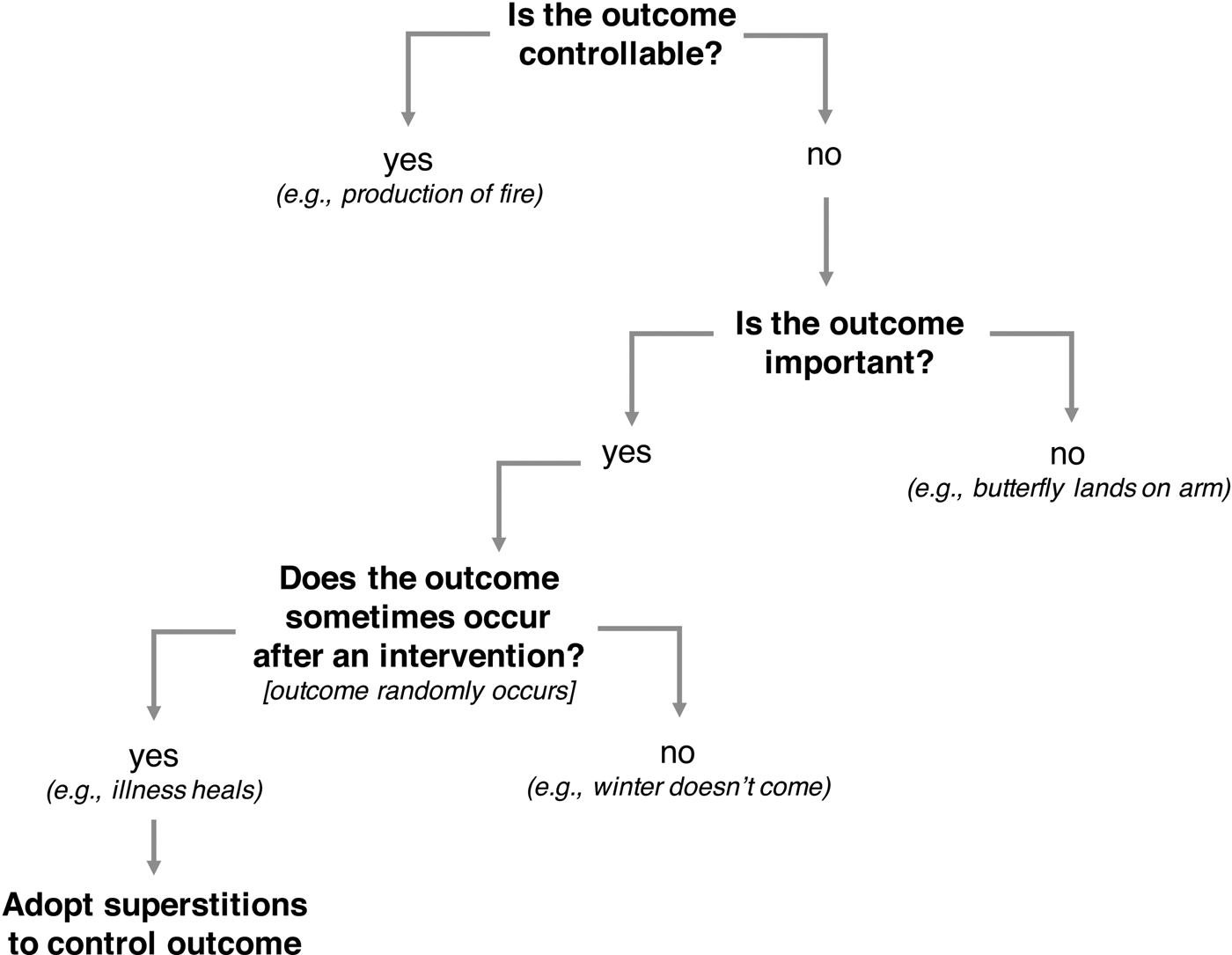
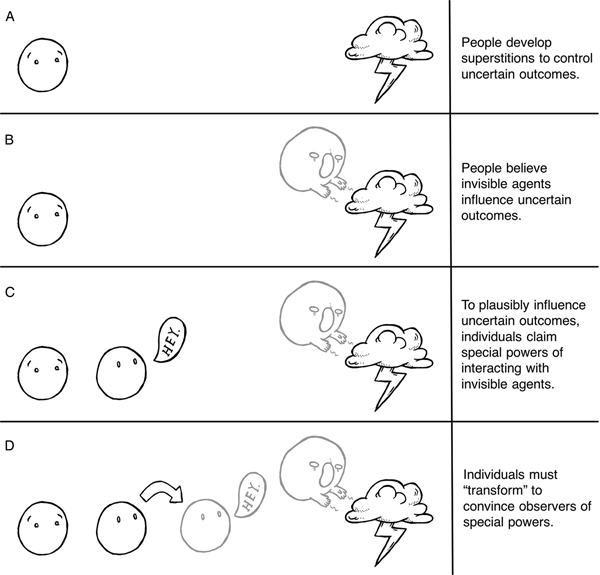
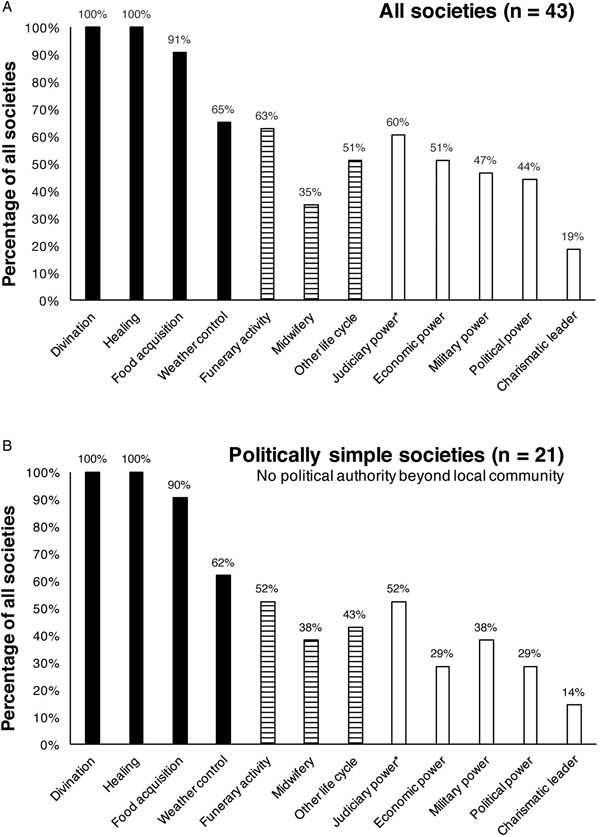
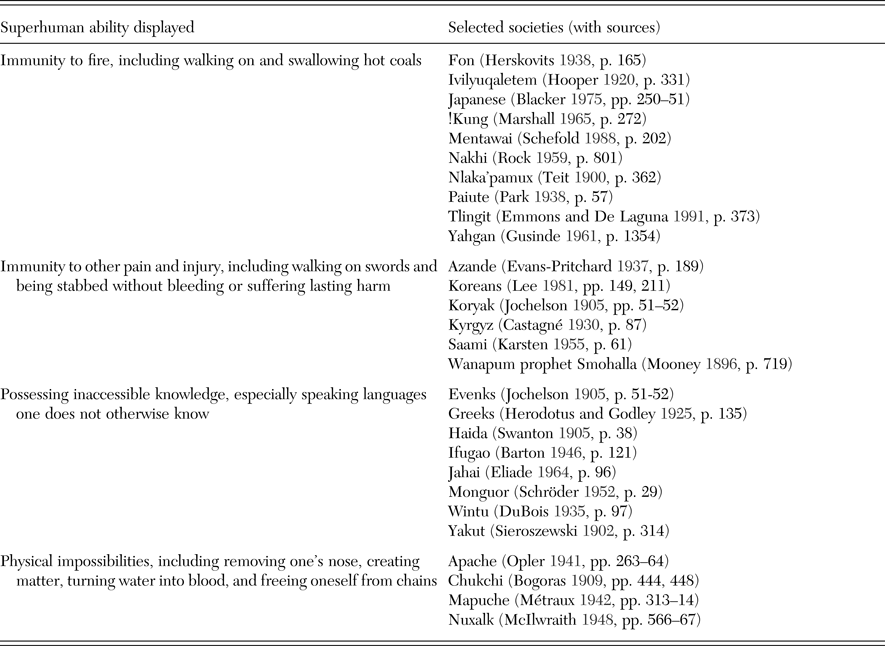
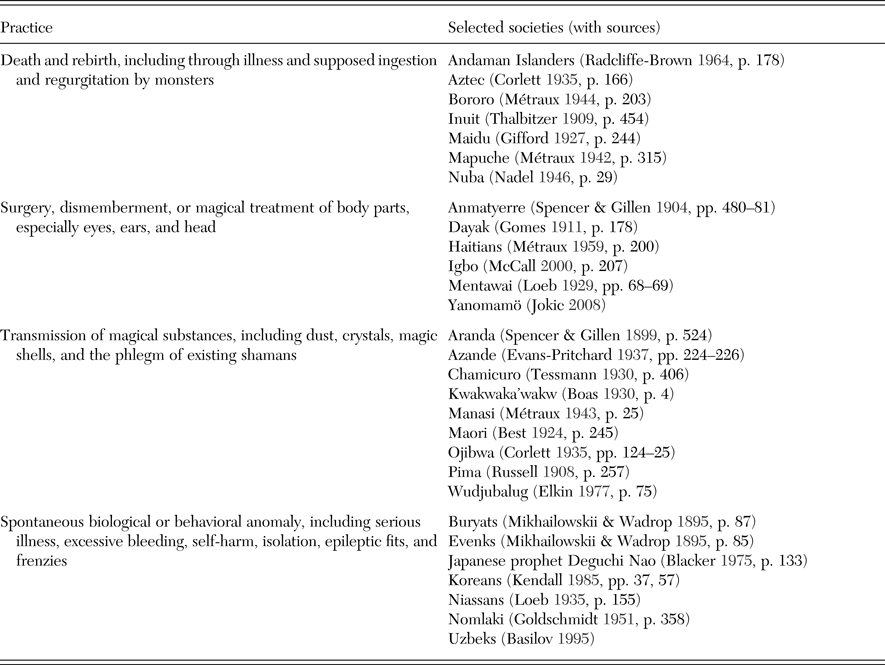
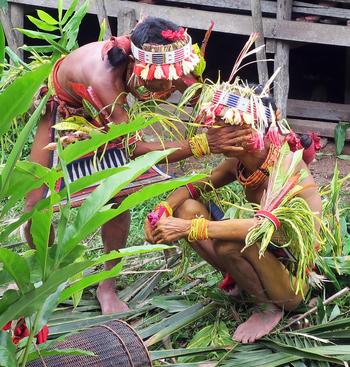
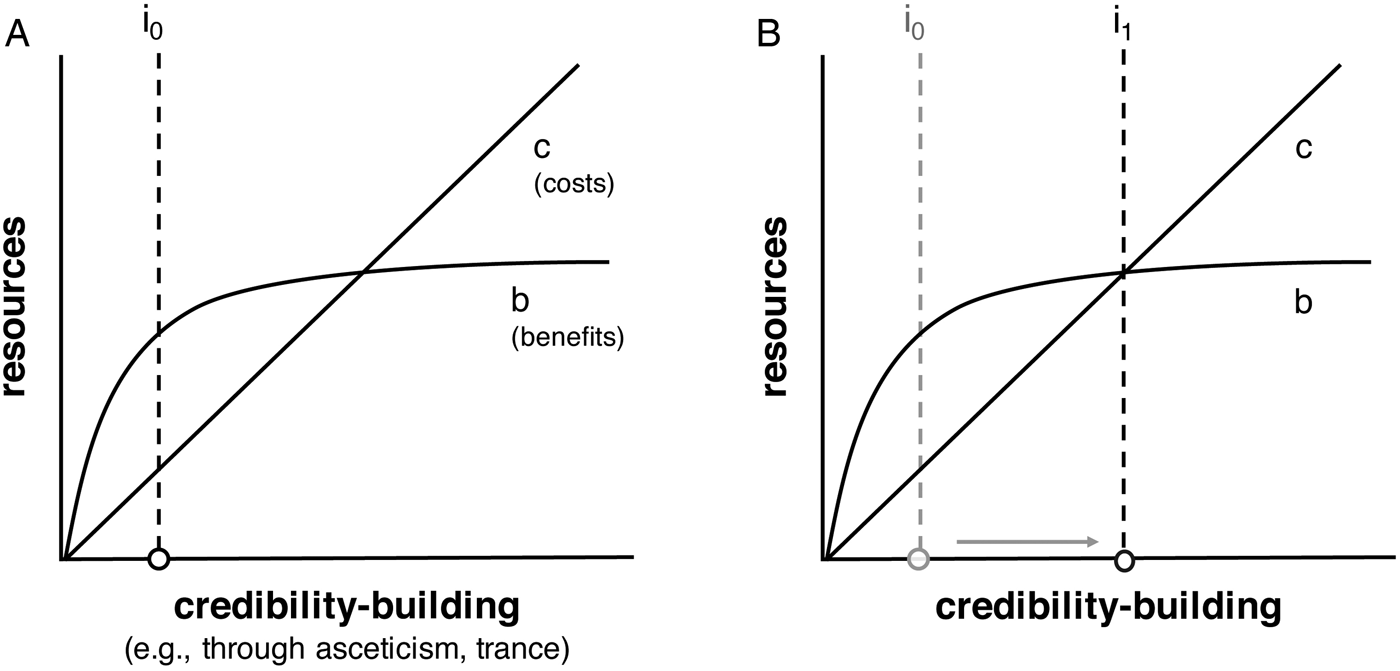
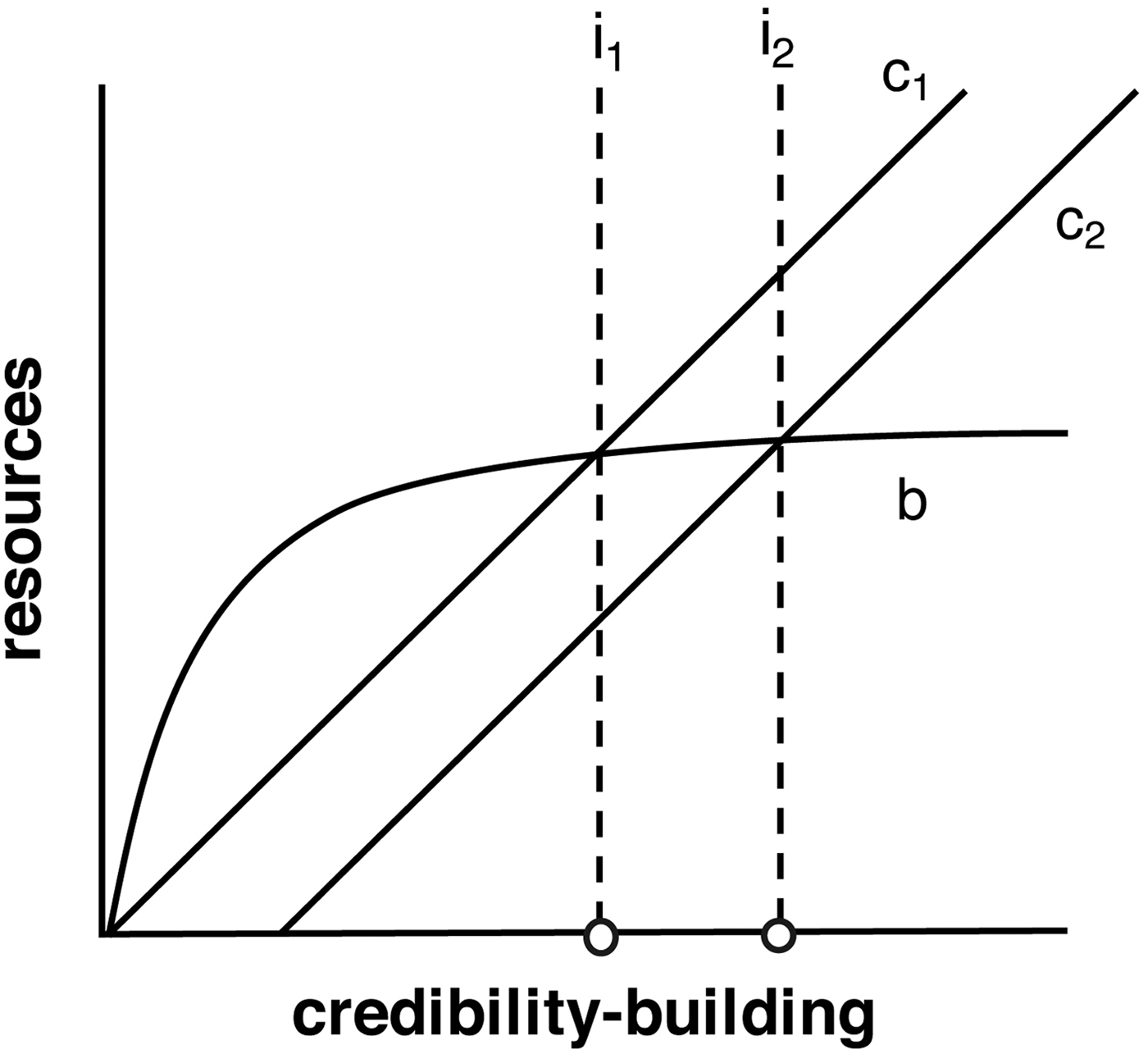



Target article
The cultural evolution of shamanism
Related commentaries (25)
A ritual by any other name
An existential perspective on the psychological function of shamans
Biological foundations and beneficial effects of trance
Commitment enforcement also explains shamanism's culturally shared features
Complexity and possession: Gender and social structure in the variability of shamanic traits
Do shamans violate notions of humanness?
Enjoying your cultural cheesecake: Why believers are sincere and shamans are not charlatans
Financial alchemists and financial shamans
Genetic predilections and predispositions for the development of shamanism
Identifying the nature of shamanism
Increased affluence, life history theory, and the decline of shamanism
Missing links: The psychology and epidemiology of shamanistic beliefs
Psychosis is episodically required for the enduring integrity of shamanism
Shamanism and efficacious exceptionalism
Shamanism and psychosis: Shared mechanisms?
Shamanism and the psychosis continuum
Shamanism and the social nature of cumulative culture
Shamanism within a general theory of religious action (no cheesecake needed)
Shamans as healers: When magical structure becomes practical function
Some needed psychological clarifications on the experience(s) of shamanism
The cultural evolution of war rituals
The evolution of the shaman's cultural toolkit
The social functions of shamanism
Therapeutic encounters and the elicitation of community care
Toward a neurophysiological foundation for altered states of consciousness
Author response
Why is there shamanism? Developing the cultural evolutionary theory and addressing alternative accounts