Events such as the 9/11 attacks, killing approximately 3000 people, marked the necessity for the United States, NATO, and other allies to strengthen international cooperation and initiate a “Global War on Terrorism” (GWOT). Given the new terrorist objectives for mass killings, the use of chemical, biological, radiological, and nuclear (CBRN) materials was perceived to be of great threat for future attacks. Given, too, the global nature of international terror, appropriate measures include a coordinated worldwide approach which aims to prevent, detect and mitigate the consequences of CBRN attacks. Reference Sabol, Šesták, Polívka, Apikyan and Diamond1 Accordingly, by November 2001, health ministers from several nations (eg, Canada, France, Germany, Italy, Japan, Mexico, the United Kingdom, and the United States) called for concerted global action to strengthen the public health response to the threat of international CBRN terrorism and decided to create the Global Health Security Initiative (GHSI). At the same time, the Health Security Committee (HSC) was set up at the request of European Union (EU) ministers and used by the European Commission (EC) to coordinate health-security measures across EU. This enables EU governments to exchange information, evaluate health events, advise health ministers, and facilitate coordinated crisis response. By the end of 2013, the role of the HSC was formalized to coordinate public health measures dealing with serious cross-border threats to health in the EU. In 2016, the GHSI reiterated the increasing importance of their purpose: “The rise in terrorist related events over the past year has reinforced that our collaborative efforts in response to CBRN threats remain a high priority” . 2
If effectively disseminated, a single release of some CBRN agents could cause tens of thousands of casualties. Protection by means of medical countermeasures (MedCMs), such as prophylactic drugs, vaccines, and postexposure treatments, could help shield human vulnerability to the serious threat posed against health and life. Nonetheless, for some diseases caused by CBRN agents, MedCMs do not exist and many of those that do might not be readily available. Moreover, many existing MedCMs could be upgraded with new ones that offer higher efficacy. Reference Unal and Aghlani4
To secure availability of CBRN MedCMs at the time of an event, responsible preparedness measures include appropriate stockpiling and distribution methods. Yet, to ensure stockpiles can be provided, this often necessitates reliable and robust health research and development (R&D) funding and government procurement efforts. Hence, the forefront of defense is the R&D of new and innovative MedCMs. In addition to inducing immunity and providing treatment options, investment in MedCMs may even send a message of deterrence to terrorist groups aiming to use such weapons. Reference Unal and Aghlani4 That is, a perception of preparedness against particular agents may discourage its use as a weapon. However, some critics suggest that, if only specific CBRN MedCMs are developed and sustained, the overall threat will not be reduced because terrorists will then simply target alternative agents. This explains why details about the efficacy of MedCMs are sometimes classified. If so, a broad approach to build resistance against a wide-ranging array of agents must be developed and maintained. Reference Pellérdi and Berek3
Unless demand for MedCMs is fueled directly by an acute attack with a particular agent (eg, the US response to the “Amerithrax” anthrax letter attacks in 2001 which led to the acceleration of its public health policy surrounding the BioShield Act in 2004), Reference Gronvall5 evaluation to prioritize MedCM availability often hinges on threat and risk assessments as well as demonstration of cost-benefit. When considering threat and risk assessments, for example, likelihood of CBRN use stems from the ability of nonstate actors to acquire relevant materials and their financial resources to research, produce, purchase, and sustain them. Reference Unal and Aghlani4
Terrorists seem to show an increased interest in CBRN material, and some groups are trying to acquire them, meaning their access to relevant technical information, technologies, and materials can by no means be ruled out. Reference Vičar and Vičar6 Because many technical difficulties have historically hindered a perpetrator’s ability to release CBRN agents and generate maximum efficacious exposure, the threat of such a devastating attack is typically referred to as low probability-high impact. This historic element of low probability to gain access to CBRN agents may indeed potentially present an opportunity for health authorities to ignore the threat as well as the associated human life and economic vulnerability imposed. Nonetheless, even intentional use of crude and easy to achieve CBRN weapons bear the potential to create maximum panic. Reference Pellérdi and Berek3
One must also consider the recent synthesis and use of sulfur mustard by the Islamic State of Iraq and the Levant, referred to as ISIL. 7 Likewise, access to a range of relevant technical information, technologies, and materials has become easier. That is, while new and rapid technologies (eg, nanostructures, CRISPR Cas-9, synthetic biology and chemistry, drone, 3D printing) are becoming readily available and affordable for civilian purpose, their applications are dual-use. Reference Unal and Aghlani4 This means that the technologies, although intended for peaceful domestic use, can also be used to facilitate the production and use of CBRN weapons. For instance, nanostructures can be applied to aid the dispersal and delivery process, or even conceal pathogens. CRISPR Cas-9 makes it possible also for terrorists to perform genome editing in virtually any living organism accessible to experimental manipulation. Reference Haeussler and Concordet8 As such genetic technologies mature, less expertise is required. Hence, the terrorist threat of engineered viruses will increase. Synthetic biology and chemistry may simplify the dissemination of knowledge to enable development of biological and chemical weapons and/or the ability to increase resistance to medical treatment. A cyberattack has also the potential to turn critical infrastructure itself (eg, chemical plant, nuclear power plant) into a weapon of mass destruction/disruption. The use of drones could prove effective for executing assassination attempts or terrorist attacks. And 3D printers might provide for the easy transfer of electronic blueprints to more complex and reliable explosives and detonators. Some of these dual-use developments are so revolutionary that they have not been taken into account in policy that aims to influence appropriate legal and resilience measures. Reference Unal and Aghlani4
Upon evaluating CBRN events and the cost-benefit associated with MedCMs, the cost to diminish health vulnerability appears quite high in relation to available financial resources. Reference Ramseger, Kalinowski and Wei9 Although it may be possible to procure some less innovative MedCMs (ie, antibiotics against anthrax) because they are cheap and already readily available on the market for other nonrelated purposes, some new MedCMs need to be developed. This necessitates out-of-pocket R&D costs for new drugs that can often range from 850 million to 1.5 billion USD and a time period from 10 to 22 years needed to achieve an approved MedCM. Reference Robinson10 Particularly for low probability-high impact events where the optimization of public safety is a key objective, decisional support needs to prioritize those measures most likely to best shelter well-being.
Moreover, the safeguarding of vulnerability while satisfying financial constraints must be balanced through cost-effective responses so that such measures can be sustainable. Reference Chapman and Leng11,Reference Stewart12 For example, cost-benefit analysis can be used to measure cost associated with the reduction, avoidance, or transfer of risk posed to social and economic structures. Reference Stewart12 Namely, casualties and physical damage inflicted directly during an event can be compounded with psychological, social, political, and economic damage. Reference Klein13 For this reason, decision support framework of cost-benefit analysis needs to consider various factors, such as threat scenarios and probabilities, value of human life, physical (direct and indirect) damage, risk reduction, and protective measure costs. Reference Stewart12 The literature demonstrates Reference Prager, Wei and Rose14‐Reference Giesecke, Burns and Barrett18 that a computable general equilibrium analysis can be applied to methodically examine such equilibrium impacts, resilience, and behavioral responses. Thus, the relevant cost-of-doing-nothing to guard against natural disasters, technological accidents, and terrorist attacks can be determined.
The position of GHSI would suggest that threat of CBRN attack is credible. Yet, only few governments appear willing and able to fund the prerequisites (eg, R&D, procurement) of achieving the availability of MedCMs. This may result in inappropriate MedCM preparedness and stockpiling of the necessary means to face the medical consequences in the event of an attack. Correspondingly, high casualty rates could potentially induce adverse economic consequences that far exceed the costs of strong and comprehensive preparedness initiatives. For example, rare but deadly diseases can pose detrimental financial risks (eg, lost income) to social and economic structures, Reference Baumstark, Dervaux and Treich20 cost per loss of life has been estimated at 3 million Euros in France, Reference Baumstark, Dervaux and Treich20 and medical expenses such as hospitalization in intensive care units can stretch beyond 1500 Euros per day). Reference Garrigues21
Hence, this infers that exclusive focus on current core criteria (eg, threat and risk assessments, cost-benefit) to determine MedCM investment may not be enough to guide responsible preparedness policy. By illustrating factors of demand-side rationale for CBRN MedCMs, this article aims to strengthen integrity of policy-making associated with current demand requirements. Namely, an approach to inspire broader assessment is introduced by compiling and adapting existing economic models and concepts to characterize both soft and hard factors capable of influencing demand-side rationale. The Soft Factor Context section sets the soft factor context by demonstrating the impact of behavioral and political economics. Then, lessons learned from past public health funding models and associated collaborative access infrastructure are depicted in the Hard Factor Considerations section to represent hard factors that can enhance the viability of MedCM preparedness evaluations. To frame and summarize key points, key take home messages are listed in a table at the end of each section.
SOFT FACTOR CONTEXT
Guiding policy decision based purely on apparent cost-benefit may indeed appear rational; however, this approach would assume choice to be fully shielded from the reality of human limitations (eg, ignorance, emotion, impulsiveness, distraction, and selfishness). Since Kahneman and Tversky (1979), behavioral economics study the influence of psychological, social, cognitive, and emotional factors on economic decisions, in particular cognitive biases that reflect the bounded rationality of agents and alter their judgment. Reference Kahneman and Tversky22 Thaler and Sunstein (2008) have shown that these biases may be used to improve the decisions of others, especially concerning health, and without restricting their freedom of choice. Reference Thaler and Sunstein23,Reference Oullier, Cialdini and Thaler24
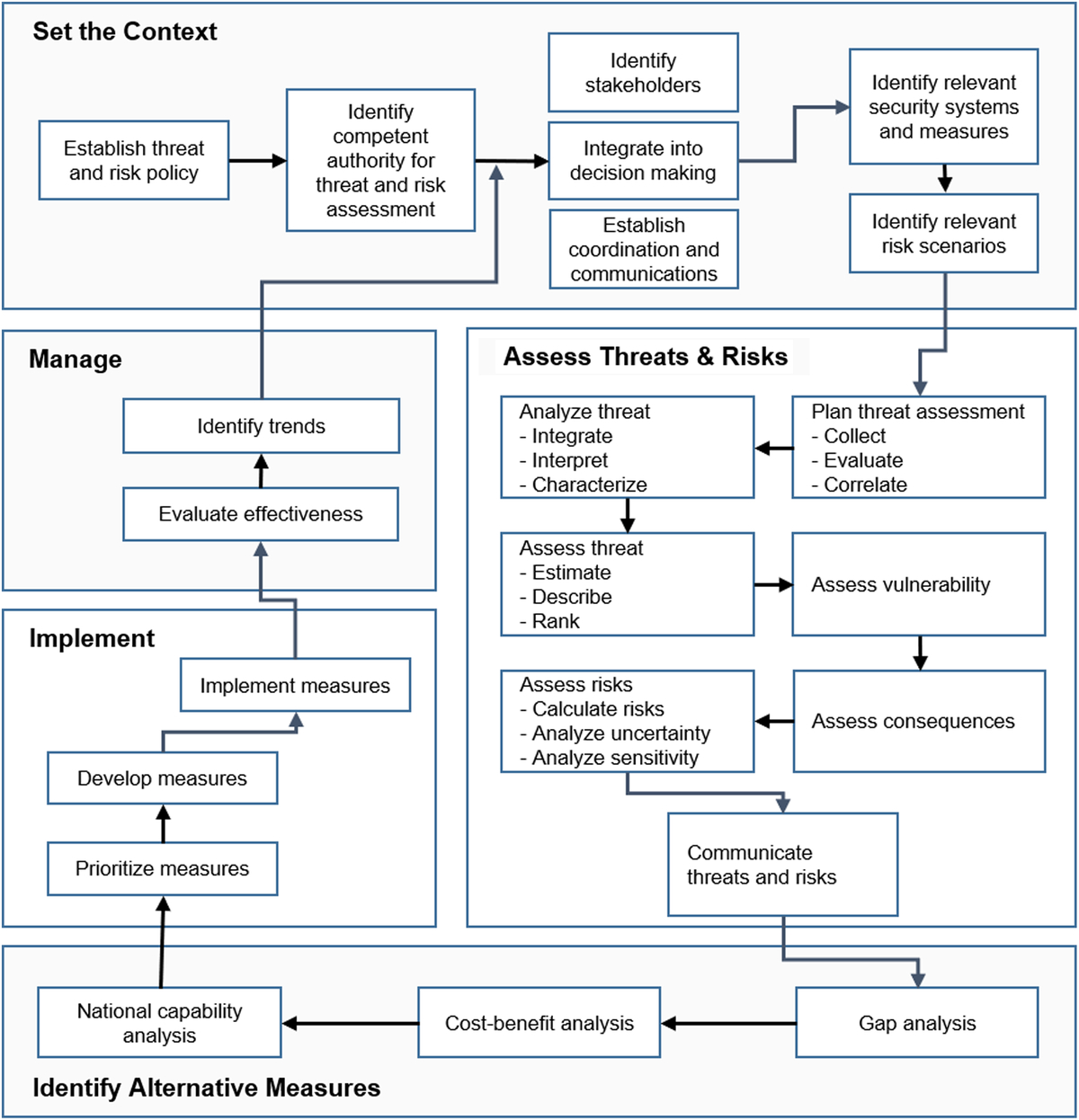
Before new public health policy can be implemented, consideration must go far beyond its intrinsic merit. Reference Catford25 In terms of making managerial and political sense, interventions need to be shown to be reliable, valuable, acceptable, affordable, feasible and accountable. Hence, to determine if intervention is “able,” factors pertaining to efficacy and safety, potential health impact, policy and political fit, cost and sustainability, capacity for action, and responsibility and monitoring must be evaluated. To facilitate a systematic, iterative, and broader process to rationalize demand for CBRN MedCMs and its associated R&D and procurement, one can apply risk-informed framework. Devised by the International Atomic Energy Agency (IAEA), this framework can guide prevention, detection, response, mitigation, and recovery efforts to minimize risks. 26
Key components of this approach include decision-making support within a wider context in areas such as strategic planning, policy-making, funding, prioritizing R&D, as well as designing operational activities for security. Given the IAEA’s specific mandate, their approach has specifically targeted the low probability-high impact threats of nuclear and other radioactive material threats (RN). However, because many chemical and biological (CB) agents also pose low probability-high impact threats, we consider the risk-informed approach compatible across the range of CBRN. While this framework provides orientation for this construal, it should be noted that specific economic models and concepts were freely chosen and allocated across its components. Hence, this evaluation is not necessarily (nor intended to be) fully IAEA conform.
Due to high potential negative impact of a CBRN event, governments are not only challenged with taking all necessary steps to prevent its occurrence, but to mitigate the impact if such a catastrophic event does take place. 26 The individual and interdependent components of the risk-informed framework to implement security systems and measures are labeled as “Set the Context,” “Assess Threats and Risks,” “Identify Alternative Measures,” “Implement,” and “Manage.” As described by IAEA, a definition of each component is outlined in Figure 1.
Threat Assessment and Risk-Informed Approach Template. 26

Upon considering the full scope of a risk-informed approach, it becomes evident that evaluation of typical core investment criteria (eg, threat and risk assessments, cost-benefit) can be associated with the components of “Assess Threat and Risks” and “Identify Alternative Measures,” respectively. In many cases, however, exclusive focus on these 2 components may render important economic considerations associated with other risk-informed components (ie, “Set the Context,” “Implement,” and “Manage”) unexploited. Hence, the following sections explore this notion by associating soft factors of political and behavioral economics under the “Set the Context” component. Subsequent to brief theoretical and practical depiction of attributes specific to fear messages, emotion, political interests, and policy nudges, an example at the end of the Soft Factor Context section portrays an interdependent role these soft factors may play in influencing demand-side rationale for CBRN MedCMs.
Fear Messages
If stressing the negative consequences of health-impairing behaviors induces a level of fear, it can, under certain conditions, initiate a positive response to counteract the associated threat. This is referred to as a “fear message”, with its potential to engage political action. To positively influence behavior to counteract threat, Li (2014) suggests fear messages of a high-threat condition can indeed motivate positive attitudes/behavioral changes for those affected. Evaluated in the context of achieving political action against the threat of climate change, it is recommended that a message directed to change behavior should contain both threat and efficacy content. Reference Li27 The concept of representing a “fear message” by means of educating political leaders and even the public of threats, their consequences, and the need to prepare against them by no means suggests it should be applied as a manipulative tool. It rather suggests effective and actionable communication can be appropriately applied by competent health authorities and/or even the public community to stimulate the “right” public health response and policy for self-protection in their own best interest.
There are past related incidences where distress messages containing both threat and efficacy content appear to have been successful. For example, historically infectious diseases including plague and smallpox have been the cause of enormous fear and social distress. This often led to immediate and emotional responses to improve failures of public health systems. Reference Smith, Battin and Jacobson28 Even in the 1950s, cold war fears of bioterrorism were used to convince the US Congress to fund the transformation of a Malarial Control Center into the modern Centers for Disease Control and Prevention (CDC). Reference Richards, O’Brien and Rathbun29
Following the 2001 anthrax letter terrorist attacks in the United States, bioterrorism became an emotional issue capable of triggering immediate intense reaction. Reference Vičar and Vičar6 Most likely, fear of bioterrorism drove politicians and government agencies to defend themselves from accusations they were unprepared for bioterrorist attack. Namely, in a democracy, public fears have precedence over what politicians should do, even if the public’s view is scientifically inaccurate. Reference Posner30 The power of the state to keep the public safe and protect well-being is based on common law, and politicians facing pressure from voters are keen to exploit it. Reference Risse31 Hence, public outcry can be very beneficial toward enabling relevant authorities to pass associated legislation to remedy public concerns. Reference Richards, O’Brien and Rathbun29 Yet, unless occurring on a regular basis and/or with substantially high death rates, responses related to unconventional (CBRN) terrorism are likely to be only short-term. This infers that key to effective CBRN terrorism policy is its ability to establish a healthy balance between complacency and fear. While voter complacency poses risk that public health authorities will ignore issues off the radar of its voters, fear is essential to public action. However, response driven by fear bears the risk that when the threat fails to materialize, the credibility of authorities could be damaged.
To observe the relationship between the use of fear appeals, attitudes, and behavioral intentions, Li (2014) Reference Li27 applied principles from available literature (Witte 1992, 1996) Reference Witte32,Reference Witte, Andersen and Guerrero33 to an analysis, referred to as the extended parallel process model (EPPM). EPPM suggests important variables (severity, susceptibility, response efficacy, and self-efficacy) must be perceived if fear appeal messages are to be effective. Perceived “severity” describes the seriousness of the threat and “susceptibility” indicates whether the message recipient feels personally exposed. Perceived “response-efficacy” is how effective proposed counteraction is believed to be and “self-efficacy” entails the recipient’s awareness of their own ability to perform this action. Reference Li27 EPPM suggests a high degree of threat is required to sufficiently motivate response to fear messages, thus evoking 2 different processes, namely, the danger or fear control processes.
On 1 extreme, the danger control process is an attempt to manage threat by performing the recommended actions which were communicated in the fear message. This process can only be initiated if the severe threat to which the message recipient feels personally exposed is perceived, with any recommended counteraction viewed as effective and self-efficacious. For instance, despite decades of multiple Ebola virus disease outbreaks in Western Africa, the international community maintained a rather quasi–laissez-faire attitude. However, the outbreak of 2014/2015 shifted the paradigm. Reference Johnson, Belin and Dorandeu19 Namely, response included international cooperation to develop efficacious MedCMs against the deadly disease. While the “unprecedented extent” of this outbreak introduced susceptibility even to Western countries for the first time, the disease also underscored political and geostrategic implications as well as social disruption and emotional factors affecting gross domestic product of the main African countries hit (or likely to be hit). On the other extreme, the fear control process represents the unintended consequences of a fear message. Namely, although the recipient perceives a severe threat and feels personally susceptible, he will attempt to minimize the issue’s importance if suggested solutions are interpreted as neither efficacious nor self-efficacious. This condition is typically portrayed by lack of response to improve environmental issues believed to cause climate change.
Emotion
Whereas the previous section provides indication that fear, in certain cases, can influence behavior to counteract threats, one can also surmise that such emotion should not be exaggerated. During a decision-making process, there is a tendency for cognitive bias to rely too strongly on the first piece of information offered (the “anchor”) or even uninformed random information points. Once an anchor is set, new messages aimed at shaping alternative interpretations that might differ from the anchor will be perceived with bias. Experimental evidence suggests there is a relationship between this anchor and one’s emotional state. Reference Araña and León34 Namely, the degree of anchoring declines as emotional intensity increases, reaching a minimum for an average value emotional intensity. Hence, the estimated relationship between emotion and anchoring effect can be best expressed as U-shaped. This experimental result infers that the optimal point for influencing opinion to change status quo would be when an intermediate level of emotional intensity can be achieved. This is because when emotional intensity is too low, blockage of short-term memory and lack of attention is dominant. By contrast, if emotional intensity is too high, thinking becomes disorganized and irrational interpretation of cost benefits will prevail. The relationship between emotions and the decision process is quite complex and evidence has not yet differentiated between valuation in the context of private and public or environmental goods. Yet, this suggests that some degree of emotional intensity might help to reduce cognitive load; thus, enhance human decision-making.
Political Interests
Promoting health requires public policy to support its prerequisites. Although this often includes sustainable resources, the literature indicates a significant gap exists between declared health promotion policy and practice. Reference Zalmanovitch and Cohen35 The potential root cause for this gap is lack of political will to secure healthy environments. Although insufficient willpower could stem from lack of political courage or poor judgement, it can also be attributed to a politicians’ inattentiveness to the unique structural conditions associated with the health policy domain. Of course, budget constraints as well as competing priorities might also play a role.
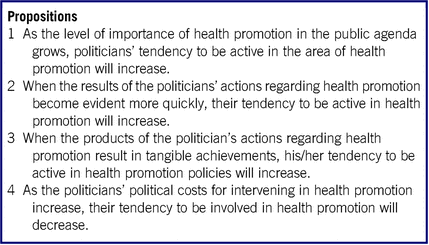
Before undertaking active political involvement in a modern democracy to promote health, or create more demand for MedCMs, certain conditions of rationality must be met. Reference Zalmanovitch and Cohen35 These are formulated in Table 1 as propositions and assume that politicians are rational beings acting to optimize their own political self-interest, with the mobilization of political gain (eg, more voters) being a cornerstone. Given that promoting health often does not achieve this, then laisser-faire is rational. To emphasize this point, one can consider the lengthy, risky, and expensive R&D process associated with developing innovative CBRN MedCMs. When combined with the historically low probability that a release of CBRN agents will occur, Reference Pellérdi and Berek3 none of the conditions as depicted by the 4 propositions are likely to be met. That is, in the absence of acute perceived threat about such a release, the relevant health policy initiatives tend to lack importance. Second, a ponderous and risky development phase of up to ca. 20 years is too long, and its success uncertain. Third, even when successful, the long period’s completion is likely to occur outside of one’s own political term, meaning the tangible achievements would fall to one’s political successors. This imposes political costs because the politician could have benefited from alternative actions more compatible with the motivational aspects of the propositions.
Politicians’ Involvement in Health Promotion Policies Reference Zalmanovitch and Cohen35

Policy Nudges
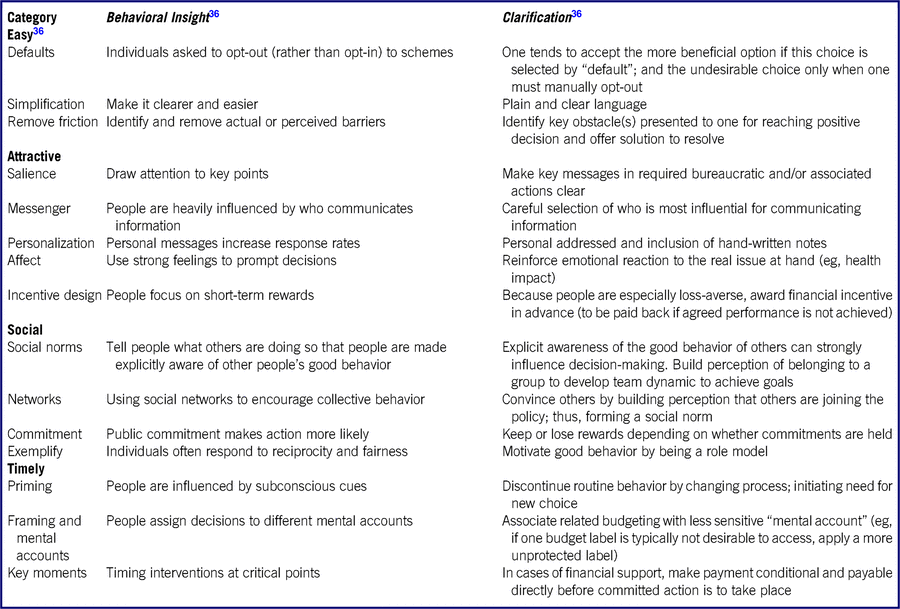
For a strategy to influence policy endorsement, nudging can be applied to sway decision. Nudges are informational interventions that can alter human behavior in a predictable and beneficial manner without prohibiting alternative options. In fact, to be considered a nudge, the intervention may not be obligatory and must be easy and inexpensive to avoid. Reference Thaler and Sunstein23 To promote well-being, a nudge is a cognitive strategy that guides one to make good choices for themselves. The core stimulus created by means of such behavior sciences is that the body, mood, desires, and habits of human beings are put at the heart of economic concerns. In other words, given there are human flaws in individual decision-making, nudges can work by making use of these flaws. Reference Valatin, Moseley and Dandy36 To do so, relevant human cognitive factors that guide decision and increase involvement can be targeted. In Table 2, behavioral economic elements are listed and categorized by Easy, Attractive, Social, Timely (EAST) nudges. Empirical evidence demonstrates, in a variety of settings, the potential impact these nudges can have on decision-making. Reference Valatin, Moseley and Dandy36
Behavioral Economics Elements of EAST Nudges
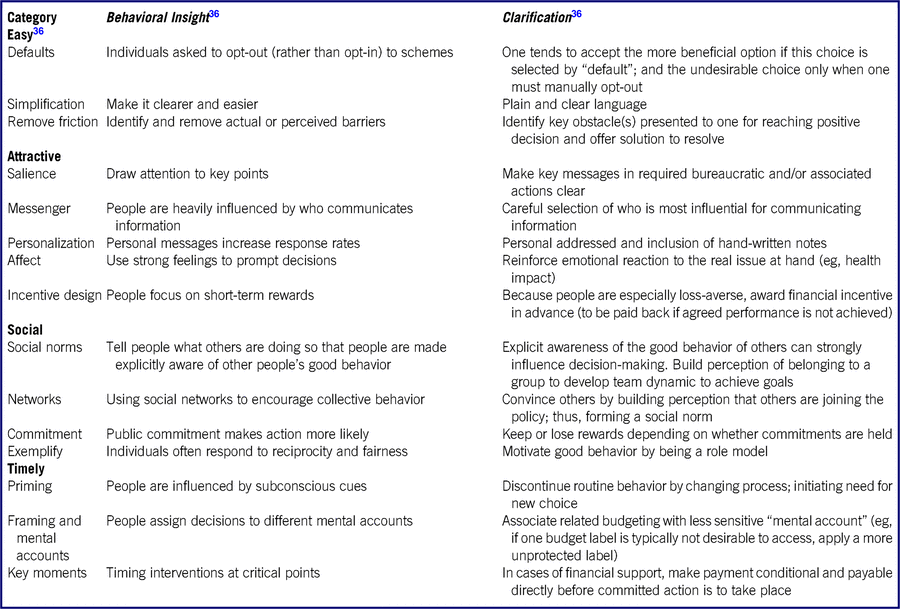
Matjasko et al. (2016) suggest it could be effective to determine what influences behavior, then to design nudges which aim to alter them.Reference Matjasko, Cawley and Baker-Goering37 To illustrate how nudges could be applied toward the availability of CBRN MedCMs, one could revisit the previous example concerning fear response. For instance, assuming a politician perceives a severe CBRN threat and feels personally susceptible but minimizes the issue’s importance because suggested solutions are interpreted as neither efficacious nor self-efficacious, fear control could potentially be resolved by applying the “remove friction” nudge. Namely, a feasible solution to remove friction could be the offering of a global and viable approach toward achieving prioritized CBRN MedCMs, such as that witnessed during the Ebola outbreak of 2014/2015. Reference Johnson, Belin and Dorandeu19 Assuming this alternative could be interpreted as efficacious and self-efficacious, applying this nudge would empower those overstrained politicians to transform political response from fear to danger control.
Correspondingly, the shifting of burden to third parties by means of a global approach may offer a feasible solution in terms of making political and managerial sense. Another example showed that under a “default” nudge, participation can be increased if individuals are asked to opt-out (rather than opt-in) to schemes. Hence, the number of countries participating in global CBRN MedCM ex-ante preparedness initiatives (before an event) could be increased if they are opted-in by default (eg, by means of the amendment of an international public health agreement). If so, individual costs would most certainly be far lower and much more sustainable than when emergency measures for MedCMs depend on a handful of voluntary donors.
Pertaining to political motivation surrounding the availability of CBRN MedCMs, one must also reiterate that benefits associated with R&D and/or preparedness against a probable attack are likely to materialize far beyond the political term of an incumbent politician. This suggests that nudges capable of satisfying more short-term behavioral needs could be most effective. It should be noted that a prerequisite to defining a behaviorally informed policy intervention is to fully understand the decision-making process at the stem of the targeted behavior. That is, the problem must be recognized, the decision process traced, and deviations from rational decision-making identified. Reference Michie and West38 Yet, before a nudge design is finalized, it should be comprehensively tested to ensure its impact is effective and its results are cost-effective.
Upon considering soft factors as they relate to behavioral and political economics and the role it can play to set the context for CBRN MedCM preparedness activities, it may prove useful to demonstrate their potential interdependence. Hence, a practical example associated with demand rationale for CBRN MedCMs is portrayed by interpreting responses to a real event. While it does not appear possible to validate the actual cause of response as shown in this example, it does allow a plausible and logical illustration. For instance, although former President George W. Bush was responsible for signing the US government’s BioShield program into law, it seems that behavioral response was first prompted by his predecessor, President Bill Clinton. Reference Charatan39‐Reference De Paolo41 After reading the book, “The Cobra Event” by Richard Preston, President Clinton became alarmed and the message appears to have induced some degree of emotional intensity that reduced cognitive load (the lowering of the anchoring effect). Although this book plots the fictitious occurrence of mysterious deaths caused by a fabricated infectious agent, it references real history, politics, technology, and bureaucracy of bioterrorism.
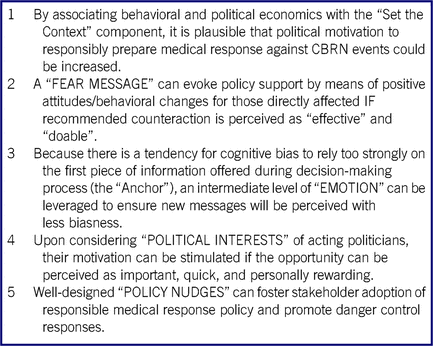
Section Take-Home Messages
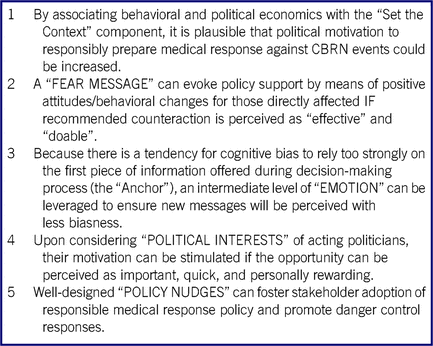
Clinton’s reaction to request his Defense Secretary, William Cohen, to read the book and conduct an intelligence analysis of the viability of a real-life cobra event demonstrates a “danger control” response to the fear message. Moreover, it can also be surmised that the fear message led President Clinton to perceive himself as politically vulnerable attributed to his potential lack of public health preparedness. Consequently, this reading influences President Clinton as a real example, to perceive and respond to the increasing probability of such an event. Hence, this availability or representativeness heuristic influenced President Clinton to adjust his federal budget proposal to augment defenses against biological weapons. This indicates that subsequent review of experts and government leaders to consider the implications of bioterrorism not only validated the context of this fear message, but also determined both response- and self-efficacy; thus, the triggering of this second “danger control” response. One could also infer that, given Clinton’s presidential status and access to internal experts, intelligence reports, and available budget, the fundamentals for “Easy” (eg, removed friction) and “Attractive” (eg, messenger, affect) policy nudges were able to prod these “danger control” responses to fear messages. Key findings of this section on soft factor context are summarized in Table 3.
HARD FACTOR CONSIDERATIONS
Although proposals for MedCM preparedness against a probable CBRN threat can often be determined as cost-effective, financial opportunity costs can be significant and render associated investment far less beneficial. Reference Stewart12 The concept of opportunity costs and other prioritization factors can be associated under the “Implement” component of the risk-informed framework. Within the context of a societal perspective, the true opportunity cost of a resource used in 1 health-care intervention is the loss of not using it in the next most efficient but unused intervention. Reference Hutton and Baltussen42 Given finite resources, it is necessary to put proposed negative consequences into perspective with opportunity costs associated with alternative health risks. For example, where CBRN events can be considered as low probability-high impact, natural disasters represent a far higher certainty of occurrence and can often be considered high-impact. Hence, from a global perspective, disaster preparedness measures for natural threats, such as drought, earthquakes, floods, and storms, may be found more likely to express benefit, for example, over 850 natural disasters globally from 2013 to 2015 caused over 250 billion USD in damage. 43
In addition to immense cost and time associated with the development and approval of prioritized CBRN MedCMs, insufficient market rewards fail to incentivize manufacturers to develop them. Hence, it may be necessary to consider CBRN MedCMs as a public good. Reference Robinson10 Public goods are nonexcludable and nonrivalrous and are often supplied by governments and paid for collectively. Reference Samuelson44 Upon considering public policies and the resolution of ethical conflicts, according to utilitarianism, the best action is the one that maximizes utility (eg, for society) and not for affected individual(s). This theory was founded by Jeremy Bentham (1789) who described utility as the sum of all pleasure that results from an action minus the suffering of anyone involved in the action or the greatest happiness of the greatest number. Reference Bentham45 Correspondingly, “fair” is maximizing net balance of social satisfaction with a decision-making process that weighs present and future profits with present and future losses. Reference Salazar46 To achieve sustainable public health funding for CBRN MedCMs while minimizing opportunity costs, this section further explores the notion that exclusive focus on risk assessment and cost-benefit analysis may render important economic considerations associated with other risk-informed components unexploited. Namely, relevant hard factors related to the “Manage” component are outlined. These factors are identified as funding and sustainability models along with collaborative access infrastructure.
Funding and Sustainability Models
Determination to minimalize both political and financial opportunity costs while maximizing cost-effectiveness is likely to draw public health funding resources toward measures that protect against more widespread threats. Yet, ignoring CBRN MedCM preparedness could potentially lead to detrimental economic consequences. To manage this dilemma, it is necessary to move beyond a pure domestic sphere. Indeed, as globalization progresses, it is becoming clear that many public goods and policies that were previously confined to national territory are now issues of global impact and concerns. Examples include carbon emission of climate change, but also health which is an even greater international problem and increasingly considered as a global public good. Reference Smith, Beaglehole and Woodward47 As stated by Kofi Annan, former Secretary-General of the United Nations: “It is not beyond the powers of political volition to tip the scales towards more secure peace, greater economic well-being, social justice and environmental sustainability. But no country can achieve these global public goods on its own, and neither can the global marketplace. Thus, our efforts must now focus on the missing term of the equation: global public goods”. Reference Kaul, Grunberg and Stern48
Because CBRN exposure threatens all countries and is likely to extend across borders, in particular through travel, Reference Pavia49 while investment in MedCMs is very costly, MedCMs could then be considered as global public goods. However, because no global government or organization exists to invest in such health-related goods, their development requires international cooperation at state level and with international organizations to implement innovative financing models. This is especially the case when considering exposure to rare and deadly CBRN agents. For example, given that no single developed country had the ability nor incentive to stop the natural spread of the Ebola virus across Western Africa in 2014/2015, need for international cooperation became essential. Reference Johnson, Belin and Dorandeu19 Insights into public health funding mechanisms and their underlying models can be drawn from the global health sector’s past decade. These mechanisms include those that rely on taxation, bonds, and contracts. However, more recent initiatives also include insurance, sustainability, and auctioning models. Despite their common objective of creating supplementary funding to provide medical response to unmet needs, the future liabilities created by each of these alternatives must be weighed. Reference Gartner50 Correspondingly, it may be advantageous to briefly outline past lessons learned from global and domestic mechanisms that aimed to raise funding while minimizing opportunity costs. Pending further research and evaluation, it is plausible some of these principles could be adapted for CBRN MedCMs.
Global Taxation, Bond, and Contract Mechanisms
Earlier established global initiatives for the health sector include UNITAID, International Finance Facility for Immunization (IFFIm), and Advanced Market Commitment (AMC). These mechanisms as described in Table 4 shared the common goal of creating supplementary funding to provide medicines that address unmet health needs. However, attributes of their underlying models (taxation, bond, and contract) and governance influence their ability to shape the market. Market-shaping can be defined as actively influencing markets for health products to optimize price, quality, design, and sustainable supply. 51
Earlier Established International Health Sector Funding Initiatives
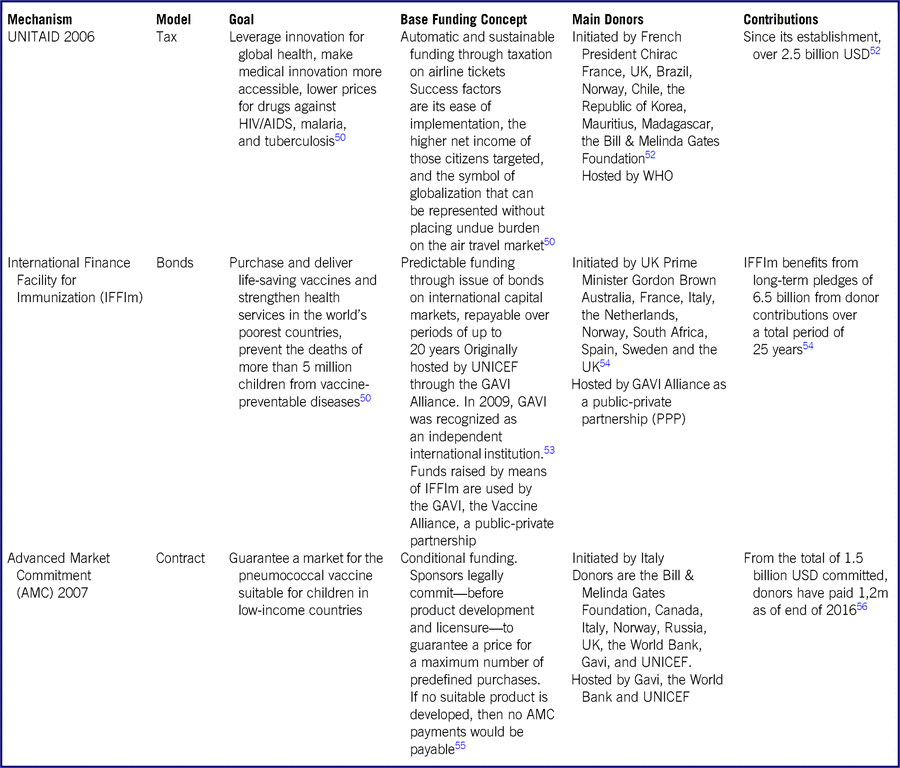
France, the United Kingdom, and Italy are most dominantly promoting these innovative funding mechanism initiatives, but it is only with the participation of others would their initiatives be likely to succeed. 51 Yet, in addition to other state actor contributions, the role of nonstate actors ultimately fosters the desired outcomes concerning their ability to shape the market. For example, governance characteristics that contribute to better performance include independency, participation, and accountability. Such attributes could be better achieved within the context of multi-stakeholder governance as defined under the UNITAID initiative than within an expert governance as in the case for IFFIm and AMC. Namely, while French officials impose taxes under the UNITAID initiative, its governance structures include multiple stakeholders. In addition to the inclusion of representatives from leading donor country governments and the WHO on its board, members also encompass governments from areas affected by the targeted diseases (eg, government representatives from Africa and Asia). This enhances potential to efficiently and successfully channel funds appropriately to impact the market. The specific UNITAID objectives that target market-shaping interventions include the definition of funding priorities, alignment with effective health partners, enhancement of strategic approach to funding, and engagement of country level stakeholders and partners to enhance the long-term. Subsequently, an evaluation 57 validated UNITAID’s ability to identify, select, and fund market-shaping interventions through the implementation of its partners.
In addition to participatory governance, another foremost success factor attributed to these funding mechanisms is the automatism of financing. Again, these conditions are best met by the UNITAID initiative. For instance, once the airline ticket tax is implemented, further actions to sustain financing are not necessary. In contrast, financing for the IFFIm and AMC initiatives are predictable, but both remain dependent on national government donors to fulfil their commitments. Reference Gartner50 And because the political cycle of donor countries rarely extends throughout the duration of the contractual commitments, these are not long-term mechanism of funding and their durability is uncertain. In addition, any doubts associated with honoring commitments is of utmost concern, particularly in the developing world where infrastructural weaknesses undermine procurement and delivery capabilities. Reference Sciarretta, Røttingen and Opalska59 Because UNITAID funds could increase bulk purchase potential, its position for negotiating lower drug prices with manufacturers was strengthened. In fact, overall the UNITAID model achieved the highest level of market impact while that of the AMC model was the lowest. Reference Gartner50
Given potential benefits associated with the UNITAID taxation model, this might add merit to a US proposal for a new tax on antibiotics. Namely, as outlined in Table 5, this proposal aims to raise R&D funding for innovative MedCMs against antimicrobial resistance. Although the imposition of taxes may in some cases carry downsides (eg, increasing health-care costs, limiting patient access), it also offers upsides: parallel to raising funding capacity, the inappropriate uses of antibiotics might be better restrained if structured appropriately, for example, targeting generic antibiotics used in the outpatient setting. Reference Sciarretta, Røttingen and Opalska59
US Health Sector Funding Initiatives

Assuming the sale of alternative products could be linked to contributing to specific CBRN threats, it is plausible this taxation principle could be adopted to source other CBRN MedCM funding initiatives. For example, it has been noted in the introduction that new dual-use technology (eg, nanostructures, genetic technologies such as CRISPR Cas-9, synthetic biology and chemistry, drone, 3D printing) is becoming readily available and affordable for civilian purpose. Given that such technologies can also facilitate the production and use of CBRN weapons, the taxation of some of these technologies to fund CBRN MedCM initiatives could be evaluated and debated. If so, corresponding justification of this relationship, as well as the upside and downside effects imposed by means of taxation, would require evaluation on an individual case-by-case basis.
Global Insurance Mechanism
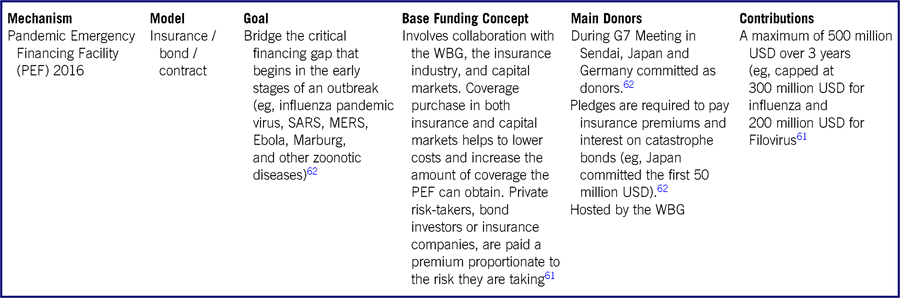
To improve pandemic response, an innovative financing scheme inspired by the Ebola outbreak of 2014/15 was to create a new collaboration with the World Bank Group (WBG) and the insurance industry. 61 Key features of the Pandemic Emergency Financing Facility (PEF) are outlined in Table 6. Typically, response funds are not available until a major pandemic outbreak has reached far higher catastrophic levels. However, the provision of early funding can significantly limit adverse effects. For instance, if the PEF would have been in place before this Ebola outbreak, surge funding could have been available in the early summer of 2014 instead the autumn when the crisis had already skyrocketed.
More Recent International Health Sector Funding Initiative
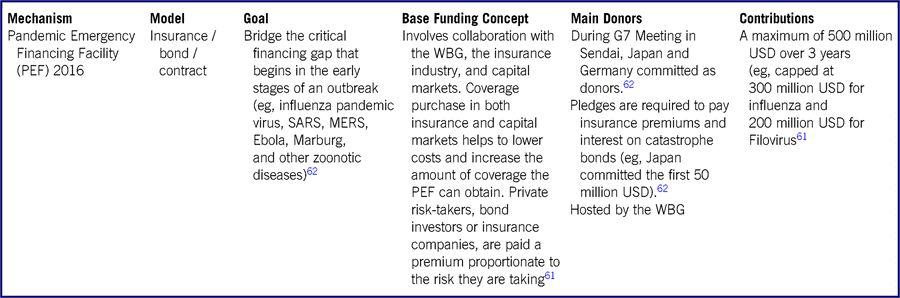
In fact, the WBG cites that, if 100 million USD could have been mobilized for emergency response as early as July 2014, Ebola virus disease cases would not have increased by 10-fold. 62 The availability of early surge funding could have not only prevented deaths, but it could also have saved billions of USD. Indeed, as a direct consequence of late funding, the international community ended up committing more than 7 billion USD for response and recovery initiatives. In addition, the impact on gross domestic product of the main countries hit (Guinea, Liberia, and Sierra Leone) exceeded 2 billion USD. Reference Johnson, Belin and Dorandeu19 To avoid such consequences, a quicker and more effective response against pandemics is economically advisable. Although the monetary basis for the PEF is provided by means of both insurance and cash, it also requires long-term pledges from development partners. Insurance funding is acquired in combination with payments from the reinsurance industry as well as capital market proceeds from catastrophe bonds. 62
To provide innovative financing for MedCMs against prioritized naturally occurring diseases that can also be weaponized and intentionally released, a health foundation working to contribute to global efforts to prioritize particular MedCMs could adapt contemporary principles of the PEF mechanism. For instance, while insurance protection potentially benefits everyone because its funding comes from shared and reasonable contributions to mitigate the financial risk of specified threats, core competencies of insurance companies include the coordination of membership high enough to secure substantial “pay out” capability. Hence, to fill financing gaps created by market failure, an international institute (eg, nonprofit health foundation) able to achieve global consensus for prioritized MedCMs could propose an alternative form of insurance, for example, to multiple governments worldwide. Instead of making monetary pay-outs available upon specified disease outbreak, as with the insurance model of the PEF initiative, R&D progress, and eventually the availability of MedCMs against prioritized naturally occurring diseases that can also be weaponized and intentionally released could be offered.
Upon considering the US CDC’s “Category A Biological Threats”, this could include examples such as anthrax, plague, smallpox, tularemia, and viral hemorrhagic fevers, such as Ebola virus disease. 63 Targeting such diseases would render the larger international community as a potential policy-holder because all or most are susceptible to bioterrorism. And this may possibly set the stage to enable a more global and mandatory insurance coverage requirement. Moreover, establishment of such a mechanism may even potentially align diverse government agencies and philanthropic organizations with different missions to establish R&D progress and availability of MedCMs against the same threat agents, whether naturally or intentionally released. This is not likely the case when only rare or potentially emerging diseases are considered.
As described in Table 6, the PEF mechanism involves collaboration with profit-driven sectors: the insurance industry and capital market proceeds from catastrophe bonds. Hence, to retain and maximize its own financial platform, the profit-driven sector may even choose to proactively drive risk mitigation initiatives (ie, by assuring preparedness measures are implemented so that pay-outs following an event can be limited). Should a high number of insurance policyholders be achieved under an insurance model, insurance premium rates would most certainly be far lower and much more sustainable than when emergency measures for MedCMs are dependent only on a handful of voluntary donors. To reinforce investment cases and create more direct incentive for preparedness measures (ie, the purchase of insurance coverage), a country’s bond ratings and investment criteria could reflect the status of its economic vulnerability to prioritized agents. Because the status quo of preparedness could impact financial markets and businesses’ investment decisions, political interest to prioritize associated health-care standards would extend far beyond the Health Minister. 64 Further to economic and governance analysis to determine various feasible case scenarios (eg, including both naturally and intentionally released prioritized CBRN agents), a new funding mechanism could emerge.
US Domestic Auction and Sustainability Models
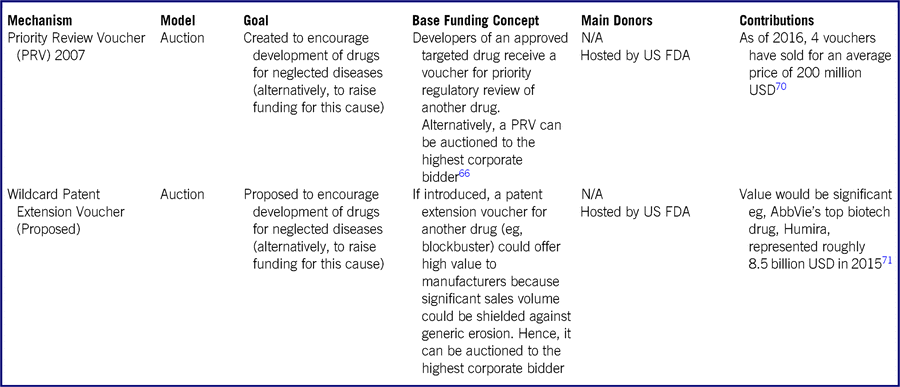
By 2016, the US Biomedical Advanced Research and Development Authority (BARDA) could announce that, in addition to MedCMs that target radiological agents, its CBRN MedCM program supported 21 MedCMs against biological agents and that it added 14 of these to the US’s national stockpile. Reference Lurie65 When challenged to raise funding for new antibiotics caused by an increase in antimicrobial resistance to classes of antibiotics (eg, carbapenems), an auction model was created. Reference Outterson and McDonnell66 In this case, supplier incentives that are intended to decrease a manufacturer’s financial risk associated with R&D and/or increase market rewards are sold to the highest corporate bidders. These incentives, originally earned by suppliers to reward successful development of specified MedCMs, are depicted in Table 7.
US Health Sector Funding Initiatives
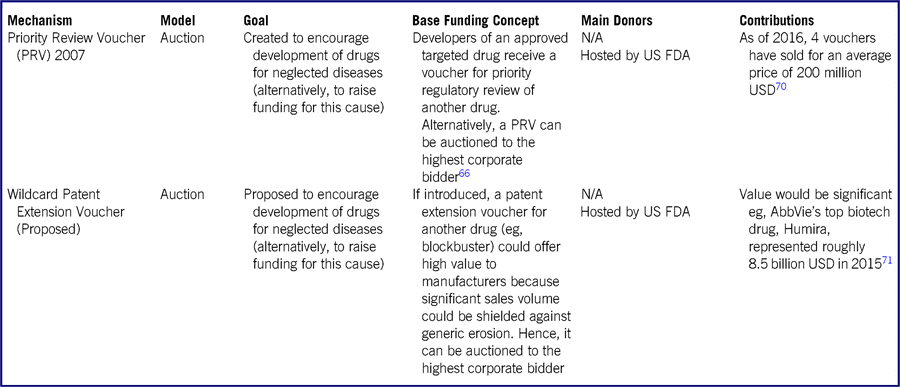
The Priority Review Voucher (PRV) grants a fast-tracked regulatory review for another more profitable drug within its portfolio. Achieving time reduction for marketing approval by means of priority review does not directly increase income. However, it does enable the manufacturer to sell the product earlier; thus, revenues can be reaped more short-term. This increases net present company revenues and its Net Present Value (NPV), which represents total development costs and expected present value of future revenues, given the relevant discount rate. Reference Sharma and Towse67 A Wildcard Patent Extension (also referred to as transferable intellectual property protection or tradable patent voucher) allows the recipient to extend the patent of another more profitable drug (eg, blockbuster drugs with annual sales of at least 1 billion USD) within its portfolio approaching patent expiration. Reference Mossialos, Morel and Edwards58-Reference Renwick and Brogan68
Auction models provide industry with the alternative to obtain these vouchers by purchasing them; thus, raising capital for CBRN MedCM preparedness initiatives. While funds generated from wildcard patent extension can be significant, such extension would also bear significant social costs. For instance, when companies apply the extension to disease areas that are not related to CBRN MedCM funding purposes, patients suffering from those nonrelated diseases would bear the costs of the extension. Namely, those patients would continue to pay higher prices than would have been the case otherwise. This unjustly transfers costs from 1 nonrelated disease area, for which the incentive was established, to a more profitable disease area for which it was applied. In this case, generic manufacturers would also be disadvantaged because the launch of their low-cost alternatives would be delayed in the market by means of the extension’s protection. Consequently, the auctioning of patent extensions has been delayed and remains subject to controversy. Reference Mossialos, Morel and Edwards58 In contrast to wildcard patent extensions; however, PRVs are very cost-effective because they create almost zero social costs: only those expenses associated with extra personnel needed to conduct a priority regulatory review are incurred. 69
Yet, to reinforce its own sustainability, BARDA strives to increase the efficiency of its approach. For example, there is higher priority to target MedCMs capable of broadening use to commercial areas. This entails increasing focus on MedCMs that have the capability to meet both CBRN and “peacetime” purposes. For instance, instead of protecting against specific chemical, radiological, and nuclear agents, new strategies are to treat injuries. This is because many pathologies resulting from exposure to these agents are similar to those observed with more common diseases. This can include pathogen reduction technologies for blood, silver-impregnated dressing for thermal (and other) burns, artificial skin substitutes, and debridement technologies for thermal burns (and diabetic ulcers), and antibiotics for resistant organisms. To fortify return on investment, BARDA has set a goal that 80% of its stockpile should include broader use MedCMs that extend to commercial areas. Reference Lurie65,Reference Disbrow72,Reference Hatchett73
Further BARDA sustainability initiatives include the enhancement of existing MedCMs, cost containment, use of existing technologies, as well as the exploitation of less costly stockpiling alternatives. Reference Hatchett73 Enhancements of MedCMs can include increasing yield and/or potency, extending shelf-life extensions, and simplifying storage. In addition, because one-agent, one-drug approach is not suited for new diseases, BARDA is shifting focus to platform technologies. Reference Lurie65 Concerning cost-containment measures, BARDA launched a cost containment tool in 2013 to improve financial planning and portfolio management. Referred to as Total Life Cycle Cost (TLCC), this tool aims to track the total cost to the US Government and sponsor of a MedCM over its full life (eg, discovery, development, acquisition, infrastructure, operations, support, and disposal). Reference Merkeley74
Use of existing technologies entails supporting the development of diagnostic assays that are compatible with existing commercial platforms Reference Hatchett73 and/or assessing viability of using MedCMs already approved for other diseases. For example, the active ingredient midazolam to treat nerve agent exposures is a benzodiazepine typically used to treat conditions such as seizures or to induce sedation. Silverlon® burn contact dressings can be applied to sulfur mustard burns and Alteplase® (originally indicated for the treatment of acute ischemic stroke) can treat sulfur mustard inhalation. Reference Hatchett73-Reference Laney75 Stockpiling alternatives include exploiting less expensive alternatives to traditional stockpiling, such as vendor-managed inventory—ie, industry guarantees specified quantity for government use in their own inventory. Reference Hatchett73
Collaborative Access Infrastructure
To further consider hard factors that can influence demand-side rationale for CBRN MedCMs, 2 additional cross-border partnering models are depicted to emphasize lessons learned during attempts to fortify more effective international response. The first model addresses the sharing of knowledge and technology during development of the Galileo space-based navigation system project. The second model describes deficits concerning international distribution compatibility of MedCMs that were revealed during the 2009 H1N1 influenza pandemic.
Knowledge and Technology Sharing
Public-private partnerships (PPPs) are commonly applied to situations where market conditions do not adequately entice industry to get involved. This is especially the case when new public goods or services must be financed, and public debt is already important or when demand for private goods and services is low, but governments want to encourage technological innovation and demand. Common themes of PPPs are the sharing of risk and the development of innovative, long-term relations between the public and private sectors. This concept can be extended to include multi-public-private partnerships (MP3) such as involving various EU Member States or cooperating with the United States to form a transatlantic multi-public–private partnership (TMP3). The main advantage of a multi-public-partnership (MPP) is avoidance of duplication in civil/scientific programs amongst the member states. Upon collaborating with private industry to transform the partnership to a MP Reference Pellérdi and Berek3 , the financial risk associated with high-technological requirements can be spread. Moreover, investors are enabled to feel more reassured about engagement due to the shared views of several countries (and higher number of committed customers); especially over politically sensitive security issues. Reference Zervos and Siegel76
To best illustrate potential advantages of these concepts, it is useful to refer to the EU’s Galileo space-based navigation system project. This project is considered as the most notable MPP and was created at the European level in 1970 when the European Space Agency (ESA) was formed. Reference Zervos and Siegel76 A key lesson drawn was that, even though some particular knowledge and technology had already been developed in other countries (eg, United States, Russia), the European-only collaboration project did not have access to it. While it would have been possible to develop such technologies independently, doing so would have added significant costs and time to the project. Furthermore, there was certainly no guarantee that the newly developed European technology would be superior to foreign technologies based on long learning curves. To quickly gain such technology and avoid delays in achieving the main goal, that is, creation of the Galileo space-based navigation system, extension of the MP³ model to TMP Reference Pellérdi and Berek3 , which included transatlantic support from the United States, was determined as advantageous. Given there are numerous and uncatalogued R&D projects that target new and innovative CBRN MedCMs, spanning across global public and private sectors, the sharing and consolidation of available knowledge and technology may bear significant potential to accelerate and fortify preparedness efforts.
Distribution Compatibility
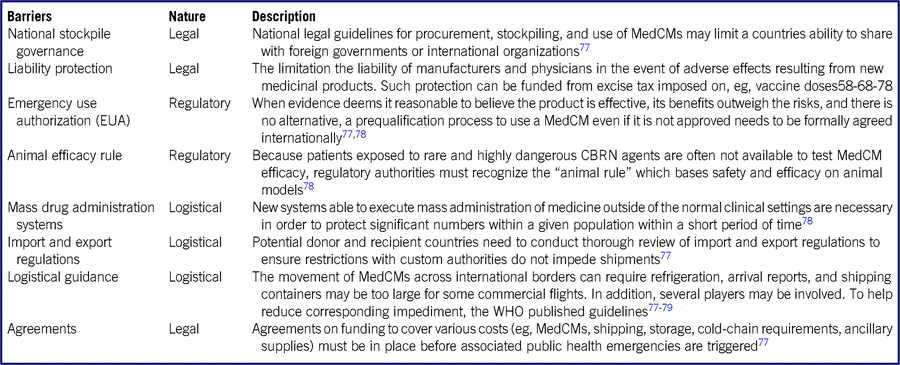
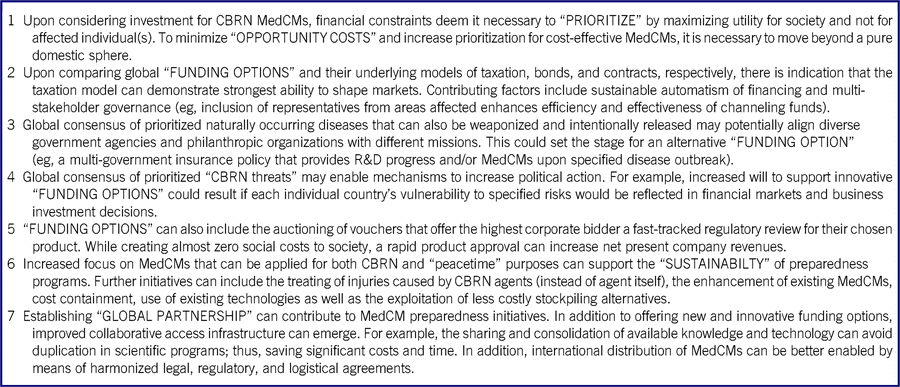
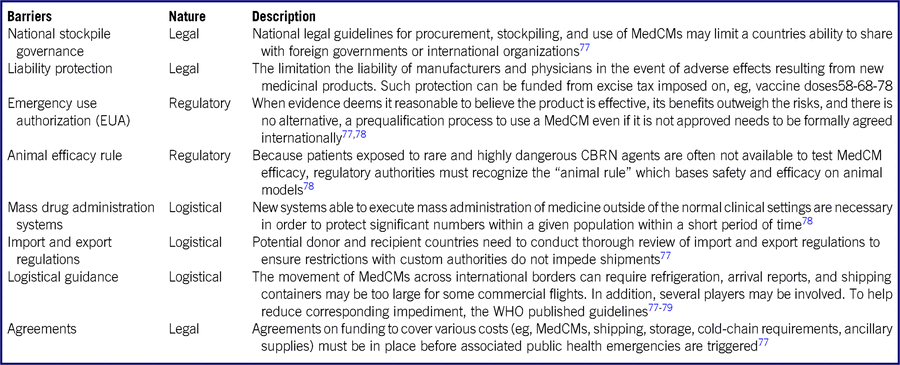
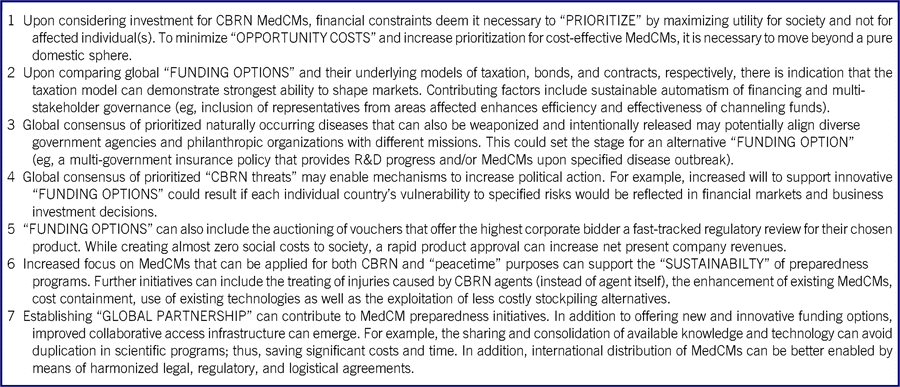
Despite it becoming clear since April 2010 that most of the vaccine produced in response to the 2009 H1N1 influenza pandemic was not needed and millions of doses had to be destroyed, this event provided an opportunity to learn much about infrastructure needed to achieve international distribution compatibility for MedCMs. While the intensity and quickness of the vaccination campaign reached an unprecedented level, it was rapidly apparent that several barriers hampered the efforts of the WHO as well as various governments to deploy and/or receive a vaccine. The nature of these barriers, summarized in Table 8, concerned poor pre-agreements on associated legal, regulatory, and logistical issues. To accelerate GHSI efforts to strengthen health preparedness and response for CBRN threats and pandemic influenza, Reference Marinissen, Barna and Meyers77 the Global Health Security Agenda (GHSA) was launched in 2014. GHSA partners include an expanded network of international organizations and over 50 partner countries. The aim of both the GHSI and the GHSA builds upon the objectives set by the WHO’s International Health Regulations (IHR). Hence, it includes the improvement of global distribution of MedCMs. Fortunately, the 2009 H1N1 influenza pandemic did not become more severe; thus, the consequences posed by MedCM distribution barriers were not detrimental. Although the high cost of unnecessary vaccines could have been better used, lessons learned from this event call for concerted collaboration of relevant organizations and policy-makers, regulatory and legal experts, as well as logisticians of the international community to narrow the global preparedness gap by improving infrastructure. Reference Marinissen, Barna and Meyers77 Key findings of this section on hard factor considerations are summarized in Table 9.
Barriers to International Distribution Compatibility of MedCMs
Section Take-Home Messages
CONCLUSIONS
By compiling and adapting existing economic models and concepts to gauge demand-side rationale, interdependent hard and soft factors can work together to strengthen integrity of policy-making associated with current demand requirements for CBRN MedCMs. Use of risk-informed framework can be useful to guide broader assessment that extends beyond more typical analysis of risk assessment and cost-benefit. To safeguard and enhance the sustainability of public health funding, a reduction of political and financial opportunity costs and avoidance of donor fatigue can be pursued. Namely, demand-side rationale ultimately requires acknowledgement and resource allocation by relevant politicians. Thus, enhancement of political motivation is key to enabling the availability of this public good.
In setting this context, a global approach to achieve MedCM solutions appears to offer significant advantages, with a team of world leaders best placed to raise the political importance. Likewise, sharing the overall burden for developing solutions would reduce the individual political and financial opportunity costs of each member. If coordinated globally (eg, by means of TMP3), it is conceivable that policy nudging could be induced. For example, friction would be removed because solutions are executed externally, while team dynamics, awareness of good behavior, and social norms would be created. This approach would also enable the global community to establish compatible legal, regulatory, and logistic infrastructure, as well as create access to a pool of the best available technologies to promote further risk mitigation and effectiveness of government efforts.
Preparedness stakeholders should consider partnering with credible institutions to inform political leaders of known threats, their consequences to member states, and the need to create viable countermeasure solutions. This may further enhance political motivation because anchoring effects could be diminished, and danger control responses to “fear messages” triggered. Because it is rational to expect politicians to seek opportunities that attract voter support, enhancing civilian appreciation for CBRN investment could further raise the issue’s importance while lowering the political opportunity costs. This could be achieved through better communication of CBRN threats and associated preparedness requirements to civilian communities.
Concerning the reduction of financial opportunity costs, the value of funding options that use taxation (eg, of dual-use technology), auctioning (eg, of priority regulatory review vouchers), and insurance models (eg, opt-out charging for coverage that allows access to latest MedCM technology) could be demonstrated. To fortify sustainability, increased focus on MedCMs that can be applied for both CBRN and “peacetime” purposes should be maintained. Further initiatives can include the treating of injuries caused by CBRN agents (symptomatic treatments instead of too specifically targeted treatments, viz. etiologic treatments), the enhancement of existing MedCMs, cost containment, use of existing technologies, as well as the exploitation of less costly stockpiling alternatives. In some cases, probability of cost-benefit can also be increased by scaling the evaluation of adverse economic impact caused by the release of CBRN agents by means of natural outbreaks or industrial accidents, which are more prone to occur. While such industrial events are more plausible for releases of chemical, radiological, and nuclear agents, it would appear less applicable to particular highly rare biological agents.
Through broader use of economic concepts and tools, it is suggested that government leaders could deem it more rational to allocate investment to develop and procure CBRN MedCMs if appropriately determined. Yet, this alone may not be enough. To further reinforce investment cases and create even more direct political incentive, it may be advantageous to prioritize CBRN threats by means of global consensus. This may potentially align diverse government agencies and philanthropic organizations with different missions. Moreover, if each individual country’s vulnerability to these specified risks could be reflected in financial markets and business investment decisions, this would transform CBRN MedCM preparedness initiatives from being solely a public health-care issue to a more mainstream political agenda item. Correspondingly, collaboration between governments, academia, private endeavors, and even institutions could expand. Likewise, this could further incentivize membership to an insurance concept that aims to provide availability of MedCMs that can mitigate the risks that prioritized CBRN agents can pose to social and economic structures.
Acknowledgments
Key thoughts from this study originate from the first author’s dissertation Reference Johnson80 that was codirected by Frédéric Dorandeu and Marianne Guille. The authors thank Joseph Lanfranchi and Ali Skalli from Université Panthéon-Assas for inspiring use of political/behavioral economics and Nigel Hale from CBRNE Ltd the use of risk-informed framework.
Compliance With Ethical Standards
All authors (Mark Lawrence Johnson, Jean Belin, Frederic Dorandeu, and Marianne Guille) declare no conflict of interest. No financial support was received for the preparation of this manuscript.