Unipolar depression is one of the most frequent psychiatric complaints and the first cause of disability worldwide (Murray & López, Reference Murray and López1996). In accordance with its relevance, a wide range of psychological therapies with their respective etiological models of depression have been proposed during the last decades.
One of such approaches is cognitive therapy (CT; Beck, Rush, Shaw, & Emery, Reference Beck, Rush, Shaw and Emery1979). CT is based on a diathesis stress model that proposes depressogenic schemas as the main cognitive vulnerability to depression. Depressogenic schemas contain extremely inflexible beliefs mainly focused on the need to be perfect and have others’ approval in order to be happy (de Graaf, Roelofs, & Huibers, Reference De Graaf, Roelofs and Huibers2009). They are thought to be shaped by early negative life experiences, to be relatively stable, and to remain latent until the individual encounters negative events that activate them (Beck et al., Reference Beck, Rush, Shaw and Emery1979). In this case, depressogenic schemas would skew the information processing system, leading to the production of negative automatic thoughts that constitute the cognitive triad (i.e., negative views about oneself, the world, and the future). These negative automatic thoughts are more unstable and state-dependent and are considered to be the most proximal cause of depressive symptoms (Kwon & Oei, Reference Kwon and Oei1994). In most cases, the CT model of depression has received empirical support from cross-sectional and longitudinal studies (e.g., Cui, Shi, & Oei, Reference Cui, Shi and Oei2013; Kwon & Oei, Reference Kwon and Oei1992; Oei & Kwon, Reference Oei and Kwon2007; Olinger, Kuiper, & Shaw, Reference Olinger, Kuiper and Shaw1987).
A more recent cognitive approach to depression is metacognitive therapy (MCT; Wells, Reference Wells2009), which is based on the metacognitive model of emotional disorders proposed by Wells and Matthews (Reference Wells and Matthews1994). The authors proposed that the cause of these disorders is not the presence of negative thoughts and emotions but the activation of a specific pattern of thinking called the Cognitive Attentional Syndrome (CAS). The CAS consists of repetitive thinking in the form of worry and rumination, excessive attentional focus on thoughts and feelings, and coping behaviors such as avoidance and thought suppression. It is problematic because it extends negative thinking, leads to reduced attentional flexibility, and a failure to exercise appropriate control over negative experiences (Wells, Reference Wells2009). According to the model, the CAS is generated by two types of metacognitive beliefs: (a) positive beliefs about worry, rumination, threat monitoring, and coping strategies; and (b) negative metacognitive beliefs about the uncontrollability of worry and rumination, and the threat of depressive experiences. On the one hand, positive beliefs lead to the use of the CAS as coping strategies in response to stress and mood changes, which in turn, due to the ironically nature of the CAS, causes more emotional disturbance. On the other hand, negative beliefs contribute to the persistence of rumination and worry because the individual lacks metacognitive awareness that these processes are subject to voluntary control. Accordingly, depressed individuals get entangled in ruminative cycles that they are unable to stop and fail to realize that the CAS is the problem and not the solution to their situation.
Lastly, another approach to depression is acceptance and commitment therapy (ACT; Hayes, Strosahl, & Wilson, Reference Hayes, Strosahl and Wilson1999). In the ACT model, psychological inflexibility is considered to be at the core of psychopathology and behavioral ineffectiveness, with empirical evidence showing that it mediates the effects of a wide range of psychological constructs and stressors on psychological symptoms (see reviews in Hayes, Luoma, Bond, Masuda, & Lillis, Reference Hayes, Luoma, Bond, Masuda and Lillis2006; Ruiz, Reference Ruiz2010). Psychological inflexibility entails the dominance of private experiences over chosen values and contingencies in guiding action (Bond et al., Reference Bond, Hayes, Baer, Carpenter, Guenole, Orcutt and Zettle2011) and it is usually described in terms of interrelated middle-level processes (e.g., Hayes et al., Reference Hayes, Masuda, Shenk, Yadavaia, Boulanger, Vilardaga, Hildebrandt, Woods and Kanter2007) including cognitive fusion, experiential avoidance, and lack of values clarity.
Cognitive fusion refers to a verbal process by which individuals become attached to private experiences (e.g., thoughts, memories, sensations, etc.) and fail to discriminate that they are only ongoing experiences that do not necessarily have to guide behavior. When the person does not have the skills to distance herself from private experiences, she often gets entangled with their content, losing contact with the present moment contingencies and engaging in some form of experiential avoidance (e.g., Luciano, Valdivia-Salas, & Ruiz, Reference Luciano, Valdivia-Salas, Ruiz, McHugh and Stewart2012). Experiential avoidance is a pattern of verbal regulation based on deliberate efforts to either avoid or escape from discomfiting private experiences, or to retain pleasant ones, even when doing so leads to actions that are inconsistent with one’s values and goals (Hayes, Wilson, Gifford, Follette, & Strosahl, Reference Hayes, Wilson, Gifford, Follette and Strosahl1996). When rigidly applied, experiential avoidance has a paradoxical effect because, although it often works in the short term in reducing discomfort and increasing the feeling that one is doing what one is supposed to do, it usually expands unwanted private experiences in the long term and further prevents the person from moving toward valued directions. Lastly, in the ACT context, values are seen as verbally constructed, freely chosen, positive reinforcers that promote patterns of behavior that are meaningful and fulfilling (e.g., Hayes et al., Reference Hayes, Strosahl and Wilson1999; Wilson & DuFrene, Reference Wilson and DuFrene2009; Wilson & Luciano, Reference Wilson and Luciano2002). Lack of values clarity prevents the person from behaving towards long-term abstract consequences, and makes acting towards short-term contingencies more probable, fusing with unwanted private experiences and involving in a pattern of destructive experiential avoidance.
Little research has been conducted exploring the interrelations of key constructs of the CT, MCT, and ACT models in the prediction of depressive symptoms. To our best knowledge, only two cross-sectional studies have analyzed the relationship between depressogenic schemas, psychological inflexibility, and emotional symptoms. Cristea, Montgomery, Szamoskozi, and David (Reference Cristea, Montgomery, Szamoskozi and David2013) found that psychological inflexibility mediated the relationship between dysfunctional schemas and emotional distress in a sample of undergraduates (Study 1). In Study 2, with a small sample of patients diagnosed with generalized anxiety disorder, they found that the effect of dysfunctional schemas on emotional distress was mediated by psychological inflexibility, the effect of which was further extended by increasing the frequency of negative automatic thoughts, which were the most proximal cause of emotional distress. In a study with undergraduates, Ruiz and Odriozola-González (Reference Ruiz and Odriozola-Gonzálezin press) found that psychological inflexibility mediated the effect of depressogenic schemas on negative automatic thoughts, which were the most proximal cause to depressive symptoms.
Although the MCT and ACT models come from different philosophical and theoretical standpoints, they share a number of similarities. For instance, the MCT concept of CAS, which involves perseverative worry and rumination, excessive attention to thoughts and feelings, and counterproductive coping behaviors such as avoidance and thought suppression, seems to be very similar to the ACT concepts of experiential avoidance and cognitive fusion. Indeed, worry and rumination have been proposed to be experiential avoidance strategies (Borkovec, Reference Borkovec, Davey and Tallis1994; Giorgio et al., Reference Giorgio, Sanflippo, Kleiman, Reilly, Bender, Wagner and Alloy2010; Roemer & Orsillo, Reference Roemer and Orsillo2002) and excessive attentional focus to thoughts and feelings resembles cognitive fusion. Also, as experiential avoidance, the CAS is thought to have counterproductive effects that lead to more emotional disturbance.
The current study was designed to explore the interrelationships of key constructs of CT (depressogenic schemas), MCT (dysfunctional metacognitive beliefs), and ACT (psychological inflexibility). One hundred and six participants responded twice to an online survey containing questionnaires assessing the constructs of interest with a lapse of nine months. Two predictions were made. First, and according to previous research (Cristea et al., Reference Cristea, Montgomery, Szamoskozi and David2013; Ruiz & Odriozola-González, Reference Ruiz and Odriozola-Gonzálezin press), it was predicted that psychological inflexibility would longitudinally mediate the relationship between depressogenic schemas and depressive symptoms. Second, given the similarities between the CAS and psychological inflexibility, it was hypothesized that psychological inflexibility would also mediate the relationship between dysfunctional metacognitive beliefs and depressive symptoms.
Method
Participants
The sample consisted of 289 participants (59.5% females) with age ranging between 22 and 82 years (M = 35.38, SD = 8.63). The relative educational level of the participants was: 7.3% primary studies, 32.8% mid-level study graduates, and 59.9% were college graduates. They responded to an anonymous internet survey distributed through social media. All of them were Spanish speakers. Thirty-six percent reported having received psychological or psychiatric treatment at some time, but only 6.6% were currently in treatment. Also, 4.8% of participants reported consumption of some psychotropic medication.
Instruments
Acceptance and Action Questionnaire – II (AAQ-II; Bond et al., Reference Bond, Hayes, Baer, Carpenter, Guenole, Orcutt and Zettle2011 )
The AAQ-II is a general measure of experiential avoidance or psychological inflexibility. It consists of 7 items that are rated on a 7-point Likert-type scale (1 = never true; 7 = always true). The items reflect unwillingness to experience unwanted emotions and thoughts (e.g., “I am afraid of my feelings,” “I worry about not being able to control my worries and feelings”) and the inability to be in the present moment and behave according to value-directed actions when experiencing psychological events that could undermine them (e.g., “My painful experiences and memories make it difficult for me to live a life that I would value,” “My painful memories prevent me from having a fulfilling life”). In this study, we used the Spanish version by Ruiz, Langer, Luciano, Cangas, and Beltrán (Reference Ruiz, Langer, Luciano, Cangas and Beltrán2013), which has shown a one-factor solution, good internal consistency (mean α = .88), and discriminant, convergent, and divergent validity.
Metacognitions Questionnaire-30 (MCQ-30; Wells & Cartwright-Hatton, Reference Wells and Cartwright-Hatton2004 )
The MCQ-30 is a short version of the MCQ-65. It is a 30-item, 4-point Likert-type scale (1 = do not agree; 4 = agree very much) that contains the following five factors: Positive Beliefs about Worry, Negative Beliefs about Uncontrollability and Danger of Worry, Beliefs about the Need to Control Thoughts, Cognitive Confidence, and Cognitive Self-Consciousness. Only the first three factors were administered in this study because they are the types of metacognitive beliefs most related to depression. The MCQ-30 has shown good internal consistency, convergent validity, and acceptable test-retest reliability. We used the Spanish version employed by Odriozola-González (Reference Odriozola-González2011), which showed good internal consistency in the subscales administered in the current study (alphas from .78 to .84).
Depression subscale of the Depression Anxiety and Stress Scales-21 (DASS-21; Antony, Bieling, Cox, Enns, & Swinson, Reference Antony, Bieling, Cox, Enns and Swinson1998 )
The DASS-21 is a 21-item, 4-point Likert-type scale (0 = did not apply to me at all; 3 = applied to me very much, or most of the time) consisting of sentences describing negative emotional states. It contains three subscales (Depression, Anxiety, and Stress), each one with seven items, and has shown good internal consistency and convergent and discriminant validity. We administered the Spanish version of the DASS-21 by Daza, Novy, Stanley, and Averill (Reference Daza, Novy, Stanley and Averill2002), which has shown good psychometric properties (Fonseca-Pedrero, Paino, Lemos-Giráldez, & Muñiz, Reference Fonseca-Pedrero, Paino, Lemos-Giráldez and Muñiz2010). Only the results of the depression subscale will be presented here because depressive symptoms are the criterion variable of this study.
Dysfunctional Attitude Scale – Revised (DAS-R; de Graaf et al., Reference De Graaf, Roelofs and Huibers2009 ; Weissman & Beck, Reference Weissmann and Beck1978 )
The DAS is a measure designed to evaluate depressogenic schemas that would constitute a main underlying factor of depression according to Beck’s CT (Beck et al., Reference Beck, Rush, Shaw and Emery1979). It comprises 40 items that are rated on a 7-point Likert-type scale (1 = fully disagree; 7 = fully agree). A revised version by de Graaf et al. (Reference De Graaf, Roelofs and Huibers2009) has been recently proposed (DAS-R) with 17 items and two subscales concerning Perfectionism/Performance evaluation (e.g., “It is difficult to be happy unless one is good-looking, intelligent, rich and creative,” “If I do not do as well as other people, it means I am inferior human being”) and Dependency (“My value as a person depends greatly on what others think of me”). In the present study, we used the Spanish version of the DAS by Sanz and Vázquez (Reference Sanz and Vázquez1993) without the 23 items eliminated by de Graaf et al. (Reference De Graaf, Roelofs and Huibers2009) for the DAS-R, which has shown good psychometric properties and the same factor structure (Ruiz et al., Reference Ruiz, Odriozola-González, Suárez-Falcón, Barbero-Rubio, Eisenbeck, López-López and Gilin press).
Procedure
At Time 1 (T1), an anonymous survey was distributed through social media with the title “Survey of Psychological Discomfort Applied to Online General Population.” The first page of the survey stated that the data obtained would only be used for scientific purposes and specified the requirements to participate: (a) to be older than 18 years old, and (b) to be a Spanish speaker. When participants provided informed consent, the previous questionnaires appeared in the order presented above. Nine months after the first survey application (T2), participants were invited to respond to the follow-up survey, which contained the same questionnaires, and was completed by 106 participants.
Data analysis
Descriptive data, Cronbach’s alphas, and zero-order relationships between all constructs were computed first. Because scores on the constructs of interest did not show a normal distribution, Mann Whitney’s U was computed to analyze potential differences between participants who completed the study and those who did not respond at T2.
Independent mediation analyses were conducted with the non-parametric bootstrapping procedure to estimate direct and indirect effects using the PROCESS package (Hayes, Reference Hayes2013). The predictor variables at T1 were depressogenic schemas (as measured by the DAS-R), and each of the specific types of metacognitive beliefs. The outcome was depressive symptoms as measured by the DASS-21 at T2. In all cases, the mediator variable was psychological inflexibility (as measured by the AAQ-II) at T2. Although the AAQ-II was administered at both waves, scores on T2 were selected because they were the most accurate assessment of what occurred between T1 and T2. To control for previous levels of depressive symptoms, the scores on the DASS-21 at T1 were entered as a covariate Footnote 1 in addition to the demographic variables. Indirect effects were deemed significant if the 95% bias corrected (BC) bootstrap confidence intervals (CI) for those effects based on 20,000 bootstrapped samples did not include zero.
Results
Descriptive data, internal consistencies and zero-order correlations
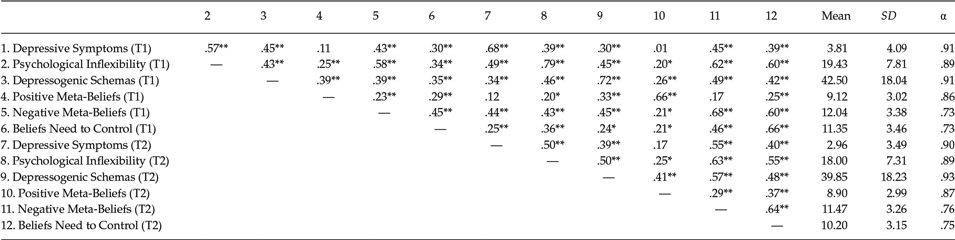
Table 1 shows the descriptive data, internal consistencies obtained for each scale, and the correlations between measures at T1 and T2. Participants’ mean scores on all measures did not differ significantly from scores obtained with nonclinical populations in other studies (e.g., de Graaf et al., Reference De Graaf, Roelofs and Huibers2009; Fonseca-Pedrero et al., Reference Fonseca-Pedrero, Paino, Lemos-Giráldez and Muñiz2010; Odriozola-González, Reference Odriozola-González2011; Ruiz et al., Reference Ruiz, Langer, Luciano, Cangas and Beltrán2013). The internal consistencies of the DASS-21, AAQ-II, and DAS-R were excellent, ranging from .89 to .93. The internal consistencies of the factors of the MCQ-30 were acceptable, ranging from .73 to .87. In all cases, Cronbach’s alphas were similar to previous evidence using all these instruments.
Descriptive Data, Internal Consistencies, and Correlations at T1 and T2

Note: *p < .05. **p < .01.
Participants who completed the study did not show statistically significant differences from the participants who did not respond to the questionnaires at T2 in psychological inflexibility (completers: M = 19.56, SD = 7.54; noncompleters: M = 19.36, SD =7.98; U = 9546.5, p = .82), depressogenic schemas (completers: M = 40.81, SD = 16.05; noncompleters: M = 43.48, SD = 19.08; U = 9161.5, p = .43), depressive symptoms (completers: M = 3.22, SD = 3.61; noncompleters: M = 4.15, SD = 4.32; U = 8568, p = .095), positive metacognitive beliefs (completers: M = 9.20, SD = 3.25; noncompleters: M = 9.08, SD = 2.89; U = 9677.5, p = .98), negative metacognitive beliefs (completers: M = 12.19, SD = 3.17; noncompleters: M = 11.96, SD = 3.50.; U = 9254.5, p = .51), and metacognitive beliefs about the need to control thoughts (completers: M = 11.17, SD = 3.26; noncompleters: M = 11.45, SD = 3.57; U = 9334.5, p = .59).
Mediation analysis of the effect of depressogenic schemas on depressive symptoms
The mediation analysis revealed that psychological inflexibility, as measured at T2, acted as mediator in the relationship between depressogenic schemas at T1 and depressive symptoms at T2 (see Figure 1). Depressogenic schemas significantly predicted the proposed mediator variable (i.e., psychological inflexibility, path a: TE = .166, SE = .044, p < .001) but not the dependent variable (i.e., depressive symptoms; path c or total effect: TE = .019, SE = .018, p = .29). However, psychological inflexibility at T2 significantly predicted depressive symptoms (path b: TE = .140, SE = .039, p = .0005) and the indirect effect of depressogenic schemas on depressive symptoms through psychological inflexibility was statistically significant (path ab), with a point estimate of .023 (SE = .010; 95% BC CI [.008, .048]).
Mediation analysis diagrams of the effect of depressogenic schemas on depressive symptoms through psychological inflexibility. Values are path coefficients representing unstandardized weights and standard error in parenthesis. The c path coefficient refers to the total effect of depressogenic schemas on depressive symptoms whereas the c-prime path coefficient refers to the direct effect.

Mediation analysis of the effect of specific types of dysfunctional metacognitive beliefs on depressive symptoms
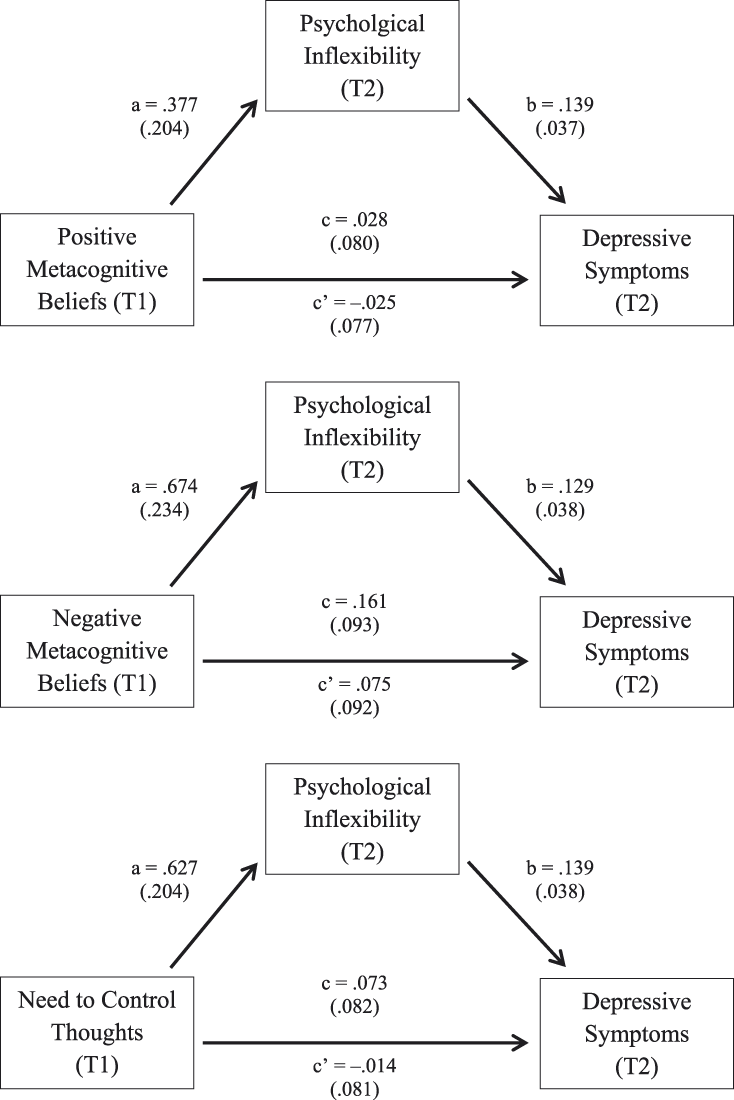
In the first mediation analysis, psychological inflexibility was shown to be a statistically significant mediator of the relationship between positive metacognitive beliefs at T1 and depressive symptoms at T2 (see Figure 2, upper panel). Positive metacognitive beliefs marginally predicted psychological inflexibility (path a: TE = .377, SE = .204, p = .07) but did not predict depressive symptoms (path c or total effect: TE = .028, SE = .080, p = .73). However, psychological inflexibility at T2 was a significant predictor of depressive symptoms (path b: TE = .139, SE = .037, p = .0003). The point estimate of the indirect effect (path ab) was .052 (SE = .031) and was statistically significant with 95% BC CI [.005, .134].
In the second mediation analysis, psychological inflexibility acted as a mediator in the relationship of negative metacognitive beliefs at T1 and depressive symptoms at T2 (see Figure 2, medium panel). Negative metacognitive beliefs at T1 predicted psychological inflexibility (path a: TE = .674, SE = .234, p < .01) and marginally predicted depressive symptoms (path c or total effect: TE = .161, SE = .093, p = .09) at T2. The latter prediction lost significance when psychological inflexibility was included in the model (path c’ or direct effect: TE = .075, SE = .092, p = .42); however, psychological inflexibility significantly predicted depressive symptoms (path b: TE = .129, SE = .038, p = .0009). The indirect effect was significant (path ab), with a point estimate of .087 (SE = .049, 95% BC CI [.016, .214]).
Lastly, Figure 2 (lower panel) shows that the third mediation analysis also revealed that psychological inflexibility was a mediator of the relationship of the metacognitive beliefs about the need to control thoughts at T1 and depressive symptoms at T2. The need to control thoughts at T1 predicted psychological inflexibility (path a: TE = .627, SE = .204, p < .01), but did not predict depressive symptoms (path c or total effect: TE = .073, SE = .082, p = .38) at T2. The latter prediction lost significance when psychological inflexibility was included in the model (path c’ or direct effect: TE = –.014, SE = .081, p = .87); however, psychological inflexibility was a significant predictor of depressive symptoms (path b: TE = .139, SE = .038, p = .0004). The indirect effect was significant (path ab), with a point estimate of .087 (SE = .051, 95% BC CI [.013, .220]).
Mediation analysis diagrams of the effect of dysfunctional metacognitive beliefs on depressive symptoms through psychological inflexibility. Values are path coefficients representing unstandardized weights and standard error in parenthesis. The c path coefficient refers to the total effect of dysfunctional metacognitive beliefs on depressive symptoms whereas the c-prime path coefficient refers to the direct effect.

Discussion
To our best knowledge, this is the first study that has analyzed the potential longitudinal mediating role of psychological inflexibility in the effect of both metacognitive beliefs and depressogenic schemas on depressive symptoms. The results show that psychological inflexibility, as measured at T2, acted as a mediator of the effect of depressogenic schemas and dysfunctional metacognitive beliefs at T1 on depressive symptoms at T2 after controlling for T1 level of depressive symptoms and demographic variables.
This study advances over previous cross-sectional studies that have shown that the relationship between dysfunctional schemas and depression was mediated by psychological inflexibility (Cristea et al., Reference Cristea, Montgomery, Szamoskozi and David2013; Ruiz & Odriozola-González, Reference Ruiz and Odriozola-Gonzálezin press). Accordingly, psychological inflexibility seems to play a relevant role in the CT model of depression and CT theorists might analyze the theoretical and practical implications of these findings. From an ACT perspective, depressogenic schemas can be seen as a type of rule governed behavior mostly characterized by the sensitivity to social whim, which in the ACT model is called generalized pliance (Luciano et al., Reference Luciano, Valdivia-Salas, Ruiz, McHugh and Stewart2012; Ruiz & Odriozola-González, Reference Ruiz and Odriozola-Gonzálezin press).
The mediational results can be seen as relatively consistent with the MCT model if we accept that the CAS significantly overlaps with the ACT constructs of cognitive fusion and experiential avoidance, which are key behavioral processes underlying psychological inflexibility. In the ACT context, dysfunctional metacognitive beliefs can be seen as verbal rules that prompt cognitive fusion with negative thoughts and feelings and the use of experiential avoidance strategies (e.g., rumination, thought suppression, etc.) to deal with them. For instance, positive metacognitive beliefs prompt the use of rumination and counterproductive coping behaviors such as suppression, threat monitoring, and avoidance to deal with negative thoughts. Likewise, negative metacognitive beliefs prevent the person from interrupting rumination, and promote further engagement in experiential avoidance because depressive experiences are viewed as dangerous. Further studies might analyze the commonalities between the MCT and ACT models more closely.
Some limitations of the current study are worth mentioning. Firstly, as all data were obtained using self-report measures, relationships among variables might be artificially inflated. Secondly, as the sample was made up of nonclinical participants, generalizability of the current findings may be limited. Thirdly, only 106 participants completed the study out of the 289 who responded to the survey at T1. However, no differences in the scores on the psychological constructs of interest were found between completers versus noncompleters. Fourthly, three subscales of the MCQ-30, which is a measure more relevant to anxiety than depression (Yilmaz, Gençöz, & Wells, Reference Yilmaz, Gençöz and Wells2011), were used in this study to assess dysfunctional metacognitive beliefs. There are metacognitive measures that assess metacognitive beliefs that are thought to be more specific to depression, such as the Positive Beliefs about Rumination Scale (PBRS; Papageorgiou & Wells, Reference Papageorgiou and Wells2001). The MCQ-30 was used for two reasons: (a) to our best knowledge, there was no Spanish translation of the PBRS available; and (b) as indicated by Wells et al. (Reference Wells, Fisher, Myers, Wheatley, Patel and Brewin2012), metacognitive measures more specific to depression mention depression and sadness in the items so that using them could lead to the possible problem of criterion contamination. Further research should include all five subscales of the MCQ-30 and specific metacognitive measures for depression in order to extend the findings of the present study. Lastly, the longitudinal design used in this study does not allow for attributions of causality because no independent variable was manipulated in this study. Nonetheless, longitudinal studies such as this one provide a way to test the predictive ability and interrelations of key concepts of psychological models of psychological disorders.
In conclusion, this is the first study that longitudinally compared key constructs of CT (depressogenic schemas), MCT (dysfunctional metacognitive beliefs), and ACT (psychological inflexibility) in the prediction of depressive symptoms. The results highlight the relevance of psychological inflexibility as the most proximal predictor of depressive symptoms and warrant the examination of further interrelationships between the CT, MCT, and ACT models of depression.