The staged Fontan palliation with a bidirectional cavopulmonary shunt and subsequent total cavopulmonary connection is currently a standard treatment strategy in patients with univentricular hearts. Reference de Leval, Kilner, Gewillig and Bull1–Reference Ono, Kasnar-Samprec and Hager4 The mid-term survival after total cavopulmonary connection has become excellent, with 90–97% at 10 years, Reference Ono, Kasnar-Samprec and Hager4–Reference Rogers, Glatz and Ravishankar9 and complications such as thrombus, tachyarrhythmia, and ventricular dysfunction have been significantly reduced after the introduction of a staged total cavopulmonary connection strategy. However, Fontan patients still face specific morbidities, including pleural effusions, chylothorax, protein-losing enteropathy, plastic bronchitis, and ascites. Reference Sharma, Iyengar and Zannino10–Reference Lo Rito, Al-Radi and Saedi12 Previous studies focused on the preoperative variables to identify factors affecting these morbidities and found several variables, such as high pulmonary artery pressure, reduced systemic ventricular function, atrioventricular valve regurgitation, heterotaxy syndrome, and right dominant ventricle. Reference Ono, Kasnar-Samprec and Hager4–Reference Rogers, Glatz and Ravishankar9,Reference Kaulitz, Ziemer, Luhmer and Kallfelz13–Reference Hosein, Clarke and McGuirk15 However, only few studies analysed how the early postoperative parameters might affect such morbidities following total cavopulmonary connection. Therefore, we hypothesised that the early postoperative haemodynamic and laboratory variables, following our current cohort of extra-cardiac total cavopulmonary connection, might predict the morbidities after extra-cardiac-total cavopulmonary connection.
Materials and methods
Ethical statement
The Institutional Review Board of the Technical University of Munich approved the study (approval number: 305/20 S-KH on 2nd June, 2020) and waived the need for informed consent from the patients who were retrospectively analysed in the study.
Patients and data collection
We reviewed all patients who underwent extra-cardiac-total cavopulmonary connection at the German Heart Center Munich between January 2012 and December 2021. At our institute, all patients were admitted to the ICU after the procedure and extubated early (about 3 hours after admission), according to our early extubation strategy. Reference Ono, Georgiev and Burri16 The early haemodynamic and laboratory data were collected using the electronic charts of the ICU. Serial pulmonary artery pressure, mean arterial pressure, peripheral oxygen saturation, and lactate levels were collected at the time of ICU admission, 6 and 12 hours after ICU admission and on the 1st, 2nd, and 3rd postoperative day. As we recognise that post-Fontan haemodynamic is closely related to the respiration status, these variables were also collected 1 hour before extubation, 1, 6, and 12 hours after extubation. In-hospital events were evaluated using the following variables: duration of chest tube drainage, chylothorax, and ascites needing drainage.
Operative techniques
The surgical techniques for extra-cardiac-total cavopulmonary connection were described in previous reports. Reference Ono, Kasnar-Samprec and Hager4 An 18 mm polytetrafluoroethylene graft (Gore-Tex, W.L. Gore&Assoc, Flagstaff, Arizona) was used most frequently, and the indications for fenestration were quite limited. Reference Ono, Kasnar-Samprec and Hager4
Follow-up and adverse outcomes
The patients obtained outpatient follow-ups with paediatric cardiologists. The most current vital status and follow-up data were obtained from our institutional single ventricle database, which is regularly tracked. The follow-up period was defined as the time from extra-cardiac-total cavopulmonary connection to the last follow-up for analysis. The adverse events after extra-cardiac-total cavopulmonary connection were defined as protein-losing enteropathy, plastic bronchitis, recurrent pleural effusions/chylothorax needing hospital admission, and thrombus formation. The impact of pulmonary artery pressure, mean arterial pressure, peripheral oxygen saturation, and lactate levels in the early postoperative period, up to 72 hours after ICU admission (3 postoperative days), on the occurrence of chylothorax, duration of chest tube drainage, ascites needing drainage, and adverse events after hospital discharge were analysed.
Statistical analysis
Categorical variables are presented as absolute numbers and percentages. The distribution of continuous variables is described by median and interquartile ranges. The outcomes of chylothorax and ascites were analysed by logistic regression. The time-dependent outcomes of chest tube duration and adverse events were analysed using Cox proportional hazard models. The p-values from the univariable Cox regression model and the univariable logistic regression model were adjusted using the conservative Bonferroni method. Furthermore, a conditional Random Forest model was used to rank the importance of variables with respect to their ability to predict the response. Reference Hothorn, Hornik and Zeileis17 Variables using Random Forest model are shown in the Supplementary Table S1. We assume a significance level at 5% for all statistical analyses. Receiver operating characteristic curve analysis with the prolonged chest tube drainage (> 7 days), chylothorax, ascites and adverse events was performed to determine the sensitivity and specificity of haemodynamic and laboratory variables for estimating the events. The Youden Index (J) was defined for all points on the receiver operating characteristic curve, and the maximum value of the index was used as a criterion for selecting the optimum cut-off point. Data analysis and graphing were performed with IBM SPSS Statistics for Windows, Version 28.0. The analyses for the Random Forest model were conducted in R version 4.3.0 (R Foundation for Statistical Computing, Vienna, Austria).
Results
Patients
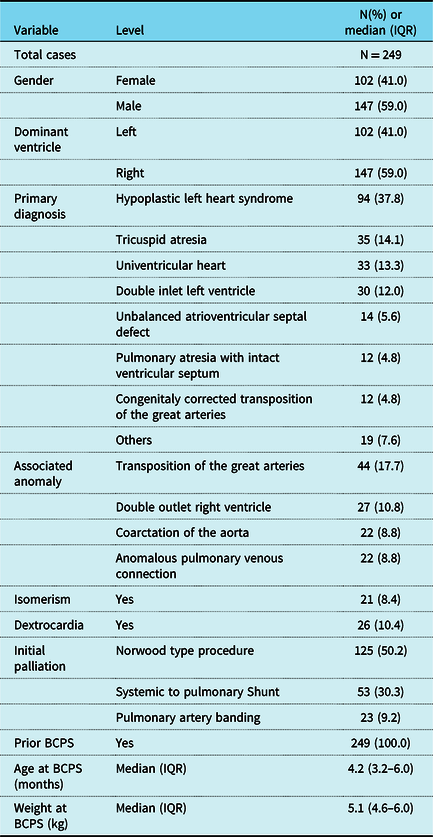
A total of 249 patients were included. Patient characteristics are shown in Table 1. The most frequent diagnosis was hypoplastic left heart syndrome (38%). All patients had previous bidirectional cavopulmonary shunt with median age and weight of 4.2 (3.6–6.0) months and 5.1 (4.6–6.0) kg, respectively.
Baseline characteristics

BCPS = bidirectional cavopulmonary shunt; IQR = interquartile range.
Perioperative outcome
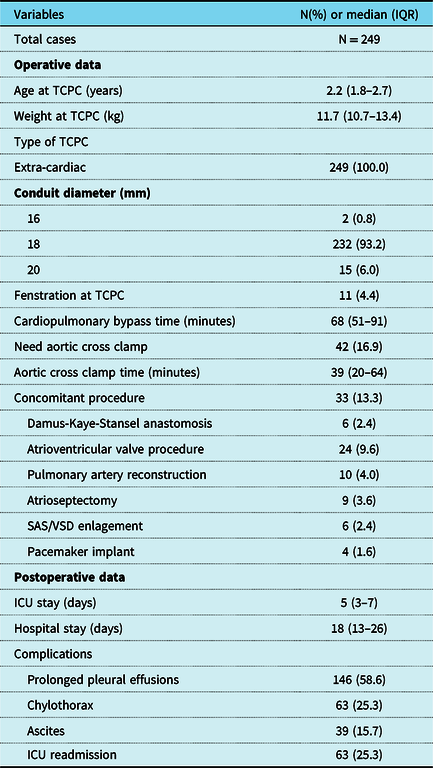
Operative and perioperative data are shown in Table 2. Median age at extra-cardiac-total cavopulmonary connection was 2.2 (1.8–2.7) years. There were no early deaths within 30 days following extra-cardiac-total cavopulmonary connection. The median ICU length of stay and hospital length of stay were 5 (3–7) and 18 (13–26) days, respectively. Postoperative chylothorax and ascites were observed in 63 (25.3%) and 39 (15.7%) patients after extra-cardiac-total cavopulmonary connection, respectively. The serial changes of early postoperative parameters are shown in Figure 1.
Perioperative variables

SAS = subaortic stenosis; TCPC = total cavopulmonary connection; VSD = ventricular septal defect.
Follow-up outcome
The median follow-up period after total cavopulmonary connection was 3.3 (1.5–5.0) years. Two late deaths occurred at 35 and 60 days after extra-cardiac-total cavopulmonary connection. Adverse events occurred in 16 patients at a median of 1.9 (0.5–2.8) years after extra-cardiac-total cavopulmonary connection, including protein-losing enteropathy/plastic bronchitis in 12 patients (protein-losing enteropathy alone in 7, plastic bronchitis alone in 3, both protein-losing enteropathy and plastic bronchitis in 2 patients), recurrent pleural effusions/chylothorax in 3 patients, and thrombus formation in 1 patient.
Influence of early postoperative pulmonary artery pressure, mean arterial pressure, peripheral oxygen saturation, and lactate levels on outcome
Chest tube duration
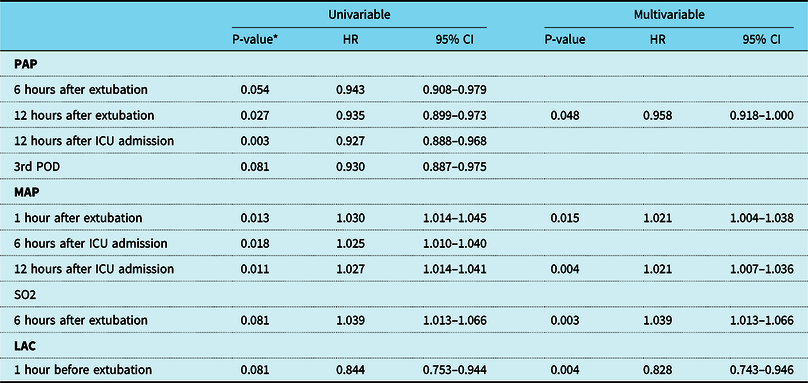
The significant variables in the univariable analysis are shown in Table 3. In the multivariable analysis, pulmonary artery pressure 12 hours after extubation (p = 0.048), mean arterial pressure 1 hour after extubation (p = 0.015), mean arterial pressure 12 hours after ICU admission (p = 0.004), peripheral oxygen saturation 6 hours after extubation (p = 0.003), and lactate levels 1 hour before extubation (p = 0.004) were associated with chest tube duration. The results of the Random Forest model showed pulmonary artery pressure 12 hours after ICU admission as the strongest variable for longer chest tube duration, followed by mean arterial pressure 72 hours after ICU admission and mean arterial pressure 6 hours after ICU admission (Fig. 2a).
Serial changes of early postoperative parameters after extra-cardiac-total cavopulmonary connection. ( a ): Pulmonary artery pressure (PAP), ( b ): Peripheral oxygen saturation (SO2), ( c ): Mean arterial pressure (MAP), and ( d ) Lactate levels (LAC). Admit = admission, extu = extubation.

Results of the Random Forest model to identify the 10 most related features for morbidities. ( a ) Chest tube duration, ( b ) Chylothorax, ( c ) Ascites, and ( d ) Adverse events.

Variables affecting chest tube duration after TCPC

POD = postoperative day; TCPC = total cavopulmonary connection; MAP = mean arterial pressure; SO2 = peripheral oxygen saturation.
* adjusted using the conservative Bonferroni method.
Chylothorax
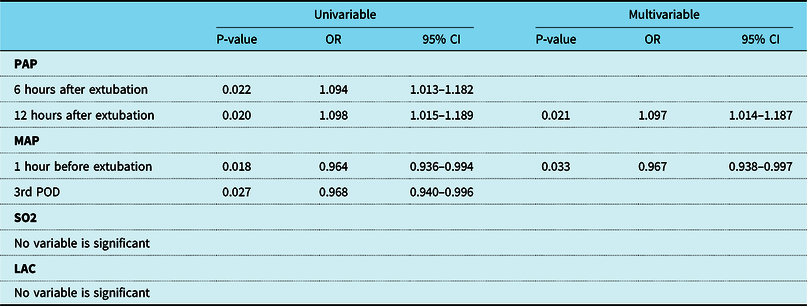
The significant variables in the univariable analysis are shown in Table 4. In the multivariable analysis, pulmonary artery pressure 12 hours after extubation (p = 0.021) and mean arterial pressure 1 hour after extubation (p = 0.033) were associated with chylothorax. The results of the Random Forest model showed pulmonary artery pressure 12 hours after extubation as the strongest variable for chylothorax, followed by mean arterial pressure 1 hour before extubation and pulmonary artery pressure 48 hours after ICU admission (Fig. 2b).
Variables affecting chylothorax after TCPC

POD = postoperative day; TCPC = total cavopulmonary connection; MAP = mean arterial pressure; SO2 = peripheral oxygen saturation.
Ascites
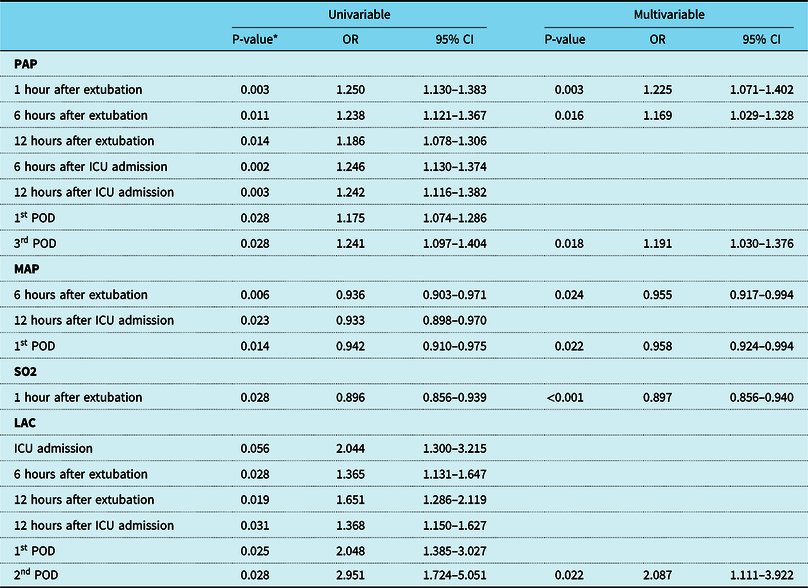
The significant variables in the univariable analysis are shown in Table 5. In the multivariable analysis, pulmonary artery pressure 1 hour after extubation (p = 0.003), pulmonary artery pressure 6 hours after extubation (p = 0.016), pulmonary artery pressure on the 3rd postoperative day (p = 0.018), mean arterial pressure 1 hour before extubation (p = 0.046), mean arterial pressure 6 hours after extubation (p = 0.024), mean arterial pressure on the 1st postoperative day (p = 0.022), peripheral oxygen saturation 1 hour after extubation (p < 0.001), and lactate levels on the 2nd postoperative day (p = 0.022) were associated with ascites. The results of the Random Forest model showed pulmonary artery pressure 6 hours after extubation as the strongest variable for ascites, followed by pulmonary artery pressure 6 hours after ICU admission and peripheral oxygen saturation 1 hour after extubation (Fig. 2c).
Variables affecting ascites after TCPC

POD = postoperative day; TCPC = total cavopulmonary connection; MAP = mean arterial pressure; SO2 = peripheral oxygen saturation.
* adjusted using the conservative Bonferroni method.
Adverse events
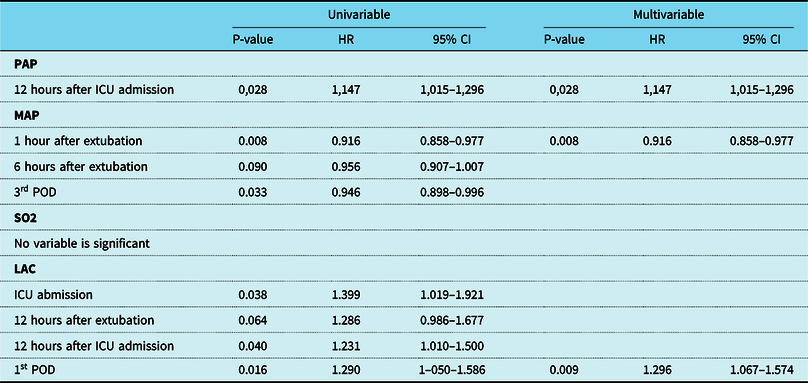
The significant variables in the univariable analysis are shown in Table 6. In the multivariable analysis, pulmonary artery pressure 12 hours after extubation (p = 0.028), mean arterial pressure 1 hour after extubation (p = 0.008), and lactate levels on the 1st postoperative day (p = 0.009) were associated with adverse events. The results of Random Forest model showed mean arterial pressure 1 hour after extubation as the strongest variable for ascites, followed by peripheral oxygen saturation 6 hours after ICU admission and pulmonary artery pressure 12 hours after ICU admission (Fig. 2d).
Variables affecting adverse events after TCPC

POD = postoperative day; TCPC = total cavopulmonary connection; MAP = mean arterial pressure; SO2 = peripheral oxygen saturation.
Receiver operating characteristic curve analysis
For the variables, which are significant in the multivariable analysis and in the Random Forest analysis, the cut-off values were calculated using the receiver operating characteristic curve analysis. The results are shown in Supplementary Table S2. For prolonged chest tube drainage (> 7 days), a cut-off value of 14.5 mmHg at pulmonary artery pressure 12 hours after ICU admission was identified with a model quality of 0.52. For chylothorax, a cut-off value of 13.5 mmHg at pulmonary artery pressure 12 hours after extubation was identified with a model quality of 0.53. For ascites, a cut-off value of 17.5 mmHg at pulmonary artery pressure 1 and 6 hours after extubation, and 6 hours after ICU admission was identified with a model quality of 0.62, 0.61, and 0.61, respectively. A cut-off value of 13.5 mmHg at pulmonary artery pressure 72 hours after ICU admission was also identified with a model quality of 0.59. A cut-off value of 1.45 mg/dl at lactate levels 48 hours after ICU admission was also identified with a model quality of 0.66. For adverse events, a cut-off value of 16.5 mmHg at pulmonary artery pressure 12 hours after extubation was identified with a model quality of 0.51.
Discussion
Summary of the results
The present study analysed the impact of postoperative haemodynamic and laboratory parameters on short and mid-term morbidities following extra-cardiac-total cavopulmonary connection. As a result, higher pulmonary artery pressure 12 hours after extubation/admission was associated with prolonged chest tube duration, chylothorax, and post-discharge adverse events. Lower mean arterial pressure 1 hour after extubation was a risk factor for prolonged chest tube drainage, chylothorax, and post-discharge adverse events. Higher lactate levels were associated with chest tube duration and adverse events. These results demonstrated that early postoperative haemodynamic and laboratory variables might be markers, which predict the in-hospital morbidities, as well as the post-discharge adverse events.
Timing for representative haemodynamic and laboratory parameters
The greatest challenge in assessing the early postoperative haemodynamic and laboratory parameters is their fluctuations in time. In addition, many factors such as dose of inotropes, respiratory condition, and volume administration influence the haemodynamic and laboratory parameters. Due to the refinement of operative techniques and postoperative management, the most recent patients after extra-cardiac-total cavopulmonary connection need no administration of catecholamines and can be extubated in the operative room or some hours after ICU admission. In 2009, our institute adopted an early extubation strategy in the ICU and achieved improved postoperative haemodynamics and recovery, regardless of the initial haemodynamic status. Reference Ono, Georgiev and Burri16 Therefore, we can achieve stable haemodynamics after early extubation in most of our patients. As we hypothesised, our investigation sampling serial timing after extubation and ICU admission demonstrated that pulmonary artery pressure 12 hours after extubation might be an ideal parameter to predict postoperative morbidities, such as prolonged pleural effusions, chylothorax, and adverse events. We also found that mean arterial pressure 1 hour after extubation was associated with chest tube duration, chylothorax, and adverse events. Therefore, mean arterial pressure soon after extubation is important to assess whether the Fontan circulation is well established. In this study, peripheral oxygen saturation was not strongly associated with postoperative outcomes. This is due to the limited number of patients with fenestrated extra-cardiac-total cavopulmonary connection.
As for the laboratory parameters, lactate levels were associated with chest tube duration, ascites, and adverse events. Our data demonstrated that lactate levels increased after ICU admission, were highest at 6 hours after extubation, and decreased over time. As for the timing, it varied between lactate levels 1 hour before extubation for chest tube duration, on the 2nd postoperative day for ascites, and on the 1st postoperative day for adverse events. Therefore, further studies are needed to clarify the best timing for this parameter.
Parameters affecting the outcomes following total cavopulmonary connection
In the current era, it is of the utmost importance that Fontan candidates have the lowest pulmonary artery pressure possible and a preserved ventricular function. Hosein, et al demonstrated that preoperatively elevated pulmonary artery pressure and impaired ventricular function had an adverse influence on both early and late outcomes. Reference Hosein, Clarke and McGuirk15 Ohuchi, et al demonstrated that a high pulmonary artery pressure and low peripheral oxygen saturation after the Fontan procedure strongly predicted the early and late clinical outcomes. Reference Ohuchi, Miyazaki and Negishi18 Rogers et al. demonstrated that higher pulmonary artery pressure was associated with mortality and prolonged hospital stay. Reference Rogers, Glatz and Ravishankar9 Our results clearly demonstrated that early postoperative higher pulmonary artery pressure was associated with prolonged chest tube drainage, chylothorax, and adverse events after hospital discharge. Although the timing when the parameters most significantly correlated with the morbidities varied, we found that pulmonary artery pressure 12 hours after extubation most frequently correlated with the morbidities. Receiver operating characteristic curve analysis revealed a cut-off value around 13 mmHg for prolonged chest tube drainage and chylothorax and 17 mmHg for ascites and post-discharge adverse events. Therefore, we assume that initial pulmonary artery pressure values with spontaneous breathing might be potential prognostic parameters to predict the outcomes after the Fontan procedure.
Postoperative mean arterial pressure might be a simple representative variable of systemic ventricular function. Our previous study demonstrated that mean arterial pressure increased significantly soon after extubation, both in stable and unstable patients. Reference Ono, Georgiev and Burri16 The results of this study demonstrated that mean arterial pressure 1 hour after extubation might be a representative parameter, predicting the preserved ventricular function and good Fontan haemodynamics. Other haemodynamic and laboratory parameters, such as peripheral oxygen saturation and lactate levels were also associated with in-hospital morbidities and adverse events, but their impact was weaker when compared to pulmonary artery pressure and mean arterial pressure.
Future prospective
Our results demonstrated that pulmonary artery pressure 12 hours after extubation was associated with postoperative prolonged chest tube drainage and chylothorax (with a cut-off value of 13–15 mmHg), as well as adverse events after hospital discharge (with a cut-off value of 17 mmHg). Mean arterial pressure 1 hour after extubation was also associated with postoperative prolonged chest tube drainage and chylothorax, as well as adverse events after hospital discharge. Therefore, we could identify these high-risk patients on the first postoperative day. Patients with a pulmonary artery pressure higher than 17 mmHg after extubation should receive special care. Early medication, close observation, and early treatment or prevention of the complications might be important. Risk stratification could be performed using these parameters. For refined management of high-risk patients, further studies are mandatory to establish risk stratification algorithms.
Study limitations
This study is limited by its retrospective and single-center design. Many factors, including volume administration and inotropic support guided by the attending ICU physician, might reflect the postoperative haemodynamics and bias haemodynamic and laboratory parameters.
Conclusions
Our results demonstrated that pulmonary artery pressure 12 hours after extubation and mean arterial pressure 1 hour after extubation were associated with prolonged chest tube drainage, chylothorax, and adverse events after hospital discharge. These early postoperative parameters might be useful markers to anticipate early and late complications after total cavopulmonary connection, with consideration of early diagnosis and appropriate intervention.
Supplementary material
The supplementary material for this article can be found at https://doi.org/10.1017/S1047951124000040.
Author contribution
Chiara Di Padua and Takuya Osawa contributed equally.
Financial support
None.
Competing interests
None.