Group identity attributes have been both a help and hindrance to the candidates holding them (Campbell, Gurin, and Miller Reference Campbell, Gurin and Miller1954; Funk Reference Funk1996; Hayes Reference Hayes2005; Kimball and Patterson Reference Kimball and Patterson1997). Although perceptions of candidate competence and warmth often receive greater attention (Kinder et al. Reference Kinder, Peters, Abelson and Fiske1980; Rahn et al. Reference Rahn, Aldrich, Borgida, Sullivan, Ferejohn and Kuklinski1990), a candidate's group identity traits may be a wild card, particularly where religious affiliation may be suspect. This is, after all, a country where a Roman Catholic did not occupy the Oval Office until 1961. Some 45 years later, another Massachusetts politician, former governor Willard “Mitt” Romney, discovered that the passage of time did not reduce the scrutiny his religious identity garnered. Although some have determined Mitt's Mormonism to be a detrimental electoral factor (Campbell, Green, and Monson Reference Campbell, Green and Monson2012), we assess whether and how it might be parlayed into a partisan advantage.
To be sure, Romney's faith was hardly an albatross in 2012. Polls suggest that many on the Right eventually overcame any aversion to supporting a Mormon nominee, especially as their desire to defeat president Barack Obama took precedence (Kucinich Reference Kucinich2012; Public Religion Research Institute 2012). Yet if the presidential race was determined by unanticipated levels of turnout, then we cannot entirely dismiss Romney's Mormonism as a lingering drag on his performance (Eckholm Reference Eckholm2012). Although Romney's faith likely did not inspire Democratic counter-mobilization (see Kramer Reference Kramer1970; Huckfeldt and Sprague Reference Huckfeldt and Sprague1992), we wonder about social desirability effects within GOP circles. Just as the “Bradley effect” may lead to over-reported support of minority candidates in preelection polling (see Payne Reference Payne2010), some GOP identifiers, including white evangelicals, may have tended to over-report their comfort and enthusiasm with a Mormon standard bearer.
On Election Day 2012, in national exit polls 78% of white evangelicals claimed to have voted for Romney, while 82% of conservatives reported doing the same. Although these are high percentages, they are not as high as, for example, Obama's 86% share of liberals (Webster Reference Webster2012). The Tea Party, for that matter, was also a mixed bag of support, with 12% of strong movement identifiers voting for Obama and around one quarter of weak identifiers doing the same (Debenedetti Reference Debenedetti2012). And, although no other religious group voted in as high a percentage for one candidate as white evangelicals did for Romney, his 78% support left more than one-fifth of self-identified white evangelicals “on the field” (Obama won a majority of Roman Catholics). This makes the assurance of Romney support from a key GOP constituency far less certain than conventional punditry suggests. Indeed, despite four years of Republican focus on denying Obama a second term, Romney managed to win two million fewer votes than did senator John McCain in 2008—suggesting an overall drop in GOP support. Hence, it is worth asking whether Romney's problem was a lack of enthusiasm even among groups whose support was considered won.
In trying to refute the “Massachusetts moderate” characterization during the Republican primary, Romney's campaign used a variety of communication strategies to secure support from conservatives and evangelicals alike (Finnegan Reference Finnegan2012; see also Jacobs and Shapiro Reference Jacobs and Shapiro1994; Jerit Reference Jerit2004). Because shared opinions and values are critical in establishing voter trust (Carmines and Stimson Reference Carmines and Stimson1989; Edelman Reference Edelman1964; Sears, Hensler, and Speer Reference Sears, Hensler and Speer1979), Romney adopted some of the policies championed by his strongest conservative primary rival: former Pennsylvania senator Rick Santorum. These included rigid opposition to same-sex marriage, civil unions, and abortion (Blake and Henderson Reference Blake and Henderson2012). And, despite his campaign's overarching economic issue focus, Romney continued to emphasize a shared religiosity by mentioning his faith (although Mormonism itself often went unmentioned) (but see Kranish and Viser Reference Kranish and Viser2012). In making these policy and religious appeals, Romney tapped into the power of political heuristics to rally GOP voter groups to his side, allowing him to exploit the cultural touchstones long-effective in Republican campaigns (Leege et al. Reference Leege, Wald, Krueger and Mueller2002; Mendelberg Reference Mendelberg2001).
GOD TALK: SUBTLY COURTING THE BASE
The heuristics advantage reflects the reality that voters, even many motivated ones, try to make quick political decisions (Lau and Redlawsk Reference Lau and Redlawsk2001, Reference Lau and Redlawsk2006). To do this, they use cognitive shortcuts that focus on, among other things, candidate-affiliated “ingroups” (Berinsky and Mendelberg Reference Berinsky and Mendelberg2005; Hogg and Abrams Reference Hogg and Abrams1988; Tajfel and Turner Reference Tajfel, Turner, Worchel and Austin1986). To exploit the advantages of group religion, Republican candidates have used coded religious campaign appeals primarily intended for white evangelical reception (see Kuo Reference Kuo2006). These “God Talk” cues, as Calfano and Djupe (Reference Calfano and Djupe2009) termed them, deliver covert, identity-based signals that boost candidate credibility and acceptability with the targeted ingroup. And, the cues are designed to avoid outgroup notice, such as from Democrats and those hostile to religion in secular political life (see Djupe and Calfano Reference Djupe and Calfano2013). Yet, just as God Talk might prove invaluable as a group identity appeal, other stereotyped candidate attributes might render the covert cue null. Romney's Mormonism brings a potentially cross-cutting force to his God Talk use, making it unclear whether these coded-message strategies help build bridges for candidates or merely reinforce existing group cleavages.
Because religious cues are not offered in an information vacuum, we compare their effect to another type of candidate ingroup cue: party-congruent policy information. Given its natural tie-in to Tea Party concerns and its “easy” issue characterization, we focus here on immigration (Carmines and Stimson Reference Carmines and Stimson1980; Leege et al. Reference Leege, Wald, Krueger and Mueller2002; Skocpol and Williamson Reference Skocpol and Williamson2011). Our comparison enables evaluation of whether candidates in Romney's position may more effectively overcome negative attributes using party-congruent policy rhetoric or the covert God Talk strategy. In addition, Romney's candidacy may stoke affective responses from party faithful (Marcus and MacKuen Reference Marcus and MacKuen1993). We are especially interested in anger generated among GOP identifiers. According to Valentino et al. (Reference Valentino, Brader, Groenendyk, Gregorowicz and Hutchings2011), anger is a powerful galvanizer of political action, but, when directed toward one's own partisan group, it may actually diminish candidate support. Thus, anger is relevant in evaluating mitigation strategies. At the same time, assessing anger directed at the party helps diminish social desirability tendencies in asking partisans to make the same claim about an actual candidate.
CANDIDATE ATTRIBUTE EXPERIMENT
Leveraging the causal inference provided by experimental design using media platforms (Gerber, Green, and Kaplan Reference Gerber, Green, Kaplan, Shapiro, Smith and Massoud2004; Green, Calfano, and Aronow, Reference Green, Calfano and Aronowforthcoming) our data come from a spring 2012 survey experiment featuring 318 self-identified Republicans, including those identifying as “independent near Republican.” Subjects were drawn from a larger pool that also included 193 Democrats and 44 independents (who are not used in this analysis). All subjects were recruited through two methods: participation credit in political science classes at a large public university in Missouri and local metro-area media advertisements asking for adult survey participants. The resulting subject pool is a combination of college students and noncollege age adults (age range from 18 to 66, with 47% between 24 and 66). Subject recruitment in this particular geographic region provided a particular advantage because the area has been identified as an epicenter of both evangelical and Tea Party activities (see Chinni and Gimpel Reference Chinni and Gimpel2010). Therefore, we have a higher-than-average potential of including GOP identifiers with political preferences receptive to party-congruent policy and God Talk cues and suspicious—if not hostile—toward outgroup religious identities. All subjects were provided e-mail-embedded links to the experiment fielded through Qualtrics and asked to respond online within a specified five-day period (March 14–19, 2012).
The experiment followed a 2 × 3 factorial design that randomly assigned subjects to one of five treatments or a control condition. Each treatment consisted of one of three images designed to look like a political direct mailer (see Appendix). Above each of the images, subjects received descriptive information about the candidate (a white male in the mailer photograph), informing them that he is a “candidate for the Republican Party's nomination for President of the United States.” Half of the sample was primed with information that the candidate is “Mormon” immediately prior to viewing the mailer image. Mailer content varied at random between three different messages. In one, participants saw the candidate offering party-congruent views on immigration policy. In the second condition, participants saw a God Talk cue that Calfano and Djupe (Reference Calfano and Djupe2009) tested from Kuo's (Reference Kuo2006) revelation of the GOP strategy. The third control condition included boilerplate language that asked mailer recipients to provide their support.Footnote 1
Following exposure to their assigned condition, subjects were asked a battery of candidate evaluation questions, including measures of perceived electability, a feeling thermometer, and a likelihood of voting for the candidate.Footnote 2 Also included were three subject emotion questions (including anger) directed at the Republican Party and patterned after Marcus's (Reference Marcus2002) example for these indicators.Footnote 3 Because the treatment content—including mention of the candidate's Republican and/or Mormon affiliation—was readily accessible when answering the emotion response items, we are confident that the cognitive link between the party, candidate, and subject affective response was palpable.Footnote 4
RESULTS
Although not one of our featured outcome variables, 174 of the 318 GOP subjects indicated a preference for “stricter enforcement of laws against illegal immigration” as part of their survey response. This suggests that they were positioned to have strong reactions to the candidate's conservative immigration policy. At the same time, the 129 subjects identifying as “evangelical” had higher levels of expressed anger at the GOP following candidate exposure versus the 189 nonevangelicals in the sample (χ2 = 39.05, p < .01). Meanwhile, the 124 Republican subjects who identified as the most conservative had higher anger levels at the GOP after candidate exposure than did the remaining subjects (χ2 = 50.07, p < .01). Although the interaction of subject evangelical identity and conservatism was not significant in anger response, the noted difference for the base variables might indicate these partisans are ripe for anger when encountering unfavorable candidate attributes such as Mormonism. No differences or interactions with the Tea Party measure were significant.
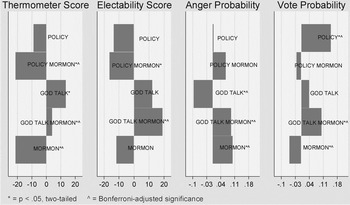
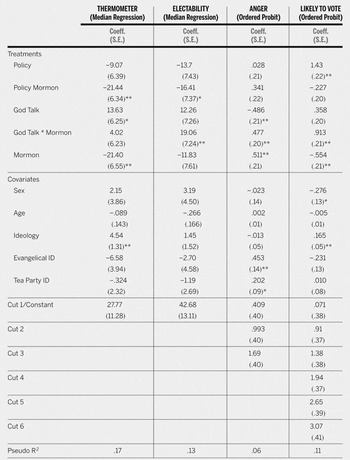
Figure 1 presents our median regression results for the candidate feeling thermometer and electability scores.Footnote 5 It also includes ordered probit outcomes providing the probability of feeling anger toward the Republican Party and voting for their assigned candidate. The models include several covariatesFootnote 6 (results featured in table 1), although the direction and significance of the treatment indicators did not change when run alone. The control condition is the omitted category across the four models. Significance levels in figure 1 are reported using Bonferroni-adjusted standard errors for our five-treatment group design p < .008.
Treatment Effects on Four Dependent Variables vs. Control Candidate
(Median regression for the first two columns, ordered probit for the last two columns)

Candidate Feeling Thermometer, Electability and Likelihood to Vote Regressed on Experiment Conditions, Demographics, and Subject Anger

*** p < .001,
** p < .01,
* p < .05 (all two-tailed) N = 318
Overall, the Mormon candidate is viewed more coolly than the control by slightly more than 20 points on the feeling thermometer, while subjects perceived Mormon electability almost 12 points lower than the control candidate. These Republicans are also about 10% more likely to express anger toward the Republican Party after viewing a Mormon candidate vying for its nomination, and about 5% less likely to cast a vote for the Mormon. Taken alone, these results suggest trouble for a Romney-like candidate, except that voters have additional information available to them in a real campaign context—including elements of the two mitigation strategies that we test.
Subjects favor the candidate presenting the immigration policy argument as much as the control (the difference is not significant), see the candidate as less electable (p = .08), and are not any more angry at the Republican Party than they are when exposed to the control. Most importantly, our GOP subjects are about 15% more likely to vote for this candidate. As seen across the outcome measures, pairing the policy stance with Mormon identification is a marginally helpful mitigation strategy. This result is because the anti-immigration Mormon is disliked as much as the Mormon, is seen as less electable than the control, and engenders vote support that is indistinguishable from the control candidate. The upshot is that the anti-immigration Mormon avoids encouraging subject anger at the GOP (like the control). Overall, the party-congruent policy statements provide barely perceptible advantages in attribute mitigation.
God Talk, by contrast, appears to be more effective. The God Talk candidate is looked on more warmly by subjects and is considered more electable versus the control. Importantly, these advantages are shared by the Mormon candidate using God Talk cues. That candidate is better liked than the control, is seen as more electable, and gains a sizable boost in vote support (about an 11% probability increase). There is, however, one main drawback: the God Talk-using Mormon builds significant subject anger toward the GOP—almost as much as the Mormon candidate alone. Hence, although GOP identifiers appear willing to vote for a Mormon candidate sending broad and coded religious cues, they foment anger at their party for having to do so. This finding is hardly trivial in light of the 22% of white evangelicals and 12% of strong Tea Party identifiers not voting for Romney. To be sure, subject anger does not explain the gaps in support for Romney from these two GOP constituencies. However, it points to a possible moderating relationship where party-centered anger chips away candidate support at the margins. In cases when swings of even a few percentage points in constituent support can have large electoral consequences, the affective response to candidates mitigating unfavorable attributes in a campaign is ripe for additional research.
CONCLUSION
Taken in tandem, these results show that Mormon candidates face some substantial, but not completely insurmountable, challenges in garnering Republican support. Religion appears to be both the problem and a partial solution. Religious cues are not hammers that can knock voting blocs into any desired position. As the lack of response among Tea Party identifiers in the subject pool suggest, the God Talk cues are more effective, on average, than policy-congruent statements, but they exact an emotional price for their effectiveness. The God Talk strategy has not been assessed when articulated by a candidate with a negative group identity relative to her or his partisan base. The good news for Mormon candidates, and perhaps minority candidates more generally, is that the strategy has a positive impact.
Perhaps our most intriguing finding is that although God Talk lessened negative assessments of the Mormon candidate, it did not flag anger toward the Republican Party. Of course, the GOP subjects were unwilling to harm the candidate's electoral chances despite their affective reaction or, at least, indicate this intention in a survey response to our experiment. Yet this finding still does not discount the possibility that party-directed anger takes some toll on actual candidate support where it counts—at the polls. The palpable increase in anger within our GOP subject pool, coupled with the not-inconsequential percentages of key Republican constituencies abandoning Romney on Election Day, recommends additional reflection on the continued use of the now-familiar constituent appeal strategies Republicans have used. Here, we find that a Mormon candidate can use a proven religious cueing technique to boost his conservative bona fides and ingroup appeal, but the associated anger directed at the ingroup party may carry unknown putative costs for candidate and party interests alike.
APPENDIX: Experimental Conditions
“God Talk” Condition is same as Control, but replaces the Control quote with: “We have this land, and we're told to be good stewards of it and each other.”