

Introduction
In order to maintain homeostasis under exercise stress, the hypothalamus–hypophysis–adrenocortical (HPA) axis is activated together with the autonomic nervous system. The secretion of adrenocorticotrophin (ACTH) and cortisol is modulated by the intensity, duration and type of exercise, as extensively reportedReference Thornton1–Reference Ferlazzo, Fazio, Medica and Boffi8.
Endorphins are endogenous, opiate-like peptides of pituitary origin that modulate pain perception and they also play a role in the response to physical and psychological stress. In man, the heightened activation of the HPA axis and increased β-endorphin modulate the time to fatigue and are associated with performance impairmentReference Adler9.
In horses, plasma β-endorphin, ACTH and cortisol are considered to be reliable physiological markers for welfareReference Canali, Ferrante, Mattiello, Sacerdote, Panerai, Lebelt and Zanella10–Reference McCarthy, Jeffcott and Clarke12 and performance/fitness evaluationReference McCarthy, Jeffcott, Funder, Fullerton and Clarke13. The association of plasma β-endorphin concentrations with the severity of exercise stress has also been studiedReference Mehl, Sarkar, Schott, Brown, Sampson and Bayly14, Reference Mehl, Schott and Sarkar15.
It has been reported that increases in plasma cortisol induced by ACTH administration could be used to predict the exercise-induced stress responseReference Marc, Parvizi, Ellendorff, Kallweit and Elsaesser16. It is widely known that physical exercise generally induces a clear-cut increase in circulating cortisol levels, even from activities requiring exercise of mild intensity and short duration, such as showjumpingReference Lekeux, Art, Linden, Desmecht, Amory, Persson, Lindholm and Jeffcott3, Reference Ferlazzo, Fazio and Lindner5, Reference Linden, Art, Amory, Desmecht, Lekeux, Persson, Lindholm and Jeffcott17.
In Thoroughbreds, exercising on a treadmill, the response of cortisol to an incremental exercise and two constant relative workload exercises (105 and 80% VO2max) appeared to be correlated with the duration of exercise but were not correlated to plasma ACTHReference Nagata, Takeda, Kurosawa, Mima, Hiraga, Kai and Taya18. However, cortisol secretion from the adrenal cortex in the horse is generally promoted by ACTH administration and/or endogenous releaseReference Church, Evans, Lewis, Rose, Gillespie and Robinson2, Reference Linden, Art, Amory, Desmecht and Lekeux19.
It is well known that the cortisol response usually depends on the state of individual fitness and trainingReference Linden, Art, Amory, Desmecht, Lekeux, Persson, Lindholm and Jeffcott17, Reference Foreman and Ferlazzo20–Reference Lindner, Fazio, Medica and Ferlazzo22. Moreover, training may produce a more rapid decline in cortisol levels after exercise towards resting valuesReference Church, Evans, Lewis, Rose, Gillespie and Robinson2, while overtraining has been associated with a reduction in the cortisol response to exerciseReference Golland, Evans, Stone, Tyler, Rose and Hodgson23, Reference Golland, Evans, Stone, Tyler-McGowan, Hodgson and Rose24. It has been reported that cortisol and β-endorphin modifications usually occur in phase in response to exerciseReference McKenna, Lembert, Evans and Foreman25.
Age as well as training has been reported to affect β-endorphin basal levels and the hormonal response to acute exerciseReference McCarthy, Jeffcott, Funder, Fullerton and Clarke13, Reference Malinowski, Shock, Roegner, Rochelle, Kearns, Guirnalda and McKeever26, Reference Malinowski, Shock, Rochelle, Kearns, Guirnalda and McKeever27. Falling ACTH and β-endorphin values were recorded after trainingReference McCarthy, Jeffcott, Funder, Fullerton and Clarke13. After overtrainingReference Golland, Evans, Stone, Tyler-McGowan, Hodgson and Rose24, the mean β-endorphin concentrations in resting horses were not significantly different.
Exercise produces significantly increased concentrations in β-endorphinReference McCarthy, Jeffcott, Funder, Fullerton and Clarke13, Reference Golland, Evans, Stone, Tyler-McGowan, Hodgson and Rose28. Treadmill exercises at submaximal levels of exercise produced significant increased concentrations of β-endorphin in horse plasma, while ACTH levels did not changeReference McCarthy, Jeffcott, Funder, Fullerton and Clarke13. In contrast, acute vigorous physical exercise promptly heightened both pituitary venous blood ACTH as well as vasopressin, the main ACTH secretagogueReference Alexander, Irvine, Ellis and Donald29. Moreover, increased plasma ACTH concentrations have been recorded in response to exhaustive incremental treadmill exerciseReference Kurosawa, Nagata, Takeda, Kurosawa, Mima, Hiraga, Kai and Taya30. The ACTH response found was more sensitive to the intensity of exercise and showed a significant correlation with blood lactate concentrationsReference Nagata, Takeda, Kurosawa, Mima, Hiraga, Kai and Taya18 and with plasma vasopressin concentrations during incremental exercise testsReference Hada, Onaka, Takahashi, Hiraga and Yagi31.
The effect of exercise duration on β-endorphin modifications was found to be highly dependent on the type of exercise performedReference Goldfarb, Hatfield, Armstrong and Potts32. During incremental exercise tests, plasma β-endorphin concentrations were positively correlated with both exercise speedReference McCarthy, Jeffcott, Funder, Fullerton and Clarke13, Reference Art, Franchimont and Lekeux33 and intensityReference Mehl, Sarkar, Schott, Brown, Sampson and Bayly14. A critical threshold intensity of ≤ 60% VO2max for significant increases in β-endorphin concentrations in horses exercising on a treadmill for 5 min or longer has been reportedReference Mehl, Schott and Sarkar15.
Showjumping is quite an intense sport despite the relatively slow average speed. This is due in part to the intense effort required to jump fences every 5 s. Despite this, the cortisol increase in showjumpers was found to be lower than in racehorsesReference Lekeux, Art, Linden, Desmecht, Amory, Persson, Lindholm and Jeffcott3, Reference Linden, Art, Amory, Desmecht, Lekeux, Persson, Lindholm and Jeffcott17.
Power, speed and technical jumping skill influence how successfully horses performReference Clayton, Hodgson and Rose34. Smaller increases in plasma cortisol were found in experienced jumpers than in inexperienced jumpers, suggesting that horses become conditioned to the psychological stress of the show environmentReference Clayton35. In competing horses, exercise stress is determined by a mix of different factors depending on the characteristics of the exercise and on individual fitness level and perception of stress conditions. In fact, resting cortisol levels of sport horses appear to be affected by emotional stress prior to competitionReference Ferlazzo, Fazio and Lindner5. Emotional stress in the form of novelty stimuli during exercise tests was also shown to increase plasma ACTHReference Hada, Onaka, Takahashi, Hiraga and Yagi31.
Moreover, the circuit design specific to showjumping incorporates a number of additional exercise features to cope with, represented by the variety, number and height of fences. It requires that horses are able to continuously adapt their cardiovascular, respiratory and musculoskeletal systems in order to modulate the intensity of speed as well as to demonstrate their technical jumping skill.
Previous investigations on jumpers suggested that jumping ability as well as other competitive factors (e.g. size of fences) could influence serum cortisol changes, while circulating ACTH and β-endorphin were not so affectedReference Ferlazzo, Fazio, Aronica, Di Majo, Medica and Grasso36, Reference Fazio, Alberghina, Aronica, Medica, Ferlazzo and Lindner37.
Based on the above, in order to gain a better understanding of whether the lack of competition stress and/or sampling time had an influence on hormone modifications after showjumping and to study whether there are effects of fence height on hormone changes after exercise, this research studied the response of circulating β-endorphin, ACTH and cortisol concentrations in horses after three experimental showjumping sessions by evaluating the effects on hormone levels caused by the increasing fence heights used in the exercises.
Materials and methods
Horses and experimental design
Six trained sport jumper horses (three Sella Italiano, one Belgian Warmblood, one Dutch Warmblood and one Selle Français), three geldings, two mares and one stallion with a mean age of 10.3 ± 3.4 years (range 6–13) and weight 580 ± 50 kg were used. All horses were housed individually in 4 × 4 stables at the Equine Research Facility where the test was carried out.
Each horse was fed a daily ration of 8 kg of alfalfa and grass hay and 4 kg of a commercially available hay cube ration (split into two feeds). Water and a salt/mineral block were provided in the boxes ad libitum.
The horses used in the study were able to cope with fences up to 1.30 m high and they all had previous experience of showjumping competition at the same level. The horses were under regular training and were considered by the referring veterinarian to be clinically healthy before entering the study. The horses and rider usually trained together approximately 1–2 h per day, performing low-level jumping exercises approximately twice a week, and were familiar with the jumping exercises required.
The experimental study was designed to limit the emotional stress arising from a competition environment and to exclude the influence of horses having differing degrees of competition experience.
Using a randomized crossover study design, the horses performed the three experimental jumping sessions over fences of different heights: 1.00 m (session 1), 1.10 m (session 2) and 1.20 m (session 3) over three consecutive days. The jumping sessions were performed after a warm-up. The warm-up consisted of a 10 min walk, trot and quiet canter. The horses jumped two low fences before tests commenced. After the warm-up, the horses walked for 10 min until the heart rate decreased to < 50 beats min− 1.
The horses performed the three different sessions with the same rider. All the tests were performed in an outdoor arena before the morning feed and the mean ambient temperature was 12°C (range 10–15°C). The horses cantered an 800 m course and the circuit design differed exclusively on the basis of fence height. Five upright and five cross-pole fences were utilized in each session. The mean speed during the tests was 5.5 ± 0.3 m s− 1.
Heart rate was continuously monitored with a Polar Sport Tester (Polar Electro Europe BV, Fleurier, Switzerland).
Blood samples before and after the tests were taken between 07.00 and 09.00 hours, in order to minimize the effects of diurnal rhythms.
Blood samples (10 ml) were collected by jugular venipuncture using evacuated tubes (Venoject, Terumo®, Leuven, Belgium), while horses were in their stalls at rest daily at 07.00 hours, before both feeding and exercise. The same operator performed the procedure under quiet conditions and the horses were not restrained during it. All the other samples were collected after warm-up, then 5 and 30 min after the end of showjumping sessions.
In order to analyse β-endorphin concentrations, after collection an aliquot of the blood samples (5 ml) was transferred into polypropylene tubes containing EDTA (1 mg ml− 1 of blood) and aprotinin (500 KIU ml− 1 blood, ICN Biomedicals Inc., Aurora, OH, USA) and kept at 4°C. Plasma samples were harvested after centrifugation at 3000 for 15 min at 4°C and stored at − 80°C until the day of analysis. Peptides were extracted from plasma samples with 1% trifluoroacetic acid (TFA, HPLC grade) and elution with 60% acetonitrile (HPLC grade) in 1% TFA.
Plasma β-endorphin concentrations were measured in duplicate utilizing a commercial RIA kit (Peninsula Lab. Inc., Belmont, CA, USA) for human β-endorphin, which has a 100% cross-reactivity with equine β-endorphinReference Mehl, Sarkar, Schott, Brown, Sampson and Bayly14, Reference Mehl, Schott and Sarkar15, Reference Pell and McGreevy38. The hormone assay utilized has a range for the amount of β-endorphin detected of 1–128 pg 100 μl− 1 (3–371 pmol l− 1). The respective inter- and intra-assay CVs were 7 and 15%.
For the analysis of serum ACTH and cortisol concentrations, the blood samples (5 ml) were centrifuged at 3000 × g for 15 min at 4°C after collection. Serum samples were then harvested and stored at − 20°C and assayed for ACTH and cortisol.
Serum ACTH concentrations were analysed in duplicate using a commercially available RIA kit (ELSA-ACTH, CIS-BioInternational, Gif-sur-Yvette, France) suitable for equine useReference Ferlazzo, Fazio, Aronica, Di Majo, Medica and Grasso36. The hormone assay utilized has a range of the amount of ACTH detected of 0–2000 pg ml− 1 (0–440 pmol l− 1). The inter- and intra-assay CVs were 6 and 15%, respectively.
Serum cortisol concentrations were analysed in duplicate using a commercially available immunoenzymatic kit (Roche Diagnostics GmbH, Mannheim, Germany). The hormone assay utilized has a range for the amount of cortisol detected of 0–1380 nmol l− 1. The inter- and intra-assay CVs were 4.6 and 6.9%, respectively.
All methods and procedures used in this experiment were reviewed and approved by the Messina University Institutional Board for the Care and Use of Animals.
Statistics
Data are presented as mean ± SD.
Results were analysed using a statistical analysis software programme (SAS/STAT, Version 8.0; SAS Institute Inc., Cary, NC, USA). A one-way ANOVA for repeated measures (RM-ANOVA) was applied to test for any differences in the basal values on the three experimental days and to test for any differences in values after warm-up on the three experimental days. A two-way ANOVA for repeated measures (two-way RM-ANOVA) was applied to test for the effects of different fence heights and sampling times. When the F statistic was significant, the differences between individual means over time were then assessed using a post hoc multiple comparison test (Bonferroni).
The percentage differences (Δ%) of changes in hormone concentrations were also calculated by comparing the different post-exercise times with basal levels.
Correlations between cortisol and β-endorphin, cortisol and ACTH and β-endorphin and ACTH were evaluated using linear regression analysis.
Statistical significance was set at P < 0.05.
Results
Heart rate
The horses had a mean heart rate of 93.7 ± 6.3 beats min− 1 after warm-up. The respective mean peak heart rates during the sessions were: 175 ± 15 in session 1, 182 ± 10 in session 2 and 185 ± 18 beats min− 1 in session 3. During the recovery, heart rate decreased to a mean of 70.5 ± 9.5 beats min− 1 after 5 min and was < 50 beats min− 1 after 30 min.
β-Endorphin
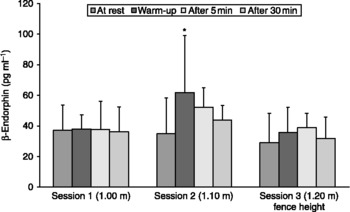
The effects of experimental jumping exercise sessions on β-endorphin modifications are presented in Fig. 1.
Plasma β-endorphin concentrations (mean ± SD) of horses (n = 6) before and after sessions with various fence heights. Asterisk indicates significant (P < 0.01) differences in average hormone versus basal in each session

Basal and post-exercise β-endorphin values showed a wide range of individual variability.
RM-ANOVA showed that the mean basal β-endorphin levels of horses did not show any statistically significant changes over the 3 days of activity. After warm-up, the only significant increases in comparison with basal levels were recorded for session 2 (P < 0.01).
In session 1, the jumping exercise did not modify plasma β-endorphin concentrations. In session 2, higher but not statistically significant post-exercise values than basal were recorded at both 5 and 30 min, although they were lower than warm-up levels. In session 3, no statistically significant higher post-exercise values than basal and warm-up were recorded at 5 min, and levels declined at 30 min.
Two-way RM-ANOVA showed the interaction fence height/time not to be significant. However, sampling time did significantly affect β-endorphin changes (F = 2.88; P < 0.04).
Adrenocorticotrophin
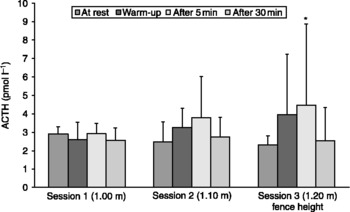
The effects of experimental jumping exercise sessions on ACTH modifications are presented in Fig. 2.
Serum ACTH concentrations (mean ± SD) of horses (n = 6) before and after sessions with various fence heights. Asterisk indicates significant (P < 0.05) differences in average hormone versus basal in each session

RM-ANOVA showed that the mean basal ACTH levels of horses did not statistically significantly decrease over the 3 days of activity.
At warm-up, non-statistically significant increases in comparison with basal levels were recorded, but only in session 2 and session 3, with values showing wide-ranging individual variability in session 3.
The jumping exercise did not modify serum ACTH concentrations after session 1. After session 2, ACTH showed higher basal levels 5 min post-exercise, and values declined after 30 min. After session 3, ACTH showed statistically significant higher values than basal 5 min post-exercise (P < 0.05) and declining levels at 30 min. In both session 2 and session 3, 5 min post-exercise ACTH values showed wide-ranging individual variability.
The interaction fence height/time was not statistically significant. However, sampling time significantly affected ACTH changes (F = 3.84; P < 0.01).
The increases in the two hypophyseal hormones, β-endorphin and ACTH, recorded at 5 min post-exercise were equivalent (+51.0%) when horses jumped 1.10 m fences (session 2), while they were lower for β-endorphin (+33.7%) than for ACTH (+93.1%) when the horses performed a showjumping session over 1.20 m fences (session 3). No correlation between β-endorphin and ACTH was detected when the values for each test were analysed.
Cortisol
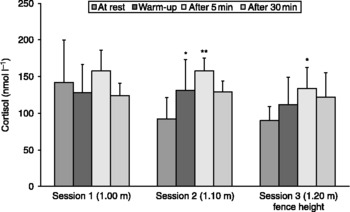
The effects of experimental jumping exercise sessions on cortisol modifications are presented in Fig. 3.
Serum cortisol concentrations (mean ± SD) of horses (n = 6) before and after sessions with various fence heights. Asterisks indicate significant (*P < 0.05; **P < 0.001) differences in average hormone versus basal in each session

RM-ANOVA showed the mean basal levels of cortisol of horses did not statistically significantly decrease over the 3 days of activity.
At warm-up, significant increases in comparison with basal levels were recorded in session 2 (P < 0.05).
Cortisol levels showed higher values than basal 5 min post-exercise over the course of the three showjumping sessions. The values at 30 min showed a drop in levels, although they still tended to be higher than basal after session 2 and session 3. With respect to basal conditions, significant differences were recorded at 5 min post-exercise in session 2 (P < 0.001) and in session 3 (P < 0.05).
The interaction fence height/time was not found to be statistically significant. However, the effect of sampling time was highly statistically significant (F = 7.96; P < 0.0002).
Statistically positive significant correlations emerged between cortisol and β-endorphin changes in session 1 (r = 0.47; P < 0.029) and between cortisol and ACTH changes in session 3 (r = 0.52; P < 0.001).
Discussion
The results of this study demonstrated that experimental showjumping sessions induced increases in cortisol levels 5 min post-exercise, which were statistically significant only after performances over fence heights of 1.10–1.20 m (session 2 and session 3), and declining levels at 30 min, although values remained still higher than basal after session 2 and session 3, probably as an effect of the higher fences. No significant ACTH and β-endorphin modifications were recorded at 5 min post-exercise, with increases being found, once again, exclusively after showjumping sessions over 1.10–1.20 m fences (session 2 and session 3). At 30 min post-exercise, both ACTH and β-endorphin values tended to decline.
The degree of post-exercise increases was not equivalent for the different variables studied, and therefore the influence of haemoconcentration would not account for the β-endorphin, ACTH and cortisol changes recorded post-exercise.
The general increase in circulating cortisol levels recorded in horses after the three experimental sessions was consistent with the results usually reported as an effect of different types of exerciseReference Thornton1, Reference Rose, Hodgson, Hodgson and Rose4–Reference Ferlazzo, Fazio, Medica and Boffi8, as well as after showjumpingReference Lekeux, Art, Linden, Desmecht, Amory, Persson, Lindholm and Jeffcott3, Reference Ferlazzo, Fazio and Lindner5, Reference Clayton35, Reference Ferlazzo, Fazio, Aronica, Di Majo, Medica and Grasso36, Reference Cayado, Muñoz-Escassi, Domínguez, Manley, Olabarri, Sánchez de la Muela, Castejon, Marañon and Vara39. In the various reports, the entity of post-exercise increases recorded generally differed due to the timing of blood sampling or the differing levels of horse competition experience.
Therefore, the post-exercise cortisol increases recorded in this study represent mainly the physiological challenge response to the physical stress of exercise. In response to exercise, the cortisol increase affects substrate mobilization and cardiopulmonary function and it also prepares the system for the post-exercise recovery periodReference McKeever, Gordon, Hinchcliff, Kaneps and Geor40. Moreover, it is well known that jumping as an exercise normally involves a substantial physical stress componentReference Clayton, Hodgson and Rose34.
In this study, the cortisol increase evaluated 5 min post-exercise in the horses studied did not show any clear-cut differences compared with competitive showjumping sessions previously studiedReference Ferlazzo, Fazio, Medica and Boffi8. Nevertheless, on evaluating the post-exercise cortisol changes in horses with different levels of competition experienceReference Ferlazzo, Fazio, Aronica, Di Majo, Medica and Grasso36, it was shown that the less experienced horses had higher post-exercise cortisol increases after competition, even for jumping over 1.00 m fences, than those recorded in the experimental session over the same fence height in this present procedure, probably due to the previous competition experience of horses studied. Cortisol and ACTH responses to jumping in competition have previously been shownReference Clayton35, Reference Ferlazzo, Fazio, Aronica, Di Majo, Medica and Grasso36, Reference Cayado, Muñoz-Escassi, Domínguez, Manley, Olabarri, Sánchez de la Muela, Castejon, Marañon and Vara39 to be much lower with more experienced horses.
Moreover, in this experimental study, the mix of individual factors (experience, environmental stress and effect of the rider) that normally contribute to affect the involvement of HPA axis during competition were essentially kept under control, and therefore the psychological stress that is usually elicited by exercise performed in competitive conditions was probably slight.
The interaction fence height/time was not statistically significant for cortisol changes. The cortisol response examined at 5 and 30 min post-exercise did not appear to be dependent on fence height, while sampling time was shown to significantly affect these changes. Therefore, the sampling times adopted in this study could have influenced the results obtained.
However, the most relevant and significant effect of exercise was recorded during competition in horses when they jumped the highest fencesReference Ferlazzo, Fazio, Medica and Boffi8, as also occurred during these experimental performances carried out in this study by the same horses. This again would suggest that, in these experimental trials, the results obtained could be dependent on the sampling times adopted and/or the actual effect of exercise could be also partly masked by the different resting cortisol levels, which were lower before session 2 and session 3 than before session 1. Although the tests were performed using a randomized crossover design, it is likely that this result is also due to a combined effect of the exercise being performed over consecutive days, inducing stress and fatigue, and a negative feedback effect of increased post-exercise cortisol levels.
As regards the finding that there were no statistically significant effects of exercise on β-endorphin and ACTH concentrations, this could be attributed mainly to the low intensity and speed of the showjumping exercise performed by horses, which was certainly below the critical thresholds for β-endorphinReference Mehl, Schott and Sarkar15 and ACTHReference Nagata, Takeda, Kurosawa, Mima, Hiraga, Kai and Taya18 secretion. However, this hypothesis cannot be confirmed because of the lack of lactate evaluation. Nevertheless, a peak β-endorphin response was evaluated after warm-up in session 2.
It is known that β-endorphin modifies the excitability of the central nervous system, inducing the control over various functional systems, including motor activity and pain perception following lactic acid and catecholamine increases during exerciseReference Goldfarb and Jamurtas41, Reference Munck, Naray-Fejes-Toth, Guyre, Berczi and Kovacs42. Catecholamine and lactate production contribute to HPA axis regulation during exercise and in turn induce stress-coping activitiesReference Kurosawa, Nagata, Takeda, Kurosawa, Mima, Hiraga, Kai and Taya30.
In contrast with the results obtained after competitive showjumping over different fence heightReference Ferlazzo, Fazio, Medica and Boffi8, which showed that the equivalent increases in the two hypophyseal hormones recorded at 5 min post-experimental exercise were maintained when the fence height increased, in this study the increases in values were higher than after competition for β-endorphin and lower for ACTH.
The lack of significant changes in ACTH and β-endorphin levels after exercise could also be explained by the high individual variability of values shown by horses both before and especially after the exercise, probably explained by the different horses' temperament and consequent individual catecholamine secretionReference Snow, Harris, MacDonald, Forster and Marlin43.
Despite this, treadmill exercises at submaximal levels of exerciseReference McCarthy, Jeffcott, Funder, Fullerton and Clarke13 as well as exercise tests of different intensityReference Mehl, Sarkar, Schott, Brown, Sampson and Bayly14, Reference Mehl, Schott and Sarkar15, Reference Golland, Evans, Stone, Tyler-McGowan, Hodgson and Rose28, Reference Art, Franchimont and Lekeux33 were found to induce significant increases in β-endorphin concentrations, which were correlated to exercise intensity, but they too induced a widely varying range of valuesReference Mehl, Sarkar, Schott, Brown, Sampson and Bayly14.
The significant effect of sampling time found for the hormone changes recorded may again explain the lack of significant changes being recorded. In fact, as already stated, in session 2 the time of peak β-endorphin response was evaluated after warm-up, with significantly higher than basal values, although a wide range of individual variability was recorded; and in both session 2 and session 3, the β-endorphin and ACTH concentrations were higher than basal 5 min post-exercise. It is known that the time of peak β-endorphin response varies according to training and horses' ageReference McCarthy, Jeffcott, Funder, Fullerton and Clarke13, Reference Malinowski, Shock, Roegner, Rochelle, Kearns, Guirnalda and McKeever26, Reference Malinowski, Shock, Rochelle, Kearns, Guirnalda and McKeever27. However, during incremental exercise tests in Thoroughbreds, plasma ACTH concentrations were increased between 5 and 30 min after the end of exerciseReference Nagata, Takeda, Kurosawa, Mima, Hiraga, Kai and Taya18, and in previous studies, β-endorphin increases were recorded using a 5-min post-graded exercise testReference Malinowski, Shock, Roegner, Rochelle, Kearns, Guirnalda and McKeever26 and were statistically significant at 10 min even after submaximal exerciseReference McCarthy, Jeffcott, Funder, Fullerton and Clarke13. A peak β-endorphin increase after test at 95% VO2max was measured in the 10 min after exercise and returned to pre-exercise values 30–90 min after the end of exerciseReference Mehl, Schott and Sarkar15. In contrast, in horses tested at 60% VO2max, β-endorphin concentrations returned to pre-exercise values more slowly, 30–120 min after the end of exerciseReference Mehl, Schott and Sarkar15.
In this study, two-way RM-ANOVA demonstrated that, in the experimental conditions adopted, the fence height had no influence on ACTH and β-endorphin changes in the 30 min following the exercise. The controlled experimental conditions adopted probably also had an influence on the limited hormone changes recorded in this study because, in a previous study with Thoroughbreds exercising on treadmill, the ACTH response was dependent on emotional stress in the form of novel environmental stimuliReference Hada, Onaka, Takahashi, Hiraga and Yagi31. In competitive conditions, no clear relationships between β-endorphin changes and fence height could be demonstrated, although the β-endorphin increase was found to be delayed in horses jumping the highest fences with all jumping a penalty roundReference Clayton35.
The entity of responses of the two hypophyseal hormones to experimental showjumping was not reciprocally correlated. β-Endorphin was correlated to cortisol increase only in session 1, when the exercise presented a low level of difficulty, while ACTH was correlated to cortisol only in session 3, when the horses were subjected to the highest level of exercise stress. In young horses during training, treadmill exercises at submaximal levels of exercise produced increases only in β-endorphin concentrationsReference McCarthy, Jeffcott, Funder, Fullerton and Clarke13. In Thoroughbreds exercising on a treadmill, the response of cortisol was not found to be correlated to plasma ACTHReference Nagata, Takeda, Kurosawa, Mima, Hiraga, Kai and Taya18.
It was recorded that changes in β-endorphin and cortisol concentrations did not occur in phase when showjumping over the highest fences, in line with results already mentioned in response to competitive exerciseReference Clayton35, while differing from previous reported data obtained during trainingReference McCarthy, Jeffcott, Funder, Fullerton and Clarke13. However, a lack of correlation between β-endorphin and cortisol concentrations has also been reported in other situations: in normal and crib-biter horsesReference McGreevy and Nicol44, after exercise tests associated with thermal stressReference Williams, Marlin, Smith, Harris, Haresign and Davis Morel45 and after restraint and application of a nasogastric tubeReference Hydbring, Nyman and Dahlborn11, all of which are stressful conditions with a high emotional content. Therefore, it would be interesting to better evaluate whether there is any relationship between β-endorphin changes, emotional content of experimental trials and the effects of sampling times adopted. On the other hand, in humans with obsessive–compulsive disordersReference Weizman, Gil-Ad, Hermesch, Munitz and Laron46, it has been suggested that the elevated cortisol levels may exert a negative feedback effect on β-endorphin release and such a result could explain the hormonal changes recorded after session 2 and session 3.
In conclusion, this study demonstrated that experimental showjumping sessions led to cortisol increases and moderately higher levels than basal of ACTH and β-endorphin after jumping over the highest fences. However, these hormonal modifications were not found to be dependent on fence height based on the sampling times adopted in this study. Hence, these results suggest the need to gather further experimental data in order to differentiate the possible role of the emotional content of stress experienced during exercise from the influence of the sampling times adopted, to explain hormonal changes and their correlations in the course of showjumping exercises and in order to gain more precise information concerning the correct timing of samples for the post-exercise evaluation of hypophyseal hormones.
Acknowledgements
Support for this project was provided by the Italian Ministry for Universities and Research (MiUR) and the University of Messina.