Introduction
Over the past several decades, migration has emerged as a major process that involves demographic changes worldwide (Massey et al., Reference Massey, Arango, Hugo, Kouaouci, Pellegrino and Taylor1993; Bell et al., Reference Bell, Charles-Edwards, Kupiszewska, Kupiszewski, Stillwell and Zhu2015). After children's outmigration, the majority of older adults are left behind in rural, migrant-sending areas (Kuhn et al., Reference Kuhn, Everett and Silvey2011; Song, Reference Song2017a), but an increasing number of older adults are migrating with their children to rich, urban areas and becoming older migrants (Miller-Martinez and Wallace, Reference Miller-Martinez and Wallace2006). Various studies suggest that being left behind in rural regions or migrating to urban areas has a variety of effects on the older population's quality of life. To our knowledge, however, no study has compared whether children's migration and that of older adults has different effects on older parents’ social networks and mental health in the context of rural China. Therefore, the aim of this study is to compare family/friendship ties and mental health among older parents who are left behind, older adult migrants and older adults who live in rural areas with their non-migrating family.
International and internal migration is a worldwide major demographic process. With working-age adult children migrating to destination areas, older adults and their families have two options: to be left behind or to migrate. The present research conducted in a Chinese context may be useful for the families, especially older adults, in countries with a massive migrant population, in terms of making rational decisions and improving the quality of life of the involved older adults. Moreover, this research potentially contributes to the existing literature on the association between migration and social networks, while deepening the understanding and expanding the application of social convoy theory across social contexts.
Migration and mental health among older adults
The working population is the primary sector among international and internal migrants (White and Lindstrom, Reference White, Lindstrom, Poston and Mickin2005; Bell et al., Reference Bell, Charles-Edwards, Kupiszewska, Kupiszewski, Stillwell and Zhu2015). In pursuit of higher salaries or better career development opportunities, the working-age population migrates from poor/rural to rich areas/countries (White and Lindstrom, Reference White, Lindstrom, Poston and Mickin2005). This massive labour outmigration critically impacts the lives of older parents, who have to choose between two living arrangements: becoming left-behind older adults in rural/poor areas (Kuhn et al., Reference Kuhn, Everett and Silvey2011; Song, Reference Song2017a) or migrant older adults moving to urban/rich areas with their children (Miller-Martinez and Wallace, Reference Miller-Martinez and Wallace2006). Accordingly, there are three patterns of migration for rural older adults: non-migration (i.e. living in rural areas with all the children), children migration (i.e. at least one child migrates and the older adults are left behind) and older adults’ migration (i.e. older adults migrating to urban areas with their children).
Numerous studies have focused on the relationship between adult children's migration and the mental health of their left-behind older parents. For instance, children's migration may disrupt traditional family systems/connections, which causes the left-behind older adults to have poorer mental health, as compared to their counterparts without migrant children (Yamada and Teerawichitchainan, Reference Yamada and Teerawichitchainan2015). Although migrant children can provide more economic support (Du et al., Reference Du, Ding, Li and Gui2004), left behind Chinese older adults report poor physical and psychological health status due to the loss of social connections and service support (Song, Reference Song2014). Specifically, they are relatively more isolated, lonely (Lin et al., Reference Lin, Yin and Loubere2014) and have higher levels of depressive symptoms (Song, Reference Song2017a).
The immigration of adult children has given rise to an older population that migrates with them; thus, an increasing number of researchers have shifted their focus towards studying these older immigrants and their quality of life (e.g. Wu et al., Reference Wu, Chi, Plassman and Guo2010; Kim et al., Reference Kim, Linton and Lum2015; Conkova and Lindenberg, Reference Conkova and Lindenberg2020). Most studies about immigrant older adults have concentrated on the differences within the members of this group (Kim et al., Reference Kim, Linton and Lum2015) or comparisons between them and native/local older residents of the destination area (Li et al., Reference Li, Zhou, Ma, Jiang and Li2017). For instance, Chan and Chou (Reference Chan and Chou2016) found that older adults who migrated from mainland China to Hong Kong experienced higher poverty rates than native older adults. Additionally, older immigrants with lower social capital are more likely to experience life dissatisfaction (Kim et al., Reference Kim, Linton and Lum2015). Moreover, there is evidence that living in a neighbourhood that has a negative social environment further contributes to poorer mental health (Zhang et al., Reference Zhang, Liu, Zhang and Wu2020). Researchers also indicate that older immigrants usually experience acculturation, which involves stress, language problems, social isolation and a lack of resources. Acculturation may also lead to a higher risk of depression and negative attitudes towards ageing (Wu et al., Reference Wu, Chi, Plassman and Guo2010; Conkova and Lindenberg, Reference Conkova and Lindenberg2020). In addition to voicing concerns about their mobility and language limitations, international older immigrants describe dissatisfaction about their isolation and the heavy domestic responsibilities they shoulder in their children's household (Treas and Mazumdar, Reference Treas and Mazumdar2002). Further, the socio-economic status of older migrants is lower than that of local residents because they usually arrive in the cities later in life and, thus, encounter more difficulties in adapting to a new life (Liu, Reference Liu2014). Chinese rural-to-urban older migrants are not entitled to the same social benefits as the local residents due to the household register system; consequently, they are less likely to have comprehensive access to health-care services, comfortable housing and fair life conditions (Feng et al., Reference Feng, Zuo and Ruan2002; Tang and Wang, Reference Tang and Wang2021). On the one hand, there is evidence that older adult migrants report poorer physical and mental health than their native counterparts (Wang, Reference Wang2017); on the other hand, research has found that the mental health of migrant older adults was superior to that of local counterparts (Peng et al., Reference Peng, Zhang and Wang2017) due to migrant selectivity (Wallace and Kulu, Reference Wallace and Kulu2014). However, no study has compared migrating older adults with their counterparts in rural areas (i.e. left-behind older adults or rural residents without migration).
Migration and social network
According to the ‘social convoy theory’, individuals are surrounded by the dynamic, long-lasting support of others (e.g. family and friends) throughout their life (Antonucci et al., Reference Antonucci, Ajrouch and Birditt2014). Previous studies have identified two important types of social network among older adults: family and friendship ties (Litwin and Shiovitz-Ezra, Reference Litwin and Shiovitz-Ezra2011; Chopik, Reference Chopik2017).
The patterns of migration may change the family and friendship ties in various ways. For the left-behind older adults, the migration of their adult children removes close family members from their social support systems, which may decrease their family ties; however, it keeps their friendships stable (Lu, Reference Lu2012; Yamada and Teerawichitchainan, Reference Yamada and Teerawichitchainan2015; Song, Reference Song2017b). Ke et al. (Reference Ke, Jiang and Chen2019) believed that being left behind had negative effects on individuals’ social capital, including the social networks of rural older adults. The migrant older adults, however, are largely motivated to migrate for family reasons, such as caring for grandchildren, remaining closer to some of their children and receiving superior care in urban/rich areas during their old age (Miller-Martinez and Wallace, Reference Miller-Martinez and Wallace2006; Dou and Liu, Reference Dou and Liu2017). Nevertheless, they leave family members in the rural area and their friendship ties (e.g. neighbours) may fade or even dissolve in a migrant-sending area (Wrzus et al., Reference Wrzus, Hänel, Wagner and Neyer2013). Not only may they lose their established friends, but developing new friendships is challenging enough for young immigrants, let alone older adults (Angel et al., Reference Angel, Angel and Markides2000; Kemperman et al., Reference Kemperman, Berg, Weijs-Perree and Uijtdewillengen2019; Dahlberg, Reference Dahlberg2020). Moreover, migrant older adults’ social networks, including family and friendship ties, are smaller than those of local older citizens (Peng et al., Reference Peng, Zhang and Wang2017).
Social networks and mental health
The close association between social networks and older adults’ mental health have been widely studied in gerontological research (e.g. Sicotte et al., Reference Sicotte, Alvarado, León and Zunzunegui2008; Thoits, Reference Thoits2011; Lei et al., Reference Lei, Shen, Smith and Zhou2015). For example, older adults with large-scale, high-quality and diverse social networks report lower levels of depressive symptoms (Sicotte et al., Reference Sicotte, Alvarado, León and Zunzunegui2008). Social networks act as part of social supports, which benefits individuals’ mental health (Thoits, Reference Thoits2011). Specifically, diversified social networks may produce social resources for individuals and have beneficial effects (Son and Lin, Reference Son and Lin2012).
As shown in the studies reviewed earlier, migrating to or having one's children migrate to a distant, unfamiliar location is stressful for older adults and places their mental health at risk (Treas and Mazumdar, Reference Treas and Mazumdar2002; Song, Reference Song2017a). It is plausible to consider social networks as a mediator in the relationship between higher levels of depressive symptoms and being an older adult left behind or migrating to a new city. However, no empirical study has explored the extent to which the mental health of older adults – who are either left behind or migrate – is impacted by the subsequent changes in family/friendship ties.
The context of China
Over the last three decades, China has experienced the largest rural-to-urban migration in human history (Liang, Reference Liang2016); a recent report from the National Bureau of Statistics of China estimates that approximately 277 million people have migrated from villages to cities (National Health and Family Planning Commission (NHFPC), 2016). Rural-to-urban migration has provided young people with opportunities, like superior employment and education, which are unavailable in rural areas. Meanwhile, the hukou system (household registration system), which is unique to China, serves as a social boundary that separates residents in rural and urban areas, and can only be altered through highly limited methods, like enrolling in higher education (Li et al., Reference Li, Zhou, Ma, Jiang and Li2017). Therefore, when considering the numerous social and economic benefits of the hukou system, rural migrants must often leave their older parents behind.
Since 2000, migration patterns have gradually changed from individual to family migration (Dou and Liu, Reference Dou and Liu2017). Increasingly, older parents are migrating with their adult children. Approximately nine million migrants, who are at least 60 years old, account for approximately 6 per cent of all migrants in China (NHFPC, 2016). Due to this massive rural-to-urban migration, older adults who are left behind and those who migrate have been receiving greater attention from Chinese researchers recently (e.g. Dou and Liu, Reference Dou and Liu2017; Li et al., Reference Li, Zhou, Ma, Jiang and Li2017; Song, Reference Song2017a).
Importantly, a family's social support (i.e. social network) is more important for older adults’ wellbeing in non-Western cultures than in Western contexts (Alegria et al., Reference Alegria, Sribney and Mulvaney-Day2007; Lee et al., Reference Lee, Jang and Lockhart2018). For example, China is an Eastern nation that adheres to a traditional family system with strong expectations regarding children's filial responsibilities (e.g. caring for their older parents; Tang et al., Reference Tang, Lin and Chen2020).
The current study
Thus far, no study has directly compared migrating older adults, left-behind older adults and non-migrating rural older adults with non-migrating family. Nevertheless, comparing these three groups in terms of their mental health and social networks may yield important findings that can inform families’ decision-making process about migration and improve older parents’ quality of life. Therefore, the current study aims to answer the following questions:
(1) Are there differences in the mental health of migrating older adults, left-behind older adults and non-migrating rural older adults with non-migrating family?
(2) Are migration patterns associated with the social networks (i.e. family ties and friendship ties) of rural older adults? If so, how?
(3) Do family and friendship ties play different roles in protecting the mental health of older adults with different migration patterns? If so, how do those roles differ?
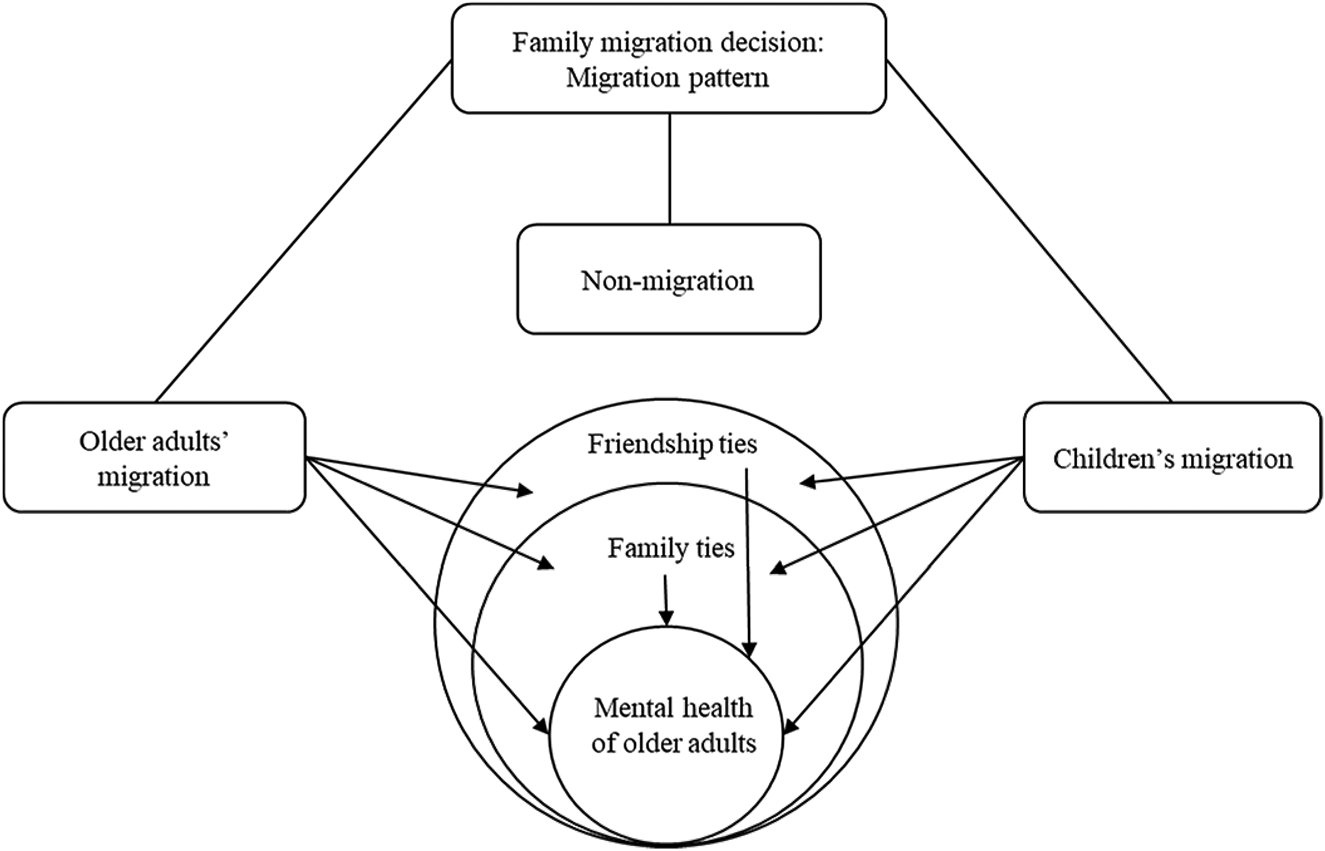
To answer these questions, we propose a framework concerning the relationship among migration patterns, two types of social network and older adults’ mental health in the context of rural China, based on the social convoy theory and a literature review on migration, social networks and older adults’ wellbeing (see Figure 1).
Framework of the current study.

We expected left-behind older adults to report worse mental health than non-migrant older adults, due to the former's family ties being broken. As for the older migrants, whether a more financially developed environment or reuniting with children and grandchildren results in better mental health than that of non-migrant or left-behind older adults remains unanswered.
According to the social convoy model, individuals are surrounded by supportive others who significantly contribute to their health and wellbeing (Antonucci, Reference Antonucci, Binstock and Shanas1985). Usually, the convoy structure has been represented as several concentric circles, indicating different levels of closeness and social support. For Chinese older adults, close family members (e.g. children and spouse), who often provide the highest levels of aid and affection, are placed in the innermost circle, while friends are usually located in the outer circles (Tang et al., Reference Tang, Lin and Chen2020). As a result, we expected family ties to play a more important role in protecting older adults’ mental health.
However, the structure, function and quality of the convoys are influenced by personal and situational attributions (Antonucci et al., Reference Antonucci, Ajrouch and Birditt2014). Migration, as a critical situational characteristic, significantly impacts rural older adults’ convoy structure, leading to different mental health outcomes. As reviewed earlier, children's migration may negatively influence older parents’ family ties, while the impact of older adults’ migration on family ties remains unclear. While they might benefit from intergenerational support by reuniting with family members, their family ties might be injured after separating from relatives who still live in the rural area. Additionally, older adults’ migration might have worse impacts on friendship ties than children's migration. In conclusion, the impact of different patterns of migration on rural older adults’ family and friendship ties may result in diverse mental health outcomes. However, specific hypotheses are difficult to propose due to lack of research on this topic.
Method
Data and sample
We used data from the China Longitudinal Ageing Social Survey (CLASS), which was conducted by the National Survey Research Centre at Renmin University of China (NSRC). It is a nationally representative sample of older adults in mainland China who are at least 60 years old (NSRC, 2014). The baseline survey was conducted in 2014 using a multi-stage, stratified probability sampling method. First, 134 counties were selected from 30 provinces and municipalities in mainland China as the primary sampling unit. Second, 462 villages and neighbourhood communities were selected as the secondary sample unit. Third, 25 older adults aged 60 or above were randomly selected within each secondary sample unit. This resulted in a potential sample of 11,550 older adults, with 11,511 completing the questionnaire.
For the current study, the sample was limited to older adults within a rural hukou system, which resulted in 4,604 respondents. Since participants’ cognition may affect the validity of self-reported questions, we used a widely practised method in clinical and epidemiological studies to select cognitively suitable respondents (Wang et al., Reference Wang, Chen and Han2014). Those who answered two or more (out of five) cognition-related questions incorrectly were excluded (N = 1,811).Footnote 1 Since the differences between local residents and immigrants who had lived at their destination for many decades faded away (Kritz et al., Reference Kritz, Gurak and Chen2000), the current study explored the impact of new migration, specifically. Thus, older migrants who lived in their present counties for over 10 years were excluded (N = 60). We also excluded respondents with missing values in relation to analytical variables (N = 249). As a result, this study included 2,484 rural respondents aged 60 or older.
Measurements
Depressive symptoms
Depressive symptoms were assessed with a subset from the Center for Epidemiologic Studies Depression Scale (CES-D) (Silverstein et al., Reference Silverstein, Cong and Li2006). In nine questions, respondents were asked how frequently (over the course of a week) they experienced the following feelings related to depressive symptoms: feelings with positive effects (e.g. happiness), feelings with negative effects (e.g. loneliness), marginalisation (e.g. uselessness) and somatic symptoms (e.g. a poor appetite). The potential responses included: 0 = never, 1 = sometimes and 2 = always. Three positive items were reverse coded, so a higher score would indicate more severe depressive symptoms. The Cronbach's alpha for the nine items is 0.755; in the bivariate analyses, we added the scores for the nine items, ranging from 0 to 18.
Social network
The Lubben Social Network Scale is widely employed to assess older adults’ social networks (e.g. Chan et al., Reference Chan, Malhotra, Malhotra and Østbye2011; Leung et al., Reference Leung, Teo, Chua, Raman, Liu and Chan2016). Lubben et al. (Reference Lubben, Blozik, Gillmann, Iliffe, Kruse, Beck and Stuck2006) suggest that the scale can be used to measure both family and friendship ties. For family ties, respondents answered three questions concerning the number of relatives they: (a) could ask for help, (b) may converse with about private issues, and/or (c) had seen or heard from in the past month. Similarly, three comparable questions were asked to measure friendship ties, with answers coded as 0 = none, 1 = one relative/friend, 2 = two relatives/friends, 3 = three or four relatives/friends, 4 = five to eight relatives/friends and 5 = nine or more relatives/friends. Then, the three items were placed into separate scales (ranging from 0 to 15) for family and friendship ties. The Cronbach's alpha was 0.742 and 0.852 for family and friendship ties, respectively. In the bivariate analyses, the two sub-scales were added, with scores ranging from 0 to 15.
Patterns of migration
According to Liang (Reference Liang2016), individuals who live beyond the county boundary designated by the hukou registration system are defined as the ‘migrant population’. The primary purpose of our study is to identify the different migration patterns of older adults with hukou registered in rural areas and how these patterns affect their quality of life. Accordingly, we identified three migration patterns: 1 = non-migration, 2 = children's migration (i.e. older adults are left behind) and 3 = older adults’ migration (i.e. older migrants). Older adults in group 1 are locals living in rural areas without migrant children. Older adults in group 2 are locals living in rural areas as well, but they have at least one migrant child (also called left-behind older parents in China). Older adults in group 3 are migrants living in urban cities who do not adhere to the hukou system.
Covariates
According to previous studies, there are factors associated with older adults’ depressive symptoms and social networks. For instance, older women usually show more depressive symptoms than older men (Song, Reference Song2017b); being married is positively associated with social networks and mental health status (de Vries et al., Reference de Vries, Utz, Caserta and Lund2014); good physical health status, higher education, and income can expand older adults’ social networks, especially friendship ties, and protect their mental health (Peng et al., Reference Peng, Zhang and Wang2017); and living with offspring may improve older adults’ family ties (Tang et al., Reference Tang, Lin and Chen2020). Therefore, we evaluated the following covariates: gender (1 = female, 0 = male), age (in years), marital status (1 = married, 0 = not married), education level (1 = secondary school or above, 0 = lower than secondary school), annual personal income (in yuan), functional limitations (with an index of 0–30; higher being worse limitations), number of chronic diseases, number of surviving children, whether they were living with children (1 = yes, 0 = no) and whether they were living with grandchildren (1 = yes, 0 = no). Continuous variables were normally distributed, except for personal income. We used log transformation for personal income in a model estimation (the original values were presented in descriptive analyses).
Analysis
First, we conducted univariate and bivariate analyses to describe the socio-demographic characteristics, social network and depressive symptoms of older adults in a total sample and three sub-samples. A one-way analysis of variance and chi-square test were employed to test the significant differences among the three groups of older adults. Then, we used structural equation modelling (SEM) to examine the relationships among migration types, social networks and depressive symptoms, as SEM is suitable for simultaneously predicting three outcome variables in a single analysis. Moreover, by treating family ties, friendship ties and depressive symptoms as latent variables, the variations’ scores could be isolated due to measurement errors. We used Mplus version 7.4 for SEM analyses.
Before we conducted SEM, a confirmatory factor analysis (CFA) was performed to confirm the structures of the social networks and depressive symptoms. We used weighted least squares means and variance adjusted (WLSMV) estimation because of the depressive symptom indicators’ ordinal nature. The results of the CFA show that the model fits the data well (χ2 = 665.721, degrees of freedom (df) = 83, p < 0.001; Root Mean Square Error of Approximation (RMSEA) = 0.050; Comparative Fit Index (CFI) = 0.942; Tucker–Lewis Index (TLI) = 0.927). After the measurement model was determined, we exclusively examined the direct impacts of migration on two types of social networks and depressive symptoms by controlling all covariates through SEM. Furthermore, we tested the direct and indirect effects of migration types on the CES-D scores, with the family/friendship ties included as mediators. Produced by the bootstrap method, a 95 per cent bias-corrected confidence interval (CI) was used to examine the significance of the mediation effect (Muthén et al., Reference Muthén, Muthén and Asparouhov2016). Since the CI did not contain zero, it suggested significant mediation effects.
Results
Sample characteristics
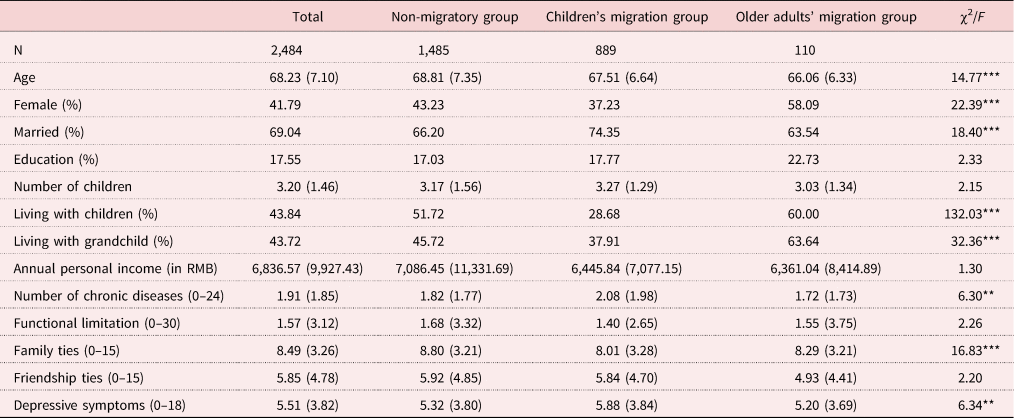
Table 1 shows the sample characteristics. Migrant older adults, left-behind older adults, and non-migrant older adults with non-migrant family significantly varied in age, gender, marital status, living arrangements and their number of chronic diseases. On average, migrant older adults were on the younger side of the spectrum and had a lower number of chronic diseases. Additionally, migrant older adults were more likely to be female and be living with children/grandchildren than the other older adults; they were also less likely to be married than the other older adults. In contrast, left-behind older adults experienced the highest number of chronic diseases, tended to be married, and were less likely to be female and be living with children/grandchildren than the other older adults.
Sample characteristics

Note: Values for categorical variables are percentages; for all other variables, the mean values with standard deviations in parentheses are presented.
Significance levels: ** p < 0.01, *** p < 0.001 (significant difference between the three groups of older adults based on chi-square test or one-way analysis of variance).
Notably, among the three groups of older adults, significant differences were identified between their family ties and depressive symptoms. Multiple comparisons of the least significant difference (LSD) test showed that left-behind older adults’ family ties (p < 0.001) were weaker while depressive symptoms (p = 0.001) were significantly more than those of non-migrant older adults with non-migrant family. However, there was no significant difference between the family ties and depressive symptoms of migrant older adults and the other two groups of older adults. The LSD test showed that migrant older adults’ friendship ties were significantly weaker than those of non-migrant older adults (p < 0.043) and marginally weaker than among left-behind older adults.
Migration, social network and depressive symptoms
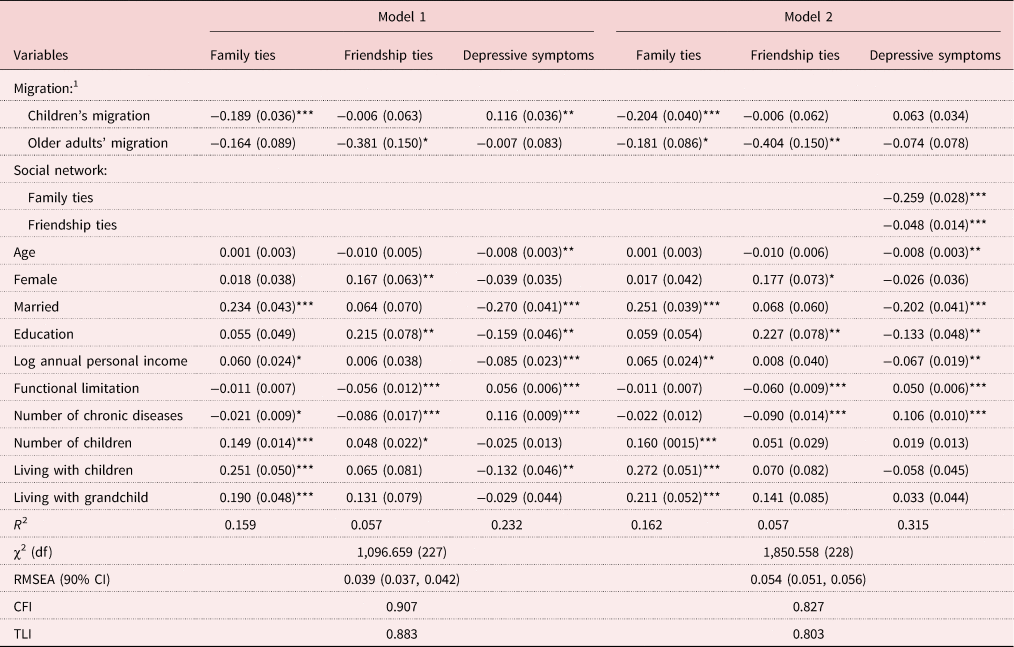
The results from SEM analyses are shown in Table 2. In Model 1, family ties, friendship ties and depressive symptoms were endogenous variables predicted by migration types. Upon controlling for the covariates, left-behind older adults reported weaker family ties (β = −0.189, p < 0.001) and a higher level of depressive symptoms (β = 0.116, p < 0.001) than non-migrant older adults with non-migrant families. Meanwhile, migrant older adults reported weaker friendship ties (β = −0.381, p < 0.001) than non-migrant older adults. Migrant older adults’ family ties were relatively weaker than those of the other older adults and the coefficient was marginally significant (p = 0.066). To compare left-behind older adults and migrant older adults in terms of family and friendship ties and depressive symptoms, the migration type variable was recoded to change the reference group. The results showed that compared to left-behind older adults, migrant older adults reported weaker friendship ties (β = −0.374, p < 0.05). However, no significant difference was found between left-behind older adults’ and migrant older adults’ family ties (p = 0.850) and depressive symptoms (p = 0.140).
Regression analyses on social network and depression

Notes: N = 2,484.
Significance levels: * p < 0.05, ** p < 0.01, *** p < 0.001.
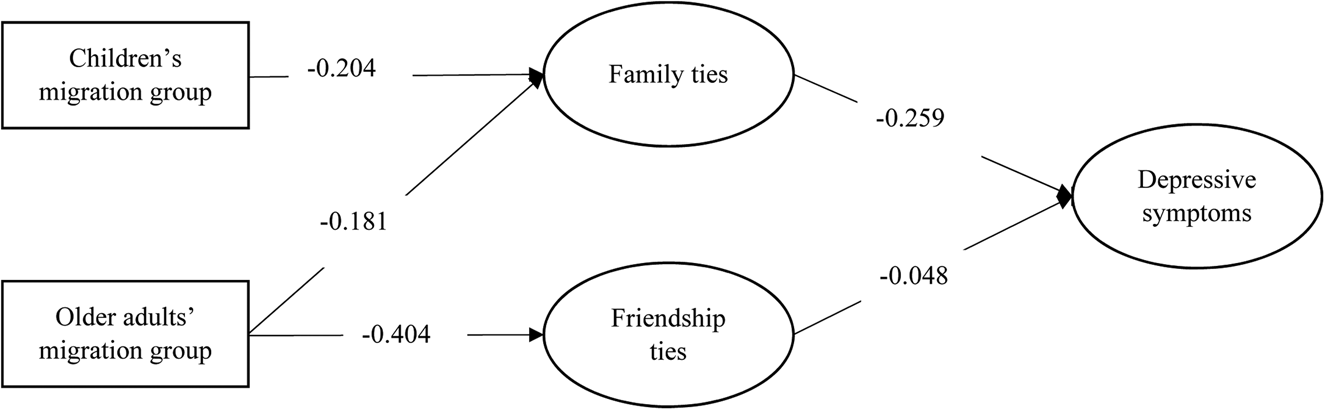
In Model 2, family and friendship ties were included as mediators. As shown in Table 2, children (β = −0.204, p < 0.001) and older adults’ (β = −0.181, p < 0.001) migration was associated with weaker family ties. In addition, migrant older adults showed weaker friendship ties than non-migrant older adults. Finally, family (β = −0.259, p < 0.001) and friendship (β = −0.048, p < 0.001) ties were significantly associated with lower levels of depressive symptoms. Rerunning the model with left-behind older adults as the reference group yielded similar results.
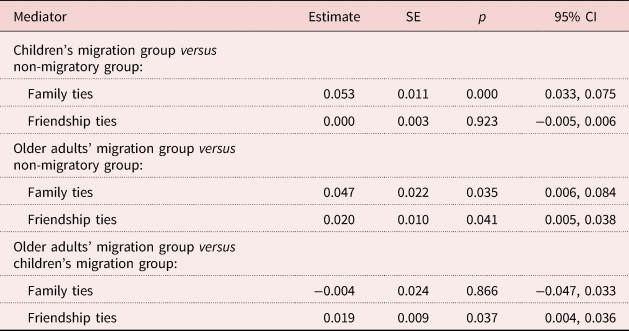
The mediating effects of family/friendship ties were tested by utilising the bootstrap method: the CI values in Table 3 confirmed their mediation effects. For instance, the CI values of left-behind older adults, family ties and depressive symptoms did not include zero (CI = 0.033, 0.075), which suggests that being left behind as an older adult is significantly associated with weaker family ties that may lead to higher levels of depressive symptoms. For migrant older adults, a complete mediation model was identified, indicating that family/friendship ties fully mediated the relationship between being a migrant older adult and having depressive symptoms. Moreover, results suggest that compared to left-behind older adults, migrant older adults are more likely to have weaker friendship ties, which leads to higher levels of depressive symptoms (Table 3). However, no direct effects were found between migration patterns and depressive symptoms. Figure 2 shows the significant relationships among migration pattern, social networks and depressive symptoms.
Mediation effects of family and friendship ties on depressive symptoms.

Bootstrap test of the mediating effect of family and friendship ties on depressive symptoms

Notes: SE: standard error. CI: confidence interval.
Discussion
By utilising a national representative dataset in China, the current study explored the relationships between the older adults’ social networks and depressive symptoms, which are influenced by population migration. As compared to non-migrant older adults with non-migratory families, the results show that left-behind older adults have significantly weaker family ties and higher levels of depressive symptoms, while migrant older adults have weaker friendship ties. The migration of adult children negatively impacts left-behind older adults’ mental health through reduced family ties, while the migration of older adults themselves is associated with negative psychological wellbeing due to damaged family/friendship ties. Additionally, family ties play a more important role than friendship ties in protecting the mental health of rural older adults who migrate.
As per our expectations, left-behind older adults experience significantly higher levels of depression than non-migrant older adults. This is in line with the findings of previous studies on the psychological wellbeing of left-behind older adults in developing countries (Thapa et al., Reference Thapa, Visentin, Kornhaber and Cleary2018). Interestingly, older adults who migrated with their family do not show more depressive symptoms than non-migrant older adults. In other words, left-behind older adults are more likely to be at risk of depression than migrant older adults.
Being left behind because at least one child migrates or migrating as an older adult was found to be negatively associated with older people's social networks, with both migration patterns leading to the shrinkage of family or friendship ties, thus adversely affecting older adults’ mental health. In that sense, migration does not directly affect older adults’ mental health; instead, it impacts their social network, which, in turn, affects their mental health. This finding is consistent with the social convoy model, which posits that the structure of social networks is influenced by situational characteristics and influences individuals’ health (Antonucci et al., Reference Antonucci, Ajrouch and Birditt2014).
Specifically, having children who migrate or an older adult's own migration impacts social networks differently. For left-behind older adults, family ties are significantly weaker than those of non-migrant older adults living with non-migrant families. However, no significant difference was found in friendship ties between migrant (migrant older adults and left-behind older adults whose children migrate) and non-migrant older adults. Thus, as found in previous research, the out-migration of adult children significantly reduces older adults’ kinship connections (Kreager, Reference Kreager2006). When adult children migrate away from their county, they create a significant distance between themselves and their older parents, which increases the challenges that older adults encounter. They become unable to see, communicate with and seek help from their children, who are usually the most important source of support for rural older adults in China. Since left-behind older adults still live in their native communities, however, their decades of friendship with neighbours and others remain mostly intact.
In contrast to left-behind older adults, migrant older adults’ social networks change in a different manner. As compared to their non-migrant counterparts, migrant older adults report significantly weaker friendship ties and slightly weaker family ties. Although older migrants who move to urban areas leave family members in the rural regions, they become highly integrated into their immediate families (NHFPC, 2016). For instance, among left-behind older adults, non-migrant older adults and migrant older adults, the latter group is more likely to reside with their children/grandchildren (see Table 1). Consequently, although their family ties are weaker than those of non-migrant older adults, they are not as seriously severed as those of left-behind older adults. As for the friendship ties, older migrants experience weakened friendship ties during this major life transition. Not only are their old friendships negatively influenced by their relocation, but new friendships may also be difficult to establish. Similar to elderly newcomers to the United States of America, China's older adults who had previously lived in rural areas before moving to urban areas do not have the same high level of sociability that they experienced at home (Treas and Mazumdar, Reference Treas and Mazumdar2002). According to the socio-emotional selectivity theory, older people tend to restrict their networks as they age (Carstensen, Reference Carstensen1995). Thus, older migrants are not as strongly motivated as younger migrants to build and broaden their social networks in new places due to language obstacles, complicated traffic systems and different life habits.
As for our third question, our findings suggest that family ties have greater effects on rural older adults’ depressive symptoms than friendship ties, which is in line with our hypothesis that the emotional and instrumental support provided by close family members is more important to protect older adults’ mental health than that provided by friends. Although both family and friendship ties are important sources of social support for older adults, there are important cultural differences. For instance, for Chinese older adults, as compared with their Western counterparts, family members are often placed in the innermost circle of the social convoy model, since they can provide a higher level of aid and affection, while friends are usually located in the outer circles. Due to the dominant role of filial piety in Chinese culture, family ties play a relatively stronger role in mitigating rural older adults’ depressive symptoms (Lin and Pei, Reference Lin and Pei2016).
As indicated by our mediation model, family ties fully mediate the association between the left-behind older adults and depressive symptoms, which implies that damage to family ties plays a vital role in increasing the depressive symptoms of left-behind older adults in rural areas. Beyond our expectations, however, the experience of moving to a new place does not seem to have a significant effect on migrant older adults’ depressive symptoms. Nevertheless, it should be noted that being a migrant has negative indirect effects on mental health due to impaired family/friendship ties. These results are likely because direct and indirect effects (of similar magnitude and opposite signs) lead to a non-significant overall relationship (MacKinnon et al., Reference MacKinnon, Krull and Lockwood2000). Here are some potential explanations. First, comparing with other children, the children with whom older adults are willing to migrate usually have closer connections with their parents (Angel et al., Reference Angel, Angel and Markides2000). Although the size of the family ties of migrant older adults is smaller than that of non-migrants, the quality of the family ties among the former might be higher, and thus protect their mental health more effectively (Peng et al., Reference Peng, Mao and Lai2015). Second, friendship ties are not as vital as family ties for Chinese older adults’ mental health (Tang et al., Reference Tang, Lin and Chen2020). Therefore, the potential negative effect of weakened friendship ties on older adults’ mental health is mitigated. Third, immigrants are usually not randomly sampled at their place of origin, but are likely to be healthier (e.g. fewer chronic diseases and lower mortality rates) than non-migrants given their socio-economic status (Jasso et al., Reference Jasso, Massey, Rosenzweig, Smith, Anderson, Bulatao and Cohen2004; Wu et al., Reference Wu, Chi, Plassman and Guo2010). Moreover, personality traits (e.g. extraversion and openness) that usually protect individuals’ mental health are positively associated with the intention to migrate (Jokela, Reference Jokela2009; Fouarge et al., Reference Fouarge, Özer and Seegers2019). In our sample, older migrants were on the younger end of the spectrum and most had graduated from secondary school or continued into higher education. Therefore, migration's potential negative effects on the older adults in our sample may be offset by their positive socio-demographic and psychological characteristics. In conclusion, our findings suggest that older adults’ mental health and quality of life might be better preserved if they migrate along with their children than if they are left behind.
Several limitations must be considered when interpreting this study's results. First, the sample size of older migrants is relatively small, so one must practise caution when drawing conclusions. However, CLASS is the only available database that allows for distinction between migrant, left-behind and non-migrant older adults. Second, longitudinal data were needed to clarify the causal effects of migration on the psychological wellbeing of rural older adults. Despite these limitations, this study has contributed to the existing literature by examining how different migration patterns affect older adults’ mental health, exploring the roles of family and friendship ties in protecting older people's mental health, and identifying the relationship between children's and older adults’ migration, two types of social network and older adults’ mental health. Furthermore, the results are consistent with the convoy model of social relations and expand its application.
Our findings have important implications for social policies and social services that involve protecting the mental health of older adults in rural China. For instance, it was found that both children's and older adults’ migration have negative effects on the mental health of rural older adults. Therefore, it would be best if the working-age population could stay in their native areas while providing financially for their older parents. This would allow older adults to age in their native region. To achieve this, the government should work on increasing the employment opportunities as well as the quality of life in rural regions to motivate the working-age population to stay. Similarly, the living conditions in the rural areas must also be improved, so that they become more age-friendly. Although migration to cities may negatively influence older adults’ social networks leading to worse mental health, migrant older adults reported better mental health than older adults living in rural areas (i.e. left-behind and non-migrating older adults). This implies that more comfortable, convenient and age-friendly environments may promote older adults’ overall wellbeing.
Additionally, among individuals who live in rural areas, our findings suggest that the left-behind older adults are the most vulnerable. Thus, more attention should be paid to their mental health status. As indicated by our study, strengthening their family ties may be an effective strategy. Policies that place an emphasis on migrant children maintaining contact with their older parents in rural villages must be developed. Although China has revised the elderly law to encourage young people to visit their older parents more often (‘Chang hui jia kan kan’), how this should be implemented requires further discussion. For instance, a technology education programme in villages may assist older adults to stay connected with their migrant children in a way that is more flexible and convenient.
Furthermore, our findings suggest that special attention should be paid not only to left-behind older adults in rural areas, but also to migrant older adults who are new to a city. Even though their overall wellbeing might be better than that of older adults living in rural areas, the relocation may affect their friendships to a large extent. Therefore, policy concerning social integration and rebuilding social networks can largely improve older migrants’ mental health and quality of life. Most of the previous policies in China have focused on social integration of migrant workers (Chen and Wang, Reference Chen and Wang2015; Wang et al., Reference Wang, Zhang and Wu2016). As a growing number of older parents have been moving to their migrant children's home to take care of grandchildren, policy makers should pay more attention to this new, but largely growing, migrant group. In practice, communities and local residents should attempt to connect with older migrants and engage them in local life, which would help expand their friendship ties.
It must be reiterated that it is the changes in social networks, and not migration in itself, that hurts the mental health of older adults. Given that we cannot interfere in individuals’ decisions to migrate, we should try to minimise the negative effects of migration on the social networks of older adults to protect their mental health.
Data
The data that support the findings of this study are available from the National Survey Research Centre at Renmin University of China. Restrictions apply to the availability of these data, which were used under licence for this study. Data are available with the permission of National Survey Research Centre at Renmin University of China.
Financial support
This work was supported by the National Office for Philosophy and Social Sciences (18CRK010).
Conflict of interest
The authors declare no conflicts of interest.
Ethical standards
Ethical approval was not required.