Multi-tenure reserve networks (MTRNs) aim to connect areas managed for biodiversity conservation across public and private land (for example biosphere reserves (BRs) and conservation management networks (CMNs)). A key function of MTRNs is facilitating communication, information exchange and management activities between land managers of differing tenures not usually in contact with each other; governance arrangements are therefore crucial. Australian MTRNs vary greatly in their goals and measures of success, criteria for entry, ecosystems targeted, geographic extent and financial arrangements. The successful operation of a MTRN is likely to be influenced by a manager's confidence in the governance model/coordination arrangements (Belcher & Wellman Reference Belcher and Wellman1991). We analysed the organizational structure of three Australian MTRNs (Fig. 1) including the objectives and role of the coordinating body, entry requirements, goals and measures of success, restrictions placed on the geographic or ecological extent of the network and financial arrangements. We highlight how substantial changes in governance arrangements have occurred for two of three networks studied, suggesting a fluid evolution of MTRN structures is likely.
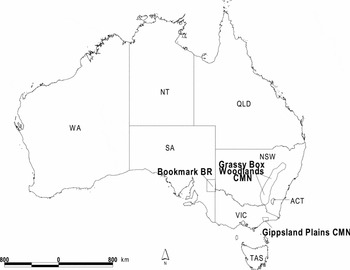
Figure 1Location of the Bookmark BR, Grassy Box Woodlands CMN and Gippsland Plains CMN in Australia.
The Bookmark BR (BBR) includes large former pastoral properties and smaller privately-owned properties along the Murray River in South Australia. The Grassy Box Woodlands CMN (GBWCMN) incorporates small woodland remnants, often in cemeteries and along travelling stock routes, in the largely cleared inland slopes of New South Wales. The Gippsland Plains CMN (GPCMN) includes a number of public reserves and a variety of private reserves in eastern Victoria (Fitzsimons & Wescott Reference Fitzsimons and Wescott2005). BRs are concerned primarily with integrating biodiversity conservation with ecologically sustainable development across a variety of land tenures and uses. A CMN is a network of properties with remnant vegetation managed for conservation under a variety of tenures and protection mechanisms, the managers of those properties and other interested parties.
We obtained information on the operation of the MTRNs from key personnel involved in coordinating each network through questionnaires (consisting mostly of open ended questions; see Fitzsimons Reference Fitzsimons2004), follow-up telephone calls and face-to-face interviews. Our findings are as follows.
Objectives and the role of coordinating body
‘Improving information exchange’ between managers (on ecology and adaptive management) was considered the most important objective of the coordinating body, across the three networks. ‘Accounting for biodiversity assets managed across tenures’ was considered a very high priority for BBR and GBWCMN.
The coordinators of all three networks perceived their role as improving links and communication between land managers, while protecting threatened vegetation communities, increasing the profile of these communities and providing a source of funds was stated as a role in both CMNs. The BBR coordinating body considered their official role was to coordinate ‘activities mainly in the biosphere reserve ‘transition zone’ (and) improving relationships and communication between partners’.
Entry requirements
A requirement for entry into both CMNs was a commitment to manage the vegetation remnants for nature conservation. In contrast, the requirement for entry into BBR is that a property ‘must be managed to increase sustainability’. GBWCMN had a formal process of requesting landowners/managers to sign a registration form to formalize a site's inclusion in the network. No network specified a requirement for legally-binding agreements.
Goals and measures of success
Goals set by coordinators ranged from broad statements of successful outcomes (BBR), to the number of conservation covenants over remnants and the number of trials and management goals achieved (GPCMN), to the number, size and quality of remnants under agreements, the registration of new sites, management actions undertaken, the production of educational material and monitoring the ‘viability and health’ of remnants (GBWCMN).
Despite having requirements for entry and management, all coordinating bodies had trouble providing definitive lists of properties considered a part of their network. This highlights a potential challenge for traditional conservation planning and auditing, which often relies on formal designations and classifications for particular land uses or protection mechanisms enacted. Whilst a requirement for some minimum form of written or verbal agreement may seem logical to justify entry into a network, such a requirement may disenfranchise particular landholders (public or private) who are unwilling to formally commit to an entity whose legal status and objectives are not clear.
Limits to network extent and focus
All respondents suggested that there were geographical limits to networks. For BBR coordinators, the physical size was ‘limited by the fact that it needs to be seen as three biosphere reserve zones contained around the core area’. Despite designating broad geographical limits to the extent of the networks, coordinators of both CMNs suggested that the size and effectiveness of a network depended on the resources allocated to it, specifically a coordinating officer.
Whilst the coordinators of all networks stated that particular vegetation types were targeted for protection, the emphasis on this varied according to the landscape in which each was situated. Thus while all networks considered accounting for biodiversity values to be a primary objective, their ability to do this would depend on the ecosystems targeted for protection and a clear definition of geographic extent of the network.
Financial arrangements
Funding came from a range of sources, including government agencies, NGOs and philanthropic sources, varying in nature from ‘ongoing’ to ‘short-term’ and ‘in-kind’. The governing bodies of BBR and GBWCMN considered funding levels to be sufficient for successful implementation of their aims. Both CMNs noted the importance of securing funds for a ranger/facilitator.
International experience suggests that early and substantial investments of time, financial resources and human resources are required to develop collaborative management agreements (Borrini-Feyerabend Reference Borrini-Feyerabend, Stolton and Dudley1999). The lack of long-term financial security is symptomatic of the broader inadequacy of linking catchment-scale planning with local implementation in Australia (Briggs Reference Briggs2001).
Changes in governance arrangements
A number of changes in the organizational structure had recently occurred in the BBR and the GPCMN, with smaller changes to that of the GBWCMN.
The Bookmark Biosphere Trust, a legislatively established body, was dissolved following disharmony and difficulties in maintaining autonomy (Cottam Reference Cottam2003). An interim planning committee evaluated several governance options and decided upon a ‘community committee’, not allied to any government or non-government identity but including representatives of the Commonwealth and State nature conservation agencies, indigenous and community representatives.
The GPCMN became an incorporated body, with an elected committee, including private landowners and representatives from the Trust for Nature and government agencies.
That both the GPCMN and BBR have moved towards incorporation is significant, particularly when considering that both of these new bodies were formed independently and from opposite ends of the institutional spectrum (i.e. BBR, top-down; GPCMN, bottom-up). This suggests that a fluid evolution of network structures is likely, which contrasts with the desire for legalistic and administrative rigidity promoted by government agencies. Institutionalizing collaborative management processes and making them as independent as possible from individuals and outside inputs minimizes the risk of failure if key extension staff are transferred or key landholders no longer participate. However, the recent changes in the BBR's organizational structure suggest that an overarching body established under legislation may be too restrictive (see also Castelló i Vidal & López Lillo Reference Castelló i Vidal and López Lillo1993). Changes observed in MTRN governance arrangements were to some extent reflective of broader changes in protected area governance arrangements worldwide. For example, Dearden et al. (Reference Dearden, Bennett and Johnston2005) found that 65% of protected area agencies in countries with medium to low levels of development had changes in structure between 1992 and 2002, while 39% of highly developed nations experienced increased agency decentralization.
As more MTRNs form under a variety of arrangements, the ability to predict the most effective format for particular biophysical and social landscapes is likely to increase, although experience in the USA suggests that no real consensus exists for defining certain networks (such as greenline parks; Mason Reference Mason1994). The evolution in structure and governance arrangements of MTRNs, as witnessed in these Australian networks, contrasts with the typical preference of protected area bureaucracies for stability and certainty. Thus the longevity of particular network structures may be required for such networks to be considered a viable alternative to strict protected areas by these bureaucracies.





 You have
Access
Multi-tenure reserve networks (MTRNs) aim to connect areas managed for biodiversity conservation across public and private land (for example biosphere reserves (BRs) and conservation management networks (CMNs)). A key function of MTRNs is facilitating communication, information exchange and management activities between land managers of differing tenures not usually in contact with each other; governance arrangements are therefore crucial. Australian MTRNs vary greatly in their goals and measures of success, criteria for entry, ecosystems targeted, geographic extent and financial arrangements. The successful operation of a MTRN is likely to be influenced by a manager's confidence in the governance model/coordination arrangements (Belcher & Wellman Reference Belcher and Wellman1991). We analysed the organizational structure of three Australian MTRNs (Fig. 1) including the objectives and role of the coordinating body, entry requirements, goals and measures of success, restrictions placed on the geographic or ecological extent of the network and financial arrangements. We highlight how substantial changes in governance arrangements have occurred for two of three networks studied, suggesting a fluid evolution of MTRN structures is likely.
Location of the Bookmark BR, Grassy Box Woodlands CMN and Gippsland Plains CMN in Australia.
The Bookmark BR (BBR) includes large former pastoral properties and smaller privately-owned properties along the Murray River in South Australia. The Grassy Box Woodlands CMN (GBWCMN) incorporates small woodland remnants, often in cemeteries and along travelling stock routes, in the largely cleared inland slopes of New South Wales. The Gippsland Plains CMN (GPCMN) includes a number of public reserves and a variety of private reserves in eastern Victoria (Fitzsimons & Wescott Reference Fitzsimons and Wescott2005). BRs are concerned primarily with integrating biodiversity conservation with ecologically sustainable development across a variety of land tenures and uses. A CMN is a network of properties with remnant vegetation managed for conservation under a variety of tenures and protection mechanisms, the managers of those properties and other interested parties.
We obtained information on the operation of the MTRNs from key personnel involved in coordinating each network through questionnaires (consisting mostly of open ended questions; see Fitzsimons Reference Fitzsimons2004), follow-up telephone calls and face-to-face interviews. Our findings are as follows.
Objectives and the role of coordinating body
‘Improving information exchange’ between managers (on ecology and adaptive management) was considered the most important objective of the coordinating body, across the three networks. ‘Accounting for biodiversity assets managed across tenures’ was considered a very high priority for BBR and GBWCMN.
The coordinators of all three networks perceived their role as improving links and communication between land managers, while protecting threatened vegetation communities, increasing the profile of these communities and providing a source of funds was stated as a role in both CMNs. The BBR coordinating body considered their official role was to coordinate ‘activities mainly in the biosphere reserve ‘transition zone’ (and) improving relationships and communication between partners’.
Entry requirements
A requirement for entry into both CMNs was a commitment to manage the vegetation remnants for nature conservation. In contrast, the requirement for entry into BBR is that a property ‘must be managed to increase sustainability’. GBWCMN had a formal process of requesting landowners/managers to sign a registration form to formalize a site's inclusion in the network. No network specified a requirement for legally-binding agreements.
Goals and measures of success
Goals set by coordinators ranged from broad statements of successful outcomes (BBR), to the number of conservation covenants over remnants and the number of trials and management goals achieved (GPCMN), to the number, size and quality of remnants under agreements, the registration of new sites, management actions undertaken, the production of educational material and monitoring the ‘viability and health’ of remnants (GBWCMN).
Despite having requirements for entry and management, all coordinating bodies had trouble providing definitive lists of properties considered a part of their network. This highlights a potential challenge for traditional conservation planning and auditing, which often relies on formal designations and classifications for particular land uses or protection mechanisms enacted. Whilst a requirement for some minimum form of written or verbal agreement may seem logical to justify entry into a network, such a requirement may disenfranchise particular landholders (public or private) who are unwilling to formally commit to an entity whose legal status and objectives are not clear.
Limits to network extent and focus
All respondents suggested that there were geographical limits to networks. For BBR coordinators, the physical size was ‘limited by the fact that it needs to be seen as three biosphere reserve zones contained around the core area’. Despite designating broad geographical limits to the extent of the networks, coordinators of both CMNs suggested that the size and effectiveness of a network depended on the resources allocated to it, specifically a coordinating officer.
Whilst the coordinators of all networks stated that particular vegetation types were targeted for protection, the emphasis on this varied according to the landscape in which each was situated. Thus while all networks considered accounting for biodiversity values to be a primary objective, their ability to do this would depend on the ecosystems targeted for protection and a clear definition of geographic extent of the network.
Financial arrangements
Funding came from a range of sources, including government agencies, NGOs and philanthropic sources, varying in nature from ‘ongoing’ to ‘short-term’ and ‘in-kind’. The governing bodies of BBR and GBWCMN considered funding levels to be sufficient for successful implementation of their aims. Both CMNs noted the importance of securing funds for a ranger/facilitator.
International experience suggests that early and substantial investments of time, financial resources and human resources are required to develop collaborative management agreements (Borrini-Feyerabend Reference Borrini-Feyerabend, Stolton and Dudley1999). The lack of long-term financial security is symptomatic of the broader inadequacy of linking catchment-scale planning with local implementation in Australia (Briggs Reference Briggs2001).
Changes in governance arrangements
A number of changes in the organizational structure had recently occurred in the BBR and the GPCMN, with smaller changes to that of the GBWCMN.
The Bookmark Biosphere Trust, a legislatively established body, was dissolved following disharmony and difficulties in maintaining autonomy (Cottam Reference Cottam2003). An interim planning committee evaluated several governance options and decided upon a ‘community committee’, not allied to any government or non-government identity but including representatives of the Commonwealth and State nature conservation agencies, indigenous and community representatives.
The GPCMN became an incorporated body, with an elected committee, including private landowners and representatives from the Trust for Nature and government agencies.
That both the GPCMN and BBR have moved towards incorporation is significant, particularly when considering that both of these new bodies were formed independently and from opposite ends of the institutional spectrum (i.e. BBR, top-down; GPCMN, bottom-up). This suggests that a fluid evolution of network structures is likely, which contrasts with the desire for legalistic and administrative rigidity promoted by government agencies. Institutionalizing collaborative management processes and making them as independent as possible from individuals and outside inputs minimizes the risk of failure if key extension staff are transferred or key landholders no longer participate. However, the recent changes in the BBR's organizational structure suggest that an overarching body established under legislation may be too restrictive (see also Castelló i Vidal & López Lillo Reference Castelló i Vidal and López Lillo1993). Changes observed in MTRN governance arrangements were to some extent reflective of broader changes in protected area governance arrangements worldwide. For example, Dearden et al. (Reference Dearden, Bennett and Johnston2005) found that 65% of protected area agencies in countries with medium to low levels of development had changes in structure between 1992 and 2002, while 39% of highly developed nations experienced increased agency decentralization.
As more MTRNs form under a variety of arrangements, the ability to predict the most effective format for particular biophysical and social landscapes is likely to increase, although experience in the USA suggests that no real consensus exists for defining certain networks (such as greenline parks; Mason Reference Mason1994). The evolution in structure and governance arrangements of MTRNs, as witnessed in these Australian networks, contrasts with the typical preference of protected area bureaucracies for stability and certainty. Thus the longevity of particular network structures may be required for such networks to be considered a viable alternative to strict protected areas by these bureaucracies.