Introduction
Schistosomiasis is a waterborne disease caused by the trematode parasites belonging to the genus Schistosoma. It infects 200 million people, with 600 million people at risk of infection, in more than 76 countries, including Nigeria (WHO, 1985, 1993, 2002; Gryseels et al., Reference Gryseels, Polman, Clerinx and Kestens2006; Mathers et al., Reference Mathers, Ezzati and Lopez2007; Hotez & Kamath, Reference Hotez and Kamath2009; Stothard et al., Reference Stothard, Chitsulo, Kristensen and Utzinger2009). Of the five species of Schistosoma known to infect humans, Schistosoma haematobium is the most widespread, occurring in Africa and the Middle East (WHO, 1985; Steinmann et al., Reference Steinmann, Keiser, Bos, Tanner and Utzinger2006). In sub-Saharan Africa, it is estimated that 70 million individuals experience haematuria (blood in the urine), 32 million have difficulties in urinating (dysuria), 18 million have bladder-wall pathology and 10 million have major hydronephrosis due to infection by S. haematobium. The mortality rate due to non-functioning kidneys (due to S. haematobium) and haematemesis has been put at 150,000 per year (Van der Werf et al., Reference Van der Werf, de Vlas, Brooker, Looman, Nagelkerke, Habbema and Engels2003). The above figures indicate that S. haematobium infection is a serious public health problem in sub-Saharan Africa, next to malaria in morbidity (Chitsulo et al., Reference Chitsulo, Engels, Montresor and Savioli2000).
Recently, there has been an increasing need for information on the status of schistosomiasis in infants and preschool children (0–6 years). This age group is generally not screened nor included in national control programmes (Mafiana et al., Reference Mafiana, Ekpo and Ojo2003; Bosompem et al., Reference Bosompem, Bentum, Otchere, Anyan, Brown, Osada, Takeo, Kojima and Ohta2004; Odogwu et al., Reference Odogwu, Ramamurthy, Kabatereine, Kazibwe, Tukahebwa, Webster, Fenwick and Stothard2006; Opara et al., Reference Opara, Udoidung and Ukpong2007; Ekpo et al., Reference Ekpo, Laja-Deile, Oluwole, Sam-Wobo and Mafiana2010; Garba et al., Reference Garba, Barkiré, Djibo, Lamine, Sofo, Gouvras, Bosqué-Oliva, Joanne, Webster, Stothard, Utzinger and Fenwick2010; Sousa-Figueiredo et al., Reference Sousa-Figueiredo, Pleasant, Matthew, Betson, Rollinson, Montresor, Kazibwe, Kabatereine and Stothard2010a). We have previously reported the existence of S. haematobium infection in preschool children, in some parts of Ogun State, south-western Nigeria (Mafiana et al., Reference Mafiana, Ekpo and Ojo2003; Ekpo et al., Reference Ekpo, Laja-Deile, Oluwole, Sam-Wobo and Mafiana2010). We are reporting further the prevalence of preschool schistosomiasis in two rural communities in Ijebu East, south-western Nigeria.
Materials and methods
Ethical statement
Before the study began, the community leaders, with guardians and caregivers of the preschool children, were fully briefed on the objective of the study. After that, the guardians and caregivers were given an informed consent form to sign for themselves and their wards, after its text was translated for them in the local language. Only preschool children whose guardian and caregivers signed the consent form took part in the study. The research purpose was also explained to the older preschool children for their understanding and cooperation. The study protocol was reviewed and approved by the Ogun State Ministry of Health, and the ethical review committee of the College of Natural Sciences, University of Agriculture, Abeokuta.
Study area
Korede and Obada are two rural communities in the Ijebu East of Ogun state, Nigeria. They are located between longitudes 4°26′ and 4°27′E and latitudes 6°716′ and 6°715′N. The two communities are at 10.9 km and 11.71 km from Ogbere town, respectively. These communities had been reported to be endemic for schistosomiasis based on a statewide survey conducted among school-aged children in 2004 (Ekpo & Mafiana, Reference Ekpo and Mafiana2004). The climate and vegetation of the communities are of the tropical rain forest, in the midst of which are established rubber and oil palm plantations. The inhabitants of these communities are Yoruba mixed with settlers from the southern parts of Nigeria. The major occupations in the two communities are food crop, rubber and oil palm plantation farming. There exists a public primary school in Korede, with two blocks of classrooms and a health clinic established by the rubber company for rendering health care to its members of staff. The communities lack some key amenities such as potable water, sanitation facilities, electric power distribution and proper waste disposal system, and as such, they depend on several streams located in the plantation for their domestic activities, such as drinking, washing and recreational purposes. One of the desired streams used frequently by the communities is called Awawa (latitude 6°719′ and longitude 4°264′E). One hundred (100) preschool children were enumerated in the two communities, in a house-to-house census conducted for children below 6 years of age. Children were registered using an epidemiological form, which documented their age, sex, name of the household head and the history of visible haematuria. Sampling and sample size calculation were not necessary, due to the small number of preschool children in the two communities. Of the 100 preschool enumerated, only 83 preschool children provided urine samples for examination.
Collection and examination of urine
Dark (black), sterile, plastic universal containers (labelled) were given to the parents/ guardians of the children after child enumeration, to collect their urine samples. The parents/guardians were given instructions to collect urine samples between the hours of 10.00 and 14.00 hours. The urine collected was returned to the researchers and was immediately taken to the laboratory for analysis. In some cases, older preschool children (4–6 years old) were able to provide a urine sample during enumeration. Eighty-three children had their urine samples returned, and these were subsequently used for the study. A reagent strip (Medi-test Combi 9, Macherey-Nagel GmbH & Co. KG, Düren, Germany) was dipped carefully into the dark sterile bottle containing the urine for 5 s. The amount of blood in urine was determined by comparing the changes in colour of the strip with that of manufacturer's colour chart.
Ten millilitres of each urine sample was centrifuged at 5000 rpm for 5 min. The supernatant was discarded to leave the sediment, which was transferred to the centre of a clean grease-free glass slide and covered with a coverslip. This was mounted on a light microscope and examined at × 40, to identify S. haematobium eggs, which are characterized by a terminal spine. The eggs were counted and recorded as eggs/10 ml of urine. At the end of the study, the children who were positive for urinary schistosomiasis infection received 40 mg/kg of praziquantel.
Focus group discussions
Focus group discussions (FGDs) on perceptions of the disease and water contact practices were held in the community with guardians, caregivers and preschool children, using an interview guide. There were three sessions each with preschool children, adult males and adult females (most nursing mothers). The sessions with preschool children were limited to children between 4 and 6 years old. Each discussion group comprised a minimum of six and maximum of ten randomly selected willing participants. In addition, an in-depth interview about perceptions of urinary schistosomiasis, water contact practices and disease control was held with the village leader. A portable electronic voice recorder was used to record the discussions.
Data analysis
The data were entered and analysed using SPSS version 16.0 for Windows (SPSS Inc., Chicago, Illinois, USA). Differences in proportions were tested using the chi-square test, either for trend or independence, as appropriate. The number of eggs counted were transformed to log10(x+1) values to normalize the distribution of the residual values for statistical analyses. Differences between means were tested using an independent samples t-test and one-way ANOVA. Qualitative data from the FGDs were transcribed and analysed manually.
Results
One hundred preschool children were enrolled from the two communities for the study comprising 49 from Korede and 51 from Obada. We obtained urine samples from 83 preschool children: 38 (45.8%) from Korede and 45 (54.2%) from Obada. Forty-nine (59.0%) of the total participants were male while 34 (41.0%) were female. Four (4.8%) of the children were under 1 year old; 7 (8.4%) were 1–2 years old; 17 (20.5%) were 2–3 years old; 12 (14.5%) were 3–4 years old; 20 (24.1%) were 4–5 years old and 23 (27.7%) of the participants were 5–6 years old. The ages of the children in this study ranged from less than 1 year to 6 years, with a mean age of 4.36 years.
Prevalence and intensity of S. haematobium infection
The overall prevalence of S. haematobium infection was 16.9%; 18.4% in boys and 14.7% in girls. There was no significant difference in prevalence between the sexes (χ2 = 0.192, df = 1, P = 0.661). However, prevalence between communities was significantly different (χ2 = 4.462, df = 1, P = 0.035).
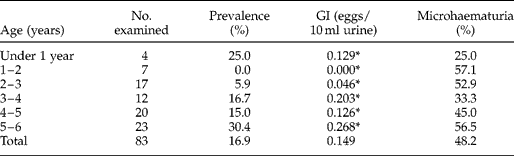
The intensity of infection within the age groups is shown in table 1. The table also shows that the geometric mean intensity of infection was 0.149 eggs/10 ml of urine. There were no significant differences (F = 0.989, df = 5, P = 0.430) in the mean intensity of infection among age groups. Preschool children aged 5–6 years had the highest mean intensity of infection (0.268 eggs/10 ml) while the lowest level (0.046 eggs/10 ml) was found in preschool children aged 2–3 years. Microhaematuria was present in 40 children (48.2%); however, this was not significantly different between the age groups (χ2 = 3.022, df = 5, P = 0.697). There was also no significant difference in the mean intensity of infection between Korede and Obada (t = 1.445, P = 0.152), nor the sexes (t = 0.787, P = 0.434), as shown in table 2.
Prevalence and geometric mean intensity of infection (GI) of Schistosoma haematobium and microhaematuria relative to the age of children.
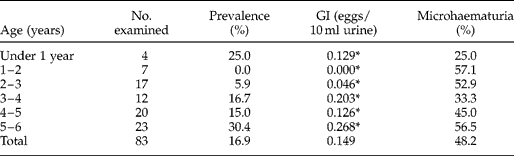
*ANOVA, F = 0.989, df = 5, P = 0.430.
Prevalence and geometric mean intensity of infection (GI) of Schistosoma haematobium by community relative to the sex of children.

*Between communities; **between sexes.
Water contact practices
The pattern of water use of preschool children was similar in the two communities; these were bathing, washing and recreation. Physical observation during the study showed that preschool children aged 3–6 years were seen in the streams, bathing and washing whereas the younger preschool children were seen accompanying their mothers to the streams, either to be bathed or for safety. FGDs with community members revealed that they have to resort to the use of water from the streams as the private water borehole in the communities was non-functional. They explained that the streams were their only source of water for washing, bathing and cooking. The FGDs also revealed that although they were aware that the source of infection with S. haematobium was from their streams, they did not know the exact mode of transmission. They were of the opinion that the infection was through drinking of stream water and as such; they only used the stream water for bathing, washing and cooking.
Discussion
Several studies of urinary schistosomiasis tended to focus on school-age children and adults, with little or no emphasis on preschool children, and when preschool children were part of the study, information about them was often unclear (Akogun & Akogun, Reference Akogun and Akogun1996; Ofoezie et al., Reference Ofoezie, Christensen and Madsen1998). However, owing to growing concern about schistosomiasis in infants and preschool children and its implications for control, which was first reported by Mafiana et al. (Reference Mafiana, Ekpo and Ojo2003), there is the need for more information on the status of schistosomiasis in this age group. The result of this study shows a prevalence rate of 16.9% for infection with S. haematobium among the preschool children in Korede and Obada communities. This observation is lower than the 71.8% documented for preschool children living in settlements near a dam reservoir in Ogun State, Nigeria (Mafiana et al., Reference Mafiana, Ekpo and Ojo2003); 19.8% in Adim, Cross River State, Nigeria (Opara et al., Reference Opara, Udoidung and Ukpong2007); and 58.1% in Ilewo Orile, Ogun State, Nigeria (Ekpo et al., Reference Ekpo, Laja-Deile, Oluwole, Sam-Wobo and Mafiana2010). The differences in prevalence between these studies could be attributed to the types of water bodies, water contact practices and poor health education. The low prevalence of 16.9% observed in this study is due to the increasing awareness among members of these communities about the source of infection, which has reduced the frequency of contact with the streams. However, some of the streams used for fish breeding, such as ‘Awawa’, have become attractive to preschool children for swimming and bathing. Water contact practices were high during 07.00–11.00 hours. There is no waste disposal system in these communities, and as such human wastes and urine are directly deposited in the streams or indirectly run off into the streams during rainfall. However, more research is needed to explain the epidemiology of infant and preschool schistosomiasis in sub-Saharan Africa.
The prevalence of S. haematobium infection in the present study was not affected by the age of the children, meaning that all the age groups are equally at risk of infection through their exposure to contaminated stream water, either by their guardians and caregivers or the preschool children themselves. Streams are the only source of water supply in the two communities, and it is difficult, if not impossible, to prevent the communities from visiting these streams every day for various uses. There was also no significant difference in the prevalence between boys (18.4%) and girls (14.7%) and this may be an indication that both genders are equally exposed to infection. These patterns of contact with the stream by preschool children may remain the same until they start school. The mean intensity of infection reported here is lower than that reported by Ekpo et al. (Reference Ekpo, Laja-Deile, Oluwole, Sam-Wobo and Mafiana2010) and the reason for this could be immunity, water contact practices or density of infected snail intermediate hosts in the water bodies.
The prevalence of microhaematuria in this study (48.2%) shows no significant difference between age and sex (P>0.05). Microhaematuria is a typical symptom of S. haematobium infection in endemic communities, where its prevalence correlates positively with urinary schistosomiasis infection (Savioli et al., Reference Savioli, Hatz, Dixon, Kisumku and Mott1990; Anosike et al., Reference Anosike, Nwoke and Njoku2001). The prevalence of microhaematuria (48.2%) was higher than the prevalence determined by urine microscopy (16.9%), and we could speculate that S. haematobium infection in preschool children may be much higher than reported, as single or multiple examinations of urine samples may not detect all positive infections. Authors, have however, recommended the use of single or a combination of several diagnostic methods, such as questionnaires, microhaematuria, proteinuria and urine microscopy, in diagnostic tests for treatment (Mott et al., Reference Mott, Dixon, Osei-Tutu, England, Ekue and Tekle1985; Lengeler et al., Reference Lengeler, Mshinda, Morona and deSavigny1993; Hammad et al., Reference Hammad, Gabr, Talaat, Orieby, Shawky and Strickland1997; Mafe, Reference Mafe1997; Guyatt et al., Reference Guyatt, Brooker, Lwambo, Siza and Bundy1999; Mafe et al., Reference Mafe, von Stamm, Utzinger, Goran and Goran2000; Lengeler et al., Reference Lengeler, Utzinger and Tanner2002; French et al., Reference French, Rollinson, Basáñez, Mgeni, Khami and Stothard2007; Ugbomoiko et al., Reference Ugbomoiko, Dalumo, Ariza, Bezerra and Heukelbach2009).
The occurrence of S. haematobium infection in infants and preschool children, in this study, supports the calls for inclusion of these age groups in mass treatment programmes (Stothard & Gabrielli, Reference Stothard and Gabrielli2007; Ekpo et al., Reference Ekpo, Laja-Deile, Oluwole, Sam-Wobo and Mafiana2010; Sousa-Figueiredo et al., Reference Sousa-Figueiredo, Pleasant, Matthew, Betson, Rollinson, Montresor, Kazibwe, Kabatereine and Stothard2010a) and the creation of a treatment dose pole for preschool children (Sousa-Figueiredo et al., Reference Sousa-Figueiredo, Day, Betson, Kabatereine and Stothard2010b). However, the issue of the safety of praziquantel treatment in children less than 3 years old needs to be addressed with more studies and trials (Stothard & Gabrielli, Reference Stothard and Gabrielli2007).
In the meantime, participatory health education programmes for the human population could help prevent or reduce contact with infected stream water and disease transmission. These programmes should be targeted at parents, guardians and caregivers so that they can understand the mode of transmission of the disease. There should be a promotion of effective behavioural change by parents, guardians and caregivers who expose their infants to the infection. Finally, provision of an alternative water supply, such as hand-dug wells and water boreholes, could help reduce the contact with infected stream water and transmission of the disease. Older preschool children should also be enlightened about the risk of having contact with stream water.
This study shows that in endemic communities, infection with S. haematobium starts early in life among infants and preschool children and there is the need for these age groups to be considered in the planning of any control measure. If these age groups are treated together with school-aged and adult members of the population, this may reduce continuous transmission of the disease. Therefore, there is the need to consider control measures in preschool children by their inclusion in mass treatment programmes.
Acknowledgements
The authors wish to thank the heads of Korede and Obada communities, and the parents, guardians and caregivers of the preschool children for their willingness to take part in the study. We thank all the members of the two communities for their cooperation during the focus group discussion sessions.