King’s thought-provoking paper raises a number of important issues regarding the archaeological record of banditry and rebellion. I will focus my remarks on a particular aspect of the challenges raised by the paper, namely the matter of topography and how close familiarity with it enabled renegades to engage in ‘asymmetrical’ forms of resistance against colonial powers. In King’s discussion, she focused on the reliance by South African herders on habitual refuges in the Maloti–Drakensberg highlands to evade the imposition of sedentary lifestyles by British authorities. In my research a similar dynamic concerns a reliance on the rugged coast of Rough Cilicia by the so-called Cilician pirates to resist Roman hegemony in the Mediterranean world between 139 and 67 B.C. Parallels between the two landscapes are evident, as are the highly mobile lifeways of the rebels in each instance. One of the more challenging questions for the Cilician example, however, concerns the precise role played by agropastoralists of the Cilician mainland in piratical disturbances along the coast. Were the pirates and the Cilician natives one and the same people, or did they represent a merger of interests between two wholly unrelated yet mutually supportive groups?
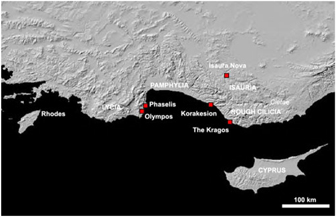
Much like the Maloti–Drakensberg highlands, the rugged, 200-kilometre-long coast of Rough Cilicia (south coastal Turkey directly north of Cyprus) offered limited capacity for agricultural settlement. The shore rises from sea level to 2,000 metres elevation in less than 30 kilometres, with long stretches of the shore forming prohibitive walls of inaccessible coastline. Prior to the Roman era (67 B.C.–250 A.D.) the principal lifeway in Rough Cilicia consisted of transhumant agropastoralism. Remains of necropolis centers in the ‘midlands’ (c.500–900 metres elevation) indicate that tribal entities drove their herds into the highland meadows (c.1,500 metres elevation) during summer and returned them to the shore for slaughter, processing and winter grazing (Matei, Kansa and Rauh Reference Matei, Kansa and Rauh2011). During their time in the highlands the animals would obtain four times the nutrients otherwise available on their trek. These midland ritual centres occupied a halfway point along the arduous route that was traversed twice a year and became logical places for herders to settle the sick and the infirm (Frachetti Reference Frachetti2009). Confirmation of this pattern is available not only from the consistent placement of these ritual centres along the midlands, but also from an otherwise visible lack of permanent stone structures throughout the region prior to the conquest of Alexander the Great (c.333 B.C.). From the perspective of built landscapes, the most dominant influence was the Ptolemies of Egypt and Cyprus, who governed this rugged coast from c.301 to 197 B.C., securing the shore with stone-constructed fortresses and signal towers (the largest being the fortress at Korakesion – modern-day Alanya – constructed by Ptolemy I, c.309 B.C.; Rauh, Dillon and Rothaus Reference Rauh, Dillon, Rothaus, Hoff and Townsend2013). Settlements which did exist at this time, such as Korakesion, were small, and often little more than moorages furnished by projecting promontories, natural embayments or lagunal river mouths. It needs to be stressed that the nature of ancient Mediterranean seaborne commerce, nonetheless, required negotiating this prohibitive coastline. Although ancient cargo ships were suitably capable of plying the open seas of the Mediterranean, the requirements of navigation necessitated that they hug the shore and moor at night at safe harbours. In addition, Rough Cilicia furnished abundant natural resources essential to the maintenance of maritime networks, including shipbuilding timber, wood by-products, textiles and metals. In other words, traffic along this sea lane was a given, regardless of the risks it entailed. It was, therefore, natural terrain for piracy, and the reputation of the inhabitants of Rough Cilicia, as well as those of Lycia further west, was characterized by accusations of piracy and terrestrial banditry dating back to the Bronze Age. To thwart this threat, merchant companies from advanced polities, such as the Republic of Rhodes and that of Rome, typically dispatched cargo fleets in convoys protected by accompanying warships (Gabrielsen Reference Gabrielsen1997; Rauh Reference Rauh and Gabrielsen2000; Reference Rauh2003).
Given the long-standing reputation for piracy in Rough Cilicia, the first question concerns the identity of the inhabitants of this coast and their relationship with the Cilician pirates. According Philip De Souza (Reference De Souza1999; Reference De Souza, Hoff and Townsend2014), the label of piracy in Graeco-Roman antiquity was largely the residue of political rhetoric. Established sea powers, such as the Rhodians and the Romans, hurled accusations of piracy against those who refused to abide by the norms of maritime commerce, even if those accused happened to be locally prominent elites. Were it possible to peer beyond the rhetoric and to view these sea warriors on their own terms, we would likely discover the sons and relatives of local warlords who viewed these waters as offshore territories and claimed the authority to charge ‘tolls’ on those sailing by. By refusing to acknowledge, let alone abide by, maritime rites of passage established by the great sea powers, Cilician warlords challenged the authority and the commerce of these powers, and were accordingly branded pirates. In favour of De Souza’s argument, the populations of Rough Cilicia, particularly those dwelling in the mountainous highlands, were distinctly tribal and characterized by networks of petty kings dwelling in fortified mountain fastnesses. The prominence of these polities, not to mention their identities, rose and fell over time, and was subject to patterns of recombination typical of segmentary societies. Warlords there undoubtedly were, in other words, and at times certain dynasties came to dominate large extents of the highlands and the coast as paramount kings. During the Iron Age (9th–6th centuries B.C.) many of these were crushed by the encroaching Assyrian and Neo-Babylonian empires (Casabonne Reference Casabonne2004). Persian authorities implemented a more effective policy of selectively designating cooperative local dynasts ‘client kings’ and worked with these to secure the peace in Rough Cilicia. However, the fierce independence and predatory behaviour of other warlords remained a constant. Cyrus the Younger, Alexander the Great and his regent Perdiccas all conducted military campaigns against warlords of the Cilician interior. Perdiccas’ sack of the highland bastion of Isaura Vetus in 322 B.C. signals the emergence of a particularly troublesome tribal element known as the Isaurians. Little seems to have changed during the Hellenistic era (323–27 B.C.). The rebellion of a neighbouring highland tribe, the Cietae, toward the end of the era underscored the persistent pastoral roots of Cilician dissidence as well as the continuing reliance of Mediterranean great powers on regional client kings. In 36 B.C., the Cietae rebelled against the Roman client king, Archelaus of Cappadocia, following his decision to conduct a census throughout Cilicia. Census remained the anathema of transhumant pastoralists throughout history, essentially because it was correctly interpreted as an incipient step toward taxation (Lindner Reference Lindner1983, 53–55). Dwelling on the margins of settled agricultural society, living off the land and expropriating resources by force when necessary, pastoralists viewed taxation as an illegitimate interference in their ancestral way of life, particularly since the authorities imposing taxes furnished little in return. Despite repeated suppression by the Romans and their surrogates, not to mention the imposition of Roman veterans’ colonies in their midst, hinterland tribes, such as the Isaurians and the Cietae, endured oppression to mount repeated rebellions during the 3rd and 4th centuries A.D. The Isaurians eventually furnished the military stock of the Isaurian dynasty that ruled Constantinople during the latter half of the 5th century (Leo I, 457–74 A.D.). In other words, despite the mounting pressure of development along the shore, transhumant lifeways in the highlands remained remarkably stable and consistent.
This brief synopsis returns us to one of the key points in King’s discussion, namely that mobility, transhumance and warlordism characterized the upland populations of Rough Cilicia from the Iron Age through to the Roman era, much as it did patterns of behaviour in modern South Africa. The advantages of these herders rested in their mobility, their ability to retreat into the highlands, and their familiarity with the supply lines and choke points of the upland routes. Fierce, independent and austere, the Cilician reputation for banditry and lawlessness most probably resulted from a refusal to adapt to, let alone accept, the norms of settled agricultural existence. The Rough Cilician highlands were a prime recruiting ground for ancient warriors precisely because they lived and fought well in harsh conditions. The question remains of how this population and this particular lifestyle lent itself to seaborne piracy.
Pirates, after all, were seamen, not herders, and even in antiquity seamanship was a craft acquired through years of apprenticeship at sea (Rediker Reference Rediker1987; Rauh Reference Rauh2003). Sailors learned how to run the largest and most complicated machine of the era, the ancient sailing ship. They knew how to control sails, ropes and rudders; how to detect bad weather, prevailing winds and subtle currents; and where to avoid shallow reefs, submerged rocks and lurking pirates. In one respect, like herders they lived on the margin of settled urban society, but their margin was the vast watery deep that served as the highway connecting Mediterranean urban settlements to essential goods and services. Maritime communications furnished the lifeblood of ancient urban populations, without which settlements, such as Athens, Alexandria and Rome, simply could not have existed. The social isolation, the harsh labouring conditions and the extreme danger of life at sea compelled many sailors to convert to piracy. Having laboured along the maritime networks of the Mediterranean, renegade sailors exploited their acquired knowledge to attack the very same, turning the tables on their former employers.
At the end of the second century B.C., coordinated piracy known as the Cilician pirates came to plague the entire Mediterranean world (c.139–67 B.C.; Rauh Reference Rauh1998; Reference Rauh2003). Ancient sources consistently identify these pirates as ‘Cilicians’. Given the pastoral origins of these peoples, and the minimal size of the regional population, this assertion is difficult to accept. The most likely explanation holds that Cilician warlords dominating the seascape dispatched some percentage of their young male populations to sea, if only to exploit the trade occurring directly offshore. Emerging archaeological evidence of Iron Age fortresses along the Cilician shore argues in favor of a pattern of offshore force projection by Cilician warlords (Varinlioğlu et al. Reference Varinlioğlu, Kaye, Jones, Ingram and Rauh2017). Still, the numbers entailed here would inevitably have been small, hardly sufficient to staff the sizeable armadas recorded for the Cilician pirates. More likely, the Cilician example of highland warlords projecting force onto neighbouring sea lanes was repeated and replicated in remote coastal regions throughout the Mediterranean. This is where Marcus Rediker’s (Reference Rediker1987) template for early modern transatlantic piracy comes into play.
The phenomenon of Cilician piracy was aided by the implosion of declining Hellenistic realms in Syria and Egypt, by the mounting resistance to Roman hegemony in the Aegean (aided and abetted by King Mithradates VI of Pontus, 135–63 B.C.), and by an unrelenting sequence of civil disturbances in the Roman West. Into this power vacuum, disparate bands of pirates lodged themselves in hidden coves and desert islands across the Mediterranean, with their principal bases situated along the southern coast of Anatolia. Chief among these was Korakesion, though other bases are recorded at the nearby Mount Kragos, as well as at Olympos and Phaselis in eastern Lycia. According to Strabo, regional powers such as Rhodes and the Romans ignored the emerging problem of piracy because initially the pirates directed their predations against the imploding Seleucid dynasty in Syria. Eventually the pirates began to harass Roman trade, particularly the vital luxury trade that circulated between Italy and the Near East. In 102 B.C. the Roman Republic formally declared war on the pirates by identifying the waters along the Anatolian south coast as the newly imposed provincia, or military sphere of operations, of Cilicia.
Rediker (Reference Rediker1987, 257–58) details three critical requirements for international piracy of this magnitude: pirates tend to seek asylum in anarchic regions that border crucial sea lanes of the world; pirates tend to exploit their knowledge of established maritime networks to prey on passing commerce; and since randomly seized cargoes do not always contain foodstuffs essential for survival, pirates need a ‘fence’; that is, a nearby friendly community where they can trade their plundered cargoes for everyday essentials without consequence. As described above, the coast of Rough Cilicia furnished the necessary power vacuum and hidden places from which to harass passing commerce, and the nearby cities of the Pamphylian plain openly allowed them to market their expropriated wares in friendly harbours. Exploiting the mobility of their marginal existence, pirates, runaway slaves and renegade sailors flocked to these waters to escape likely punishment that awaited them within the confines of Roman hegemony. In addition, the mounting violence of the era compelled otherwise legitimate actors to join the pirate cause. Although the origins of Cilician piracy were complex, its function as a release valve for the underlying social tensions of maritime society, and hence as an expression of rebellion and reform, became palpable. Plutarch (Pomp. 24) concludes that ‘some men of wealth, of good family, and of exceptional intelligence began to join the pirate fleets and to share in their enterprises, regarding piracy as a profession by which honor could be attained and ambition satisfied’. Appian observes (Mith. 92) that the pirates offered genuine asylum to destitute seamen throughout the eastern maritime waters; ‘sailors from Cilicia, Syria, Cyprus, Pamphylia, and Pontus and those of almost all the eastern nations, who on account of the severity and the length of the Mithradatic War, preferred to do wrong rather than to suffer it, chose the sea instead of the land’. As Plutarch explains (Pomp. 24.3), ‘the fleets which put in at the Cilician pirate bases were admirably equipped for their own work with fine crews, expert pilots, and light fast ships’. According to Plutarch (Pomp. 28.2) and Appian (Mith. 93), the pirates eventually wielded a combined armament of several hundred warships (including 90 decked ships of the largest class) and 30,000 combatants.
When not consumed by their own destructive civil disturbances, Roman authorities conducted intermittent campaigns against the pirates. In 78 B.C., the Romans dispatched C. Servilius Vatia (soon to obtain the triumphal epithet Isauricus) to overwhelm the pirate threat in Cilicia. Scoring rapid successes in eastern Lycia and Pamphylia, Servilius unexpectedly turned his offensive inland, marching far into the Isaurian highlands to besiege and sack the heavily fortified Isaurian bastion at Isaura Nova. This campaign furnishes our best indication that the source of the pirate problem possibly originated in the highlands. Political confusion during the late 70s B.C. prevented the Romans from resuming their offensive for a time. The pirates, meanwhile, concentrated their efforts in the western Mediterranean, where they conducted kidnappings of prominent Romans, harbour raids and inland incursions in Italy. They also attempted to disrupt the shipping lanes from Italy to Spain. Finally, in 67 B.C., the Romans enacted a plebiscite conferring on their most distinguished general, Cn. Pompeius Magnus, sweeping powers to eradicate the scourge of piracy. Supported by 24 legates, Pompey methodically divided the Mediterranean into quadrants and pre-positioned his squadrons to pin down pirate bands in situ. Simultaneously, with a vast armada he swept the seas from west to east, driving the pirates eastward and besieging them ultimately at their base at Korakesion. Aware of Pompey’s assurances of leniency, most of the pirates, reportedly 20,000, surrendered in due course, but some 10,000 rebels, mindful of their crimes against humanity, fought to the death. Pompey settled his prisoners in newly founded colonies in eastern Cilicia. His forbearance in this instance was repaid by the descendants of these pirates, who faithfully supported Pompey and his son, Sextus, in their ensuing civil wars. Such is the recorded saga of the Cilician pirates.
It is important to exercise caution regarding the gravity and scale of Cilician piracy and to allow for a significant degree of hyperbole in the ancient testimony (Tomaschitz Reference Tomaschitz, Hoff and Townsend2013). Efforts to identify the archaeological remains of pirate settlements along the coast of Rough Cilicia have generated meager results (Gabrielsen Reference Gabrielsen1997; Rauh Reference De Souza1999; Reference Rauh2003; Rauh et al. Reference Rauh and Gabrielsen2000). Much like the herders in the Maloti–Drakensberg highlands, the Cilician pirates occupied pre-existing fortified settlements, such as the Ptolemaic bastion at Korakesion, leaving little in the way of a verifiable archaeological footprint. Nonetheless, our brief summary highlights several issues that return us to the relationship of topography and dissidence. First, the Cilician pirates appear to have become a Mediterranean-wide phenomenon incorporating pirates and renegades from throughout the basin. In fact, the numbers recorded by the sources probably reflect an aggregate count that was submitted to the Roman Senate by Cn. Pompeius to support his request for a triumph in 62 B.C. Forces of this scale were simply unlikely to have existed in a region as barren as Rough Cilicia, nor were they sustainable for any extended period of time. In addition, the assault of P. Servilius Vatia Isauricus on Isaura Nova, noted earlier, serves as a likely indicator of collusion between the pirates and the highland warlords of the interior. Appian (Mith. 117) asserts that the pirates peacefully coexisted with the highland Cilicians and that Pompey conducted many captured warlords in his triumph at Rome. Gathering along the Cilician coast, pirate bands conceivably furnished these warlords with a means once again to project force offshore, similar to previous patterns but on a much grander scale. Cicero (Verr. 2.4.21) indicates that the pirates conducted annual ‘pirate rounds’ from Rough Cilicia, roving the extent of the Mediterranean before returning to their winter bases along the coast. Moreover, the alacrity with which dispersed pirate bands fled to Rough Cilicia during Cn. Pompeius’ naval sweep in 67 B.C. demonstrates that no matter where they were situated, pirates from throughout the Mediterranean were familiar with the safe havens available along this coast. Regardless of the Mediterranean-wide character of the pirate menace, in other words, the sources insist that the coast of Rough Cilicia formed a crucial nexus to its survival.
In conclusion, while we may never adequately grasp the underlying reality of the Cilician pirate menace, its close association with the coast of Rough Cilicia and the highland elements above it furnish an important parallel to the rebellious herders of the Maloti–Drakensberg highlands in modern South Africa. Mobility, austerity and competence in non-sedentary lifeways enabled dissident groups in both instances to exploit their advantages to an alarming degree, seemingly in the face of overwhelming odds. What the two examples perhaps best illustrate is the degree to which peoples dwelling on the margins of settled agricultural society are those most capable of resisting its intrusion once push comes to shove.
Labeled map of Rough Cilicia and mentioned sites.