A fenestration in the Fontan pathway placed during surgical palliation lowers impedance to systemic venous return. The right-to-left shunting increases cardiac output and oxygen delivery at the expense of desaturation. Shunting may become functionally intolerable with improvement in cardiac function and ventricular end-diastolic pressures, potentially compromising oxygen saturation.Reference Rychik, Atz and Celermajer1,Reference Saiki, Kuwata and Iwamoto2 There are no dedicated devices for partial closure, and complete closure may result in systemic venous hypertension and multi-organ failure. We describe reducing Fontan fenestration size in a child using the Atrial Flow Regulator (Occlutech International AB, Helsingborg, Sweden).
Case Report
A 5-year-old male born with HLHS, DORV, mitral atresia, obstructed TAPVR, and Kabuki syndrome underwent initial pulmonary artery banding, arch reconstruction, and TAPVR repair shortly after birth. Due to the diagnosis of pulmonary lymphangiectasia and pulmonary interstitial glycogenosis, he eventually required tracheostomy and ventilator support. Takedown of PA band, placement of right modified Blalock–Taussig shunt, and Damus–Kaye–Stansel procedure were performed at 5 months followed by shunt revision at 3 years of age. The patient continued to have complications from chronic lung disease, pulmonary hypertension , and tracheal haemorrhage requiring multiple hospitalisations, and comprehensive PH therapy.
Lateral tunnel Fontan palliation was performed at the age of 5 with a 7 mm fenestration. He was discharged 3 weeks later with oxygen saturations in the mid-80s. The oxygen saturations frequently dropped to 50–60% over time. Although he slowly recovered from persistent pleural effusions, fenestration reduction was planned due to persistent hypoxaemia.
Device and delivery system
The AFR is a nitinol wire mesh-based self-expanding double-disc device with a centrally located fenestration and flexible waist connecting the two discs. The device’s proximal disc includes a welded adapter ball, which is inserted in the jaw of the Pistol Pusher (Occlutech) for implantation using a compatible Delivery Set (Occlutech).
Intervention
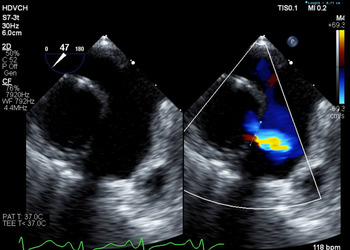
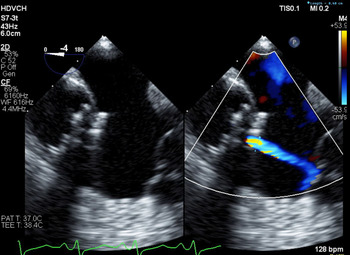
Under aseptic precautions and general anaesthesia, right and left heart catheterisation were performed 4 months post-surgery to evaluate haemodynamics. Mean Fontan pressure of 17 mmHg, mean PCWP of 14 mmHg, and aortic saturation of 65% on room air were noted. Test occlusion with a Tyshak Mini (B. Braun Interventional Systems Inc., Bethlehem, PA, USA) balloon showed improvement in oxygen saturation to 95% with mean Fontan pressure of 19 mmHg, which supported the decision to reduce the fenestration size (Table 1). An 8F Delivery Set was positioned in the left atrium over the previously positioned Amplatz Support Wire Guide (Cook Medical, LLC., Bloomington, IN, USA). An AFR with 4 mm fenestration was then deployed using the Pistol Pusher under fluoroscopic and transesophageal echocardiogram guidance in a typical fashion (Figs 1 and 2). Oxygen saturations increased to 92% with stable Fontan pressure: mean 18 mmHg. The patient was kept on intravenous heparin for 24 hours and subsequently switched to oral clopidogrel and aspirin. He was discharged 3 weeks later with a saturation of 91%.
Haemodynamic assessment under test conditions

2DTEE+colour Doppler: 7 mm lateral tunnel Fontan fenestration and shunting from Fontan to atrial chamber.

2DTEE+colour Doppler: AFR with 4 mm fenestration and shunting from Fontan to atrial chamber.

Discussion
Fontan fenestration decreases morbidity and mortality by increasing cardiac index and systemic oxygen transport, and lowering systemic venous pressures.Reference Lemler, Scott, Leonard, Stromberg and Ramaciotti3,Reference Gewillig, Boshoff, Voelkel and Schranz4 Creation of a fenestration improves outcomes in failing non-fenestrated Fontan circulation.Reference Rupp, Schieke and Kerst5
In our case, Fontan palliation carried high risk due to comorbidities. The alternative option of increasing systemic-to-PA shunt size would have caused worsening haemodynamic profile with higher flow and resistance, eliminating the feasibility of Fontan palliation. A smaller fenestration (4–5 mm) may have led to multi-organ dysfunction from high venous pressure and poor perfusion gradients, possibly resulting in post-operative collapse, and large pleural effusions. Although PA pressures were elevated, the benefits of higher oxygen saturation including a decrease in the development of collaterals outweighed the risk of reduction in fenestration size. An AFR with 4 mm fenestration was selected as there are no approved devices for the reduction of fenestration sizeReference Zablah and Morgan6; however, the device was previously reported for creation of Fontan fenestration.Reference Lehner, Schulze-Neick and Haas7
Conclusion
The AFR device provides a minimally invasive approach to reduce Fontan fenestration size and improve oxygen saturation without a significant increase in Fontan pressures. Further studies are required to evaluate long-term outcomes.
Acknowledgements
None.
Financial support
This research received no specific grant from any funding agency, commercial, or not-for-profit sectors.
Conflicts of interest
Aregullin and Samuel have no conflicts of interest. Vettukattil invented the AFR device and is a paid consultant for the manufacturer, Occlutech.
Ethical standards
The authors assert all procedures contributing to this work comply with ethical standards of relevant national guidelines on human experimentation (US CFR) and with the 1975 Helsinki Declaration (revised 2008). This case report does not meet the definition of research and is not subject to IRB oversight as per the Spectrum Health IRB. Informed consent was obtained from the parents to use the child’s information in online/printed publications.