Most work in British history on soldiers and migration has centred on soldier settlers in the colonies, with North America receiving the major share of attention. From the eighteenth century governments sporadically held out land grants and other incentives to former soldiers to secure vulnerable frontiers and boost colonial populations.Footnote 1 Soldiers certainly do not deserve to be overlooked as imperial migrants. Any colony, along with India, had its share of discharged men (and, no doubt, deserters as well) who were the leavings of regiments that typically spent long periods abroad garrisoning the outposts of empire.Footnote 2 Unlike most other migrants from Britain, such men had experience of places overseas, and the colonial societies in which they settled were often highly militarized. Even if soldiers returned home, they were a source of information, and, possibly, encouragement to prospective colonists.Footnote 3
Nonetheless, those soldiers who were imperial settlers were vastly outnumbered by homecomers among them. The number of military pensioners probably states the disproportion accurately enough, if only because full provision was made for payment of pensions overseas from 1816. Pensioner numbers peaked at little short of 86,000 in 1828 (excluding over 10,000 ordnance pensioners who only came under Chelsea Hospital administration in 1834). The grand total fell below 70,000 only in 1850–1.Footnote 4 Up to 1830, a fair estimate is that over 1,500 men were being paid in India and the colonies; an admissions book for the ‘colonies’ covering the period 1817–26 lists 1,671 names, some of whom were German subjects of the king as elector of Hanover.Footnote 5 As late as 1847, there were not more than 4,500 ‘colonial’ pensioners, compared with 66,000 domiciled in Britain and Ireland.Footnote 6 On this evidence, soldiers need to be primarily understood as ‘sojourners’, part of the phenomenon of return migration, even if in their case the cycle of expatriation and repatriation was a particularly long one of about twenty years.Footnote 7
The sheer number of veterans after the Napoleonic wars rendered them a significant presence in the home society at a time when ‘military habits’ were generally interpreted as inimical to social order. Soldiering was regarded as making men restless, improvident, and dissolute, creating difficulties when soldiers were required to re-enter a civilian world that bore little resemblance to the army. Major Alexander Tulloch, who in 1839 set out to transfer control of pensioners from Chelsea Hospital to the War Office, was clearly responding to what he saw as their habitual drunkenness, aversion to work, and easy descent into crime. But among contemporaries who attacked flogging or religious indifference in the army, there was equal concern to contain and reform a brutalized soldiery.Footnote 8
This image aside, very little is known about how soldiers actually fared after release from the army. If many, or most, literally went home, returning to that part of the country where they had been born or where they had enlisted, we might argue that far from acting as marginalized men, they showed a strong disposition to resume old affiliations to family, locality, and employment. Further, if they, on the whole, married and formed family economies and proved to be a settled rather than a shifting population, the case that they largely incorporated themselves back into civilian society is strengthened. Natalie Petiteau has found the same phenomenon with veterans of Napoleon's army.Footnote 9
Soldiers have been characterized as sharing a ‘culture of mobility’ with the rest of the itinerant poor;Footnote 10 but it may be more accurate to regard them as conforming to a classic pattern of return migration that particularly featured in the late nineteenth and early twentieth centuries when several million European workers ‘sojourned’ across the Atlantic to the Americas in search of work and the accumulation of savings that would improve their economic position back home.Footnote 11 Like such sojourning, soldiering was largely a movement of young, unmarried men. The ‘target earning’ of the labour migrant is not so different from that of a soldier who, especially after reform of the pension in 1806, commanded a worthwhile entitlement after a prescribed term of service.
As records produced by the state on a matter about which it had every reason to be thorough, pensioner records provide us with an enormous amount of information about returned soldiers. They are better documented than any other group belonging to the popular classes, though historians have been slow to take advantage of this fact. When men were discharged to the pension, their place of birth and their intended place of residence were noted. Pensions were paid by local excise offices, found in most places of any consequence in Britain; there were 107 in Scotland alone.Footnote 12 On change of residence, in order to change the place of payment, the pensioner applied for new ‘Instructions’. A central record therefore, efficient by the standards of the time, was kept of the movements of such men that often came to include in the registers the date and place of death. In 1842, when the War Office took over the administration of pensions from Chelsea Hospital, the various districts made quarterly, and then monthly, returns of men who had arrived, departed, or died.Footnote 13 Gargantuan research task though it would be, pensioner records provide historians with the means of accumulating ‘longitudinal migration profiles’ of thousands of individuals, the sort of information that has been identified as necessary for a ‘developed social history of migration’.Footnote 14
One reason for concentrating on Scottish military pensioners in this article is that a comprehensive Scottish register of 1816 exists, that prioritizes nationality in the data. There are 7,340 names, covering all branches of the army except the artillery and other ordnance corps.Footnote 15 Historiographical considerations also make the Scottish case important. From the later eighteenth century Scotland had an increasingly militarized national identity, connected with the country's sensitivity over equal partnership with England, its actual military achievements and proud ‘national’ regiments, and Lowland idealization of Highlanders and the Highlands.Footnote 16 Associated with this advance of military Scotland is a case for a ‘Scottish empire’ that challenges the idea that empire-making was predominantly an English enterprise, even before the British union of 1707.Footnote 17 Although military service has been called a ‘cheap, state-subsidized form of emigration’,Footnote 18 how well does a view of Scottish soldiers as imperial warriors and settlers conform to the knowable facts concerning the domicile of Scottish military pensioners overseas? There may have been marked differences between those Scottish soldiers who served in the Seven Years War and the American war and the ‘Napoleonic’ generation that followed. Since growth and development in the central Lowlands belt progressed more rapidly than ever in the early nineteenth century, we need to find out if discharged soldiers were drawn more to domestic opportunities than to those in the colonies. There is also the fact that during the Napoleonic wars the British army fought mainly in Europe; in contrast to previous wars, relatively few Scots found themselves in the North American colonies. If availability of information is a key determinant of the decision to migrate, it was the post-Napoleonic soldiery, undoubtedly belonging to an army of imperial service, who were more likely to provide a large cohort of imperial settlers.Footnote 19
I
The prominence of Scots in the eighteenth-century British army is often cited. While their numbers expressed as a proportion of the total rank and file probably peaked during the American war, they continued to be over-represented in terms of Scotland's population well into the nineteenth century. Approximately 16 per cent of the British Isles-born soldiery were Scottish at the conclusion of the Napoleonic wars, 13·4 per cent in 1830, and 13·9 per cent in 1840 at a time when Scotland's share of the United Kingdom population declined from 10 per cent to 9·5 per cent.Footnote 20 On these figures, Scottish veterans might be expected to have been equally over-represented in the colonies, especially because Scotland, along with Ireland and Norway, had the highest emigration rates in Europe in the nineteenth century.Footnote 21
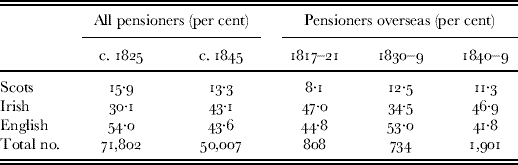
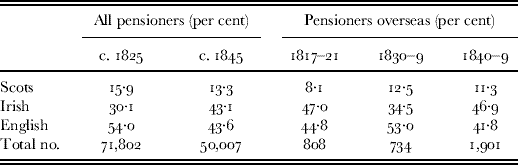
The case, however, is quite different when pensioner data is introduced into the argument. An admissions book recording the names of pensioners resident in India and the colonies shows that in 1817–21 only 8·1 per cent of the British Isles-born were Scots. This figure is close to the 7 per cent who made up the Scottish proportion of those pensioners who had gone to Upper Canada in the early 1830s under a government-organized scheme, and the 7 per cent who were Scots in the pensioner corps formed in New Zealand in 1846.Footnote 22 Admittedly, three later admission books for the ‘colonies’ covering the period 1830–49 produce a higher percentage of 11–12 per cent.Footnote 23 Data from the three registers can be regarded as authoritative because once discharged at home few pensioners would have possessed the means to emigrate to the colonies. In the absence of any official return, it is possible to establish the national proportions of the pensioner population in the 1820s and 1840s with reasonable accuracy by counting men who were serving in the army in 1810 and 1830 and who later gained the pension.Footnote 24 Scottish pensioners who were veterans of the Napoleonic wars were indisposed to settling overseas; Scots continued to be under-represented among ‘colonial’ pensioners even with the next generation of soldiers. Further, Scottish under-representation was in stark contrast to Irish over-representation, as Table 1 shows.
Veterans accepted for the pension overseas, 1814–1850
Sources: TNA, WO23/147–50, WO97.
Scottish soldiers, therefore, appear to have been reluctant imperial settlers. Indeed, most of those who, on discharge, received pensions returned to Scotland permanently. The repatriation of the Napoleonic generation of Scottish soldiers can be established from the 1816 register of Scottish military pensioners which supplies the nominated parish of residence for each individual. These were men who had often spent twenty years in the army. Six in seven (85·7 per cent) returned to Scotland, with an even higher percentage for the line infantry (89 per cent). Most who were living outside Scotland settled in England, with substantially fewer in Ireland.
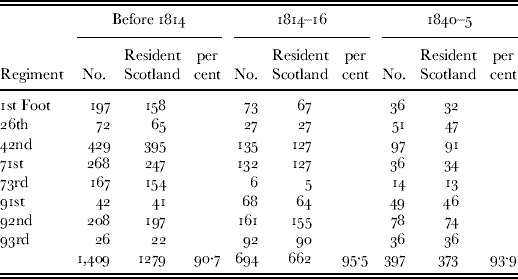
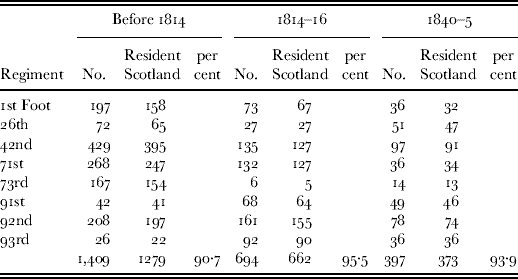
Extracting the same information for the post-Napoleonic soldiery is difficult because the Chelsea Hospital registers are organized by regiment rather than nationality. It remains important, however, to find out whether, in an army of imperial service – which is what the British army after 1815 essentially was – the same behaviour held good. A sample of eight line regiments was taken – two (1st Foot and 73rd Foot) without a predominantly Scottish rank and file (Table 2).Footnote 25 While the percentages cannot be conclusive because Scottish infantrymen were more prone to return than other Scottish soldiers, they do indicate that a high rate of repatriation existed, even during the economic downturn and social distress of the ‘Hungry Forties’. Nor is there any evidence in these figures that imperial soldiering encouraged more Scottish soldiers to settle out of Scotland, including overseas. The comparison with the Irish is also instructive. A similar Irish sample for 1840–5 admissions covering 340 men shows that a considerably lower percentage (82·0 per cent) returned to Ireland.Footnote 26
Scottish pensioners: repatriation percentages in selected regiments
Sources: NLS, Dep. 268/45; TNA, WO97, WO120/55, 57, 59, 62, 64.
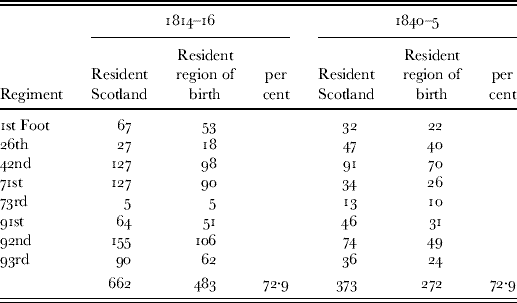
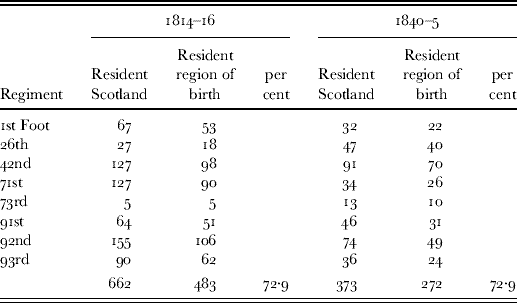
The homecoming proclivities of Scottish soldiers become even more pronounced when the proportion who returned to their part of the country is considered, native locale being defined as county of birth or adjoining county. Using the same sample regiments, nearly three-quarters of the 1814–16 pensioner cohort declaring residence in Scotland ‘went home’ in this sense (Table 3). Precise comparison with the 1840–5 cohort is more complicated because the registers do not provide the parish of residence, but only the ‘district’ where payment was received. Nevertheless, the twelve ‘pensioner districts’ into which Scotland was divided when the War Office took over payment of pensions in 1842 were, roughly speaking, clusters of counties that do not dramatically disrupt the results.Footnote 27 Interestingly, exactly the same overall result was achieved for this later generation of soldiers.
Scottish pensioners: homecoming percentages in selected regiments
Sources: NLS, Dep. 268/45; TNA, WO97, WO120/55, 57, 59, 62, 64.
Little data exists on homecoming soldiers, or return migrants for that matter. Natalie Petiteau's study of veterans in post-Napoleonic France emphasizes their successful reintegration into civilian life; in the Vaucluse department (Provence) 91·4 per cent of pensionnés, for whom the information can be found, remained within the region. Elsewhere the post-war experience of American Civil War soldiers is starting to receive attention. Russell Johnson has found that 51·6 per cent of Dubuque, Iowa's surviving soldiers returned to the town and were living there in 1870; as he concludes, ‘military service did not breed wanderlust’.Footnote 28 It is interesting that the homecoming of Scots in the early nineteenth century equalled the homecoming of American servicemen at the end of the Second World War, which is not to be expected, bearing in mind the difference between an army of long service, enlisted men, and an army of conscripts uprooted for a relatively short time from settled patterns of existence.Footnote 29 Furthermore if, in round figures, 90 per cent of Scottish pensioners of this period returned to Scotland and 75 per cent of these to home parts, about one third of Scottish emigrants from the general population returned in the later nineteenth century.Footnote 30
It nonetheless has to be acknowledged that Scottish soldiers, on the evidence of pensioners, were more likely to settle away from their region of birth than the rest of the Scottish population. If, in the early nineteenth century, over 10 per cent of Scots left the army to settle in England or Ireland, rather than Scotland, the censuses of 1841 – the first for which such calculations are possible – reveal that only 4·6 per cent of the Scottish-born population were living elsewhere in the British Isles.Footnote 31 Expatriate pensioners had often served as guardsmen or cavalrymen. In the 1816 register, about half of the former category were living away from Scotland, mostly in London. About a third of cavalrymen were domiciled outside Scotland.Footnote 32 These figures are unsurprising since guards regiments were usually stationed in London, ensuring that their soldiers were already well integrated into London's economy and society. On retirement from the army, cavalry soldiers, as skilled hands with horses, were eminently employable in the various horse trades that were expanding with urban and industrial development.Footnote 33 Indeed, soldiers, in general, were more acclimatized to urban and industrial work than to agricultural labour.
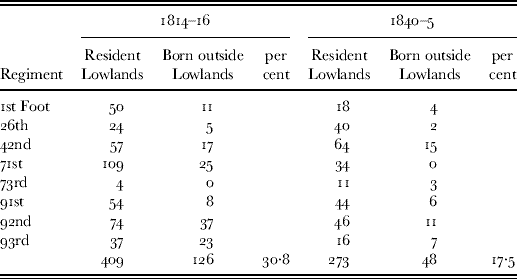
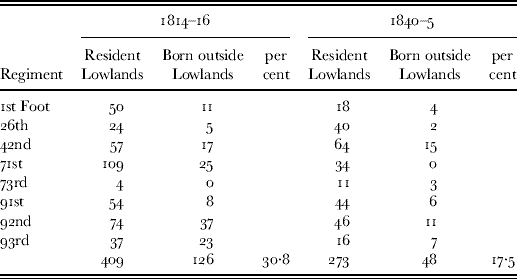
Scottish pensioners in Scotland were certainly part of a migrant flow that, from the late eighteenth century, saw people moving from the north and Borders into the central Lowlands, where some of the highest urban growth rates in Europe existed.Footnote 34 Pensioners, in fact, again prove to have been more mobile than the general Scottish population (Table 4). In 1851, 6·9 per cent of people in the Lowlands had been born elsewhere in the country;Footnote 35 17·5 per cent of the men of the 1840–5 sample who declared residence in the Lowlands had been born in other parts of Scotland. The figure was appreciably higher for the 1814–16 group.
Men declaring residence in the Lowlands: selected regiments
Sources: NLS, Dep. 268/45; TNA, WO97, WO120/55, 57, 59, 62, 64.
These figures disguise the extent to which men enlisted in the army having already migrated away from birthplaces. It is well known that heavy recruitment occurred in large towns from among casual and unemployed wage workers who arrived in search of work. As superintendent of pensioners in 1850 and having long pored over pensioner statistics, Tulloch told a parliamentary committee that pensioners generally returned to the district where they had enlisted.Footnote 36 To be more precise, one would need to amass data from a large sample of discharge documents that gave a soldier's place of birth, his place of enlistment, and where he intended to reside. What can be detected is a remarkably close correspondence between the percentages given in Table 4 and the percentages gleaned from Edinburgh attestation books. Among recruits enlisting in the city 1796–1802, 35 per cent had been born outside the Lowlands, comparable to the 30 per cent according to the sample of men admitted to the pension in 1814–16. Moreover, the Edinburgh figures show a similar decline: 17 per cent 1811–12, 16 per cent 1821–2, 15 per cent 1831–2.Footnote 37 A fairly safe conclusion to make is that soldiers on their discharge mostly returned to familiar places.
This does not necessarily mean that migrant soldiers were converted into sedentary civilians. Chelsea Hospital never assumed as much, since it established a procedure to enable men to change the place where they collected their pensions, conceivably as frequently as every quarter.Footnote 38 William Murphy, a pensioner of the 55th Foot and a native of county Down, came to Glasgow from the Newry district in September 1845, left before the end of the year, returned from Newry in June 1846, and again departed within a few months.Footnote 39 One way of ascertaining the mobility of the pensioner population is to identify men who were admitted to the pension in 1814–16 and who were still collecting it in 1840–5. Of 307 such men in the eight sample regiments, only 53 (17 per cent) had left their original residence for another further away than an adjoining county, including eleven who had either left or returned to Scotland. Among the 53 men, 14 had returned to the district in which they had been born, or very nearby.Footnote 40
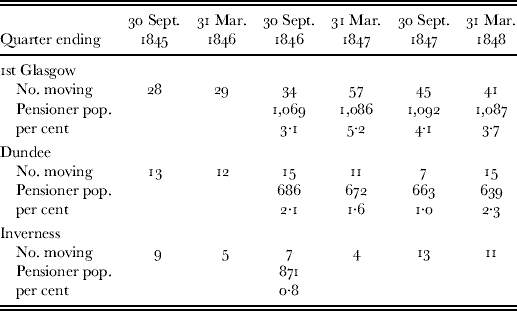
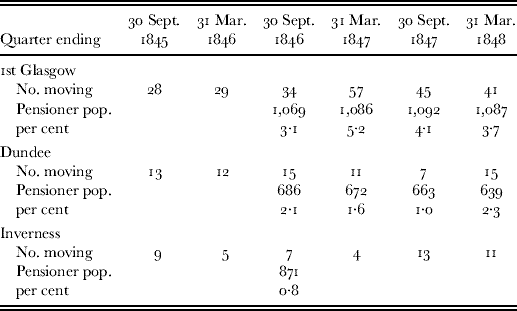
Once the War Office had assumed responsibility for the administration of pensions in 1842, quarterly, and later monthly, returns began to be made of, inter alia, men leaving and entering each district. Taking the 1st Glasgow, Dundee, and Inverness districts, a total of 781 movements by 645 men were recorded in a three-year period, 1845–8.Footnote 41 The chief clerk of Chelsea Hospital, after investigating pensioner mobility in Glasgow in 1839, concluded that the ‘great body of the Pensioners … continue Stationary’: ‘upon an Average of the total number of removals in each Quarter, it is found that they do not exceed 2 1/2 Per Cent or at most 3 Per Cent upon the entire body’.Footnote 42Table 5 suggests that the higher percentage obtained in large towns and industrial districts, which is only to be expected in view of their high rates of in- and out-migration among the general population.
Mobility of pensioners in selected Scottish districts, 1845–1848
Sources: TNA, WO22/121, 127, 131.
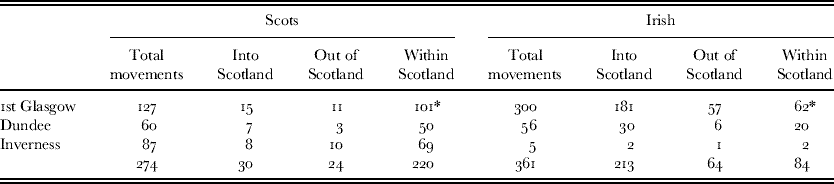
These figures require further explanation. Unfortunately, the available data dates only from 1845, which was a period of heavy Irish migration into Scotland, especially the western Lowlands. Over half of the movements recorded were by Irish, most of which were into, or out of, Scotland. By contrast, Scots mostly moved within Scotland, many in Glasgow shifting no further than the other Glasgow district or Paisley. Slightly more Scots returned to Scotland than left (Table 6).
Mobility of Scottish and Irish pensioners in selected Scottish districts, 1845–1848
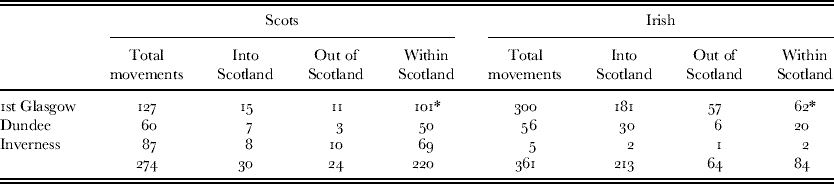
* 62 Scots and 33 Irish into or out of 2nd Glasgow and Paisley districts.
Sources: TNA, WO22/121, 127, 131.
The Scottish pensioner who emerges from such data was more often a settled working man than the archetypal soldier thrown adrift on society on discharge from the army. The pensioner population is probably better described as having a solid and sizeable core of ‘stationary’ men and a penumbra of the more restless and indigent. Pensioners were certainly not paupers. Men who became dependent on poor relief ‘assigned’ their pensions to the parish, but in England, at the beginning of the ‘Hungry Forties’, only 1,500–2,000 out of 40,000 pensioners entered into this arrangement in any one year, and 2,500 in 1842. As conditions improved, the number had dropped back to 300 by 1850.Footnote 43 While the formation of pensioner corps begun in 1843 is usually understood as a law and order measure,Footnote 44 designed to separate men with military training from radical politics, the plan was also an acknowledgement that a large and stable population of pensioners existed in different localities. A report on the Inverness men made the same point of successful reintegration:
the great majority … resident in this Collection consist of Men who having been born and enlisted in the several towns in the district, have, upon discharge from the Service, returned and settled in their native places, and who are therefore not only known by the Magistrates and Ministers to be the parties discharged from the Army, but also the very same Men who entered into it.Footnote 45
II
In attempting to understand the homecoming propensities of soldiers, the historian enters into the disorderly universe of human motivation and behaviour. Migrant decision-making remains an area of study where the devil is not in the detail, but in the absence of evidence over a population of any size. The course often followed is to revert to a generalized analysis of economic and social conditions in the two societies of departure and destination.Footnote 46 The homecoming of soldiers directs attention to the personal, social, and economic opportunities that operated in favour of return home. The argument cannot be complete, however, until more research is done on the place of soldiers and discharged soldiers in the outlying societies of the ‘British world’. Migrant decision-making was a matter of individuals weighing up the advantages and disadvantages of the move, and this decision-making operated at an emotional, as well as at a practical, level. Soldiers developed strong regimental loyalties and strong bonds of comradeship, forming alternative associations to those they abandoned on joining the army. Such attachments were hard to give up; they produced mass discharges and pensioner settlements in the colonies and, equally, at home, friendly societies exclusive to pensioners and veterans who clubbed with their regiments.Footnote 47 As one inspector observed, old soldiers all knew each other, and a ‘sort of esprit de corps’ existed among them. In Reay parish, Caithness, veterans of the 93rd Foot attended church each Sunday attired in regimental tartan vests.Footnote 48
Comradeship brings us closer to personal factors in the migration history of soldiers. So too does an empathy for one's country or yearning for home. There is good evidence that ‘national’, rather than British, affiliations were nutured by rank and file soldiers. The so-called ‘national’ regiments proclaimed such patriotisms with increasing verve as the army strengthened its ‘regimental system’. Yet however ‘mixed’ a regiment, the memoirs of common soldiers indicate that men were identified by nationality and fellow-nationals usually chosen as comrades. The Scottishness of Scots in the army was pronounced. There was, for example, jubilation when the Black Watch, Cameron Highlanders, and Gordon Highlanders met up for the first time in the south of France in 1814, a meeting repeated at Ghent the following year just before Waterloo.Footnote 49 Not that Scottishness necessarily worked against Scottish expatriation. But room must be left for nostalgia in the return migration of soldiers. Thomas Howell, a Scot, when on campaign in the Peninsula, broke down in tears on stumbling across ‘four or five soldiers seated on the turf, who sung in their turn, Scotland's sweetest songs of remembrance’. He went home to Edinburgh, and concluded the memoir of his soldiering that he published with a pathetic scene of searching for his mother, finding her, and sinking into her arms.Footnote 50
Soldiers also came home to marry, as can be proven with certainty from the available data. In 1842, for example, in the Stirling and Inverness districts 1,049 out of 1,366 pensioners were married (76·7 per cent); in the 1st Glasgow district in 1843 there were 763 wives and 976 men (78·1 per cent). This percentage was lower than in the general male population, but not substantially so.Footnote 51 While in the army, perhaps one in eight soldiers were married, rising to one in four in the garrison battalions formed of veterans. Many men seem to have married shortly before their release from the army or soon afterwards. Among the New Zealand Fencibles of 1846–52, a corps of pensioners, 60 per cent of those whose date of marriage was recorded, had married after leaving the army or within five years of being discharged.Footnote 52 Married men also formed families. Among pensioners in the three Scottish districts above, the average family size was 3·2 children.
Pensioners, therefore, leaving the army often at about age forty, conformed to the immensely powerful social norm of marriage and accepted the psychological satisfactions and economic security that marriage and family formation might offer. Respectability, or ‘decency’, achieved through marriage and the establishment of a family household, was not exclusively a middle-class aspiration but also affected the artisan and working classes of the early Victorian period. Jan de Vries has shown the economic aspect of these aspirations by emphasizing how the household economy permitted people to increase their consumption of market goods and enjoy higher living standards.Footnote 53 The incidence of marriage among pensioners is higher than expected given conventional images of soldiers. It confirms the view that Scottish pensioners, on the whole, formed a settled population, behaving similarly to the sojourners of the later European migration who, in many cases, went abroad to accumulate savings that would establish themselves in their home communities.Footnote 54
After William Windham's reform of the pension in 1806, which generally increased the amounts payable, about two-thirds of the recipients were rated at one shilling per day or more. This proportion came down to about one half in the 1820s; with the end of the war the ‘high pension group’ consisting of the ‘seriously disabled’ inevitably diminished.Footnote 55 For the great majority, however, the Windham pension was a reward for service, rather than compensation for injury or infirmity. Its ‘fundamental principle’ was that it awarded a soldier who had served out his time with an income that was sufficiently large to secure him against pauperism for the rest of his life, but not so generous that he joined the ranks of the idle poor.Footnote 56 No attempt was made to regulate the pension according to local wages, since a man was to be left free to find work where he could. It was reckoned that in Ireland, a pensioner could subsist on the lowest pension of 5d a day, and Scotland, with its low wage economy relative to many parts of England, may have been similar.Footnote 57
Certainly the shilling pension was a substantial addition to a workingman's wage anywhere, and particularly with a wife's earnings secured the family economy against most disasters. As already noted, few found themselves in a situation where they had to ‘assign’ their pensions to the parish to offset the cost of parish relief. Magistrates could also make ‘orders’ for pensions to be paid to the parish. Both arrangements dated from legislation passed in 1819, amidst hard times for the poor, but a few years later, an ‘Extra Clerk’ who had evidently worked in the outpensions office at Chelsea Hospital, divulged that, since the act, the quarterly total of parochial orders averaged out at only 138.Footnote 58 In England in 1850, a mere 300 men were being paid through the parish, suggesting that the much higher numbers in the early 1840s largely resulted from the sheer amount of misery visited on the poor at that time. Even then, the Chelsea administration concluded that pensioners generally used their regular money wisely.Footnote 59 The small minority of men who got into trouble probably negotiated with the parochial authorities to tide them over until the next quarterly payment and avoided the ultimate indignity of the poorhouse. In Scotland, where a ‘centralized’ system of poor relief did not exist before 1845, the same arrangements were likely to have been made informally at local levels. Such practices were also associated with the credit that pensioners were commonly able to obtain from local shopkeepers.Footnote 60
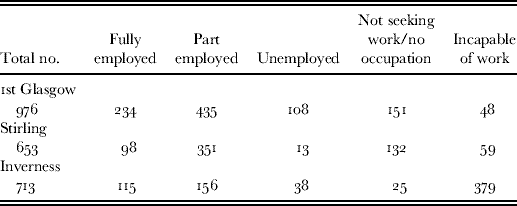
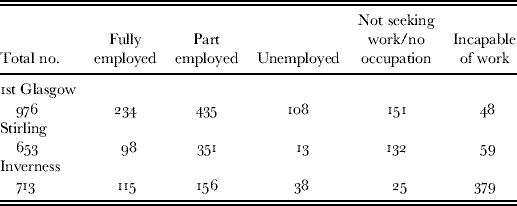
Further evidence of the pensioner's relative prosperity was that possession of a pension liberated him from the ‘quest for work’ compared with many others of his social class. A large proportion remained in casual employment, presumably often from choice, given a common disposition of workingmen not to maximize their earnings, but to achieve a livelihood. This avoidance of ‘steady labour’ irked superiors who complained of the conditioning effect of a soldier's ‘wandering life’.Footnote 61 It was also believed to render pensioners somewhat vulnerable in a declining labour market, because parish ratepayers and employers could calculate that they were cheaper to support on the poor rates than men without pensions.Footnote 62 In the 1st Glasgow, Stirling, and Inverness districts in 1842–3, for instance, two-thirds of the men in employment were earning five shillings or less per week at a time when a labourer's full wage was given as ten shillings in the Lowland districts and six shillings in the north. Excluding those ‘incapable of employment’, about a quarter were in full employment and the rest unemployed, not seeking work, ‘partially employed’ or ‘of no trade or occupation’ (Table 7).Footnote 63 Full employment was highest in Glasgow where living costs were also highest.
Employment of pensioners in selected Scottish districts, 1842–1843
Sources: TNA, WO22/127, 131, 137.
Pensioners, then, fairly typically settled in one place and established family economies wherein they regulated their ‘labour and industry’ according to how much was required to secure an ‘Independent Provision’. Most – two-thirds – who were in employment in the selected districts found their way back into the same occupations from which the majority of army recruits were drawn: labouring and weaving, the one providing much casual work, the other a semi-skilled trade that was overpopulated and therefore distinguished by underemployment. Apart from weaving, the dominant trades were shoemaking and tailoring, both carried on in the army as much as in the civilian economy.Footnote 64
The paradox of a semi-employed, yet settled, pensioner population is extended by the status such veterans acquired, particularly in Scottish society. They were part of a Scottish culture of military service which, in the aftermath of Waterloo, became exceptionally vigorous in promoting Scottish nationhood within the United Kingdom. Furthermore, they were accepted and law-abiding, even respectable and influential, in their localities; unrecognizable as the ‘scum of the earth’ that Wellington notoriously described.Footnote 65 The evidence is unequivocal on this point. Chelsea Hospital conducted a massive inspection of 40,000 pensioners in England and Scotland in 1839–40 and found that almost all were willing to meet the inspectors and to give an account of themselves; only a handful had convictions for felony.Footnote 66 It was also pointed out to the War Office, which subscribed to Wellington's dismal view of the soldiery, that of 12,589 men admitted to the pension list over the previous four years 10,485 had been discharged with ‘good’ or ‘excellent’ characters.Footnote 67 In his Sketches of the Highlanders (1821), David Stewart of Garth had already scanned the returns of criminal offending for Scotland to show that soldiers were not the real or potential malefactors that many believed them to be. Over two and a half years from December 1814 to July 1817, only ten soldiers were held in Edinburgh's tollbooth after arrest for serious offences. The inspector who went to Stirling and Linlithgow found many pensioners of ‘high Character while in the Service’ had graduated to ‘holding offices of trust and responsibility’, most likely as policemen, stewards and bailiffs, gaolers, sheriff's officers, and town sergeants.Footnote 68
Chelsea Hospital's high opinion of its veterans was reciprocated by the increasing respect accorded to the soldier by society at large, especially in Scotland where he and the ‘national’ regiments became increasingly important symbols of national character and achievement.Footnote 69 The cult of military Scotland probably did not do as much to attract the soldier home in the first instance, as to lodge him firmly in the usually familiar place to which he returned. Perhaps an old soldier was often the most available national symbol with his tales of Scottish valour, his Waterloo medal – the first awarded to the rank and file of the army – and his pension as the crown's reward for service. As was said of Neil Mackintosh in his Sutherland parish, they were ‘men of war’ who had ‘seen a great deal of the world outside their own native localities’.Footnote 70 In the early nineteenth century, Waterloo was inseparable from Scottish nation-making; the presence of the national regiments made it the pre-eminent episode of Scottish military prowess. The Waterloo regiments – Scots Greys (2nd Dragoons), Black Watch (42nd Foot), Cameron Highlanders (79th Foot), Gordon Highlanders (92nd Foot) – were 97 per cent Scottish by 1843, up from 81 per cent at the time of the battle itself. Moreover, the same trend in recruiting was manifested over all eleven regiments that carried Scottish names from 1821. According to inspection returns, these were 70 per cent in their rank and file c. 1814 and 80 per cent in 1843.Footnote 71 The Edinburgh attestation books show how Scottish-born recruits increasingly crowded themselves into Scottish regiments; under a quarter chose to enlist in these during the wars, half by the late 1820s, and almost three-quarters by the late 1830s.Footnote 72
The myth of a warrior people was the most important formative influence on Scotland's national identity in the early nineteenth century. Veterans were more easily reassimilated back into the civilian world as convenient and visible representatives of this military Scotland. Many later emerged as ‘local characters’ in published local histories and recollections.Footnote 73 The deaths of veterans could be widely noticed and their record of service re-told in newspaper obituaries. In 1833, for example, the funeral of John Stewart, the oldest pensioner aged 103, took place with full military honours in the presence of 8,000–10,000 spectators.Footnote 74 There can be little doubt that such veterans had a direct effect on army recruitment, their local roots helping to sustain their regiment's association with their part of the country. If the cycle of the soldier's return migration began in desperate circumstances, it ended for many in relative economic security, settled residence, and a measure of social respect in the same community they had left ignominiously so many years previously.
III
A ‘push–pull’ analysis of migration invites the further question of why settlement in the colonies appears to have been comparatively unattractive to soldiers, certainly more unattractive than is commonly supposed. Without embarking on close investigation of soldier settlers in colonial societies – a major research task in itself – the contention is that much can be learnt from the data-rich profile of the ex-soldier, pensioner population in the British Isles homelands. The point of key importance is that the behaviour of these men was, to a degree, calculative. As with working people in general, marriage was sought for offering the security of a family economy – not unconnected with social status – and employment was taken as it was needed or available, not to maximize earnings but to maintain an ‘independent’ livelihood. Perhaps surprisingly, men on small (under one shilling) pensions were less likely to move around than others; their circumstances were more precarious, and it seems that they preferred to seek employment in places they knew or where they were known and where, in hard times, they could find support. In the Scottish register of 1816, 90 per cent of these pensioners had returned to Scotland against 84 per cent of the 1/- to 1/8 men and 77 per cent of the 1/9 to 3/3 men. In the eight regiments used as a sample earlier, 61 per cent of the under a shilling men and 49 per cent of the shilling or over men admitted to the pension 1814–16 returned to their natal county. In 1840–5, with the same regiments, 80 per cent of men on the lower pensions went back to their region of birth compared with 60 per cent of those on higher pensions.Footnote 75
The great disadvantage veterans operated under in the labour market was their age and competition faced from younger men in manual occupations that, for the most part, were all that was available. According to the Chelsea figures, more than half of veterans were in their forties and fifties.Footnote 76 Pensioners, as already described, were underemployed, not always entirely by choice. Nor did it help old soldiers that soldiering was understood to give men an aversion to regular work. In such circumstances, marriage and the earnings that a wife and family could contribute assumed special importance. The proportion of married men in the Scottish pensioner population was high. Economic survival for veterans, with or without the pension, seems to have been a matter of seizing marriage opportunities and adjusting to the local market for waged work as circumstances required. Most stayed put because most returned to large towns and manufacturing districts where the largest markets for wage labour, including female and casual employment, existed. ‘A very large proportion of them’, observed Tulloch, ‘go to the manufacturing districts, owing to the facility with which their wives and children obtain work.’Footnote 77 By 1842, nearly half the Scottish pensioner population resided in the five Glasgow, Paisley, and Edinburgh districts.Footnote 78 Inverness also provides an example of the extent to which such men could adapt to local conditions. There was a higher proportion of married pensioners in Inverness than in Stirling and Glasgow, yet a much higher proportion of the non-employed, which was a consequence of a small labour market, the prevalence of crofting and low living costs.Footnote 79
Over two-thirds of outpensioners in the settler colonies were found in North America.Footnote 80 By the 1840s, the next largest concentration was in Australia, though under a government scheme to relieve regulars in imperial garrisons over 700 emigrated to the new colony of New Zealand in 1847–9. An earlier scheme of 1831–2 may have sent away 3,500, mainly to Canada; but these men relinquished their pension rights in return for a small capital sum and promises of land.Footnote 81 A reasonable estimate is that the total living overseas (excluding old foreign soldiers in Europe and negro pensioners in the West Indies) was under 2,000 in 1830 and 4,500 in 1847.Footnote 82 These numbers represented a very small percentage of the total pensioner population.
As return migrants, soldiers had the advantage of a free passage home. Those veterans found overseas had usually taken their discharge there; few possessed the means to emigrate independently to the colonies once they had left the army. Part of the explanation for the relatively small number of pensioners settling in the empire is that the rotation of regiments through imperial garrisons worked unevenly; there were too many regiments marooned for long periods in India, the Caribbean, and the Mediterranean without a posting to North America, the Cape, or Australia, which were easily the most attractive migrant destinations. The service records of army surgeons suggest that a soldier had a two in five chance of getting to the West Indies and only a one in five chance of serving in North America; only one in ten soldiers got to the Cape and only one in thirty to Australia.Footnote 83 After 1837, the army began to alter the western hemisphere rotation by reducing the stay of regiments in the West Indies and then, if practicable, reconditioning them in the temperate climate of Canada before returning home. With these new arrangements (together with the larger garrison required after the 1837 rebellions), the pensioner population in British North America rose to 2,800 by 1846. But nothing further eventuated, though Tulloch was one who argued the wisdom of ending rotations in the settler colonies in order to encourage the discharges of old soldiers who could be added to the local defences.Footnote 84
The crux of the case, however, that soldiers were reluctant imperial settlers is that colonial conditions did not favour veterans, especially because of gender and age imbalances in the settler population. Considering their relatively advanced age, marriage was a primary security and marriage opportunities can be assumed to have been limited in any society with a deficit of adult females and a predominantly ‘young’ age structure, as well as a society in which they lacked the personal connections that could be employed in their home country. Emigrant handbooks commonly recommended young men to marry before they departed; and many settlers made the long journey back to find a bride.Footnote 85 The Irish were distinctive in that family groups and single females were prominent in the migrant stream, and the intriguing possibility arises that Irish soldiers were more likely to remain abroad than others because of the more favourable sex ratios of Irish colonial populations. In particular, Irish in the early nineteenth century dominated emigration to the Canadian colonies, forming large communities in Newfoundland, New Brunswick, and Upper Canada (Ontario).Footnote 86 Where veteran corps existed in these places, the number of Irish in the ranks easily exceeded their due proportion. The Newfoundland Veterans Company and the Canadian Rifle Regiment (Upper Canada) of the 1840s were 42 per cent and 44 per cent Irish respectively. At this time Irish made up about one third of the entire pensioner population.Footnote 87
If age impeded the marriage prospects of pensioners, it also restricted their employment opportunities in what were, in any case, small-scale urban and industrial economies; mostly veterans were labouring men and, as such, relied heavily on temporary employment. Accordingly, their search for work, and their independence in a sense, were facilitated where large concentrations of labour existed. Soldiers were essentially townsmen: they were mostly recruited in towns, spent much of their time in towns, and their comradeship often assumed the cocky egalitarianism of the apprentice gang or the tavern club. The 10 per cent of Australian convicts who repatriated themselves despite meagre resources provide some idea of how deeply unattractive the option of a colonial life was for many.Footnote 88 Access to land was never crucial for most veterans, for they, like most other emigrants, lacked the capital and skills to create farms from wilderness and thus ended up in towns or in country work away from the land, which largely explains the failure of the 1831–2 scheme in Canada. By contrast, the scheme of 1846 was a resounding success in New Zealand and Canada by settling pensioners on cottage holdings in the vicinity of towns where they could live from an acre or two and local wage work.Footnote 89 Between 1846 and 1852, the pensioner population overseas increased from 4,500 to 7,000, but most of this increase was accounted for not by changes in the colonies but by government-promoted heavily subsidized emigration and settlement.Footnote 90
Unfortunately soldiers who took their discharge without pension disappear from the record. Yet these men differed from the pensioned only in the degree of their dependence on wage work. A much greater difference was that between Irish and Scots, as well as the English. About 20 per cent of Irish pensioners lived outside Ireland compared with 10 per cent of Scottish pensioners who lived outside Scotland. The Irish, too, formed the largest national group of pensioners overseas, though they were concentrated in the North American colonies where they comprised over half the pensioner population and outnumbered English two to one. In India, for reasons that remain to be explored, the position was reversed.Footnote 91 From the 1820s to the 1840s probably 700–2,000 Irish pensioners (3–7 per cent of the Irish total) were in the colonies and India. Scottish numbers overseas were only 250–550 (1·5–5·5 per cent).Footnote 92 There is nothing in these figures to confirm the imperial sentiment of Irish soldiers, a matter about which historians have been uncertain.Footnote 93 The strong tendency of Scots to return home might allow more to be claimed for their national sentiment, especially bearing in mind the regimental preferences of Scottish soldiers and the nineteenth-century efflorescence of military Scotland. Yet, in the last analysis, all pensioners, and by implication, all veterans, were searching for security and opportunities. At the level of the individual this would seem to have been a matter of entering into marriage, finding adequate wage earnings, and contact with a wider support network. On the whole, Scots joined the army from their country's rapidly developing urban-industrial heartland and eventually returned to there. By contrast, Ireland's overpopulated agricultural economy offered fewer opportunities to Irish veterans (and many other Irish) than did Britain's towns and industries or the colonies. Irish pensioners are another, albeit small, manifestation of the prominence of the Irish in the peopling of the empire at this time. A good point to consider is not how Scottish the empire was becoming, but how Irish.