1 Introduction
Subshifts are closed and G-invariant subsets of
 $A^G$
, with G a finitely generated group and A a finite alphabet. These are fundamental and ubiquitous examples, and can be viewed both as dynamical systems and as computational models. Interestingly, every expansive G-action can be encoded inside a subshift that shares the same dynamical properties: the complexity is transferred from the action to the phase space—the subshift in this case. This dynamical definition of subshifts has a combinatorial equivalent: subshifts are also subsets of
 $A^G$
that respect local rules given by forbidden patterns (forbidden finite configurations). Given a set of forbidden patterns
 $\mathcal {F}$
, the subshift
 $X_{\mathcal {F}}$
it defines is the set of configurations
 $x\in A^G$
that avoid all patterns from
 $\mathcal {F}$
. Any set of patterns—not necessarily finite and even not necessarily computable—defines a subshift, while the same subshift may be defined by several sets of forbidden patterns. Subshifts of finite type (SFT for short)—those for which the set of forbidden patterns can be chosen as finite—form an interesting class of subshifts, since they can model real life phenomena described by local interactions, and also define a model of computation whose computational power depends on the group G.
Among the questions related to SFTs, an open problem is to characterize groups G that admit a strongly aperiodic SFT, i.e. an SFT such that all its configurations have a trivial stabilizer. The interest of aperiodic SFTs is two-fold. On the one hand, they evidence how finite local configurations can generate complex global behaviour. For instance, constructions of strongly aperiodic SFTs are often key elements of proofs of undecidability of the domino problem. This suggests a possible connection between the two phenomena; indeed proofs of the undecidability of the original domino problem made extensive use of aperiodicity [Reference Jeandel, Vanier, Akiyama and Arnoux33]. On the other hand, Gromov noted in [Reference Gromov and Gersten30] that the existence of an aperiodic tileset has close affinity with the question of whether or not the fundamental group of CAT(0) spaces contains
 $\mathbb {Z}^2$
. The question of the existence of aperiodic subshifts in general—non SFT—has been answered positively [Reference Aubrun, Barbieri and Thomassé3, Reference Gao, Jackson and Seward28]. Free groups and more generally groups with at least two ends cannot possess a strongly aperiodic SFT [Reference Cohen17] and a finitely generated and recursively presented group with an aperiodic SFT necessarily has a decidable word problem [Reference Jeandel32]. Groups that are known to admit a strongly aperiodic SFT are
 $\mathbb {Z}^2$
[Reference Robinson46] and
 $\mathbb {Z}^d$
for
 $d>2$
[Reference Culik, Kari, Maurer, Calude and Salomaa21], fundamental groups of oriented surfaces [Reference Cohen and Goodman-Strauss18], 1-ended hyperbolic groups [Reference Cohen, Goodman-Strauss and Rieck19], discrete Heisenberg group [Reference Şahin, Schraudner and Ugarcovici48] and more generally groups that can be written as a semi-direct product
 $G = \mathbb {Z}^2 \rtimes _{\phi } H$
—provided G has decidable word problem [Reference Barbieri and Sablik9]—, self-simulable groups with decidable word problem [Reference Barbieri, Sablik and Salo10]—which include braid groups and some RAAGs—and residually finite Baumslag–Solitar groups [Reference Esnay and Moutot24]. Combining results in [Reference Cohen17, Reference Jeandel32], one may conjecture that finitely generated groups admitting a strongly aperiodic SFT are exactly 1-ended groups with decidable word problem.
Conjecture 1. A finitely generated group admits a strongly aperiodic SFT if and only if it is 1-ended and has decidable word problem.
There are several techniques to produce aperiodicity inside tilings, but in the particular setting of
 $\mathbb {Z}^2$
-SFTs, two of them stand out. The first goes back to Robinson [Reference Robinson46]: the aperiodicity of Robinson’s SFT follows from the hierarchical structure shared by all configurations. The second technique goes back to Kari [Reference Kari34]: a very simple aperiodic dynamical system is encoded into an SFT so that configurations correspond to orbits of the dynamical system. Aperiodicity of the SFT comes from both the aperiodicity of the dynamical system and the clever encoding. These two techniques have successfully been generalized to amenable Baumslag–Solitar groups
 $BS(1,n)$
[Reference Aubrun and Kari4, Reference Aubrun and Schraudner7].
In this paper, we adopt a different strategy and present an innovative construction to lift strongly aperiodic SFTs from a group to a larger group. In particular, we centre our attention on the class of generalized Baumslag–Solitar (GBS) groups, showing that all non-trivial cases admit strongly aperiodic SFTs.
Corollary 6.11. All non-
 $\mathbb {Z}$
generalized Baumslag–Solitar groups admit a strongly aperiodic SFT.
This is done by separately analysing the different quasi-isometry classes of GBS groups, as established by Whyte [Reference Whyte50].
The paper is organized as follows: §2 gives the basics of symbolic dynamics on groups. Section 3 presents graphs of groups and some examples of interest, i.e. Torus knot groups and Baumslag–Solitar groups, and §3.4 is devoted to preliminary results that prove the existence of weakly aperiodic SFTs on some classes of graphs of groups. The main result of §4 shows that the property of having a minimal strongly aperiodic SFT is transferred from H to G if H is a normal subgroup of finite index of G. Section 5 is devoted to the construction of a minimal, strongly aperiodic and horizontally expansive SFT that will be used later. This construction is a small adaptation of an existing construction presented in [Reference Labbé, Mann and McLoud-Mann39].
The last two sections contain the main results of the paper. In §6, we present the key idea of this article: the path-folding technique in the case of
 $\mathbb {F}_n\times \mathbb {Z}$
. The key idea is to fold a
 $\mathbb {Z}^2$
SFT along a flow on
 $\mathbb {F}_n$
to obtain an SFT on
 $\mathbb {F}_n\times \mathbb {Z}$
that shares some dynamical properties with the original SFT. In particular, strong aperiodicity and minimality are preserved.
Theorem 5.5. There exists a minimal strongly aperiodic SFT on
 $\mathbb {F}_n\times \mathbb {Z}$
.
Then in §7, we explain how to adapt the path-folding method to the Baumslag–Solitar group
 $BS(2,3)$
to construct a strongly aperiodic SFT in this group. Instead of lifting an aperiodic subshift from
 $\mathbb {Z}^2$
, we codify orbits of a simple dynamical system that ultimately grants the aperiodicity. Consequently, we are able to establish that all non-solvable Baumslag–Solitar groups admit a strongly aperiodic SFT.
Theorem 6.10. Non-residually finite Baumslag–Solitar groups
 $BS(m,n)$
with
 $m, n> 1$
and
 $m\neq n$
admit strongly aperiodic SFTs.
2 Subshifts and aperiodicity
We begin by briefly defining notions from symbolic dynamics needed in this article. For a more comprehensive introduction, we refer to [Reference Aubrun, Barbieri, Jeandel, Berthé and Rigo1, Reference Ceccherini-Silberstein and Coornaert16, Reference Lind and Marcus41].
Let A be a finite alphabet and G a finitely generated group. We define the full-shift on A as the set of configurations
 $A^G = \{x:G\to A\}$
. The group G acts naturally on this set through the left group action,
 $\sigma :G\times A^{G}\rightarrow A^{G}$
, defined as
 $$ \begin{align*}\sigma^{g}(x)_{h} = x_{g^{-1}h}.\end{align*} $$
By taking the discrete topology on the finite set A, the full-shift
 $A^{G}$
is endowed with the pro-discrete topology and is, in fact, a compact set.
Let P be a finite subset of G. We call
 $p\in A^{P}$
a pattern of support P. We say a pattern p appears in a configuration
 $x\in A^G$
if there exists
 $g\in G$
such that
 $p_h = x_{gh}$
for all
 $h\in P$
.
Given a set of patterns
 $\mathcal {F}$
, we define the subshift
 $X_{\mathcal {F}}$
as the set of configurations where no pattern in
 $\mathcal {F}$
appears. That is,
 $$ \begin{align*}X_{\mathcal{F}} = \{x\in A^G \mid p \text{ does not appear in } x \text{ for all } p\in\mathcal{F}\}.\end{align*} $$
It is a well-known result that subshifts can be characterized as the closed G-invariant subsets of
 $A^G$
. When
 $\mathcal {F}$
is finite, we say
 $X_{\mathcal {F}}$
is a subshift of finite type, which we will refer to by the acronym SFT.
If
 $x\in A^G$
is a configuration, its orbit is the set of configurations
 $$ \begin{align*} \mathrm{orb}(x):=\{\sigma^{g}(x) \mid g\in G \} \end{align*} $$
and its stabilizer is the subgroup
 $$ \begin{align*} \mathrm{stab}(x):=\{g\in G \mid \sigma^{g}(x) = x \}. \end{align*} $$
A subshift is said to be minimal if it does not contain a non-trivial subshift or, equivalently, if all orbits are dense.
A subshift is weakly aperiodic if all its configurations have infinite orbit. It is strongly aperiodic if all its configurations have trivial stabilizer. For a recent survey on the existence of strongly aperiodic SFTs, we refer to [Reference Rieck45].
A decision problem that seems strongly related to the existence of aperiodic SFTs is the domino problem, or emptiness problem for SFTs: A group G is said to have decidable domino problem if there is an algorithm that, starting from a finite set of forbidden patterns, decides whether the SFT it generates is empty or not. The problem is said to be undecidable if no such algorithm exists. The commonly accepted conjecture states that virtually free groups are precisely those with decidable domino problem. We refer to [Reference Aubrun, Barbieri, Moutot, Rossmanith, Heggernes and Katoen2, Reference Bartholdi and Salo11] for recent advances on this problem. In this article, we will only make use of the fact that the domino problem is undecidable on
 $\mathbb {Z}^2$
and that if H is a subgroup of G, then if H has undecidable domino problem, then so has G [Reference Aubrun, Barbieri, Jeandel, Berthé and Rigo1].
3 Graphs of groups and GBS
A common strategy in the study of group theoretical properties is to decompose groups into simpler components and then look at those properties on these simpler groups. HNN-extensions and amalgamated free products are examples of these decompositions. It is along these lines that, to establish the existence of strongly aperiodic SFTs on groups, we make use of the graph of groups decomposition. The Dunwoody–Stallings theorem gives a powerful tool in this regard.
Theorem 3.1. (Dunwoody and Stallings [Reference Dunwoody23])
Let G be a finitely presented group. Then, G is the fundamental group of a graph of groups where all edge groups are finite, and vertex groups are either 0 or 1-ended.
This approach seems relevant regarding the two problems of characterizing groups which admit strongly aperiodic SFTs or which have decidable domino problem. For instance, examples of this proof technique for characterization of virtually free groups can be seen in [Reference Gentimis29, Reference Khukhro36].
3.1 Definition
For the purposes of this section, we define a graph
 $\Gamma $
as a tuple
 $(V_{\Gamma }, E_{\Gamma })$
, where
 $V_{\Gamma }$
is the set of vertices and
 $E_{\Gamma }\subseteq V_{\Gamma }^2$
is a set of edges, such that the graph is locally finite. We also associate the graph with two functions
 $\mathfrak {i},\mathfrak {t}:E_{\Gamma }\to V_{\Gamma }$
that give the initial and terminal vertex of an edge, respectively. Given an edge
 $e\in E_{\Gamma }$
, we denote by
 $\bar {e}$
the edge pointing in the opposite direction to e, that is,
 $\mathfrak {t}(\bar {e}) = \mathfrak {i}(e)$
and
 $\mathfrak {i}(\bar {e})=\mathfrak {t}(e)$
.
Definition 3.1. A graph of groups
 $(\Gamma , \mathcal {G})$
is a connected graph
 $\Gamma $
, along with a collection of groups and monomorphisms
 $\mathcal {G}$
that includes:
-
• a vertex group
 $G_v$
for each
$v\in V_{\Gamma }$
;
-
• an edge group
$G_e$
for each
$e\in E_{\Gamma }$
, where
$G_e = G_{\bar {e}}$
; -
• a set of monomorphisms
$\{\alpha _{e}:G_e\to G_{\mathfrak {t}(e)} \ | \ e\in E_{\Gamma } \}$
.


The main interest of this object is its fundamental group. As its name suggests, this group is obtained through a precise definition of paths on the graph of groups. Luckily there is an explicit expression for the fundamental group, which allows us to skip the formal definition. A complete treatment of the concept can be found in [Reference Lyman42, Reference Serre49].
Theorem 3.2. Let
 $T\subseteq \Gamma $
be a spanning tree. The group
 $\pi _1(\Gamma , \mathcal {G}, T)$
is isomorphic to a quotient of the free product of the vertex groups, with the free group on the set
 $E_{\Gamma }$
of oriented edges. That is,

where R is the normal closure of the subgroup generated by the following relations:
-
•
$\alpha _{\bar {e}}(h)e = e\alpha _{e}(h)$
, where e is an oriented edge of
$\Gamma $
,
$h\in G_{e}$
; -
•
$\bar {e} = e^{-1}$
, where e is an oriented edge of
$E_{\Gamma }$
; -
•
$e = 1$
if e is an oriented edge of T.


We will omit
 $\mathcal {G}$
as the context allows it. Furthermore, the fundamental group does not depend on the spanning tree, up to isomorphism.
Proposition 3.3. [Reference Serre49, Proposition 20]
The fundamental group of a graph of groups does not depend on the spanning tree.
Let us look at how traditional operations of geometric group theory are viewed as fundamental groups of graph of groups. The amalgamated free product
 $G\ast _{K}H$
is viewed as the fundamental group
 $\pi _1(\Gamma _1)$
:

Similarly, an HNN-extension
 $G\ast _{\phi }$
can be seen as the fundamental group
 $\pi _1(\Gamma _2)$
:

with H a subgroup of G,
 $\alpha _e = \text {id}$
and
 $\alpha _{\bar {e}} = \phi :H\to \phi (H)$
an isomorphism. In this sense, the concept of graph of groups can be seen as the natural generalization of these concepts.
This article is primarily concerned with a specific class of graph of groups.
Definition 3.2. A group G is said to be a generalized Baumslag–Solitar group (GBS group) if it is the fundamental group of a finite graph of groups where all the vertex and edge groups are
 $\mathbb {Z}$
.
As their name suggest, GBS groups were introduced as a generalization of Baumslag–Solitar groups. This class also contains all torus knot groups as well as
 $\mathbb {Z}$
,
 $\mathbb {Z}^2$
and the fundamental group of the Klein bottle. For an extensive introduction to this class, see [Reference Forester26, Reference Forester27, Reference Levitt40].
3.2 Torus knot groups
The
 $(n,m)$
-torus knot group is given by the presentation
 $$ \begin{align*}\Lambda(n,m) = \langle a,b \ | \ a^nb^{-m}\rangle.\end{align*} $$
As mentioned above, they are a particular case of the generalized Baumslag–Solitar groups given by the amalgamated free product
 $\mathbb {Z}\ast _{\mathbb {Z}}\mathbb {Z}$
, along with the inclusions
 $1\mapsto n$
and
 $1 \mapsto m$
. Their name comes from the fact that they are the knot groups of torus knots [Reference Rolfsen47].
Remark that
 $\Lambda (n,m)\simeq \Lambda (m,n)$
. Also, if n or m is equal to one, then
 $\Lambda (n,m) \simeq \mathbb {Z}$
and the group is therefore abelian. In fact, these are the only cases where the group is amenable as a consequence of the following proposition.
Proposition 3.4.
 $\Lambda (n,m)$
has a finite index normal subgroup isomorphic to
 $\mathbb {F}_{(n-1)(m-1)}\times \mathbb {Z}$
.
This fact is deduced from the short exact sequence
 $$ \begin{align*}1 \to \mathbb{Z} \to \Lambda(n,m) \to \mathbb{Z}/n\mathbb{Z}\times\mathbb{Z}/m\mathbb{Z}\to 1.\end{align*} $$
As we will later see, these groups are part of a larger subclass of GBS groups having this property.
Proposition 3.5. For
 $n,m\geq 2$
,
 $\Lambda (n,m)$
has undecidable domino problem.
This is a consequence of the fact that these groups contain isomorphic copies of
 $\mathbb {Z}^2$
, namely
 $\langle a^n, ba\rangle $
.
3.3 Baumslag–Solitar groups
Baumslag–Solitar groups were introduced, as we now know them, in [Reference Baumslag and Solitar12] to provide examples of non-Hopfian groups, although cases of them were defined some years prior by Higman in [Reference Higman31]. They are simple cases of HNN-extensions, and have provided discriminating examples in both combinatorial and geometric group theories. Concerning the study of SFTs on groups, they are also of particular interest since as one-relator groups, they have decidable word problem. Since they are also 1-ended, they fall under the scope of Conjecture 1.
Baumslag–Solitar groups are defined by the presentation:
 $$ \begin{align*}BS(m,n) = \langle a, t \mid t^{-1}a^m t = a^n \rangle.\end{align*} $$
The first things to note are that
 $BS(1,1) = \mathbb {Z}^2$
and
 $BS(m,n) \simeq BS(-m,-n)$
. Baumslag–Solitar groups may behave radically differently: the groups
 $BS(1,n)$
are solvable and amenable while the
 $BS(m,n)$
groups with
 $m,n>1$
contain free subgroups and are consequently non-amenable. This dichotomy is also present in the classification of Baumslag–Solitar groups up to quasi-isometry. On the one hand, groups
 $BS(1,n)$
and
 $BS(1,n')$
are quasi-isometric if and only if n and
 $n'$
have a common power [Reference Farb and Mosher25], and in this case, the two groups are even commensurable. On the other hand, groups
 $BS(m,n)$
and
 $BS(m',n')$
are quasi-isometric as soon as
 $2\leq m < n$
and
 $2\leq m'<n'$
[Reference Whyte50].
3.4 Weakly aperiodic SFTs on groups generated from graph structures
Proposition 3.6. Let
 $(\Gamma , \mathcal {G})$
be a graph of groups. If at least one vertex group admits a weakly aperiodic SFT, then
 $\pi _1(\mathcal {G})$
admits a weakly aperiodic SFT.
Proof. Theorem 3.2 tells us that for every
 $v\in V_{\Gamma }$
, there is a natural injective homomorphism
 $G_v\hookrightarrow \pi _1(\mathcal {G})$
. Because there is at least one
 $G_v$
that admits a weakly aperiodic SFT, and weakly aperiodic SFTs can be lifted from subgroups, we conclude that
 $\pi _1(\mathcal {G})$
admits a weakly aperiodic SFT.
One case that does not fall within the hypothesis of Proposition 3.6 is when all vertices of the graph have
 $\mathbb {Z}$
as their vertex group, which is known not to admit any weakly aperiodic SFT. However, a careful study shows that in this case, weakly aperiodic SFT can nevertheless be constructed unless the group is
 $\mathbb {Z}$
itself.
Proposition 3.7. If
 $\mathcal {G}$
is a graph of
 $\mathbb {Z}$
such that
 $\pi _1(\mathcal {G})$
is not
 $\mathbb {Z}$
, then
 $\pi _1(\mathcal {G})$
has a weakly aperiodic SFT.
Proof. Let G be a GBS group with its corresponding graph of groups
 $\Gamma $
. Because G is not
 $\mathbb {Z}$
, at least one edge,
 $e\in E_{\Gamma }$
, satisfies
 $\alpha _{e}\not \equiv \pm 1$
. If this edge is a loop, from the previous remarks, we know that G contains a non-
 $\mathbb {Z}$
Baumslag–Solitar group. These groups are known to admit weakly aperiodic SFT [Reference Aubrun and Kari4], so we are done. Similarly, if the edge is in the spanning tree
 $T\subseteq \Gamma $
such that
 $G = \pi _{1}(\Gamma , T)$
, then G contains a knot group
 $\Lambda (n,m)$
, which admits a weakly aperiodic SFT by virtue of containing
 $\mathbb {Z}^2$
as a subgroup.
The last case is when all edges in the spanning tree satisfy
 $\alpha _{e'}\equiv \pm 1$
and there are no loops. Let e be an edge such that
 $\alpha _{e},\alpha _{\bar {e}}\neq \pm 1$
, and
 $v,u$
its end points. Because T is spanning, we know that
 $v,u\in V_{T}$
, and therefore if
 $G_v = \langle a \rangle $
and
 $G_u = \langle b \rangle $
, we have that in G,
 $a = b^{\pm 1}$
. Then, the relation given by the edge e is
 $$ \begin{align*}a^{\alpha_{e}(1)}e = eb^{\alpha_{\bar{e}}(1)} \! \iff a^{\alpha_{e}(1)}e = ea^{\pm\alpha_{\bar{e}}(1)}.\end{align*} $$
This means G contains the non-
 $\mathbb {Z}$
Baumslag–Solitar group
 $BS(\alpha _{e}(1), \pm \alpha _{\bar {e}}(1))$
, which, as mentioned before, admits a weakly aperiodic SFT.
Remark 3.8. Notice that this proof also shows that all non-
 $\mathbb {Z}$
GBS groups have undecidable domino problem.
The same proof scheme can be used for the class of Artin groups, which are another example of groups generated from an underlying graph structure.
Let
 $\Gamma = (V, E, \unicode{x3bb} )$
be a labelled graph with labels
 $\unicode{x3bb} : E\to \{2,3, \ldots \}$
. We define the Artin group of
 $\Gamma $
through the following presentation:
 $$ \begin{align*} A(\Gamma) := \langle V \ | \ \underbrace{abab...}_{\unicode{x3bb}(e)} = \underbrace{baba...}_{\unicode{x3bb}(e)} \ \text{ for all } e = (a,b)\in E\rangle. \end{align*} $$
Let
 $\Gamma _n$
be the graph of two vertices a and b and the edge connecting them labelled by n. Artin groups defined as
 $A(\Gamma _n)$
are known as dihedral. Notice that
 $A(\Gamma _2) \simeq \mathbb {Z}^2$
. Furthermore, for
 $n\geq 3$
,
 $A(\Gamma _n)$
is virtually
 $\mathbb {F}_m\times \mathbb {Z}$
for some
 $m\geq 2$
(see [Reference Crisp20]). This fact also follows from the proof of the next proposition.
Proposition 3.9. All non-
 $\mathbb {Z}$
Artin groups admit a weakly aperiodic SFT.
Proof. Let
 $A(\Gamma )$
be an Artin group defined from
 $\Gamma = (V, E, \unicode{x3bb} )$
. If E is empty, then
 $A(\Gamma )$
is the free group of rank
 $|V|\geq 2$
, which is known to admit weakly aperiodic SFTs [Reference Piantadosi44].
Let
 $e=(a,b)$
be an edge in E. Notice that
 $A(\Gamma _{n}) \simeq \langle a, b\rangle \leq A(\Gamma )$
. Because weakly aperiodic SFTs are inherited from subgroups, it suffices to show that
 $A(\Gamma _n)$
admits a weakly aperiodic SFT for every
 $n\in \mathbb {N}$
. We identify two cases:
-
• Case 1:
$n = 2k$
,
$k\geq 1$
. We have that
$A(\Gamma _{2k})$
is the one-relator group:
$$ \begin{align*}A(\Gamma_{2k}) = \langle a,b \ | \ (ab)^{k} = (ba)^k\rangle = \langle a,b \ | \ (ab)^{k} = b(ab)^{k}b^{-1}\rangle .\end{align*} $$
We apply Tietze transformations to the presentation,
Therefore,
$$ \begin{align*} A(\Gamma_{2k}) &\simeq \langle a,b, c \ | \ (ab)^{k} = b(ab)^{k}b^{-1}, \ c = ab\rangle\\ &\simeq \langle b,c \mid b^{-1}c^{k}b = c^{k}\rangle\\ &= BS(k,k). \end{align*} $$
$A(\Gamma _{2k})$
admits a weakly aperiodic SFT.
-
• Case 2:
$n = 2k + 1$
,
$k\geq 1$
. Once again,
$A(\Gamma _{2k+1})$
is the one-relator group: By doing an analogous procedure, we arrive at
$$ \begin{align*}A(\Gamma_{2k+1}) = \langle a,b \ | \ (ab)^{k}a = (ba)^kb\rangle = \langle a,b \ | \ (ab)^{k}a = b(ab)^{k}\rangle .\end{align*} $$
$$ \begin{align*}A(\Gamma_{2k+1})\simeq \Lambda(2, 2k+1).\end{align*} $$
Therefore,
$A(\Gamma _{2k+1})$
also admits a weakly aperiodic SFT.


Remark 3.10. Once again, this proof also shows that all non-free Artin groups have undecidable domino problem.
4 Strong aperiodicity
4.1 State of the art
The existence of an aperiodic SFT is a geometric property of groups, at least for finitely presented ones, as stated below.
Theorem 4.1. (Cohen [Reference Cohen17])
Let G and H be two quasi-isometric finitely presented groups. Then G admits a strongly aperiodic SFT if and only if H does.
The hypothesis of finite presentation is essential here. For example, from [Reference Barbieri8], we know that the Grigorchuk group, which is finitely generated but not finitely presented, admits a strongly aperiodic SFT. Nevertheless, the Grigorchuk group has uncountably many groups which are quasi-isometric to it. This means that at least one of them has undecidable word problem and, therefore, does not admit a strongly aperiodic SFT by [Reference Jeandel32]. This result can also be seen as a consequence of the fact that being recursively presented is not a quasi-isometry invariant.
However, we do have results when two finitely generated groups are commensurable. Two groups are said to be commensurable if they have finite index subgroups which are isomorphic.
Theorem 4.2. (Carroll and Penland [Reference Carroll and Penland14])
Let G and H be two finitely generated groups which are commensurable. Then G admits a strongly aperiodic SFT if and only if H does.
Commensurability implies quasi-isometry, but there exists many examples where the converse does not hold. For instance, the groups
 $BS(m,n)$
and
 $BS(p,q)$
are quasi-isometric whenever
 $1<n<m$
and
 $1<p<q$
, but are not commensurable if
 $(m,n)$
are co-prime and
 $(p,q)$
are co-prime [Reference Casals-Ruiz, Kazachkov and Zakharov15, Reference Whyte50].
4.2 Lifting minimal aperiodic subshifts
The goal of this section is to lift a minimal strongly aperiodic SFT from a normal subgroup of finite index to the whole group. To do this, we make use of the locked shift, as introduced by Carroll and Penland [Reference Carroll and Penland14].
Let A be a finite alphabet, G a finitely generated group with N a finitely generated normal subgroup. We define the subshift
 $$ \begin{align*}\text{Fix}_A(N) = \{x\in A^{G}\mid \sigma^n(x) = x \text{ for all } n\in N\}.\end{align*} $$
Remark 4.3. For any subgroup N,
 $\text {Fix}_A(N)$
is always a closed set of
 $A^G$
, but it is only shift invariant when N is normal. In the latter case, the subshift is conjugated to
 $A^{G/N}$
.
Definition 4.1. For a finite index normal subgroup N, we define the N-locked subshift L as
 $\textrm {Fix}_{R}(N)\cap \Sigma $
, where R is a set of right coset representatives with
 $1\in R$
, and
 $\Sigma $
is the subshift defined by the the finite set of forbidden patterns
 $$ \begin{align*}\{p:\{1,r\}\to R \mid r\in R\setminus\{1\}, \ p(1) = p(r) \}.\end{align*} $$
Lemma 4.4. The N-locked subshift L is a non-empty SFT. In addition,
 $\sigma ^{g}(x) = x$
for some
 $x\in L$
if and only if
 $g\in N$
.
Proof. If we take
 $S = \{s_1, \ldots , s_m\}$
as a set of symmetric generators for N, we see that
 $\text {Fix}_R(N)$
is an SFT by the set of forbidden rules given by
 $$ \begin{align*}\{p:\{1,s_i\}\to R \mid s_i\in S, \ p(1)\neq p(s_i)\}.\end{align*} $$
Therefore, L is also an SFT. To see it is non-empty, we define
 $y\in R^{G}$
by
 $y_{nr} = r$
. If we take
 $n'\in N$
,
 $$ \begin{align*}\sigma^{n'}(y)_{nr} = y_{n^{\prime -1}n r} = r = y_{nr}.\end{align*} $$
Thus,
 $y\in \text {Fix}_R(N)$
. Next, we take
 $r'\in R$
and see that
 $$ \begin{align*}y_{nr} = \sigma^{n^{-1}}(y)_r = y_r \neq y_{rr'} = \sigma^{n^{-1}}(y)_{rr'} = y_{nrr'}.\end{align*} $$
This way,
 $y\in \Sigma $
, and therefore
 $y\in L$
. Finally, if we take
 $x\in L$
and
 $g = nr\in G$
such that
 $\sigma ^{g}(x)=x$
, then
 $$ \begin{align*}x = \sigma^{nr}(x) = \sigma^{r(r^{-1}nr)}(x) = \sigma^{r}(x).\end{align*} $$
With this,
 $x_1 = x_{r^{-1}r} = \sigma ^r(x)_r = x_r$
. Because
 $x\in \Sigma $
,
 $r=1$
and thus
 $g = n\in N$
.
We now have all the ingredients to prove the result.
Proposition 4.5. Let G be a finitely generated group and H a finite index normal subgroup. If H admits a minimal strongly aperiodic SFT, then G does also.
Proof. Let
 $X\subseteq A^{H}$
be a minimal strongly aperiodic SFT over H. Given a set R of right coset representatives with
 $1\in T$
, we define the G-subshifts
 $$ \begin{align*}\hat{X} = \{y\in A^G\mid \text{ there exists } x\in X \text{ for all }(h,r)\in H\times R, \ y_{hr} = x_h \},\end{align*} $$
and
 $Y = \hat {X}\times L$
, where L is the H-locked shift. Let us see that Y is the subshift for which we are looking.
-
• Aperiodicity. Suppose there is a
$y\in Y$
and
$g\in G$
such that
$\sigma ^{g}(y) = y$
. Due to Lemma 4.4, we know that
$g\in H$
. Then, for some
$r\in R$
and
$x\in X$
, that is,
$$ \begin{align*}x_{h} = y_{hr} = y_{g^{-1}hr} = x_{g^{-1}h},\end{align*} $$
$x = \sigma ^{g}(x)$
which contradicts the aperiodicity of X.
-
• Minimality. Let us take
$y, y'\in Y$
along with
$x,x'\in X$
their corresponding X configurations. By the minimality of X, there exists a sequence
$\{h_n\}_{n\in \mathbb {N}}\subseteq H$
such that
$\sigma ^{h_n}(x)\to x'$
. Then, for
$(h,r)\in H\times R$
, Thus,
$$ \begin{align*}\sigma^{h_n}(y)_{hr} = y_{h_n^{-1}hr} = x_{h_n^{-1}h} = \sigma^{h_n}(x)_h \to x^{\prime}_{h} = y^{\prime}_{hr}.\end{align*} $$
$\sigma ^{h_n}(y)\to y'$
.


4.3 Strong aperiodicity for GBS
The quasi-isometric structure of GBS groups is well understood: they are classified according to the following result.
Theorem 4.6. (Whyte [Reference Whyte50])
If
 $\mathcal {G}$
is a graph of
 $\mathbb {Z}$
, then for
 $G = \pi _1(\mathcal {G})$
, exactly one of the following is true:
-
(1) G contains a finite index subgroup isomorphic to
$\mathbb {F}_n\times \mathbb {Z};$
-
(2)
$G = BS(1,n)$
for some
$n>1$
; -
(3) G is quasi-isometric to
$BS(2,3)$
.


GBS groups that fall into the first category are called unimodular. In [Reference Jeandel32], Jeandel shows that
 $\mathbb {F}_2\times \mathbb {Z}$
admits a strongly aperiodic SFT through the use of Kari-like tiles. Nevertheless, this construction is not minimal and is only valid on
 $\mathbb {F}_2\times \mathbb {Z}$
and not all
 $\mathbb {F}_n\times \mathbb {Z}$
for
 $n\geq 3$
. As explained in §4.2, for a group G, containing a finite index subgroup that admits a minimal strongly aperiodic SFT is not enough to get a minimal strongly aperiodic SFT on G. Fortunately, the statement of Theorem 4.6 can be sharpened, as stated in the following remark.
Remark 4.7. In the case of unimodular GBS, it can even be proven that G contains
 $\mathbb {F}_n\times \mathbb {Z}$
as a normal subgroup of finite index [Reference Delgado, Robinson and Timm22, Lemma 4]. The additional normality hypothesis will be needed in Proposition 4.5.
In §6, we provide an example of a minimal strongly aperiodic SFT on
 $\mathbb {F}_n\times \mathbb {Z}$
for all
 $n\geq 2$
. The case of groups quasi-isometric to
 $BS(2,3)$
is also treated in this paper: in §7, we explain how to construct a strongly aperiodic SFT on
 $BS(2,3)$
. Groups
 $G = BS(1,n)$
for some
 $n>1$
are already known to possess a minimal strongly aperiodic SFT [Reference Aubrun and Schraudner7]. In total, we are able to construct strongly aperiodic SFTs for all GBS.
5 A minimal, strongly aperiodic and horizontally expansive SFT on
$\mathbb {Z}^2$

In this section, we present a construction of a strongly aperiodic SFT on
 $\mathbb {Z}^2$
with additional properties that will be useful in §6.2. We begin by presenting the notion of expansive subspaces or directions as introduced in [Reference Boyle and Lind13]. Let F be a subspace of
 $\mathbb {R}^2$
and
 $v\in \mathbb {R}^{2}$
, we define
 $$ \begin{align*}\text{dist}(v,F) = \inf\{\|v-w\|: w\in F\},\end{align*} $$
where
 $\|\cdot \|$
denotes the Euclidean norm on
 $\mathbb {R}^{2}$
. For
 $t>0$
, we define the thickening of F by t as
 $F^{t} = \{v\in \mathbb {Z}^{2}: \text {dist}(v,F)\leq t\}$
. We say a subspace F is expansive for a subshift X if there exists
 $t> 0$
such that for any two configurations
 $x,y\in X$
,
 $x|_{F^t} = y|_{F^t}$
implies
 $x = y$
. Conversely, F is said to be non-expansive if for all
 $t> 0$
, there exist distinct
 $x,y\in X$
such that
 $x|_{F^t} = y|_{F^t}$
.
As we are working with two dimensions, non-trivial subspaces can be represented by directions. Thus, we speak of expansive and non-expansive directions.
For our purposes, a subshift
 $X\subset A^{\mathbb {Z}^2}$
is horizontally expansive (respectively vertically expansive) if for every pair of configurations
 $x,y$
in X, if
 $x_{\mathbb {Z}\times \{0\}}=y_{\mathbb {Z}\times \{0\}}$
(respectively
 $x_{\{0\}\times \mathbb {Z}}=y_{\{0\}\times \mathbb {Z}}$
), then
 $x=y$
. Said otherwise, one single row entirely determines the global configuration in the subshift. To construct our sought after SFT, we can, for instance, make use of the following construction.
Theorem 5.1. (Labbé, Mann and McLoud-Mann [Reference Labbé, Mann and McLoud-Mann39], Labbé [Reference Labbé37, Reference Labbé38])
There exists an aperiodic, minimal SFT
 $X_0$
such that its non-expansive directions are given by the lines of slope
 $\{0, \varphi +3, 2-3\varphi , \tfrac 52 - \varphi \}$
, where
 $\varphi = ({1+\sqrt {5}})/{2}$
is the golden mean.
In particular, this result tells us that the vertical line is an expansive direction for
 $X_0$
. It suffices to convert this expansive direction into horizontal expansivity to get the desired SFT, as we will show in what follows. Notice that we can take
 $X_0$
to be a Wang tile SFT by taking a higher block shift. This process preserves expansive directions as stated in the next result.
Lemma 5.2. [Reference Labbé, Mann and McLoud-Mann39]
Let X and Y be two conjugated
 $\mathbb {Z}^2$
-subshifts and
 $v\in \mathbb {R}^2$
. Then, v is a non-expansive direction for X if and only if it is non-expansive for Y.
Moreover, up to another conjugacy—a higher block again in this case—we can also impose that the thickening t of an expansive direction is zero. Then we get the following lemma.
Lemma 5.3. Let X be a
 $\mathbb {Z}^2$
-subshift and
 $v\in \mathbb {R}^2$
an expansive direction for X. Then there exists Y a
 $\mathbb {Z}^2$
-subshift conjugate to X such that Y is expansive in direction v with thickening
 $t=0$
.
Now that the SFT
 $X_0$
from [Reference Labbé, Mann and McLoud-Mann39] has been converted, thanks to Lemma 5.3, into a conjugated vertically expansive Wang tile SFT
 $Y_0$
. We can rotate its Wang tiles and thus its configurations by
 ${\pi }/{2}$
(see Figure 1). This rotated tileset defines an SFT, called the rotation by
 ${\pi }/{2}$
of
 $Y_0$
.
A Wang tile and its rotation by
 ${\pi }/{2}$
.

Lemma 5.4. Let X be a minimal, strongly aperiodic and vertically expansive Wang tile SFT. Then its rotation by
 ${\pi }/{2}$
is a minimal, strongly aperiodic and horizontally expansive Wang tile SFT.
The proof of Lemma 5.4 does not pose any specific difficulties and is thus omitted. Combining this result with Theorem 5.1, we conclude that there exists a minimal, strongly aperiodic and horizontally expansive Wang tile SFT. This result will be used in §6.3.
Proposition 5.5. There exists a minimal, strongly aperiodic and horizontally expansive Wang tile SFT.
6 The path-folding technique on
$\mathbb {F}_n\times \mathbb {Z}$

In this section, we present a technique to convert a subshift on
 $\mathbb {Z}^2$
into a subshift on
 $\mathbb {F}_n\times \mathbb {Z}$
that shares some of its properties: the path-folding technique. In our case, the properties that are proven to be preserved are: being of finite type (SFT), strong aperiodicity and minimality. In this section, we use
 $\pi _1$
as the projection onto the first coordinate, and not as a fundamental group.
As we will see later, this technique has a broader scope. In its most abstract version, it consists on the following steps.
-
(1) Find a regular tree-like structure in the group. In the case of
$BS(2,3)$
, we take its Bass–Serre tree and in the case of
$\mathbb {F}_n\times \mathbb {Z}$
, we simply take
$\mathbb {F}_n$
. -
(2) We define the flow shift on the tree: using an alphabet of arrows of the same size as the degree of the vertices, we define a local rule demanding that, for every vertex, only one of its neighbours has an arrow pointing away from the vertex and the rest point towards it (see Figure 2). This allows us to make a correspondence between the elements of the flow shift and the boundary of the tree.
-
(3) Finally, we fold configurations from other structures along the directions provided by the flow shift. In the case of
$BS(2,3)$
, we fold configurations from the hyperbolic plane and for
$\mathbb {F}_n\times \mathbb {Z}$
, we fold configurations from
$\mathbb {Z}^2.$


Flow tiles for
 $\mathbb {F}_2$
.

6.1 The flow SFT
Let us begin by introducing the flow shift over
 $\mathbb {F}_n\times \mathbb {Z}$
, which we will denote as
 $Y_{f}$
. We define this shift from tiles representing different directions. Let
 $S = \{s_1, \ldots , s_{n}\}$
be a set of generators of
 $\mathbb {F}_n$
and
 $\mathbb {Z} = \langle t\rangle $
. We will define the flow shift over the alphabet
 . We can interpret these tiles as pointing in the direction specified by a generator or its inverse.
To define
 $Y_{f}$
, we demand that a configuration
 $y\in A^{\mathbb {F}_n\times \mathbb {Z}}$
satisfies
 $$ \begin{align*}y_{g} = s \! \implies\!\! \begin{cases}y_{gs}\neq s^{-1} \\ y_{gs'} = s^{\prime -1} \quad \text{for all } s'\in A\setminus\{s\}.\\ y_{gt} = s \end{cases} \end{align*} $$
Notice that fixing a tile at the identity completely determines the tiling of the
 $2n-1$
subtrees of
 $\mathbb {F}_n$
the tile does not point towards. Then, this leaves
 $2n-1$
possible tiles for the unspecified neighbour. In addition, the last rule makes sure that each
 $\mathbb {Z}$
-coset contains the same tile.
This allows us to describe each configuration with an infinite word W (see Figure 3). Given
 $y\in Y_f$
, we recursively define
 $W(y)\in A^{\mathbb {N}}$
by setting
 and setting
 .
If we look at the configuration in
 $\mathbb {F}_2 = \langle a, b\rangle $
as shown, the prefix of its infinite word is given by
 $bab$
.

Due to the local rules, this correspondence between configurations and infinite words effectively creates a bijection W between
 $Y_{f}$
and
 $\partial _{\infty }\mathbb {F}_{n}$
, the boundary of
 $\mathbb {F}_n$
.
Proposition 6.1. If
 $y\in Y_f$
has period
 $g\in \mathbb {F}_n$
, then
 $W(y)$
is either the infinite word
 $g^{\mathbb {N}}$
or the infinite word
 $(g^{-1})^{\mathbb {N}}$
.
Proof. Let
 $y\in Y_f$
be a configuration with a period
 $g\in \mathbb {F}_2$
, that is,
 $\sigma ^{g}(y)=y$
. We get right away that
 $y_1=y_g$
. Let us write g as a reduced word
 $g_1\ldots g_k$
on
 $\{s_1^{\pm 1}, \ldots , s_{n}^{\pm 1}\}$
. If we assume that
 $y_1\neq g_1^{\pm 1}$
, then following the path from
 $1$
to g, we get that
 $y_{g_1}=g_1^{-1}$
,
 $y_{g_1g_2}=g_2^{-1}, \ldots $
as well as that
 $y_{g}=g_k$
,
 $y_{g_1\ldots g_{k-1}}=g_{k-1}$
and so on, by following the path in the opposite direction. So there necessarily exists an index i such that
 $y_{g_1\ldots g_i}=g_{i}^{-1}$
and
 $y_{g_1\ldots g_i}=g_{i}$
, which is not possible, and hence
 $y_1= g_1^{\pm 1}$
. Iterating this process, we conclude that either
 $y_{g_1\ldots g_i}=g_{i}^{-1}$
for each
 $i=1,\ldots , k$
or
 $y_{g_1\ldots g_i}=g_{i}$
for each
 $i=1,\ldots , k$
. Thus,
 $W(g)$
has either g or
 $g^{-1}$
as a prefix. By applying the same reasoning to
 $\sigma ^{g}(y)$
,
 $\sigma ^{g^2}(y)$
, … , all of which also admit g as a period, we conclude that either
 $W(y)=g^{\mathbb {N}}$
or
 $W(y)=(g^{-1})^{\mathbb {N}}$
.
6.2 The structure of a path-folding SFT
Let
 $X\subseteq B^{\mathbb {Z}^{2}}$
be an horizontally expansive, strongly aperiodic SFT on
 $\mathbb {Z}^2$
; for instance, the SFT detailed in Proposition 5.5. Without loss of generality, we assume X to be a nearest neighbour SFT. We want to ‘fold’ each configuration along the path defined by the infinite word of a configuration in
 $Y_{f}$
. Let Z be the subshift of
 $B^{\mathbb {F}_n\times \mathbb {Z}}\times Y_f$
, given by the following set of allowed patterns.
-
• For each valid pattern H of support
$\{(0,0), (1,0)\}$
in X, we define the pattern P of support
$\{1, t\}$
by where
$$ \begin{align*}P(1) = (H_{(0,0)}, d), \quad P(t) = (H_{(1,0)}, d),\end{align*} $$
$d\in A$
.
-
• For each valid pattern V of support
$\{(0,0), (0,1)\}$
in X, we define the patterns Q of support
$\{1, s\}$
by where
$$ \begin{align*}Q(1) = (V_{(0,0)}, s), \quad Q(s) = (V_{(1,0)}, s'),\end{align*} $$
$s'\in A\setminus \{s^{-1}\}$
.


Proposition 6.2. The configurations in Z have the following structure:
 $$ \begin{align*}x\otimes y: wt^{i} \to (x_{(i,j)}, \ y_w),\end{align*} $$
where
 $w\in \mathbb {F}_n$
,
 $x\in X$
,
 $y\in Y_{f}$
defined by the word W, with
 $$ \begin{align*}j = 2\max\{|w'| : w'\sqsubseteq w \wedge w'\sqsubseteq W\} - |w|.\end{align*} $$
Proof. Let us have
 $y\in Y_f$
and
 $x\in X$
. We begin by showing that
 $x\otimes y\in Z$
. We know the second coordinate satisfies the allowed patterns by definition, so we must look at the first.
Let
 $g = wt^{i}\in \mathbb {F}_n\times \mathbb {Z}$
, then
 $$ \begin{align*}x\otimes y(g) = (x_{(i,j)}, \ y_g),\end{align*} $$
as in the definition. We begin by looking at the support
 $\{1, t\}$
. We have that
 $gt = wt^{i+1}$
. Because w does not change when adding t, j does not change and
 $y_{wt^{i+1}} = y_{wt^i}$
. Therefore,
 $$ \begin{align*}\{x\otimes y(g), x\otimes y(gt)\} = \{(x_{(i,j)}, y_w), (x_{(i+1, j)}, y_{w})\}\end{align*} $$
is allowed for all
 $g\in \mathbb {F}_n\times \mathbb {Z}$
. For patterns of support
 $\{1,s\}$
, with
 $s\in S\cup S^{-1}$
, we have
 $gs = wst^{i}$
. Let us denote
 $u = \text {arg}\max \{|w'| : w'\sqsubseteq w \wedge w'\sqsubseteq W\}$
,
 $j= 2|u| - |w|$
and
 $\pi _1(x\otimes y)_{gs}= x_{(i,j')}$
. If it happens that
 $y_w = s$
, we have two cases:
-
•
$u = w$
. Then, by applying s, we continue on the configurations path, i.e.
$ws\sqsubseteq W$
. Therefore,
$j' = j + 1$
; -
•
$u \sqsubset w$
. Then, because of the local rules defining
$Y_f$
, the last letter in w must be
$s^{-1}$
. Then,
$|ws| = |w| - 1$
and therefore
$j' = j+1$
.


This means
 $\{x\otimes y(g), x\otimes y(gs)\} = \{(x_{(i,j)}, y_w), (x_{(i, j+1)}, y_{w})\}$
is allowed. If, however,
 $y_w \neq s$
, we have that
 $$ \begin{align*} \text{arg}\max\{|w'| : w'\sqsubseteq ws \wedge w'\sqsubseteq W\} = u. \end{align*} $$
Thus,
 $j' = 2|u| - |ws| = j -1$
. Once again, this means
 $\{x\otimes y(g), x\otimes y(gs)\} = \{(x_{(i,j)}, y_w), (x_{(i, j+1)}, y_{w})\}$
is allowed. We conclude that
 $x\otimes y\in Z$
.
Now, let us have
 $z\in Z$
. We can easily obtain
 $y\in Y_f$
linked to a word W through the recursive method mentioned above. To find x, we begin by setting
 $$ \begin{align*} x_{(i,0)} = \pi_1(z_{t^{i}}) \quad \text{for all } i\in\mathbb{Z}. \end{align*} $$
Next, we define the path function
 $\rho :\mathbb {Z}\to G$
as follows:
 $$ \begin{align*}\rho_W(j) = \begin{cases} W_0 \ldots W_j & \text{if } j\geq 0, \\ (W_0)^{j} & \text{if } j < 0. \end{cases} \end{align*} $$
We continue looking at our configuration y by defining the group elements
 $\{g_{i,j}\}_{i,j\in \mathbb {Z}}$
as
 $g_{i,j} = \rho _W(j)t^{i}$
.
Finally, we set
 $$ \begin{align*}x_{(i,j)} = \pi_1(z_{g_{i,j}}).\end{align*} $$
Claim.
 $x\in X$
.
Let us take a look at two cases.
-
•
$\text {There exists } (i,j)\in \mathbb {Z}^2$
:
$\{x_{(i,j)}, x_{(i+1,j)}\}$
is forbidden in X. This would mean that the pattern
$\{z_{g_{i,j}}, z_{g_{i,j}t}\}$
would be forbidden in Z, which is a contradiction. -
•
$\text {There exists } (i,j)\in \mathbb {Z}^2$
:
$\{x_{(i,j)}, x_{(i,j+1)}\}$
is forbidden in X.Notice that
$g_{r,n+1} = g_{r,n}W_{n+1}$
. This would mean that the pattern
$\{z_{g_{i,j}}, z_{g_{i,j}W_{n+1}}\}$
would be forbidden in Z, which is a contradiction.


Claim.
 $z = x\otimes y$
.
Because of the way y was obtained, it suffices to check the first coordinate. Let us have
 $g = wt^i$
and
 $\pi _1(x\otimes y)_g = x_{(i,j)}$
as in the proposition statement. In addition, let
 $$ \begin{align*}u = \text{arg}\max\{|w'| : w'\sqsubseteq w \wedge w'\sqsubseteq W\},\end{align*} $$
and
 $N = |u|$
. As we have seen, this means that
 $$ \begin{align*}\pi_1(z_{h}) = x_{(0, N)},\end{align*} $$
because
 $u = \rho _W(N)$
. Now, if we have
 $w = u w_0 \ldots w_m$
, we can see that
 $y_u$
is not in the direction of the flow. Thus, we can deduce from the allowed local rules that the second coordinate of x must decrease by 1 when applying
 $w_0$
. Now, because X is expansive, we know that x is the only configuration with the pattern
 $x|_{\mathbb {Z}\times \{N\}}$
on
 $\mathbb {Z}\times \{N\}$
. This allows us to say
 $$ \begin{align*}\pi_{1}(z_{hw_0}) = x_{(0, N-1)}.\end{align*} $$
By repeating the same argument for
 $w_{1}$
up to
 $w_{m}$
, we obtain
 $$ \begin{align*}\pi_{1}(z_{w}) = \pi_{1}(z_{hw_0\ldots w_{m}}) = x_{(0, \ N-(m-N))} = x_{(0, \ j)}\end{align*} $$
and we can conclude
 $$ \begin{align*}\pi_1(z_g) = \pi_1(z_{wt^{i}}) = x_{(i,j)}.\\[-34pt] \end{align*} $$
Theorem 6.3. There exists a strongly aperiodic SFT on
 $\mathbb {F}_n\times \mathbb {Z}$
.
Proof. We proceed by contradiction to prove that the SFT Z is strongly aperiodic. Let
 $z\in Z$
be such that there exists
 $g\in \mathbb {F}_n\times \mathbb {Z}\setminus \{1\}$
satisfying
 $\sigma ^{g}(z) = z$
. We decompose
 $g^{-1}$
as
 $wt^{i}$
, with
 $w\in \mathbb {F}_n$
and
 $i\in \mathbb {Z}$
. In addition, let us have
 $x\in X$
and
 $y\in Y_{f}$
such that
 $z = x\otimes y$
.
By Proposition 6.1,
 $W = W(y)$
is a periodic word given by either
 $w^{\mathbb {N}}$
or
 $(w^{-1})^{\mathbb {N}}$
. Let us call
 $l = |w|$
, and suppose without loss of generality that
 $W = w^{\mathbb {N}}$
.
Claim.
 $\sigma ^{(-i,-l)}(x) = x$
.
Let
 $(\alpha , \beta )\in \mathbb {Z}^{2}$
and let
 $h = \rho _{W}(\beta )t^{\alpha }$
. Then,
 $x_{(\alpha , \beta )} = \pi _1(z_h)$
.
If we call
 $\pi _1(\sigma ^{g}(z)_h) {\kern-1pt}={\kern-1pt} \pi _1(z_{g^{-1}h}) {\kern-1pt}={\kern-1pt} x_{(\alpha ', \beta ')}$
, it is straightforward to see that
 $\alpha ' {\kern-1pt}={\kern-1pt} \alpha + i$
. For the second coordinate, notice that for
 $g^{-1}h$
, the greatest prefix this element has in common with W is given by
 $w\rho _{W}(\beta )$
, due to the definition of W. This means that
 $\beta ' = \beta + l$
and thus
 $x\in X$
is periodic in the direction
 $(-i,-l)$
, which is a contradiction.
6.3 Minimality
We would like to see if properties from the aperiodic SFT X over
 $\mathbb {Z}^2$
can be lifted to our new aperiodic subshift Z. In particular, we are interested in preserving minimality. A
 $\mathbb {Z}^2$
-SFT of the sought after characteristics is shown to exist in Proposition 5.5.
The idea is as follows. First, we show that the flow shift
 $Y_f$
is minimal. The idea here is, for configurations defined by words
 $W'$
and W, to shift the first configuration progressively obtaining configurations whose defining word is
 $W_0W_1 \ldots W_n e_n W'$
, where
 $e_n$
is an error term of length 1. Second, we couple this minimality with that of X to establish the sought after result.
Lemma 6.4. Let
 $y,y'\in Y_f$
be two configurations defined by the words W and
 $W'$
, respectively. Then, there exists a sequence
 $\{g_n\}_{n\in \mathbb {N}}$
in
 $\mathbb {F}_n\times \mathbb {Z}$
such that
 $$ \begin{align*} \lim_{n\to\infty}\sigma^{g_n^{-1}}(y') = y, \end{align*} $$
and
 $|g_{n+1}| = |g_n| + 1$
for all
 $n\in \mathbb {N}$
.
Proof. We would like to find
 $g_n$
such that
 $W(\sigma ^{g_n^{-1}}(y')) {\kern-1pt}={\kern-1pt} W_0 \ldots W_n e_n W'$
, with
 $|e_n| {\kern-1pt}={\kern-1pt} 1$
. We add the error term so we avoid forbidden flow patterns (we must avoid
 $W_n = (W^{\prime }_0)^{-1}$
at every point) and for the size of the new word to increase by exactly 1 at each step (see Figure 4). This term will disappear upon taking the limit.
The first three steps to go from the word
 $(ba)^{\infty }$
to
 $(b^{-1}a^{-1})^{\infty }$
, with error term
 $e_n = \ a^{-1}$
for all n. The original word is marked in red, the new one in blue and the error term in green (colour available online).

We begin by introducing the directions involved in the error term:
 $$ \begin{align*}a_{i} = \begin{cases} s_i^{-1} & \text{if }\ W^{\prime}_0 = s_i, \\ s_i &\text{if not. }\end{cases}\end{align*} $$
Then, we define
 $g_0 = a_iW_0^{-1}$
for
 $W_0\in (S\cup S^{-1})\setminus \{s_i, s_i^{-1}\}$
. This way, we arrive at
 $W(\sigma ^{g_0^{-1}}(y')) = W_0e_0W'$
, where
 $e_0$
is the arrow we added as padding to avoid
 $W_0$
conflicting with
 $W^{\prime }_0$
. Next, we recursively define
 $g_n = a_i(W_0 \ \ldots \ W_n)^{-1}$
for
 $W_n\in (S\cup S^{-1})\setminus \{s_i, s_i^{-1}\}$
. This way, we have
 $$ \begin{align*}W(\sigma^{g_n^{-1}}(y')) = W_0 \ \ldots\ W_n e_n W',\end{align*} $$
where
 $e_n$
is the error term of size 1. Therefore,
 $$ \begin{align*}\lim_{n\to\infty}\sigma^{g_n^{-1}}(y') = y.\\[-34pt] \end{align*} $$
Theorem 6.5. There exists a minimal strongly aperiodic SFT on
 $\mathbb {F}_n\times \mathbb {Z}$
.
Proof. We prove that the SFT Z satisfies the statement of the theorem. Let us take two configurations
 $x'\otimes y'$
and
 $x\otimes y$
in Z. Because X is minimal, there exists a sequence
 $\{(i_n, j_n)\}_{n\in \mathbb {N}}$
in
 $\mathbb {Z}^2$
with
 $(j_n)_{n\in \mathbb {N}}$
increasing, such that
 $$ \begin{align*}\lim_{n\to\infty}\sigma^{(i_n,j_n)}(x') = x.\end{align*} $$
Let
 $\{g_n\}_{n\in \mathbb {N}}$
be the sequence from Lemma 6.4, that is,
 $$ \begin{align*}\lim_{n\to\infty}\sigma^{g_n^{-1}}(y') = y.\end{align*} $$
Let
 $M\in \mathbb {N}$
be such that
 $j_M\geq 2$
. Next, let
 $\{n_k\}_{k\geq M}$
be the increasing subsequence satisfying
 $n_k + 1 = j_{k}$
. Then,
 $$ \begin{align*}\sigma^{(g_{n_k}t^{i_k})^{-1}}(x'\otimes y') = (x^{\prime}_{(-i_k,-j_k)}, W_0).\end{align*} $$
It follows that
 $$ \begin{align*}\sigma^{(g_{n_k}t^{i_k})^{-1}}(x'\otimes y') = \sigma^{(i_k,j_k)}(x')\otimes \sigma^{g_{n_k}^{-1}}(y'),\end{align*} $$
and thus
 $$ \begin{align*}\lim_{k\to\infty}\sigma^{(g_{n_k}t^{i_k})^{-1}}(x'\otimes y') = x\otimes y.\end{align*} $$
This shows that Z is minimal.
As a consequence, because unimodular groups contain
 $\mathbb {F}_n\times \mathbb {Z}$
as a finite index normal subgroup, Proposition 4.5 tells us that they admit minimal strongly aperiodic SFTs. In particular, both torus knot groups and
 $BS(n,n)$
admit this kind of subshift, as they are unimodular. This latter result improves [Reference Esnay and Moutot24].
Corollary 6.6. Unimodular GBS groups admit minimal strongly aperiodic SFTs. In particular, both
 $\Lambda (n,m)$
and
 $BS(n,n)$
admit minimal strongly aperiodic SFTs.
7 Adaptation to the Baumslag–Solitar group
$BS(2,3)$

Amenable Baumslag–Solitar groups
 $BS(1,n)$
are known to have strongly aperiodic SFTs [Reference Esnay and Moutot24] and even minimal strongly aperiodic SFTs [Reference Aubrun and Schraudner7]. The case of
 $BS(m,n)$
for
 $m\neq n$
and
 $m,n>1$
has remained unsolved until now. Since all these groups are quasi-isometric [Reference Whyte50], it is enough to focus on
 $BS(2,3)$
(see Figure 5). A weakly aperiodic SFT is known to exist on this group [Reference Aubrun and Kari4] and we prove here that, thanks to the path-folding technique, this construction can be modified to get strong aperiodicity. In a few words, the weakly aperiodic SFT relies on an embedding of
 $BS(2,3)$
into
 $\mathbb {R}^2$
that fails to be injective, and this injectivity default irremediably produces some periods in the SFT. We modify the embedding so that it now depends on an infinite path in the group, such that the choice of the path allows to break the existing periods.
The Cayley graph of
 $BS(2,3)=\langle a,t \mid t^{-1}a^2t=a^3 \rangle $
.

7.1 The group
$BS(2,3)$

Since
 $BS(2,3)$
is an HNN-extension, by Britton’s lemma, we get a normal form for elements of
 $BS(2,3)$
.
Lemma 7.1. (Normal form)
Every element
 $g\in BS(2,3)$
can be uniquely decomposed as
 $g = w a^k$
, where w is a freely reduced word over the alphabet
 $\{ t, at, t^{-1}, at^{-1}, a^2t^{-1}\}$
and
 $k\in \mathbb {Z}.$
Proof. Britton’s lemma states that every element
 $g\in BS(2,3)$
has the form
 $$ \begin{align*} g = a^{N}t^{e_1}a^{m_1} \ldots t^{e_n}a^{m_n}, \end{align*} $$
where
 $N\in \mathbb {Z}$
and
 $e_i=\pm 1$
, such that if
 $e_i = 1$
, then
 $m_i\in \{0,1\}$
, if
 $e_i = -1$
, then
 $m_i\in \{0,1,2\}$
, and we never have a subword of the form
 $t^{\pm } a^0 t^{\mp }$
.
Notice that if
 $g = a^{N}$
, it is already in the form for which we are looking. Next, if we have
 $g = a^{N}t$
, we can decompose
 $N = 2d + r$
, where
 $0\leq r < 2$
to change the order of the generators,
 $$ \begin{align*} g = a^Nt = a^{2d + r}t = a^{r}t a^{3d}. \end{align*} $$
Analogously, if
 $g = a^{N}t^{-1}$
, we decompose
 $N = 3d + r$
with
 $0\leq r < 3$
and arrive at
 $$ \begin{align*} g = a^Nt^{-1} = a^{3d + r}t^{-1} = a^{r}t^{-1} a^{2d}. \end{align*} $$
Finally, for an arbitrary g, we simply iterate the two preceding procedures to arrive at an expression for g in the sought after form.
7.2 The orbit coding construction
In this section, we briefly overview the key ideas in the construction originally found by Kari for
 $\mathbb {Z}^2$
[Reference Kari34] and then generalized to
 $BS(m,n)$
[Reference Aubrun and Kari4, Reference Aubrun and Kari6]. We start with an overview of the original construction on
 $\mathbb {Z}^2$
from a group theoretical point of view to set the scene for generalizations to
 $BS(m,n)$
. For details and proofs, we refer to the original article [Reference Kari34]. Consider the standard presentation
 $\langle a,t\mid at=ta\rangle $
for
 $\mathbb {Z}^2$
. The idea of Kari is to start with a rational piecewise affine map
 $f:I\subseteq \mathbb {R}\to \mathbb {R}$
such that all
 $x\in I$
are immortal, meaning that for every
 $k\in \mathbb {Z}$
, the kth iteration
 $f^k(x)$
lies inside I, and f is aperiodic. Then he defines an SFT
 $X_f$
such that:
-
(1) each configuration of the SFT encodes the orbit of an immortal point by f;
-
(2) within a configuration, each
$\langle a\rangle $
-coset encodes a real number
$x\in I$
. This is done thanks to the Beatty sequence
$(B_k(x))_{k\in \mathbb {Z}}$
of x given by
$B_k(x)=\lfloor (k+1)x\rfloor - \lfloor kx\rfloor $
, that is, a bi-infinite sequence that alternates between the two integers
$\lfloor x\rfloor $
and
$\lfloor x\rfloor +1$
, and that in average converges to x; -
(3) the computation of f follows the t-direction. If the real number x is encoded on
$t^k\cdot \langle a\rangle $
for some
$k\in \mathbb {Z}$
, then the real number
$f(x)$
is encoded on
$t^{k+1}\cdot \langle a\rangle $
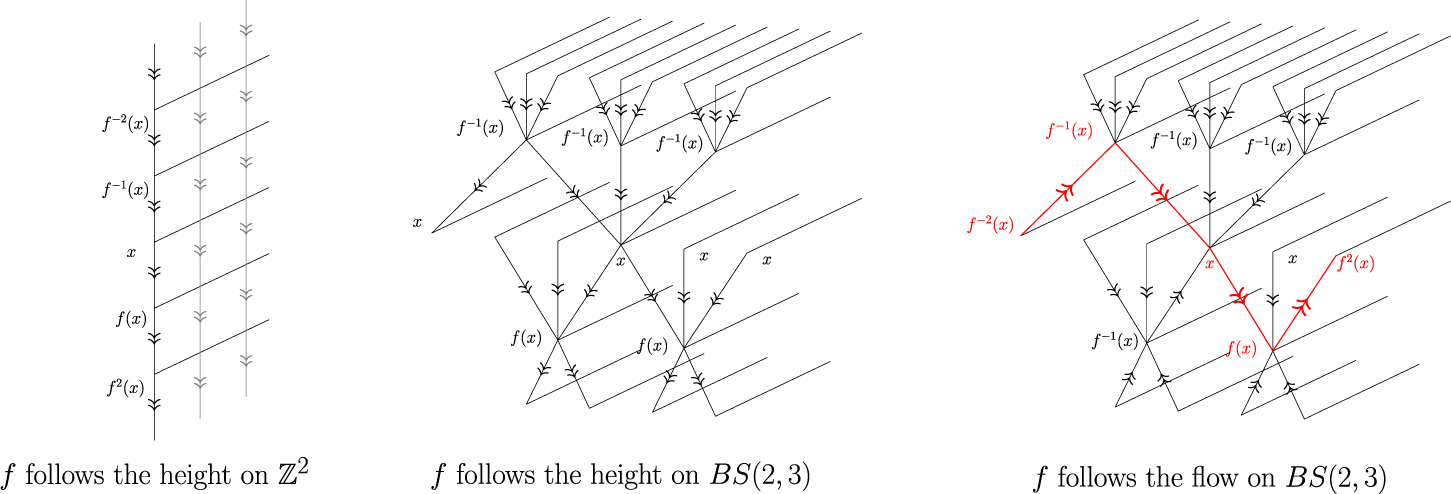
(see Figure 6 on the left). For
$g=a^jt^k\in \mathbb {Z}^2$
, the integer
$k\in \mathbb {Z}$
is called the height of g;Figure 6On the left, the Cayley graph of
$\mathbb {Z}^2=\langle a,t\mid at=ta\rangle $
where is pictured how an orbit for f is encoded. In the middle, the equivalent picture for
$BS(2,3)=\langle a, t \mid t^{-1}a^2 t = a^3 \rangle $
. For these two pictures, edges corresponding to generator t in the Cayley graphs are pictured with a double arrow. On the right, edges with double arrows represent the direction given by the flow SFT on
$BS(2,3)$
. -
(4) the function f is computed locally from one coset to the next one. This local computation is exact up to some bounded error, in a way such that globally, the errors compensate and vanish making the global computation exact;
-
(5) the aperiodicity of each configuration is a consequence of the aperiodicity of f.


The main difficulty in this construction is to ensure that only finitely many letters are needed in the alphabet of the SFT. Since we choose a rational piecewise affine map, the coefficients used as colours on the Wang tiles are certainly also rational numbers. The nature of the different encodings (both of the real numbers and of the local computation) ensures that there are a finite amount of Wang tiles and the corresponding SFT
 $X_f$
is non-empty (see [Reference Kari, Durand-Lose and Margenstern35] for more details).
The same construction may be adapted to
 $BS(m,n)$
, as presented in [Reference Aubrun and Kari4, Reference Aubrun and Kari6]. There are some technicalities to synchronize the different sheets of
 $BS(m,n)$
, but the general idea is the same. The main difference with
 $\mathbb {Z}^2$
is that in this construction, the real number
 $f^k(x)$
is encoded not only on a unique
 $\mathbb {Z}$
-coset but on infinitely many of them. With the presentation
 $\langle a, t \mid t^{-1}a^m t = a^n \rangle $
, every coset
 $g\cdot \langle a\rangle $
with
 $g\in BS(m,n)$
encodes the real number
 $f^k(x)$
, provided that g can be represented by a word w on
 $\{a,a^{-1},t,t^{-1}\}$
such that
 $|w|_{t}-|w|_{t^{-1}}=k$
. Similar to
 $\mathbb {Z}^2$
, the number k plays the role of the height of g (see Figure 6 in the middle). The construction provides a weakly aperiodic SFT, but since a same real number
 $f^k(x)$
is encoded on infinitely many
 $\langle a\rangle $
-cosets, this SFT is not strongly aperiodic.
We modify the construction for
 $BS(m,n)$
so that the computation of f no longer follows the generator t, but rather a direction given by a flow SFT similar to the flow of §6.1 (see Figure 6 on the right). Figure 6 sums up how Kari’s construction on
 $\mathbb {Z}^2$
, the construction on
 $BS(m,n)$
as presented in [Reference Aubrun and Kari6] and our construction on
 $BS(m,n)$
are similar, but also how our construction differs from that of [Reference Aubrun and Kari6] and thus provides strong aperiodicity instead of weak aperiodicity only.
7.3 A flow SFT on
$BS(2,3)$

Consider the alphabet
 $A=\{ t, at, t^{-1}, at^{-1}, a^2t^{-1}\}$
and the SFT
 $Y_{\text {flow}}\subset A^{BS(2,3)}$
defined by the following local rules: for every group element
 $g\in BS(2,3)$
and every configuration
 $y\in Y_{\text {flow}}$
:
-
•
$y_g=y_{g\cdot a^2}$
if
$y_g\in \{t,at\}$
; -
•
$y_g=y_{g\cdot a^3}$
if
$y_g\in \{t^{-1},at^{-1}, a^{2}t^{-1}\}$
; -
• if
$y_g=u\in A$
, then for every
$v\in A\setminus \{u\}$
, we have
$y_{g\cdot v^{-1}}=v$
.


This SFT can be equivalently, and in a more visual way, defined through the finite patterns with support
 $\{1,a,a^2,t, ta,ta^2,ta^3\}\cup A$
as pictured in Figure 7.
The allowed patterns
 $p^{(1)}$
to
 $p^{(5)}$
for the flow SFT on
 $BS(2,3)$
. For more readability, the outgoing edges are pictured in red (colour available online).

Notice that for each flow configuration
 $y\in Y_{\text {flow}}$
and for every
 $g\in BS(2,3)$
, the restriction of y to
 $g\cdot a^{\mathbb {Z}}$
is necessarily periodic, with this period being either
 $a^2$
or
 $a^3$
. More precisely, the coset
 $g\cdot a^{\mathbb {Z}}$
is
 $a^2$
-periodic if
 $y_g\in \{t,at\}$
and
 $a^3$
-periodic if
 $y_g\in \{t^{-1},at^{-1},a^2t^{-1}\}$
. Consequently, we may represent y just by a flow on the Bass–Serre tree of
 $BS(2,3)$
, that is to say, an edge colouring of the complete tree of degree
 $5$
where each vertex has a single outgoing arrow and four incoming arrows (see Figure 8).
A configuration in the flow SFT on
 $BS(2,3)$
, pictured on the Bass–Serre tree only. Starting from the upper-left corner, this configuration is represented by a word with prefix
 $tta^2t^{-1}$
.

In the same fashion as in §6.1, we can express flow configurations from
 $Y_{\text {flow}}$
as infinite words.
Proposition 7.2. There is a bijective corresponding between configurations of
 $Y_{\text {flow}}$
and semi-infinite words on the alphabet
 $A=\{ t, at, t^{-1}, at^{-1}, a^2t^{-1}\}$
.
Proof. If
 $y\in Y_{\text {flow}}$
, we denote by
 $W(y)$
the word in
 $A^{\mathbb {N}}$
given by the recursion starting with
 $W_0 = y_1$
and proceeding with
 $W_n = y_{W_0 \ldots W_{n-1}}$
.
Reciprocally, if W is a word in
 $A^{\mathbb {N}}$
, we define a flow configuration
 $Y_{\text {flow}}$
. We begin by defining
 $y_{W_0 \ \ldots \ W_{n-1}} = W_n$
for all
 $n\geq 0$
. Next, we can determine all other values through the use of the periodicity of a-cosets and the third rule defining the flow SFT, as shown by the definition of
 $Y_{\text {flow}}$
(see Figure 7).
Proposition 7.3. If
 $y\in Y_{\text {flow}}$
has period
 $g\in BS(2,3)$
with normal form decomposition
 $g^{-1} = wa^k$
, then
 $W(y)$
is either the infinite word
 $w^{\mathbb {N}}$
or the infinite word
 $(w^{-1})^{\mathbb {N}}$
.
Proof. The proof is analogous to the proof of Proposition 6.1.
7.4 Embedding
$BS(2,3)$
into
$\mathbb {R}^2$
along a flow configuration


We also define an embedding of
 $BS(2,3)$
into
 $\mathbb {R}^2$
driven by a flow configuration
 $y\in Y_{\text {flow}}$
, denoted by
 $\Phi _y:BS(2,3)\to \mathbb {R}^2$
, that is first recursively defined on finite words w on the alphabet
 $B=\{ a,t,a^{-1},t^{-1}\}$
.
We define
 $\Phi _y(w)=( \alpha (w),h_y(w))$
recursively, coordinate by coordinate. Let
 $\varepsilon $
denote the empty word. The second coordinate is such that, for
 $u\in \{ t, at, a^2t, t^{-1}, at^{-1}\}$
,
 $$ \begin{align*} h_y(\varepsilon) &= 0,\\ h_y(w.u) &=h_y(w)+1\quad\text{if }y_w=u,\\ &=h_y(w)-1\quad\text{otherwise},\\ h_y(w.a) &= h_y(w) = h_y(w.a^{-1}). \end{align*} $$
This coordinate
 $h_y(g)$
represents how far the
 $\langle a\rangle $
-cosets of a group element g is from
 $\langle a\rangle $
(the
 $\langle a\rangle $
-coset of the identity) if we follow the flow configuration y from the identity. In our construction, this corresponds to the simulated height in the original Kari’s SFT, and we call it the y-height of g in what follows. The first coordinate is
 $$ \begin{align*} \alpha(\varepsilon) &= 0,\\ \alpha(w.t) &=\alpha(w.t^{-1})=\alpha(w),\\ \alpha(w.a) &=\alpha(w)+{\big(\tfrac{2}{3}\big)}^{\beta(w)},\\ \alpha(w.a^{-1}) &=\alpha(w)-{\big(\tfrac{2}{3}\big)}^{\beta(w)}, \end{align*} $$
where
 $\beta (w):=\parallel w\parallel _t = |w|_t - |w|_{t^{-1}}$
counts the contribution of the generator t to w. This first coordinate
 $\alpha (w)$
is exactly the first coordinate of the
 $\Phi $
embedding given in [Reference Aubrun and Kari6]. The difference with
 $\Phi _y$
lies in the second coordinate,
 $h_y(w)$
, that no longer follows the generator t but the path induced by the flow configuration y instead.
Proposition 7.4. For every
 $g\in BS(2,3)$
, the value of
 $h_y(w)$
does not depend on the choice of the word w that represents g, and hence
 $h_y$
is well defined on
 $BS(2,3)$
.
Proof. We prove this by induction on the size of the normal form of Lemma 7.1. Since
 $h_y(w.a^{\pm 1}) = h_y(w)$
, we can get rid of the last term,
 $a^k$
, in the writing of the normal form; it does not contribute to
 $h_y$
. Assume every
 $h_y$
is well defined for all group elements that can be written with n letters from alphabet
 $A=\{ t, at, t^{-1}, at^{-1}, a^2t^{-1}\}$
. Let
 $g\in BS(2,3)$
be an element with normal form
 $w\in A^{n+1}$
. Denote
 $g'$
the group element with normal form
 $w_0\ldots w_{n-1}\in A^n$
. Then,
 $$ \begin{align*} h_y(g) &= h_y(w_0\ldots w_n). \end{align*} $$
There are two cases, depending on whether
 $w_n=y_{g'}$
or
 $w_n\neq y_{g'}$
. In the first case,
 $$ \begin{align*} h_y(g) &= h_y(w_0\ldots w_n) +1\\ &= h_y(g') +1\quad\text{by induction hypothesis}, \end{align*} $$
and in the second case,
 $$ \begin{align*} h_y(g) &= h_y(w_0\ldots w_n) -1\\ &= h_y(g') -1\quad\text{by induction hypothesis}, \end{align*} $$
so that
 $h_y(g)$
does not depend on the chosen word.
Proofs of analogous results for
 $\alpha $
and
 $\beta $
can be performed in a similar way. Again, following [Reference Aubrun and Kari6], we define
 $\unicode{x3bb} :BS(2,3)\to \mathbb {R}$
as
 $$ \begin{align*} \unicode{x3bb}(g) = \tfrac{1}{2}\big(\tfrac{3}{2}\big)^{\beta(g)}\alpha(g). \end{align*} $$
Proposition 7.5. Let g be an element of
 $BS(2,3)$
. Then for
 $i=0, \ldots , 2$
:
-
(1)
$\beta (g\cdot ta^i) = \beta (g)+1$
; -
(2)
$\unicode{x3bb} (g\cdot ta^i) = \tfrac 32\unicode{x3bb} (g)+ {i}/{2}$
.


Proof. The first point is a direct application of the rules that define
 $\beta $
. For the second point, we have that
 $$ \begin{align*} \unicode{x3bb}(g\cdot ta^i) &= \frac{1}{2}\bigg(\frac{3}{2}\bigg)^{\beta(g\cdot ta^i)}\alpha(g\cdot ta^i)\\ &= \frac{1}{2}\bigg(\frac{3}{2}\bigg)^{\beta(g)+1}\alpha(g\cdot ta^i)\\ &= \frac{1}{2}\bigg(\frac{3}{2}\bigg)^{\beta(g)+1}\bigg(\alpha(g)+ i \cdot \bigg(\frac{2}{3}\bigg)^{\beta(g\cdot t)}\bigg)\\ &= \frac{3}{2}\unicode{x3bb}(g) + \frac{i}{2}\bigg(\frac{3}{2}\bigg)^{\beta(g)+1}\bigg(\frac{2}{3}\bigg)^{\beta(g)+1},\\ \unicode{x3bb}(g\cdot ta^i) &= \frac{3}{2}\unicode{x3bb}(g)+ \frac{i}{2}.\\[-3.3pc] \end{align*} $$
7.5 A strongly aperiodic SFT on
$BS(2,3)$

To construct an aperiodic SFT, we will add a new layer of tiles to the flow shift. These new tiles are Wang tiles for
 $BS(2,3)$
that encode a piecewise linear function.
Each tile consists of 7-tuple integers
 $s = (t_1, t_2, l, b_1, b_2, b_3, r)$
, as shown in Figure 9. Let
 $\tau $
be a set of these Wang tiles. We say that a configuration
 $z\in \tau ^{BS(2,3)}$
is a valid tiling if the colours of neighbouring tiles match. More explicitly, for every
 $g\in BS(2,3)$
, we must have
 $$ \begin{align*} z_{g}(r) &= z_{g\cdot a^2}(\ell),\\ z_{g}(b_i) &= z_{g\cdot a^{i-1}t}(t_1)\quad\text{for }i=1,2,3,\\ z_{g}(b_i) &= z_{g\cdot a^{i-2}t}(t_2)\quad\text{for }i=1,2,3. \end{align*} $$
A Wang tile for
 $BS(2,3)$
.

We say that a Wang tile for
 $BS(2,3)$
computes a function
 $f:I\subset \mathbb {R}\to I$
if
 $$ \begin{align*} f\bigg( \frac{t_1+t_2}{2}\bigg) + \ell = \frac{b_1+b_2+b_3}{3}+r. \end{align*} $$
If this equality holds for f, we say that the tile computes f along the generator t. If f is invertible and the tile computes
 $f^{-1}$
, we say that the tile computes f against the generator t.
Let us define the circle
 $I = [{1}/{10};5/2]/_{{1}/{10}\sim 5/2}$
. We introduce
 $T:I \to I$
the piecewise linear map defined by

This linear map is invertible with inverse
 $$ \begin{align*} T^{-1}: x \mapsto \begin{cases} 10x & \text{if } x\in\hspace{3pt} ]\tfrac{1}{10};\tfrac{1}{4}[, \\[8pt] \tfrac{2}{5}x & \text{if } x\in [\tfrac{1}{4};\tfrac{5}{2}]. \end{cases} \end{align*} $$
It is not difficult to see that T admits immortal points, that is, real numbers x such that for every
 $k\in \mathbb {Z}$
,
 $T^k(x)$
lies in I. It is also easy to check, since
 $5$
and
 $2$
are coprime, that T is aperiodic, meaning that for every
 $x\in I$
if
 $T^k(x)=x$
for some integer
 $k\in \mathbb {Z}$
, then
 $k=0$
.
We do not use the same function as in [Reference Kari34] to construct a strongly aperiodic SFT on
 $\mathbb {Z}^2$
and in [Reference Aubrun and Kari4] to construct a weakly aperiodic SFT on
 $BS(3,2)$
, because it may cause trouble in our construction. Indeed, a careful observation of how tiles are built (see [Reference Aubrun and Kari5] for the bounds on the values for
 $\ell $
) shows that the tileset corresponding to the piece of the function given by
 $x\mapsto \tfrac 23x$
is empty! It is safer to use a piecewise linear function where no multiplicative coefficient matches
 $\tfrac 23$
, and hence our choice for T. More generally, for
 $BS(m,n)$
, no multiplicative coefficient should match
 ${m}/{n}$
.
Thanks to the machinery presented in [Reference Aubrun and Kari4, Reference Aubrun and Kari6], we can define from the function T two tilesets: first,
 $\tau _T$
that computes T along t, then
 $\tau _{T^{-1}}$
that computes
 $T^{-1}$
along t—or equivalently computes T against t. We thus define the following quantities that depend on three parameters: a function f that can be either T or
 $T^{-1}$
in our case, a real number
 $x\in [ {1}/{10};\tfrac 52]$
and a group element
 $g\in BS(2,3)$
.
 $$ \begin{align} t_k(x,g) &= \lfloor (2\unicode{x3bb}(g)+k )x \rfloor - \lfloor (2\unicode{x3bb}(g)+(k-1) )x \rfloor \quad\text{for }k=1,2,\nonumber \\ b_k(f,x,g) &= \lfloor (3\unicode{x3bb}(g)+k )f(x) \rfloor - \lfloor (3\unicode{x3bb}(g)+(k-1) )f(x) \rfloor \quad\text{for }k=1,2,3, \\ \ell(f,x,g) &= \tfrac{1}{2}f(\lfloor 2\unicode{x3bb}(g)x \rfloor) - \tfrac{1}{3}\lfloor 3\unicode{x3bb}(g)f(x) \rfloor, \nonumber \\ r(f,x,g) &= \tfrac{1}{2}f(\lfloor (2\unicode{x3bb}(g)+2)x \rfloor) - \tfrac{1}{3}\lfloor (3\unicode{x3bb}(g)+3)f(x) \rfloor.\nonumber \end{align} $$
We gather
 $\tau _T$
and
 $\tau _{T^{-1}}$
, which are both finite by [Reference Aubrun and Kari5, Proposition 8], into a single tileset
 $\tau $
which is thus finite and combine it with the flow SFT
 $Y_{\text {flow}}$
to define the SFT
 $Y_T$
over the alphabet
 $A\times \tau $
as follows: every configuration
 $z\in Y_T$
, which we denote
 $z_g=(y_g,\tau _g)$
for every
 $g\in BS(2,3)$
, satisfies:
-
• if
$y_g=t$
, then
$\tau _g\in \tau _T$
; -
• if
$y_g\in \{at,t^{-1},t^{-1},at^{-1},a^2t^{-1}\}$
, then
$\tau _g\in \tau _{T^{-1}}$
.


These two conditions impose that the computation of iterates of T follows the flow: we put tiles that compute T on outgoing arrows and tiles that compute
 $T^{-1}$
on incoming arrows (see Figure 10).
The flow configuration drives the choice for computing T or
 $T^{-1}$
in the different sheets of
 $BS(2,3)$
.

Combining the formulae from equation (7.1) and the patterns from Figure 7, we can picture Wang tiles from
 $\tau $
as follows.
Proposition 7.6. The tile pictured on the left of Figure 11 computes T along t, and the tile on the right computes
 $T^{-1}$
along t (or T against t).
Wang tileset
 $\tau $
that computes T along a flow configuration for
 $BS(2,3)$
.

Proof. The tiles are a simplified version of the tiles in [Reference Aubrun and Kari6], since we have a one-dimensional function T or
 $T^{-1}$
instead of a two-dimensional one, and our functions are linear and not affine. The calculations are left to the reader: the main idea is that terms on top and bottom telescope and the left and right carries precisely compensate the remaining terms.
Remark 7.7. The proof of Proposition 7.6 does not depend on the choice for the function
 $\unicode{x3bb} $
.
Proposition 7.8. There exists a configuration in
 $Y_T$
.
Proof. The proof follows the proof of [Reference Aubrun and Kari6, Lemma 9], since the function T we have chosen has immortal points. Fix a flow configuration
 $y\in Y_{\text {flow}}$
and choose x an immortal point for T. For every
 $g\in BS(2,3)$
, we put the tile
 $\tau (f,T^{h_y(g)}(x),g)$
in g, where
 $f=T$
if
 $y_g=t$
and
 $f=T^{-1}$
otherwise. This defines a configuration z in
 $\tau ^{BS(2,3)}$
. It remains to check that it is indeed in the SFT
 $Y_T$
. We need to check that the three matching rules conditions in §7.5 are satisfied.
(1)
 $z_{g}(r) = z_{g\cdot a^2}(\ell )$
? We distinguish two cases, depending on whether
 $y_g=t$
or not. If this is the case, then
 $z_{g}(r)$
is
 $r(T,T^{h_y(g)}(x),g)$
:
 $$ \begin{align*} z_{g}(r)=\tfrac{1}{2}T(\lfloor (2\unicode{x3bb}(g)+2)T^{h_y(g)}(x) \rfloor) - \tfrac{1}{3}\lfloor (3\unicode{x3bb}(g)+3)T^{h_y(g)+1}(x) \rfloor. \end{align*} $$
In this case, by the definition of
 $Y_{\text {flow}}$
(see Figure 7), we also have that
 $y_{g\cdot a^2}=t$
. Thus,
 $z_{g\cdot a^2}(\ell )$
is
 $\ell (T,T^{h_y(g\cdot a^2)}(x),g\cdot a^2)$
and since
 $h_y(g\cdot a^2)=h_y(g)$
, we get
 $$ \begin{align*} z_{g\cdot a^2}(l)=\tfrac{1}{2}T(\lfloor 2\unicode{x3bb}(g\cdot a^2)T^{h_y(g)}(x) \rfloor) - \tfrac{1}{3}\lfloor 3\unicode{x3bb}(g\cdot a^2)T^{h_y(g)+1}(x) \rfloor. \end{align*} $$
It suffices to use the fact that
 $\unicode{x3bb} (g\cdot a^2)=\unicode{x3bb} (g)+1$
to conclude.
In the second case,
 $y_g\neq t$
,
 $z_{g}(r)$
is
 $r(T^{-1},T^{h_y(g)}(x),g)$
and the allowed patterns of Figure 7 impose that
 $y_{g\cdot a^2}\neq t$
. Thus,
 $z_{g\cdot a^2}(\ell )$
is equal to
 $\ell (T^{-1},T^{h_y(g)\cdot a^2}(x),g\cdot a^2)$
. The equalities
 $\unicode{x3bb} (g\cdot a^2)=\unicode{x3bb} (g)+1$
and
 $h_y(g\cdot a^2)=h_y(g)$
give that
 $z_{g}(r) = z_{g\cdot a^2}(\ell )$
.
(2)
 $z_{g}(b_{i+1}) = z_{g\cdot ta^{i}}(t_1)$
for
 $i=0,1,2$
?
If
 $y_g=t$
, then
 $$ \begin{align*} z_{g}(b_{i+1}) &= b_{i+1}(T,T^{h_y(g)}(x),g)\\ &= \lfloor(3\unicode{x3bb}(g)+i+1 )T^{h_y(g)+1}(x) \rfloor - \lfloor (3\unicode{x3bb}(g)+i )T^{h_y(g)+1}(x) \rfloor. \end{align*} $$
However,
 $$ \begin{align*} z_{g\cdot ta^{i}}(t_1) &= t_1(T^{h_y(g\cdot ta^{i})}(x),g\cdot ta^{i})\\ &= \lfloor (2\unicode{x3bb}(g\cdot ta^{i})+1 )T^{h_y(g\cdot ta^{i})}(x) \rfloor - \lfloor (2\unicode{x3bb}(g\cdot ta^{i}) )T^{h_y(g\cdot ta^{i})}(x) \rfloor. \end{align*} $$
Using results from Proposition 7.5, we get that
 $$ \begin{align*} z_{g\cdot ta^{i}}(t_1) &= \lfloor \bigg(2\bigg(\frac{3}{2}\unicode{x3bb}(g)+ \frac{i}{2}\bigg)+1 \bigg)T^{h_y(g)+1}(x) \rfloor - \lfloor \bigg(2\bigg(\frac{3}{2}\unicode{x3bb}(g)+ \frac{i}{2}\bigg) \bigg)T^{h_y(g)+1}(x) \rfloor\\ &= \lfloor (3\unicode{x3bb}(g)+i+1 )T^{h_y(g)+1}(x) \rfloor - \lfloor (3\unicode{x3bb}(g)+i )T^{h_y(g)+1}(x) \rfloor\\ &= z_{g}(b_{i+1}). \end{align*} $$
If
 $y_g\neq t$
, the calculations are quite similar, except that T is replaced by
 $T^{-1}$
in the expression of
 $z_g(b_{i+1})$
, which is compensated by the fact that, in that case,
 $h_y(g\cdot ta^{i})=h_y(g)-1$
.
 $z_{g}(b_{i+1}) = z_{g\cdot ta^{i-1}}(t_2)$
for
 $i=0,1,2$
?
This part is very similar to what precedes and left to the reader, since
 $t_2(x,g)$
is just a shift of
 $t_1(x,g)$
.
Let
 $(x_i)_{i\in \mathbb {Z}}$
be a bi-infinite sequence on the alphabet
 $\{k,k+1\}$
for some integer
 $k\in \mathbb {Z}$
. Then,
 $(x_i)_{i\in \mathbb {Z}}$
is a representation of a real number x if arbitrarily long sub-sequences have averages arbitrarily close to x. For instance, a given real number x has its Beatty sequence
 $(B_k(x))_{k\in \mathbb {Z}}$
, where
 $B_k(x)=\lfloor (k+1)x\rfloor - \lfloor kx\rfloor $
is a representation of x. A compactness argument shows that any bi-infinite sequence
 $(x_i)_{i\in \mathbb {Z}}$
represents at least one real number, but it may also represent different real numbers.
Proposition 7.9. The SFT
 $Y_T$
is strongly aperiodic.
Proof. Let
 $z=(y,\tau )$
be a configuration in
 $Y_T$
and assume it possesses a period
 $g\in BS(2,3)$
. Thus for every
 $k\in \mathbb {Z}$
, one has that
 $$ \begin{align*} z_{a^k}=z_{g^{-1}\cdot a^k} \end{align*} $$
so that the two
 $\langle a \rangle $
-cosets at
 $1$
and
 $g^{-1}$
are the same. If we denote by x one real number represented by
 $\tau $
on the
 $\langle a \rangle $
-coset of the identity, we get that
 $$ \begin{align*} T^{h_y(g)}(x)=x. \end{align*} $$
However, the periodicity of z also constrains the flow configuration y. Necessarily by Proposition 7.3, if we decompose g into its normal form
 $g = wa^{p}$
, we have that y is characterized by either the infinite word
 $w^{\mathbb {N}}$
or
 $(w^{-1})^{\mathbb {N}}$
. Without loss of generality, we take
 $W(y) = w^{\mathbb {N}}$
, which in particular implies that
 $h_{y}(w) = h_y(g)=|g|_t+|g|_{t^{-1}}$
. Hence, we can rewrite
 $T^{h_y(g)}(x)=x$
as
 $$ \begin{align*} T^{|g|_t+|g|_{t^{-1}}}(x)=x, \end{align*} $$
which in turn implies, by the aperiodicity of T, that
 $|g|_t+|g|_{t^{-1}}=0$
. Because the two terms are positive, they are necessarily zero. The period g is therefore a power of a that we denote as
 $a^{-N}$
for some
 $N\in \mathbb {Z}$
. We now know that for every group element
 $h\in BS(2,3)$
,
 $$ \begin{align*} z_{h}=z_{a^N\cdot h}, \end{align*} $$
so that each
 $\langle a \rangle $
-coset in the configuration y wears an N-periodic bi-infinite word. Since there are only finitely many possible words of length N, by following the flow component of y, there must exist two distinct integers
 $k,k'$
such that
 $T^k(x)=T^{k'}(x)$
. Again, the aperiodicity of T implies that
 $k=k'$
, which contradicts our initial assumption. We conclude that z has no period.
Combining Propositions 7.8 and 7.9 gives the existence of a strongly aperiodic SFT on
 $BS(2,3)$
. Since all non-residually finite Baumslag–Solitar groups are finitely presented, torsion free and quasi-isometric between them, [Reference Cohen17, [Theorem 4.1]] applies and we conclude that all the
 $BS(m,n)$
with
 $m,n>1$
and
 $m\neq n$
admit strongly aperiodic SFTs.
Theorem 7.10. Non-residually finite Baumslag–Solitar groups
 $BS(m,n)$
with
 $m, n> 1$
and
 $m\neq n$
admit strongly aperiodic SFTs.
Corollary 7.11. All non-
 $\mathbb {Z}$
GBS groups admit a strongly aperiodic SFT.
7.6 Consequences
Through the machinery provided by Theorem 4.1, we can push the result to a broader class of groups, namely those obtained as the fundamental group of a graph of virtual
 $\mathbb {Z}$
. This structure is the same as in Definition 3.2 but all vertex groups are virtually
 $\mathbb {Z}$
instead of just
 $\mathbb {Z}$
.
Theorem 7.12. [Reference Mosher, Sageev and Whyte43]
A group G is quasi-isometric to a GBS group if and only if it is the fundamental group of a graph of virtual
 $\mathbb {Z}$
.
This way, Corollary 7.11 implies the following result.
Corollary 7.13. Let G be the fundamental group of a graph of virtual
 $\mathbb {Z}$
. If G is not virtually
 $\mathbb {Z}$
, it admits a strongly aperiodic SFT.
8 Conclusion
We have shown the existence of strongly aperiodic SFTs for all GBS groups and even graphs of virtual
 $\mathbb {Z}$
that are not virtually
 $\mathbb {Z}$
. Moreover, for non-
 $\mathbb {Z}$
unimodular GBS groups and residually finite Baumslag–Solitar groups, the strongly aperiodic SFT can also be chosen minimal.
A question that remains open is the existence of a minimal strongly aperiodic SFT on non-residually finite Baumslag–Solitar groups
 $BS(m,n)$
. Note that the existence of such an SFT would imply the same for all non-virtually
 $\mathbb {Z}$
GBS groups. Another related question concerns strongly aperiodic SFTs for Artin groups: can the path-folding technique be adapted to this class of groups?