It is widely known that phonological processes lead to variation in speech production. In English, consonants that are produced with a coronal place of articulation appear to take the place of articulation of the immediately following consonant. For example, the final consonant of the word right is realized as a labial ([p]) in the context of right berries, even though it is a coronal ([t]) when the word right appears alone (Gaskell & Marslen-Wilson, Reference Gaskell and Marslen-Wilson1996, Reference Gaskell and Marslen-Wilson1998; Gow, Reference Gow2001, Reference Gow2002, Reference Gow2003; Lahiri & Marslen-Wilson, Reference Lahiri and Marslen-Wilson1991; Mitterer & Blomert, Reference Mitterer and Blomert2003). This variation has been accounted for in two different ways in the literature: one assuming a single underlying representation and the other assuming multiple representations in the lexicon. In Levelt, Roelofs, and Meyer (Reference Levelt, Roelofs and Meyer1999) and Dell (Reference Dell1986), the coronal nasal is assumed to be in the lexicon, and the labial nasal is derived from the coronal nasal through the assimilation process. These accounts assume that even though there are several allophonic variants, only one phonological representation, or lexeme, is stored in the mental lexicon, and thus, the stored form is abstract and different from the actual pronunciation. Other speech perception models, such as TRACE (McClelland & Elman, Reference McClelland and Elman1986), phonological inference (Gaskell & Marslen-Wilson, Reference Gaskell and Marslen-Wilson1996, Reference Gaskell and Marslen-Wilson1998), and feature parsing (Gow, Reference Gow2001, Reference Gow2003), also claim that only one form is stored in the lexicon.
These models have been challenged recently by some psycholinguistic studies (Bürki, Alario, & Frauenfelder, Reference Bürki, Alario and Frauenfelder2011; Bürki, Ernestus, & Frauenfelder, Reference Bürki, Ernestus and Frauenfelder2010; Connine, Reference Connine2004; Connine & Pinnow, Reference Connine and Pinnow2006; LoCasto & Connine, Reference LoCasto and Connine2002; Patterson & Connine, Reference Patterson and Connine2001; Ranbom & Connine, Reference Ranbom and Connine2007), where two lexemes have been proposed. For instance, Connine and her colleagues proposed multiple representations for allophonic variants produced from the flapping process. Word-medial flapping is dominant in American English, such as the segment /t/ (pretty [prɪɾi]). It was demonstrated in a series of experiments that the most frequent form, the flap, as well as the hyperarticulated [t] form, is lexically represented (Connine, Reference Connine2004; Connine & Pinnow, Reference Connine and Pinnow2006; Patterson & Connine, Reference Patterson and Connine2001; Ranbom & Connine, Reference Ranbom and Connine2007). Similarly, Bürki et al. (Reference Bürki, Ernestus and Frauenfelder2010, Reference Bürki, Alario and Frauenfelder2011) proposed multiple representations of the French schwa, using the pseudohomophone effect. In the example of cerisier “cherry tree,” they compared naming latencies to pseudohomophones of the schwa (seriziez) and a reduced variant (srizier) to those of matched pseudowords (serasien and srazien) and found pseudohomophonic advantages for both words with a schwa and a reduced variant. These results were taken to reflect the activation of the phonologically matching stored representation in the mental lexicon, suggesting that both words containing the schwa and words containing the reduced variant are lexically stored.
As for the reason that allophonic variants are lexically stored, these studies suggested a possible explanation based on the influence of orthography; the variants might be derived from the way that words are spelled. For instance, Ranbom and Connine (Reference Ranbom and Connine2007) conducted a corpus analysis and found that nasal flap production in the cluster /nt/ of the word gentle (gentle → [ʤɛɾ
 l]) is dominant in spoken American English. In a subsequent lexical decision task, it was demonstrated that lexical decisions were faster and more accurate for the [nt] productions compared with the nasal flaps. The results of the lexical decision task demonstrated that orthographic information is able to influence spoken-word processing.
Previous research has amply illustrated that orthographic knowledge can influence spoken-word processing. Most of these studies focused on recognition tasks using a wide range of experimental paradigms (Castle, Holmes, Neath, & Kinoshita, Reference Castles, Holmes, Neath and Kinoshita2003; Dijkstra, Roelofs, & Fieuws, Reference Dijkstra, Roelofs and Fieuws1995; Jakimik, Cole, & Rudnicky, Reference Jakimik, Cole and Rudnicky1985; Montant, Schön, Anton, & Ziegler, Reference Montant, Schon, Anton and Ziegler2011; Seidenberg & McClelland, Reference Seidenberg and McClelland1989; Seidenberg & Tannenhaus, Reference Seidenberg and Tannenhaus1979; Taft, Reference Taft2006; Treiman & Cassar, Reference Treiman and Cassar1997; Van Orden & Goldinger, Reference Van Orden and Goldinger1994; Ziegler & Ferrand, Reference Ziegler and Ferrand1998; Ziegler & Muneaux, Reference Ziegler and Muneaux2007). For instance, Seidenberg and Tannenhaus (Reference Seidenberg and Tannenhaus1979) found that participants' responses were faster in a rhyme judgment task when the pairs of words shared spellings (e.g., toast–roast; cf. toast–ghost). A similar claim was drawn from priming tasks in which the auditory target was responded to faster with the prior presentation of a phonologically similar prime that overlapped with the spelling of the target (e.g., message–mess) than a prime with nonoverlapping spellings (e.g., definite–deaf; Jakimik et al., Reference Jakimik, Cole and Rudnicky1985).
Despite long-standing acceptance of the role of orthography in spoken-word recognition, little research has been conducted on how orthography may exert an influence on spoken-word production, and previous studies have provided somewhat conflicting results. Lupker (Reference Lupker1982) investigated the effects of orthographic and phonological relatedness between distractor words and object names in a picture–word interference task. When participants were asked to name pictures but to ignore visually presented distractor words, they named the pictures more slowly if the distractors rhymed with the picture names but were spelled differently (e.g., train–cane) than if the rhyming distractors were spelled similarly (e.g., train–brain). Damian and Bowers (Reference Damian and Bowers2009) attempted to replicate this study, whereas when distractors were presented auditorily, they found no effect of orthographic overlap, and form priming was demonstrated to be determined only by the presence of phonological overlap between pictures and words. Gaskell, Cox, Foley, Grieve, and O'Brien (Reference Gaskell, Cox, Foley, Grieve and O'Brien2003) asked participants to shadow auditorily presented nouns with indefinite or definite articles and found that the pronunciation of words depended not only on the sound of the target but also on its spelling. For instance, words beginning with [j] (e.g., union) were expected to be used with [ðə], not with the [ði] version, because the initial sound of the word was not a vowel. However, the [ði] version was also elicited based on the initial spelling of the word. Damian and Bowers (Reference Damian and Bowers2003) investigated the effects of orthographic knowledge in a task following a form preparation paradigm (Meyer, Reference Meyer1990). In this paradigm, participants were asked to memorize word pairs and then produce the second word of the pair upon seeing a visual representation of the first. A common finding was that latencies were shorter when response words shared initial phonemes. With this paradigm, Damian and Bowers (Reference Damian and Bowers2003) found that naming latencies were shorter when the words shared pronunciation and spelling (e.g., coffee, cushion, camel) but not when the spelling of one item differed (e.g., coffee, cushion, kennel). This finding was interpreted to show the influence of spelling on spoken-word production, but Alario, Perre, Castel, and Ziegler (Reference Alario, Perre, Castel and Ziegler2007), Bi, Wei, Janssen, and Han (Reference Bi, Wei, Janssen and Han2009), and Roelofs (Reference Roelofs2007) did not replicate their results in French, Mandarin Chinese, and Dutch, respectively, suggesting possible cross-linguistic differences in orthographic effects.
Rastle, McCormick, Bayliss, and Davis (Reference Rastle, McCormick, Bayliss and Davis2011) attempted to resolve the inconsistent results of previous studies using an artificial word-learning paradigm. In this paradigm, participants were asked to learn from a set of associations between novel words (spoken forms) and the corresponding pictures on a first day of learning sessions and were then tested in a series of speech-processing tasks on the second and third days. The novel words were introduced on the second day as either sound–spelling consistent or sound–spelling inconsistent. Orthographic effects on speech production were found in picture naming, which emerged immediately following the introduction of the spellings of the words and persisted in testing on the third day. However, such effects were not observed in the shadowing task, where participants appeared to activate only the phonological representation, without any possibility for orthographic feedback to exert an influence.
Zhang and Damian (Reference Zhang and Damian2012) recently investigated the potential role of orthography on spoken-word production in Chinese, a nonalphabetic and orthographically nontransparent language. In three different experiments, they demonstrated that a reliable orthographic effect was found in an oral reading task but not in a response generation task, suggesting that orthographic knowledge was activated only in a task where the spelling of a word played a role. Similarly, in Roelofs (Reference Roelofs2007), when the experimental task required orthographic information (i.e., reading aloud), orthographic knowledge was activated, whereas in the tasks that did not require such information as in picture naming or a response generation task, orthographic knowledge was not activated. Zhang and Damian also found a significant inhibitory effect of orthography when the word-initial characters of the prompt words were visually similar, but this effect was not observed when prompt stimuli were presented auditorily. Thus, the orthographic inhibition effect with visual stimuli may occur at the memorization stage of words, rather than at the stage of word production. This result is in line with Alario et al. (Reference Alario, Perre, Castel and Ziegler2007) in that they suggested the locus of the orthographic effect to be in memorization, not in production.
Overall, it is clear that orthographic effects are strong in spoken-word recognition/perception, but this does not hold true for spoken-word production. As for the discrepancy, Bürki, Spinelli, and Gaskell (Reference Bürki, Spinelli and Gaskell2012) suggested that unlike for spoken-word recognition, orthographic knowledge may influence spoken-word production via an offline restructuring of the phonological representation. They noted that in experimental tasks detecting online activation of orthographic information during spoken-word production (e.g., Alario et al., Reference Alario, Perre, Castel and Ziegler2007; Roelofs, Reference Roelofs2007), the role of orthography was limited. A previous study of Rastle et al. (Reference Rastle, McCormick, Bayliss and Davis2011), however, demonstrated an offline restructuring of the preexisting phonological representation due to the orthographic information. Adapting Rastle et al. (Reference Rastle, McCormick, Bayliss and Davis2011)'s artificial word-learning paradigm, they trained participants using the auditory forms of potential reduced variants of novel French words with corresponding pictures over 4 consecutive days, and on the fourth day, the spellings of the novel words were presented once. Half of the test words were presented with a spelling for the schwa (i.e., <e>), and the other half were not. Then, when participants were tested with naming tasks, they produced more schwa variants for the target words that were spelled with <e> compared to those words that did not include <e>. A crucial aspect of this study was that a single exposure to the spellings of the novel words changed the representations in the mental lexicon, and the participants used such variants even in the production task.
Due to the inconclusive results on the role of orthographic knowledge in spoken-word production, this study attempts to further investigate the influence of orthographic information in spoken-word production. Specifically, this study examines whether exposure to a word's spelling is sufficient to restructure a corresponding phonological representation in a picture-naming task, as proposed by Bürki et al. (Reference Bürki, Spinelli and Gaskell2012). Because the previous literature demonstrating the lexical storage of phonological variants is limited to a few Indo-European languages, such as English and French, the present study focuses on the representation of allophonic variants in a language that has never been examined, Korean. The data from Korean, which is typologically and orthographically unrelated to these two languages, would provide a further test case to support or contradict the role of orthography as proposed recently in psycholinguistic studies.
In Korean, the glottal fricative /h/ displays different behaviors according to the phonological contexts in which it occurs. When the phoneme /h/ appears in word-initial position, it is realized as a voiceless fricative ([hε] /hε/ “sun”). Between two voiced sounds, however, it is realized as numerous variants: it is optionally deleted ([ahop]/[aop] /ahop/ “nine”) or realized as a voiced fricative, [ɦ], or an approximant, [w] (Huh, Reference Huh1985; Ku, Reference Ku1999; Shin, Reference Shin2003). Among these choices, the most common one is deletion. The realization of /h/ differs according to the speed of production, degree of formality (Ahn, Reference Ahn1986), number of syllables, prosodic context, adjacent segments (Cha, Jung, & Shin, Reference Shin2003), and word frequency (Choi, Lim, & Han, Reference Choi, Lim and Han2006). For example, Choi et al. (Reference Choi, Lim and Han2006) recorded the production from 10 native speakers of Koreans of 13 high- and low-frequency words with /h/ in intervocalic position and then examined the spectral properties of each token of /h/. The purpose of their experiment was to test whether /h/ would be more likely to be reduced in high-frequency words than in low-frequency words. As expected, more than four different phonetic realizations of the intervocalic /h/ appeared in spoken Korean, but there was a significant difference in the realization of /h/ between high-frequency words and low-frequency words. The percentages of the realizations of [h], [ɦ], [w], and ø, for example, were 1.5%, 2.3%, 6.2%, and 90% in high-frequency words, respectively, and 5.8%, 1.15%, 9.6%, and 83.5% in low-frequency words, respectively. It is crucial that, for the purpose of the study, the combined results of high- and low-frequency words demonstrated that the deletion of /h/ is dominant over the other realizations in spoken Korean.
Based on impressionistic descriptions, it is widely assumed that these variants of /h/ are gradiently realized (Ahn, Reference Ahn1986; Shin, Reference Shin2003); however, there has been little research with acoustic data. Cha et al. (Reference Cha, Jung and Shin2003) may be the only acoustic study to provide evidence for the gradient behavior of /h/. Cha et al. (Reference Cha, Jung and Shin2003) recorded 10 native Korean speakers (Seoul dialect), manipulating the speech rate, the prosodic context in which the /h/ variants occurred, and the number of syllables of the target words in the domain of accentual phrase (AP). They showed that the rate of /h/-deletion was gradiently increased as (a) the speech rate increased (from slow to normal to fast), (b) the distance from the AP-initial position became longer (from the second and third to fourth to fifth syllables from the AP-initial position), and (c) the number of the syllables increased from three to four to five syllables. These results demonstrated that the variability of the phoneme /h/ is gradient.
The variants of /h/ are represented orthographically. The Korean orthographic system (“Hangul”) is an alphabetic writing system, with 21 consonant and 8 vowel phonemes. It shows transparent spelling to sound correspondence, and thus each phoneme is represented by a Hangul letter. However, instead of being written as a string of letters as the Latin alphabet, the Korean alphabet letters are grouped into a squarelike block, which corresponds to a syllable. For instance, three alphabet letters <ㅎ> (/h/), <ㅏ> (/a/), and <ㄴ> (/n/) can be grouped into a block <한> (/han/), and represent a syllable. Thus, the Korean orthographic system is a syllabary as well as alphabetic writing system. Each syllabic block is composed of two to five letters, including at least one consonant for an onset and a vowel. For this reason, a letter shaped like a simple circle <ㅇ> is used for silence (null consonant) in the onset (Kim, Reference Kim and Kim-Renaud1997, Reference Kim2007; Taylor, Reference Taylor, Kolers, Wrolstad and Bouma1980). These blocks are then arranged horizontally from left to right or vertically from top to bottom. If the allophonic variants of /h/ as in [h], [ɦ], [w], and ø are directly represented in the Korean orthography, there may be three possible forms: when /h/ is realized as [h] or [ɦ] in the onset, the letter <ㅎ> appears in the top left of the second block (e.g., <기한> [ki.han] /ki.han/), but when the /h/ is deleted, the letter <ㅇ> appears in the same place (e.g., <기안> [ki.an]). If the /h/ variant is realized as similar to [w], the letter corresponding to /w/, <ㅗ>, is included as a left member of the diphthong, <ㅘ>, for [wa] (e.g., <기완> [ki.wan]).
This study investigates the production of /h/-lenited variants by Korean speakers using an adapted format of the artificial word-learning paradigm (Bürki et al., Reference Bürki, Spinelli and Gaskell2012; Rastle et al., Reference Rastle, McCormick, Bayliss and Davis2011) in order to examine the impact of spellings on the production and lexical storage of these variants.
METHODS
Participants
Forty-eight native Korean speakers, using the Seoul dialect (“standard Korean”), participated in the experiment. Participants were randomly assigned to a “ø-letter” group, an “h-letter” group, or a “no-letter” group, with 16 participants in each group. The ø-letter group consisted of 8 males and 8 females, and their ages ranged from 19 to 25 years old (mean = 22.5). The h-letter group consisted of 8 males and 8 females, and their ages ranged from 19 to 25 years old (mean = 21.8). The no-letter group consisted of 9 males and 7 females, and their ages ranged from 20 to 29 years old (mean = 22.7). All of the participants began their study of foreign languages, if any, after the age of 7 and had no experience living or studying in other countries for more than 6 months. None of the participants reported any speech disorders, and they were all paid for their participation.Footnote 1
Stimuli
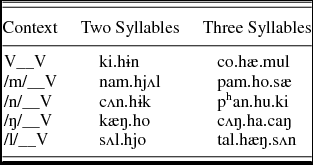
The stimuli consisted of 20 Korean nonwords, 10 of which were test words and the other 10, fillers. Both test and filler words had either two or three syllables. In the test words (as in Table 1), /h/ occurred in the onset of the second syllable and was positioned between various voiced sounds (vowel, /m, n, ŋ, l/) and a vowel, which could serve to elicit the lenition of the target segment (Shin, Reference Shin2003).
Test words

In each test word, the phoneme /h/ in the onset of the second syllable can be produced similarly to [h] (voiceless fricative), [ɦ] (voiced fricative), or [w] (labial-velar approximant), or deleted. Note that these variants did not differ in a categorical way, but rather they were generated through a gradient process of lenition. For example, the voiced version of /h/, [ɦ], showed considerable variation in acoustic values such as noise duration, duration of voicing, and amplitude of noise. Similarly, [w] as a variant of /h/, showed much weaker acoustic cues than the phoneme /w/ as in /wi/ “top.” Thus, we classified each variant of /h/ based on how similar a certain sound was to one of [h], [ɦ], [w], or ø. The variants, except for the voiceless fricative, are regarded as the ones undergoing lenition. In addition to the test words, 10 fillers were generated where /h/ was not included. Each filler item was recorded as two forms according to the application of various optional phonological processes in Korean, such as aspiration, glide insertion, place assimilation, tensification, and lateralization. For instance, the filler item /ki.u.mi/ was recorded as [ki.u.mi] (without application of glide insertion) and [ki.ju.mi] (with a glide inserted). All of the other conditions were the same as in the test words.
Both the test words and the fillers were recorded by a male native-Korean speaker using the Seoul dialect in a soundproof booth with a Shure KSM44 and a Tascam (HD-P2) solid-state recorder. Each word was recorded with various lenited variants through numerous repetitions of production. The recorded tokens were digitized in Praat at a sampling grate of 44.1 kHz and saved as 16-bit computer audio files to be used in the experiments. The sample spectrograms of variants of /h/ are presented in Appendix A. Each novel word was randomly associated with pictures of unfamiliar objects. The pictures were drawings of nonexistent objects that were taken from Bürki et al. (Reference Bürki, Alario and Frauenfelder2011) and Leach and Samuel (Reference Leach and Samuel2007). The entire set of pictures is presented in Appendix B.
Procedure
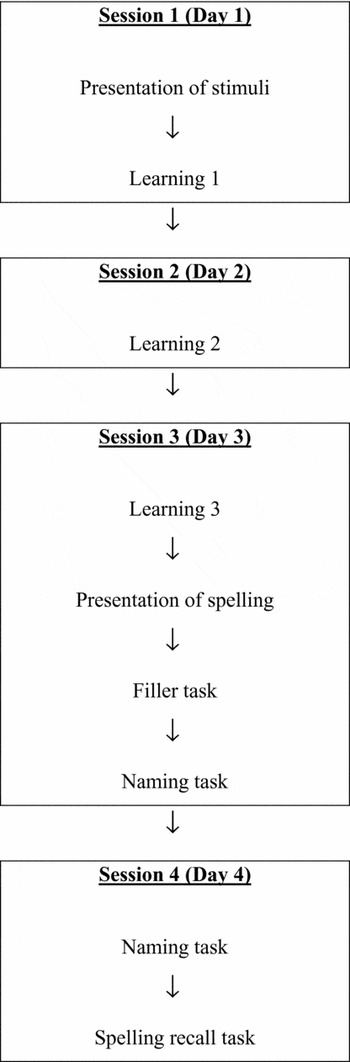
The overall design of the sessions is summarized in Figure 1. Each participant took part in a 4-day consecutive experimental session. The participants were tested individually in a soundproof booth, which had in it a computer with SuperlabPro (Cedrus) installed. The microphone (Shure KSM 44) was also used for picture-naming tasks on Day 3 and Day 4. The detailed procedures for each session are as follows. On Day 1, the participants were told that they would learn novel words with their associations of pictures of novel objects and that all of the words were artificial but possible Korean words. They were informed that they would learn 20 words total over the course of three sessions over 3 days and would then be tested on their knowledge of the newly learned words on Day 3 and Day 4.
The schematic design of the experiment sessions over 4 days.

On Day 1, during the first session, each participant was presented with a randomized list of all 20 words with corresponding pictures three times. Three repetitions of the test words consisted of three different versions of the lenited forms, those similar to [ɦ], [w], and ø, respectively. The filler words were also presented in a randomized order. When the spoken form was played via headphones (Sennheiser HD 590), the corresponding picture appeared on the screen of the computer. The participants were asked to memorize the association of spoken words to pictures and were allowed to set the interstimulus interval by clicking the space bar on a keyboard. The actual time each participant used to memorize the new words with pictures varied, but did not exceed 10 min.
The first learning session (Learning 1) followed the presentation of the stimuli, where each participant heard the spoken form of a novel word via headphones. At the same time, two different pictures appeared at the center of the screen, one of which was associated with the spoken word while the other was not. Each participant was asked to click on the target picture. If the response was correct, the following word was heard; however, if the response was incorrect, the word “wrong” appeared on the screen and the participant was instructed to click on the correct picture. There was a 500-ms blank-screen interval between trials, and the interstimulus interval was 10 s. Each target word was heard 10 times in a randomized order, 8 of which were realized as ø (with deletion) and the other 2 of which were variants similar to [ɦ] and [w]. The distribution of /h/ variants reflected native-Korean speakers' actual tendency to produce /h/ variants, as shown in Choi et al. (Reference Choi, Lim and Han2006). The total number of tokens was 200 in total (20 words × 10 repetitions), and they were presented in three blocks. After training, participants took a test that consisted of 20 words to examine how well they memorized the words, and their scores for accurate judgments were computed.
On Day 2, the participants took the learning session only, which constituted the second session of learning (Learning 2). The detailed procedure was the same as for the first learning session (Day 1), but there were three pictures, on the screen, not two, in order to make the test more challenging. At the end of training, the memorization test was conducted with 20 words, which was the same as for the first learning session.
On Day 3, all of the participants started the session with the third and final learning session (Learning 3) in the same way they did for the second learning session (Day 2). The third learning session was followed by the presentation of the spellings of the novel words for the first and only time. The way the spellings were presented differed according to the participant group. For the ø-letter group (n = 16), the spelling <ㅇ>, corresponding to the null consonant, was presented to represent the case that the segment /h/ was deleted, and for the h-letter group (n = 16), the test words had the spelling <ㅎ>, corresponding to the segment [h]/[ɦ].Footnote 2 The remaining 16 participants, in the no-letter group, were not exposed to the spellings of the novel words, and thus they received auditory input only. While participants were listening to the spoken forms of each novel word, the spellings of the words appeared on the center of the computer screen with the corresponding pictures, written in 16-point Arial font. They were instructed to pay attention to the spelling of the words. They were allowed to take as much time as they felt they needed, and told to press Enter if they felt that they were ready to move on to the next word. Immediately after that, the participants performed a filler task, the aim of which was to distract their attention from the novel words. The detailed procedure of the filler task was similar to that in Bürki et al. (Reference Bürki, Spinelli and Gaskell2012). Each participant looked at a sequence of two- to five-digit numbers at the center of the computer screen for 2000 ms and then a colored question mark in a colored square. The participants were asked to name the color of the square and at the same time press the keys for the sequence of digits on the keyboard as quickly as possible. The picture remained on the screen for 3000 ms unless a response was given. The filler task was composed of four blocks, with six trials in each block. The first block presented sequences of two digits each, and a digit was added in each subsequent block. A 2000-ms blank screen was provided between blocks. The participants were then tested with a picture-naming task, where pictures of the novel words appeared one by one on the screen, and they were instructed to produce the names of the words as quickly as possible. A fixation point was presented on the screen for 500 ms, and then a picture was provided until the participants responded, or until 3000 ms had expired. The order of presentation was randomized. The participants' production was recorded using a Shure KSM 44 microphone.
On Day 4, the participants started the session with the same picture-naming task as on Day 3. The rationale to retest the participants after a night of sleep was to see if there was any long-term effect of spelling. Specifically, the purpose of this task was to investigate whether the spelling effects, if any, were merely a short-term phenomenon due to the recent presentation of the spelling form or whether effects represented a durable change that became stronger after a night of sleep (Dumay & Gaskell, Reference Dumay and Gaskell2007). After the picture-naming task, the participants were asked to write the spelling of each novel word. The purpose of this task was to examine how the participants retained the spellings of novel words in their mental lexicon. The picture of each novel word was provided on the computer screen one by one, and the participants were asked to write the spellings of the words on a sheet as they recalled. They were allowed to have as much time as they felt they needed and then moved on to the following word by pressing “Enter.” In this session, the spoken forms of the words were not presented in order to prohibit the participants from writing the spellings of the words based only on fine-grained, low-level acoustic properties. The mean time to complete the experiment was approximately 30 min for Day 1, 15 min for Day 2, 30 min for Day 3, and 15 min for Day 4.
RESULTS
Artificial word learning results
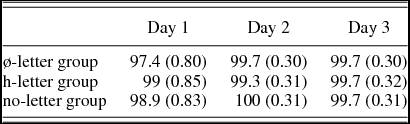
Before presenting the results of the picture-naming task, it is important to examine whether participants learned robustly the associations between the novel words (spoken forms) and their corresponding pictures at the end of the learning phase. Table 2 summarizes the results of the tests conducted at the end of each learning session.
Mean (standard deviations) correct scores (%) as a function of the day of learning

Analyses of variance (ANOVAs) were performed for the correct scores (%) corresponding to participants' correct selection of the target picture among two to three pictures. There was a significant effect of day of learning (Day 1, Day 2, or Day 3), F (2, 90) = 6.157, p < .05, η2 = 0.145, but not of participant group (ø-letter group, h-letter group, or no-letter group), F (2, 45) = 0.833, p > .05, η2 = 0.075, and their interaction, F (4, 90) = 1.167, p > .05, η2 = 0.006. Pairwise comparisons revealed that the scores for correctly selecting the target picture were significantly increased from Day 1 to Day 2 (p < .05) but were similar for Day 2 and Day 3 (p > .05). The statistical results reveal that all three groups of participants reached a maximum in terms of correct scores at the end of the learning session (Day 3), suggesting that after 3 days of learning, the participants fully encoded the novel words, or associations of the spoken forms and the corresponding pictures.Footnote 3
Picture-naming accuracy results
The vocal responses in the picture-naming task were checked through acoustic analyses by two researchers, both of whom are native speakers of Korean and trained phoneticians. Each token was displayed with its waveform and spectrogram, and was classified as one of various lenited variants on the basis of acoustic information ([h], [ɦ], [w], and ø). Producing incorrect words, mispronunciations, and no responses were regarded as errors and were not included for analysis. There were 17 errors on Day 3 and 7 errors on Day 4 out of 480 tokens per day (4% and 1%, respectively).
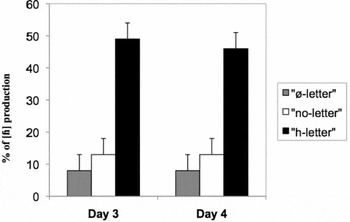
Figure 2 shows the percentage of novel words produced with variants similar to [ɦ] as a function of the spelling presentation on Day 3 and Day 4. The proportion of novel words produced with [ɦ] variants was submitted to a mixed ANOVA in which the participant group (ø-letter group, h-letter group, or no-letter group) was a between-subject factor and the day (Day 3 or Day 4) was a within-subject factor. The effect of group was significant, F (1, 45) = 66.05, p = .000, but there was no main effect of day, F (1, 45) = 2.96, p > .05. No significant interaction between day and group was found, F (2, 45) = 1.37, p > .05. The probability of producing [ɦ] variants was significantly higher for the group of participants who were presented with the letter <ㅎ> (h-letter group) than for the group of participants who were presented with the letter <ㅇ> (ø-letter group) or for those who were not presented with any letters (no-letter group). The simple effects of group demonstrated that the results of all three participant groups were significantly different from one another (p < .05). Based on these results, two important findings are evident. First, the insignificant difference in the picture-naming responses between Day 3 and Day 4 reveals long-term effects of spelling. Second, the native-Korean speakers presented with the letter for the null sound (<ㅇ>) named the novel words with [ɦ] variants less frequently than did participants in the no-letter group. In contrast, the Korean speakers who were presented with the letter <ㅎ> named the novel words with [ɦ] variants much more frequently than did those in the no-letter group. The impact of orthography was demonstrated by the naming results.
Percentage of novel words produced with [ɦ] by three groups of participants on Day 3 and Day 4. The error bars represent the standard errors.

Despite the apparent influence of orthography in spoken-word production, it is not clear whether the participants generated phonological representations for the corresponding variants. To test this hypothesis, responses in the spelling recall task were examined as explained in the following section.
Spelling recall results
The responses in the spelling recall task were examined, and all of the participants succeeded in writing the spellings of each novel word without demonstrating any cases of incorrect syllables or no responses.
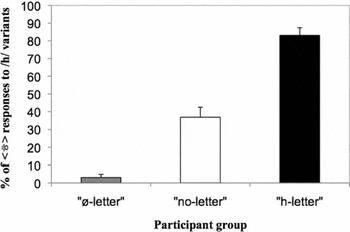
Figure 3 shows the percentage of the responses with the letter <ㅎ> (e.g., <기흔> for /ki.hɨn/) in the spelling recall task. The ø-letter group participants rarely used the letter <ㅎ>, and the h-letter group participants used this letter in more than 80% of the tokens. The no-letter group participants responded with the letter <ㅎ> in approximately 40% of the tokens. A one-way ANOVA was conducted on the percentage of <ㅎ> as a function of the participant group (ø-letter group, h-letter group, or no-letter group), and a significant effect of group was found, F (2, 45) = 91.95, p = .000. Post hoc tests (least significant difference) indicated that there were significant differences among all three groups of participants (p = .000). As expected, the performance of the participants was greatly influenced by the orthography presented in the experiment. Without encountering spellings, the participants, as shown in the results for the no-letter group, spelled approximately half of the tokens with the letter corresponding to [ɦ] (<ㅎ>). These results are compared with those of the participants who were provided either <ㅎ> (for [ɦ]) or <ㅇ> (for ø), where they showed responses corresponding to the given letters.Footnote 4
Percentage of instances of the letter <ㅎ> in the spelling recall task.

An important finding here is that there is a difference in the results between picture naming and spelling recall. In the picture-naming task, the [ɦ] responses amounted to close to 10% in the case of no-letter group participants, but in the spelling recall, they were close to 40%. Similarly, the results for the h-letter group participants indicated that the [ɦ] responses were approximately 85% in the spelling recall, while they were close to chance level in the picture-naming task. Thus, a variant does not need to be used on a frequent basis to be retained in the lexicon (Pitt, Reference Pitt2009). That approximately half of the no-letter group participants used the letter corresponding to [ɦ], and the other half used the letter corresponding to other variants should be further investigated to determine whether participants consistently used one and only one specific letter among the options corresponding to each of the variants of /h/, or if any participant used more than one of the relevant letters.
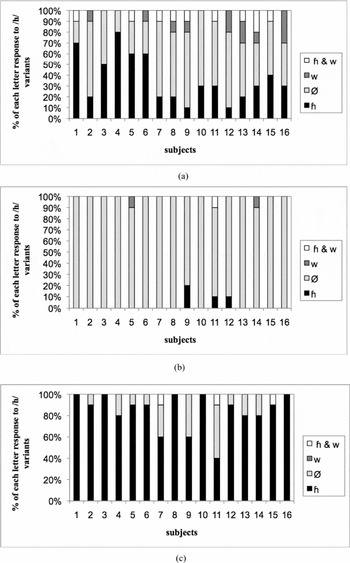
Figure 4 shows the results from individual subjects of each group in the spelling recall task. The black bars represent the tokens spelled with the letter <ㅎ> (e.g., <정하장> for [cʌŋ.ɦa.caŋ] /cʌŋ.ha.caŋ/); the light gray bars, the tokens spelled with the letter <ㅇ> (e.g., <정아장> for [cʌŋ.a.caŋ]); the dark gray bars, the tokens spelled with the letter <ㅗ> (e.g., <정와장> for [cʌŋ.wa.caŋ]); and the white bars, the tokens spelled with the letters <ㅎ> and <ㅗ> together (e.g., <정화장> for [cʌŋ.ɦwa.caŋ]). As shown in Figure 4a, each subject of the no-letter group displayed various patterns in the spelling recall. The results for the no-letter group were clearly differentiated from those for the ø-letter group (Figure 4b) and the h-letter group (Figure 4c), both of which were observed to move toward the letters given in the experiment, i.e., <ㅎ> for the h-letter group and <ㅇ> for the ø-letter group. Close inspection of the results for these two groups reveals that the h-letter group used the letters corresponding to [ɦ] and [w] together in some tokens but never used the letter for [w] alone, whereas the ø-letter group used the letter for [w] but far less frequently used [ɦ] and [w] together.
Percentage of instances of the letters in the spelling recall task by individual subjects in the (a) no-letter group, (b) ø-letter group, and (c) and h-letter group (ɦ + w = <ㅎ> + <ㅗ>, ɦ = <ㅎ>, w = <ㅗ>, ø = <ㅇ>).

DISCUSSION
The objective of the study was to examine the potential impact of orthography in the production and storage of spoken words. Specifically, we tested the hypothesis that orthographic information influences the production of words via an offline restructuring of the preexisting phonological representation (Bürki et al., Reference Bürki, Spinelli and Gaskell2012). To address this issue, each participant in this study was trained to learn novel Korean words that included the numerous variants of /h/ in Korean. Immediately after 3 days of learning, the participants were divided into three groups with varying exposure to spelling: two groups of participants were presented with two letters, one corresponding to a deleted phoneme (<ㅇ> as in <기은> [ki.ɨn] from /ki.hɨn/) and the other corresponding to [ɦ] (<ㅎ> as in <기흔> [ki.hɨn] from /ki.hɨn/), whereas a third group of participants was presented with auditory input only. The study examined whether exposure to an orthographic representation of /h/ was sufficient to affect the subsequent processing in the picture-naming and spelling recall tasks.
The results revealed that in both the picture-naming and spelling recall tasks, orthographic knowledge influenced the production of the spoken words. In the picture-naming tasks, it was demonstrated that participants presented with the letter <ㅇ>, which corresponded to the null consonant, named the novel words with [ɦ] in less than 10% of cases. Those presented with the letter <ㅎ> produced approximately half of the words with [ɦ]. The participants who were not presented with any letters named the novel words with intermediate values between the first two groups. These results indicate that orthographic knowledge influences the spoken-word production. The results of the recall spelling task lend further support to the effect of orthography. The ø-letter group participants rarely used the letter <ㅎ>, and the h-letter group participants used this letter for more than 80% of the tokens. The participants who were not exposed to the letters responded to approximately 40% of the tokens with this letter. The results of the spelling recall task provided evidence for the influence of orthography on the lexical representation of spoken-word forms.
It is also important to note that there is a difference in the results between picture naming and spelling recall. For example, for the no-letter group participants, the mean of [ɦ] responses was close to 10% in the picture-naming task, but rose up to 40% in the spelling recall task. The results from individual participants also demonstrated that 4 out of 16 participants displayed [ɦ] responses for more than half of the tokens, even though the [ɦ] tokens were rarely presented (only in 10% of tokens) in the learning phase. This result reflects the fact that the presence of a certain phonological representation in the lexicon does not necessarily mean that the speaker uses the pronunciation corresponding to the representation regularly in her/his everyday speech. Similar results were demonstrated in Ranbom and Connine (Reference Ranbom and Connine2007), where the /nt/ cluster of the American English word (gentle) is mostly realized as a flap in everyday speech but the [nt] form is demonstrated to be processed more quickly and accurately than the flap form. Bürki et al. (Reference Bürki, Alario and Frauenfelder2011) also demonstrated that Swiss–French speakers have two representations for noninitial schwa words but rarely use the schwa variant in spoken-word production tasks. Taken together, the variant frequency does not appear to be the criterion that speakers rely on to represent the variants in the lexicon. Ranbom and Connine (Reference Ranbom and Connine2007) suggested a possible explanation in that rarely used variants are lexically stored, based on the influence of orthography. The rarely used form might be derived from the spelling of the words. Bürki et al. (Reference Bürki, Alario and Frauenfelder2011, Reference Bürki, Spinelli and Gaskell2012) similarly proposed that exposure to a word's spelling is sufficient to generate a corresponding phonological representation of the word.
The results from the picture-naming and spelling recall tasks in the present study lend direct empirical support to the hypothesis that orthographic information influences the production of words via an offline restructuring of previously established phonological representations (Bürki et al., Reference Bürki, Spinelli and Gaskell2012). Using an artificial word-learning paradigm, Bürki et al. (Reference Bürki, Spinelli and Gaskell2012) exposed participants to reduced variants of novel French words, namely, a schwa and a reduced variant. After the participants established the phonological representations for these variants with 3 days of learning, they were provided with the spellings of the words, half of which were spelled with an orthographic representation of the schwa, while the others were not. The orthographic knowledge was demonstrated to be sufficient to affect subsequent processing in the picture-naming as well as the recognition tasks. In the present study, the method of varying the exposure to spellings was manipulated with three different groups of participants, rather than with the stimuli. The two groups of participants who were exposed to the letters corresponding to [ɦ] and a deleted variant were compared with those who were not presented with any letters. As shown in the comparison of naming results for the ø-letter group and h-letter group, the participants behaved differently in the production of the novel words according to the spellings to which they were exposed. When they encountered the letter <ㅎ> (for [ɦ]), the participants produced more [ɦ] variants, while they rarely produced these variants when they were provided with the letter <ㅇ> (for ø). The no-letter group participants displayed significantly different results from both the ø-letter group and the h-letter group, whose [ɦ] responses were positioned in between. The present findings suggest that the participants of all three groups appeared to have similar (or even the same) lexical representations of the novel words before they were exposed to orthographic information, as demonstrated in the results of the no-letter group participants, but after exposure to the orthographic forms, they began to restructure their phonological representations immediately as given in the spelling forms and then produced the novel words following those representations. Because a single exposure to the spellings induced a considerable change in naming, a further exposure would likely strengthen the phonological representation.
The present results, together with those of Bürki et al. (Reference Bürki, Spinelli and Gaskell2012), can explain the discrepancy among the previous studies on the role of orthography in spoken-word production: some studies have demonstrated the influence of orthographic knowledge on spoken-word production, but others have not. The inconsistent results of previous studies appear to lie in the complex nature of the spelling effect. In online activation of orthographic knowledge, only a limited effect of spelling has been found, but orthographic knowledge can influence spoken-word production through modifying the preexisting phonological representation.
Given that realization of the phoneme /h/ as ø is dominant over [ɦ] and other variants, it can be said that exposure to the letter <ㅎ> may have led the participants to the unnatural articulation (~50%), whereas the participants who were exposed to the letter <ㅇ> could have produced the /h/ variants more similarly to the actual target pronunciation (~10%). It was shown in some studies on second language (L2) acquisition that exposure to orthography can influence the acquisition of L2 phonemes either positively or negatively (Bassetti, Reference Bassetti2006; Escudero, Hayes, & Mitterer, Reference Escudero, Hayes and Mitterer2008; Hayes-Harb, Nicol, & Barker, Reference Hayes-Harb, Nicol and Barker2010). For instance, availability of the orthographic information can help L2 learners establish contrastive representations for certain sounds that are contrastive in their L2, but not in their first language (L1). Escudero et al. (Reference Escudero, Hayes and Mitterer2008) found that Dutch speakers had difficulty with the English /ɛ/–/æ/ contrast as in the first syllables of pencil and panda, but in the learning stage of English words, the Dutch speakers who were provided with the letters <e> and <a> were shown to create lexically contrastive representations for these auditorily confusable words, unlike those who were provided with the spoken forms only. However, the negative effect of orthography was also documented. Bassetti (Reference Bassetti2006) showed that English learners of Chinese mispronounced Chinese vowels [uei] without [e], because the pinyin written form was <ui>. Hayes-Harb et al. (Reference Hayes-Harb, Nicol and Barker2010) also found that if the written forms in L2 were not consistent with their L1 spelling conventions as in <faza> for [faʃə], participants showed interference from the spellings.
The results of the present study also reveal that the orthographic effect is not a merely short-term priming effect due to a recent presentation of spellings, but is a durable change because the effect of spelling was still present on the following day, as shown in the insignificant difference between the results of Day 3 and Day 4. Dumay and Gaskell (Reference Dumay and Gaskell2007) demonstrated that sleep helped newly learned spoken words to be incorporated into long-term lexical memory, and Bürki et al. (Reference Bürki, Alario and Frauenfelder2011) demonstrated that phonological variants of the newly learned words were more frequently produced after sleep. The present results are in good agreement with Dumay and Gaskell (Reference Dumay and Gaskell2007), providing evidence for the ability of spelling to induce a durable change in phonological representation. In addition, the spelling effect observed in the present study is not likely triggered by a strategic use of orthographic information to enhance the memorization of the spoken forms (Bürki et al., Reference Bürki, Spinelli and Gaskell2012). The association of the novel words (spoken forms) with the corresponding pictures was demonstrated to be fully memorized before the picture-naming task, as displayed in the observed scores being at a maximum at the learning phase. Thus, the phonological representations of the novel words appeared to be fully established in the participants' mental lexicon.
Finally, although spoken-word production in the L1 and L2 might be processed with different mechanisms, it is worth discussing the role of orthography in the production of L2 sounds in that our results mirror some of the findings in L2 studies (Bassetti, Reference Bassetti2006; Erdener & Burnham, Reference Erdener and Burnham2005; Rafat, Reference Rafat2013; Young-Scholten, Reference Young-Scholten, Burmeister, Piske and Rohde2002). For instance, Erdener and Burnham (Reference Erdener and Burnham2005) investigated the effect of orthography on the production of nonnative speech, manipulating the orthographic depth of the native and target languages. Turkish (transparent) and Australian English (opaque) speakers were tested for their production of nonwords in Spanish (transparent) and Irish (opaque). In particular, when phoneme errors in their shadowing task were measured under two conditions (with auditory input only and with auditory and orthographic input), the facilitative effect of orthographic information was shown at least for the target language with transparent orthography.
Of particular relevance is Rafat (Reference Rafat2013), in which a picture-naming task was given to English learners of Spanish speakers after training. The experimental stimuli were manipulated to have either the same or different spelling-to-sound correspondence between English and Spanish. For example, in word-initial position, the spelling <b> is pronounced as /b/ in both languages (e.g., <botina> [botina]), whereas the spelling <v> is pronounced as /v/ in English, but as <b> in Spanish (e.g., <vireca> [bireka]). Their results showed that there was no L1-based phonological transfer leading to errors for the same spelling-to-sound correspondence between English and Spanish, but those correspondences that differ between these two languages resulted in such transfer, which led to non-target-like productions. As it relates to study, /h/ is silent intervocalically in both languages (e.g., <ahumar> [aumar] for Spanish, <ahead> [əɛd] for English), whereas in word-initial position, it is silent in Spanish, but realized as [h] in English (e.g., <hanega> [aneɤa] for Spanish, <hand> [hænd] for English). Of interest here, /h/ in thr intervocalic position showed an exception to the identical spelling to sound correspondence results in that the letter <h> induced [h] production from many learners, although it is silent in English (e.g., <ahumar> as [ahumaɾ], not [aumaɾ]). Rafat explained this unexpected behavior with the higher frequency of words with /h/ realized as [h] (e.g., beehive) than silent (e.g., annihilate) in English. When there is variability in the realization of a sound as for /h/, the more frequent form ([h]) is phonologically represented, which might lead to non-target-like production.
The explanation based on word frequency, however, does not seem to apply to Korean /h/ realization in that deletion of /h/ is dominant in Korean regardless of the frequency of words (Choi et al., Reference Choi, Lim and Han2006). Further, L2 studies such as Erdener and Burnham (Reference Erdener and Burnham2005), Hayes-Harb et al. (Reference Hayes-Harb, Nicol and Barker2010), and Rafat (Reference Rafat2013) do not seem to provide evidence for the effect of orthography on spoken-word production, despite its role on the storage of spoken words. As Alario et al. (Reference Alario, Perre, Castel and Ziegler2007) and Zhang and Damian (Reference Zhang and Damian2012) argued, it is not clear whether the effect of orthography in production (shadowing) resides in the production stage or the memory stage, because the orthography was provided in the preshadowing, training stage in these previous studies. Erdener and Burnham (Reference Erdener and Burnham2005) even mentioned that the participants may pay attention to the orthography provided in the training stage, disregarding the auditory information, and store the relevant orthographic information in their working memory. Thus further study is necessary to explore the locus of the effect of orthographic information in the spoken-word production in L2 as well as L1.
APPENDIX A
Sample spectrograms of /h/ variants: (a) [ɦ], (b) [w], and (c) ø.

APPENDIX B
Pictures of novel objects and their corresponding novel words.

ACKNOWLEDGMENTS
This research was supported by the National Research Foundation of Korea Grant funded by the Korean government (NRF-2013S1A5A2A01014553). An earlier version of this paper was presented at the 88th meeting of the Linguistics Society of America, Minneapolis. We thank audience members for their invaluable comments. We are also grateful to Rachel Hayes-Harb, Jiyoung Shin, and the three anonymous reviewers for their insightful and constructive comments; Sean C. O'Rourke for proofreading; and Gyung-Ho Kim for his help with running the experiments.