Introduction
In aging populations, depression and functional disabilities are major impediments to independent living and quality of life. Among older persons in the community, depressive symptoms short of threshold diagnostic criteria (Diagnostic and Statistical Manual of Mental Disorders, Fourth Edition, DSM-IV), also called subsyndromal or subthreshold depression, are just as disabling and costly as major depressive disorders in healthcare and socio-economic terms (Broadhead et al., Reference Broadhead, Blazer, George and Tee1990; Rappaport and Judd, Reference Rappaport and Judd1998; Preisig et al., Reference Preisig, Merikangas and Angst2001; Soh et al., Reference Soh, Kumar, Niti, Kua and Ng2008). There is therefore much to be gained from efforts to reduce the burden of depression and functional disability in the primary care setting.
The association of depression with functional disability is well documented (Broadhead et al., Reference Broadhead, Blazer, George and Tee1990; Bruce et al., Reference Bruce, Seeman, Merrill and Blazer1994; Lenze et al., Reference Lenze2001). Longitudinal studies of community-living older persons have shown that the presence of depressive symptoms was associated with subsequent physical decline (Penninx et al., Reference Penninx1998; Reference Penninx1999; Cronin-Stubbs et al., Reference Cronin-Stubbs, de Leon, Beckett, Field, Glynn and Evans2000; Mehta et al., Reference Mehta, Yaffe and Covinsky2002; Everson-Rose et al., Reference Everson-Rose, Skarupski, Bienias, Wilson, Evans and de Leon2005; Kondo et al., Reference Kondo, Kazama, Suzuki and Yamagata2008). These observations suggest that a reduction of depressed mood could possibly have the effect of reducing functional decline in older persons. However, few population studies have followed up older persons with the view of examining directly the impact of changes in depressive symptoms or depressed mood on changes in physical and functional disability.
Penninx et al. (Reference Penninx2000) reported in a study of community-living older persons that chronic persistent depressed mood over three years when compared to never-depressed persons was associated with increased risk of physical performance and functional decline, and persons with remitted depression did not have greater physical decline than never-depressed persons. On the other hand, in a study of older persons with disability in long-term nursing home care facilities, Li and Conwell (Reference Li and Conwell2009) found that improvement in depression status from “subthreshold depression” to “no depression” was associated with improvement in daily living activities, independent of concomitant changes in cognitive function. However, worsening changes from “subthreshold depression” to “depression” had no significant worse effects on subsequent basic activities of daily living (ADL) and instrumental activities of daily living (IADL) status. This study, as well as a few other studies (Mehta et al., Reference Mehta, Yaffe and Covinsky2002; Carbonara et al., Reference Carbonara2009; Li and Conwell, Reference Li and Conwell2009), controlled for the concomitant effects of both chronic medical conditions and cognitive impairment. The latter commonly accompanies depression (Thomas and O'Brien, Reference Thomas and O'Brien2008; Panza et al., Reference Panza2010) and is a major risk factor for physical decline (Greiner et al., Reference Greiner, Snowdon and Schmitt1996).
Evidently, patterns of changes in depressive symptoms are variable both among different individuals and for different populations of older persons such as those in geriatric or long-term institutional care or living in the community. Thus, it is possible that changes in the levels of depressive symptoms may have an impact on physical and functional decline but the relationship may not be linear with respect to different patterns of changes in depressed mood. Except for the above study that involved disabled older persons in long-term nursing care, it is unknown whether among community-living older persons, a reduction in the levels of depressive symptoms, or improvement or remission of depressed mood, is associated with improvements in physical functional ability.
The present prospective study examined the impact of changes in depressive symptoms on changes in functional ability in community-living older persons who were treated for clinically significant depressive symptoms in a primary care setting. Using a continuous measure of change in depressive symptoms as well as a dichotomous categorization of changes in depressed mood, we explored whether improvement in levels of depressive symptoms or reduction in depressed mood to non-depressed status was associated with improvement in physical performance on ADL and IADL over 12 months.
Methods
Study population
Older persons with clinically significant depressive symptoms were identified from among participants in the Community-Based Early Psychiatric Intervention Strategy (CEPIS) program in Singapore. The CEPIS was a pan-island community-based outreach service program aimed at improving access to and acceptance of primary care treatment of depression among the older population in Singapore. Details of the CEPIS program have been described in a previous publication (Nyunt et al., Reference Nyunt, Ko, Kumar, Fones and Ng2009b).
Briefly, under the CEPIS program, a total of 4,633 older persons aged 60 years and above who were known users of services in 42 senior activities and social service sites, 18 special needs services, 12 sheltered and welfare homes, and four nursing homes across the island state were screened for depressive symptoms through face-to-face interviews on-site or at home by trained research nurses. The screening survey using the Geriatric Depression Scale (GDS; Yesavage et al., Reference Yesavage1983) excluded older individuals with cognitive impairment (Mini-Mental State Examination (MMSE) score of below 18; Folstein et al., Reference Folstein, Folstein and McHugh1975), dementia, hearing, visual, and speech impairment, severe physical illness(es), or impaired mental capacity to give informed consent. The study was given ethical approval by the Domain Specific Review Board (DSRB) in Singapore.
Except for depressed individuals who were already receiving psychiatric treatment, 370 older persons who were found to have depressive symptoms from screening (GDS score ≥5) were counseled by community nurses trained to provide psycho-education to accept primary care treatment for depressive symptoms. Those who accepted treatment (74% of those with depressive symptoms) were referred to general practitioners in the CEPIS program for treatment. The treatment received was either through a structured collaborative shared care with case management and patient education support or usual care according to published clinical practice guidelines. All participants with depressive symptoms, including those who did not accept primary care treatment, were re-interviewed at three, six, and 12 months after their initial participation in the screening survey. The data of 267 participants who completed baseline and 12-month follow-up interviews were analyzed in the current study.
Symptoms of depression
The presence of depressive symptoms was assessed using the 15-item GDS (Yesavage et al., Reference Yesavage1983). The scale was translated into Mandarin and Malay and back-translated for linguistic and semantic equivalence. Participants were administered the English, Mandarin, or Malay versions of the GDS, depending on their dominant and preferred language. These versions of the GDS-15 have been found to be a valid and reliable screening tool for depression from validation studies in the local older population (Nyunt et al., Reference Nyunt, Fones, Niti and Ng2009a). Using a GDS cutoff score of ≥5, we have previously reported sensitivity of 0.97 and specificity of 0.95 according to DSM-IV criteria, area under curve (AUC) of 0.98, Cronbach's α of 0.80, intra-class coefficients of test–retest reliability of 0.83, and inter-rater reliability of 0.94. Depressive symptoms defined as such by GDS ≥5 is clinically significant, because such cases, representing mostly “subthreshold” depression, had been shown in the same population to be associated with significantly poorer mental and physical health and functional status, more healthcare resource utilization compared to non-cases, and to be similar to or worse than syndrome threshold cases of depression (Soh et al., Reference Soh, Kumar, Niti, Kua and Ng2008; Feng et al., Reference Feng, Yap, Kua and Ng2009).
Cognitive functioning
The cognitive functioning of the participants was assessed at baseline using the MMSE (Folstein et al., Reference Folstein, Folstein and McHugh1975). The MMSE (cutoff: 23/24) has been shown to discriminate well between individuals with and without dementia in the local older population in Singapore (Ng et al., Reference Ng, Niti, Chiam and Kua2007).
Physical functioning
Basic physical functioning was assessed using Barthel's ADL scale (Mahoney and Barthel, Reference Mahoney and Barthel1965), which assesses performance in ten basic daily activities: bowel and bladder continence, grooming, toilet use, feeding, transfers, walking, dressing, climbing stairs, and bathing. Each item is rated “0” for complete dependence and the maximum point “3” for complete independence. The scale yields a maximum total score of 20.
Performance on IADL was assessed using the Lawton and Brody's IADL scale (Lawton and Brody, Reference Lawton and Brody1969). The scale assesses the performance in eight items of IADL: ability to use telephone, shopping, preparing food, housekeeping, doing laundry, using means of transport, managing own medication, and handling finances. Each item was rated “0” for complete inability to perform the task and “3” for complete independence in performing the task. The scale yields a maximum total score of 27. Self-reports and proxy reports (in some cases who reported subjective memory problems) of basic and instrumental physical functioning were recorded at baseline and at 12-month follow-up.
Covariates
Socio-demographic data including age, gender, ethnicity, education level, living arrangement, and marital status were collected at baseline. The presence of any one or more of 16 chronic illnesses including coronary artery disease, heart failure, hypertension, diabetes, stroke, cancer, high cholesterol, asthma, chronic obstructive pulmonary disease, hip fracture, renal failure, urinary tract infection, mental illness, and arthritis was recorded. Self-reported global health status was rated as “poor,” “fair,” “good,” “very good,” or “excellent.”
Statistical analysis
Change in depressive symptoms was determined by subtracting the GDS score at 12-month follow-up from the baseline GDS score. Hence, a zero change score denotes no change of symptom level, a positive change score denotes improved symptom level, and a negative change score denotes worsening symptom level. Conversely, changes in ADL and IADL physical functioning were calculated by subtracting the baseline physical functioning scores from the scores at 12-month follow-up. In the same way therefore, zero, positive, and negative change scores in physical functioning denoted respectively no change, improved, and worse physical functioning at follow up.
Among those participants who were assessed to be with depressed mood (GDS ≥5) at baseline, changes in depressed mood status at follow up were assessed as follows: participants with GDS <5 at follow-up were considered “no longer depressed;” participants with the same level of GDS score at follow-up were considered to “remain depressed, no change;” subjects who reported GDS scores lower than that at baseline but at or above 5 at follow up were considered to “remain depressed but improved;” and participants who reported higher GDS scores at follow up than their baseline GDS scores were considered to “remain depressed and worsened.”
Multiple regression analyses were performed to explore the associations between changes in GDS scores or depressed mood status and changes in ADL and IADL scores. Covariates entered simultaneously into the model included age (continuous variable), sex, (male vs. female), ethnicity (Chinese vs. non-Chinese), marital status (never married, separated/divorced/widowed, vs. married as reference), living arrangements (alone, with others, e.g. friends, sheltered, or nursing homes, vs. with spouse/partner/children/extended family as reference), education (none, 1–6 years vs. >6 years as reference), number of chronic medical conditions (≥3 vs. 0–2 as reference), self-rated health status (poor, fair, vs. good to excellent as reference), baseline MMSE score (continuous variable), baseline GDS score (continuous variable), and baseline IADL score or baseline ADL score (continuous variable).
Results
Study sample characteristics
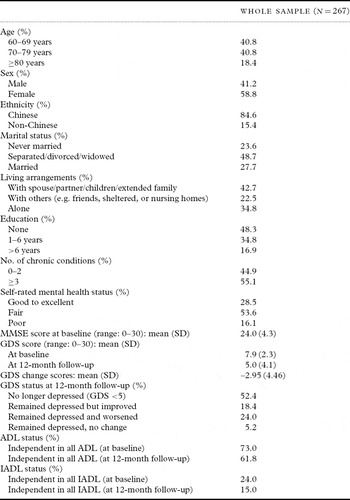
The baseline characteristics of the study participants are presented in Table 1. The mean age of the participants was 72.5 (SD = 7.9) years. The mean baseline GDS score of these participants with depressed mood at baseline was 7.9 (SD = 2.3). At 12-month follow-up, 52.4% of them showed an improvement and were no longer in depressed mood, and 47.6% of the participants remained depressed (but improved, 18.4%; worsened, 24.0%; no change, 5.2%). At baseline, 73.0% of the participants were independent in all ADL and 24.0% were independent in all IADL.
Study sample characteristics at baseline and 12-month follow-up

Note: Values are percent of column totals unless otherwise stated. MMSE = Mini-Mental State Examination; GDS = Geriatric Depression Scale; SD = standard deviation; ADL = activities of daily living; IADL = instrumental activities of daily living.
Associations of depressive change scores with functional change scores
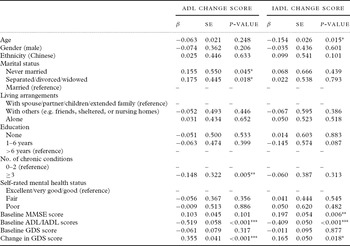
Table 2 shows the associations of changes in GDS scores with ADL and IADL change scores in saturated regression models including other potential predictors of physical functional change.
Linear regression models showing associations of changes in GDS scores with ADL and IADL change scores

*p < 0.05; **p < 0.01; ***p < 0.001.
Note: GDS = Geriatric Depression Scale; ADL = activities of daily living; IADL = instrumental activities of daily living; β = standardized beta; SE = standard error; MMSE = Mini-Mental State Examination.
ADL change score
GDS change scores significantly predicted ADL change scores at follow-up (β = 0.355, p < 0.001). Increasing GDS change scores was positively associated with increasing ADL change scores indicating improving depressive symptom levels was accompanied by improving ADL functioning, and vice versa. Baseline ADL score, marital status scores, and chronic medical conditions were also significant predictors of ADL change scores at follow up.
IADL change score
Change in GDS score was also a significant predictor of IADL change score (β = 0.165, p = 0.018), indicating similar directions of change in the level of both depressive symptoms and IADL functioning. Age and baseline MMSE and IADL scores were concomitant significant predictors of change in IADL change scores.
Associations of depressive status changes with functional change scores
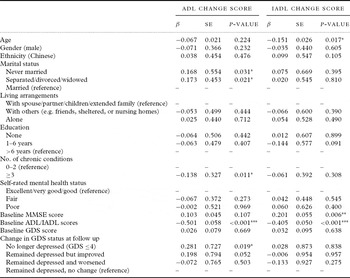
Table 3 shows the associations of changes in depressed mood statuses with ADL and IADL change scores.
Linear regression models of associations of changes in GDS statuses with ADL and IADL change scores

*p < 0.05; **p < 0.01; ***p < 0.001.
Note: GDS = Geriatric Depression Scale; ADL = activities of daily living; IADL = instrumental activities of daily living; β = standardized beta; SE = standard error; MMSE = Mini-Mental State Examination.
ADL change score
A conversion of depressed to non-depressed mood from a reduction in the number of depressive symptoms to below five was positively associated with ADL change scores (β = 0.281, p = 0.019), compared to those who remained depressed. A similar reduction in depressive symptoms but not to below threshold level was accompanied by a smaller magnitude of positive ADL change (β = 0.198, p = 0.052).
IADL change score
Changes in GDS depressive status were not found to be significantly associated with changes in IADL change scores.
Discussion
In this intervention study of community-living depressed older adults, we found that an improvement in the level of depressive symptoms over 12 months was accompanied by a corresponding improvement in levels of performance in daily living activities. This finding agrees with another intervention study of depressed and disabled older adults in long-term nursing homes, which found a similar independent association between improvement in depressive symptoms and physical functioning (Li and Conwell, Reference Li and Conwell2009).
In this study, remission of depression was observed to have a significant impact on ADL performance; a conversion from depressed to non-depressed state was significantly associated with improvement in physical functional ability compared to persons who remained depressed. A previous study comprising a mixed population group of both depressed and non-depressed older persons (Penninx et al., Reference Penninx2000) compared those with persistent, emerging, and remitted depressive symptoms versus those who were never depressed; in that study, persistent and emerging depression was observed to be associated with significantly greater decline in physical ability, but persons with remitted depression did not show greater decline in physical ability. Given that the comparison groups in the two studies were in reverse, the findings from both studies appear to be in concordance. It is also pertinent to note that the results reported by Penninx et al. (Reference Penninx2000) were based on an observational non-intervention study, whereas both the study by Li and Conwell (Reference Li and Conwell2009) and our study involved older participants who were recipients of clinical and psychosocial care in an intervention program. Additionally, we found that more subtle changes in depressive symptoms did not have any significant effect on physical functioning, and this is also consistent with previous observations (Hybels et al., Reference Hybels, Pieper and Blazer2009; Li and Conwell, Reference Li and Conwell2009; Payette et al., Reference Payette, Gueye, Gaudreau, Morais, Shatenstein and Gray-Donald2011).
Although we observed that a remission of depressed mood had a positive impact in improving ADL functioning, it did not appear however to be associated with a positive impact on IADL functioning. In contrast, the study by Li and Conwell (Reference Li and Conwell2009) showed that a remission of depressed mood was significantly associated with a subsequent improvement in both ADL and IADL performances. However, the differences in physical functional status of the participants in the two studies should be noted, as the study participants by Li and Conwell (Reference Li and Conwell2009) were restricted to older persons with physical disability receiving home care in a community-based long-term care program.
Performance on IADL tasks places a greater demand on cognitive ability, and has been shown to correlate with cognitive performance on the MMSE (Ng et al., Reference Ng, Niti, Chiam and Kua2006a). Studies have found that cognitive deficits associated with late-life depression persisted in many but not all older persons even after clinical recovery (Thomas and O'Brien, Reference Thomas and O'Brien2008; Köhler et al., Reference Köhler, Thomas, Barnett and O'Brien2010). Late-life depression is heterogeneous with respect to various biological and psychosocial causation and mechanistic pathways, and is expectedly associated with a heterogeneous mix of cognitive and physical functional effects. For this reason, it was possible that despite the improvement in depressive symptoms, cognitive deficits that accompanied their depression may have persisted in many participants. This may possibly explain a lack of impact on performance of IADL tasks observed in our study.
The cognitive determination of functional ability is but one of many possible mechanisms by which depression leads to physical decline. The mechanistic pathways are likely to be complex and not well understood. They include behavioral mechanisms such as impaired self-care and medical and lifestyle non-adherence, and biological mechanisms such as aggravated medical illnesses, via stress-induced alterations in hypothalamic–pituitary–adrenal axis and the sympathetic nervous and immunological system, or common neuropathological disorders such as cerebrovascular small vessel disease and/or neurodegenerative (such as Alzheimer tau or beta-amyloid) pathology leading to cognitive deficits. Activity restriction that characterizes physical functional ability is also greatly influenced by physical and social factors in the built environment, which either facilitate or hinder performance of daily living activities.
In addition to depressive symptomatology, we also found that changes in functional status were significantly associated with age, marital status, medical conditions, and cognitive status. Similar associations have been noted in other studies (e.g. Barberger-Gateau et al., Reference Barberger-Gateau, Chaslerie, Dartigues, Commenges, Gagnon and Salamon1992; Hebert et al., Reference Hebert, Brayne and Spiegelhalter1999; Ng et al., Reference Ng, Niti, Chiam and Kua2006b). Furthermore, being single, separated, or widowed was found to be associated with positive changes in functional status. However, similar finding have also been reported in previous studies (Williams and Umberson, Reference Williams, Umberson and 2004; Hewitt and Turrell, Reference Hewitt and Turrell2011), which showed that physical health improved with separation, particularly among women. These studies support the argument that not all marital dissolutions have a negative impact on health. As poor marital quality is negatively associated with physical and mental health, ending an unhappy marriage may have health benefits for either or both spouses, depending on whether the separations were self- or jointly initiated.
A limitation of our study is that we used only self-reported measure of physical ability, and did not include more objective performance-based measures. The use of such performance-based measures may be more sensitive in showing directly the effect of changes in depressive symptoms on specific aspects of physical mobility such as muscle strength, gait, and balance. Another limitation in this study is that the analysis did not include a measure of cognitive changes (measured by MMSE) at follow up. Also, despite observing directly in a longitudinal study that changes in depressive symptoms were associated with changes in functional statuses, these remain correlative findings and care should be exercised in inferring causality.
In conclusion, we found that in depressed older persons, an improvement in depressive symptoms to below threshold level was associated with improved physical functional ability. This finding has important public health implications for aging populations and the provision of healthcare and social services in the community. The results suggest that community interventions and primary care services aimed at early recognition and timely psychosocial and therapeutic intervention for depressive symptoms can have a strong impact in preventing or reversing physical decline among older persons. By helping to prolong independent living in the community and promoting better quality of life of the older persons, this should contribute significantly towards reducing the disability burden in aging societies.
Conflict of interest
None.
Description of authors' roles
MSZN and MLL performed the literature review, analyzed the data, and drafted and revised the paper; KBY participated in the conceptualization of the study, the interpretation of the results, and review of the paper; and TPN formulated the hypothesis, designed the study, interpreted the results, and reviewed and revised the paper.
Acknowledgment
The study is supported by a research grant (No. 03/1/21/17/214) from the Biomedical Research Council, Agency for Science, Technology and Research (A*STAR).