INTRODUCTION
Human rights standards call for independent courts. Criminal cases should be adjudicated by independent courts to ensure the prime institutional requirement for a fair trial under article 14(1) of the International Covenant on Civil and Political Rights (ICCPR).Footnote 1 Independence is also an institutional requirement for a fair trial under article 7 of the African Charter on Human and Peoples' Rights 1981 (the African Charter).Footnote 2 But what is an independent court? As Nowak concisely puts it, the independence of a court means separation of the organs of government, specifically the judge, from the control of the executive and, to a lesser degree, the legislature. Independence also relates to the appointment and impeachment of judicial officers.Footnote 3 Therefore, the doctrine of separation of powers is at the nucleus of the independence of a state's judiciary.
Whilst independence is usually thought of in terms of courts of law, it also applies to traditional courts under the African regional human rights framework. To this end, section S(1) of the Principles and Guidelines on the Right to a Fair Trial and Legal Assistance in Africa 2003 (the Guidelines)Footnote 4 defines a traditional court as: “a body which in a particular locality, is recognised as having the power to resolve disputes in accordance with local customs, cultural or ethnic values, religious norms or tradition.”
In short, traditional courts are non-state, indigenous “judicial” institutions that decide cases according to customary norms. Such norms include an “African” notion of human rights where, as Gyekye contends, individual rights are abridged by social responsibilities in so far as abridgement is necessary to maintain the integrity and stability of the group.Footnote 5 Individual rights are therefore interconnected with a duty to community. Despite this normative difference, traditional courts are enjoined under section Q(a) of the Guidelines to comply with international human rights standards on the right to a fair trial. An individual's right to a fair trial by an independent and impartial court is sacrosanct under article 10 of the Universal Declaration of Human Rights 1948Footnote 6 as expounded in article 14(1) of the ICCPR.
The independence of a traditional court is provided for in section Q(c) as follows:
“The independence of traditional courts shall be guaranteed by the laws of the country and respected by the government, its agencies and authorities:
1. they shall be independent from the executive branch
2. there shall not be any inappropriate or unwarranted interference with proceedings before traditional courts.”
Under this section, states must pass legislation to guarantee the independence of traditional courts. Uganda has not yet enacted laws in this regard, thereby failing to comply with the peremptory requirements of section Q(c). This is unexpected, given the fact that Uganda, as a signatory to the African Charter,Footnote 7 is obliged to enforce the rights contained in the charter and the associated Guidelines. Under Uganda's Constitution of 1995 (the Constitution), the president may make conventions with any international body and Parliament may enact laws governing their ratification.Footnote 8 Although the Ratification of Treaties Act establishes a dualist approach, where a convention must be incorporated in national legislation, Uganda has not integrated the African Charter into domestic law.Footnote 9 Accordingly, traditional courts operate in the absence of a national prescriptive framework. Fundamentally, section Q(c)(1) stipulates that traditional courts shall be independent from the executive branch. How this may be achieved by kinship systems is not specified.
This article focuses on examining whether traditional courts are in fact “independent”, as understood by the human rights approaches. It does so by shedding light on how clans create an “independent” court, and considering whether clan courts meet the emergent international standards of independence within the context of section Q(c)1.Footnote 10 Such analysis is important because, while the institutional set up of “statutory traditional courts” has generated some research, that of indigenous traditional courts has been largely overlooked.Footnote 11 For though the Guidelines are meant to be an “interpretational and normative aid”, as Baderin rightly argues, it is ambitious to expect traditional courts to apply international standards, given their practices.Footnote 12 For instance, kinship systems conflate executive and judicial functions, in contradistinction to the doctrine of separation of powers. Furthermore, a fair trial translates into a notion of procedural fairness (or even-handedness) where everyone is heard and is required to protect kinship members. This is quite unlike formal court procedures that safeguard the interests of individual litigants.
On the basis of qualitative data gathered from two Jopadhola clan (traditional) courts of the Jo-Gem and Morwa Guma Malasang (Morwa Guma) clans, this article presents the empirical findings of a research study that examined the adaptation of legal doctrine and structures by local communities. It suggests that clans have partially reproduced, in various ways in their normative structure, features of the government system with which they are familiar. First, the clans incorporate the local government system by adopting an abridged doctrine of separation of powers. Secondly, the clans apply women and youth quotas used in local council courts to ensure fair representation. The quota provision enshrined in the Constitution is designed to address the lack of participation by women and youth in lower level and national decision making institutions. Article 180(2)(b) of the Constitution reserves one third of all local council membership for women. Youth membership is alluded to in article 180(2)(c), as is affirmative action for marginalized groups under article 32.
Concurrently, clans apply a traditional approach underpinned by the duty of kin to participate in social control. Appointments are centred on meritocracy and adult suffrage; clan members participate in the removal of officials; and clan officials manage spiritual activities. Importantly, the eligibility criteria exclude legal qualifications.
Some key definitions will be useful for the purposes of this article. Clan courts fall within the definition of traditional courts in section S (1) of the Guidelines. The term refers to kinship institutions that resolve cases of a criminal nature within a social group from the same extended family lineage clan. This is part of what anthropologists call kinship organization.Footnote 13Lower level government comprises the local councils and their associated courts with quasi-judicial status. The judiciary comprises the superior courts: Supreme Court; Court of Appeal and Constitutional Court; and the High Court; as well as lower courts - chief magistrate, grade I and grade II magistrates courts.Footnote 14
The article is set out in five sections. First is the methodology to the study and a background to the Jopadhola through the lens of the Jo-Gem and Morwa Guma clans. Next, the article outlines the status of clan courts within Uganda's legal framework, and then briefly highlights the key findings from earlier research. The main discussion follows, analysing the “reproduction” process by which Jopadhola clans have assimilated national features to create their notion of an independent court. The article concludes with a brief evaluation of the wider implications of this assimilation process on the implementation of the Guidelines in the local context.
JO-GEM AND MORWA GUMA CLANS: METHODOLOGY AND SETTING
The data in this article derive from interviews and a workshop for clan court officials of the Jo-Gem and Morwa Guma clans of the Jopadhola in July and August 2006, and further interviews in August 2008. Respondents included the kwar adhola [Jopadhola supreme leader] of Tieng Adhola (the Padhola cultural union). The studyFootnote 15 covered West Budama County (north constituency) in Tororo district, comprising Kirewa, Kisoko, Nagongera, Paya and Petta sub-counties. In all, 25 participants attended the workshop on 15 August 2006: seven women and 18 men. There were seven groups representing seven clan courts: the gombolola [sub-county], miluka [parish] and kisoko [village] courts of the Jo-Gem clan, and the p'oriwa [supreme unifying organ], saza [county], gombolola and miluka (combined with kisoko) courts of the Morwa Guma clan. The workshop was preceded by an interview on 12 August 2006 with Mr AO, the highest Jo-Gem clan leader, and Mr YO, a Morwa Guma saza head. Mr RO, (acting) Morwa Guma saza head, was interviewed on 18 August 2008.
The study used a simulation of a reconstructed trial involving two offenders accused of incest for being related as members of the same clan. The simulation was done by participants who were real clan court officials acting as defendants, witnesses, court officials and the audience. The participants selected incest as one of the most common offences tried by clan courts. The use of a trial simulation was to illuminate the hitherto undocumented composition of clan courts and the restorative processes that lead to a particular verdict and sentence.
These two clans were chosen because they are good archetypes of how indigenous societies create an “independent” court to suit local circumstances. The Jo-Gem, a small clan formed in 1996, is an interesting example of micro level practice. They live mainly in Kisoko sub-county and number just 396: 44 men, 49 women, 43 women by marriage and 260 youth.Footnote 16 “Youth” refers exclusively to unmarried individuals between 18 and 25 years of age. By contrast, the Morwa Guma is one of the larger clans. Although its total numbers are unknown, they are estimated to be several thousand, scattered in mainly Kisoko, Paya and Nagongera sub-counties. The practice of the Morwa Guma as an older, better established clan, illustrates the reproduction of “law” within a traditional context at a more advanced level. Inquiring into these different clan experiences will unearth similarities and divergence in each clan's notion of an independent court. Such features would be missed if one were to aggregate their practices in a single approach, as was the case in other studies discussed in this article.
Before examining the data, one caveat needs to be highlighted. The study is based primarily on interview data: on what clan officials said, rather than what they did. This limitation may affect the reliability of the findings to some extent, although the workshop discussion and trial simulation provided some grounds for confidence that claims in interview did in fact represent actual practice. That, combined with the fact that all Jo-Gem and Morwa Guma clan courts in Budama North were represented in the interviews, marks this study of traditional legal institutions of the Jopadhola people as ground breaking.
The Jopadhola
The Jopadhola ethnic group, who live mainly in West Budama County, Tororo district in Eastern Uganda, bordering Kenya, are from the Nilotic linguistic cluster. Their language, Dhupadhola, is similar to two Nilotic languages of Alur and Kenya Luo. 70–80 per cent of the Jopadhola live below the poverty line.Footnote 17 Their activities are mainly subsistence agricultural farming, on land held under customary land tenure. They call this land Padhola which, according to renowned historian Bethwell Ogot, is an elliptic form of “Par Adhola” meaning the “place of Adhola”: founder father of the Jopadhola. Officially, Padhola is called Budama, but according to tradition this is the Kiganda version of “‘Widooma’ a Jopadhola war cry: ‘You are in trouble’”.Footnote 18
Traditional beliefs govern Jopadhola everyday life, but to varying degrees. For instance, people believe in Were [an omnipresent Christian god], kuni [clan shrines] and a common religion, Bura; they also have a deep rooted fear of jwogi [evil spirits].Footnote 19 Pervasive belief in mysticism thus remains an integral part of social organization.
The social structure of the Jopadhola can be described as polysegmentary because there is no traditional centralized government and its organization is limited to a clan. Currently, 52 clans are listed in appendix III to the Tieng Adhola Constitution. A clan is defined as a cultural sub-division known as the nono that shares cultural practices, common ancestry and language (Dhupadhola), but has a distinct lineage.Footnote 20 Jopadhola clans are patrilineal. Descent is traced through the father's line and each lineage is made up of closely related families who claim ascendancy from a common grandfather or founder of the clan.Footnote 21 What is not in dispute is that the Jopadhola are descendants of Adhola and that Owiny (his brother) migrated to Kenya where he later formed the Ja-Luo.
A distinguishing feature of clan formation among the Jopadhola was that membership of the kinship system depended on biological relationship or “fictional agnation” (relations through the male line). The Jopadhola let non-Nilotic groups live with them, absorbing them in Jopadhola clans and eventually according them fictional agnation. The Morwa Guma clan, for instance, originated from the neighbouring Iteso of Nilo Hamitic stock. They were adopted agnatically by the Sule clan. Following a split from Sule, Morwa Guma was recognized as an independent Padhola clan and possesses clan emblems like the kunu [sacred shrine]. The Jo-Gem, a sub-group of the (Nilotic) Luo Jok-Omolo, migrated from river Yala in Nyanza-Kenya to Padhola. The Jo-Gem was likewise absorbed agnatically by the Oruwa Pa Demba clan, but broke away in 1996 preferring to follow its sub-culture. The Jo-Gem is now autonomous and possesses a kunu.Footnote 22
This adaptation process continued during the colonial and post-colonial eras when clans were subjected to external pressure to transform their structures. Clans survived by absorbing features they could not change, while retaining a traditional communitarian approach to the composition of clan courts.
Metamorphosis of clan courts
Kinship courts have been investigated at the fringes of academic literature. In this regard, Elias's observations about the set up of courts being dependent on the type of society (A and B) are very instructive. The group A type of society was a strong, centralized political authority, based on the rule of chiefs or kings. The Buganda Kingdom in Uganda, for instance, had a “well ordered and regular system of courts with personnel of judges”, even court orderlies. Conversely, group B types (like the Jopadhola) were a “segmentary un-centralised political community” where kinship was powerful, and cultural and ethnic homogeneity was the imperative.Footnote 23
Pre-colonial era
The traditional court system functioned within kinship, law, religion and culture, underpinned by philosophical foundations in the African variant of humanism called Ubuntu.Footnote 24 Ubuntu finds expression in the rule of reconciliation that restores society's equilibrium through principles similar to group rights and natural justice. Group rights, M'baye explains, applied to societies like clans where individuals were users of collective rights by virtue of belonging to a clan, family or ethnic group.Footnote 25 In effect, the entire clan was involved in the administration of justice through a communitarian notion of human rights.
Since the Jopadhola had no centralized government, there was no separation of powers. Jopadhola law was not legislated as such, but derived from custom that was tied to the supernatural. Societal norms applied to the well-being of members and cohesion of the unit.Footnote 26 New norms were generated in these acephalous societies, most probably by tribal compact or a public assembly where chiefs, elders and the public would debate the community's affairs.Footnote 27
Group B societies had no permanent court. Nevertheless, scant evidence exists of an organized judicial system that recognized certain elders “as traditionally qualified and entitled to participate in the adjudication of disputes”, based on their seniority as members of the social unit.Footnote 28 Mair argues, convincingly in the author's view, that clans recognized the authority of older men as the elders to resolve disputes. The most essential quality of an elder was his ability to soothe angry feelings and prevent fights.Footnote 29 Among the Jopadhola, disputes were handled by the clan leaders and elders who regularized an individual's relationship with their kin and other communities.Footnote 30 Therefore, it seems evident that the pre-qualification and appointment to the court (an executive function) was determined by clan leaders who were all elders (that is to say, old men). To Kakooza, this segmentary organization was effective because it lacked a single source of overall authority. To ensure conformity with the law, traditional leaders had to woo the clan as its members bore little loyalty to them.Footnote 31 For this reason, clan members may have had a voice in determining the security of tenure and removal from office of clan officials.
Equally important was the control of supernatural activities. Jopadhola traditional belief included the Bura and kuni [clan shrines]. The gods of kuni speaking through a designated clan leader provided spiritual guidance by revealing what actions needed to be taken to protect the clan if it were attacked by enemies.Footnote 32
In communities with patriarchal heritage, power relations emasculated the group rights of women and youth to sit on the clan courts. Driberg's account of the legal status of Nilotic women established that they had to be represented by a male relative or other male.Footnote 33 This implies that women could not preside over or sit on the clan courts: convincing evidence of their inferior position in the clan. It appears that youth similarly had no position on the clan court. The dearth of literature on this point is most likely because deliberations and decision making were done by adults who did not consider the lack of youth representation to be worthy of comment. Clearly, youth occupied a lesser position, like women.
Thus, in pre-colonial times, kinship was the central unifying force. There was no formal separation of powers. Qualification, appointment and removal of clan court officials were determined through adult suffrage based on a communitarian notion of rights. Managing spiritual activities was equally important for the protection of the clan. Nevertheless, it is evident that clan courts were controlled by male elders, so women and youth were not on an equal standing.
Colonial era
On 19 June 1894 Uganda became a British protectorate. The country was subjected to “indirect rule” through which the different ethnic groups continued to administer their territories using customary law, and adjudicate their crimes in a like manner.Footnote 34 Still, there were major changes regarding administrative and judicial features.
First, in 1901, a Muganda chief, Semei Kakungulu, ruthlessly imposed the Buganda administrative system that divided Budama into saza, gombolola, miluka and pecho [village].Footnote 35 Secondly, the Buganda centralized system was introduced, in which a chief (judge) had the power to try cases.Footnote 36 This changed the decision making from kinship units to a chief with legislative and judicial powers to preside over clan courts. For, as noted above, the Jopadhola adjudicatory system had no place for a dominant court official.Footnote 37 Thirdly, assessors were introduced in civil cases involving locals under the Courts Ordinance of 1909. In 1941, criminal cases could be heard with the help of assessors appointed by the senior courts advisor under the Native Courts Act.Footnote 38 Later in 1957, the African district courts, at sub-county level, could sit with the aid of two assessors whose opinions were not binding on the presiding official.Footnote 39 These courts, whose officials were appointed by the colonial administration, gradually moved away from the traditional public participatory approach that applied when all parties (litigants, assessors and judge) were personally acquainted. A fourth change was the introduction of a prosecutor. The Morwa Guma clan asserts that the position of prosecutor in its courts existed since the 1960s. Based on the legislative reforms noted above, the author suggests that this structure was most likely assimilated in the 1960s from the African district courts.
Although the Jopadhola fought to protect their diminishing jurisdiction, they adapted to Kakungulu's imposed administrative structures by creating a hierarchy of clan leaders to mimic the local government system. However, the authority of clan leaders' did not necessarily coincide with the government administrative regions. Moreover, the Jopadhola did not differentiate between the official local government system and clan courts. To them, kinship organization was the everyday government responsible for sanctioning certain behaviours and prohibiting others. The official chiefs found that they had to rely on the authority of clan leaders to do their work.Footnote 40 The outcome was the operation of clan courts “conjoined” with the African district courts.
Despite legislative reforms, Jopadhola clans continued to determine the qualification, appointment and tenure of their “judicial” officials and to use an abridged notion of separation of powers. The combined effect of colonial rule was to reinforce women and youth's subordinate position in the clan courts.
Post-independence
The legislative abolition of traditional courts was finalized following Uganda's independence. Under article 24(8) of Uganda's 1962 Independence Constitution, all laws were subject to the doctrine of legal certainty: nullum crimen sine lege, nullum poena sine lege [any offence or punishment must be written in law]. This doctrine was ill suited for the communitarian nature of societies like the Jopadhola, whose laws were oral and unwritten. Yet legal certainty was retained in the subsequent constitutions of 1966 (article 15(8)), 1967 (article 15(8)) and the present 1995 constitution (article 28(12)).
Constitutional disenfranchisement of traditional courts was followed by similar moves at the statutory level. The Magistrates Courts Act 1964 (MCA) created a single hierarchy of magistrates courts with powers to administer customary law in their areas of jurisdiction, in so far as it was not “repugnant to natural justice, equity and good conscience”.Footnote 41 The MCA arrogated the jurisdiction of traditional courts to administer criminal justice in accordance with customary practices and oral laws. Although indigenous communities lost their autonomy to make decisions about their legal system, clan courts survived. So, in post-independence Uganda, two different normative systems (traditional and national) co-exist, each with divergent ideologies.
To conclude, this demographic and historical background shows how clans assimilated and resisted external pressure to change their structures. Clans transformed by accommodating features from the state, while preserving traditional methods of clan participation in the creation of “their” independent courts. This modus operandi still applies today.
CLAN COURTS UNDER UGANDA'S LEGAL FRAMEWORK
The full force of the Guidelines that obligate clan courts to apply international human rights law is somewhat diminished in the case of Uganda, because the state does not accept liability for their shortcomings. For example, there is no law that guarantees the existence of clan courts, far less their independence. The Constitution only provides for a standing committee on cultural matters under a regional assembly of districts. The committee, comprising representatives of cultural interests, is intended to have exclusive jurisdiction on cultural matters, including traditional and cultural practices that are consistent with the Constitution. This regional tier of governance is not yet in force because Parliament has yet to prescribe the composition of the Regional Assembly.Footnote 42 Besides, customary criminal matters fall outside the remit of this assembly.
Under article 37 of the Ugandan Constitution, the state as the primary duty bearer has an obligation to ensure the continued existence of a cultural community and to support cultural institutions. Despite this manifestation of constitutional recognition, criminal jurisdiction is not granted to cultural institutions. This is because, under article 28(1) of the Bill of Rights, a person is entitled to a fair hearing before an independent court or tribunal “established by law”. Also, article 28(12) of the Constitution prohibits the conviction and punishment of offenders for offences that are not written in law. Traditional criminal laws are unwritten and clan courts are not established by law. Absent a constitutional amendment to article 28, any clan court exercising criminal jurisdiction in accordance with traditional criminal laws acts outside the scope of the Constitution.
RESEARCHING CLANS' ADAPTATIONS OF HUMAN RIGHTS STANDARDS
The lack of interest in how clan courts that operate outside state law might protect (rather than jeopardize) international human rights standards, is mirrored in the paucity of academic scholarship in countries where such traditional courts exist. As Benda-Beckmann notes, most analyses tend to focus on issues where social life and adjudication is governed by customary law under a national legal system, leading to deficiencies in the socio-legal analytical framework when studying western “law out of context”. The interpretation and application of state (“western”) law by local communities is not viewed as a proper process since it takes place outside national legal frameworks. He makes the empirical argument that: “[v]illagers reproduce what they consider to be ‘their’ normative system in everyday activities and processes of decision making”.Footnote 43 While the imitation may be quite different in substance and composition from traditional laws created in other contexts, Benda-Beckmann persuasively argues that such reproduction of normative conceptions outside state law or original traditional law must be treated at the same analytical level to give a fuller understanding of local traditions and their laws.Footnote 44
What's more, as Woodman convincingly argues, the abolition of customary law brought about by legislative reforms, does not change the social conduct of its observance. Rather, there exist recorded instances, such as M Bussani's study on tort law in Ethiopia and Eritrea,Footnote 45 of customary law being effective during periods when the state followed policies of non recognition. To Woodman, a concern with justice requires a methodological examination of social justice of which the primary aspect is “the basic structure of society”. Such an examination, he correctly points out, is rare.Footnote 46 For example, the most comprehensive studies in Uganda are those of the state-governed local council courts, which only apply national penal laws using limited customary processes. However, as Barya and Oloka-Onyango persuasively argue, these “popular justice” courts were not an attempt to revert to tradition, but only to provide a semblance of a traditional approach to judicial power.Footnote 47 Such studies do not delve into the independence of traditional courts.
Elsewhere, the South African Law Commission (SALC) has examined the independence of statutory traditional courts presided over by chiefs and headmen. SALC identified normative divergence, specifically the lack of separation of powers, absence of legal qualifications of officials and exclusion of women from the composition of traditional courts.Footnote 48 Koyana also notes the inferior position of women in the headmen courts, where decisions were based on the opinions of wise men of the community.Footnote 49
Scholars like Elechi have conducted a methodological examination of social justice of the type that Woodman suggests. Elechi's seminal work on the ekpuke essa [age-grade] courts among the Afikpo of Nigeria, gives insight into indigenous traditional courts operating outside state law despite the existence of statutory traditional courts. Ekpuke Essa courts are made up of middle and senior sub-grades with elderly men (in their 50s and 60s) who are drawn from the age sets. The men are elected based on their knowledge of customs, oratory skills and wisdom. Most importantly, ekpuke essa courts combine legislative and judicial functions. Of equal significance is Elechi's finding that women are not among the ekpuke essa judges. Despite having equal locus standi [legal capacity] as men and being able to bring cases in their own right or on behalf of other people, women do not sit on the court.Footnote 50 Elechi's findings demonstrate that ekpuke essa courts bear similar normative features to South Africa's traditional courts: conflation of powers, lack of legal qualifications and inequality in representation.
Comparatively, Griffiths's study on the gendered power relations in marriage among the Bakwena of Botswana exemplifies that kgotla [public assembly] courts are perceived as a “men's space”. There, the mediator is a man, usually the headman of the family kgotla, the ward head or official of the chief's kgotla.Footnote 51 Likewise, Chase's examination of oracular justice among the Azande in Central Africa highlights the unequal position of women and children. They are not permitted to consult or operate benge [the poison oracle used to determine contested facts], a process controlled by the (all male) chief's court.Footnote 52 Griffiths and Chase, however, do not conduct a legal analysis on the independence of the kgotla and chief's courts.
Further, in a survey of public perceptions about traditional leaders in Africa, Logan makes one important finding: customary societies are adept at integrating incompatible institutional structures. While accentuating the irrefutable importance of customary leaders in localized socio-political life, including local justice,Footnote 53 Logan does not systematically consider how societies integrate mismatched structures (such as judicial features) into their institutions.
This review of academic scholarship reveals three underlying problems. First is the use of legal intervention by the state to enforce “rationalization” of traditional courts with national law. This approach fails to accommodate the traditional notion of an independent court. The second problem is a principal legal objection to traditional courts: their normative features are inimical to international human rights standards for an independent court. More importantly, the review reflects the gaps in knowledge on how traditional normative frameworks adapt “foreign” laws to create their notion of an independent court. For that reason, there is much to learn about how local communities do this.
CREATING AN “INDEPENDENT” CLAN COURT
In presenting the main findings, this article sets out a thematic appraisal of the study participants' views on an independent court, particularly their approach to the separation of powers, manner of appointment, qualifications, security of tenure, equitable representation and mysticism. It starts by establishing the normative considerations that underpin Jopadhola administration of justice.
Jopadhola clans apply their own concept of a fair trial based on Ubuntu, where individuals are users of collective rights by virtue of belonging to a clan. This view is also in line with the definitions of Gyekye (discussed previously), Cobbah and Sudarkasa. Cobbah maintains that social roles within kinship are rights which each member possesses and duties which each member has towards his kin; so entitlements and obligations underpin the kinship system.Footnote 54 To Sudarkasa, the right of one kinship member is the duty of the other. The duty for the other kinship member is the right of another.Footnote 55 In fact the word “right” is a misnomer, for participants described human rights as chik ma yiko kwo pa ji jie [laws that protect the lives of all people]. Jie denotes “everybody” as contrasted with dhano [a person] or ani [me]. The use of jie therefore reflects a communitarian nature of self that, as Ikuenobe correctly puts it, has the notion of a moderate sense of individual autonomy that avoids extreme independence or the lack of it.Footnote 56 This ensures that the trial is fair to both the individual and the community. Within this communitarian setting, Jopadhola clans reproduce what they regard as their normative standard of an independent court.
The Jopadhola notion of separation of powers
At first blush, section Q(c)(1) of the Guidelines obliges states to ensure that traditional courts remain separate from the state's executive branch. This means that customary courts conform to human rights standards of independence. Viewed more critically, section Q leaves open the question of what comprises an independent traditional court. The resolution of this issue is left to the vagaries of kinship government.
Non-separation from the state's executive
There is no guidance from the African Commission on the precise meaning of “independence from the executive” as set out in section Q(c)(1). However, in Bahamonde v Equatorial Guinea the Human Rights Committee considered that, where functions of the judiciary and executive were not clearly distinguishable or where the executive is able to control the former, this is incompatible with the idea of an independent and impartial tribunal within the context of article 14(1) of the ICCPR.Footnote 57 If the Human Rights Committee's definition is extrapolated to section Q(c)(1), then clan courts should be completely separate from the state's executive branch. This is more so because, under Uganda's legal framework, clan courts are not “statutory” traditional courts, being neither regulated by law nor a part of the government.
The Jopadhola word for a clan court is koti (plural: koti), borrowed from the English word “court”. Participants explained that a koti belongs to every clan member because, collectively, each person has a stake in determining the criteria for qualification, appointment and tenure of koti officials. Ostensibly, a koti comprises clan members only.
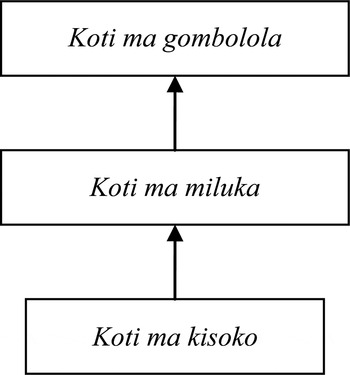
An unexpected finding then was that all three tiers of Jo-Gem clan courts (figure 1) include a local government village executive official: the local council chair.
Hierarchy of Jo-Gem clan courts

According to Jo-Gem respondents: “[t]he clan call a representative of government like the LC [local council] 1 chairman, and the clan chair of the area then they sit during that time to hear the case [sic]. The LC 1 chairman helps the clan to ensure that they decide the case without breaking the law of the government.”Footnote 58 The chair of the local government village council level 1, referred to in this quote as the “LC 1 chairman”, sits ex-officio in all Jo-Gem clan courts. The LC 1 chairman's role in the clan court is different from the official one performed ordinarily. The chairman is head of the lowest government administrative unit, political leader of the council and chairs the local council court.Footnote 59 The chairman therefore combines legislative, executive and judicial functions.
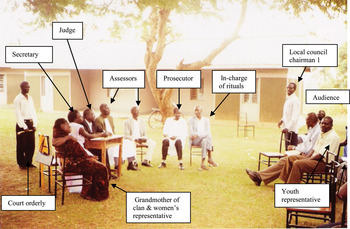
Inversely, in all Jo-Gem koti, the LC 1 chairman is only invited to sit in a quasi-judicial capacity (though not as chair) to ensure that the koti adheres to national law. It may be suggested that the LC 1 chairman oversees the protection of the right to a fair trial by the koti. The clan head called ja gombolola, ja miluka or ja kisoko, sits as the ex-officio chair of their koti, assisted by three jo kony [helpers] called assessors who advise on clan law and make decisions. The ja kalani [secretary] takes minutes. Of note, in Morwa Guma courts, local council officials are only invited like any other clan member to participate in proceedings. As depicted in figure 2, the LC 1 chairman is part of the audience, seen here welcoming clan members to his village. He is not one of the koti officials.
Trial simulation re-enacting a clan court session. © Maureen Owor (2006)

Thus, in the context of section Q(c)(1) of the Guidelines, the presence of the LC 1 chairman on the Jo-Gem koti signifies an “abridged” notion of the legal doctrine of separation of powers: one that combines the lower level state executive with traditional “judicial” officials. In this sense, Jo-Gem koti do not meet regional standards for an independent court that demand separation of traditional courts from the state's executive.
Conflation of executive and judicial functions
In order to adopt a more expansive reading of section Q(c)(1) as referring to the independence of traditional courts from kinship government, then koti should be independent of the executive organ of each clan: the nono. However, Jopadhola courts are not independent of their executive bodies. As Sanders states, traditional government is by discussion and consent, doing whatever possible to ensure cohesion of the group. Likewise, traditional legal proceedings are a community affair aimed at reconciling parties.Footnote 60 Extrapolating Sanders's reasoning to Jopadhola clans shows that, in adhering to the principle of governance by public participation, traditional government combines legislative, executive and judicial functions.
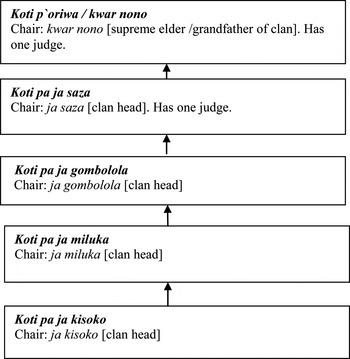
This conflation of powers also present in the Jopadhola courts was explained as follows. The nono comprises the heads of all clan units who are answerable to adult clan members, collectively called the ju nono. Participants pointed out that the nono has no legislative authority to repeal or amend chik [law] because of the mystical nature of Jopadhola chik, derived from custom. Still, as the supreme policy making body of each clan, the nono carries out executive and judicial functions. In its executive capacity, the nono organizes elections of clan heads and court officials and oversees their appointment and dismissal. Any clan head also exercises judicial functions while sitting as the (executive) ex-officio chair of the koti. This point is best illustrated by the Morwa Guma courts' composition outlined in figure 3.
Hierarchy of Morwa Guma clan courts

The Morwa Guma Constitution provides for a judge as a position in leadership, but not as a separate judicial entity.Footnote 61 As a result, in the higher saza and p'oriwa courts, positions exist for both judge and clan head. The latter has judicial powers to hear cases on a par with a judge. For instance, the ja saza has the same judicial powers as the ja thum banja [judge] of the saza koti. In the appellate p'oriwa koti, the kwar nono has equal judicial authority as the judge. Like the Jo-Gem, the gombolola and the lower miluka and kisoko courts are all chaired by a clan head (see figure 3). The gombolola court also has a deputy chair. Notably, all (eight) jo kony from the lower courts (two assessors per court) sit in the p'oriwa. Similar to the Jo-Gem, jo kony here have powers to hear evidence and determine both verdict and sentence.
Executive members, some of whom are pictured in figure 2, sit in the koti and participate in decision making. In the p'oriwa they are the: adha nono [grandmother of the clan], ja kiosa [prosecutor], kalani [secretary], ja kani [treasurer], ja luwo [speaker], ja kow wach [publicity secretary] and ja chowiroki [person in charge of rituals]. The saza and gombolola courts have the: adha nono [women] representative and soye [youth] representative, secretary, treasurer, prosecutor, ja kika [funeral chair] and ja kony pere [assistant] who collects kika [money to help with funeral expenses of a clan member]. The lower kisoko and miluka courts each have a secretary, and women and youth representatives.
Clearly then, the composition of the Morwa Guma and Jo-Gem clan courts, viewed in the context of section Q(c)(1), partially mimics the composition of courts of law by having a judge, assessors and a prosecutor. The hierarchy of courts of both clans retains the colonial local government divisions of saza, gombolola, miluka and kisoko (formerly pecho). Additionally, the lower level local government LC 1 chairman is invited to sit in Jo-Gem courts. That a clan leader wields executive power and also exercises a judicial role as the ex-officio chair of the koti, demonstrates the lack of separation of powers between executive and judicial functions of the nono. These findings support the SALC literature, Elechi's study of ekpuke essa courts, and Burke and Elias's descriptions of segmentary societies. This lack of separation extends to the manner of appointment where, in carrying out executive functions, clan leaders use a participatory approach that accommodates ju nono decisions.
Manner of appointment
The underlying assumption in section Q(c)(1) of the Guidelines is that the appointment procedure for national courts can be replicated in a traditional context. This supposition is explicit in section Q(c)(1) that reproduces section A(4).Footnote 62 Under section A(4)(h), the process for appointment to judicial bodies shall be transparent and accountable and an independent body shall be created for this purpose. This body also aims to safeguard the independence and impartiality of judicial officers. As the Human Rights Committee has stated, the manner of appointment determines whether a court of law is independent and fair.Footnote 63 That way, the individual's right to a fair trial by an independent court is protected. The fact that no guidance exists in section Q(c) on the manner of appointment may be because, as implied in section S(1), traditional courts are created in accordance with cultural norms and customs. Yet, modernists criticize customary forms of governance, maintaining that traditional authorities rely on deference and place the community ahead of the individual, thereby hampering the growth of a just and democratic society.Footnote 64
A surprise result then was the egalitarian manner of appointment by the nono of each clan. Participants made clear that appointments are based on adult suffrage and meritocracy (the exemplary performance of social obligations), or “[t]he contribution of the individual to the community, their ability and behaviour”.Footnote 65 Meritocracy and adult suffrage aim to achieve transparency and a democratic appointment process.
The Jo-Gem clan follows a conservative traditional approach. Appointments are by the nono, through adult suffrage of the ju nono. There are no regular elections and no campaigns are permitted. Meritocracy is an imperative, for as Mr AO, the supreme Jo-Gem elder said: “[y]ou cannot simply want this job.” The only exception is the LC 1 chairman who sits ex-officio.
The Morwa Guma appointments depict an innovative approach that combines meritocracy with democratic elections. To this end, chapter 11 of the Morwa Guma Constitution provides that leaders “must be good clans' people [sic]”. In this respect, the Morwa Guma underscores meritocracy in much the same way as the Jo-Gem. The main distinction is the election of court officials by an electoral committee. The concept of an electoral body, according to Mr RO, was borrowed from the government in 1985. In the author's view, the idea of a specific institution to oversee elections was probably copied from Uganda's first ever multi-party elections in December 1980, organized by the commission for the 1980 general elections. Though the composition of the Morwa Guma's electoral committee is not specified, the presiding officer is an okewo [a nephew to the clan]. An okewo is perceived as neutral, since he is not a clan member. Canvassing and campaigns are permitted, and voting is by lining up [bol] behind a candidate.Footnote 66
As noted earlier, under Morwa Guma law, a judge is not separate from leadership functions. To this end, the appointment of judges is, as for other clan office bearers, by election, in contrast to national courts. Appointment of magistrates by the Judicial Service Commission (JSC)Footnote 67 is based on an individual's legal qualifications and experience, not contributions to the community and certainly not by adult suffrage. Likewise, under article 142 of the Ugandan Constitution, judges are nominated by the JSC, vetted by Parliament and appointed by the president. Kanyeihamba correctly observes that the appointment process for judges in Uganda is “rigid”.Footnote 68 To Madhuku, subjecting the nominees to parliamentary approval (people's representatives), is intended to be a check against the “spectre of political pressure on the appointment process”.Footnote 69 Thus, Parliament may reject an appointment to obtain a more reasonable proposal. For the Morwa Guma, appointment of judges is by adult suffrage of the ju nono. To them this is a democratic, transparent process in which those who lack a sense of social obligation are rejected.
The concept of a prosecutor (as representative of society's interests) in the higher Morwa Guma courts is adapted from the state's director of public prosecutions (DPP). Appointment of the DPP and staff, however, differs significantly from that of the prosecutor in the Morwa Guma courts. The latter is appointed by the nono based on meritocracy, following election by adult suffrage. Conversely, the DPP is nominated by the Public Service Commission (PSC), vetted by Parliament and appointed by the president under article 120(1) of the Constitution. Other employees, state attorneys and lay prosecutors are appointed by the PSC.
Participants explained that the term “assessor” used by both clans, is borrowed from the courts of law. In the magistrates courts (for civil customary matters) and the High Court, assessors are pre-selected from a list prepared by the chief magistrate,Footnote 70 then appointed by the presiding judge or magistrate. By contrast, assessors in both clans are elected by adult suffrage based on meritocracy.
To summarise, the clans use traditional and modern approaches where the nono guarantee that the ju nono participate through adult suffrage in the appointment of all clan court officials including assessors, judges and the prosecutor. The appointment process that borrows from national structures is based on meritocracy. As Oomen contends, if participation and the “ability to debate one's destiny” can be regarded as essential to democracy, then customary leadership may be “more democratic than the elected local governments with which they supposedly compete”.Footnote 71 These findings confirm that the procedure of appointment is democratic and accountable in the local context.
Qualifications
Section Q(c) does not specify the requisite qualifications for appointment to a traditional court, leaving its determination to the customary institutions. As noted earlier, the absence of legal qualifications is one weakness of statutory traditional courts identified by SALC. As Madhuku argues, appointing from a restricted group who are subjected to professional standards and qualifications, aims to ensure that appointments are made on merit.Footnote 72 For instance, judicial officers in Uganda must be qualified to practise law under the Advocates Act.Footnote 73
The Jopadhola, by contrast, have no minimum educational qualifications as eligibility criteria to serve on the koti. Rather, they use a traditional approach where positions are open to any clan member, including the illiterate, to guarantee equity. Important considerations for all posts are an in-depth knowledge of Jopadhola clan laws and proficiency in Dhupadhola. This finding is consistent with Elechi's study of the ekpuke essa which established that court elders must be erudite in local customs. A third consideration is one's ability to pacify angry litigants. As study participants explained: “[t]he clan must strengthen the heart of the complainant so that he does not feel very upset”.Footnote 74 This statement is significant because it illustrates the competencies expected of a clan court official: a conciliatory approach that fosters reconciliation between the parties.
By excluding legal qualifications, clans apply a communitarian notion of rights where every clan member (aged 18 or older) has locus standi. As such, judicial and prosecutorial functions are shared between the judge, prosecutor, assessors, other clan officials and the community. Under shared jurisdiction, every kinship member has a “right” to be heard and to participate in the adjudication process. This principle of even handedness is the benchmark for considering whether a trial was fair to the individual and community. Public participation contrasts rules of natural justice applied in local council courts that emphasize the right of individual litigants to be heard.Footnote 75 One may argue that the consequential lack of legal expertise implies that clan courts may not protect individual rights during a trial. The clans' counter-argument may be that, since their eligibility criteria are not pegged to formal and legal qualifications, it is appropriate to their non-technical public nature of customary deliberations.
Although formal “westernized” education (and legal qualifications) are irrelevant, both clans have successfully combined these two contrasting levels of informal and formal education. For instance, assessors in the High Court must understand the language of the court (English) with a “degree of proficiency”,Footnote 76 which indicates they must have a formal education. By contrast, information provided by the study participants showed that all jo kony were semi-literate farmers. The same applied to the ja chowiroki in the p'oriwa court and all but one of the clan heads. Equally, the kalani were primary or secondary school teachers. The benefit of this mix appears to be that the kalani can record court proceedings in both Dhupadhola and English. To this end, two copies of court records (on land matters) availed to the author by the Namwaya saza koti had translations in English. This is convincing evidence of how the traditional system transforms itself to suit both local and modern circumstances.
To summarise, the eligibility criteria for appointment are conservative as they focus on individual disposition, proficiency in the local language and clan law. Additionally, educational and legal qualifications are disregarded because formal or legal training is not required due to the uncomplicated participatory nature of koti proceedings.
Security of tenure and removal of officials
Section Q(c) makes no mention of security of tenure for traditional court officials. By contrast, section A(4)(n), (p) and (q) provide that judicial officials must not be appointed for a fixed term and can only be removed following stringent procedures and a fair hearing. Madhuku underscores the importance of security of tenure, arguing that, if judges can easily be removed from office, then there is in reality no independence of the judiciary. Such a strict process also exists in Uganda to prevent judges being “beholden” to any authority or person.Footnote 77 The Jopadhola process has similarities and differences.
The Jo-Gem clan has no fixed term of office. This appears to give some measure of security of tenure for the officials, as they may serve for as long as they are capable. The Morwa Guma clan by comparison has fixed tenure for all officials. Under paragraph 31 of the Morwa Guma Constitution, elections of clan office bearers are held every five years. A person is only eligible for re-election twice, giving a maximum tenure of 15 years. This practice is consistent with Nowak's reasoning that judges need not be appointed for life, but should serve for a relatively long period.Footnote 78
Removal of officials under the Jopadhola procedure is subject to the decision of the nono following consultations with the ju nono. To illustrate: under chapter 12, paragraph 33 of the Morwa Guma Constitution, the grounds for removal of a clan leader include breaking clan law, such as: “[h]aving a relationship or eloping with a relative or any other behaviour that the other leaders deem to fit into that category”.
One example given was of the dismissal of a clan official by the nono for concealing the fact that his son married a relative, in direct contravention of Morwa Guma law. The leader was dismissed in disgrace and was not permitted to stand for any office again.
In summary, security of tenure and removal of an official is parochial, subject to the nono acting on the consensus of the ju nono. Questions may be raised from a legal perspective about the extent to which public participation in determining the tenure and removal of “judicial” officials guarantees the independence of traditional courts. In response, the clans may argue that public participation ensures integrity of the koti, as its officials are ultimately accountable to the ju nono.
Representation of women and youth
The Guidelines are silent on posts for women and youth on traditional courts. Nonetheless, one significant finding was the transformation of koti from bastions of patriarchy to institutions that ensure fair representation of women and youth (aged 18 or older). Participants spoke of how koti accommodate these interests through provision for women's and youth representatives to ensure their constituents are protected. These representatives are appointed in both clans in much the same way as other koti officials: through adult suffrage based on meritocracy. This new development was adopted in 1992 from the government's policies of equal representation in governance, concretized in the local councils and their associated courts. Under the LCCA, one youth and two women's representatives sit on lower level local council courts as ex-officio members of the village or parish executive committee. A local council court comprises all members of that village or parish executive committee. Women and youth quotas in these executive committees are specified under section 47(2)(h) and (i) of the Local Governments Act (LGA), following constitutional provisions in article 180(2)(b) and (c) of the Local Council Courts Act.Footnote 79
The Jo-Gem clan does not assign posts for women or youth. Rather, it ensures that all courts have women and youth members. The explanation given by Mr AO was that “[g]overnment laws do not permit women to be denied representation in anything nowadays”.Footnote 80 Any clan member is eligible to hold any post regardless of age or gender. Ultimately, each of the Jo-Gem courts had at least one woman official. In the case of the court at the kisoko level, there were two women (both of them assessors), quite unlike the Morwa Guma where all the assessors were men. The secretary to the Jo-Gem gombolola court was a young man. By not “compartmentalizing” positions for women or youth, the Jo-Gem guarantees wider representation for them at all levels. By contrast, the Morwa Guma has specific positions for women and youth in all clan courts, although youth do not sit in the p'oriwa court.
To conclude, age and gender parity is one area where clans in the post-independence era have adopted lower level government features. This is in contradistinction to studies like that of Griffiths, which establish that traditional courts (kgotla) are a “men's space”. One explanation could be that, in an era of democratization, traditional leadership adapts to meet the needs of modern day society in an effort to strengthen its position within local communities.Footnote 81 Accordingly, giving positions to women and youth in Jopadhola patrilineal society ensures some semblance of fair representation in clan courts, which was previously lacking.
The spiritual overseer
The Guidelines are silent on the position of a spiritual overseer in traditional courts, yet supernatural activities are integral to localized African societies. For example, Jopadhola clans have kuni at which rituals take place, and the Bura temple at Nyakiriga is still in use. As Chase contends, rituals are ceremonies that are used to gain legitimacy in society. Using shared normative values and involving leaders and the audience in the performance of the rituals, help to authenticate a dispute process.Footnote 82
It is worth mentioning that no distinction exists between civil and criminal matters as is the case in a formal legal system. This characteristic of segmented societiesFootnote 83 may be attributed to the restorative inclinations of the clan in punishing the breach of social norms, like taboos, which make such a distinction largely pointless. Beyaraza explains that taboos are comparable to crimes attracting punishment in positive law, which clearly prescribes rules of what to do or not to do.Footnote 84 One such example is nywomo wat [incest]. Clan members are regarded as being as close as blood relatives. Nywomo wat is believed to bring lusiwa [extreme bad luck] to the offenders, their families and entire clan. The sanction for such breach is largely compensatory. This taboo is buttressed with mystical beliefs, so that only chowiroki [ritual cleansing] of any person afflicted by lusiwa removes the iniquity. Other social norms the breach of which necessitates ritual cleansing include yeti manya ori [abusing an in-law] and lami [verbal cursing].Footnote 85
One noteworthy finding was that koti sit in judgment on the breach of social norms within the court's jurisdiction, “[f]or example: cursing, theft, witchcraft, adultery / fornication, murder or the ghost. All this behaviour if the clan does not cleanse as it is required, even if the government imprisons a person for ten years still the tendencies listed above will remain. This behaviour retards the clan until the person is cleansed in accordance with traditional rites.”Footnote 86
This excerpt demonstrates that, whereas clan jurisdiction covers “ordinary” crimes like murder, rituals take a central place in validating the clan court process. The passage portrays clearly that koti engage in “trials” that include a communal therapeutic style of social control where “criminal” acts may be attributed to supernatural forces. The whole community is then involved in the “treatment”.Footnote 87 Communal therapy therefore deals with deviance through rituals where clan leaders and the community participate. The affected parties are returned to normality and reconciled with the community.
Customary trials are not very different from the therapeutic intervention described by Roberts, where family relationships that have broken down are examined using professional techniques. Once the latent problems have been dealt with, the parties' relationship is transformed using therapeutic techniques.Footnote 88 Thus, in both models, the affected parties are reconciled with the community, although therapeutic intervention, unlike communal therapy, neither uses mythical intercession nor involves kin in dealing with deviance.
Consider the trial simulation where two members of the same clan were tried for nywomo wat. Following their plea of guilty, the adha nono said: “[t]his act is a big curse called lusiwa. It can only be treated and finished in accordance with the rites on lusiwa.”Footnote 89
The adha nono's avowal underscores the koti's responsibility in removing lusiwa thereby protecting offenders and their kinfolk. In this regard, the function of the ja chowiroki found only in the p'oriwa (pictured in figure 2) is of special interest. His role is to guide the koti on the prescribed punishment and the procedure for ritual cleansing, and to ensure that rituals are carried out in accordance with clan law. The ja chowiroki proclaimed:
“There are four requirements: a cow called ‘Luk’, rombo [a sheep], a dog and a kayindi [small hut]. The first two are payable by the father of the boy. The okewo will build a hut and the couple will strip naked, leave their clothes in the hut, and remain in the hut with a dog. The hut is set alight and they all run out naked where okewo will be waiting to whip them. As they run out the lusiwa is removed and they are cleansed.”Footnote 90
The ja chowroki's declaration shows that, after compensation is paid by the male offender's father to the father of the female offender, the ritual cleansing is conducted by the okewo. As the naked couple escape from the burning grass hut, the okewo whips them. The lusiwa is removed and the offenders are reunited with the clan.
It is conspicuous that women are debarred from performing these ceremonies which are conducted by a male okewo. This may be likened to women among the Azande who are prohibited from taking part in oracular justice. Clearly, women's participation in rituals remains peripheral.
This data leads to the conclusion that koti are not independent in the framework of international human rights standards, where courts of law have no place for a spiritual adviser, far less supernatural beliefs. Although nowadays all clan officials are responsible for spiritual affairs, the exclusion of women from the performance of rituals affirms their subordinate position within this social framework. The control of divine matters therefore represents the preservation of traditional roles, reminiscent of pre-colonial times.
CONCLUSION
The evidence presented in this article raises a number of distinct features of the independence of clan courts. The similarities and divergence in each clan's notion of an independent court adds to the inconsistencies and strengths identified here and elsewhere. Jopadhola koti do not qualify as independent courts by international human rights standards because they do not adhere to the legal doctrine of separation of powers. The Jo-Gem clan, for instance, merges the lower level state executive with the koti officials, similar to the “combined” African district courts of the colonial era. The Morwa Guma courts exhibit a conflation of executive and judicial functions. Furthermore, legal qualifications are largely irrelevant in both clans. In this respect, the SALC comments aptly sum up their status in law. SALC contends that, if traditional courts are regarded as courts of law, they could be viewed as courts sui generis [in their own right] which need not be subject to the doctrine of separation of powers and which do not give audience to legal practitioners.Footnote 91
Equally, the clans' strength is in reconciling normative differences in legal doctrine with a communitarian notion of human rights that permits every clan member to participate in the creation of clan courts. One may argue that features like age and gender parity, election of office bearers based on fulfilling social obligations to kin (meritocracy), protection of the clan from evil through ritual, and the fact that court and litigants are personally acquainted as kin, all make clan courts independent within the traditional framework. Jopadhola clans have thus created an “expanded” notion of “judicial” independence: one that is culturally appropriate in the local African context.
In view of these findings, there is need for a rethink concerning the enforcement of the Guidelines by traditional courts. At the national level, this would involve an amendment of articles 28(1) and (12) of the Constitution, and lawsFootnote 92 to bring traditional courts within the ambit of the Guidelines. That way, clan courts could receive guidance on how to protect the right to a fair trial as prescribed in section Q(a) of the Guidelines. Even so, some caveats are in order.
On the one hand, safeguarding the independence of traditional courts through legislation risks creating “statutory” traditional courts that become an extension of the state's executive. For instance, statutory traditional courts in Malawi are aptly described by Wanda as an “extended arm of the executive” because they are subjected to “excessive” control by the Ministry of Justice.Footnote 93 Cultural norms would be diluted in the process. On the other hand, leaving compliance with the Guidelines to the vagaries of clans may undermine an individual's right to a fair trial, more so since judicial functions are shared by clan heads and judges alike.
This article has shown how clans accommodate elements of an independent court by borrowing from the state using a traditional construct of human rights. The differences and similarities identified here enable us to appreciate that, within the milieu of the African regional human rights instruments, what pertains now may be defined as a “hybrid” clan court system, influenced by outside factors, yet retaining dominant customary control.