





Introduction
Terminal illnesses impose profound burdens on patients and families. Cancer – a leading terminal illness – caused an estimated 10.4 million deaths globally in 2023 and is projected to cause 18.6 million deaths by 2050, with the sharpest increases expected in low- and middle-income countries (GBD 2023 Cancer Collaborators 2025). India’s cancer incidence is rising rapidly (projected to reach ≈2.08 million new cases by 2040) (Ferlay et al. Reference Ferlay, Colombet and Soerjomataram2021). In 2022, India already registered about 1.46 million new cancer cases (crude incidence 100.4/100,000), yielding a lifetime risk of roughly 1 in 9 persons (Sathishkumar et al. Reference Sathishkumar, Chaturvedi and Das2022). Cancer and its treatments often produce chronic disabling symptoms (pain, fatigue, functional decline) that necessitate prolonged, complex care (Sung et al. Reference Sung, Ferlay and Siegel2021). In practice, much of this care is provided by family caregivers, including spouses, children, other relatives, or close friends.
Family caregivers perform essential roles in the care of terminally ill patients, often taking on tasks ranging from basic daily care to complex medical and decision-making support. This role is physically, emotionally, socially, and financially demanding (Biney et al. Reference Biney, Sarfo and Poku2024). Caregivers typically lack formal training or preparation, and the sudden onset of intensive care needs can disrupt their routines. Studies show that caregiving duties often leave individuals with little time for their own needs, leading to neglect of personal health. Over time, caregivers frequently experience deteriorating health and routine (e.g., poorer sleep, nutrition, exercise) alongside elevated psychological distress (Samal et al. Reference Samal, Panda and Rath2024). The emotional toll is substantial: caregivers commonly report high levels of anxiety, fear, sadness, anger, and loneliness and may feel helpless or hopeless (Biney et al. Reference Biney, Sarfo and Poku2024; Samal et al. Reference Samal, Panda and Rath2024). Indeed, recent research indicates that a majority of cancer caregivers exhibit clinically significant symptoms of stress, anxiety, or depression (Samal et al. Reference Samal, Panda and Rath2024; Joshi et al. Reference Joshi, Gopichandran and Agrawal2025). For example, one cross-sectional study found that roughly 40–45% of caregivers of children with cancer had borderline or abnormal anxiety or depressive symptoms (Joshi et al. Reference Joshi, Gopichandran and Agrawal2025). Without intervention, these mental health struggles can persist or worsen over time, further undermining caregiver well-being and the quality of care they can provide.
Caregivers use various coping strategies to manage these challenges. Empirical studies show that both problem-focused coping (e.g., actively seeking solutions, planning) and emotion-focused coping (e.g., acceptance, seeking emotional or spiritual support) are commonly employed (Joshi et al. Reference Joshi, Gopichandran and Agrawal2025). In one recent survey, caregivers most frequently reported using active coping (taking action to make things better) and self-distraction to handle stress (Joshi et al. Reference Joshi, Gopichandran and Agrawal2025). Cultural and familial values strongly influence coping approaches: many caregivers in India emphasize a sense of duty and family obligation and frequently rely on religious faith or prayer for comfort (Biney et al. Reference Biney, Sarfo and Poku2024). These patterns highlight the importance of social and spiritual support networks. Importantly, interventions that integrate palliative care or psychosocial support can measurably reduce caregiver burden – for example, palliative care programs have been shown to reduce caregiver stress by half while improving patient outcomes (Yadullahi et al. Reference Yadullahi, Misra and Sanghavi2023).
Understanding caregivers’ specific stressors and coping styles is thus critical for designing effective support services.
Despite the clear impact of terminal illness on families, caregiver mental health remains understudied in many settings. In India, most research has focused on the patients themselves (Samal et al. Reference Samal, Panda and Rath2024). There is a particular paucity of data on caregivers in Eastern India. To address this gap, the present study systematically investigates stress, anxiety, depression, and coping strategies among caregivers of terminally ill cancer patients at a tertiary hospital in Kolkata, West Bengal. We use standardized, psychometrically evaluated instruments – the 21-item Depression, Anxiety and Stress Scale (DASS-21) and the Brief-COPE inventory – to quantify mental health outcomes and coping behaviors. These insights can inform culturally tailored interventions and policies (in clinical and public health practice) to better support family caregivers of terminally ill patients in Eastern India. For the purposes of this study, a family caregiver was defined as an unpaid individual – typically a family member or close relative – who provides physical, emotional, logistical, or medical assistance to a person with a serious or life-limiting illness, without formal professional training or remuneration (Adelman et al. Reference Adelman, Tmanova and Delgado2014; WHO 2020). Family caregiving in the palliative oncology context is characterized by high task intensity, emotional proximity to the patient’s illness trajectory, and frequent assumption of responsibilities spanning personal care, medication management, symptom monitoring, and coordination with healthcare teams (Ferrell et al. Reference Ferrell, Kravitz and Borneman2018). Unlike professional caregivers, family caregivers operate outside formal healthcare structures and typically receive little or no institutional support, rendering them particularly vulnerable to psychological burden (Adelman et al. Reference Adelman, Tmanova and Delgado2014).
Based on prior empirical evidence and theoretical frameworks of caregiver stress, we formulated the following a priori hypotheses. First, we hypothesized that a clinically substantial proportion of caregivers would exhibit significant levels of depression, anxiety, and stress, consistent with the documented burden of terminal-illness caregiving in Indian oncology contexts (Biney et al. Reference Biney, Sarfo and Poku2024; Samal et al. Reference Samal, Panda and Rath2024). Second, we hypothesized that emotion-focused and avoidant coping strategies would be positively associated with higher psychological distress, whereas problem-focused coping would show a weaker or inverse relationship, in line with theoretical models suggesting that disengagement-oriented strategies are less adaptive in uncontrollable caregiving situations (Joshi et al. Reference Joshi, Gopichandran and Agrawal2025). Third, we anticipated that problem-focused and emotion-focused coping domains would be intercorrelated, reflecting the tendency of highly distressed caregivers to mobilize multiple coping resources simultaneously.
Methodology
Study design and setting
This is a cross-sectional survey conducted at the Oncology Department of Medical College & Hospital, Kolkata, a tertiary referral center serving a diverse urban and peri-urban population. In this setting, caregivers typically provided sustained support, including assistance with daily activities, medical care, emotional support, and participation in health-related decision-making, reflecting the comprehensive nature of family caregiving in terminal oncology contexts in India.
Sampling and recruitment
Systematic random sampling was employed among caregivers attending the oncology wards/clinics. A sampling interval was computed from expected daily caregiver flow. The first participant was selected at random, and every 5th caregiver thereafter was invited. Recruitment continued until the target sample was reached, with data collected over a 5-month period from February to June 2025. Trained research staff approached potential participants during hospital visits, explained the study, obtained written informed consent, and administered the questionnaire.
Study population and eligibility
Inclusion criteria
• Aged 18 years or older.
• Unpaid family caregiver of a patient with confirmed terminal cancer under active palliative management at the study site – including a spouse, child, other relative, or close friend.
• Self-identified as the primary caregiver – defined as the individual most responsible for the patient’s day-to-day physical, emotional, or medical care – where more than 1 caregiver was present, to ensure independence of observations.
• Actively involved in caregiving for a minimum of 3 months prior to enrolment, on at least 3 days per week.
• Able to communicate in Bengali, Hindi, or English.
• Willing and able to provide written informed consent.
“Terminal cancer” was defined as an advanced-stage malignancy for which curative treatment was no longer available, and the clinical focus had shifted to palliation. Such patients were under active palliative management at the study site, typically presenting with progressive disease, limited life expectancy as determined by the treating team, and significant symptom burden, including but not limited to uncontrolled pain, fatigue, cachexia, or organ dysfunction.
Exclusion criteria
• Paid or professional caregivers, including nurses, home healthcare workers, or other formal care providers.
• Caregivers of patients with non-cancer terminal illnesses.
• Individuals who, in the clinical judgment of the trained interviewer, lacked the capacity to understand the study purpose or complete the questionnaire, for example, due to acute emotional distress at the time of approach, and were therefore unable to provide meaningful informed consent. Such assessments were made through brief direct observation; individuals showing signs of acute distress, inability to engage verbally, or who explicitly declined participation were not enrolled.
• Individuals without substantive direct involvement in caregiving, such as distant relatives with no regular role in the patient’s physical or emotional support.
Fewer than 5 caregivers were excluded due to incapacity or acute distress at the time of approach.
Sample size
Sample size was calculated for estimation of a single proportion (Aim 1: estimating the prevalence of clinically significant depression, anxiety, and stress among caregivers) using the standard formula:
 \begin{equation*}n = \frac{{{Z^2}p\left( {1 - p} \right)}}{{{d^2}}}\end{equation*}
With a Z-value of 1.96 (corresponding to a 95% confidence level), an estimated prevalence (p) of 0.5 (maximum variability), and a precision (d) of 0.10 (absolute precision), yielding n ≈ 96 (rounded to n ≈ 100 for feasibility) (Daniel and Cross Reference Daniel and Cross2013). For the correlational analyses (Aim 2), a formal separate power analysis was not conducted. However, for a sample size of 100, power analysis (2-tailed α = 0.05) indicates approximately 80% power to detect a small-to-moderate correlation (ρ ≈ 0.28), based on Cohen’s effect size conventions and calculations performed using G*Power (Cohen Reference Cohen1988; Faul et al. Reference Faul, Erdfelder and Lang2007). Hence, this level of power was considered sufficient for exploratory hypothesis testing.
Data collection and instruments
Data were collected by face-to-face interview using a structured proforma covering sociodemographic, clinical, and caregiving variables (relationship to patient, duration of care, hospital visit frequency, disease visibility, comorbidities, symptom burden, and perceived social support). Cancer visibility was categorized as a dichotomous variable (hidden vs. prominently visible) based on whether the malignancy or its physical manifestations were externally apparent on routine visual inspection, as determined by the investigators using clinical context (e.g., internal malignancies such as lung, hepatic, hematological cancers vs. externally visible lesions such as oral cancers, visible breast masses, or post-surgical deformities).
Two widely used psychometric instruments were administered:
• DASS-21 to quantify depressive, anxiety, and stress symptoms; scoring and severity interpretation followed the DASS-21 manual (Lovibond and Lovibond Reference Lovibond and Lovibond1995). The DASS-21 has a well-established 3-factor structure corresponding to its 3 subscales, with good internal consistency reported in the original and cross-cultural studies (Cronbach’s α typically 0.88 for depression, 0.82 for anxiety, and 0.90 for stress; Henry and Crawford Reference Henry and Crawford2005). The instrument has been previously used in Indian caregiving and clinical populations (Samal et al. Reference Samal, Panda and Rath2024).
• Brief-COPE (28-item inventory) to assess 14 coping strategies. Each subscale score was calculated as the mean (range 1–4) of the 2 constituent items, and higher-order domain scores (problem-focused, emotion-focused, avoidant) were computed as the mean of relevant subscales. The Brief-COPE has been widely used across cultural contexts including Indian samples (Joshi et al. Reference Joshi, Gopichandran and Agrawal2025); its 14 subscales each have modest internal consistency given the 2-item format (α typically 0.50–0.90 across subscales in prior studies) (Carver Reference Carver1997).
Both instruments were used in their standard forms without structural modification. Given that the aims of the present study were descriptive and correlational rather than psychometric, sample-specific internal consistency estimates were not separately calculated. This approach is consistent with published observational studies in palliative and psycho-oncology contexts that similarly rely on psychometric properties of these instruments rather than recalculating reliability within each applied sample.
Interviewers completed a dedicated training session covering standardized questionnaire administration, neutral and non-judgmental phrasing, handling of sensitive items, procedures for ensuring privacy, and referral pathways for participants reporting severe distress. Wherever possible, interviews were performed in a private or semi-private area away from other family members to reduce response bias. Participants were explicitly informed that responses would be kept confidential, that participation was voluntary, that they could skip any question, and that their care would not be affected by their answers. Both instruments were administered in the participant’s preferred language (Bengali, Hindi, or English). Bengali and Hindi versions of the DASS-21 and previously adapted versions of the Brief-COPE were employed for administration (Alim et al. Reference Alim, Kibria and Islam2017; Kumar et al. Reference Kumar, Kumar and Mehrotra2019). The DASS-21 has demonstrated robust psychometric validity in Indian populations, while the Brief-COPE, although not uniformly adapted across all Indian languages, has been culturally adapted and applied in prior Indian studies with acceptable reliability and construct validity (Mohanraj et al. Reference Mohanraj, Jeyaseelan and Kumar2015; Singh et al. Reference Singh, Gupta and Mishra2021). No formal back-translation procedure was conducted for the purposes of this study, as preexisting language versions were employed. A short pilot (n ≈ 10) tested local phrasing and administration time.
Minor clarifications to phrasing were made by the trained interviewers in the moment of administration to aid comprehension, for instance, by paraphrasing an unfamiliar term using a locally equivalent expression, without altering item meaning, response options, or scoring. No systematic modification to any item was made, and the standardized scoring and interpretation procedures of both instruments were followed without deviation. Completed forms were checked immediately for missing or ambiguous responses and clarified in situ.
Quality control and data management
Interviewers received standardized training in questionnaire administration and ethical conduct to ensure uniformity in data collection. Completed questionnaires were checked daily for completeness and consistency. Data were double-entered into a secure, password-protected database, and discrepancies were reconciled through source verification. Random cross-checks of 10% of entries were performed to minimize transcription errors. Data were anonymized before analysis to maintain participant confidentiality. Descriptive screening was performed to detect outliers or implausible values, and all analyses were conducted on complete cases.
Statistical analysis
All statistical analyses were performed using IBM SPSS Statistics (version 31). Data were inspected for completeness, range, and logical consistency prior to analysis. Frequency tables and descriptive summaries were produced for all variables to ensure data quality. Continuous variables (e.g., age, psychometric scale scores) were summarized using mean ± standard deviation (SD) and median with interquartile range (IQR), while categorical variables were presented as counts and percentages.
DASS-21 subscale scores for depression, anxiety, and stress were computed according to the DASS-21 manual (as the sum of 7 items per subscale, multiplied by 2 to yield a 0–42 range) and categorized into severity levels following published cutoffs (Lovibond and Lovibond Reference Lovibond and Lovibond1995): for Depression – below threshold 0–9, mild 10–13, moderate 14–20, severe 21–27, extremely severe ≥28; for Anxiety – below threshold 0–7, mild 8–9, moderate 10–14, severe 15–19, extremely severe ≥20; and for Stress – below threshold 0–14, mild 15–18, moderate 19–25, severe 26–33, extremely severe ≥34. Brief-COPE scores were derived following Carver’s (Reference Carver1997) guidelines: each of the 14 subscales was calculated as the mean of its 2 constituent items (range 1–4), and the higher-order domains (problem-focused, emotion-focused, and avoidant coping) were computed as the mean of their respective subscales (Carver Reference Carver1997). For the Brief-COPE, scores reflect the relative frequency of use of each coping strategy on a 1–4 scale (1 = “I haven’t been doing this at all”; 4 = “I’ve been doing this a lot”); there are no standardized normative cutoffs, and scores are interpreted in relative terms within and across samples.
Descriptive results, including means, medians, percentiles, minima, and maxima for all psychometric measures, were reported.
Given that the psychometric scores were ordinal/scale and did not consistently meet normality assumptions – assessed using the Shapiro–Wilk test, supplemented by visual inspection of Q–Q plots and histograms – nonparametric methods were applied. Associations between coping domains and psychological distress (DASS-21 subscales) were examined using Spearman’s rank correlation (ρ). Spearman’s correlation assumes a monotonic relationship between variables and is appropriate for ordinal or non-normally distributed continuous data; monotonicity was evaluated by visual inspection of scatter plots, which confirmed no gross violations. Correlation coefficients and corresponding 2-tailed p-values were reported, with p < 0.05 considered statistically significant. The magnitude of associations was interpreted using Cohen’s (Reference Cohen1988) benchmarks adapted for correlation coefficients (small: ρ ≈ 0.10, medium: ρ ≈ 0.30, large: ρ ≈ 0.50). Note that p-values indicate whether an observed association is statistically distinguishable from 0 and do not quantify the strength of association; effect magnitude is reflected by the size of ρ itself.
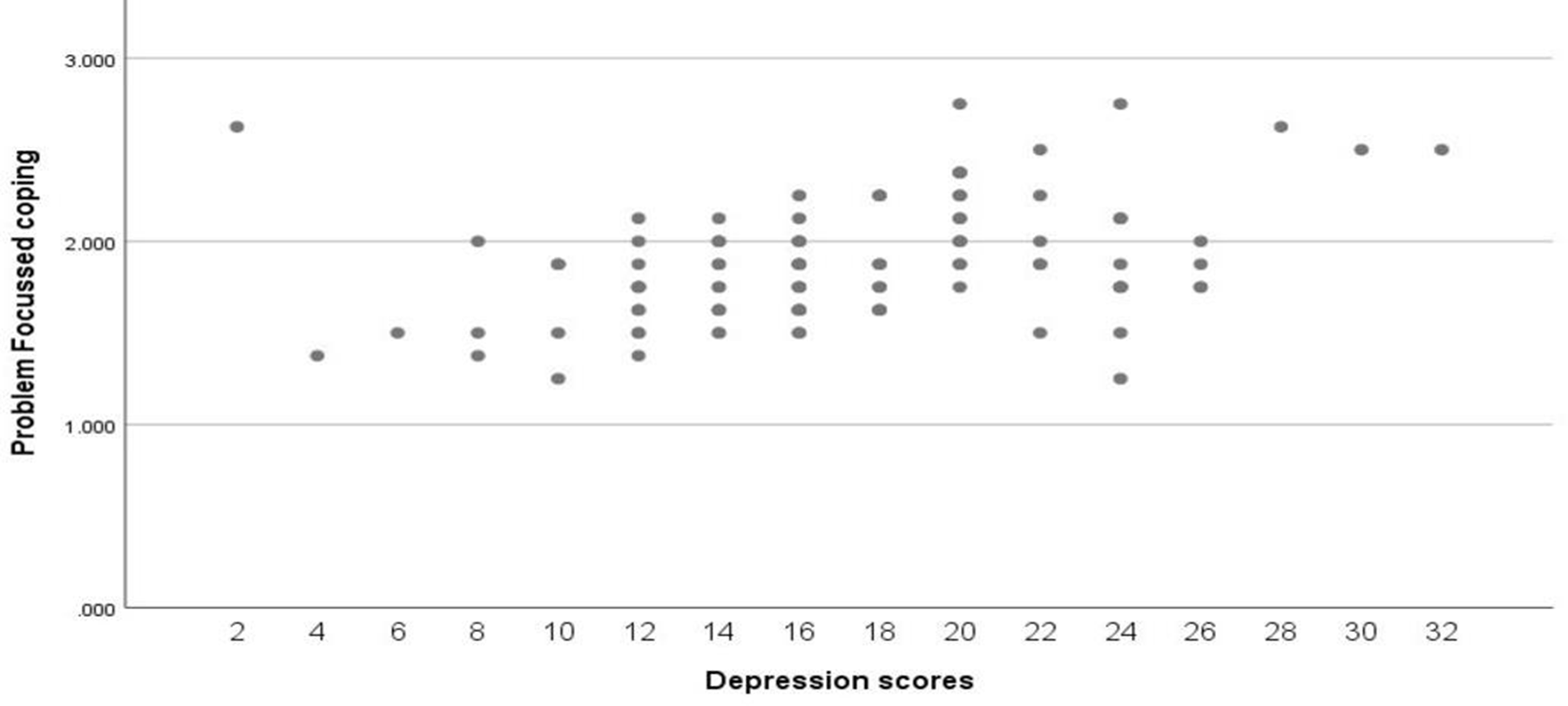
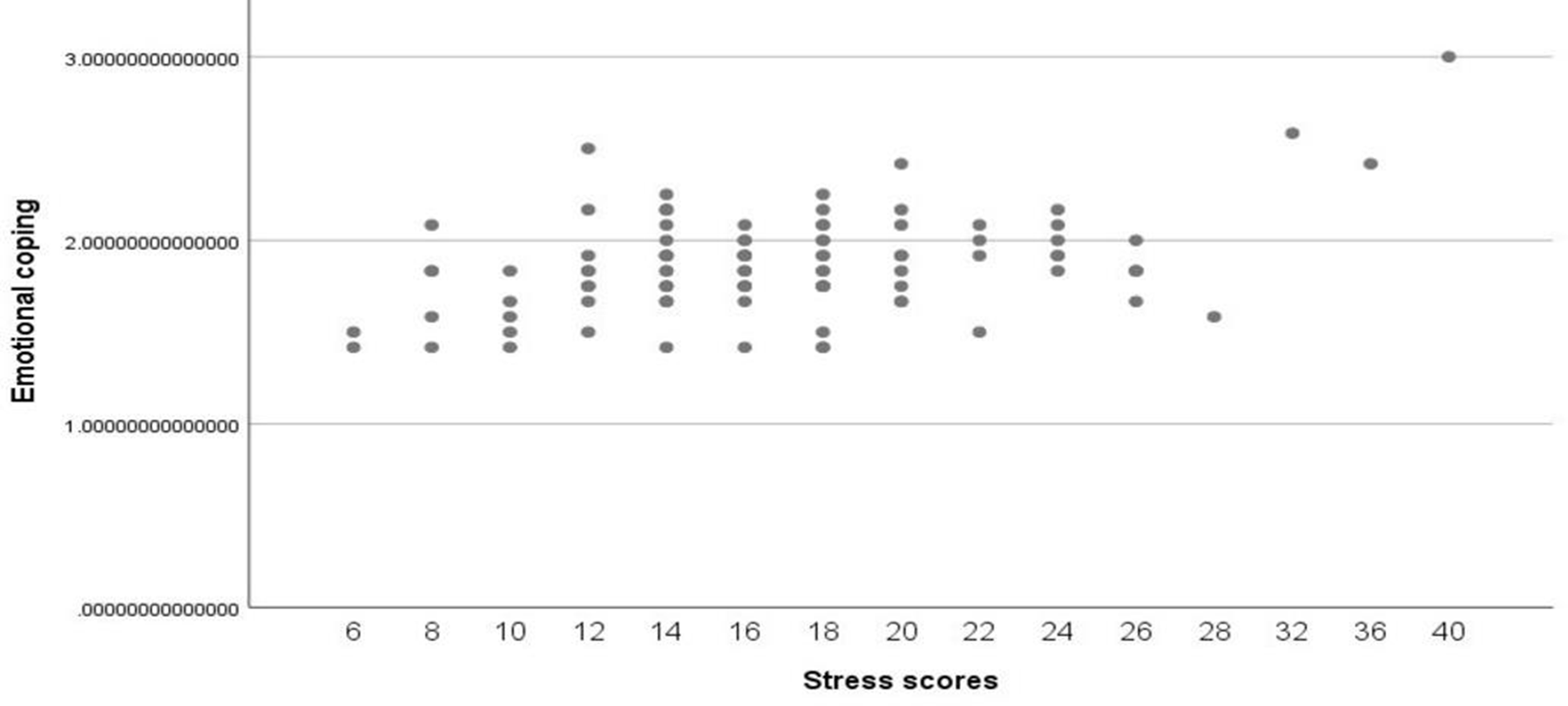
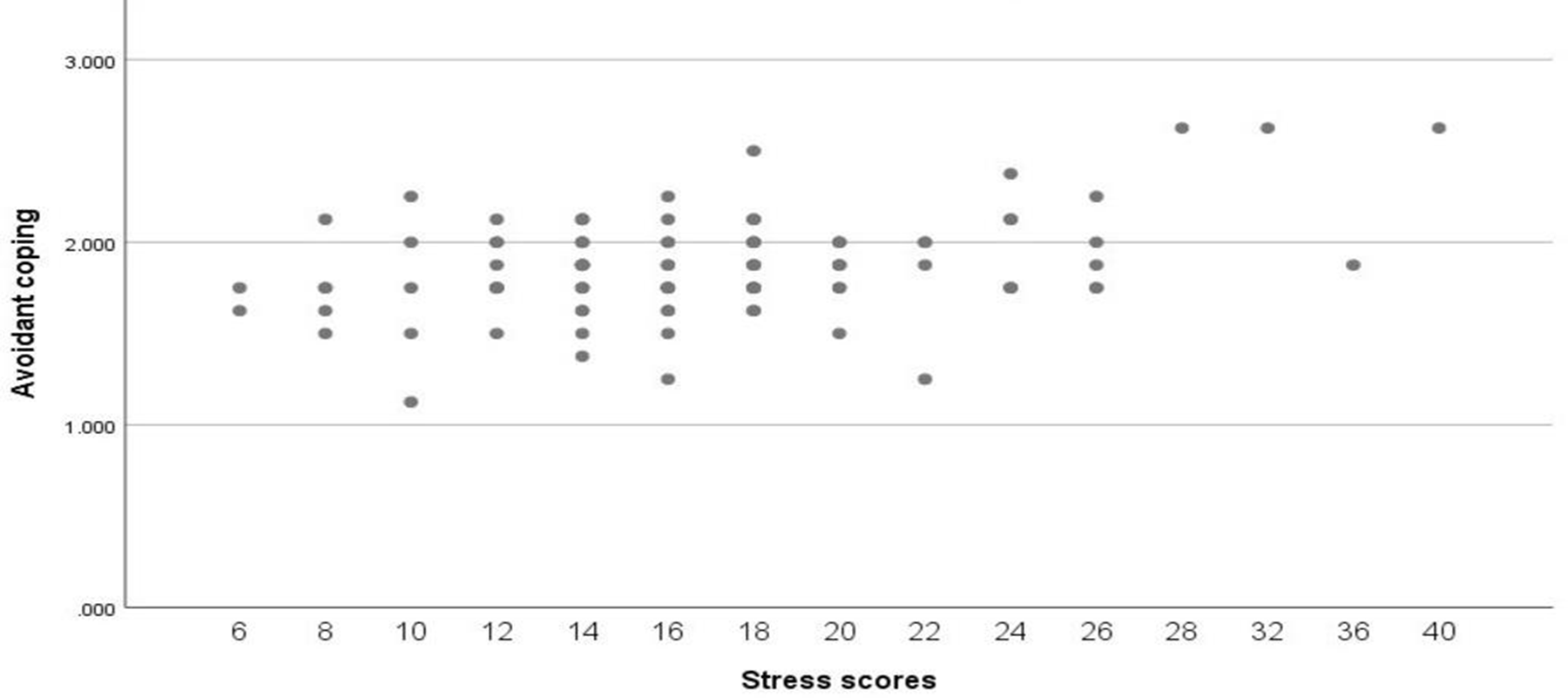
To visually assess relationships between coping domains and distress dimensions, scatter plots with fitted trend lines were generated (e.g., emotional coping vs. anxiety and depression scores) to illustrate correlation patterns and outlier behavior.
All analyses were 2-sided, and results are presented with exact p-values to facilitate transparent interpretation of statistical strength.
Results
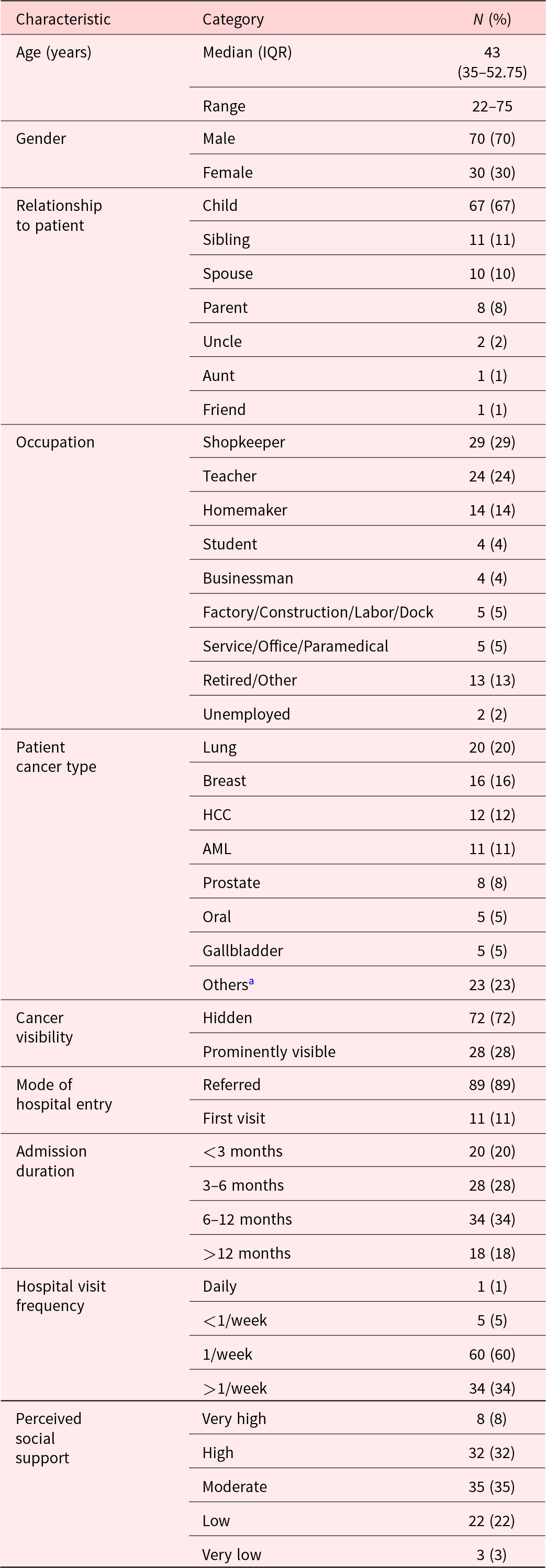
A total of 100 caregivers (Table 1) were included in the analysis. The median age was 43 years (IQR: 35–52.75; range: 22–75); mean age was 43.95 ± 12.09 SD years. Seventy percent were male. The majority of caregivers were the patient’s children (67%), followed by siblings (11%), spouses (10%), and parents (8%). The most frequent occupations were shopkeeper (29%), teacher (24%), and homemaker (14%). Patient clinical characteristics reported by caregivers showed that lung cancer was the single most common diagnosis (20%), followed by breast cancer (16%), hepatocellular carcinoma (12%), and acute myeloid leukemia (11%). Other diagnoses occurred at lower frequencies (prostate cancer: n = 8, oral cancer: n = 5, gallbladder cancer: n = 5, etc.). Most cancers were not prominently visible (hidden in n = 72; 72%), and the majority of patients were referred cases (referred n = 89; first visit n = 11).
Sociodemographic and clinical characteristics of caregivers of terminally ill patients (n = 100)

Table 1 Long description
Characteristics are reported for caregivers using the columns, Characteristic, Category, and N percent, with age also given as median with interquartile range and as a range. Age was median 43 years with interquartile range 35 to 52.75, and range 22 to 75. Gender was 70 male and 30 female. Relationship to patient was 67 child, 11 sibling, 10 spouse, 8 parent, 2 uncle, 1 aunt, 1 friend. Occupation was 29 shopkeeper, 24 teacher, 14 homemaker, 13 retired or other, 5 factory construction labour dock, 5 service office paramedical, 4 student, 4 businessman, and 2 unemployed. Patient cancer type was 23 others with an asterisk, 20 lung, 16 breast, 12 HCC, 11 AML, 8 prostate, 5 oral, and 5 gallbladder. Cancer visibility was 72 hidden and 28 prominently visible; mode of hospital entry was 89 referred and 11 first visit. Admission duration was 20 under 3 months, 28 from 3 to 6 months, 34 from 6 to 12 months, and 18 over 12 months; hospital visit frequency was 60 once per week, 34 more than once per week, 5 less than once per week, and 1 daily. Perceived social support was 35 moderate, 32 high, 22 low, 8 very high, and 3 very low.
Data are presented as “N (%)” unless otherwise indicated.
IQR = interquartile range; AML = acute myeloid leukemia; HCC = hepatocellular carcinoma.
a Others include major less frequent cancers, e.g., acute lymphoblastic leukemia, brain cancer, cervical cancer, endometrial cancer, Hodgkin lymphoma, non-Hodgkin lymphoma, pancreatic cancer, and testicular cancer.
Comorbidity reporting was heterogeneous; diabetes mellitus was recorded in n = 48 (48%), hypertension in n = 58 (58%), and thyroid disorders in n = 16 (16%; hypothyroidism n = 9 and hyperthyroidism n = 7), either alone or in combination. Admission duration most frequently spanned 6–12 months (n = 34), followed by 3–6 months (n = 28), <3 months (n = 20), and >12 months (n = 18). Weekly hospital visits were most common (once a week, n = 60), followed by several times a week (n = 34), less than once a week (n = 5), and daily visits (n = 1). Perceived social support was reported as moderate (35%), high (32%), low (22%), very high (8%), or very low (3%). Psychological distress (DASS-21): median (IQR) scores were as follows – depression 16 (IQR: 14–20), anxiety 14 (IQR: 10–17.5), and stress 16 (IQR: 14–20). By severity category (Figure 1), most caregivers had at least moderate depressive symptoms (moderate n = 54, severe n = 20, extremely severe n = 3). Anxiety scores were distributed with 32% moderate, 28% severe, and 16% extremely severe; only 16% fell below the symptom threshold. Stress scores were more varied: below threshold n = 40, mild n = 32, moderate n = 19, severe n = 7, and extremely severe n = 2. These distributions indicate a substantial burden of psychological symptoms in this caregiver sample. Coping (Brief-COPE domains): Mean (±SD) domain scores on the 1–4 scale were problem-focused coping 1.875 ± 0.321, emotion-focused coping 1.871 ± 0.269, and avoidant coping 1.865 ± 0.266, indicating overall low-to-moderate use of these coping strategies among caregivers.
Severity distribution of anxiety, depression, and stress among caregivers (n = 100).

Figure 1 Long description
A stacked bar graph with three vertical stacked bars labeled Anxiety, Depression and Stress. Horizontal axis label, Psychological domain. Vertical axis label, Number of caregivers left parenthesis n right parenthesis, with tick labels 0, 20, 40, 60, 80, 100. Legend title, Severity. Legend categories, Normal, Mild, Moderate, Severe, Extremely severe. Anxiety stacked bar segment values from bottom to top: 16, 8, 32, 28, 16. Depression stacked bar segment values from bottom to top: 6, 17, 54, 20, 3. Stress stacked bar segment values from bottom to top: 40, 32, 19, 7, 2.
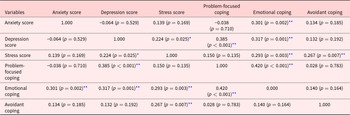
Spearman’s rank correlations were computed to examine bivariate relationships between DASS-21 symptom scores (anxiety, depression, stress) and 3 Brief-COPE domains (problem-focused, emotional, avoidant) (Table 2); all coefficients are reported with df = 98 and 95% confidence intervals (CIs) computed via Fisher’s Z transformation. Key findings were as follows: anxiety correlated positively with emotional coping (ρ = 0.301, 95% CI [0.11, 0.47], p = 0.002) but not with depression (ρ = −0.064, 95% CI [−0.26, 0.14], p = 0.529), stress (ρ = 0.139, 95% CI [−0.06, 0.33], p = 0.169), or problem-focused coping (ρ = −0.038, 95% CI [−0.23, 0.16], p = 0.710); depression correlated with stress (ρ = 0.224, 95% CI [0.03, 0.40], p = 0.025), problem-focused coping (ρ = 0.385, 95% CI [0.20, 0.54], p < 0.001), and emotional coping (ρ = 0.317, 95% CI [0.13, 0.48], p = 0.001), with a non-significant association with avoidant coping (ρ = 0.132, 95% CI [−0.07, 0.32], p = 0.192); stress correlated with emotional coping (ρ = 0.293, 5% CI [0.10, 0.46], p = 0.003) and avoidant coping (ρ = 0.267, 95% CI [0.07, 0.44], p = 0.007) but not with problem-focused coping (ρ = 0.150, 95% CI [−0.05, 0.34], p = 0.135). Among coping domains, problem-focused and emotional coping were moderately intercorrelated (ρ = 0.420, 95% CI [0.24, 0.57], p < 0.001), while problem-focused vs. avoidant (ρ = 0.028, 95% CI [−0.17, 0.23], p = 0.783) and emotional vs. avoidant (ρ = 0.140, 95% CI [−0.06, 0.33], p = 0.164) showed no significant association. Overall effect sizes were small to medium as per Cohen’s (Reference Cohen1988) benchmarks (ρ ≈ 0.224–0.420; small ≈ 0.10, medium ≈ 0.30, large ≈ 0.50).
Spearman’s rank correlations (ρ) between DASS-21 scores and coping domains

Table 2 Long description
Spearman rank correlations are reported among six variables: anxiety score, depression score, stress score, problem focused coping, emotional coping, and avoidant coping, with p values shown for each pair. Anxiety score correlates with emotional coping at rho 0.301 with p 0.002, and has smaller correlations with depression score at rho minus 0.064 with p 0.529, stress score at rho 0.139 with p 0.169, problem focused coping at rho minus 0.038 with p 0.710, and avoidant coping at rho 0.134 with p 0.185. Depression score correlates with stress score at rho 0.224 with p 0.025, with problem focused coping at rho 0.385 with p less than 0.001, with emotional coping at rho 0.317 with p 0.001, and with avoidant coping at rho 0.132 with p 0.192. Stress score correlates with emotional coping at rho 0.293 with p 0.003 and with avoidant coping at rho 0.267 with p 0.007, and has rho 0.150 with p 0.135 with problem focused coping. Problem focused coping correlates with emotional coping at rho 0.420 with p less than 0.001 and with avoidant coping at rho 0.028 with p 0.783. Emotional coping correlates with avoidant coping at rho 0.140 with p 0.164, and its diagonal cell is shown as.000.
DASS-21 = Depression, Anxiety and Stress Scale – 21 items; df = 98 for all reported coefficients; 95% CIs computed via Fisher’s Z transformation.
** p < 0.01, statistically significant.
* p < 0.05, statistically significant.
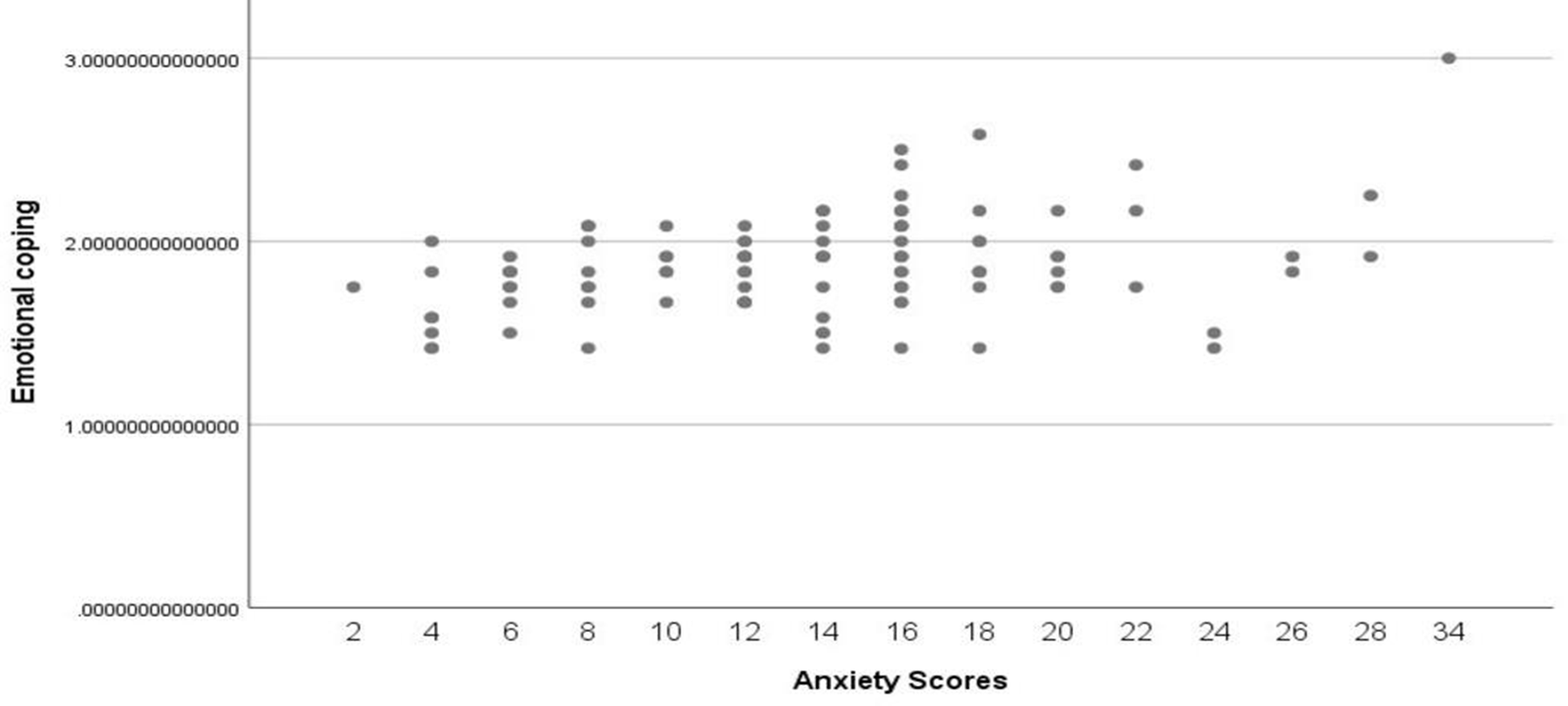
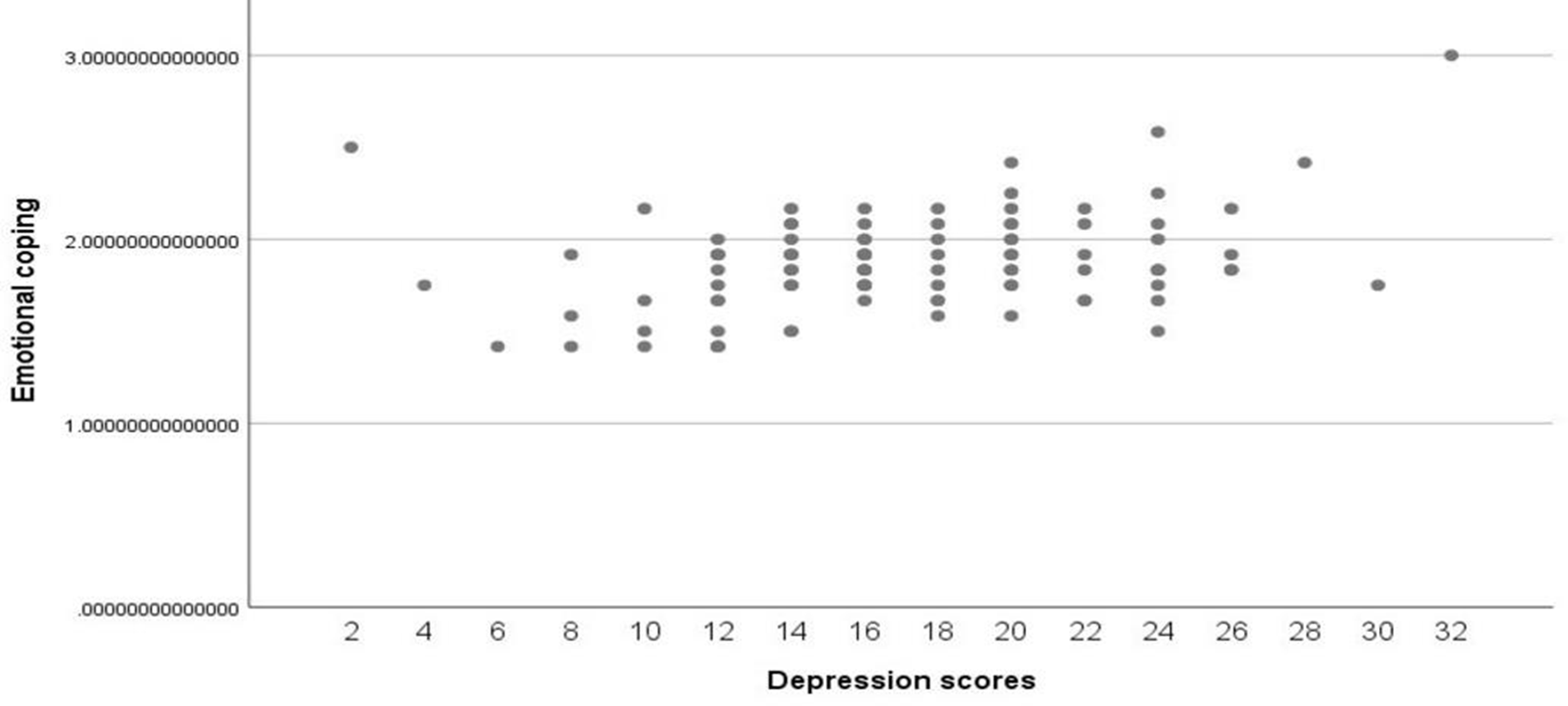
Scatter plots with linear fitted trend lines were generated to visually assess the relationships between coping domains and distress dimensions (e.g., emotional coping vs. anxiety and depression scores), illustrating correlation patterns and outlier behavior, as shown in Figures 2–6 (p < 0.01, statistically significant).
Scatter plot showing the relationship between emotional coping and anxiety scores with fitted regression lines.

Scatter plot showing the relationship between emotional coping and depression scores with fitted regression lines.

Scatter plot showing the relationship between problem-focused coping and depression scores with fitted regression lines.

Scatter plot showing the relationship between emotional coping and stress scores with fitted regression lines.

Scatter plot showing the relationship between avoidant coping and stress scores with fitted regression lines.

Discussion
Caregivers in this study exhibited a substantial psychological burden, with the majority experiencing clinically significant depression and anxiety. Specifically, 77% of caregivers scored at the moderate or above threshold for depression (moderate n = 54, severe n = 20, extremely severe n = 3) and 76% reached at least the moderate anxiety threshold, while only 28% met criteria for at least moderate stress. These rates are notably higher than those reported in similar Indian studies. Joshi et al. (Reference Joshi, Gopichandran and Agrawal2025) found approximately 40–45% of caregivers of children with cancer had borderline or abnormal anxiety or depressive symptoms, and Chakraborty et al. (Reference Chakraborty, Jana and Vibhute2023) reported that roughly half of family caregivers in a national Indian survey endorsed depressive symptoms. Our higher rates likely reflect the distinctly demanding nature of terminal adult cancer caregiving as opposed to pediatric oncology or mixed caregiving contexts, where prognosis is explicitly poor and curative hope is absent, worsening emotional strain. Similarly, Samal et al. (Reference Samal, Panda and Rath2024) documented high psychological burden (∼45%) among cancer caregivers in Bhubaneswar, and Shanmugam et al. (Reference Shanmugam, Jebasingh and Singodiya2024) reported pervasive psychosocial impacts across Indian oncology settings. Our findings extend this pattern to Eastern India, a region previously underrepresented in the literature.
These results confirm one of our hypotheses that a clinically substantial proportion of caregivers in this context would exhibit significant depression, anxiety, and stress, consistent with the documented burden of terminal-illness caregiving in Indian oncology (Biney et al. Reference Biney, Sarfo and Poku2024; Samal et al. Reference Samal, Panda and Rath2024). Our findings also align with the well-established association between caregiver burden and poor mental health (Biney et al. Reference Biney, Sarfo and Poku2024; Samal et al. Reference Samal, Panda and Rath2024; Joshi et al. Reference Joshi, Gopichandran and Agrawal2025). For instance, caregiving has been shown to entail intense emotional and financial demands in India, placing caregivers at higher risk of depression and ill health (Biney et al. Reference Biney, Sarfo and Poku2024). Beyond the Indian context, our findings are also broadly consistent with international evidence demonstrating that psychological distress among family caregivers of patients with cancer is a pervasive phenomenon across diverse healthcare settings. Recent meta-analyses have reported pooled prevalences of depression ranging from 25.1% to 42.3% and anxiety approaching 46.6% among cancer caregivers, although considerable heterogeneity exists owing to differences in study design, caregiver characteristics, disease stage, and assessment instruments (Geng et al. Reference Geng, Chuang and Yang2018; Bedaso et al. Reference Bedaso, Dejenu and Duko2022; Pan and Lin Reference Pan and Lin2022). Importantly, Pan and Lin (Reference Pan and Lin2022) demonstrated that depression was more prevalent among Eastern than Western populations (41.1% vs. 21.2%) and among caregivers of patients receiving terminal or palliative care than those caring for patients with non-advanced malignancies (41.6% vs. 22.1%), findings that are compatible with the high levels of psychological distress observed in our exclusively terminal cancer cohort. Similarly, Bedaso et al. (Reference Bedaso, Dejenu and Duko2022) and Geng et al. (Reference Geng, Chuang and Yang2018) identified clinically significant depression in approximately two-fifths of cancer caregivers worldwide, reinforcing that the emotional burden associated with caregiving extends well beyond the Indian setting. Nevertheless, substantial methodological heterogeneity – including differences in caregiver populations, psychological assessment tools, and disease stage – precludes direct comparison of prevalence estimates across studies (Van Warmerdam et al. Reference Van Warmerdam, Zabih and Kurdyak2019; Pan and Lin Reference Pan and Lin2022). Taken together, these findings suggest that although the magnitude of caregiver distress may vary across healthcare systems and sociocultural contexts, the overall pattern of significant psychological morbidity observed in our study is likely to be broadly generalizable beyond India.
An important and relatively novel finding of our study was the predominance of male family caregivers (70%), contrasting with the female predominance reported in much of the international cancer caregiving literature. A recent scoping review of palliative care in South and Southeast Asia found that caregivers were predominantly women, reflecting sociocultural norms that traditionally assign caregiving responsibilities to females, although India and Singapore emerged as notable exceptions with higher proportions of male caregivers, possibly because many were caring for female patients (Wicaksono et al. Reference Wicaksono, Muhaimin and Willems2024). Similarly, caregivers were predominantly female in studies from Malaysia (62.6%) (Chua et al. Reference Chua, Pang and Yee2020) and India (93.7% and 77%, respectively), with female caregivers also experiencing greater caregiving burden and work–life challenges (Antony et al. Reference Antony, George and Jose2018; Muralidharan et al. Reference Muralidharan, Sikalgar and Deepak2024). In contrast, our findings align with another Indian geriatric oncology study reporting 74% male caregivers (Menon et al. Reference Menon, Patil and Ramaswamy2022) and a Nigerian study in which 53% of caregivers were male (Jite et al. Reference Jite, Adetunji and Folasire2021). These variations likely reflect differences in patient demographics, kinship structures, cultural expectations, and caregiving roles rather than gender alone. Indeed, although women continue to provide most unpaid caregiving globally, approximately 40% of caregivers in the United States are now men, and evidence regarding gender differences in psychological outcomes remains inconsistent, suggesting that caregiving experiences are shaped by broader sociocultural and contextual factors beyond caregiver sex (Ketcher et al. Reference Ketcher, Trettevik and Vadaparampil2020).
The Brief-COPE profiles suggest caregivers employed a mix of coping strategies, with mean subscale scores around 1.87 (problem-focused: 1.875 ± 0.321; emotional: 1.871 ± 0.269; avoidant: 1.865 ± 0.266) on a 1–4 scale. This pattern is consistent with prior Indian studies. Joshi et al. (Reference Joshi, Gopichandran and Agrawal2025) similarly found that both active problem-solving and emotional strategies were commonly used by cancer caregivers, with religious coping also prominent. Cultural context likely influenced these coping patterns. In India, caregiving is often viewed as a familial duty, strongly embedded in social and religious norms, with extended families frequently sharing caregiving responsibilities (Chakraborty et al. Reference Chakraborty, Jana and Vibhute2023). This cultural scaffolding may support sustained use of multiple coping modes simultaneously rather than convergence on a single dominant strategy, which may partly explain the intercorrelation between coping domains observed in our study. This multidimensional coping profile also appears consistent with international evidence. Papastavrou et al. (Reference Papastavrou, Charalambous and Tsangari2012) reported that family caregivers predominantly relied on emotion-focused coping strategies, particularly hope, faith, and acceptance, while more confrontational or assertive responses were infrequently employed. Beyond describing coping patterns, other studies have demonstrated that coping behaviors are closely intertwined with broader health and psychosocial outcomes. Litzelman et al. (Reference Litzelman, Kent and Rowland2018) found that problem-focused coping was associated with healthier behaviors such as greater physical activity, whereas dysfunctional coping correlated with smoking, binge drinking, and poor sleep, suggesting that coping strategies may influence caregiver well-being beyond psychological distress alone.
Likewise, Perez-ordóñez et al. (Reference Perez-ordóñez, Frías-osuna and Romero-rodríguez2016) reported that emotion-focused coping was associated with lower anxiety, whereas dysfunctional coping predicted higher anxiety, while problem-focused coping showed no independent association after adjustment for caregiver burden. Although these findings differ from our observation of positive correlations between emotional coping and all 3 distress dimensions, such discrepancies likely reflect differences in caregiver populations, cultural context, disease stage, timing of assessment, and the conceptualization of coping domains. Collectively, however, these studies support the broader conclusion that coping is a complex, context-dependent process rather than a fixed adaptive or maladaptive trait, and that the relationships observed in our study are likely to have relevance beyond India while remaining influenced by local sociocultural and healthcare contexts.
Correlation analysis revealed interesting patterns between psychological variables, prompting deeper interpretation. One of our hypotheses predicted positive association between emotional and avoidant coping with distress, and an inverse relation with problem-focused coping. As per our results, emotional coping was consistently and significantly associated with all 3 distress dimensions (anxiety: ρ = 0.301, p = 0.002; depression: ρ = 0.317, p = 0.001; stress: ρ = 0.293, p = 0.003), and avoidant coping was significantly associated with stress (ρ = 0.267, p = 0.007), both in the predicted direction. However, contrary to the hypothesis, problem-focused coping showed a significant positive association with depression (ρ = 0.385, p < 0.001) rather than an inverse relation. This was one of the more unexpected findings of the study and warrants careful interpretation. In the context of an inherently uncontrollable stressor (terminal illness), active problem-solving efforts may be ineffective or even frustrating, as the core stressor cannot be resolved. Under these conditions, problem-focused coping may paradoxically intensify depressive symptoms by repeatedly confronting caregivers with their psychological limitations or may reflect a reactive pattern in which more depressed caregivers attempt greater compensatory action. This interpretation aligns with the theoretical argument that the adaptiveness of any coping strategy is contingent on the controllability of the stressor (Folkman and Lazarus Reference Folkman and Lazarus1988) and echoes findings from Joshi et al. (Reference Joshi, Gopichandran and Agrawal2025), who similarly reported complex, strategy-specific associations rather than a simple adaptive/maladaptive dichotomy.
The consistent positive associations of emotional coping with anxiety, depression, and stress may partially reflect measurement and conceptual overlap. Items tapping emotional coping (e.g., venting, seeking emotional support) can mirror affective symptomatology measured by DASS-21. Directionality cannot be established in a cross-sectional design, and elevated distress may elicit greater emotional coping as readily as emotional coping may amplify distress.
Avoidant coping’s association primarily with stress (and not with anxiety or depression) is consistent with short-term relief behaviors that may reduce acute arousal but contribute to cumulative stress over time. This also indicates that purely disengagement or denial was less prominent.
Another of our hypotheses, which suggested that problem-focused and emotional coping would be intercorrelated, was confirmed. They showed a moderate positive association (ρ = 0.420, 95% CI [0.24, 0.57], p < 0.001) while neither correlated significantly with avoidant coping. This intercorrelation is consistent with the notion that highly distressed caregivers mobilize multiple active coping resources simultaneously (Lazarus and Folkman Reference Lazarus and Folkman1984), and that problem-focused and emotional strategies are not mutually exclusive but complementarily deployed in this population. Contextual moderators (caregiving burden, illness severity, social support, cultural norms) and methodological constraints (sample size, subscale reliability, item-level variation) probably shape these associations, and the adaptive value of any coping strategy depends on specific behaviors (e.g., seeking social support vs. substance use) and on longer-term outcomes such as functioning and resilience. One unexpected finding that warrants specific comment is that anxiety and depression were essentially uncorrelated in this sample (ρ = −0.064, p = 0.529), despite the well-documented conceptual and empirical overlap between these constructs, with moderate positive associations (r ≈ 0.50–0.70) typically reported in clinical and Indian samples (Joshi et al. Reference Joshi, Gopichandran and Agrawal2025). Several non-mutually exclusive explanations are plausible. In a terminal caregiving context, anxiety and depression may reflect temporally distinct emotional responses – acute anxiety concentrated around clinical events (deterioration episodes, hospital admissions) and a more chronic, resigned depression accumulating over the caregiving trajectory – producing dissociated subscale scores in a cross-sectional snapshot. Additionally, differential coping engagement may selectively buffer one domain; for example, social and emotional support-seeking may attenuate anxiety without equivalently addressing hopelessness or anhedonia. Finally, sampling variability in a relatively small, heterogeneous sample may have destabilized this particular estimate. Notably, depression did correlate significantly with stress (ρ = 0.224, p = 0.025) and with both coping domains (ρ ≈ 0.32–0.39), suggesting the null anxiety-depression correlation is not a global artifact of the dataset. This finding should be interpreted cautiously and requires replication in larger samples before conclusions about a genuine phenomenological dissociation can be drawn. Anxiety showed weaker links, correlating only with emotional coping (ρ ≈ 0.30, p = 0.002). From a broader perspective, these findings highlight the heavy burden borne by palliative caregivers in India. Caregivers reported substantial psychosocial burden across domains – emotional strain, financial worry, fatigue – paralleling other reports from Indian oncology centers (Chakraborty et al. Reference Chakraborty, Jana and Vibhute2023; Shanmugam et al. Reference Shanmugam, Jebasingh and Singodiya2024). While stress scores were below threshold, or mild in 72% of cases, unlike depression and anxiety, the overall profile indicates clinically meaningful distress in many caregivers. This is troubling given India’s fragmented palliative care infrastructure: social and financial support for end-of-life patients and families is often inadequate. A recent scoping review highlighted that poor psychosocial support is a defining feature of India’s palliative care context (Varkey et al. Reference Varkey2025). Inadequate resources, limited hospice access, and social stigma about terminal illness all exacerbate caregiver strain. Our study, therefore, fills a regional gap by quantifying caregiver mental health in a Kolkata hospital setting, where data have been scarce.
Clinical implications and actionable recommendations
Our findings – high median DASS-21 scores and consistent associations between emotional coping and distress – indicate an urgent need to recognize caregivers as a target population for routine clinical support in oncology and palliative settings. We recommend: (1) Systematic screening for depression, anxiety, and stress (e.g., brief DASS-21 triage or single-item screens) integrated into outpatient and inpatient workflows, with clear referral pathways to psychosocial or psychiatric services; early identification would allow timely escalation to counselling, psychoeducation, or formal mental healthcare, potentially preventing symptom progression; (2) Brief psychoeducational interventions delivered at the bedside or during clinic visits focusing on recognition of distress, sleep and self-care, and practical problem-solving; supported by evidence that structured psychosocial support and caregiver training can meaningfully reduce distress (Varkey et al. Reference Varkey2025); (3) Skill-building workshops teaching adaptive emotional strategies (e.g., cognitive reappraisal, paced breathing, behavioral activation) and reducing maladaptive avoidant responses, given the strong link observed between emotional coping and distress; (4) Peer-support and caregiver groups (in-person or virtual) to reduce isolation and provide pragmatic caregiving guidance, with culturally tailored formats such as family-based or spiritually integrated support models to enhance acceptability in this context; and (5) task-sharing models where trained counsellors, social workers, or community health workers provide structured support, increasing scalability in low-resource settings.
Public-health and policy implications
At the service and system level, caregivers must be explicitly recognized in palliative-care planning. Hospitals and state health programs should consider: caregiver inclusion in palliative care protocols, modest respite schemes, subsidized travel/food stipends, and caregiver training modules incorporated into routine discharge counselling. Formal recognition of family caregivers as integral members of the care team may improve continuity of care and reduce unaddressed caregiver burden. Partnerships with corporate social responsibility initiatives and nongovernmental organizations can finance pilot programs (peer groups, tele-counseling). Lessons from regionally successful community-based palliative care models, such as those implemented in Kerala, could be adapted and scaled to other states, accounting for local health-system capacity and sociocultural context (Varkey et al. Reference Varkey2025). At the policy level, advocacy for national/state policies that allocate funds for caregiver support and integrate caregiver metrics into quality indicators for cancer/palliative services would promote sustained investment. Complementary investments in training healthcare providers to communicate effectively with families and proactively assess caregiver needs may further enhance the impact of these policy measures. All such interventions should be culturally sensitive, with scope for engaging family elders, faith leaders, or community stakeholders to improve acceptability and uptake.
Limitations
Key limitations temper interpretation. The cross-sectional design precludes causal inference; observed associations (especially emotional coping ↔ distress) may reflect reactive coping or measurement overlap. The single tertiary-hospital sample limits generalizability to other regions and to rural populations. Face-to-face interviews could introduce social desirability bias.
Conversely, the exclusion of fewer than 5 caregivers with preexisting severe mental illness or acutely severe distress may have led to underestimation of true burden. Finally, aggregated Brief-COPE domains may mask heterogeneity at the subscale/item level.
Future research directions
Future work should prioritize longitudinal and mixed-methods studies to delineate temporal relationships between distress and coping and to explore the “why” behind coping choices. Randomized or pragmatic trials of brief, culturally adapted psychosocial interventions (e.g., group problem-solving, tele-counseling, task-sharing), and implementation research assessing feasibility, acceptability, and cost-effectiveness in low-resource settings are needed. Subgroup analyses by caregiver role, gender, socioeconomic status, and illness visibility will refine targeting. In sum, our data underscore substantial, addressable caregiver distress in Eastern India and provide a basis for scalable, culturally sensitive interventions that could improve caregiver well-being and patients’ end-of-life care.
Conclusion
In conclusion, this study highlights the substantial psychological burden experienced by caregivers of terminal cancer patients in Kolkata and the complex interplay between distress and coping strategies within a culturally specific context. While our findings provide valuable regional insights, limitations such as the cross-sectional design, hospital-based sampling, and small sample size constrain causal inference and generalizability. Future research should incorporate longitudinal designs, item- and subscale-level analyses of coping, multivariable models adjusting for caregiving intensity, social support, and illness-related moderators, and complementary qualitative work to elucidate the real-world effectiveness and potential maladaptiveness of distinct coping behaviors. Despite these caveats, the evidence highlights real burdens and suggests targeted interventions (e.g., support groups, counseling, faith-integrated care) to support caregivers. Addressing these needs could improve the quality of life not only for caregivers but also for the patients they serve.
Data availability statement
The datasets generated and/or analyzed during the current study are not publicly available due to ethical restrictions and participant confidentiality but are available from the corresponding author on reasonable request.
Acknowledgments
The authors gratefully acknowledge the support of the MedEngage Academic Research and Innovation Grant provided by the Metropolis Foundation. All statistical analyses, methodological design, interpretation of results, and scientific conclusions were conducted and verified independently by the authors, who take full responsibility for the content of this work. Artificial intelligence-based tools were used solely for language editing, formatting, and clarity improvement of the manuscript. No AI system was involved in study design, data collection, analysis, interpretation, or decision-making.
Author contributions
T.J. conceptualized the study, conducted data collection and data entry, and drafted the manuscript. M.O.A. contributed to manuscript drafting and critical revision. S.M. and S.S. assisted with data collection and data entry, while A.B. performed the statistical analysis. A.C. provided conceptual guidance, supervised the study as the corresponding author, and critically revised the manuscript. All authors reviewed and approved the final version of the manuscript.
Funding
The author(s) disclosed receipt of the following financial support for the research, authorship, and/or publication of this article: This work was supported by the Metropolis Foundation under its MedEngage Research Grant, a Corporate Social Responsibility (CSR) initiative by Metropolis Healthcare.
Competing interests
The author(s) declared no potential conflicts of interest with respect to the research, authorship, and/or publication of this article.
Ethical approval
The Institutional Ethics Committee at Medical College, Kolkata, approved our study protocol (approval: MC/KOL/IEC/NON-SPON/2256/03/2024) on March 23, 2024. Confidentiality was maintained by using anonymized participant IDs and secure storage of hardcopy and electronic data. Participants with severe distress identified during interviews were offered referral to hospital mental health services. The study was conducted in accordance with the principles of the Declaration of Helsinki.
Ethics and consents
Written informed consent to participate was obtained from all individual participants included in the study, in accordance with approval from the Institutional Ethics Committee. Respondents gave written consent for review and signature before starting interviews.


 Open access

