Introduction
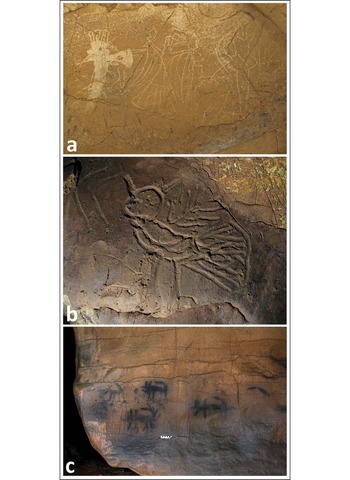
Since its discovery in the mid-nineteenth century, ancient cave art has captured the world's imagination. Long known from Eurasia (Leroi-Gourhan Reference Leroi-Gourhan1971; Breuil Reference Breuil1979), dark-zone cave art (i.e. that beyond the reach of external light) was first discovered in North America in 1979, when a cave in Tennessee was found to contain 750–800-year-old mud drawings depicting pre-Columbian Native American religious themes (Faulkner et al. Reference Faulkner, Deane and Earnest1984; Faulkner Reference Faulkner1986). Since then, 89 other pre-Columbian cave art sites have been identified in south-eastern North America. The earliest is nearly 7000 years old, but the majority date from AD 800 to 1600 (Faulkner & Simek Reference Faulkner and Simek1996; Simek et al. Reference Simek, Cressler, Douglas and Moyes2012, Reference Simek, Cressler, Douglas and Holliday2014). South-eastern cave art comprises an ancient and longstanding Native American art practice—the only such cave art tradition known in North America. Until recently, the documented images have all been fairly small—less than 1m in maximum dimension—although some are artistically compelling (Figure 1). Here, we report the recent discovery of a number of very large rock art images, which are amongst the largest known from North America. These images were only recognised using high-resolution 3D photogrammetry, a technique that produces photorealistic digital models that can be manipulated in virtual space. Our results show how photogrammetry promises a new era of discovery of ancient cave art. The technique might also contribute to the discovery of many other unanticipated aspects of the archaeological record, for example architectural features.
Pre-contact cave art from the Southeast USA: a) petroglyphs of birds and weapons from 11th Unnamed Cave, Tennessee; b) mud glyph owl from Mud Glyph Cave, Tennessee; c) pictographs of canids from 48th Unnamed Cave, Tennessee (photographs by A. Cressler).

19th Unnamed Cave and its cave art
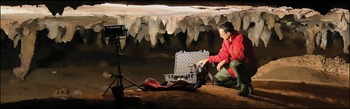
19th Unnamed Cave, Alabama (arbitrarily numbered to protect its location), was formed by solution erosion in the Carboniferous Monteagle Limestone formation found at the base of the Mississippian series in Tennessee and Alabama. The cavern comprises more than 5km of underground passageways. The entrance faces east at 219m amsl, and is approximately 10m high and 15m wide (Cressler et al. Reference Cressler1999). An intermittent stream flows out of the cave, and the vestibule has been washed clean of sediments by fluvial action emanating from inside the karst. As a result, no intact archaeological materials survive in the cave's entrance. From the vestibule, a main passage climbs to a 25 × 20m open chamber (the ‘glyph chamber’) that is bounded by flowstone formations. The mud glyphs are inscribed on the ceiling of this room, which is low—often only 0.60m from the floor—and with very few places where the space between floor and ceiling is more than 1.25m (Figure 2). A person must therefore crouch or crawl to move through this area. Sediment deposits are preserved in this chamber, and all the prehistoric artefacts so far found in the cave have been recovered from this location. The cave continues for several kilometres through predominantly low, damp passageways. It should be noted that there is a detailed and widely disseminated map of the cave passages available, but we do not show it here, as the cave is on private land, completely unprotected, and could be easily identified by vandals and looters.
Stephen Alvarez in the glyph chamber, 19th Unnamed Cave, Alabama (photograph by A. Cressler).

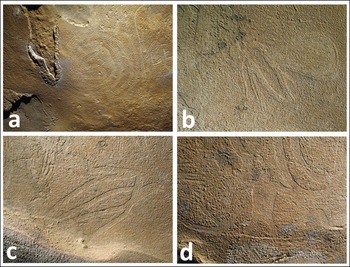
19th Unnamed Cave is the richest of all known cave art sites in south-eastern North America. First recognised to contain cave art in 1998, it contains hundreds of glyphs incised into the natural sediment coatings on the cave ceiling (Cressler et al. Reference Cressler1999). The pictures cover an area of nearly 400m2 in varying densities, from single figures to palimpsests of extensively superimposed engravings. While much of the imagery comprises abstract shapes and swirling lines, many representational figures are also worked into the sediment, including serpents, insects, birds and anthropomorphs (Figure 3a–b). Due to the low ceilings, most of these images, even though less than 1m in size, can only be viewed by lying on the cave floor. Thus, visibility of the cave art is constrained by the narrow confines of the cave itself, and the attenuated distance between the floor and ceiling limits perception of any larger images that might extend beyond the viewers’ field of vision.
Smaller mud glyphs from 19th Unnamed Cave: a) coiled serpent figure with head in the centre (0.50m diameter); b) wasp with head to the left and abdomen to the right (0.35m across); c) stylised bird (0.40m across); d) anthropomorphic figure surrounded by swirling lines (0.20m tall) (photographs by A. Cressler).

All of the glyphs are incised into a natural, thin mud veneer on the cave ceiling that was produced and conserved by condensation corrosion (Tarhule-Lips & Ford Reference Tarhule-Lips and Ford1998). Most of the images comprise multiple lines that reflect the use either of human fingertips or an inscribing instrument composed of several parallel, rounded elements. A few glyphs were formed with a wider line scraped through the mud veneer using a flat-edged tool. Our first documentation of the glyphs in 1998 used still photography of all the individual images and more general photographs of wider areas of the ceiling. We also made a series of 20mm-wide cores into the floor sediments below the mud glyphs. While we did not map the entire glyph array, we did map the chamber outline and surface rocks, and we located a number of individual glyphs using Cartesian coordinates. We examined the floor surface below the glyphs and documented all the artefacts found there. The published results of our early work include our sketch map of the glyph chamber (Cressler et al. Reference Cressler1999: 36).
Assessing chronology
Chronological data on pre-contact visitation to 19th Unnamed Cave come from two sources: temporally diagnostic artefacts and radiocarbon age determinations. Eight artefacts—all ceramic sherds—were recorded on the floor in the glyph chamber. These sherds have limestone temper, which is characteristic of the Woodland period (1000–3000 BP) in this area of the Tennessee River Valley. Given the observed variability in surface treatment and the quantity of temper included in the ceramic paste, at least five vessels must have been brought into the glyph chamber and broken or abandoned there. Curiously, no lithics or bone fragments have ever been found in the cave. This assemblage may, therefore, reflect a limited range of activities.
We have obtained two radiocarbon age determinations from 19th Unnamed Cave, calibrated in OxCal v4.4 using the IntCal20 curve (Bronk Ramsey Reference Bronk Ramsey2009; Reimer et al. Reference Reimer2020). One sample comes from the bottom of a sediment core extracted from the centre of the glyph chamber. This sample, a fragment of wood charcoal from just above a rock surface (0.30m below the current surface), is dated by AMS (Beta-126043) to a conventional age of 1240±60 BP, which calibrates to AD 660–949 (at 95% confidence). This corresponds to the Middle to Late Woodland phase in this area. The second date derives from a small fragment of river cane (‘American bamboo’, Arundinaria gigantea) sampled from a torch stoke mark on the wall, located nearly 1km beyond the glyph chamber. This sample (Beta-126044) yielded a conventional age of 1740±60 BP, which calibrates to AD 133–433 (at 95% confidence)—well within the Middle Woodland period and contemporaneous with several of the ceramic artefacts. All chronological data, therefore, point to human activity in the cave during the Woodland period, and specifically the Middle and Late Woodland periods. This was a time when food production and sedentary residential patterns, which had first developed independently in the region several centuries earlier, began to replace mobile foraging as the primary lifeway.
3D modelling at 19th Unnamed Cave
In late 2017, advances in 3D photogrammetry enabled Stephen Alvarez of the Ancient Art Archive to produce a high-resolution topographic record of the 19th Unnamed Cave mud glyphs. The goal was to create a photorealistic 3D model with millimetric accuracy. If the mud glyphs were visible in the model (which they were), it would allow for the precise measurement of image sizes and orientations, and for the examination of relationships among glyphs and their physical contexts. As modelling progressed, however, it quickly became clear that 3D photogrammetry might allow us to see images that were otherwise invisible during in-person observation.
Photogrammetry is a software-based 3D modelling technique. It begins with taking many photographs of a target object or location, with each photograph overlapping its neighbour by 60–80 per cent. Photogrammetry software compares the images and overlaps, and then calculates the camera positions used to produce the images. The software then triangulates the pixels in 3D space to create a point cloud. That cloud is rendered into a highly accurate mesh of the surface being modelled, and that mesh is skinned, or ‘textured’, with the original images to give a photorealistic 3D model. The result is then calibrated by measuring known distances. In 19th Unnamed Cave, we created three interlinked models: two of the engraved ceiling and a third model of the undecorated cave passages.
For the first ceiling model, the engraved area was photographed using a Canon 5D MK IV camera with a 30-megapixel sensor and a Canon L series 24–70mm f2.8 lens set to 24mm. The lines that form the mud glyphs were emphasised by using oblique light. Although using angled lighting made some glyphs more obvious while obscuring others, this first model was intended to provide a ‘roadmap’ for a second, higher resolution model. This second model was photographed with flat light using a very high-resolution Canon 5DS DSLR camera with a 50-megapixel sensor and a Sigma 24mm Art Series lens. These photographs, shot with 80 per cent overlap, were used to create the high-resolution model of the cave ceiling. The third model was of the entire cave space, from the entrance through the engraved sections. This final model was photographed using the same camera as in the first model (the higher resolution was not required for the final model), but with fewer images taken, resulting in lower resolution. This approach still allowed us to model the entire cave from the mouth through the glyph chamber.
Over the course of two months of field work at 19th Unnamed Cave, we captured 16 000 photographs. Images for the overall cave model (the third model) were all taken first, using the on-camera flash, and shot both handheld and with a tripod. Following this, a 12-foot movable track was positioned at the edge of the engraved ceiling section. The track allowed a camera to be mounted pointing vertically up, so that the camera's sensor plane was parallel with the ceiling. The movable track was placed roughly parallel to and often directly on the cave floor, allowing the camera to be quickly and accurately moved in a straight line. For the oblique light ceiling model, four LED video lights, mounted on tripods, were positioned perpendicular to the passage to light evenly the section of ceiling being photographed. For the second ceiling model, flat light was provided by the camera's flash.
In the laboratory, the images for the overall model and oblique light model were loaded, in TIF format, into the Ancient Art Archive's 3D modelling computer and aligned using Agisoft Photoscan v1.4.5. With more than 10 000 30-megapixel images in the two models, we quickly encountered the processing limits of our desktop computer if we attempted to run the models as single datasets. The models were therefore processed as smaller sections from the entrance area to the back of the cave.
The 4884 50-megapixel, 16-bit TIF files shot for the flat ceiling model were loaded into a new Agisoft Photoscan catalogue, and the images were aligned into sections. Medium density clouds and meshes were created for each section. Using the ceiling sections of the obliquely lit model as guides allowed us to build high quality, very dense clouds and meshes of sections of the cave ceiling. The result shows that very faint engravings, which are difficult to see in person, show up clearly in the mesh of the dense, flat-lit model. This method also allows for manipulation of the cave space by, for example, digitally lowering the cave floor to view the ceiling from different positions and as an entire composition. This latter process is particularly useful in that it allows us to view and render the very large mud glyph images discussed below.
Next, we exported the total and oblique models as textured OBJ files, which we imported into Autodesk Maya. This software allows us to fly a virtual camera through the 3D space built using photogrammetry. Using the Redshift render plugin for Maya, the virtual fly-through was recorded as a video. This resulted in an easily accessible, viewer-friendly experience of the cave. Readers are invited to view the animated model at: https://youtu.be/cQTAOqAnL-s.
Large cave art images revealed through 3D photogrammetry
The 3D models produced by the above process made it possible to identify very large mud glyphs that were not apparent in person, given the tight physical confines of the cave. Digitally ‘lowering’ the cave floor to 2m, 4m or more below the ceiling allows for a much wider field of view than possible in the cave itself. Where areas of the expanded ceiling seemed to exhibit discrete, coherent figures, a still image was produced from the 3D display of the area, and this was examined closely by magnifying sub-areas within the image. When this examination revealed the presence of very large mud glyph images, the model-derived still image was made a base layer in Adobe Photoshop and viewed using a Wacom Cintiq graphics tablet. The photographic image in the base layer was then rendered in black and white by enlarging sections of the image and tracing the outline of lines that comprise the glyph images. Using this technique, complete and accurate black-and-white renderings of individual glyphs were generated as 2D outputs from the 3D model. These drawings were then taken to the cave for visual confirmation.
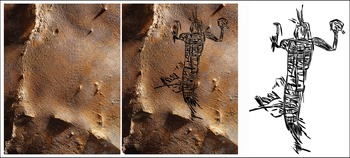
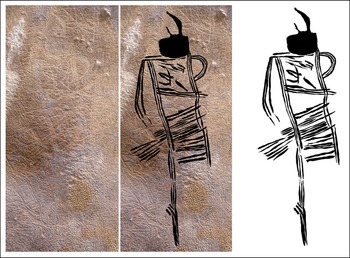
Manipulation of the distance between the viewer and the ceiling of the glyph chamber reveals myriad human and animal figures that could not be seen in situ due to their size and the viewer's physical proximity. Here, we describe the five largest images discovered using photogrammetry and manipulation of the internal cave space. Within the digital model, the cave floor was lowered to 3m below the ceiling, making it possible to view an overhead area of 5 × 5m. Using the graphics tablet, we rendered a newly recognised engraving containing dense crosshatching as a digital drawing (Figure 4). The mud glyph that emerged depicts a remarkable human figure facing the viewer. It has a long, well-formed body, with broad, rounded shoulders and extended arms. A complex design covers the torso, comprising a few long, vertical lines connected along their lengths by numerous short, horizontal line segments. This design may represent garments or regalia, as the pattern extends from the shoulders to the bottom of the figure, and the legs are obscured by the patterned area. Near the bottom of the anthropomorph, lines define a train or sash on the back of the figure, and parallel short line segments at the very base suggest a connection with the cave ceiling or, perhaps, symbolic emergence from the rock itself. The head is square with no facial features. Lines extending from the top of the head resemble feathers. The figure holds in its left hand a round object—perhaps a rattle or weapon—and the figure's right hand connects to a natural, round depression in the cave ceiling, which is similar in size to the drawn circle in the opposite hand. Although this anthropomorph measures 1.81m in length, it cannot be seen in its entirety, even when lying flat on the cave floor.
Anthropomorph in regalia (1.81m tall) from 19th Unnamed Cave, Alabama (photograph by S. Alvarez; illustration by J. Simek).

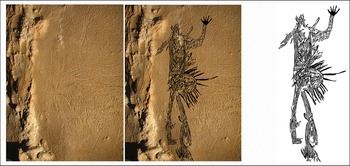
Figure 5 shows another anthropomorph with a square head and two tapered lines extending from the top. The torso is rectangular, and the upper chest area has a series of short incisions with no clear pattern. There is an unadorned rectangular area in the midsection, and the lower torso is covered by parallel horizontal lines. Parallel lines to the left side of the figure may again depict a sash. The upper limbs are both curved downwards at the torso's sides, with the figure's left limb touching the waist and the right limb extending down the body. A single, long leg is suggested by a vertical line descending from the left side of the torso. This figure is 2.08m long.
Anthropomorph in regalia (2.08m tall) from 19th Unnamed Cave, Alabama (photograph by S. Alvarez; illustration by J. Simek).

Figure 6 shows a third anthropomorph. The upper torso is rectangular and outlined with incised lines. Inside this boundary, two ‘X’ shapes fill the torso outline, and other small line segments were added around these shapes. At the bottom of the torso, a rayed semicircle projects outwards from the body. The interior of this is filled with short lines, while the rays themselves are formed by long, deep, curving incisions. This figure has two lower limbs, each of which is illustrated by multiple parallel vertical lines completed with feet, although the rightmost leg terminates in a widened structure at the foot position. The head is triangular with oval projections extending from either side, giving the general aspect of an animal head with pricked ears. The figure's right arm extends outward and disappears into a line of natural flowstone, while the left arm is raised, bent at the elbow, and terminates in a clearly human hand featuring five extended digits. This mud glyph is 0.93m in length.
Anthropomorph in regalia, with a rayed circle in the midsection (0.93m tall) from 19th Unnamed Cave, Alabama (photograph by S. Alvarez; illustration by J. Simek).

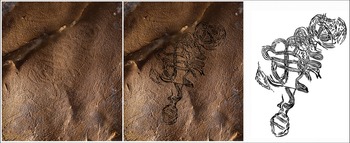
Figure 7 shows a complex figure composed of numerous twisting and curving lines. At one end is a large oval bisected by a straight-line segment. Another filled oval is positioned at one side of the midline within a sequence of looping lines. These loops project out towards opposite sides of the medial axis. At the other end of the image is a single, curving line connecting the dense central mass of lines to a terminal oval that is divided on the interior by three parallel line segments. The terminal ovals at each end of the long axis suggest a head (the bisected larger oval) and a tail resembling that of a rattlesnake. This figure is 2.12m in length; we do not know what it represents.
Enigmatic figure of swirling lines, with a round head at one end and a possible rattlesnake tail at the other (2.12m wide) from 19th Unnamed Cave, Alabama (photograph by S. Alvarez; illustration by J. Simek).

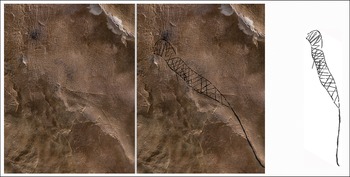
The largest figure we have so far identified in 19th Unnamed Cave is probably that of a serpent (Figure 8). The head and body begin with a rounded top that grades imperceptibly into the torso and tapers to a pointed tail. The interior is filled with six parallel lines at the head and then diamond patterns to the tail that are formed by intersecting angled lines. This diamond pattern is similar to the body colouration of the eastern diamondback rattlesnake (Crotalus adamanteus), a species endemic to the North American Southeast. The largest rattlesnake in the Americas (Klauber Reference Klauber1956: 177), this formidable animal was sacred to Southeast Indigenous people (Hudson Reference Hudson1984). The mud glyph adjoins a natural fissure in the ceiling, which appears to add to its length, and suggests that the serpent is emerging from the rock. This glyph measures 3.37m from head to tail.
Serpent figure with a round head and diamond-shaped body markings from 19th Unnamed Cave, Alabama. Note that the base of the engraved glyph joins a natural fissure in the ceiling limestone (3.3m long) (photograph by S. Alvarez; illustration by J. Simek).

Discussion and conclusions
As we have not seen their like before, we do not know the identity of these ancient cave art anthropomorphs. They are not recognisable characters from ethnographically recorded Southeast Native American stories, nor from archaeologically known iconographic materials (see Waring Jr. & Holder Reference Waring and Holder1945; Townsend Reference Townsend2004). They do, however, share certain themes with other known regional rock art, such as anthropomorphs wearing regalia, rattlesnakes and symbolic emergence from rock (Simek et al. Reference Simek, Cressler, Henson, Diaz-Granados, Simek, Sabo and Wagner2018, Reference Simek, Pritchard, Loubser and Bow2021). Thus, they probably depict characters from previously unknown religious narratives, likely of the Middle Woodland period.
The most striking aspects of these cave art images are their size and context. Among the 19th Unnamed Cave mud glyphs are the largest cave art images known in North America. They are so large that the makers had to create the images without being able to see them in their entirety. Thus, the makers worked from their imaginations, rather than from an unimpeded visual perspective. These glyphs are similar in scale to the largest open-air rock art recorded in various contexts across the North American continent. These include the famous Barrier Canyon Style images of Utah, most of which are anthropomorphic figures (Schaafsma Reference Schaafsma1971). Curiously, there are no published metric data available for the Barrier Canyon pictographs, but they are typically described as being ‘life-sized’ (i.e. around 2m in height). In one case where a measurement is given, the largest figure at the renowned Horseshoe Canyon site in Utah is described as being “over seven feet”, or 2.13m tall (Mozdy Reference Mozdy2016). Very large rock art figures are also found in the ancient murals of Baja California (Crosby Reference Crosby1997). Meighan (Reference Meighan1966: 384) observed that Baja “animals are drawn life-size or slightly larger”, and human figures can be up to 10ft (3.05m) tall. He also noted the presence of a ‘whale’ pictograph that is around 15ft (4.57m) long (Meighan Reference Meighan1966: 383), although systematic measurements for the Baja pictographs are unavailable in the literature. Finally, some of the well-known Pecos Style pictographs in Texas (Boyd Reference Boyd2016) are also very large. Boyd (Reference Boyd2019: 14), for example, illustrates a 10ft (3.05m) anthropomorph pictograph from the Cedar Springs Shelter, and there is a 4.23m-tall anthropomorph from Panther Cave (J. Lee, pers. comm.). Thus, there are large rock art figures from across North America that are similar in size to those from 19th Unnamed Cave. Before the use of photogrammetry in the cave, however, the presence of such large figures in the American Southeast was unknown and unsuspected.
The context of 19th Unnamed Cave is also an important and distinctive aspect of these mud glyphs. Unlike the large-scale rock art found elsewhere in the Americas, the 19th Unnamed Cave images are found in the dark zone of a deep cave. Indeed, cave art is a unique feature of eastern North American prehistory. From the Late Archaic period (c. 6000 years ago) until historic times, Native Americans in the American Southeast used caves as sacred places (Simek et al. Reference Simek, Cressler, Herrmann and Sherwood2013). Caves were considered to be pathways to the underworld, juxtaposed with pre-contact cultural landscapes and their large-scale, organised, sedentary communities. In those settlements, Native Americans in the Southeast built mounds, by which they could ascend to the spirits of the upper world for religious interaction. Decorated caves represented the opposite: gateways to the worlds below (Simek et al. Reference Simek, Cressler, Henson, Diaz-Granados, Simek, Sabo and Wagner2018, Reference Simek, Pritchard, Loubser and Bow2021). We know that Native Americans modified their landscapes on very large scales in order to connect the living with the natural and supernatural worlds and to the varied elements of those worlds (Anderson Reference Anderson, Wright and Henry2013; Simek et al. Reference Simek, Cressler, Herrmann and Sherwood2013). The large figures drawn in 19th Unnamed Cave therefore probably represent spirits of the underworld, their power and importance expressed in their shape, size and context. They were elements in the broader sacred spiritual landscape of pre-contact Native Americans.
Clearly, the figures from 19th Unnamed Cave have much in common with large rock art elsewhere in North America. Their size is impressive, and their subject matter—particularly the anthropomorphs dressed in elaborate regalia and exhibiting supernatural characteristics—also corresponds with the large rock art depictions found across the continent. Large anthropomorphic images in North America share a ghost-like form, with complex clothing, headgear and a position facing the viewer. Thus, although the 19th Unnamed Cave figures are the only such images so far identified in such a context, they appear to reflect ideas about the inhabitants of the supernatural world—ideas that are shared by Indigenous people over much of the continent, and depicted in their rock art.
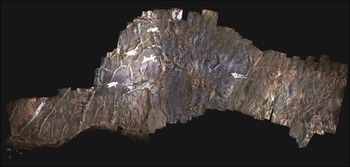
Whatever the eventual interpretation, identification of the large figures in 19th Unnamed Cave would have been impossible without the use of photogrammetry and the manipulation of 3D models. While the method has previously been used to model archaeological materials from artefacts to temples, it has always been for basic documentation, rather than to discover unanticipated or unperceived phenomena. Modelling has also been used to provide virtual-reality experiences for sites around the world (St-Cyr & Feruglio Reference St-Cyr and Feruglio2017). These are important capabilities for educating people about early cultures and for public outreach on cultural heritage and diversity, especially when used to produce animations and virtual-reality experiences. Such experiences can be of particular interest to descendant communities as they work to educate their young generations about their ancestors. The potential of photogrammetry for discovery and analysis through the digital manipulation of spaces, however, has not yet been explored in archaeology. In the case of 19th Unnamed Cave, this manipulation capability was particularly important. Moreover, the resulting data are amenable to high precision spatial analysis on a very large scale (Figure 9), opening exciting new possibilities for 3D cave art analysis.
Panorama of the entire ceiling model from 19th Unnamed Cave, Alabama, with silhouettes of the large mud glyphs described above in their spatial locations on the ceiling. The individual mud glyphs can be distinguished by comparing their shapes to Figures 3–8 (photograph by S. Alvarez).

Remote-sensing methods, such as lidar, have begun to revolutionise regional-scale analyses in archaeology (Chase et al. Reference Chase2012). Lidar, however, is not photorealistic and is therefore less satisfying than photogrammetry for analysing visual phenomena such as cave art. Photogrammetry can produce very high spatial resolution models that are inherently photorealistic, and we believe that this technique can revolutionise the study of rock art, much as lidar has done for regional site-distribution analysis. In 19th Unnamed Cave, photogrammetry has allowed us to identify previously unperceived and unknown large prehistoric cave art figures, and these will surely lead us to new understandings about ancient Native American cave art in North America.
Acknowledgements
We acknowledge the Lyndhurst Foundation, the donors of the Ancient Art Archive and the University of Tennessee for their material support. Photographs and 3D models produced at 19th Unnamed Cave are archived at the Ancient Art Archive. Virtual representations of various rock art sites, including other American sites, are available for public viewing at https://ancientartarchive.org/.
Funding statement
Funding for the early phase of the 19th Unnamed Cave project came from the US National Science Foundation (BCS-9903076). The National Geographic Society (6352-98) provided funding for radiocarbon age determinations.