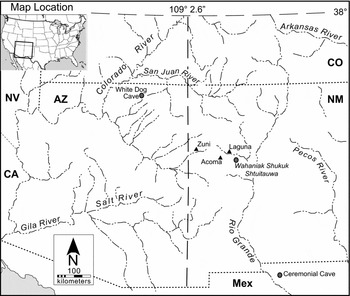
In this paper, we demonstrate that some parts of Puebloan ritual practice in the North American Southwest, especially as they relate to warfare/group defense, constitute perduring beliefs. The supporting evidence comes from our analysis and radiocarbon dating of materials recovered more than 60 years ago from an important Puebloan shrine in New Mexico (Sandburg Reference Sandberg1950). Elsie Clews Parsons brought this site to the attention of anthropologists almost 100 years ago with her descriptive report on Zuni and Laguna war god shrines (Parsons Reference Parsons1918). The first shrine she described and the one considered here is wahaniak shukuk shtuitauw Footnote 1 located west of Albuquerque, New Mexico (Figure 1). Still actively used, she considered it “one of the most important of the Laguna shrines,” visited by cheani (medicine men) and tsatio hucha (war captains), and a marker for the southeastern boundary to their traditional land (Parsons Reference Parsons1918:381). Such an interpretation is consistent with descriptions of the duties of the outside chief and his two assistants (the war captains), who were responsible for Laguna boundary maintenance (Ellis Reference Ellis1959:338). Parsons (Reference Parsons1918:390) interpreted the shrine as that of the war gods based on the presence of “feather-sticks analogous with the war god feather-sticks of Zuñi” and the abundant prehistoric weapons that she observed—arrows and atlatl darts. Although labeled a war god shrine used by war captains,Footnote 2 she thought that feather-sticks not resembling those of the war gods indicated other ceremonial roles. She noted that “men from Acoma, Zuni, and other towns” also visited the shrine (Parsons Reference Parsons1918:381).Footnote 3
Map of the North American Southwest showing the location of the shrine wahaniak shukuk shtuitauwa (Parsons Reference Parsons1918), also known as the Correo Snake Pit (Sandburg Reference Sandberg1950) and adjacent modern Pueblos. Two other archaeological sites mentioned in the text are also shown.

Some of the shrine artifacts found by Parsons resembled those thought to date prior to the Puebloan period. Chief among these were grooved curved sticks like those recovered by Guernsey and Kidder (Reference Guernsey and Kidder1921) from Basketmaker II sites in NE Arizona. The shrine atlatl darts were also known to be a Basketmaker II trait. Guernsey and Kidder (Reference Guernsey and Kidder1921:89) thought that these prehistoric artifacts derived from relatively recent deposition of old materials into the shrine. Later excavation of the shrine proved otherwise (Sandberg Reference Sandberg1950), and Parsons (Reference Parsons1918:385, 390; Reference Parsons1939:180 footnote, 305) seems to have always thought that shrine use had some antiquity.
We contend that it is no coincidence that prehistoric weapons occur at a site identified as a war god shrine where war captains made offerings. In fact, the documented ethnohistoric use reflects a long tradition of depositing offerings into this inaccessible repository in the earth for assistance in protection from other humans. These offerings initially consisted mostly of atlatl darts, flat curved sticks, and knobbed wooden clubs. We maintain that darts represented the original form of feathered prayer sticks, followed in time by arrows that served a similar purpose. We also maintain that flat curved sticks were initially used principally for defense against atlatl darts in ritual fights, but that the function of these artifacts changed through time and, ultimately, they became the rabbit sticks of historic times, which are associated with the war gods in Zuni and Keresan myths (Parsons Reference Parsons1918:385, footnotes).
The dates reported below indicate that artifact accumulation in the shrine began early during the agricultural transition of the Southwest. Radiocarbon dates on flat curved sticks and atlatl darts from wahaniak shukuk shtuitauwa indicate that shrine use began some 3,800 years ago. By this time, maize had diffused into the Southwest (e.g., Merrill et al. Reference Merrill, Hard, Mabry, Fritz, Adams and Roney2009) and started to alter the natural ecology and social relationships of resident groups. It is in this context that individuals sought supernatural assistance in defense of their social group. There are theoretical grounds to expect that lethal intergroup conflict resulting from territorial disputes would have escalated as food production became established (e.g., Dyson-Hudson and Smith Reference Dyson-Hudson and Smith1978). Researchers have documented a strong cross-cultural correlation between this sort of economy and war (e.g., Ember and Ember Reference Ember and Ember1992; Wright Reference Wright1965).
We begin by briefly describing the shrine and then consider what the ethnographic record has to say about the cultural significance of this geologic feature, Puebloan war societies, and ritual practice. We then present and discuss the radiocarbon dates on wooden artifacts from the shrine. Finally, we discuss three artifact classes that likely represent some of the earliest materials deposited in the shrine: atlatl darts, knobbed sticks, and flat curved sticks. We provide more descriptive detail on the latter; their functional role is controversial as they might have served in warfare, rabbit hunting, or both (e.g., Guernsey and Kidder Reference Guernsey and Kidder1921; Heizer Reference Heizer1942; LeBlanc Reference LeBlanc1999).
The Shrine
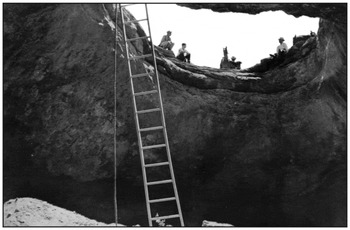
Wahaniak shukuk shtuitauwa is a travertine mound about 70 m in diameter that rises some 10–11 m above the surrounding plain. Near its center is a 6–9 m deep shaft through the precipitated calcium carbonate. The oval pit opening measures roughly 5 by 11 m, but the walls expand outward with depth reaching a maximum diameter of about 21 m at the level of sediment fill (Figure 2). This jar-like conformation provided areas sheltered from precipitation, preserving organic remains to a variable extent. The pit served as a natural trap for sediment and hapless animals and for ritual deposition.
View from the bottom of wahaniak shukuk shtuitauwa looking out the mouth. Photo taken during excavation of the site by a University of New Mexico archaeological field school in 1949 (photo courtesy of Anne Willis, one of the participating students).

When Parsons visited the shrine in 1917, she saw looter disturbance, particularly in the western end. Her guide said that it was undisturbed on his first visit in 1913 and “that the west end looked like a big pincushion stuck full of arrows” (Parsons Reference Parsons1918:382–383). Parsons observed hundreds of worked sticks in this area, mostly arrow and dart shafts. She described some of these and other artifacts, both ethnographic specimens of relatively recent origin (feathered prayer sticks) and those that seemed significantly older such as atlatl darts and grooved, flat curved sticks. Her selective sample of specimens is housed in the ethnographic collections at the American Museum of Natural History (Accession No. 1918-17; a collection made by John Goggin in 1934 is at the Yale Peabody Museum of Natural History [Accession No. YPM.05853]). Parsons (Reference Parsons1918:390) concluded that the main shrine was in the west side of the pit, under the overhang, facing the rising sun, and that formerly implements of war and hunting were tossed as offerings into this area and the opposing east side.
Excavation
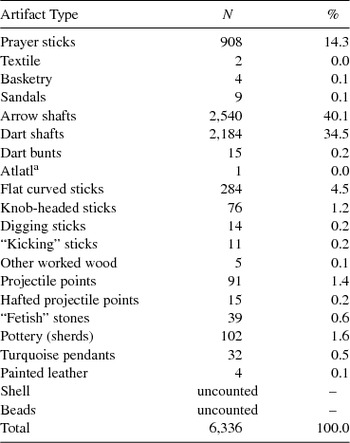
In 1949, the University of New Mexico (UNM) conducted a field school excavation at the shrine directed by Paul Reiter and supervised by Sigfred Sandberg, who subsequently wrote his master's thesis on the recovered artifacts (Sandberg Reference Sandberg1950). Named the Correo Snake Pit (LA46316), we refer to the shrine by its Laguna name wahaniak shukuk shtuitauwa (WSS) or simply as the shrine. Sandberg (Reference Sandberg1950:2) claimed that “the 1949 field group excavated the area in its entirety,” but his work effort map indicates that they disturbed only about 5 percent of the floor. Nonetheless, they recovered copious artifacts of the sort that Parsons observed, plus basketry, sandals, and more (Table 1).
Artifacts from Wahaniak Shukuk Shtuitauwa.

Note: Recovered by the 1949 University of New Mexico field school and reported in Sandburg (Reference Sandberg1950).
a Sandberg (Reference Sandberg1950:71) listed this artifact as a digging stick and claimed that no atlatls were recovered from the site.
Sandburg (Reference Sandberg1950) tabulated remains by the arbitrary six-inch excavation levels used for vertical control, but these are meaningless given the undulating stratigraphy coupled with projectiles that penetrated to various depths within the fill. Determining chronological trends in technology requires direct dating; fortunately, the AMS radiocarbon technique makes this possible with minimal destruction of perishables. When Sandburg wrote his thesis, radiocarbon dating was new and the possibility of directly dating the WSS finds was likely beyond imagining (a potent reminder of the value of keeping archaeological collections accessible for study).
Based on the recovered remains, Sandburg (Reference Sandberg1950:178) concluded that “the pit was a perennial shrine from Basketmaker times up to and including the Pueblo V Period.” His “Basketmaker times” referred to the Basketmaker II period, and in the 1950s this meant roughly the first 500 years of the Common Era. Excavation exposures convinced him that the prehistoric artifacts were not from modern deposition of old materials, but, rather, from an accretion across a long span of time. Nonetheless, the temporal range revealed here by radiocarbon dates likely would have surprised Sandburg and Parsons. He corroborated Parsons's observation that the archaeological material was concentrated in western and eastern portions of the pit, emphasizing the ritual significance of these cardinal points and the east-to-west axis (perhaps, as we discuss below, related to the path of the sun and use of the pit as a solstice shrine). Sandburg Reference Sandberg1950:179) postulated “an evolution of shrine uses” with “hunting or warfare prayers” early on “followed by an agricultural emphasis.”
The pit preserved organic remains because humans tossed or shot artifacts down in preferred directions so that the overhang protected them from falling precipitation. Some artifacts are in relatively good condition but none are as well preserved as occurs within dry caves of the Southwest. Artifacts sat on the surface for some length of time subject to blowing and dripping precipitation and, after burial, to moisture wicked through the sediment fill. Darts and arrows probably started out rather vertically, but most fell over in time and became buried by sediment and subsequent additions. Weathering, rock falls, the addition of new materials, and excavation no doubt fragmented many artifacts.
New Museum Research
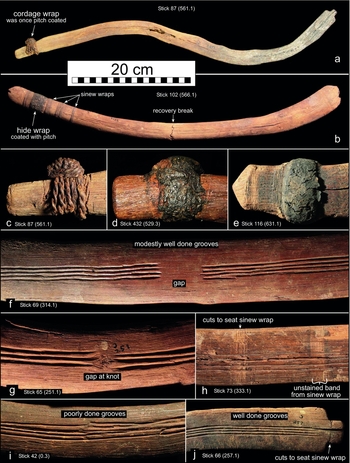
Interest in the artifacts recovered by the UNM excavation and housed at the Maxwell Museum of Anthropology occurred when the senior author learned about the site and the numerous examples of the curved sticks found there (Figure 3). Commonly labeled as fending sticks, rabbit sticks (throwing sticks), or grooved clubs, we designate them descriptively as flat curved sticks (FCS) so as not to presume function. Archaeologists have recovered similar artifacts from sheltered sites throughout the Southwest and at Chichén Itzá in Mesoamerica (Coggins Reference Coggins, Coggins and Shane1984). The shrine collection has the largest assemblage of FCS from a single site, and the variability represented seemed of potential temporal if not functional significance. Geib's (Reference Geib2016) examination of the shrine's FCS concerned their potential role in conflict and warfare among early farming groups of the Colorado Plateau. The details are not of concern here, but some salient findings are included below.
Examples of flat curved sticks from wahaniak shukuk shtuitauwa (handles on the left) and close-ups showing details of these and other sticks: (a) S-shaped stick; (b) crescent-shaped stick; (c, d) cordage wrapped grips, one with the pitch coating intact and the other eroded showing the knot-like construction of the knob; (e) hide wrapped grip; (f–j) incised longitudinal facial grooves. (Color online)

Fields (Reference Fields2013, Reference Fields2016) has conducted additional research in recent years with the WSS collection, focusing on atlatl darts and atlatl dart foreshafts. He has also contacted some of the original field school participants to learn about their experiences working at the site.
Puebloan War Shrines and Rituals
Broad patterns of shared reverence and selective use of naturally occurring geologic features such as caves and sinkholes extend well into Mesoamerica and appear to have great time depth, possibly dating back to the Olmecs (Taube Reference Taube1986). In Puebloan cosmographies, caves and crevices such as the natural shaft of wahaniak shukuk shtuitauwa provide a more direct connection to the underworld (Ellis and Hammack Reference Ellis and Hammack1968:30; Taube Reference Taube1986). In a Maya context, Brown and Emery (Reference Brown and Emery2008:311, 323) have referred to such spaces as “animate doorways,” where social interactions with the natural world are enlivened and performed. Taube (Reference Taube1986:72) ties such features in the American Southwest and Mesoamerica to shared concepts of emergence mythology involving subterranean worlds. In a Puebloan context, Naranjo and Swentzell (Reference Naranjo and Swentzell1989:261) argue that shrines are openings to the underworld, important “because they connect the interior of the earth with the human-defined space.” Ortiz (Reference Ortiz1968:24) described such contexts at the pueblo of Ohkay Owingeh as “earth navels,” center places that connect to and call in sacred connections at multiple levels: “They serve not only as entrances to the below, but as the points at which the above, the middle and the below come closest to intersecting in each direction” (Ortiz Reference Ortiz1968:24). This particular geologic feature relates to these broader patterns and to the particular association of solstice shrines with war chiefs who are considered chiefs of the nadir or below (Parsons Reference Parsons1939:125–126, 169–170, 908–909).
War societies played a prominent part among all Puebloan groups of the Southwest even at the time of ethnographic recording, when the external overarching political force of the U.S. government had imposed a general cessation of hostilities, both among various Puebloan groups and between them and the nomadic Apache and Navajo. Early ethnographers recognized the political and ritual significance of war societies, but lamented that they were but a shadow of their former self. For example, Parsons and Beals (Reference Parsons and Beals1934:497) state that “[t]he Pueblo war groups or chieftaincies have disintegrated more than any other part of the social organization, due to the passing of war.” In another report, she states that “formerly there were the u'pi', the scalp-taking warrior organization, but now they are all gone” (Parsons Reference Parsons1920:69). According to Bunzel (Reference Bunzel1932a:525), “the war cult of the Pueblos, as in other tribes, is greatly in abeyance at the present time due to enforced peaceableness.” She noted that “intertribal warfare was once an important part of life and was accompanied by elaborate ceremonies,” but concluded that the Pueblos were “probably not aggressive warriors” (Bunzel Reference Bunzel1932a:525). Yet Bandelier (Reference Bandelier1890:194) stated that Puebloans practiced scalping far more commonly than did the Apache.
Scalps provided tangible proof of success in warfare and allowed admittance to Puebloan war societies (e.g., Curtis Reference Curtis and Hodge1922:65, 69, 131, 221; Parsons Reference Parsons1924:7; Stevenson Reference Stevenson1904:577). Indeed, any slayer of an enemy had no choice but to join a warrior society so that the ghost of the deceased could be prevented from doing harm (Bunzel Reference Bunzel1932b:674; White Reference White1962:305–306). Scalps provided the opportunity for prestige and even political advantage. In her discussion of the Zuni's political hierarchy, Stevenson (Reference Stevenson1904:577) mentions that, when a new “Elder Brother Bow Priest” was needed, the person customarily put into that position (the Younger Brother Bow Priest) might be superseded by another that became “more famous in war when his scalp trophies [won] for him the highest honors conferred on any member of the body.” In addition to enlarging the ranks of those whose role was to help protect the group, scalps were thought to possess important ritual power to help with fertility, rain, and the like (e.g., Ellis Reference Ellis1951:189, 192; Parsons Reference Parsons1924:6). This was achieved by the initiation and propitiation of the dead into the killing group (Parson Reference Parsons1924:6). In this manner, enemies that would threaten group survival not only were eliminated but their power was commandeered to help the group.
Either Zuni and Keresan war chiefs (also called priests by ethnographers) are themselves paired and explicitly connected to the twin war gods, as evident with Elder Brother and Younger Brother Zuni Bow priests (Stevenson Reference Stevenson1904:577–582) or a war chief may oversee two assistants (often referred to in the literature as war captains or lieutenants) who are symbolically representative of the hero twins, Elder and Younger brother, Masewi and Oyoyewi (e.g., Ellis Reference Ellis1951:186–187, 195; Parsons Reference Parsons1939:348). The ethnographic term “Outside chief” is also used and may refer to the singular principal war chief, or “Outside chiefs” may refer to both the war chief and his two assistants or lieutenants. Various ethnographic data suggest that the role of war priest/chief may, at an earlier time, have had primacy over the town chief (e.g., Ellis Reference Ellis1951:183–184; Ellis and Hammack Reference Ellis and Hammack1968:38; Ladd Reference Ladd and Ortiz1979:488–489; White Reference White1942:102–105).
Documented duties for Puebloan war chiefs/priests in the ethnohistoric era included boundary maintenance, warfare, ritual hunting, safeguarding traditions, keeping the solar horizon calendar, and determining the timing of solstice events (Ellis Reference Ellis1951:184; Ladd Reference Ladd and Ortiz1979:488–489; Parsons Reference Parsons1939:150, 305–306, 884 n.). Their purview clearly extended far beyond warfare per se to include numerous activities re-quired to keep their people safe in a more holistic sense. Such activities involved the regulation of the agricultural calendar as marked by solstices, weather control, kick-stick races intended to assure the movement of the sun (e.g., Parsons Reference Parsons1939:638–639, 821–824), and maintaining the traditions that ensured health and security. The role of the war captain, according to Eggan (Reference Eggan1950:250), was to “protect the village against enemies—external, internal, and supernatural.”
Offerings deposited for the war twins by war chiefs and war societies include miniature bows and arrows as well as various forms of prayer sticks (Parsons Reference Parsons1939:150, 305–306, 483, 532). Such items are given to the sun as part of a winter solstice ceremony and as offerings to the sun on other occasions (Parsons Reference Parsons1939:305–306). Pueblo consultants described winter offerings (Ellis and Hammack Reference Ellis and Hammack1968:32–33) as those
addressed to supernaturals concerned with warfare and hunting, as well as to the Sun. These should consist of miniature—and sometimes full size—bows and arrows, rabbit sticks, lightening sticks, prayer sticks . . . such items as the netted “shield” of the War gods, and images of plants and animals for which increase is desired.
This description seems to fit well with the artifacts recovered from wahaniak shukuk shtuitauwa and led Ellis and Hammack (Reference Ellis and Hammack1968:32) to interpret it as a major sun shrine containing offerings deposited during the observation of solstice ceremonies. Ellis and Hammack's solstitial emphasis is not at odds with Parson's war shrine interpretation. Rather, it simply emphasizes the ritual connection between war captains and astronomical observations of solar events and recognizes that, in Puebloan conceptions, war and ceremony are not divisible into secular and sacred activities (Ellis Reference Ellis1951:180).
Shrine Age
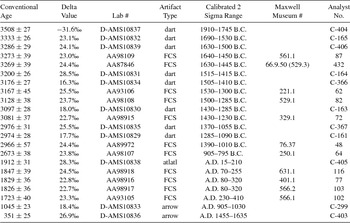
Radiocarbon dates on a sample of the recovered artifacts provide an estimate for when ritual deposition began at wahaniak shukuk shtuitauwa.Footnote 4 A total of 22 radiocarbon dates are available: 11 on FCS, 8 on atlatl darts, 1 on an atlatl, and 2 on arrows (Table 2). We selected samples to adequately include distinct specimens while simultaneously taking into account condition so as to include items with the greatest information. The two arrows had to postdate the arrival of bow technology in the southwest (after ~A.D. 500) but the ages of the other samples were unknown. Degree of preservation did not provide a useful indication of relative age: FCS 116 is quite degraded, yet it is one of the youngest artifacts, whereas FCS 87 and 432 are better preserved, yet over 1,000 years older.
Radiocarbon Dates on Select Wooden Artifacts from Wahaniak Shukuk Shtuitauwa.

Note: Dates are are calibrated with OxCal version 4.2, IntCal13 calibration curve, five-year rounding.
The 11 FCS samples were dated at the NSF-Arizona AMS Facility at the University of Arizona with the other 11 dated at the DirectAMS laboratory. The samples consisted of minute wood splinters or shavings less than the size of a pin removed from cracks or breaks (preventing visible damage) or drilled shavings on a few occasions. Sampling interior wood limited contamination from handling or other extraneous additions that might have occurred since deposition and recovery. In instances where preservative might have been applied to the wood, sample pretreatment involved soxhlet extraction (hexane, ethanol, and methanol) prior to the standard acid-base-acid protocol.
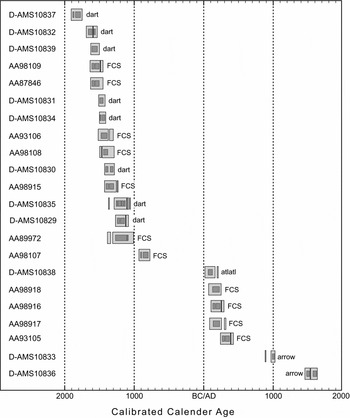
Table 2 presents the 14C results in sequence from oldest to youngest, along with the calibrated two-sigma calendar age as calculated with OxCal version 4.2 using the IntCal13 calibration curve and five-year rounding; Figure 4 graphs these results. The artifacts range in age from just over 3500 B.P. to less than 400 B.P., a span of over 3,100 radiocarbon years. The dates reveal that deposition of atlatl darts and FCS into the shrine began shortly after 2000 cal B.C. This continued for at least a thousand years until about 800 cal B.C. There is then a gap of about 800 years followed by continued deposition of atlatl darts and FCS during the early part of the Common Era, from about cal A.D. 15–410. The two arrows date to the final 1,500 years of the Common Era; any gaps during this most recent interval should be considered illusory in the absence of additional dates on arrows and other materials of probable more recent age. The same might not apply to the date gap during the first millennium B.C., given that it is based on 20 samples: 15 on the early side of the gap and five on the late side. Although additional dating might reveal no break in shrine use from 800–0 cal B.C., there are changes in some characteristics of FCS that coincide with this gap: shift from S-shaped to crescent-shaped and from having three to four longitudinal facial grooves (discussed below).
Graph of calibrated dates on wooden artifacts from wahaniak shukuk shtuitauwa, ordered from oldest to youngest.

Atlatl Darts as Original Prayer Sticks
Sandburg (Reference Sandberg1950) recovered over 2,100 portions of atlatl darts and over 2,500 portions of arrows from wahaniak shukuk shtuitauwa. Fields's (Reference Fields2013) reanalysis of these projectiles documented 974 atlatl darts represented by 492 proximal portions, 482 distal portions, and 376 dart foreshafts; he did not count midsections. Sandburg's (Reference Sandberg1950:Tables 6–9) count of arrows included 1,380 foreshafts, 451 distal ends to receive foreshafts, 395 proximal portions (nock ends), and 54 nock end inserts (notched pieces of hard wood inserted into the proximal end of reed mainshafts). It seems safe to conclude that some of both weapons were removed by previous people who entered the shrine.Footnote 5
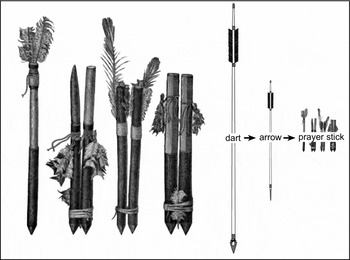
In historic times, Puebloans dropped feathered prayer sticks into the shrine. There are differences in prayer sticks that have both ritual and cultural significance (e.g., Ladd Reference Ladd1963; Solberg Reference Solberg1906), but they generally consist of short twigs that may be whittled at one end, often to a point, with feathers attached at the other end (Figure 5). We believe that such sticks represent a miniaturization and modification of the original artifact used to make prayer offerings: atlatl darts. Arrows ultimately supplanted darts for prayer offerings after the introduction of bow technology during the Common Era. Many arrows in prehistory were tipped by wooden projectiles fashioned from sticks whittled and abraded to a point and this is also true for wooden atlatl dart tips, examples of which occur in the shrine collection (Fields Reference Fields2013, Reference Fields2016; Sandburg Reference Sandberg1950). Parsons (Reference Parsons1939:276) notes a selection of different feathers depending on the nature of the prayer stick, with those for flight (wing feathers) selected for war sticks among the Hopi and Zuni because of their “strength” or stiffness. Since flight feathers are also those most commonly used for fletching darts and arrows, the association with war prayer sticks seems rather direct: the feathers are those used on lethal projectiles. The embodied qualities that things have in the material world, like strong wing feathers, create a mimetic effect: a link between war and strength and the stiff wing feathers that fletch darts and arrows and adorn war prayer sticks. Feathers also carry multiple meanings and varied forms of efficacy: they convey messages to supernaturals, they placate and provide raiment for supernaturals, and they may explicitly refer to the directional and/or seasonal association of a particular bird species or plumage color (Parsons Reference Parsons1939:281–283).
Examples of prayer sticks that Parsons recovered from wahaniak shukuk shtuitauwa (modified from Parsons Reference Parsons1918:Figure 40) along with the analogous and predecessor artifacts for prayer offerings: arrows and atlatl darts.

Our argument that darts served as the original prayer sticks might not be a controversial proposal to Puebloans. Indeed, Parsons (Reference Parsons1929:644) relates that “the concept of prayer-stick as miniature weapon occurs, we know, among the Pueblos, in the miniature bow and arrow and war club.” In this vein, she also sees close parallels between the feathered lances of the Plains and “certain types of Pueblo prayer-sticks” (Parsons Reference Parsons1929:644). These parallels are straightforward in that the offerings are essentially scaled-down and somewhat simplified versions of the life-size artifacts. Elsewhere, Parsons (Reference Parsons1918:385) notes the use of the term hachamuni (usual word for feather-stick offering) by a Laguna informant when referring to the rabbit stick painted with feathers attached and deposited as an offering. Our proposed metamorphosis from dart to feathered prayer stick recalls Hall's (Reference Hall1977, Reference Hall1997) argument about the transformation of atlatl to peace pipe.
Imploring supernatural assistance with an offering of darts and arrows seems fitting. What do people commonly pray for? Security, health, prosperity, and related aspects are common enough (e.g., Ortiz Reference Ortiz1979:501). Rain and fertility were a central Puebloan concern: prayers for life-giving rains to stave off drought and the famine that came with crop failure Parsons Reference Parsons1939; Ortiz Reference Ortiz1979). Indeed, according to Parsons (Reference Parsons1939:481), “probably no Pueblo ceremony is without song or prayer for moisture.” Equally important to individual and group survival was protection against physical attacks by outsiders or spirit attacks by witches or those with influence over supernatural forces (Simmons Reference Simmons1974; Whiteley Reference Whiteley, Nichols and Crown2008). This was true in part because “sickness or epidemic, insect pest, drought or windstorm are in large part caused by witches” (Parsons Reference Parsons1924:6). According to Ellis (Reference Ellis1951:180),
Pueblo tradition indicates that the people lived in considerable jealous fear of “power” derived from the supernaturals but controlled by other groups of human beings: a pueblo did not hesitate at forays of punishment against people who appeared to threaten them with this undue “power.”
Puebloans also offered up prayers for protection in war or group defense and for protection from enemies and witchcraft. This form of mimetic offering of items that you hope to have success with seems apropos: prayers for success in fighting enemies and in obtaining game (Parsons Reference Parsons1939:306), prayers for the true flight of darts and arrows toward targets that threaten existence and those that sustain existence. “Prayer offerings serve as objects of barter between man and god, as vehicles of mimesis within the cultural context, and as apotropaic powers in themselves” (Geertz and Lomatuway'ma Reference Geertz and Lomatuway'ma1987:30).
Knobbed Sticks as Bow Priest Clubs
Sandburg (Reference Sandberg1950) recovered 76 knob-headed sticks from wahaniak shukuk shtuitauwa (Table 1), and Parsons collected at least one of these (Reference Parsons1918:Figure 39 middle). These clubs are made from lignotubers of Gamble oak (Quercus gambelii), with the stem as the handle and the heavy burl-like mass of the lignotuber as the distal end or head. Puebloans are reported to have used these knobbed sticks as cudgels to dispatch rabbits or hares (e.g., Curtis Reference Curtis and Hodge1926:127, The Keres) and Parsons (Reference Parsons1918:384) reported the same, but she also provides an intriguing footnote. When she showed one of the knobbed clubs from WSS to a Zuni informant, he called it a “bow priest club” (pilashiwanni tamkyapnik) and told her that such sticks were not used to hunt rabbits (ParsonsReference Parsons1918:384, note 2). Parsons (Reference Parsons1918:384, note 2) concluded, “I have little doubt that the clubs in the pit shrine were war clubs although clubs like them are applied today, not to Navajo, but to rabbits.”
By identifying a knobbed stick as a bow priest club, the Zuni informant meant that it served as a symbol of leadership in the warrior society known as apilashiwanni (Parsons Reference Parsons1918:39). Similar war societies were present among all Puebloan groups. The Zuni man may have recalled an implement from an earlier time described in oral tradition. The knobbed stick from the shrine illustrated by Parsons looks quite suitable as a shock weapon, but it is not a historic Zuni war club like the one that Stevenson (Reference Stevenson1883:372, Figure 491) illustrated and that pioneer Spaniards of New Mexico called macana: a stone head lashed to a stick with strips of rawhide (Chavez Reference Chavez1959:81, footnote), the lethality of which was documented by Catholic missionaries, such as Benavides (e.g., Gueno Reference Gueno2010).
The knobbed sticks from WSS are the probable predecessor for the historic examples. Indeed, given the age of the remains in the shrine, these knobbed clubs may have been in use prior to the adoption of bow and arrow technology. Prior to this, a “bow priest” may have been designated as an “atlatl priest,” the previous weapon for war. As such, a bow priest's club might be interpreted as meaning an atlatl priest's club originally, or a war priest's club more generally. Yet FCS are a more likely candidate for such a designation because they are known to substantially predate bow and arrow technology and they might well be closely tied to atlatl use in human conflict.
FCS as Warrior Symbol
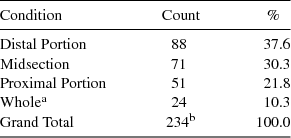
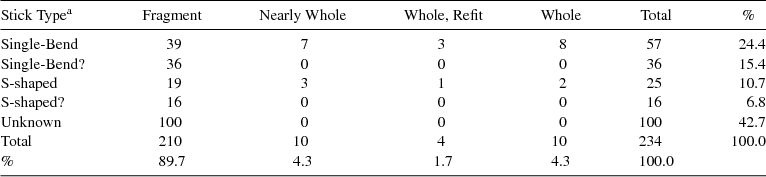
Geib (Reference Geib2016) analyzed 234 curved sticks with a flattened cross section from wahaniak shukuk shtuitauwa (Table 3). This is not a true minimum count, given that some distal and proximal ends might come from the same artifact. By considering just whole sticks and the most numerous end fragment (distal portions), the count is 112. Yet there are proximal portions with the rest of the stick rotted away and also midsections where both ends seem completely rotted. An accurate minimum count is not possible, but 150 seems a conservative estimate and it could well be greater than 180.
Minimal Count of Flat Curved Sticks from Wahaniak Shukuk Shtuitauwa.

Note: 234 is less than the number listed by Sandberg (Reference Sandberg1950; see Table 1); plus it includes 14 specimens at AMNH and 5 at Yale Peabody Museum; the difference is mainly a result of intensive fragment refitting to arrive at a minimum number of artifacts.
a Includes nearly complete and those that were broken but refit as whole.
The intended or realized purpose of FCS is controversial. Two principal options are for hunting game (i.e., as rabbit sticks) or for defense against atlatl darts—the fending hypothesis (see below). We argue that some FCS in the shrine served defensively against atlatl darts, albeit not in true warfare (for which they are poorly suited). The shrine FCS exhibit shifts in morphology that are related to changes in use reflected by physical traces on the artifacts. Through time, the artifacts become more like ethnographic rabbit sticks, and eventually they look little different. This is accompanied by a corresponding increase in physical traces from throwing use.
Stick Description
The two basic forms of FCS are crescent-shaped (single-bend) and S-shaped (double bend), with the former more common at the shrine (Table 4; Figure 3a,b). Based on an MNI using whole sticks, plus the most numerous end portion, there are at least 52 single-bend sticks (63 percent) and 30 S-shaped sticks (37 percent). The higher count of crescent-shaped sticks might be partially a consequence of age since radiocarbon dates show that S-shaped sticks are substantially older than the single-bend variety (Figure 6); hence, a greater proportion was perhaps lost to fragmentation and decay. The flattened cross section of FCS was produced by removing wood from opposing faces of an oak limb. The worked faces defined stick thickness, which is generally between 1 and 2 cm; stick width is between 1.8 and 5 cm, and length is between 53 and 83 cm. Most FCS were well finished, noticeably more so than ethnographic rabbit sticks, and most handles were once wrapped with either cordage or hide strips sealed by pine pitch (Figure 3c–e).Footnote 6
Type and Condition of Flat Curved Sticks from Wahaniak Shukuk Shtuitauwa.

a Identifying stick type of fragments depends on size; many large portions were easily classified, but smaller fragments either could not be specified, hence the unknown category, or could not be specified with certainty (affixed by a ?). Sticks of inferred probable form sometimes had other traits that increased the likelihood of correct identification. One of the near whole sticks has entire length but is split longitudinally in half.
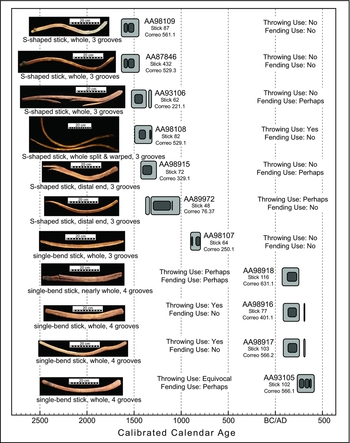
Graph of calibrated dates on flat curved sticks from wahaniak shukuk shtuitauwa ordered from oldest to youngest with all sticks shown at the same scale. (Color online)

The existing dates reveal that prior to 1000 cal B.C. all dated sticks are S-shaped (Figure 6), whereas after this they are crescent-shaped, with the earliest between about 900 and 800 cal B.C. and the rest dating to the first few centuries of the Common Era. Additional dating might eventually reveal that S-shaped sticks extend into the Common Era, since this is true for the Four Corners (Geib Reference Geib2016).Footnote 7 Crescent-shaped sticks might also be shown to date earlier, but the current suite of dates provides clear separation of stick form at the site and also reveals patterning in other attributes, such as longitudinal facial grooves.
All but 14 of the shrine FCS have parallel grooves incised into both faces for nearly complete stick length. None has more than four grooves, unlike the comparable artifacts from the Sacred Cenote at Chichén Itzá, which contain five, seven, and 11 grooves. The 14 shrine FCS lacking facial grooves are all single-bend; all of the identifiable S-shaped or possible S-shaped sticks have grooves (see Geib Reference Geib1990 for examples of ungrooved S-shaped sticks). Sticks with four grooves account for over half (56 percent) from the shrine excluding indeterminate specimens (split fragments with a groove or two but not a full count). Sticks with three grooves account for 43 percent of the sample and all FCS dating earlier than 800 cal B.C. have this number, whereas those dating after this have four grooves, except for one with two grooves.
Aside from any ritual meaning, the number of grooves may have social implications. Parsons (Reference Parsons1939:1028) sees the customary four grooves of Basketmaker II sticks from the Four Corners as representing a predilection for this number that is carried through to the modern Puebloans of the west (the Hopi, Zuni, and Keres) but not the Tanoans. Basketmaker II FCS of the Four Corners always have four grooves like the more recent sticks from WSS, so perhaps the shift in groove count reflects a change in the territorial boundaries between different ethno-linguistic groups and “ownership” of the shrine.
Stick Function
The Fending Hypothesis
Based on the notion that use can be inferred from form by direct analogy to ethnographic objects, FCS could be labeled as rabbit sticks—they are similar to what Puebloans and other Southwest tribes threw to kill small game. Since “similarity in form does not necessarily signify identity in function” (Heizer Reference Heizer1942:41), corroborating evidence consistent with an inferred use provides a critical link in such a knowledge claim (Wylie Reference Wylie2002: 136–153). When Guernsey and Kidder (Reference Guernsey and Kidder1921:88) brought S-shaped FCS to the attention of archaeologists, they used use-wear to argue against a hunting role. Puebloan rabbit sticks provided their frame of reference for use damage from throwing at small game. Because the S-shaped FCS they recovered at Basketmaker II sites lacked the expected throwing-related use-wear—bruising and battering on edges and ends—Guernsey and Kidder (Reference Guernsey and Kidder1921:88) concluded that the artifacts were unlike Puebloan rabbit sticks.
The alternative dart-fending function for FCS was based on comparison to an “odd-shaped club” that Solomon Islanders used for defense against spears (Guernsey and Kidder Reference Guernsey and Kidder1921:88, footnote). This turns out to be a poor analogue because the Solomon Island parrying clubs (qauata and roromaraugi) were formidable offensive weapons aside from their defensive role (reviewed in Geib Reference Geib2016:128–134). FCS are not genuine offensive weapons, and lightweight examples, at 200 g or less, could do little harm, especially since the mass is rather evenly distributed instead of concentrated at the distal end like historic Puebloan war clubs.
Lest readers think that trying to deflect atlatl darts is absurd, there are tribes in South America who do this: the Kamayurá (Camayurá) and adjacent groups of the Upper Xingu region of central Brazil (Basso Reference Basso1973:152; Oberg Reference Oberg1953:57–58). This impressive feat is performed in a ritual where paired opponents take turns trying to strike each other with atlatl darts thrown at close range; they use a bundle of poles for defense. This duel-like contest has explicitly violent overtones of intergroup conflict but with cultural constraints to ensure a nonlethal outcome, including prescriptions on which body portions are legitimate targets and tipping the darts with bunts. These duels reinforce men's esteem as great warriors, a measure of their worth to fellow men and in the eyes of women, while simultaneously reinforcing peaceful relations between neighboring groups (Gregor Reference Gregor1985:96). Since dart deflection is achieved with a more substantial obstacle than a flat curved stick, the analogue might seem inappropriate. Yet it is in this sort of rule-bound, duel-like setting that use of an FCS for atlatl dart defense seems plausible.
The antiquity of the South American atlatl dueling ritual remains unknown, but it could be considerable given the weapons involved. Prior to enforced peacefulness, the contest might have involved lethally tipped darts with consequences far more severe than bruises. Perhaps a similar ritual was practiced in the Southwest but using FCS for defense. The feat of deflecting atlatl darts would seem all the more impressive using just a small stick. Key for assessing whether this might have occurred is determining whether deflecting atlatl darts with FCS is possible and what an analysis of use-wear and use-inclusions reveals about stick function.
To answer whether atlatl darts can be deflected with FCS, Geib (Reference Geib2016:150–158) conducted an experiment in the controlled setting of a duel (Supplemental Video 1). Two experienced atlatlists took turns throwing bunt-tipped darts at an opponent 11 m away who defended with an FCS. Substituting stone tips for bunts would not diminish the utility of an FCS for dart deflection and such bunts were used in the Southwest, perhaps for fights lacking lethal intent (15 were recovered from the shrine, Table 1). After gaining some experience with fending away atlatl darts, approximately three hours were spent in the duel-like activity. During this time, an estimated 100 darts were thrown, although only about half of these were sufficiently on target to necessitate deflection.
Geib's (Reference Geib2016) experiment demonstrated that FCS could deflect atlatl darts thrown at close range. A shield would provide far superior protection, a conclusion that Garnett (Reference Garnett2015)Footnote 8 also reached, and defenders would have received one or two potentially lethal hits, if the darts had been tipped with stone points. Yet superior defense might not be a consideration. If achieving status by facing inherent risk was an objective, then flat curved sticks are quite suitable: despite appearing like an improbable defensive tool, they work.
The second goal of the dart-fending experiment was to determine what sort of use-wear or use-inclusions might result. This was central to assessing if this activity actually occurred in the past since an affirmative answer to whether FCS can knock aside atlatl darts says nothing about whether this occurred in prehistory. Documenting use-wear from atlatl dart-fending was difficult to fully realize without using dangerously tipped projectiles. Nonetheless, experimentation with nonlethal darts provided information about the sorts of wear traces that develop and provided a basis for making inferences about the use damage documented on prehistoric artifacts.
FCS Functional Analysis
Geib (Reference Geib2016) documented the wear traces, use-inclusions, and breakage patterns for hundreds of FCS from throughout the Southwest, including those from wahaniak shukuk shtuitauwa. His functional interpretations of these data were informed by ethnographic and experimental artifacts that allowed distinctive use-traces to be linked to particular activities (Geib Reference Geib2016:244–279). A suitable frame of reference for dart deflection came from the experiment, since there are no ethnographic specimens. Experimental rabbit sticks were also informative, as there are many unknowns about the history and settings of use for ethnographic specimens.
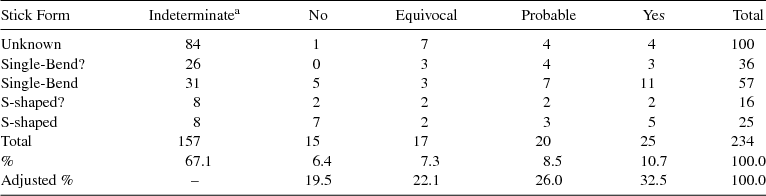
Table 5 presents an inference as to whether or not shrine FCS were used as rabbit sticks, based on an aggregate of all evidence. Excluding sticks too poorly preserved or fragmentary (indeterminateFootnote 9 ), 33 percent of the shrine FCS exhibit evidence that seems definitive of rabbit stick use, and another 26 percent were perhaps so used. Still, 20 percent of the sticks of sufficient size and preservation lacked any evidence of throwing, with more of these S-shaped than single-bend. This includes sticks so thin, narrow, and light in weight that effective rabbit killing is doubtful. The example of Figure 3a weighs just 108.5 g (~115 g to account for wood loss from rot and insect damage). Moreover, this stick and a largely similar one that likewise lacks evidence of throwing use have narrow and thin tabs for distal ends (see Figure 3j). Throwing would have easily damaged these delicate projections, yet they are smoothed and exhibit no crushing damage. It is unlikely that these particular sticks were thrown to kill game, and there is no supporting physical damage.
Inferred Use of Flat Curved Sticks from Wahaniak Shukuk Shtuitauwa as Rabbit Sticks.

a Indeterminate are sticks too poorly preserved and too fragmentary to make an inference.
Assuming that the dated sticks are generally representative of the overall shrine sample, there is a clear temporal trend for increased use of FCS for throwing at small game. Five of the seven FCS dated earlier than the Common Era lack any evidence of having been thrown. Only one has definite evidence of rabbit stick use, and this is light: a few cactus spines and minor wear traces. In contrast, two of the four sticks dated after the Common Era have unmistakable evidence of rabbit stick use, and one is in the possible category (one is equivocal). These Common Era sticks are the single-bend variety. In addition to a change from S-shaped to crescent-shaped, there was a corresponding increase in stick width and thickness and hence weight, despite an overall decrease in stick length. Although there are examples of single-bend sticks with little or no throwing-related use-wear (e.g., Stick 64 of Figure 6), crescent-shaped sticks exhibit more throwing-related use-wear and more intense use-wear than S-shaped sticks.
This pattern is also seen for the entire Southwest sample of FCS (Geib Reference Geib2016:244–279). The earliest FCS appear the least like ethnographic rabbit sticks; these are specimens from the Chihuahuan and Sonoran Deserts that date to the early Archaic (as early as ~7000 cal B.C.). Morphological change reflecting a functional refinement toward a rabbit stick includes a shift from S-shaped to single-curve, an increase in stick width and weight, and discontinuation of grip wraps, fine wood finishing, and longitudinal facial grooves. There is a corresponding increase in physical traces from throwing use such as embedded rocks and spines and heavy attrition to convex edges and ends.
Given that some of the shrine FCS not only lack evidence of having been thrown but seem far too insubstantial to have worked effectively as rabbit sticks, what about the alternative fending function? Unlike with throwing, there are few traces or inclusions that would definitively support a fending inference. An embedded dart point is an important exception, but such an occurrence should be exceedingly rare. Indeed, just a single stick of the almost 500 that Geib (Reference Geib2016) examined appears to have been so pierced, but the point was not present; this specimen came from Ceremonial Cave in western Texas (Geib Reference Geib2016:Figures 9.7, 9.8).
Nine of the shrine FCS have use-wear seemingly consistent with fending; five of these are S-shaped and the rest are single-bend. Two of the S-shaped sticks (62 and 72) are dated, as are two of the single-bend sticks (102 and 116). Some of the least probable candidates for throwing use, such as sticks 87 and 432, are not included in the tentative fending category because they lacked indicative use-wear. If wooden atlatl bunts from the shrine were used in fights as among the Kamayurá, then physical traces of fending use would be far less apparent. Also, there is no reason why a stick to kill rabbits could not be used to bat away darts should the need arise, or vice versa. Of the nine FCS with potential fending related use-wear, two also exhibited throwing use-wear and one had possible evidence of such use.
We conjecture that “bow priest club” can be construed in a historical sense to mean an atlatl priest club originally or a fending stick and that FCS was symbolic of warrior status. FCS do not qualify as shock weapons in any meaningful sense; they are not bludgeons capable of delivering a harrowing blow to humans. For example, the specimen of Figure 2a weighs just 115 g (maximum width and thickness of 2.6 cm by 1.2 cm); the other specimen (Figure 2b) is only slightly more robust, weighing 205 g (maximum width and thickness of 4.2 cm by 1.7 cm). Therefore, we add the qualification that atlatl priest clubs were used against atlatl darts, not people's heads. A stick used for defense against darts, even in a ritual fight, could well qualify as a symbol of office, especially if the fights were conducted with lethal darts.
Parsons (Reference Parsons1918:385) reports that “in Zuni and Keresan myths the rabbit stick is associated with the war gods.” Puebloan informants from Tamaya (formerly Santa Ana Pueblo) recounted that curved rabbit sticks were used as “‘war clubs,’ to be used against enemies” in the past (Ellis and Hammack Reference Ellis and Hammack1968:34). Hopi also claim that their rabbit sticks had defensive and offensive utility (e.g., Stephen Reference Stephen and Parsons1936:99), and the weight of Hopi sticks is consistent with this interpretation. Weighed ethnographic specimens average 254 g and range from 226 to 330 g (Geib Reference Geib2016:Table 7.3). Yet a link to fighting seems to be even closer and to have far greater time depth, given that the rabbit stick may represent a modified fending stick.
Conclusion
Material culture is one means by which Puebloan people can access a deep past, to “trigger recollection, which history affirms and extends back in time” (Lowenthal Reference Lowenthal1985:249). The artifacts recovered from wahaniak shukuk shtuitauwa also provide archaeologists with a means to reconstruct scenarios of ancient times, especially when the objects are coupled with and interpreted through the memory provided by the ethnographic record and existing practice, laid over a chronological scaffold erected by direct dates on artifacts.
Here we presented new evidence demonstrating that the ancestors of Puebloan people used a shrine in west central New Mexico for some 3,800 years. We think that this persistence in practice is linked to the critical life-supporting nature of the behavior involved: appeals for supernatural aid in protecting and sustaining the individual and the social group. It is not by coincidence that ancient weapons occur in a site identified ethnographically as a war god shrine; their occurrence reflects a long tradition of depositing offerings for assistance in protection from other humans, protection from overt, covert, and spiritual attacks. In historic times, prayers were carried by feathers attached to small sticks. These were derived from the initial form of prayer offerings—fletched atlatl darts during the earliest of times followed by fletched arrows after the advent of bow technology. Hundreds of both darts and arrows were deposited into the shrine—mimetic offerings of what supplicants hoped would help in life by killing enemies and obtaining game: items of barter with the gods for benefits that they could bestow.
External threats to individual and group survival were likely ubiquitous in the past, and certainly the fear of such was probably an ever-present concern inculcated from youth and buttressed by episodic violent acts or accounts of unexplained death, sickness, and bad fortune. Puebloan specialists to counter these threats were identified as war captains, chiefs, or priests and were drawn from the ranks of war society members, those who had killed an enemy. Symbolic of the warrior title was the knobbed cudgel that Parsons recovered from the shrine and that a Zuni informant identified as a war priest club. Also likely symbolic of warrior status were the grooved FCS deposited in the shrine from the earliest period of use. Ancestral to the similar rabbit sticks of historic times, FCS from the shrine exhibit a developmental sequence from those least like rabbit sticks and with little or no physical traces of such use to those that are more like rabbit sticks and that display obvious traces of throwing use. FCS are thought to have been used to defend against atlatl darts in ritually staged combat, perhaps similarly to the atlatl duels that several Native American tribes in South America still practice. Some of the shrine FCS exhibit use-wear traces consistent with deflecting atlatl darts. Atlatl duels might have been a less-lethal way to resolve conflicts and enhance warrior status, as in South America. In the South American duels, the weapons are destroyed at the end of the ritual; perhaps a similar practice occurred in the Southwest with darts and FCS tossed into wahaniak shukuk shtuitauwa as offerings that carried the prayers of those who participated in the fights.
At a broader level, our findings highlight the difficulty of parsing categories of social action according to etic categories in which war and defense are generally considered separate from the domain of religion. In this case, various lines of evidence confound such separation and instead highlight the interwoven relationship between supernatural and quotidian forms of protection. Our ability to evaluate change over time also depends on our understanding of temporal and geographic scale. These findings starkly reveal the longue durée of Puebloan religious practice and thus provide additional opportunities for constructive dialogue among diverse stakeholders.
The ethnographic, artifactual, and radiometric data presented above corroborate the importance of group defense during the early agricultural period and provide rich depth for the associated religious and ceremonial aspects of war, which ultimately faded during the colonial and post-colonial periods. As stated previously, the time depth of Puebloan cultural practices documented for the wahaniak shukuk shtuitauwa shrine will probably not surprise many indigenous groups in the region whose narratives of origin are inscribed within this landscape. Such findings, however, may have important consequences for documenting traditional cultural properties and protecting them into the future.
Acknowledgments
Financial support came from a National Science Foundation Doctoral Dissertation Improvement Grant (Award Number 1025643), the UNM Department of Anthropology via the Hibben Trust, the UNM Graduate and Professional Student Association, the New Mexico Archaeological Council, and the Albright-Wirth Grant program through the National Park Service. We appreciate the advice of Bruce Huckell, Dave Phillips, Ann Ramenofsky, Pat Lambert, Jim Boone, R.G. Matson, and Steven LeBlanc during various stages of this research and the assistance of Chuck LaRue, Byl Bryce, and Nick Geib in the fending experiment. Nora Flegenheimer checked the Spanish abstract. Three anonymous reviewers along with Bob Kelly provided valuable comments that helped to improve our report. We are grateful to the Pueblo of Laguna for their support of this research.
Supplemental Materials
Supplemental materials are linked to the online version of this paper, which is accessible via the SAA member login at https://doi.org/10.1017/aaq.2016.35:
Supplemental Video 1. Test of using flat curved sticks to deflect atlatl darts.