
I. INTRODUCTION
Solution-processed organic solar cells (OSCs) are attracting great interest as a low cost and versatile alternative to traditional inorganic based such as silicon and III–V semiconductor photovoltaic (PV) technologies, with their power conversion efficiencies (PCEs) now achieving the threshold for commercial viability (>10%). A key driving force for this improvement has been the recent advances in material design, leading to a range of high performance photoactive materials. For example, the recent development of a range of polymer and small molecule electron donor/acceptor materials has led to the design of various types of novel high efficiency OSCs.Reference Liu, Zhao, Li, Mu, Ma, Hu, Jiang, Lin, Ade and Yan1,Reference Baran, Ashraf, Hanifi, Abdelsamie, Gasparini, Rohr, Holliday, Wadsworth, Lockett, Neophytou, Emmott, Nelson, Brabec, Amassian, Salleo, Kirchartz, Durrant and McCulloch2 OSCs based on small molecule donors have already achieved comparable PCE to their polymer-based counterparts.Reference Deng, Zhang, Zhang, Wang, Zhu, Fang, Xia, Wang, Lu, Ma and Wei3,Reference Wan, Xu, Zhang, Li, Feng and Peng4 Another breakthrough has been the establishment of a class of nonfullerene small molecule electron acceptor materials, leading to a record PCE of over 13% for OSC, already exceeding that of conventional OSC typically based on fullerenes.Reference Cui, Yao, Gao, Qin, Zhang, Yang, He, Xu and Hou5,Reference Liu, Chen, Qian, Gautam, Yang, Zhao, Bergqvist, Zhang, Ma, Ade, Inganäs, Gundogdu, Gao and Yan6
Nevertheless, commercialization of solution-processed OSCs has been limited by their relatively low environmental stability.Reference Jørgensen, Norrman, Gevorgyan, Tromholt, Andreasen and Krebs7,Reference Jørgensen, Norrman and Krebs8 Under standard operating environments, unencapsulated OSC typically undergo rapid device degradation, losing their performance within days to months.Reference Kawano, Pacios, Poplavskyy, Nelson, Bradley and Durrant9 This limitation has imposed further challenges in device encapsulation, which results in significant process limitations, higher costs, and only partially effective process solutions. While numerous environmental parameters (e.g., light, heat, oxygen, and humidity) have been identified as stress factors for the degradation of OSCs, the detailed degradation mechanisms, especially their links to materials and device design, still remain widely unclear. Understanding the root cause of degradation is therefore a main research focus of the OSC community, attracting wide research interest with established stability study procedures.
The efficiency of the OSC is strongly dependent on the donor:accepter blend morphology, typically on a nanoscale, to simultaneously achieve optimized charge generation and collection. Morphological stability, particularly under thermal stress, is therefore a key requirement for the outdoor application of OSCs since devices operating under standard conditions can reach a temperature of ∼65 °C. Recently, the crystallization of [6,6]-phenyl C61 butyric acid methyl ester throughout the blend film has been proposed as a primary cause for thermally induced degradation of fullerene-based OSCs. Under thermal stress conditions, fullerene can diffuse within the polymer matrix and nucleate/crystallize to form nano-to micron-scale crystallites.Reference Li, Wong, Huang, Zhong, Tan, Tsoi, Kim, Durrant and Cabral10,Reference Piersimoni, Degutis, Bertho, Vandewal, Spoltore, Vangerven, Drijkoningen, Van Bael, Hardy, D’Haen, Maes, Vanderzande, Nesladek and Manca11 We and others have correlated the formation of such crystallites to a loss in device performance during thermal stress and developed a number of approaches (e.g., use of materials with a high glass transition temperature, chemical crosslinking, and light-induced fullerene dimerisation) to improve the thermal stability of OSCs.Reference Schroeder, Li, Brady, Faria, Ashraf, Takacs, Cowart, Duong, Chiu, Tan, Cabral, Salleo, Chabinyc, Durrant and McCulloch12–Reference Kim, Miyamoto, Ma and Fréchet14 Recently, a number of studies have reported superior thermal stability of OSCs based on a number of nonfullerene acceptor materials.Reference Zhao, Qian, Zhang, Li, Inganäs, Gao and Hou15,Reference Holliday, Ashraf, Wadsworth, Baran, Yousaf, Nielsen, Tan, Dimitrov, Shang, Gasparini, Alamoudi, Laquai, Brabec, Salleo, Durrant and McCulloch16
While the majority of thermal stability studies have focused on the degradation of the blend morphology due to thermal stress, relatively less research efforts have been dedicated to the degradation behavior of OSC subjected to thermal cycling stress conditions in which the temperature changes in a short period of time and possibly causes physical damage to the devices. Such information is relevant not only to the real-world outdoor applications (accelerated day/night alternations) but also to the outer space applications. While a limited number of studies have investigated the potential of OSCs for outer space applications by studying their performance under AM0 illumination,Reference Guo, Brandt, Andreev, Metwalli, Wang, Perlich and Müller-Buschbaum17 the stability of OSCs under rapidly changing wide temperature-range thermal cycling conditions, another critical consideration for outer space applications, is still lacking.
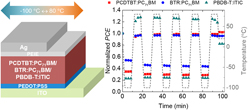
In this work, we report the initial investigation of the potential use of solution-processed OSCs in environment of large temperature variations and/or rapid change in operating temperature. In particular, we perform a direct, side-by-side comparison of the stability of three established types of OSC systems, namely polymer:fullerene, small molecule donor:fullerene, and polymer:nonfullerene, subject to 5 thermal cycles between −100 and 80 °C. We found that all the devices investigated exhibit great durability under thermal cycling stress even when rigid glass substrates and metal electrodes were used, which is likely linked to the highly flexible nature of the photoactive layers in the device. Our findings support suggestions that solution-processed OSCs could be suitable for outer space applications.
II. EXPERIMENTAL
A. Materials
Indium tin oxide (ITO) glass (15 Ω/□) substrates were purchased from Luminescence Technology (New Taipei City, Taiwan). Poly[N-9′-heptadecanyl-2,7-carbazole-alt-5,5-(4′,7′-di-2-thienyl-2′,1′,3′-benzothiadiazole)] (PCDTBT), benzodithiophene terthiophene rhodamine (BTR), poly[(2,6-(4,8-bis(5-(2-ethylhexyl)thiophen-2-yl)-benzo[1,2-b:4,5-b′]dithiophene))-alt-(5,5-(1′,3′-di-2-thienyl-5′,7′-bis(2-ethylhexyl)benzo[1′,2′-c:4′,5′-c′]dithiophene-4,8-dione))] (PBDB-T), and 3,9-bis(2-methylene-(3-(1,1-dicyanomethylene)-indanone))-5,5,11,11-tetrakis(4-hexylphenyl)-dithieno[2,3-d:2′,3′-d′]-s-indaceno [1,2-b:5,6-b′]dithiophene (ITIC) were purchased from 1-Material (Dorval, Canada). [6,6]-Phenyl-C71-butyric acid methyl ester (PC71BM) was purchased from Solenne BV (Groningen, the Netherlands). Poly(3,4-ethylenedioxythiophene)–poly(styrenesulfonate) (PEDOT:PSS) (CLEVIOS P VP.AI 4083) was purchased from Heraeus (Hanau, Germany). Polyethylenimine, 80% ethoxylated solution (PEIE), was purchased from Sigma-Aldrich (Gillingham, United Kingdom). All the materials are used as received.
B. Fabrication of OSCs
All devices are fabricated in conventional structures: ITO/PEDOT:PSS (30 nm)/PCDTBT:PC71BM (70 nm) or BTR:PC71BM (220 nm) or PBDB-T:ITIC (100 nm)/PEIE/Ag. ITO glass substrates were sequentially cleaned with detergent, deionized water, acetone, and 2-propanal in ultrasonic bath. PEDOT:PSS was spin-coated onto dried substrates treated with oxygen plasma for 150 s. All active layer solutions were dissolved and stirred on a hot plate in a nitrogen filled glovebox for at least 12 h before fabrication. PCDTBT:PC71BM (18 mg/mL with 1:2 weight ratio in chlorobenzene), BTR:PC71BM (40 mg/mL with 1:1 weight ratio in chloroform), and PBDB-T:ITIC (20 mg/mL with 1:1 weight ratio in chlorobenzene) were spin-coated onto the PEDOT:PSS-coated substrates. After spin-coating, a solvent vapor annealing treatment using tetrahydrofuran was performed on BTR:PC71BM samples for 2 min; thermal annealing on a 100 °C hotplate was performed on PBDB-T:ITIC samples for 10 min. Diluted PEIE solution (9.45 µL PEIE diluted with 3.87 mL ethanol with the presence of MgSO4 powder for at least 12 h) was first filtered with a 0.45 µm PVDF syringe filter and then spin-coated onto the active layer at 2000 rpm for 20 s. The samples were finally transferred to a separated evaporator for silver deposition at a base pressure of 2 × 10⁻⁵ torr. All the devices have an active area of 0.15 cm2 and are not encapsulated for the measurement.
C. J–V characterization and thermal cycling
The devices were loaded in a temperature-controlled probe stage (LTSE420-P [Linkam, Tadworth, United Kingdom]) under a constant nitrogen flow. J–V characteristics of the devices were measured by using a Keithley 2400 sourcemeter (Tektronix, Bracknell, United Kingdom) under simulated AM1.5G solar illumination (92193A-1000 [Newport, Didcot, United Kingdom]) through a quartz window on the stage. The temperature was precisely controlled between −100 and 80 °C with a rate of 50 °C/min. For the 5-cycle study, once reaching the target temperature, we allowed 1 min for thermal equilibrium between the device and the stage. The J–V of the devices was then scanned right after the equilibrium at 0, 2.5, and 5 min. For the 50-cycle study, the device performance was measured after every 5 complete cycles at 25 °C.
III. RESULTS AND DISCUSSION
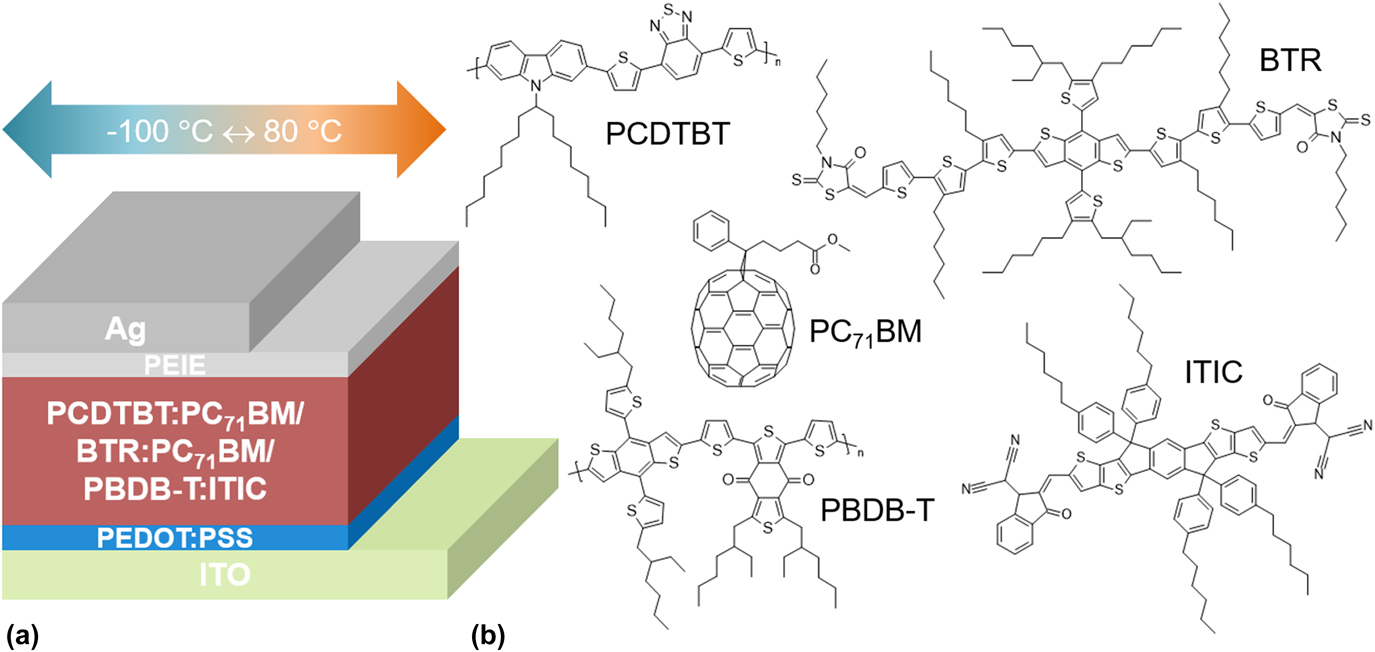
We selected three established benchmark OSC systems, namely PCDTBT:PC71BM, BTR:PC71BM, and PBDB-T:ITIC blends, respectively, for detailed study. PCDTBT:PC71BM is a widely studied benchmark polymer:fullerene system with over 7 years of operating lifetime reported.Reference Peters, Sachs-Quintana, Kastrop, Beaupré, Leclerc and McGehee18 BTR:PC71BM represents a new generation of a small molecule donor-based OPV system with comparable efficiency to polymer-based solar cells.Reference Deng, Zhang, Zhang, Wang, Zhu, Fang, Xia, Wang, Lu, Ma and Wei3 PBDB-T:ITIC is a newly established, high performance polymer:nonfullerene blend system with comparable efficiency to their fullerene-based counterpart.Reference Zhao, Qian, Zhang, Li, Inganäs, Gao and Hou15 These three types of OSCs represent the state-of-the-art material and device designs of solution-processed OSCs. Solution-processed PEDOT:PSS and PEIE were used as hole transport layers and electron transport layers, respectively. All devices were fabricated with the same device architecture for ease of comparison and the chemical structures of the materials used for device fabrication are illustrated in Fig. 1.
(a) OSC device structure and (b) chemical structures of the active materials investigated in this study.

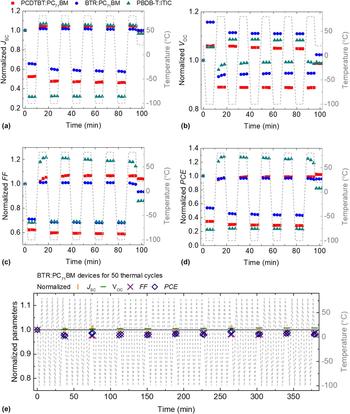
Figure 2 shows the evolution of device parameters subject to 5 thermal cycles between −100 and 80 °C in nitrogen atmosphere. It is obvious that all the devices investigated show a distinct change in all device parameters upon switching between low and high temperatures, resulting in a significant change in overall device performance. This large temperature dependence is consistent with a strong temperature dependence of the charge carrier kinetics, especially the charge collection efficiency, consistent with previous reports.Reference Li, He, Zhou, Mao, Cao, Ding and Wang19,Reference Gao, Tress, Wang and Inganäs20 Interestingly, the PBDB-T:ITIC system has the strongest temperature dependence of device efficiency, with a drop of over 80% in PCE from 80 to −100 °C, albeit with a smallest change in open circulate voltage (V oc). By contrast, the BTR:PC71BM system exhibits the least drop of approximately 55% at a low operating temperature [Fig. 2(a)]. The origin of the different temperature dependencies in different blend systems requires further studies but is likely linked to the fundamental differences in charge carrier kinetics in different OPV blend systems. Nevertheless, a good overall stability upon temperature switching is seen for all the devices investigated, which is evidenced by a minimal change in device performance upon a complete low-to-high temperature cycle. A more pronounced change in device performance is seen in the PBDB-T:ITIC system upon constant thermal stress at 80 °C, which is an indication of post thermal annealing effect and thermal degradation.
Normalized device parameters: (a) J SC, (b) V OC, (c) FF, and (d) PCE of PCDTBT:PC71BM, BTR:PC71BM, and PBDB-T:ITIC as a function of time during thermal cycling between −100 and 80 °C for 5 cycles. (e) Device parameters of BTR:PC71BM devices as a function of time measured right after every 5 thermal cycles at 25 °C for 50 thermal cycles in total. The temperature changing rate for all measurements is 50 °C/min.

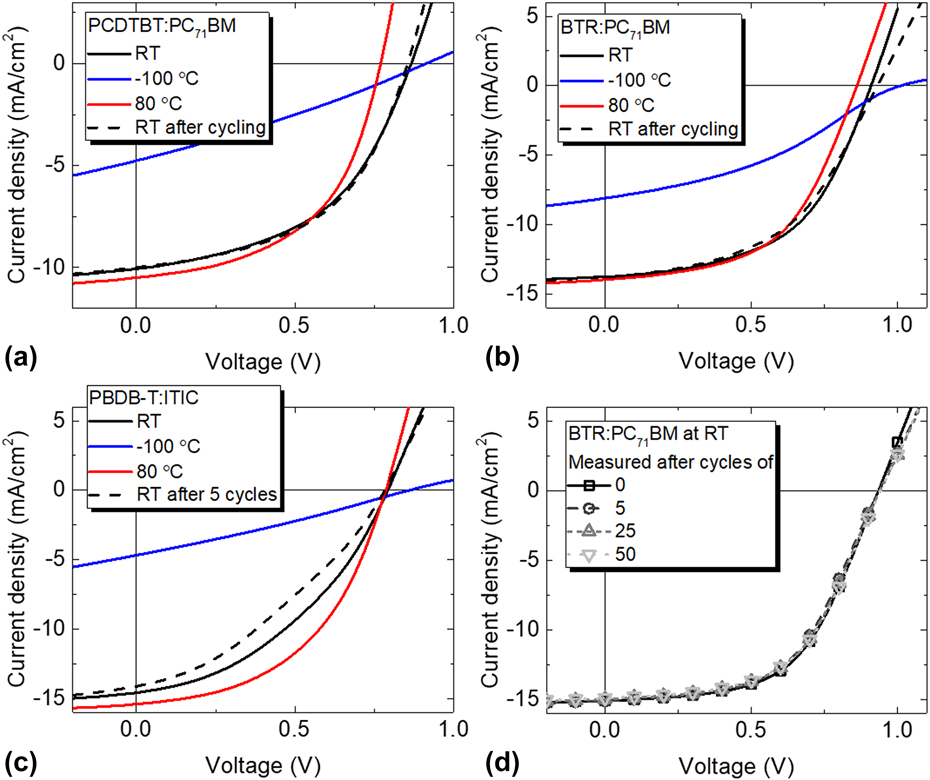
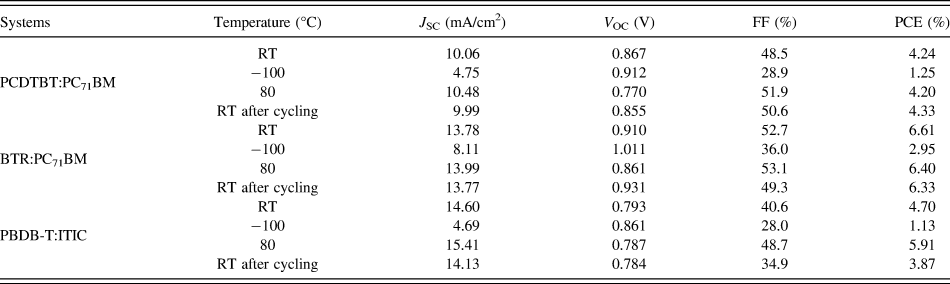
Figure 3 shows the comparison of the J–V characteristics of the OSC blend systems measured at different temperatures and before/after thermal cycling. Devices using PCDTBT:PC71BM and BTR:PC71BM show the best device stability upon thermal cycling, with minimal change in device performance [Figs. 3(a) and 3(b)]. This is due to superior device stability both under constant thermal stress and upon thermal cycling. The PBDB-T:ITIC system shows more pronounced degradation, mainly attributed to poorer device stability under constant thermal stress at 80 °C [Fig. 3(c)]. It is obvious that the BTR:PC71BM system exhibits less temperature dependence of both J SC and FF than the other systems investigated, leading to the smallest variation in PCE during the thermal cycling conditions. This is in agreement with our previous report that the BTR:PC71BM system possesses a low level of trap density, hence significantly reducing the nongeminate charge recombination losses.Reference Lee, Wu, Barbe, Jain, Wood, Speller, Li, Castro, Durrant and Tsoi21 All the device parameters are summarized in Table I.
J–V characteristics of (a) PCDTBT:PC71BM, (b) BTR:PC71BM, and (c) PBDB-T:ITIC at RT, −100 °C, 80 °C, and RT after 5 cycles. (d) J–V characteristics of BTR:PC71BM at RT after different numbers of thermal cycles [corresponding to Fig. 2(e)].

Summary of device parameters of PCDTBT:PC71BM, BTR:PC71BM, and PBDB-T:ITIC at RT, −100 °C, 80 °C, and RT after 5 cycles.

BTR:PC71BM is selected for a more intense thermal cycling study as apparently it is the most stable system upon thermal cycling as shown above. The device was tested for more thermal cycles of up to 50 cycles with the same temperature range from −100 to 80 °C. The device performance was measured under one sun at room temperature (RT) right after every 5 thermal cycles. As shown in Fig. 2(e), there is only a little drop after the first 5 thermal cycles which is consistent with the data above. However, after that, all the device parameters behave very similarly even it has experienced up to 50 thermal cycles and all the device parameters retain more than 98% of the original values. The corresponding J–V data after 0, 5, 25, and 50 thermal cycles are selected from Fig. 2(e) and plotted in Fig. 3(d), showing only minimal changes on their J–V characteristics.
Environmental stability has been widely recognized as a critical barrier for the commercialization of the solution-processed OSC. As a key consideration for outdoor applications, the degradation of device performance of the OSC due to thermal stress has been widely investigated in terms of changes in blend morphology, and various approaches has been developed to address this issue. A separate challenge that has received less investigation is the durability of the device to alternated temperature cycles. This is particularly relevant to the outdoor operation of devices since the day/night shifts typically cause a step change in operating temperatures that varies with locations and target applications, and a thermally stable device may not necessarily have good stability under such stress conditions. It should be noted that to achieve superior device stability under such applications, a good device thermal stability under constant elevated and reduced environmental temperatures, in conjunction with good device durability to thermal cycling stress conditions, is necessary. Therefore, the work presented herein represents new insights into the device stability under thermal cycling stress conditions. For devices whose degradation is controlled by thermal cycling stress rather than continuous thermal stress, thermal cycling measurements can be used as an accelerated method to evaluate their thermal stability.
It should be noted that the device stability upon thermal cycling is most likely a measure of the robustness of device mechanical properties. Our work shows that OSCs generally have very good stability upon thermal cycling, even for glass-based, lab-scale devices. For devices based on plastic substrates, it is expected that the device stability upon thermal cycling will be further improved due to a similar thermal expansion coefficient to that of polymers,Reference McCrum, Buckley and Bucknall22,Reference Thuan, Son, Trung, Thao and Dinh23 whereas it is known that the different thermal expansion coefficients of glass and polymers can cause cracks or delamination of OSCs upon thermal cycling.24,Reference Espinosa, Zimmermann, dos Reis Benatto, Lenz and Krebs25 Our results indicate that OSCs can have superior thermal cycling stability, in excellent agreement with the findings of the OSCAR project, a recent real-life stratospheric study for both organic and perovskite solar cells led by Manca et al.Reference Cardinaletti, Vangerven, Nagels, Cornelissen, Schreurs, Hruby, Vodnik, Devisscher, Kesters, D’Haen, Franquet, Spampinato, Conard, Maes, Deferme and Manca26 Combining the key advantages of the solution-processed solar cells such as superior power to weight ratio and lower costs, our findings suggest that solution-processed solar cells based on flexible substrates, such as solution-processed organic, perovskite, and quantum dot solar cells, may be a suitable candidate for applications with large variations and rapid change in operating temperature such as outer space applications.
While we find that OSCs typically exhibit good durability under thermal cycling conditions, it should be noted that the large variations in device performance for all device types studied under low and high temperatures may represent a challenge for more extreme outer space applications such as distant planet exploration, with, for example, a good overall device efficiency across a broad temperature range being desirable for such applications. While our previous work has suggested that the molecular design of a trap-free PV system may be the key in minimizing the variation in device performance at different temperatures, more work is needed to better understand the impacts of cell temperatures on their performance, especially on a charge carrier kinetics level. Undoubtedly, a systematic study of the thermal cycling stability of different classes of solution-processed solar cells as a function of their material and device design, as well as a mechanistic study to understand their degradation mechanisms under thermal cycling stress, is urgently needed. Nevertheless, our work suggests that OSCs could be a promising candidate for outer space applications, thereby paving the way for more detailed investigations in this direction.
IV. CONCLUSION
We present a side-by-side comparison of the device stability of three established types of OSCs subject to thermal cycling stress conditions. We found that all the devices investigated exhibit very good stability under thermal cycling stress between −100 and 80 °C and attribute this to the highly flexible nature of OSCs. Our findings suggest that solution-processed OSC can be a promising candidate for outer space applications.
ACKNOWLEDGMENTS
The authors would like to acknowledge the funding support from the Welsh Assembly Government funded Sêr Cymru Solar Project, the European Commission’s CHEETAH Project (FP7-Energy-2013—Grant No. 609788) and EPSRC Grant Nos. EP/M025020/1 and EP/K030671/1. ZL thanks the Welsh Assembly Government Sêr Cymru II fellowship scheme for funding.