Introduction
Alveolar echinococcosis (AE) is a severe neglected parasitic zoonosis caused by the metacestode stage of Echinococcus multilocularis, which represents an important public health threat. This parasite is predominantly maintained in a wildlife cycle, with carnivores as definitive hosts and small mammals as intermediate hosts. Humans acquire the infection by ingesting eggs shed in the feces of a definitive host and develop the metacestode stage, which is characterized by a tumour-like and infiltrative growth. If not appropriately treated, parasite expansion will eventually lead to organ failure and death of the patient (Kern et al., Reference Kern, Menezes da Silva, Akhan, Müllhaupt, Vizcaychipi, Budke, Vuitton, Thompson, Deplazes and Lymbery2017).
The metacestode stage is composed of numerous small vesicles with a wall structure formed by an outer acellular laminated layer and an internal cellular layer called germinal layer (Eckert and Deplazes, Reference Eckert and Deplazes2004). A special cell type in the germinal layer, the germinative cells, are responsible for the high regenerative potential of the parasite (Kern et al., Reference Kern, Menezes da Silva, Akhan, Müllhaupt, Vizcaychipi, Budke, Vuitton, Thompson, Deplazes and Lymbery2017).
There are several approaches to the management of AE. In patients with viable cysts, the treatment of choice is the total removal of the cystic lesion combined with oral treatment with 15 mg kg day−1 of albendazole (ABZ) for 2 years. In inoperable patients, prolonged treatment with ABZ should be carried out to decrease the proliferation of E. multilocularis. In cases of calcified or negative lesions by fluorodeoxyglucose (FDG) positron emission tomography (PET), the patient should be periodically monitored (watch and wait) (Wen et al., Reference Wen, Vuitton, Tuxun, Li, Vuitton, Zhang and McManus2019).
For an effective treatment in systemic infections, the drug must be sufficiently soluble in water to easily reach the cell membrane, but also hydrophobic enough to cross it (Thompson, Reference Thompson1997). The biopharmaceutical classification system categorizes ABZ as a class 2 drug due to its low aqueous solubility and high permeability (Kasim et al., Reference Kasim, Whitehouse, Ramachandran, Bermejo, Lennernäs, Hussain, Junginger, Stavchansky, Midha, Shah and Amidon2004). These characteristics produce a limited dissolution rate resulting in poor and erratic bioavailability of ABZ (Marriner et al., Reference Marriner, Morris, Dickson and Bogan1986; Edwards and Breckenridge, Reference Edwards and Breckenridge1988; Castro et al., Reference Castro, Márquez-Caraveo, Brundage, González-Esquivel, Suárez, Góngora, Jara, Urizar, Lanao and Jung2009). Due to the low concentration of drug reaching the parasite, ABZ acts as a parasitostatic rather than as a parasitocidal agent for many cases, and the recurrence rates after interruption of therapy are high (Reuter et al., Reference Reuter, Buck, Manfras, Kratzer, Seitz, Darge, Reske and Kern2004). Consequently, the treatment must be carried out with high daily doses of ABZ for prolonged periods, with the risk of low adherence to the treatment and the possibility of adverse effects (Bardonnet et al., Reference Bardonnet, Vuitton, Grenouillet, Mantion, Delabrousse, Blagosklonov, Miguet and Bresson-Hadni2013; Kern et al., Reference Kern, Menezes da Silva, Akhan, Müllhaupt, Vizcaychipi, Budke, Vuitton, Thompson, Deplazes and Lymbery2017). Moreover, another explanation for the parasitostatic effect of ABZ on germinative cells is that they may specifically express a β-tubulin isoform with limited affinity to benzimidazoles (Brehm and Koziol, Reference Brehm and Koziol2014).
The development of new ABZ formulations that improve its solubility is essential to increase the effectiveness of pharmacological treatment. Until now, several pharmacotechnical strategies to increase bioavailability and, consequently, the effectiveness of ABZ have been evaluated in murine models of cystic and alveolar echinococcosis: incorporation of ABZ into liposomes (Dvorožňáková et al., Reference Dvorožňáková, Hrčková, Borošková, Velebný and Dubinský2004; Lv et al., Reference Lv, Jiang, Liao, Sun, Zhang and Peng2013), ABZ loaded in lipid nanocapsules (Pensel et al., Reference Pensel, Ullio Gamboa, Fabbri, Ceballos, Sanchez Bruni, Alvarez, Allemandi, Benoit, Palma and Elissondo2015; Ullio Gamboa et al., Reference Ullio Gamboa, Pensel, Elissondo, Sanchez Bruni, Benoit, Palma and Allemandi2019), nanocrystal and nanocrystalline formulations of ABZ (Pensel et al., Reference Pensel, Paredes, Albani, Allemandi, Sanchez Bruni, Palma and Elissondo2018; Hu et al., Reference Hu, Liu, Liu, Zhang, Fan and Qian2020), solid dispersions of ABZ with poloxamer 188 (Pensel et al., Reference Pensel, Castro, Allemandi, Sánchez Bruni, Palma and Elissondo2014) and ABZ-chitosan microspheres (Abulaihaiti et al., Reference Abulaihaiti, Wu, Qiao, Lv, Zhang, Aduwayi, Wang, Wang and Peng2015).
The solid dispersions (SDs) are a successful strategy to improve the dissolution profile of poorly water-soluble drugs. This strategy is currently widely used in therapeutics, which is reflected in numerous commercialized products. For example, Sporanox®, Onmel® and Gris-PEG® are used as antifungals, whereas Kaletra®, Intelence® and Norvir® are indicated in combination with other antiretroviral agents for the treatment of HIV. On the other hand, Isoptin SR®, Nivadil®, Afeditab CR® and Adalat-XL® are indicated for the treatment of heart conditions, Cesamet® is used as antiemetic and Kalydeco® is indicated for cystic fibrosis (Cid et al., Reference Cid, Simonazzi, Palma and Bermúdez2019).
The SDs are molecular mixtures of drugs and inert carriers, prepared by the fusion method and/or solvent method (Chiou and Riegelman, Reference Chiou and Riegelman1971). According to the physical state of the carrier, SDs are classified into four generations (Vasconcelos et al., Reference Vasconcelos, Sarmiento and Costa2007). In the third generation of SDs, surfactants or emulsifiers are used as carriers, which improve the dissolution profile and the physical and chemical stability of the drug (Desai et al., Reference Desai, Alexander and Riga2006). These SDs were more stable mainly due to a reduction of drug recrystallization (Vasconcelos et al., Reference Vasconcelos, Sarmiento and Costa2007).
Poloxamers, nonionic surfactants with solubilizing properties, are suitable for most of the standard procedures used to prepare SDs because of their polymeric nature. In addition, they are not metabolized in the body (Collett and Popli, Reference Collett, Popli and Kibbe2000). Poloxamer 407 (P407) is accepted by the FDA as an inactive ingredient for different types of preparations (e.g., intravenous, inhalation, oral solution, suspension, ophthalmic or topical formulations) (Rowe et al., Reference Rowe, Sheskey and Owen2005). Simonazzi et al. (Reference Simonazzi, Cid, Paredes, Schofs, Gonzo, Palma and Bermúdez2018) designed ABZ SDs using P407 as carrier (ABZ:P407 SDs). These SDs markedly improved ABZ solubility and dissolution rate compared with pure ABZ and a commercial formulation. These drug-related factors affect the gastrointestinal absorption thus improving the bioavailability. In this context, the aim of the current work was to determine the in vivo efficacy of ABZ:P407 SDs in the murine model of AE.
Materials and methods
Preparation of solid dispersions and physical mixtures
The ABZ:P407 SDs were prepared by the fusion method as reported by Simonazzi et al. (Reference Simonazzi, Cid, Paredes, Schofs, Gonzo, Palma and Bermúdez2018) ensuring quality in terms of physicochemical properties and dose adjustment. Briefly, ABZ (Pharmaceutical grade, Parafarm, Argentina) was homogeneously dispersed in the molten P407 (BASF®, Germany) at 63° (1:1), by stirring. The preparation was rapidly cooled in liquid nitrogen, pulverized and sieved. The 210 μm particle size fraction was kept in a glass vial at room temperature until use.
Physical mixtures were prepared from ABZ and P407 previously sieved (210 μm particle size fraction). The components were mixed in equal proportions in a laboratory-scale V-blender for 5 min. The powders were stored in a glass vial at room temperature until use.
Preparation of ABZ formulations
The suspension of ABZ (3.08 mg mL−1) was prepared by dispersion of pure ABZ in distilled and deionized water (pH = 7.0) with carboxymethylcellulose (CMC, Todo Droga, Córdoba, Argentina) (0.5% w/v, pH = 6.0). The suspension was shaken for 5 h and sonicated for 1 h. The ABZ:P407 SDs (6.16 mg mL−1), physical mixture (6.16 mg mL−1) and P407 (3.08 mg mL−1) suspensions were prepared by dissolution in distilled and deionized water (pH = 7.0) under shaking (5 h). All formulations were stored at 4°C and were vigorously shaken before administration to mice.
Parasite material
The studies were carried out using E. multilocularis isolate J2012 (kindly provided by Klaus Brehm, Institute for Hygiene and Microbiology, University of Würzburg, Germany). To establish the murine intraperitoneal infection model for secondary AE, the parasite was propagated in the peritoneum of CF-1 mice and was processed as described by Albani et al. (Reference Albani, Pensel, Elissondo, Gambino and Elissondo2015), with some modifications. Briefly, the metacestodes obtained from the peritoneal cavity of the animals were cut to obtain a parasitic suspension. The suspension was passed through a metallic strainer and washed several times with phosphate-buffered saline (PBS). Finally, 0.5 vol of PBS and 12 μg mL−1 of ciprofloxacin (Roemmers, Argentina) were added to parasite tissue and incubated overnight at 4°C (Spiliotis and Brehm, Reference Spiliotis and Brehm2009).
Experimental design and evaluation of in vivo efficacy of ABZ:P407 SDs against the murine model of AE
For chemoprophylactic and clinical efficacy studies, 100 female CF-1 mice were intraperitoneally infected with 0.3 mL of homogenized parasitic material of E. multilocularis in PBS (n = 50 for each study). In the chemoprophylactic efficacy study, the dosage of the animals began 1-day post-infection, while in the clinical efficacy study the treatment began 6 weeks post-infection. In each study, the experimental groups were: (1) water control group, mice received distilled and deionized water as a placebo; (2) P407 control group, mice received P407 suspended in distilled and deionized water; (3) ABZ-CMC group, mice were treated with a suspension of ABZ in distilled and deionized water with CMC; (4) physical mixture group, the animals received a suspension of physical mixture (ABZ and P407, 1:1); (5) ABZ:P407 SDs group, animals were treated with a suspension of ABZ:P407 SDs. The animals were randomly distributed into the treatment groups (10 animals/group) with 5 mice per cage.
In both studies, treatments were performed daily for 30 days by intragastric administration in a volume of 0.3 mL. For groups 3, 4 and 5 the dose of ABZ was 25 mg kg day−1.
Approximately 10 weeks post-infection, the mice were anaesthetized with 100 mg kg−1 of ketamine and 10 mg kg−1 of xylazine and subsequently euthanized by cervical dislocation and necropsied. The cystic masses were obtained from the peritoneal cavity of each mouse and weighed. The median cysts weight from each group and ultrastructural study of the germinal layer of cysts by scanning electron microscopy were used to determine the efficacy of each treatment (Albani et al., Reference Albani, Pensel, Elissondo, Gambino and Elissondo2015).
Scanning electron microscopy
Samples of cysts obtained from animals involved in both in vivo efficacy studies were processed for scanning electron microscopy as described by Elissondo et al. (Reference Elissondo, Ceballos, Dopchiz, Andresiuk, Alvarez, Sánchez Bruni, Lanusse and Denegri2007). Briefly, samples were fixed in 3% glutaraldehyde (Sigma-Aldrich, St. Louis, USA) in 0.1 M sodium cacodylate buffer pH 7.4 (Sigma-Aldrich, St. Louis, USA) for 72 h at 4°C. Then, several washes in 0.1 M sodium cacodylate buffer were made. After that, the specimens were dehydrated by sequential incubations of 10 min in increasing concentrations of ethanol (Cicarelli, Argentina): 50, 70, 80, 90, 95% and twice in 100%. Finally, samples were immersed in hexamethyldisilazane (Sigma-Aldrich, St. Louis, USA) for 5 min, 1 h, and overnight. They were then sputter-coated with gold (100-Å thickness) and inspected on a JEOL JSM-6460 LV scanning electron microscope operating at 15 kV.
Statistical analysis
Cysts weights of the different groups, reported as median and interquartile range (IQR), were compared by Kruskal–Wallis Test (nonparametric method) followed by Dunn's Multiple Comparisons Test. The analysis was carried out using Instat 3.0 software program (GraphPad Software, San Diego, CA, USA). In all cases, P values less than 0.05 (P < 0.05) were considered statistically significant.
Results
Chemoprophylactic efficacy study of ABZ:P407 SDs against the murine model of AE
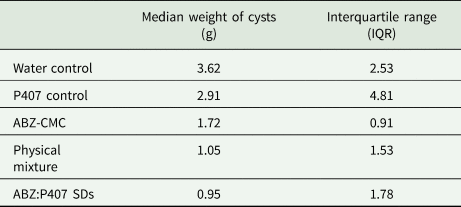
All the infected mice belonging to the chemoprophylactic efficacy study developed cystic masses in the abdominal cavity. No significant differences were found (P > 0.05) between the median weight of the cysts of the water and P407 control groups. Although the median weight of cysts recovered from mice treated with all formulations of ABZ was lower in relation to the control groups, no significant differences were detected (P > 0.05, Table 1).
Chemoprophylactic efficacy study. Median weight (g) and interquartile range (IQR) of the E. multilocularis cysts recovered from artificially infected mice from the unmedicated control and treated groups

Twenty-four hours post-infection, daily treatments were performed by intragastric administration of different formulations of ABZ at the dose of 25 mg kg−1 of ABZ over a period of 30 days.
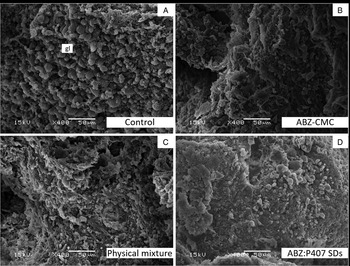
The ultrastructural study of the germinal layer of metacestodes recovered from control and treated groups is shown in Fig. 1. The germinal layer of cysts obtained from control mice showed the characteristic multicellular structure (Fig. 1A). The decrease in the weight of the cysts belonging to treated groups was correlated with ultrastructural alterations observed by scanning electron microscopy. Areas without cells in the germinal layer were observed in treated cysts (Figs 1B–D).
Scanning electron microscopy of E. multilocularis cysts recovered from infected mice belonging to the chemoprophylactic efficacy study. (A) Control cyst with an intact germinal layer (gl). (B) Cyst recovered from mice treated with ABZ-CMC. Note the loss of cells in the germinal layer. (C) Cyst obtained from treatment with the physical mixture. Observe the areas without cells. (D) Germinal layer of metacestode recovered from the ABZ:P407 SDs treated group. Areas with extensive loss of cells can be observed. Scale bar = 50 μm.

Clinical efficacy study of ABZ:P407 SDs against the murine model of AE
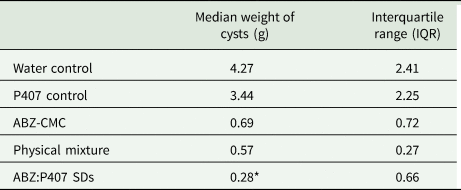
Table 2 summarizes the cyst weights (median and IQR) recorded after treatments of the different experimental groups involved in the therapeutic efficacy study. There were no statistically significant differences (P > 0.05) between the median cyst weights of control groups (i.e. water and P407 control groups). Although the median weight of cysts recovered from ABZ-CMC and physical mixture groups were lower than those observed in the control groups, no differences were found between treated groups and control groups (P > 0.05). In contrast, ABZ:P407 SDs treatment caused a significant decrease in the weight of the cysts compared with control groups (P < 0.05).
Clinical efficacy study. Median weight (g) and interquartile range (IQR) of the E. multilocularis cysts recovered from artificially infected mice from the unmedicated control and treated groups

Six weeks post-infection, daily treatments were performed by intragastric administration of different formulations of ABZ at the dose of 25 mg kg−1 of ABZ over a period of 30 days.
*Statistically significant differences with the control groups (P < 0.05).
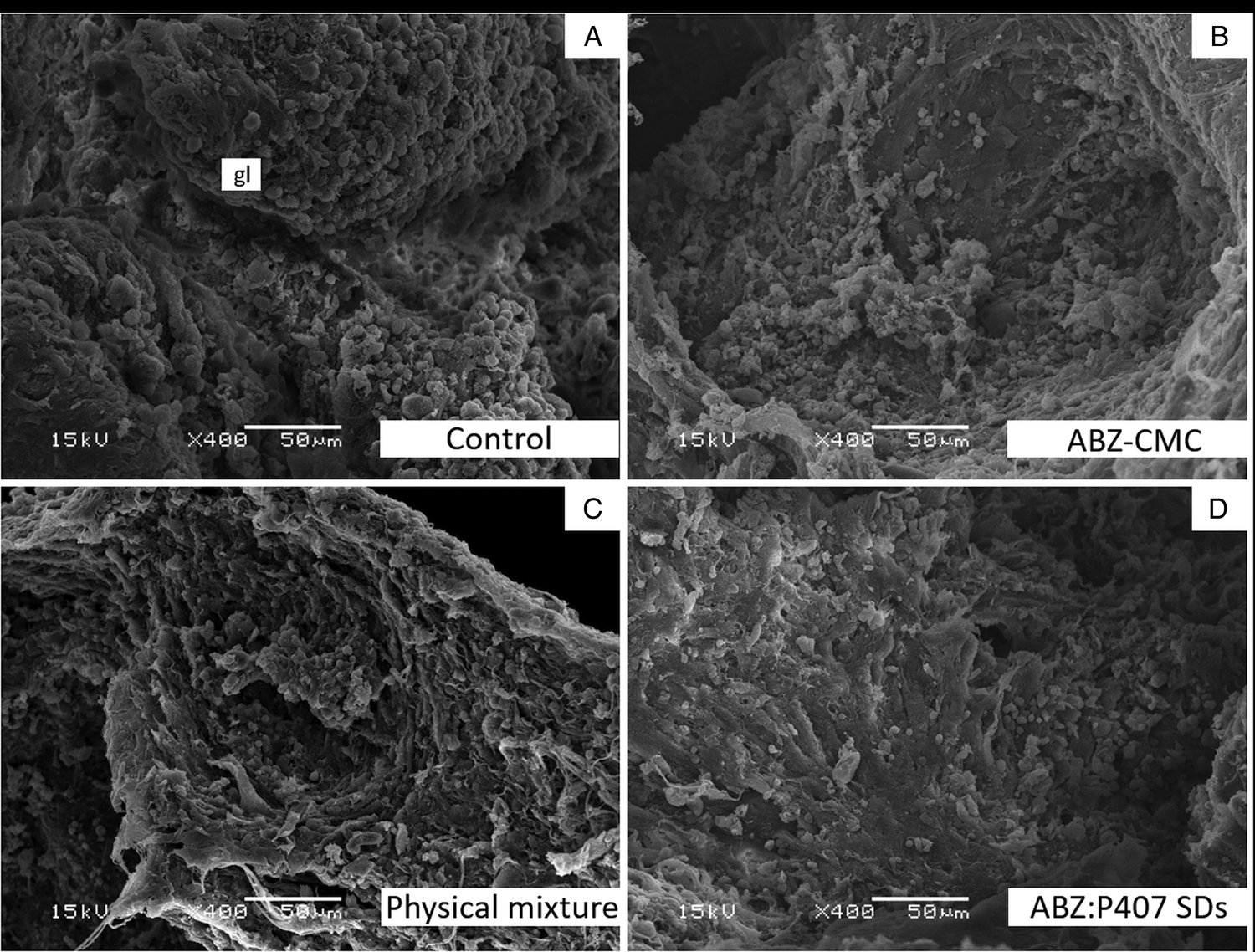
Metacestodes recovered from treated mice showed damage in the germinal layer, in relation to the control groups. However, the damage extension appears to be greater after ABZ:P407 SDs compared to the ABZ-CMC treatment (Fig. 2).
Scanning electron microscopy of E. multilocularis cysts recovered from infected mice belonging to the clinical efficacy study. (A) Control cyst with an intact germinal layer (gl). (B) Cyst recovered from mice treated with ABZ-CMC. Reduction in the cell number could be observed. (C) Cyst obtained from treatment with the physical mixture. Observe areas without cells. (D) Germinal layer of metacestode from ABZ:P407 SDs treated group. Only cellular debris and isolated cells could be observed. Scale bar = 50 μm.

Discussion
The drug of choice for the pharmacological treatment of human echinococcosis is ABZ. As this drug was developed primarily to target parasites in the gastrointestinal tract, a low bioavailability outside the intestine was considered important for its optimal performance. However, this feature is considered undesirable for a systemic parasitic disease as echinococcosis (Shuhua et al., Reference Shuhua, Jiqing, Mingjie, Pieying, Fanghua, Junjie, Wei and Hotez2002). The expression of a β-tubulin isoform with limited affinity to benzimidazoles by germinative cells and the low concentrations of ABZ reaching the parasite produces a parasitostatic effect and relapses after chemotherapy have been reported (Reuter et al., Reference Reuter, Buck, Manfras, Kratzer, Seitz, Darge, Reske and Kern2004; Brehm and Koziol, Reference Brehm and Koziol2014).
The gastrointestinal permeability and solubility of some drugs are limiting conditions for oral absorption, directly affecting their bioavailability. Although permeability is an intrinsic property of a drug, different strategies have been developed for improving the dissolution rate to design suitable formulations for oral administration (Vo et al., Reference Vo, Park and Lee2013). Scientific evidence indicates that a higher drug bioavailability correlates with improved efficacy of benzimidazoles against murine echinococcosis (Mingjie et al., Reference Mingjie, Shuhua, Junjie, Bin, Cheng, Weixia and Hotez2002; Shuhua et al., Reference Shuhua, Jiqing, Mingjie, Pieying, Fanghua, Junjie, Wei and Hotez2002; Dvorožňáková et al., Reference Dvorožňáková, Hrčková, Borošková, Velebný and Dubinský2004; Ceballos et al., Reference Ceballos, Alvarez, Sánchez Bruni, Elissondo, Dopchiz, Denegri, Torrado and Lanusse2006, Reference Ceballos, Elissondo, Moreno, Dopchiz, Sánchez Bruni, Denegri, Alvarez and Lanusse2008, Reference Ceballos, Elissondo, Sánchez Bruni, Denegri, Alvarez and Lanusse2009; Liu et al., Reference Liu, Zhang, Jiang, Yao, Tao, Xue and Wen2012; Abulaihaiti et al., Reference Abulaihaiti, Wu, Qiao, Lv, Zhang, Aduwayi, Wang, Wang and Peng2015; Hu et al., Reference Hu, Liu, Liu, Zhang, Fan and Qian2020).
The in vitro dissolution of a drug can be correlated with its bioavailability in vivo (Amidon et al., Reference Amidon, Lennernäs, Shah and Crison1995). Simonazzi et al. (Reference Simonazzi, Cid, Paredes, Schofs, Gonzo, Palma and Bermúdez2018) demonstrated that the use of P407 as the carrier in ABZ SDs markedly improved its solubility and dissolution rate compared with pharmaceutical-grade ABZ and a commercial formulation. In addition, it was observed that the polymer maintained a desirable level of a supersaturation state in the dissolution medium. This was reached by preventing solvent-mediated crystallization over the time period necessary for the absorption process. The results observed in vitro with the ABZ:P407 SDs could be correlated with the efficacy obtained in the present study in the murine model of AE.
During the chemoprophylactic efficacy study, all formulations of ABZ showed a tendency to decrease the development of E. multilocularis cysts. The ultrastructural study of metacestodes supports these results, showing the loss of cells of the germinal layer. However, no significant differences were detected between the median weight of cysts recovered from the treated mice. In contrast, Morris and Taylor (Reference Morris and Taylor1988) reported that a significant protection against protoscoleces of E. granulosus was achieved in gerbils by 1-month treatment of ABZ (10 mg kg day−1).
In the clinical efficacy study, the ABZ:P407 SDs achieved a statistically significant decrease in the weight of cysts, with an efficacy of 86%. In addition, the extent of damage caused by ABZ:P407 SDs was greater compared to the other treated groups. The ultrastructural alterations in the germinal layer were similar to those observed in mice infected with E. granulosus treated with other benzimidazoles (Ceballos et al., Reference Ceballos, Elissondo, Sánchez Bruni, Denegri, Alvarez and Lanusse2009, Reference Ceballos, Elissondo, Sánchez Bruni, Confalonieri, Denegri, Alvarez and Lanusse2010). Our results are consistent with those reported by Pensel et al. (Reference Pensel, Castro, Allemandi, Sánchez Bruni, Palma and Elissondo2014), who demonstrated a greater in vivo efficacy of ABZ formulated as SDs using P188 in the murine model of cystic echinococcosis.
The SDs increase the dissolution rate of low water-soluble drugs (Vo et al., Reference Vo, Park and Lee2013). The enhanced efficacy obtained after oral administration of ABZ:P407 SDs could be explained by an increase in ABZ dissolution rate caused by the surfactant nature of poloxamers. Poloxamers in certain concentrations form micelles with a hydrophobic core which could incorporate insoluble molecules as ABZ, promoting faster and more complete solubility, increasing ABZ bioavailability and efficacy (Kabanov et al., Reference Kabanov, Batrakova and Alakhov2002). On the other hand, the humectability effect of the surfactant could create a favorable microenvironment around the drug particles that would facilitate the dissolution process (Chen et al., Reference Chen, Zhang, Neilly, Marsh, Mawhinney and Sanzgiri2004). In this way, poloxamers would improve water solubility and wettability of ABZ.
In terms of drug safety, ABZ has been extensively investigated in a wide range of antiparasitic indications. At a low dose, the incidence of adverse experiences is low. At the higher doses and more prolonged exposure used in the treatment of echinococcosis, there is an increase in the number and severity of adverse experiences. Adverse effects include nausea, vomiting, diarrhoea, dizziness, headache, neutropenia, liver toxicity, alopecia and others (Horton, Reference Horton1997; Brunetti et al., Reference Brunetti, Kern and Vuitton2010). The ABZ SDs formulations would allow administering lower doses of the drug in the treatment of echinococcosis, with the consequent reduction in side effects. Paredes et al. (Reference Paredes, Litterio, Dib, Allemandi, Lanusse, Sánchez Bruni and Palma2018) reported ABZ self-dispersible nanocrystals to achieve the same efficacy against a model intestinal nematode parasite in dogs using a dose which was four times lower than a commercial formulation.
This pharmacotechnical strategy might in the future offer novel treatment alternatives for human AE. In the next step, we will characterize the pharmacokinetic profile after the administration of ABZ:P407 SDs in mice infected with E. multilocularis.
Acknowledgements
The authors thank Alejandra Goya, Sonia Ortega and Carolina Kelly (SENASA, Argentina). The authors also wish to thank Dr Mauro Chaparro (UNMdP-CONICET) for his assistance in the statistical study.
Financial support
This study was financially supported by the PICT 15 No. 0717 (Agencia Nacional de Promoción Científica y Tecnológica, Argentina), EXA 769/16 and EXA 871/18 (Universidad Nacional de Mar del Plata, Argentina).
Conflict of interest
None.
Ethical standards
Six-eight weeks old female CF-1 mice (body weight 25 g ± 5) were used. The animals were housed in a room with temperature-controlled (22 ± 1°C), a relative air humidity of 50 ± 5%, and a cycle of 12 h light and 12 h dark. Food and water were given ad libitum. Animal procedures and management protocols were approved by the Institutional Animal Care and Use Committee (RD 211/18) of the Faculty of Exact and Natural Sciences, National University of Mar del Plata, Mar del Plata, Argentina and carried out in accordance with the revised form of The Guide for the Care and Use of Laboratory Animals (National Research Council US, 2011). Unnecessary animal suffering was avoided throughout the study.