


Introduction
Weaning, the gradual transition from consumption of breast milk to solid foods, is a culturally and biologically pivotal phase bridging infancy and early childhood. Alongside its biological significance, weaning reflects norms and customs within a community and serves as a powerful lens through which we can explore health, traditions, culinary heritage, and family dynamics. The choice of weaning foods, post-weaning foods, and the timing of the transitions between them are shaped by historical, environmental, and socio-economic factors that can vary widely across and within cultures (Sellen, Reference Sellen2001; Sellen & Smay, Reference Sellen and Smay2001; Dukuzumuremyi et al., Reference Dukuzumuremyi, Acheampong, Abesig and Luo2020). By investigating infant feeding practices at the Greek colony of Himera in Sicily, this research expands our knowledge of ancient lifeways and situates studies of children within investigations of health and cultural diversity in Classical antiquity.
The ancient colony of the western-most Greek outpost in Sicily during the seventh–fifth centuries bc. Founded by colonists of Dorian and Chalcidian backgrounds, Himera developed into a large city with Greek, Phoenician, and indigenous Sicilian influences (Vassallo, Reference Vassallo and Tréziny2010). Himera has been the subject of archaeological and osteological research, including bioarchaeological analyses of its cemeteries, where more than 13,000 burials have been investigated. Extensive research has elucidated the city’s history, armed conflicts, mortuary customs, and cultural diversity (Vassallo, Reference Vassallo2005, Reference Vassallo, Adroit and Graells2017; Fabbri et al., Reference Fabbri, Schettino, Vassallo and Michelini2006, Reference Fabbri, Lonoce, Masieri, Caramella, Valentino and Vassallo2012; Kyle et al., Reference Kyle, Reitsema, Tyler, Fabbri and Vassallo2018; Lonoce et al., Reference Lonoce, Palma, Viva, Valentino, Vassallo and Fabbri2018, Reference Lonoce, Dalla-Zuanna, Fabbri, Vassallo and Barbiera2023; Viva et al., Reference Viva, Lonoce, Vincenti, Cameriere, Valentino, Vassallo and Fabbri2020; Reitsema et al., Reference Reitsema, Kyle and Vassallo2020, Reference Reitsema, Mittnik, Kyle, Catalano, Fabbri and Kazmi2022; Reinberger et al., Reference Reinberger, Reitsema, Kyle, Vassallo, Kamenov and Krigbaum2021). Investigations of the city’s children are still in their early stages, having focused on burial typologies and demographics (Vassallo, Reference Vassallo and Terranova2014b; Bechtold & Vassallo, Reference Bechtold and Vassallo2017; Lonoce et al., Reference Lonoce, Dalla-Zuanna, Fabbri, Vassallo and Barbiera2023).
Additional child-centred research is warranted because of Himera’s culturally diverse nature, whereby the colony flourished while incorporating inhabitants and traditions of different backgrounds. Children born into such contexts experience a cultural reality that may differ substantially from that of their parents. Previous research has suggested the success of Greek colonies in Sicily resulted not from cultural assimilation, but from flexible coexistence of people from multiple backgrounds (van Dommelen, Reference van Dommelen1997), including the likelihood that Greek male colonists married indigenous women (Ziskowski, Reference Ziskowski2007). A leading model for this coexistence is cultural hybridity (Malkin, Reference Malkin, Lyons and Papadopoulos2002; Hodos, Reference Hodos2006; Antonaccio, Reference Antonaccio2013), which rejects the ‘dualist cleave’ of colonists and local people, instead factoring in multiple interacting groups, and diversity within groups. Class, ethnicity, and gender are recognized as poles around which people group or divide themselves depending on local situations, affecting the adoption, rejection, or reinterpretation of new cultural forms (van Dommelen, Reference van Dommelen1997: 309). Diverse cultural elements come together in this ‘murky’ colonial context and are reorganized into new coherent systems, a highly localized process of culture change.
Childcare follows norms of family behaviour and reflects personal and familial identity. Breastfeeding, in particular, reflects economic, demographic, and social opportunities and constraints affecting women’s daily activities (Stuart-Macadam & Dettwyler, Reference Stuart-Macadam and Dettwyler1995). Young people are the seeds of culture change and play an important role in culture transmission across generations (Lillehammer, Reference Lillehammer1989; Dereveski, Reference Dereveski2001), thus their study enriches our understanding of colonial encounters and their generational effects.
Textual sources, art, and material culture from funerary, domestic, and votive contexts have illuminated aspects of the social significance of infancy, childhood, and adolescence in Classical antiquity (Garland, Reference Garland1990; Neils & Oakley, Reference Neils, Oakley, Neils and Oakley2003; Beaumont, Reference Beaumont2012; Golden, Reference Golden2015). However, these sources are uneven, underrepresenting lower-status freeborn and enslaved families, and overrepresenting well-documented places, such as Athens. Additionally, material objects accompanying burials or votive offerings are symbolic and imprecise representations of daily life. For example, the discovery of nearly 500 baby bottles (gutti) in graves at Himera raises the possibility that subadults accompanied by a guttus were still nursed at the time of death. However, gutti also have been found in adult burials, and only four have been found within the city itself, suggesting their symbolic role overshadows their practical role (Vassallo, Reference Vassallo, Lattanzi and Spadea2016).
Child-centred research can benefit from bioarchaeological evidence (Lewis, Reference Lewis2007), which is direct and individualized, reflecting the practices of past people, including infants and children. Stable isotope ratios of carbon (δ13C) and nitrogen (δ15N) from human remains have become standard for estimating weaning in the past, drawing from the fact that they reflect a trophic offset between the tissues of consumers and their diets (Fogel et al., Reference Fogel, Tuross and Owsley1989; Fuller et al., Reference Fuller, Fuller, Harris and Hedges2006; Herrscher et al., Reference Herrscher, Goude and Metz2017). Isotope ratios reflect periods of exclusive breastfeeding (when only milk is consumed), periods of total breastfeeding (entire period when any milk is consumed), duration of weaning (entire period of complementary feeding), complementary foods, henceforth referred to as ‘weaning trajectories’, and childhood diets.
One of the most interesting aspects of bioarchaeological research in ancient Mediterranean contexts is the unfolding potential to compare multiple cities and colonies. The feat of Mediterranean colonization, so widespread by the Greeks, was achieved through a range of means, with no single blueprint for why or how to colonize, and no singular ‘Greek’ cultural export. This, combined with hybridization (the selective incorporation of multiple cultural forms in multicultural settings), resulted in a variety of culturally diverse Greek colonies throughout the Mediterranean. The adaptive flexibility that could result from hybridization contributed to Greeks’ successes in colonizing a huge territory, in contact with many different ‘others’. Comparing weaning trajectories in various cities, colonies, and other settlements throughout the Greek diaspora allows us to explore regional variation in the conceptualization and treatment of infants and children (Tsutaya & Yoneda, Reference Tsutaya and Yoneda2013; Pearson, Reference Pearson, Agarwal and Beauchesne2018).
Whether caregivers adhered to a community norm for weaning versus made personalized decisions, and what these decisions looked like, are relevant when considering the effect of colonization on culture and culture change. The acceptability of women’s work outside the household, ideals for birth intervals and numbers of children, suitability of available complementary foods, availability of wet-nurses, and mental and physical condition of the mother and infant are some of the personal, economic, and environmental variables that can influence weaning trajectories. Adherence to a broad community norm can be seen in low variability in diets within age groups and a visible weaning ‘curve’ in δ15N values (see e.g. Gregoricka & Sheridan, Reference Gregoricka, Sheridan and Perry2012; Waters-Rist et al., Reference Waters-Rist, de Groot and Hoogland2022), whereas highly individualized practices can be seen in high dietary variability within age groups and a less discernible weaning curve (after Pearson, Reference Pearson, Agarwal and Beauchesne2018).
Using stable isotope data from subadult bone collagen at Himera, we evaluate weaning trajectories at Himera through the following research questions:
-
(1) Were all infants breastfed?
-
(2) How long did exclusive breastfeeding (EBF) last?
-
(3) When did weaning end, including the period of total breastfeeding (TBF), and how long did the weaning process take (TBF minus EBF)?
-
(4) What types of supplementary and transitional foods were used? Supplementary refers to foods other than maternal milk consumed during the weaning process, and transitional refers to foods consumed after weaning is complete.
-
(5) Do δ15N values show low or high variability within age groups?
-
(6) Is weaning at Himera similar to or different from other circum-Mediterranean populations in Classical antiquity?
Biocultural Context
Child burials at Himera
Of three cemeteries at Himera, two—the Eastern and Western—have been extensively excavated (Vassallo, Reference Vassallo, Adroit and Graells2017) (Figure 1). Subadult graves are evenly distributed throughout, not restricted to a particular area (Vassallo, Reference Vassallo and Terranova2014b; D’Elia & Meirano, Reference D’Elia, Meirano, Sánchez Romero, Alarcón García and Aranda Jiménez2015). Cremation is rare, and subadult inhumations occur in a variety of body positions and burial styles, including in ceramic vessels (enchytrismos burials), clay tubs, wooden coffins, tented tile structures, and simple pits (Vassallo & Valentino, Reference Vassallo, Valentino and Ampolo2012; Vassallo, Reference Vassallo, Greco and Ferrara2014a; Lonoce et al., Reference Lonoce, Dalla-Zuanna, Fabbri, Vassallo and Barbiera2023). Many graves contain objects such as a guttus, lekythos (flask), and kotyliskos (handled cup) (Vassallo, Reference Vassallo, Lattanzi and Spadea2016, Reference Vassallo, Adroit and Graells2017) (Figure 2), some of which are indigenous productions (Valentino, Reference Valentino2019). The variation in burial types is more likely to be related to different family traditions than to different ethnic or geographic backgrounds (Vassallo, Reference Vassallo and Terranova2014b).
Map of Himera with the ancient city, its Eastern and Western cemeteries, and the river Himera superimposed on the present-day landscape.

A young child’s grave at Himera. The clay tub burial includes a black glazed lamp (8), black figured lekythos (flask) with palmettes (9), black glazed guttus (baby bottle) (10), black glazed cup (11), and kotyliskos (handled cup) (12), all objects commonly found in children’s graves. The human remains have decomposed, but the tub’s length (70 cm) suggests that the child was under two years old (Vassallo, Reference Vassallo and Terranova2014b).

Isotopic evidence for weaning in Classical antiquity
Carbon and nitrogen atoms in human tissues are derived from foods, and different foods differ in their isotopic composition (their ratios of one isotope to another) in characteristic ways. Those differences are passed to consumers, making the overall isotopic signature of a consumer a composite reflection of the isotope signatures of his or her diet. In general, δ15N values are used to estimate trophic position, while δ13C values can be used to differentiate between C3 (e.g. wheat) and C4 (e.g. millet) plants and between terrestrial and aquatic food sources (Schoeninger & Moore, Reference Schoeninger and Moore1992). When breastfeeding, infant δ15N values are 1–3‰ higher than mother or wet-nurse values (Fogel et al., Reference Fogel, Tuross and Owsley1989; Fuller et al., Reference Fuller, Fuller, Harris and Hedges2006; Herrscher et al., Reference Herrscher, Goude and Metz2017). Carbon stable isotope ratios also show a trophic effect on the order of 1‰ (the ‘carnivore effect’) but represent not the volume of breast milk in infant diet per se, but rather the introduction of high-carbon supplementary foods to infant diet (especially plants). During weaning, it has been shown that an infant’s δ15N and δ13C values decrease until the trophic offset between mother and infant is gone, creating a so-called weaning curve.
Previous isotopic studies of weaning in the Mediterranean region have tended to show EBF ceasing around six months and TBF ending between two and four years, amidst variability (Prowse et al., Reference Prowse, Saunders, Schwarcz, Garnsey, Macchiarelli and Bondioli2008; Keenleyside et al., Reference Keenleyside, Schwarcz, Stirling and Ben Lazreg2009; Gregoricka & Sheridan, Reference Gregoricka, Sheridan and Perry2012; Kwok & Keenleyside, Reference Kwok, Keenleyside and Papathanasiou2015; Schmidt et al., Reference Schmidt, Kwok and Keenleyside2016; De Angelis et al., Reference De Angelis, Veltre, Varano, Romboni, Renzi and Zingale2020b; Ganiatsou et al., Reference Ganiatsou, Georgiadou, Souleles, Aidonis, Protopsalti and Tzevreni2023; Salahuddin & Prowse, Reference Salahuddin and Prowse2023). Many isotopic studies from Classical antiquity tend to agree with, but show more variability than, textual evidence for a gradual weaning period lasting between six months and two to three years of age (Soranus of Ephesus’s Gynaecology; Galen’s De sanitate tuenda, also known as Hygiene; Oribasius’s Collectionum Medicarum Reliquiae, and wet-nurse contracts).
Many previous studies are cross-sectional, using bone collagen which, because it models and remodels gradually, reflects diet during a period preceding age-at-death. There are at least two problems with using cross-sectional samples to estimate weaning. First is the possibility that weaning behaviours contributed to premature death, and are not normative for the population overall. In cases where suboptimal weaning is at the root of child mortality, the sample used to extrapolate infant feeding will not be representative of the population at large. However, just as non-survivors alone do not represent the population at large, neither do survivors alone, and the experiences of non-survivors should not be dismissed from consideration in the archaeological record. Here, we consider variation in weaning strategies at Himera, and we focus our research questions on variability (not ‘ideal’ weaning or even normative weaning), and strictly limit comparisons between Himera and other sites to only those that also use a cross-sectional approach based on bone collagen. A second problem to consider in cross-sectional bioarchaeological approaches to weaning is that bone turnover rates decelerate during ontogeny (Tsutaya & Yoneda Reference Tsutaya and Yoneda2013). Assigning an age-at-collagen formation to an age-at-death presents a moving target. For this, Bayesian modelling that factors dynamics of bone growth into interpretations of isotopic data from subadults has proved useful, including the Weaning Age Reconstruction from Nitrogen isotopes model (WARN; open-licence and freely available as an R package; R Core Team, 2024), which factors in variable turnover rates when modelling nitrogen isotope data from cross-sectional studies (Tsutaya & Yoneda, Reference Tsutaya and Yoneda2013; see Supplementary Material).
Materials
Individuals reported here are all from Himera’s Eastern and Western cemeteries. The Eastern necropolis (seventh to fifth centuries bc) slightly pre-dates the Western necropolis (sixth to fifth centuries bc), but the relative dates, based on proximity to city walls, of the Eastern necropolis burials considered here show they belong to the sixth to fifth centuries.
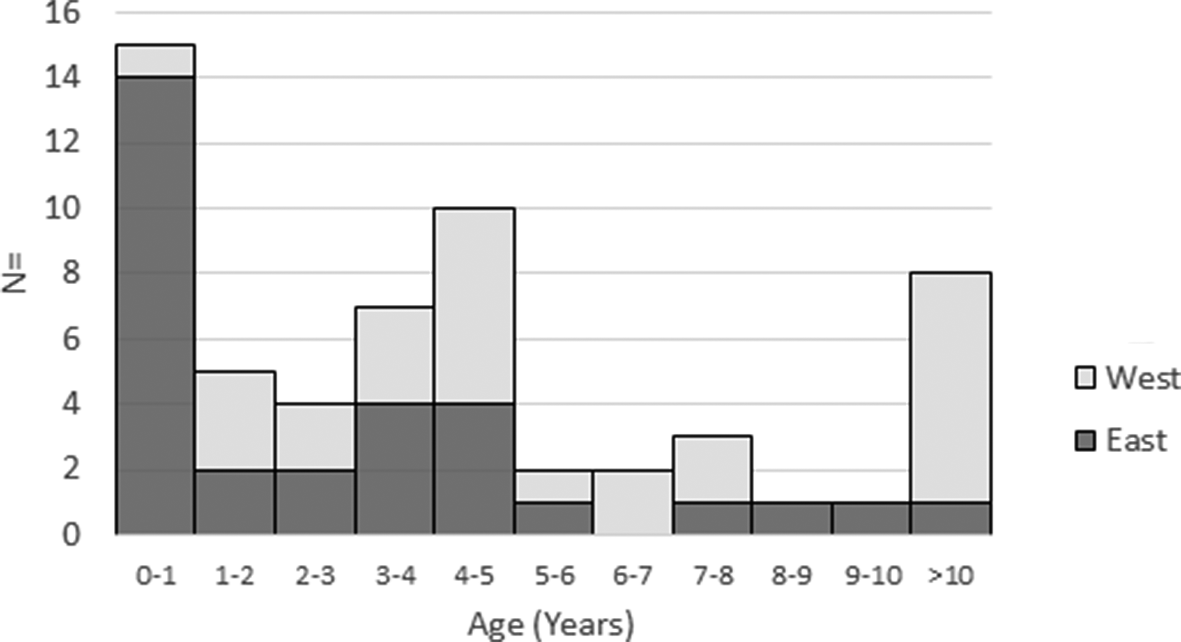
Fifty-eight individuals under eighteen years old (of which fifty are under ten years old; Figure 3) and twenty-seven adult females are included in the analysis, including several adult females previously published elsewhere (Reitsema et al., Reference Reitsema, Kyle and Vassallo2020). Age-at-death was estimated on the basis of tooth development, eruption, and attrition, auricular surface and pubic symphysis deterioration, and cranial suture closure following Steckel et al. (Reference Steckel, Larsen, Sciulli, Walker, Steckel, Larsen, Roberts and Baten2018). The age assigned to each individual in the present study is the midpoint of a possible age range. All individuals whose midpoint age is eighteen years or less are referred to as subadults. Only subadults whose midpoint age is ten years or younger are included in the Bayesian model. Sex of adults was estimated using sexually dimorphic traits of the skull and pelvis (Steckel et al., Reference Steckel, Larsen, Sciulli, Walker, Steckel, Larsen, Roberts and Baten2018).
Histogram of the ages of all subadults showing the age structure of the sample (fifty-eight subadults) from the Western and Eastern cemeteries. Individuals aged ten to eighteen are shown binned because only individuals under ten years old are included in the WARN analysis.

Figure 3. Long description
The horizontal X-axis is labeled Age (Years) and ranges from 0-1 to greater than 10. The vertical Y-axis is labeled N equals and ranges from 0 to 16 in increments of 2. A legend to the right indicates that light gray bars represent West and dark gray bars represent East.
Data points from left to right:
* 0-1 years: Total 15 (14 East, 1 West).
* 1-2 years: Total 5 (2 East, 3 West).
* 2-3 years: Total 4 (2 East, 2 West).
* 3-4 years: Total 7 (4 East, 3 West).
* 4-5 years: Total 10 (4 East, 6 West).
* 5-6 years: Total 2 (1 East, 1 West).
* 6-7 years: Total 2 (0 East, 2 West).
* 7-8 years: Total 3 (1 East, 2 West).
* 8-9 years: Total 1 (1 East, 0 West).
* 9-10 years: Total 1 (1 East, 0 West).
* Greater than 10 years: Total 8 (1 East, 7 West).
Methods
Collagen extraction methods followed the whole-bone protocol outlined in Reitsema and Vercellotti (Reference Reitsema and Vercellotti2012), after Ambrose (Reference Ambrose1990). Collagen quality indicators include carbon content (%C) of >5.2%, nitrogen content (%N) of >1.8%, >3.5% collagen by weight (%coll), and carbon-to-nitrogen ratios of 2.9–3.6 (Ambrose, Reference Ambrose1990). Measurements of stable isotope ratios took place at the University of Georgia Center for Applied Isotope Studies (see Supplementary Material).
Non-parametric Kruskal–Wallis tests compare groups, where p<0.05 is considered statistically significant. Individuals aged ten years and under, and adult females from Reitsema et al. (Reference Reitsema, Kyle and Vassallo2020), are included in WARN. From a cross-sectional sample, WARN calculates the most probable value (a maximum density estimate, MDE) for the end of EBF (t 1), end of TBF (t 2), the hypothetical δ15N value of collagen synthesized entirely from weaning foods (wnfood) and the δ15N offset between females and nursed subadults (enrich), given the prior assumptions of the model and a credible interval (CI) into which each MDE falls with 95% probability.
We also apply WARN to other sites for comparison. Criteria for inclusion include circum-Mediterranean locales, dates within Classical antiquity (approximately 800 bc to 500 ad), cross-sectional data from bone collagen, and age-at-death estimates with better-than six month resolution, which resulted in four suitable comparative sites: the Greek colony of Apollonia Pontica in Bulgaria (adult females from Keenleyside et al., Reference Keenleyside, Schwarcz and Panayotova2006, subadults from Schmidt et al., Reference Schmidt, Kwok and Keenleyside2016), and the Roman sites of Isola Sacra in Lazio in Italy (adult females from Prowse et al., Reference Prowse, Schwarcz, Saunders, Macchiarelli and Bondioli2004, subadults from Prowse et al., Reference Prowse, Saunders, Schwarcz, Garnsey, Macchiarelli and Bondioli2008) and Quarto Cappello da Prete to the east of Rome (De Angelis et al. Reference De Angelis, Varano, Battistini, Di Giannantonio, Ricci and Lubritto2020a, Reference De Angelis, Veltre, Varano, Romboni, Renzi and Zingale2020b), and Leptiminus in Tunisia (Keenleyside et al., Reference Keenleyside, Schwarcz, Stirling and Ben Lazreg2009). Although weaning and infant care were informed by similar recommendations during periods of both Greek and Roman influence (the written prescriptions on breastfeeding and weaning were recorded mainly by later Roman and Byzantine authors, but derive from earlier Greek medical traditions), the periods represent very different cultural contexts with their own sets of complex, particular customs and traditions. The Roman sites are included not as direct analogues to child rearing at Greek colonies, but as a comparative counterpoint to highlight the extent to which cultural traditions shaped infant feeding. To address the question of whether weaning at Himera followed a community norm, or represented individualized, varied decisions, we look for a visible weaning curve in the data (isotope values that decline with age, and transitions of many individuals that follow a similar chronology) and compare the weaning trajectory at Himera to other Mediterranean contexts.
Results
Collagen quality
From 154 attempted collagen extractions, 12% of individuals (n=18) did not yield enough collagen to measure, and only 62% (n=84) of the samples with enough collagen to measure yielded acceptable CN ratios (CN=2.9-3.6). Of these, one exhibited a low %N value of 1.6%, and twenty-nine (35% of the sample) exhibited %coll values below 3.5%; however, these samples are not excluded, as collagen yield and %N are not correlated with any other indicator of diagenetic alteration at Himera such as other collagen quality indicators or isotope ratios (Reitsema et al., Reference Reitsema, Kyle and Vassallo2020; Reinberger et al., Reference Reinberger, Reitsema, Kyle, Vassallo, Kamenov and Krigbaum2021).
Isotope ratios
Isotopic values of adult females (see Supplementary Material, Table S1), subadults (Table S2), and other adults (males and indeterminate sex) previously published by Reitsema et al. (Reference Reitsema, Kyle and Vassallo2020) are illustrated in Figure 4. There are no significant differences in the δ15N values of adult females in the Eastern versus the Western necropolis (10.3±0.6‰ and 10.4±0.8‰, respectively; Kruskal–Wallis test, chi-squared=0.036103, df=1, p-value=0.8493); therefore, females from both cemeteries are pooled as a single adult female baseline in the WARN analysis (δ15N=10.3±0.7).
Isotopic results of adults and subadults from Himera.

Figure 4. Long description
A multi-panel scatter plot with two vertical sections sharing a horizontal X-axis representing Age in Years from 0 to 65.
Top Panel: The Y-axis represents delta 15 N values from 4.0 to 14.0. Subadult data points, shown as yellow circles, are concentrated between ages 0 and 10, with values ranging from 8.0 to 13.5. Adult data points, represented by black triangles, white diamonds, and white squares, are spread from age 20 to 60, mostly clustering between 9.0 and 12.0. A dashed red line indicates the Adult Female Mean, flanked by two solid red lines representing plus or minus 1 S D.
Bottom Panel: The Y-axis represents delta 13 C values from -21.0 to -18.0. Subadult yellow circles are clustered between ages 0 and 10 with values between -20.5 and -18.5. Adult data points from age 20 to 60 are distributed between -20.5 and -18.5. Similar to the top panel, a dashed red line shows the Adult Female Mean with solid red lines for plus or minus 1 S D.
Legend at the bottom identifies:
* Yellow circle with dots: Subadult, East Necropolis.
* Solid yellow circle: Subadult, West Necropolis.
* White diamond: Adult Female.
* Dashed red line: Adult Female Mean plus or minus 1 s d.
* Black triangle: Adult M (Reitsema et al. Reference Reitsema, Kyle and Vassallo2020).
* White square: Adult U (Reitsema et al. Reference Reitsema, Kyle and Vassallo2020).
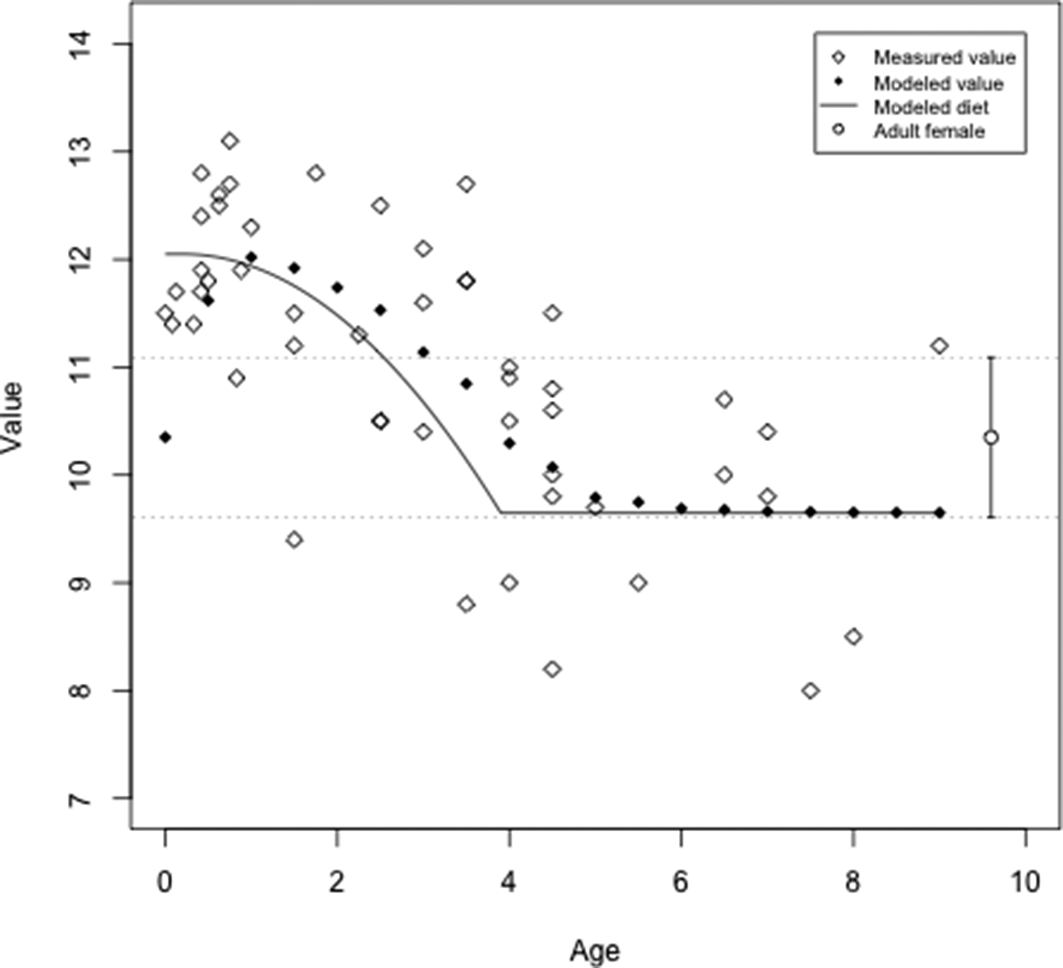
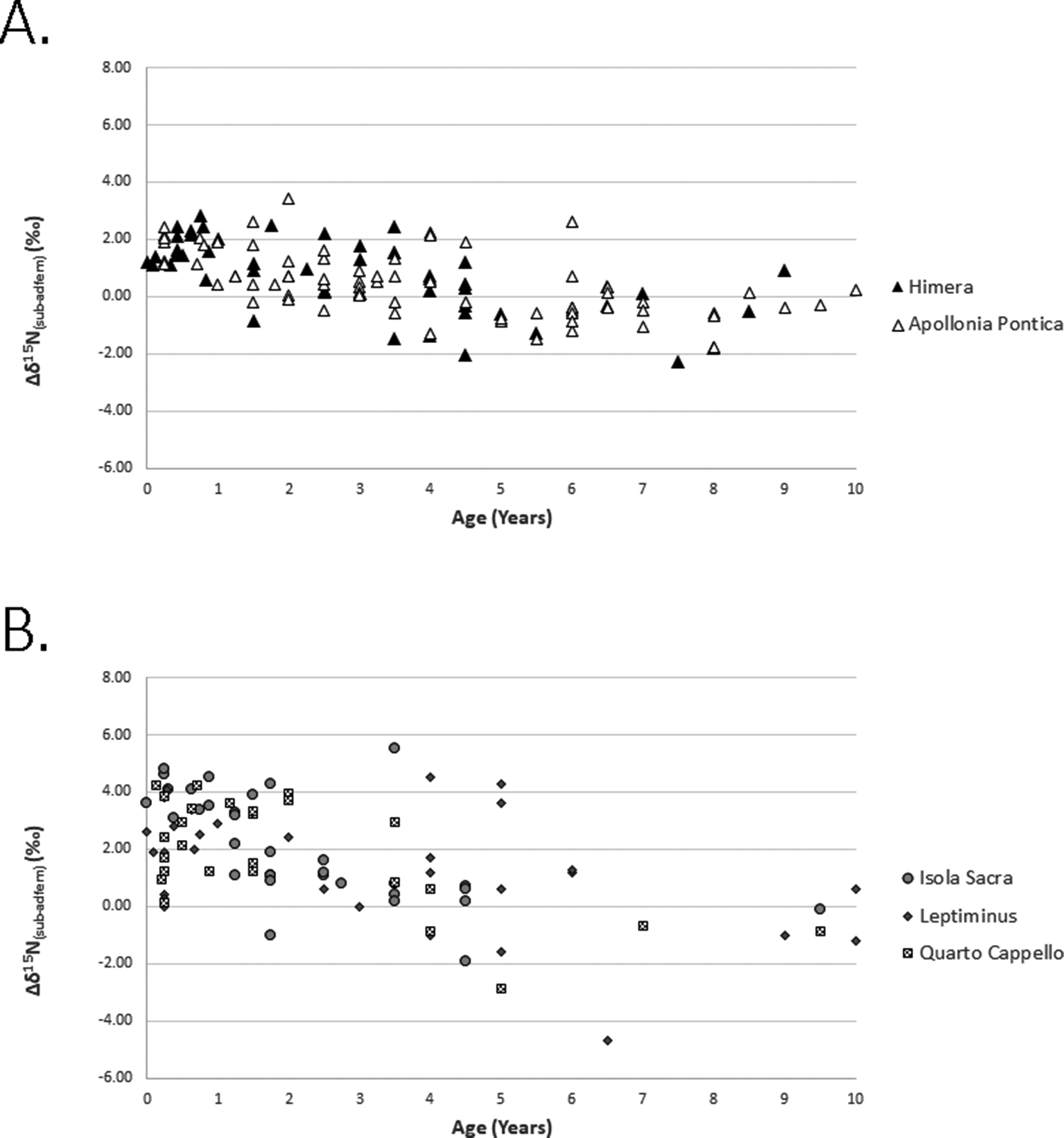
WARN estimates that the most probable age for the end of EBF at Himera is 0.3 years, and the end of TBF is 3.8 years (Table 1; Figure 5). The estimated offset between breastfed infant and nursing mother δ15N is 1.7‰ (CI 1.3‰ – 2.2‰) and the estimated δ15N value of collagen synthesized purely from weaning foods is 9.6‰ (CI 9.2‰ – 10.2‰). The results from Himera, and the results of applying WARN to a series of comparative populations, are summarized in Table 1, with details in the Supplementary Material (Table S3). The weaning curves of Himera and comparative samples are shown in Figure 6.
Results of applying WARN

Table 1. Long description
The table contains eight columns: Site Name, n (number of subadults), E B F (Exclusive Breastfeeding age in years) M D E, E B F C I (95% Credible Interval), T B F (Total Breastfeeding age in years) M D E, T B F C I, P (joint probability), and Reference.
* Himera: n=50, E B F M D E 0.3, C I 0.0–2.2; T B F M D E 3.8, C I 3.0–4.7; P 0.0082; Reference: Present study and Reitsema et al. Reference Reitsema, Kyle and Vassallo2020.
* Apollonia Pontica: n=71, E B F M D E 0.4, C I 0.0–2.4; T B F M D E 4.3, C I 2.5–5.8; P 0.0046; Reference: Keenleyside et al. 2006 and Schmidt et al. 2016.
* Isola Sacra: n=33, E B F M D E 0.2, C I 0.0–0.9; T B F M D E 1.2, C I 0.6–1.6; P 0.0221; Reference: Prowse et al. 2004 and 2008.
* Leptiminus: n=30, E B F M D E 2.4, C I 0.0–5.1; T B F M D E 5.2, C I 3.4–8.9; P 0.0011; Reference: Keenleyside et al. 2009.
* Quarto Cappello del Prete: n=26, E B F M D E 1.9, C I 0.4–3.1; T B F M D E 3.6, C I 2.9–4.2; P 0.0098; Reference: De Angelis et al. 2020a and 2020b.
The duration (in years) for exclusive breastfeeding (EBF) and total breastfeeding (TBF) estimated at Himera and comparative Mediterranean sites from the periods of Greek and Roman influence (previously published data) are estimated using WARN. MDE = maximum density estimator; CI = 95% credible interval; P = joint probability of the weaning ages, where values lower than 0.0025 should be excluded (Tsutaya & Yoneda, Reference Tsutaya and Yoneda2013). Numbers of individuals refer to the numbers of subadults.
Himera WARN results.

Figure 5. Long description
The x-axis is labeled Age, ranging from 0 to 10. The y-axis is labeled Value, ranging from 7 to 14. A legend in the top right identifies four elements: open diamonds for Measured value, solid black diamonds for Modeled value, a solid black line for Modeled diet, and an open circle for Adult female.
Data trends from left to right:
* The Modeled diet line begins at a value of 12 at age 0, follows a downward curve until age 4, and then plateaus at a value of approximately 9.6 for the remainder of the x-axis.
* Measured values (open diamonds) are highly dispersed, concentrated between values 11 and 13 for ages 0 to 2, and becoming more scattered between values 8 and 11 as age increases toward 10.
* Modeled values (solid diamonds) closely follow the downward curve of the modeled diet line until age 4, after which they align perfectly with the plateau at 9.6.
* Two horizontal dotted lines mark the range of the plateau and the initial modeled value.
* On the far right at age 9.5, an Adult female data point (open circle) is shown with a vertical error bar spanning from approximately 9.6 to 11.1.
Weaning at Himera compared with other samples to which WARN was applied. Subadult nitrogen (δ15N) data are shown in comparison to subadult data from other cross-sectional (bone collagen) sites in the Mediterranean region dating to Classical antiquity to which WARN was applied in the present study. (A) Greek cities, (B) Roman cities.

Figure 6. Long description
Two vertically stacked scatter plots labeled A and B. Both plots share an x-axis representing Age in Years from 0 to 10 and a y-axis representing Delta delta 15 N sub sub-ad fem in per mil from negative 6.00 to 8.00.
Panel A compares Greek cities. The data points for Himera (solid black triangles) and Apollonia Pontica (open triangles) are concentrated between ages 0 and 4, showing a peak in delta 15 N values around age 1 followed by a gradual decline toward the baseline as age increases. Most values cluster between negative 2.00 and 4.00 per mil.
Panel B compares Roman cities. It features three datasets: Isola Sacra (gray circles), Leptiminus (black diamonds), and Quarto Cappello (squares with an X). The data shows higher initial variance compared to Panel A, with several points for Isola Sacra and Leptiminus reaching between 4.00 and 6.00 per mil before age 2. Similar to Panel A, there is a downward trend as age increases, with data points becoming more sparse and generally lower, reaching as low as negative 4.00 per mil by age 7.
Discussion
This study reconstructs aspects of weaning as a window to diversity in childcare practices at the multicultural Greek colony of Himera. In addition to reconstructing weaning chronologies, we compare the data obtained at Himera to other evidence from Classical sites to investigate diversity versus conformity in weaning among communities. We interpret this evidence alongside historical, archaeological, and demographic contexts to evaluate ancient attitudes and practices surrounding childcare.
Presence or absence of breastfeeding
The first goal of this study was to identify whether all infants were breastfed. This appears to be the case, as all individuals under six months are enriched in 15N above the maternal baseline (Figures 4 and 5). Breastfeeding as a normative practice is noteworthy: simply because breastfeeding is biologically advantageous for infants does not mean everyone in a community can and will do it. Other isotopic studies of Classical antiquity have found evidence that some infants were not breastfed (see e.g. Kwok & Keenleyside, Reference Kwok, Keenleyside and Papathanasiou2015; De Angelis et al., Reference De Angelis, Veltre, Varano, Romboni, Renzi and Zingale2020b). Ethnographic as well as isotopic evidence in other contexts provide examples of when breastfeeding has been discouraged, and when ‘optimal’ breastfeeding is implausible (Sellen, Reference Sellen2001; Fulminante, Reference Fulminante2015; Rollins et al., Reference Rollins, Bhandari, Hajeebhoy, Horton, Lutter and Martines2016; Waters-Rist et al., Reference Waters-Rist, de Groot and Hoogland2022). It has been estimated that suboptimal breastfeeding is responsible for 1.4 million child deaths annually today (Black et al., Reference Black, Allen, Bhutta, Caulfield, de Onis and Ezzati2008). With this in mind, the ubiquity of breastfeeding at young ages among this in our sample also is noteworthy because the subadults represent a cohort who died at a young ages: their premature deaths cannot be attributed to a lack of breastfeeding.
Duration of exclusive breastfeeding
Breastfeeding is common to all individuals in the sample, but duration of EBF is quite variable, and often short. WARN estimates EBF lasting 0.3 years, but with a broad 95% credible interval of up to 2.2 years. Introducing solid foods as early as three months poses risks to infants living in pathogenic environments, as the gut epithelium is not completely ‘closed’ until four to six months, allowing communication between the bloodstream and pathogenic microorganisms and potential harmful macromolecules in the digestive tract (Weström et al., Reference Weström, Arévalo Sureda, Pierzynowska, Pierzynowski and Pérez-Cano2020). Anything longer than six months may also be challenging, as the baby begins to need more than the macronutrient and micronutrient supply of breastmilk around this time. Second-century ad writers Soranus and Galen, whose writings post-date Himera but echoed earlier practices, recommended EBF for the first six months and gradual reduction of breastmilk thereafter.
Few people today adhere to the World Health Organization’s recommendation of six months EBF (Heymann et al., Reference Heymann, Raub and Earle2013; Rollins et al., Reference Rollins, Bhandari, Hajeebhoy, Horton, Lutter and Martines2016; Victora et al., Reference Victora, Bahl, Barros, França, Horton and Krasevec2016). One of the most substantial obstacles to EBF today is women’s work outside the household. Whether this would have applied generally in ancient Greek cities is debatable. Ancient sources make it clear that a high value was placed on women being confined to their homes, where their chief responsibilities were caring for children and managing the household. Women were barred from political rights, kept out of public life, and had restrictions placed on their mobility. Yet, despite the ideal of women’s seclusion within the household, this was probably only feasible for wealthy households (Kosmopoulou, Reference Kosmopoulou2001: 284). We know that economic necessity could cause women to supplement the family income as hired hands in agricultural work, in crafts and wool-working, hawking at markets, wet-nursing, nursing, and as midwives (Kosmopoulou, Reference Kosmopoulou2001). Religious rites, family gatherings, laundry, fetching water, assisting husbands in their workshops, and agricultural work of the household were other activities that brought women outside the home (Lis & Soly, Reference Lis and Soly2012). Enslaved women had many demands on their time that interfered with childcare, including acting as wet-nurses to infants other than their own (Wrenhaven, Reference Wrenhaven2012). In sum, while exclusive breastfeeding was prioritized, in many cases, it did not last longer than a few months, which may reflect the other demands on women’s activities that necessitated introducing supplementary foods from early infancy.
Duration of total breastfeeding
Even if women ended EBF earlier than the ancient authors tended to advise, the overall investment in nursing was high. Total breastfeeding in the sample averages 3.8 years (3.0–4.7 years, 95% CI). The weaning period, calculated as TBF minus EBF, thus lasted approximately three and a half years. This is longer than most in the modern preindustrial societies studied by Sellen (Reference Sellen2001), longer than that observed on most sites reviewed by Pearson (Reference Pearson, Agarwal and Beauchesne2018), longer than the TBF recommendations of ancient authors (Galen and Soranus in the second century ad, three years and one and a half to two years respectively; Oribasius in the fourth century ad, two years; Fulminante, Reference Fulminante2015), and longer than what is documented in first-century bc to fourth-century ad Egyptian wet-nurse contracts (TBF of sixteen months to three years but usually two years; Gourevitch, Reference Gourevitch and Gourevitch1984). Even if women were more active outside the household than is typically appreciated, they were able to sustain lactation, suggesting the ideal for women’s days to revolve around the household probably supported this continued investment in nursing, even if nursing was supplemented by solid foods.
Breastfeeding is recognized today as the most vital intervention to reduce infant mortality globally (Gupta et al., Reference Gupta, Suri, Dadhich, Trejos and Nalubanga2019). At Himera, prolonged weaning may have supported infant and child health. Based on a demographic analysis of a sample of 2865 subadult burials, infant and childhood mortality at Himera is surprisingly low compared with other prehistoric and historic European sites (Lonoce et al., Reference Lonoce, Dalla-Zuanna, Fabbri, Vassallo and Barbiera2023). Despite representing a sample of people who did not survive to adulthood, the subadults sampled here demonstrate a tradition of protracted breastfeeding which may underpin the mortality regime documented at Himera.
Although long in general, the period of TBF in this sample demonstrates high variability, which points to a strong individualized element in the duration of breastfeeding. As with EBF, this may reflect variations in the daily activities, levels of support, health, personality traits, and attitudes of the women and infants involved.
Supplementary and transitional foods
The fourth goal of this study was to evaluate whether supplementary and transitional foods differed from the typical adult diet. Adult diets at Himera were plant-based and supplemented by terrestrial animal protein (Reitsema et al., Reference Reitsema, Kyle and Vassallo2020). This agrees with descriptions of Greek diets as comprising a staple (sitos), such as a cereal or legumes, paired with a smaller portion of a relish (opson) such as vegetables, fruits, nuts, meat, fish, egg, or cheese as resources allowed, and wine (oinos) (Dalby, Reference Dalby1996), although the observed isotopic data diminish the role of animal-based relishes in the overall canon.
One of the outputs of WARN is an estimate of the δ15N value of collagen synthesized purely from weaning foods. This hypothetical value is 9.6‰ at Himera, which is slightly lower than that of the previously reported adult population δ15N mean of 10.3±0.9‰ (thirty-two male, thirty female, eighteen of indeterminate sex; Reitsema et al., Reference Reitsema, Kyle and Vassallo2020), suggesting ‘childhood diets’ contained more plant foods. Subadults also exhibit lower δ13C values than adults. Supplementary foods recommended by Soranus to aid in the weaning transition include honey, bread, sheep’s or goat’s milk, wine, spelt soup, cereal porridge, and eggs (Bourbou et al., Reference Bourbou, Fuller, Garvie-Lok and Richards2013). Most of these fit the profile of low-15N, low-13C foods.
The differences between subadult and adult diets remains considerable until nine to ten years of age (Figure 5). After ten years old, all subadults plot within the range of adult values (Figures 5 and 6). The age of ten years does not factor into the five-stage life course concept that may have guided ancient Greek perceptions of childhood, based on Aristotle and Plato (Golden, Reference Golden, Neils and Oakley2003; Dasen, Reference Dasen and Rawson2010), but may be a socially significant turning point in the lifespan at Himera, based on the shift in diet occurring around this age.
Intra- and inter-population variations in weaning trajectories
Of central importance concerning cultural hybridity at colonies is the issue of conformity to a norm versus diversity in childcare strategies. To address this, we looked at variation within our sample and compared Himera to other sites.
Some aspects of weaning in this sample appear to reflect a shared community norm. These include the fact that all babies were breastfed, and the existence of a weaning curve (see Figures 4 and 5). On the other hand, the weaning curve is not as clean as has been found for some cases (e.g. at St Stephen’s monastery, Gregoricka & Sheridan, Reference Gregoricka, Sheridan and Perry2012: fig. 6.4; Isola Sacra, Prowse et al., Reference Prowse, Saunders, Schwarcz, Garnsey, Macchiarelli and Bondioli2008: fig. 6, and see also Pearson Reference Pearson, Agarwal and Beauchesne2018), and EBF and TBF still are variable, as are the foods onto which the children were weaned. These observations suggest people at Himera were making decisions informed by a community norm that was flexible and included variations according to individualized circumstances. It is important to note that variability can be integrated in a community’s norm of behaviour, with different ideals that depend on individual circumstances. For example, ancient authors recommended variations in infant care strategies: breastfeeding and dietary remedies were suggested for illness (Bertier, Reference Bertier, Potter, Maloney and Desautels1990; Goldern, Reference Golden, Neils and Oakley2003; Dasen, Reference Dasen and Rawson2010), and different approaches were sometimes suggested for female and male offspring (for example, in the fifth-century bc Damastes of Sigeum suggests that females be weaned six months later than males, as mentioned by Soranus).
The cemeteries at Himera are thought to comprise a mix of individuals from various social classes and periods (Domínguez, Reference Domínguez and Tsetskhladze2006; Fabbri et al., Reference Fabbri, Schettino, Vassallo and Michelini2006; but see Dunbabin, Reference Dunbabin1948). There is no reason to believe the sampling strategy used in the present study systematically overrepresented any one group of individuals in particular. Thus, it is interesting that individuals who might represent of a mix of freeborn, enslaved, rich, poor, indigenous, and ‘Greek’ individuals show a broad similarity in weaning trajectories, implying some similarities in the treatment of children across this diverse, multi-ethnic, hybrid, colonial community (De Angelis, Reference De Angelis2016).
Another perspective on conformity versus diversity in weaning and children’s diets comes from comparing Himera to other Mediterranean Greek and Roman sites. The sample from Himera is strikingly similar to Apollonia Pontica, the other Greek colony site to which WARN was applied in the present study. The similarities are manifest in all respects: EBF, TBF, duration of weaning, and weaning and childhood foods that consist of a lesser intake of animal protein than in the adult diet (Kwok & Keenleyside, Reference Kwok, Keenleyside and Papathanasiou2015) (Table 1, Supplementary Material, Table S3). Apollonia Pontica (present-day Sozopol) was a Greek colony on the Black Sea coast established by colonists from Miletus. It was smaller than Himera (3000 inhabitants at its peak, versus as many as 26,000 at Himera), but also a trading hub of merchants, farmers, fishers, and craftsmen. As at Himera, its necropolis consists of cremation and inhumation burials in a variety of forms and body positions. In terms of cultural background, Himera was a sub-colony of Zancle in Sicily, with Dorian and Chalcidian cultural roots that maintained close connections with Sicilian Greek cities, Phoenicians, and indigenous Sicilians. Apollonia Pontica was a colony of Miletus in Ionia (present-day Turkey) that was in close contact with Greek cities in Asia Minor and the Balkans, including indigenous Thracians. The similarity in these cities’ weaning trajectories raises the possibility of a shared cultural norm across Greek territories, despite what models of cultural hybridity would predict. One other Greek city for which isotopic weaning data from the Hellenistic period are available is Thessaloniki (Ganiatsou et al., Reference Ganiatsou, Georgiadou, Souleles, Aidonis, Protopsalti and Tzevreni2023), but this study uses dentine and is not directly comparable to Himera using WARN. Two Hellenistic individuals from Thessaloniki were weaned by the age of two years, while another was weaned when three and a half years old. Although extremely limited in size, the sample from Thessaloniki resembles the cases of Himera and Apollonia Pontica.
Comparing the Himera sample to Roman-era sites shows more differences than the comparison of Classical/Hellenistic sites shows (Table 1). Roman-era sites differ widely in EBF and TBF, as estimated by WARN. Leptiminus yielded WARN results with a poor joint probability value of 0.0011 (the recommended cut-off is <0.0025; Tsutaya & Yoneda, Reference Tsutaya and Yoneda2013), which is likely to be due to many older subadults (4+ years) maintaining high δ15N values, in reflection of a high-15N childhood diet (Keenleyside et al., Reference Keenleyside, Schwarcz, Stirling and Ben Lazreg2009: fig. 7). Quarto Cappello del Prete and Himera have similar TBF, but different EBF. These results mirror previous reviews (Fulminante, Reference Fulminante2015; Pearson, Reference Pearson, Agarwal and Beauchesne2018) that suggested Greek colonies generally introduced supplementary foods later and maintained breastfeeding into the third or even fourth year of life, while Roman contexts display more variation. At Rome itself, isotopic data indicate relatively abrupt weaning between one and two and a half years, in line with Soranus’ medical prescriptions, whereas in provincial sites breastfeeding often continued longer, up to three or four years. The distinction may be both cultural and medical: Roman urban centres may have tended to adhere to Soranus’ elite medical advice, while Greek and provincial Roman contexts reflected longer traditional feeding practices, shown by both isotopic data and scattered textual references (Fulminante, Reference Fulminante2015). Contrasting these periods underscores that Roman infant feeding practices arose from a distinct cultural milieu, rather than directly mirroring Greek precedents.
Comparisons of cross-sectional isotope ratios suggest societal norms related to breastfeeding and childrearing may have been broadly similar during the Classical and Hellenistic periods, but more studies are needed. Similarities may or may not represent a conscious choice or overt directive. Ancient authors did lay out guidelines for weaning that may have influenced societal norms, but, given the ancient recommendations are for shorter TBF periods (two to three years) than shown in the isotopic data (three to four years), additional factors must have shaped the realities of infant and child feeding practices. An extended but variable weaning process may reflect the tension between two competing forces: the Panhellenic cultural ideal that encouraged women to remain confined to the household supporting lactation, and the unpredictable, practical demands of everyday life encouraging supplementation.
Conclusion
Young people play an important role in the persistence and reinterpretation of traditions. This study raises infant care into the sphere of research into cultural hybridity at Himera, exploring potentially varied attitudes and practices surrounding weaning in multicultural contexts. The main objectives of this study were to reconstruct weaning trajectories at Himera and investigate whether these trajectories followed a community norm or represented individual decision-making. Together, the data point to a protracted weaning period, and weaning behaviours informed by a cultural norm of behaviour, but with room for flexibility, depending on different circumstances.
Although not the subject of the present study, it is interesting to note that whatever decisions were made for child and young infant feeding, they were part of an overall low mortality regime at Himera, when Himera is compared with other ancient European and Mediterranean societies (Lonoce et al., Reference Lonoce, Dalla-Zuanna, Fabbri, Vassallo and Barbiera2023). The question of biological consequences of weaning trajectories will be the basis of future isotopic research at Himera using teeth of individuals who survived childhood.
Supplementary Material
The supplementary material for this article can be found at http://doi.org/10.1017/eaa.2025.10023.
Acknowledgements
Permission for this research was granted by the Assessorato dei Beni Culturali e dell’Identità Siciliana. Funding came from the National Science Foundation Research Experience for Undergraduates (award numbers 1560227 and 1560158), the University of Georgia, and the University of Northern Colorado. We thank the University of Georgia Center for Applied Isotope Studies, the Soprintendenza di Palermo, Matteo Valentino, Norma Lonoce, Francesco Fabbri, Katie Reinberger, and Takumi Tsutaya, and three anonymous reviewers.
Funding Statement
This research was funded by National Science Foundation Research Experience for Undergraduates award numbers 1560227 and 1560158, the University of Georgia, and the University of Northern Colorado.






 Open access

