


1. Introduction
1·1. Motivation and background
The questions studied in this paper are motivated by a conjecture of Goldfeld [
Reference GoldfeldGol79
], which concerns the distribution of Mordell–Weil ranks in families of quadratic twists of a fixed elliptic curve over
 $\mathbb{Q}$
. Given an elliptic curve
 $E/\mathbb{Q}$
, one can consider its quadratic twists
 $E_d$
, indexed by square-free integers d. Goldfeld conjectured that, asymptotically, 50 percent of these twists should have rank 0, and 50 percent should have rank 1, with 0 percent having rank greater than 1. This conjecture is informed by analogies with random matrix theory, the Birch and Swinnerton-Dyer conjecture, and probabilistic models for Selmer groups. An important feature of the quadratic twist family is that the mod-2 Galois representation remains fixed: for all d, one has an isomorphism
 $E_d[2] \simeq E[2]$
of Galois modules. This mod-2 congruence implies that the 2-Selmer groups of
 $E_d$
and E are closely related—a theme that plays a central role in the work of Klagsbrun–Mazur–Rubin [
Reference Klagsbrun, Mazur and RubinKMR14
], Kriz–Li [
Reference Kriz and LiKL19
] and Smith [
Reference SmithSmi22
,
Reference SmithSmi23
]. It is natural to study generalisations of this theme to p congruences between modular Galois representations. We shall work with primes
 $p\geq 5$
. Level–raising results of Diamond–Taylor [
Reference Diamond and TaylorDT94
] provide us with parameterisations of families of p-congruent Galois representations. Congruences have also played a significant role in Iwasawa theory. For a prime p, two elliptic curves E and E
′ over
 $\mathbb{Q}$
are said to be p-congruent if there exists a Galois-module isomorphism
 $E[p] \simeq E'[p]$
. Greenberg and Vatsal [
Reference Greenberg and VatsalGV00
] showed that for such p-congruent curves, the Iwasawa invariants of their p-primary Selmer groups over the cyclotomic
 $\mathbb{Z}_p$
-extension of
 $\mathbb{Q}$
are explicitly related.
1·2. Main result
In this paper, we study the behaviour of Selmer groups in p-congruent families of modular Galois representations, with particular emphasis on their stability under congruences. We consider Selmer groups defined over
 $\mathbb{Q}$
by Greenberg’s local conditions and investigate analogues of phenomena observed in the context of elliptic curves, aiming to understand how congruences between Galois representations influence the global structure of Selmer groups. The Selmer groups considered are closely related to Bloch–Kato Selmer groups, however are not the same.
We fix a prime
 $p \geq 5$
, a p-adic field
 $\mathcal{K}$
with valuation ring
 $\mathcal{O}$
, uniformizer
 $\varpi$
, and residue field
 $\kappa$
. Denote by
 $\chi$
, the p-adic cyclotomic character. Let
 $\bar{\rho} \;:\; \operatorname{G}_\mathbb{Q} \to \operatorname{GL}_2(\kappa)$
be a surjective, odd Galois representation with determinant
 $\bar{\chi}$
, the mod-p reduction of
 $\chi$
. Let
 $N_{\bar{\rho}}$
be the prime to p part of the Artin conductor of
 $\bar{\rho}$
. By results of Khare and Wintenberger [
Reference Khare and WintenbergerKW09a
,
Reference Khare and WintenbergerKW09b
], there exists a weight 2 Hecke eigenform f of trivial nebentypus and optimal level
 $N_f = N_{\bar{\rho}}$
such that
 $\bar{\rho}_f = \bar{\rho}$
. Associated with f is a modular Galois representation
 $\rho_f:\operatorname{G}_\mathbb{Q}\rightarrow \operatorname{Aut}_{\mathcal{K}} (V_f)\xrightarrow{\sim}\operatorname{GL}_2(\mathcal{K})$
, where
 $V_f\simeq \mathcal{K}^2$
is the underlying vector space. There exists a Galois stable lattice
 $T_f\subset V_f$
. We set
 $A_f\;:\!=\;V_f/T_f\simeq (\mathcal{K}/\mathcal{O})^2$
. Denote by
 $\operatorname{Sel}_{\operatorname{Gr}}(A_f/\mathbb{Q})$
the Selmer group of f over
 $\mathbb{Q}$
defined by Greenberg local conditions. This is a cofinitely generated
 $\varpi$
-primary
 $\mathcal{O}$
-module, which contains the
 $\varpi$
-primary Bloch–Kato Selmer group as a finite index submodule. For
 $ X \gt 0 $
, let
 $ \mathcal{S}_f(X) $
denote the set of natural numbers
 $ N \leq X $
such that
 $ N = N_g $
for some Hecke eigencuspform g of weight 2 satisfying:
-
(1)
 $ \bar{\rho}_g \simeq \bar{\rho}_f $
;
-
(2)
$p\nmid N_g$
; -
(3)
$ \dim \operatorname{Sel}_{\operatorname{Gr}}(A_g/\mathbb{Q})[\varpi] = \dim \operatorname{Sel}_{\operatorname{Gr}}(A_f/\mathbb{Q})[\varpi] $
.



Define
 $ N_f(X) \;:\!=\; \# \mathcal{S}_f(X) $
.
Theorem A. With respect to notation as above, assume that no prime
 $\ell\equiv \pm 1\pmod{p}$
divides
 $N_{\bar{\rho}}$
. Then,
 $$N_f(X) \gg X (\log X)^{\alpha - 1},$$
where
 $\alpha \;:\!=\; ({p - 3})/{(p - 1)^2}$
.
This theorem may be viewed as an analogue, in the setting of modular forms and Galois representations, of classical results related to Goldfeld’s conjecture. For an elliptic curve
 $E/\mathbb{Q}$
, let
 $N_E^0(X)$
denote the number of squarefree integers d with
 $|d| \lt X$
for which the quadratic twist
 $E^{(d)}$
has analytic rank 0. Ono and Skinner [
Reference Ono and SkinnerOS98
] showed that
 $N_E^0(X) \gg {X}/{\log X}$
. Later, Ono [
Reference OnoOno01
] refined this result: if
 $E(\mathbb{Q})[2] = 0$
, then there exists an explicit constant
 $\alpha(E) \in (0,1)$
such that
 $$N_E^0(X) \gg \frac{X}{(\log X)^{1 - \alpha(E)}}.$$
For 2-Selmer groups of elliptic curves in quadratic twist families of elliptic curves over number fields, results similar to the Theorem above have been proven by Mazur and Rubin (see [ Reference Mazur and RubinMR10 , theorem 1·4]).
2. Modular forms and their Selmer groups
In this section, we discuss modular Galois representations, congruences and associated Selmer groups. We begin by setting relevant notation.
2·1. Notation
-
(i) Throughout, p will be an odd prime number.
-
(ii) Let
$\mathbb{F}_p$
be the finite field with p elements. Given an
$\mathbb{F}_p$
vector space V, set
$V^\vee\;:\!=\;\operatorname{Hom}\left(V, \mathbb{F}_p\right)$
. -
(iii) Let
$ \operatorname{G}_\mathbb{Q} \;:\!=\; \operatorname{Gal}(\bar{\mathbb{Q}}/\mathbb{Q}) $
be the absolute Galois group of
$ \mathbb{Q} $
. -
(iv) Denote by
$\chi:\operatorname{G}_{\mathbb{Q}}\rightarrow \mathbb{Z}_p^\times$
the p-adic cyclotomic character and let
$\bar{\chi}$
be its mod-p reduction. -
(v) Let
$ \tau $
be a variable in the complex upper half-plane. Setting
$ q \;:\!=\; \exp(2\pi i \tau) $
, let
$ f = \sum_{n=1}^\infty a_n(f) q^n $
be a normalised Hecke eigenform of weight
$ k \geq 2$
and level
$ N_f $
. Let
$ F_f \subset \bar{\mathbb{Q}}$
denote the number field generated by its Fourier coefficients. -
(vi) For each prime
$ \ell $
, let
$ \bar{\mathbb{Q}}_\ell $
be a fixed algebraic closure of
$ \mathbb{Q}_\ell $
, and fix an embedding
$\iota_\ell\;:\; \bar{\mathbb{Q}} \hookrightarrow \bar{\mathbb{Q}}_\ell$
. Let
$ \operatorname{G}_\ell \;:\!=\; \operatorname{Gal}(\bar{\mathbb{Q}}_\ell/\mathbb{Q}_\ell) $
be the absolute Galois group of
$ \mathbb{Q}_\ell $
. We adopt the short hand notation
$H^i(\mathbb{Q}_\ell, \cdot)\;:\!=\;H^i(\operatorname{G}_\ell, \cdot)$
. The embedding
$\iota_\ell$
induces an inclusion
\[\iota_\ell^*\;:\; \operatorname{G}_\ell\hookrightarrow \operatorname{G}_\mathbb{Q}.\]
-
(vii) The inertia subgroup of
$\operatorname{G}_\ell$
is denoted by
$\operatorname{I}_\ell$
and let
$\sigma_\ell\in \operatorname{G}_\ell/\operatorname{I}_\ell$
be the Frobenius element. When there is no cause for confusion, we occasionally choose a lift in
$\operatorname{G}_\ell$
of the Frobenius, which we shall also denote by
$\sigma_\ell$
. -
(viii) Given a module M over
$\operatorname{G}_\ell$
, the unramified classes in
$H^1(\mathbb{Q}_\ell, M)$
are defined as follows:
\[H^1_{\operatorname{nr}}(\mathbb{Q}_\ell, M)\;:\!=\;\operatorname{image}\left\{ H^1(\operatorname{G}_\ell/\operatorname{I}_\ell, M^{\operatorname{I}_\ell})\longrightarrow H^1(\mathbb{Q}_\ell, M)\right\}.\]
-
(ix) The embedding
$ \iota_\ell $
induces an injection
$ \iota_\ell^* \;:\; \operatorname{G}_\ell \hookrightarrow \operatorname{G}_\mathbb{Q} $
. Let
$\mathcal{K}/\mathbb{Q}_p$
be the finite extension generated by
$\iota_p(F_f)$
, let
$\mathcal{O}$
be the valuation ring of
$\mathcal{K}$
and
$\varpi$
be a uniformizer of
$\mathcal{O}$
. Set
$\kappa$
to denote the residue field
$\mathcal{O}/(\varpi)$
. If
$\rho$
is a representation of
$\operatorname{G}_\mathbb{Q}$
, denote by
$\rho_{|\ell}$
the restriction of
$\rho$
to
$\operatorname{G}_p$
. Then
$\rho$
is unramified at
$\ell$
if
$\rho_{|\operatorname{I}_\ell}$
is trivial. In this case,
$\rho(\sigma_\ell)$
is well defined. -
(x) Given a finite set of primes S, let
$\mathbb{Q}_S\subset \bar{\mathbb{Q}}$
be the maximal extension of
$\mathbb{Q}$
in which all primes
$\ell\notin S$
are unramified. Set
$\operatorname{G}_S\;:\!=\;\operatorname{Gal}(\mathbb{Q}_S/\mathbb{Q})$
and
$H^i(\mathbb{Q}_S/\mathbb{Q}, \cdot)\;:\!=\;H^i(\operatorname{G}_S, \cdot)$
.

















2·2. Selmer and dual Selmer data
Let S be a finite set of rational primes which includes p and suppose M is a finite-dimensional vector space over
 $ \mathbb{F}_p $
, equipped with a continuous action of
 $ \operatorname{G}_S$
. For
 $ i = 1,2 $
, define

Now, for each prime
 $ \ell \in S $
, fix a choice of subspace
 $ \mathcal{L}_\ell \subseteq H^1(\mathbb{Q}_\ell, M) $
. The collection
 $ \mathcal{L} = \{ \mathcal{L}_\ell \}_{\ell \in S} $
specifies a local condition at each prime. Using these local conditions, one defines the Selmer group
 $ H^1_{\mathcal{L}}(\mathbb{Q}_S/\mathbb{Q}, M) $
as follows:
 \[H^1_{\mathcal{L}}(\mathbb{Q}_S/\mathbb{Q}, M) \;:\!=\; \ker\bigg( H^1(\mathbb{Q}_S/\mathbb{Q}, M) \longrightarrow \bigoplus_{\ell \in S} \frac{H^1(\mathbb{Q}_\ell, M)}{\mathcal{L}_\ell}\bigg).\]
One introduces the dual module
 $ M^* \;:\!=\; \operatorname{Hom}(M, \mu_p) $
, where
 $ \mu_p $
denotes the group of pth roots of unity (viewed as a Galois module).
With respect to the Tate pairing, for each
 $ \ell \in S $
, the orthogonal complement
 $ \mathcal{L}_\ell^\perp \subseteq H^1(\mathbb{Q}_\ell, M^*) $
of
 $ \mathcal{L}_\ell $
is defined to consist of all elements of
 $ H^1(\mathbb{Q}_\ell, M^*) $
that pair trivially with every element of
 $ \mathcal{L}_\ell $
. The dual Selmer group
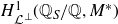 $ H^1_{\mathcal{L}^\perp}(\mathbb{Q}_S/\mathbb{Q}, M^*) $
is defined to be the subgroup of
 $ H^1(\mathbb{Q}_S/\mathbb{Q}, M^*) $
consisting of classes whose local restrictions lie inside the subspaces
 $ \mathcal{L}_\ell^\perp $
for each
 $ \ell \in S $
, that is,
 \begin{equation}H^1_{\mathcal{L}^\perp}(\mathbb{Q}_S/\mathbb{Q}, M^*) \;:\!=\; \ker\bigg( H^1(\mathbb{Q}_S/\mathbb{Q}, M^*) \longrightarrow \bigoplus_{\ell \in S} \frac{H^1(\mathbb{Q}_\ell, M^*)}{\mathcal{L}_\ell^\perp} \bigg).\end{equation}
2·3. Modular Galois representations and level raising
Let f be a Hecke eigencuspform and denote the integral representation by
 $\rho_{T_f}:\operatorname{G}_\mathbb{Q}\rightarrow \operatorname{GL}_2(\mathcal{O})$
. Let
 $\overline{\rho_{T_f}}\;:\!=\;\rho_{T_f}\pmod{(\varpi)}$
be the mod-
 $(\varpi)$
reduction of
 $\rho_{T_f}$
.
Assumption 2·1. Assume throughout this paper:
-
(i)
$p \nmid N_f$
,
-
(ii) the residual representation
$\overline{\rho_{T_f}}$
is absolutely irreducible.
-
(iii) The modular form f has weight 2 with trivial nebentype.
-
(iv) Assume that f is p-ordinary, which is to say that
$\iota_p(a_p(f))$
is a p-adic unit.


Condition (i) implies that the local representation
 $\rho_{|p}$
is crystalline. Condition (ii) ensures that
 $T_f$
is, up to scaling, the unique Galois-stable lattice in
 $V_f$
. In light of this, and with no risk of confusion, we shall henceforth write
 $\rho_f$
(respectively,
 $\overline{\rho_f}$
) in place of
 $\rho_{T_f}$
(respectively,
 $\overline{\rho_{T_f}}$
), thereby omitting the explicit reference to the choice of lattice. Condition (iii) implies that
 $\operatorname{det}\rho_f=\chi$
. Condition (iv) implies that
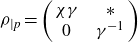 $\rho_{| p}= \bigg( {\begin{array}{c@{\quad}c} \chi\gamma & \ast \\ 0 & \gamma^{-1} \\ \end{array} } \bigg)$
where
 $\gamma:\operatorname{G}_p\rightarrow \mathbb{Z}_p^\times$
is a finite order unramified character.
Let
 $c \in \operatorname{G}_\mathbb{Q}$
denote complex conjugation. A Galois character
 $\eta$
is said to be odd if
 $\eta(c) = -1$
, and a representation
 $\rho$
is odd if
 $\det\rho(c) = -1$
. A continuous representation
 \[\bar{\rho} \;:\; \mathrm{Gal}(\overline{\mathbb{Q}}/\mathbb{Q}) \to \mathrm{GL}_2(\bar{\mathbb{F}}_p)\]
is said to be modular if it arises as the residual representation associated to a Hecke eigencuspform f, i.e., if
 $\bar{\rho} \simeq \bar{\rho}_f$
for some choice of embedding
 $F_f \hookrightarrow \bar{\mathbb{Q}}_p$
.
The weak form of Serre’s conjecture [
Reference SerreSer87
] asserts that every odd, irreducible, and continuous representation
 $\bar{\rho}$
as above is modular. Let
 $N_{\bar{\rho}}$
denote the prime-to-p part of the Artin conductor of
 $\bar{\rho}$
. Note that
 $N_{\bar{\rho}}$
is also called the Serre conductor of
 $\bar{\rho}$
. A modular form f is said to be of optimal level for
 $\bar{\rho}$
if it is new of level
 $\Gamma_1(N_{\bar{\rho}})$
and satisfies
 $\bar{\rho}_f \simeq \bar{\rho}$
. The strong form of the conjecture asserts that every odd, irreducible, and continuous representation
 $\bar{\rho}$
arises from a cuspidal newform g of weight
 $k \geq 2$
and level
 $\Gamma_1(N_{\bar{\rho}})$
, where the weight
 $k = k(\bar{\rho})$
is explicitly prescribed in [
Reference SerreSer87
, section 2]; see also [
Reference A. Ribet and SteinRS99
, p.11]. This conjecture was ultimately proven by Khare and Wintenberger in [
Reference Khare and WintenbergerKW09a
,
Reference Khare and WintenbergerKW09b
], building on foundational results of Ribet, notably his level-lowering theorem [
Reference RibetRib90
].
Assume that
 $\rho_f$
lifts
 $\bar{\rho}$
. Then the optimal level
 $N_{\bar{\rho}}$
necessarily divides
 $N_f$
. Carayol [
Reference CarayolCar89
] proved that there are explicit conditions on integers
 $N_f$
that arise as levels modular forms f.
Theorem 2·2 (Carayol). The level
 $N_f$
admits a factorisation
 \[N_f = N_{\bar{\rho}} \prod_\ell \ell^{\alpha(\ell)},\]
and for each prime
 $\ell$
with
 $\alpha(\ell) \gt 0$
, one of the following conditions holds:
-
(1)
$\ell \nmid N_{\bar{\rho}}$
,
$\ell(\mathrm{tr} \, \bar{\rho}(\sigma_\ell))^2 = (1+\ell)^2 \det \bar{\rho}(\sigma_\ell)$
in
$\bar{\mathbb{F}}_p$
, and
$\alpha(\ell) = 1$
; -
(2)
$\ell \equiv -1 \pmod{p}$
, and one of the following:-
(a)
$\ell \nmid N_{\bar{\rho}}$
,
$\mathrm{tr} \, \bar{\rho}(\sigma_\ell) \equiv 0$
in
$\bar{\mathbb{F}}_p$
, and
$\alpha(\ell) = 2$
; -
(b)
$\ell \mid N_{\bar{\rho}}$
,
$\det \bar{\rho}$
is unramified at
$\ell$
, and
$\alpha(\ell) = 1$
;
-
-
(3)
$\ell \equiv 1 \pmod{p}$
, and one of the following: -
(a)
$\ell \nmid N_{\bar{\rho}}$
and
$\alpha(\ell) = 2$
; -
(b) either
$\ell \mid N_{\bar{\rho}}$
and
$\alpha(\ell) = 1$
, or
$\ell \nmid N_{\bar{\rho}}$
and
$\alpha(\ell) = 1$
.










Definition 2·3. The set of levels
 $N_f$
satisfying the conditions in Theorem 2·2 is denoted by
 $\mathcal{S}(\bar{\rho})$
. For
 $X\gt0$
, set
 $n(\bar{\rho}; X)\;:\!=\;\#\{N_f\in \mathcal{S}(\bar{\rho})\mid N_f\leq X\}$
.
Diamond and Taylor proved a striking level raising theorem for mod p Galois representations, which provides a converse to Theorem 2·2.
Theorem 2·4 (Diamond–Taylor [
Reference Diamond and TaylorDT94
]). Let
 $p \geq 5$
be a prime, and let
 \[\bar{\rho} \;:\; \mathrm{Gal}(\overline{\mathbb{Q}}/\mathbb{Q}) \to \mathrm{GL}_2(\bar{\mathbb{F}}_p)\]
be an irreducible Galois representation. Suppose
 $\bar{\rho}$
arises from a newform g on
 $\Gamma_1(N_{\bar{\rho}})$
of weight k with
 $2 \leq k \leq p-2$
, and let
 $M \in \mathcal{S}(\bar{\rho})$
. Then there exists a cuspidal newform f of weight k and level M such that
 $\bar{\rho}_f \simeq \bar{\rho}$
.
Carayol’s theorem gives necessary local conditions on the level, Diamond and Taylor’s theorem shows that these conditions are also sufficient, thereby completing the characterization of levels at which
 $ \bar{\rho} $
arises.
2·4. Selmer groups
Associated to a Hecke eigenform f, there are two natural Selmer groups attached to its p -adic Galois representation. The first is defined using Greenberg’s local condition at p, together with the usual unramified conditions away from p. This Selmer group is defined over
 $\mathbb{Q}$
, and will differ from its Iwasawa theoretic counterpart, which is defined over the cyclotomic
 $\mathbb{Z}_p$
-extension of
 $\mathbb{Q}$
. We will refer to this as the
 $ \mathbb{Q} $
-Greenberg Selmer group of f. The second is the Bloch–Kato Selmer group, which is defined via the framework of p -adic Hodge theory.
Since f is p-ordinary,
 $V_f$
sits in a short exact sequence of
 $\mathcal{K}[\operatorname{G}_p]$
-modules,
 \[0\rightarrow V_f^+\xrightarrow{\iota} V_f \xrightarrow{\pi} V_f^-\rightarrow 0, \]
where
 $V_f^\pm$
are one-dimensional as
 $\mathcal{K}$
vector spaces. The action of
 $\operatorname{I}_p$
on
 $V_f^+$
is via
 $\chi_p^{k-1}$
, where k is the weight of f. On the other hand, the
 $\operatorname{G}_p$
action on the quotient
 $V_f^-$
is unramified. Setting
 \[T_f^+\;:\!=\;T_f\cap V_f^+\ \ \text{ and }\ \ T_f^-\;:\!=\;\pi(T_f)\]
one arrives at an exact sequence of
 $\mathcal{O}[\operatorname{G}_p]$
-modules
 \[0\rightarrow T_f^+\rightarrow T_f\rightarrow T_f^-\rightarrow 0.\]
Likewise, we set
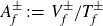 $A_f^{\pm}\;:\!=\;V_f^\pm/T_f^\pm$
and obtain the exact sequence
 \[0\rightarrow A_f^+\rightarrow A_f \rightarrow A_f^-\rightarrow 0.\]
Given a rational prime
 $\ell\neq p$
, define
 $H^1_{\operatorname{Gr}}(\mathbb{Q}_\ell, A_f)\;:\!=\;H^1_{\operatorname{nr}}(\mathbb{Q}_\ell, A_f)$
. Define
 \[H^1_{\operatorname{Gr}}(\mathbb{Q}_p, A_f)\;:\!=\;\operatorname{ker}\big\{ H^1(\mathbb{Q}_p, A_f)\rightarrow H^1(\operatorname{I}_p, A_f^-)\big\}.\]
Definition 2·5 (Greenberg Selmer group over
 $\mathbb{Q}$
). With respect to notation above, the Greenberg Selmer group associated to the p-divisible module
 ${\textrm{A}_\textrm{f}}$
is defined as follows:
 \[\operatorname{Sel}_{\operatorname{Gr}}(A_f/\mathbb{Q})\;:\!=\;\operatorname{ker}\left\{ H^1(\mathbb{Q}, A_f)\rightarrow \bigoplus_\ell \frac{H^1(\mathbb{Q}_\ell, A_f)}{H^1_{\operatorname{Gr}}(\mathbb{Q}_\ell, A_f)} \right\}.\]
Remark 2·6. Another natural Selmer group to consider was introduced by Bloch and Kato [ Reference Bloch and KatoBK90 ]:
 \[ \mathrm{Sel}_{\operatorname{BK}}(A_f/\mathbb{Q}) \;:\!=\; \ker\!\left\{ H^1(\mathbb{Q}, A_f) \longrightarrow \prod_{\ell} \frac{H^1(\mathbb{Q}_\ell, A_f)}{H^1_f(\mathbb{Q}_\ell, A_f)} \right\},\]
where the local conditions
 $H^1_f(\mathbb{Q}_\ell, A_f)$
differ from the conditions
 $H^1_{\operatorname{Gr}}(\mathbb{Q}_\ell, A_f)$
used to define the Greenberg Selmer group except at finitely many primes. One has a natural inclusion
 \[ \mathrm{Sel}_{\operatorname{BK}}(A_f/\mathbb{Q}) \subseteq \mathrm{Sel}_{\mathrm{Gr}}(A_f/\mathbb{Q}),\]
and it is known that if
 $A_f$
is p-crystalline, then
 $\mathrm{Sel}_{\mathrm{Gr}}(A_f/\mathbb{Q})$
is a finite-index subgroup of
 $\mathrm{Sel}_{\operatorname{BK}}(A_f/\mathbb{Q})$
(see [
Reference OchiaiOch00
, proposition 4·1(1)], [
Reference Longo and VigniLV21
, (3·1)], and [
Reference FlachFla90
, theorem 3]). Consequently, when the Greenberg Selmer group vanishes, so does the Bloch–Kato Selmer group.
2·5. The residual Selmer group
Let
 $A_f[\varpi]$
denote the residual representation, which may also be identified with
 $T_f / \varpi T_f$
. Define a Greenberg Selmer group associated to
 $A_f[\varpi]$
as follows. For
 $\ell \neq p$
, set
 \[H^1_{\operatorname{Gr}}(\mathbb{Q}_\ell, A_f[\varpi]) \;:\!=\; H^1_{\operatorname{nr}}(\mathbb{Q}_\ell, A_f[\varpi]),\]
and at p, define
 \[H^1_{\operatorname{Gr}}(\mathbb{Q}_p, A_f[\varpi]) \;:\!=\; \ker\{ H^1(\mathbb{Q}_p, A_f[\varpi]) \longrightarrow H^1(\operatorname{I}_p, A_f^-[\varpi])\}.\]
The inclusion
 $A_f[\varpi] \hookrightarrow A_f$
induces a map of Selmer groups
 \[\alpha \colon \operatorname{Sel}_{\operatorname{Gr}}(A_f[\varpi]/\mathbb{Q}) \longrightarrow \operatorname{Sel}_{\operatorname{Gr}}(A_f/\mathbb{Q})[\varpi],\]
which fits into the commutative diagram

The map h decomposes into a direct sum
 $h=\bigoplus_\ell h_\ell$
, where
 \[h_\ell:\frac{H^1(\mathbb{Q}_\ell, A_f[\varpi])}{H^1_{\operatorname{Gr}}(\mathbb{Q}_\ell, A_f[\varpi])}\longrightarrow \frac{H^1(\mathbb{Q}_\ell, A_f)[\varpi]}{H^1_{\operatorname{Gr}}(\mathbb{Q}_\ell, A_f)[\varpi]}.\]
We set
 $\beta_\ell(A_f)\;:\!=\;\dim_{\kappa}\operatorname{ker}h_\ell$
.
Lemma 2·7. The following assertions hold:
-
(i) suppose
$\ell\neq p$
, then there is a natural injection(2·3)
\begin{equation}\operatorname{ker}h_\ell\hookrightarrow \left(\frac{H^0(\operatorname{I}_\ell, A_f)}{\varpi H^0(\operatorname{I}_\ell, A_f)}\right)^{\operatorname{G}_\ell/\operatorname{I}_\ell};\end{equation}
-
(iii) let
$\ell\neq p$
and suppose that
$\ell\nmid N_{\bar{\rho}}$
(equivalently,
$\bar{\rho}$
is unramified at
$\ell$
). Then,
$\beta_\ell(A_f)=0$
; -
(iii) one has that
$\beta_p(A_f)=0$
.


Proof. Let us begin by proving part (i). Consider the commutative diagram
 \[\begin{array}{ccc}\dfrac{H^1(\mathbb{Q}_\ell, A_f[\varpi])}{H^1_{\operatorname{nr}}(\mathbb{Q}_\ell, A_f[\varpi])} & \xrightarrow{h_\ell} & \dfrac{H^1(\mathbb{Q}_\ell, A_f)[\varpi]}{H^1_{\operatorname{nr}}(\mathbb{Q}_\ell, A_f)[\varpi]} \\\downarrow^{} & & \downarrow^{} \\H^1(\operatorname{I}_\ell, A_f[\varpi])^{\operatorname{G}_\ell/\operatorname{I}_\ell} & \xrightarrow{g_\ell} & H^1(\operatorname{I}_\ell, A_f)^{\operatorname{G}_\ell/\operatorname{I}_\ell}[\varpi].\end{array}\]
The vertical maps are injective, and therefore,
 $\operatorname{ker}h_\ell$
injects into
 $\operatorname{ker} g_\ell$
. From the Kummer sequence,
 \[\operatorname{ker}g_\ell\simeq \left(\frac{H^0(\operatorname{I}_\ell, A_f)}{\varpi H^0(\operatorname{I}_\ell, A_f)}\right)^{\operatorname{G}_\ell/\operatorname{I}_\ell},\]
from which the result follows.
Next, we prove (ii). Since the action of
 $\operatorname{I}_\ell$
on
 $A_f$
is trivial, we find that
 $H^0(\operatorname{I}_\ell, A_f)=A_f$
. Since
 $A_f$
is
 $\varpi$
-divisible,
 $A_f/\varpi A_f=0$
and thus part (ii) follows from (i).
In order to prove part (iii), it suffices to show that the map
 \[H^1(\operatorname{I}_p, A_f^-[\varpi])\rightarrow H^1(\operatorname{I}_p, A_f^-)\]
is injective. By the Kummer sequence, its kernel is isomorphic to
 ${H^0(\operatorname{I}_p, A_f^-)}/{\varpi H^0(\operatorname{I}_p, A_f^-)}$
. Since the action of
 $\operatorname{I}_p$
on
 $A_f^-$
is trivial, and
 $A_f^-$
is
 $\varpi$
-divisible, we deduce that
 $h_p$
is injective. Consequently
 $\beta_p(A_f)=0$
, proving (iii).
Proposition 2·8. With the notation as above, one has
 \[\dim_{\kappa} \operatorname{Sel}_{\operatorname{Gr}}(A_f/\mathbb{Q})[\varpi] \leq \dim_{\kappa} \operatorname{Sel}_{\operatorname{Gr}}(A_f[\varpi]/\mathbb{Q}) + \sum_{\ell} \beta_\ell(A_f).\]
Proof. In (2·2), let h
′ denote the restriction of h to the image of
 $ \Phi $
. Applying the snake lemma yields an exact sequence
 \[0 \longrightarrow \ker \alpha \longrightarrow \ker g \longrightarrow \ker h' \longrightarrow \operatorname{coker} \alpha \longrightarrow \operatorname{coker} g.\]
Since
 $ A_f[\varpi] $
is irreducible as a
 $ \operatorname{G}_{\mathbb{Q}} $
-module, it follows that
 $ H^0(\mathbb{Q}, A_f[\varpi]) = 0 $
. Thus, the Kummer sequence shows that g is an isomorphism. In particular,
 $ \alpha $
is injective and
 $ \operatorname{coker} \alpha $
injects into
 $ \ker h $
.
There is therefore a left exact sequence
 \begin{equation}0 \longrightarrow \operatorname{Sel}_{\operatorname{Gr}}(A_f[\varpi]/\mathbb{Q}) \longrightarrow \operatorname{Sel}_{\operatorname{Gr}}(A_f/\mathbb{Q})[\varpi] \longrightarrow \bigoplus_{\ell} \ker h_\ell,\end{equation}
from which the claimed inequality follows.
A similar strategy yields lower bounds for the dimension of
 $\operatorname{Sel}_{\operatorname{Gr}}(A_f/\mathbb{Q})[\varpi]$
over
 $\kappa$
. Let S denote the set of primes dividing
 $N_f p$
. For each
 $\ell \in S$
, define the local condition
 $\mathcal{L}_\ell \;:\!=\; H^1_{\operatorname{Gr}}(\mathbb{Q}_\ell, A_f[\varpi])$
, so that the associated Selmer group is given by
 $$H^1_{\mathcal{L}}(\mathbb{Q}_S/\mathbb{Q}, A_f[\varpi]) = \operatorname{Sel}_{\operatorname{Gr}}(A_f[\varpi]/\mathbb{Q}).$$
One defines the dual Selmer group by setting
 $$\operatorname{Sel}_{\operatorname{Gr}, \perp}(A_f[\varpi]^*/\mathbb{Q}) \;:\!=\; H^1_{\mathcal{L}^\perp}(\mathbb{Q}_S/\mathbb{Q}, A_f[\varpi]^*),$$
as in (2·1). While the result that follows is not used in the proof of the main theorem, it is of independent interest.
Lemma 2·9. With respect to the above notation,

Proof. From (2·2) and the arguments in the proof of Proposition 2·8, there is a short exact sequence
 \[0 \longrightarrow \operatorname{Sel}_{\operatorname{Gr}}(A_f[\varpi]/\mathbb{Q}) \longrightarrow \operatorname{Sel}_{\operatorname{Gr}}(A_f/\mathbb{Q})[\varpi] \longrightarrow \ker h'\rightarrow 0.\]
From the Poitou–Tate sequence (cf. [ Reference TaylorTay03 , p. 555, line 7]), we find that

Thus, one finds that

It follows from Wiles’ formula [ Reference Neukirch, Schmidt and WingbergNSW08 , theorem 8·7·9] that

3. Main results
In this section, we fix a prime
 $p\geq 5$
, a p-adic field
 $\mathcal{K}$
with valuation ring
 $\mathcal{O}$
, uniformizer
 $\varpi$
and residue field
 $\kappa$
. We also fix a surjective and odd Galois representation
 \[\bar{\rho}:\operatorname{G}_\mathbb{Q}\rightarrow \operatorname{GL}_2(\kappa)\]
with
 $\operatorname{det}\bar{\rho}=\bar{\chi}$
. As is well known, the results of Khare and Wintenberger imply that there exists a Hecke eigencuspform form f of weight 2, trivial nebentype and optimal level
 $N_f=N_{\bar{\rho}}$
such that
 $\bar{\rho}_f=\bar{\rho}$
.
Let
 $\Omega_{\bar{\rho}}$
be the set of prime numbers
 $\ell$
such that
-
(1)
$\ell\nmid N_{\bar{\rho}} p$
, -
(2)
$\ell\not\equiv \pm 1\mod{p}$
, -
(3)
$\bar{\rho}_f(\sigma_\ell)= \bigg( {\begin{array}{c@{\quad}c} -\ell & 0 \\ 0 & -1 \\ \end{array} } \bigg)$
for a suitable choice of basis.


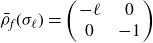
Remark 3·1. It follows from an easy application of the Chebotarev density theorem that if
 $p\geq 5$
and
 $\bar{\rho}_f$
is surjective, then
 $\Omega_{\bar{\rho}}$
has positive density. In fact, according to [
Reference RayRay24
, proposition 5·2] its density is equal to
 \begin{equation} \mathfrak{d}(\Omega_{\bar{\rho}})=\frac{(p-3)}{(p-1)^2}. \end{equation}
Lemma 3·2. Let g be a p-ordinary modular form of weight 2 and trivial nebentypus such that
 $\bar{\rho}_g \simeq \bar{\rho}_f\simeq \bar{\rho}$
. Suppose that
 $\ell \mid N_g$
is a prime lying in
 $\Omega_{\bar{\rho}}$
. Then
 \[\beta_\ell(A_f) = 0 \quad \text{and} \quad \beta_\ell(A_g) = 0.\]
Proof. Since
 $\ell\nmid N_{\bar{\rho}}$
, the vanishing
 $\beta_\ell(A_f) = 0$
follows from part (ii) of Lemma 2·7. For the vanishing of
 $\beta_\ell(A_g)$
, part (i) of the same lemma reduces the problem to showing that
 \[\left( \frac{H^0(\mathrm{I}_\ell, A_g)}{\varpi H^0(\mathrm{I}_\ell, A_g)} \right)^{\mathrm{G}_\ell/\mathrm{I}_\ell} = 0.\]
It follows from [
Reference RayRay24
, lemma 4·4] that
 $\rho_g$
factors through the maximal pro-p tame inertia quotient of
 $\mathrm{G}_\ell$
, generated by
 $\sigma_\ell$
and
 $\tau_\ell$
with the relation
 $\sigma_\ell \tau_\ell \sigma_\ell^{-1} = \tau_\ell^\ell$
. Here,
 $\sigma_\ell$
is a lift of Frobenius and
 $\tau_\ell$
is a generator of the tame inertia. Further, there exist
 $x \equiv -1 \pmod{\varpi}$
and
 $y \equiv 0 \pmod{\varpi}$
such that
 \[\rho_g(\sigma_\ell) = \begin{pmatrix} \ell x &\quad 0 \\ 0 &\quad x \end{pmatrix} \quad \text{and} \quad \rho_g(\tau_\ell) = \begin{pmatrix} 1 &\quad y \\ 0 & \quad 1 \end{pmatrix}.\]
Since
 $\rho_g$
is ramified at
 $\ell$
, one must have
 $y \neq 0$
. Write
 $y = \varpi^n u$
with
 $u \in \mathcal{O}^\times$
. It follows that
 \[A_g^{\mathrm{I}_\ell} = \left( \mathcal{K}/\mathcal{O} \right) \cdot e_1 \oplus \left( \varpi^{-n} \mathcal{O}/\mathcal{O} \right) \cdot e_2.\]
Thus,
 \[\frac{H^0(\mathrm{I}_\ell, A_g)}{\varpi H^0(\mathrm{I}_\ell, A_g)} \simeq \kappa \cdot e_2,\]
as a
 $\mathrm{G}_\ell$
-module. The element
 $\sigma_\ell$
acts on
 $\kappa \cdot e_2$
via multiplication by
 $x \bmod \varpi$
, which is
 $-1$
by assumption. Since
 $p \neq 2$
, this action is nontrivial, and so the invariants under
 $\mathrm{G}_\ell/\mathrm{I}_\ell$
vanish:
 \[\bigg( \frac{H^0(\mathrm{I}_\ell, A_g)}{\varpi H^0(\mathrm{I}_\ell, A_g)} \bigg)^{\mathrm{G}_\ell/\mathrm{I}_\ell} = 0.\]
Hence,
 $\beta_\ell(A_g) = 0$
, as desired.
Lemma 3·3. Let g be a p-ordinary modular form of weight 2 such that
 $\bar{\rho}_g \simeq \bar{\rho}_f \simeq \bar{\rho}$
. Assume that
 $p\nmid N_g$
. Let
 $\ell$
be a prime dividing
 $N_{\bar{\rho}}$
such that
 $\ell \not\equiv \pm 1 \pmod{p}$
. Then
 \[\beta_\ell(A_f) = 0 \quad \text{and} \quad \beta_\ell(A_g) = 0.\]
Proof. Let h denote f or g. Assume by way of contradiction that
 $\beta_\ell(A_h)\gt0$
. By part (i) of Lemma 2·7 we have
 $H^{0}\left(I_{\ell}, A_{h}\right) \neq 0$
, hence
 $H^{0}\left(I_{\ell}, A_{h}[\varpi]\right) \neq 0$
. Since
 $\det\bar{\rho}$
is the mod p cyclotomic character and
 $\ell\neq p$
, we find that
 $\operatorname{det}(\bar{\rho}_{|\operatorname{I}_\ell})=1$
. Consequently, there exists a basis
 $(\bar{e_1}, \bar{e_2})$
with respect to which the restriction
 $\bar{\rho}|_{\mathrm{I}_\ell}$
takes the form
 \[\bar{\rho}|_{\mathrm{I}_\ell} = \begin{pmatrix} 1 &\quad * \\ 0 &\quad 1 \end{pmatrix},\]
so that
 $\bar{\rho}$
factors through the maximal pro-p tame inertia quotient of
 $\mathrm{G}_\ell$
, generated by
 $\sigma_\ell$
and
 $\tau_\ell$
(as in the proof of Lemma 3·2). Since
 $\ell \mid N_{\bar{\rho}}$
, the representation
 $\bar{\rho}$
is ramified at
 $\ell$
. Therefore there exists
 $y\neq 0$
for which
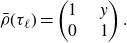 $\bar{\rho}(\tau_\ell) = \begin{pmatrix} 1 &\quad y \\ 0 &\quad 1 \end{pmatrix}.$
We also write
 $\bar{\rho}(\sigma_\ell) = \begin{pmatrix} a &\quad b \\ c &\quad d \end{pmatrix}$
. From the relation
 $\sigma_\ell \tau_\ell \sigma_\ell^{-1}=\tau_\ell^\ell$
, we find that
 \[\bar{\rho}(\sigma_\ell) \bar{\rho}(\tau_\ell) = \begin{pmatrix} a &\quad ay + b \\ c &\quad cy + d \end{pmatrix}\]
and
 \[\bar{\rho}(\tau_\ell)^\ell \bar{\rho}(\sigma_\ell) = \begin{pmatrix} 1 &\quad \ell y \\ 0 &\quad 1 \end{pmatrix} \begin{pmatrix} a &\quad b \\ c &\quad d \end{pmatrix} = \begin{pmatrix} a + c \ell y &\quad b + d \ell y \\ c & d \end{pmatrix}.\]
Equating these matrices, we obtain
 $c = 0$
and
 $a = d\ell$
. Hence,
 \begin{equation}\bar{\rho}(\sigma_\ell) = \begin{pmatrix} d\ell &\quad b \\ 0 &\quad d \end{pmatrix}.\end{equation}
Note that
 $\det \bar{\rho}(\sigma_\ell)=\bar{\chi}(\sigma_\ell) = \ell$
, and thus we conclude that
 $d^2 \ell = \ell$
, and consequently,
 $d = \pm 1$
.
Since
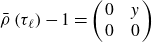 $\bar{\rho}\left(\tau_{\ell}\right)-1=\bigg(\begin{array}{l@{\quad}l}0 & y \\ 0 & 0\end{array}\bigg)$
, we see that
 $\rho\left(\tau_{\ell}\right)$
has Smith Normal Form
 $\left(\begin{array}{c@{\quad}c}1 & 0 \\ 0 & w\end{array}\right)$
for some
 $w \in(\varpi)$
. If
 $w=0$
then
 $A_{h}^{I_{\ell}} / \varpi A_{h}^{I_{\ell}}=0$
, contradicting
 $\beta_\ell\left(A_{h}\right)\gt0$
. Thus
 $w \neq 0$
, giving
 $A_{h}^{I_{\ell}}=\left(\varpi^{-N} \mathcal{O} / \mathcal{O}\right) \cdot \gamma$
for some
 $N\gt0$
and some
 $\gamma$
which is necessarily congruent to
 $\bar{e}_{1}$
modulo
 $\varpi$
. Since
 $\ell \neq \pm 1(\bmod \varpi)$
, we see from (3·2) that the action of
 $\sigma_{\ell}-1$
on
 $A_{h}^{I_{\ell}} / \varpi A_{h}^{I_{\ell}}$
is invertible, hence
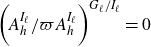 $\bigg(A_{h}^{I_{\ell}} / \varpi A_{h}^{I_{\ell}}\bigg)^{G_{\ell} / I_{\ell}}=0$
. Part (i) of Lemma 2·7 gives
 $\beta_\ell\left(A_{h}\right)=0$
. This is a contradiction and the proof is complete.
Proposition 3·4. Let g be a p-ordinary modular form of weight 2 such that
 $\bar{\rho}_g \simeq \bar{\rho}_f \simeq \bar{\rho}$
. Assume the following:
-
(i) no prime
$\ell \equiv \pm 1 \pmod{p}$
divides
$N_{\bar{\rho}}$
; -
(ii) every prime dividing
$N_g/N_{\bar{\rho}}$
lies in
$\Omega_{\bar{\rho}}$
.Then
\[\dim_{\kappa} \mathrm{Sel}_{\mathrm{Gr}}(A_f/\mathbb{Q})[\varpi] = \dim_{\kappa} \mathrm{Sel}_{\mathrm{Gr}}(A_g/\mathbb{Q})[\varpi].\]



Proof. Fix
 $h \in \{f, g\}$
. We claim that
 \[\dim_{\kappa} \mathrm{Sel}_{\mathrm{Gr}}(A_h/\mathbb{Q})[\varpi] = \dim_{\kappa} \mathrm{Sel}_{\mathrm{Gr}}(A_h[\varpi]/\mathbb{Q}).\]
By the exactness of the sequence
 \begin{equation}0 \to \mathrm{Sel}_{\mathrm{Gr}}(A_h[\varpi]/\mathbb{Q}) \to \mathrm{Sel}_{\mathrm{Gr}}(A_h/\mathbb{Q})[\varpi] \to \bigoplus_\ell \operatorname{ker}h_\ell,\end{equation}
we have the inequality
 \[\dim_{\kappa} \mathrm{Sel}_{\mathrm{Gr}}(A_h[\varpi]/\mathbb{Q}) \leq \dim_{\kappa} \mathrm{Sel}_{\mathrm{Gr}}(A_h/\mathbb{Q})[\varpi],\]
and further,
 \[\dim_{\kappa} \mathrm{Sel}_{\mathrm{Gr}}(A_h/\mathbb{Q})[\varpi] \leq \dim_{\kappa} \mathrm{Sel}_{\mathrm{Gr}}(A_h[\varpi]/\mathbb{Q}) + \sum_\ell \beta_\ell(A_h).\]
It therefore suffices to show that
 $\beta_\ell(A_h) = 0$
for all primes
 $\ell$
.
By Lemma 2·7, we have
 $\beta_\ell(A_h) = 0$
for
 $\ell = p$
and for all
 $\ell \nmid N_h$
. For the remaining primes
 $\ell \mid N_h$
, there are two cases:
-
(1) if
$\ell \mid (N_h/N_{\bar{\rho}})$
, then
$\ell \in \Omega_{\bar{\rho}}$
by assumption. Lemma 3·2 then implies
$\beta_\ell(A_h) = 0$
; -
(2) if
$\ell \mid N_{\bar{\rho}}$
, then
$\ell \not\equiv \pm 1 \pmod{p}$
by assumption. Lemma 3·3 applies, and again we conclude
$\beta_\ell(A_h) = 0$
.




Hence, we obtain the desired equality:
 \begin{equation}\dim_{\kappa} \mathrm{Sel}_{\mathrm{Gr}}(A_h/\mathbb{Q})[\varpi] = \dim_{\kappa} \mathrm{Sel}_{\mathrm{Gr}}(A_h[\varpi]/\mathbb{Q}).\end{equation}
The inertia group at p acts on
 $A_h[\varpi]$
via
 $ \bigg( {\begin{array}{c@{\quad}c} \bar{\chi} & \ast \\ 0 & 1 \\ \end{array} } \bigg)$
and
 $A_h[\varpi]^+$
is the 1-dimensional submodule on which
 $\operatorname{I}_p$
acts via the mod-p cyclotomic character and
 $A_h[\varpi]^-$
is the unique quotient on which
 $\operatorname{I}_p$
acts trivially. Thus
 $A_h[\varpi]$
determines the 1-dimensional modules
 $A_h[\varpi]^\pm$
. Since
 $\bar{\rho}_f \simeq \bar{\rho}_g$
, we deduce that
 \[\dim_{\kappa} \mathrm{Sel}_{\mathrm{Gr}}(A_f[\varpi]/\mathbb{Q})=\dim_{\kappa} \mathrm{Sel}_{\mathrm{Gr}}(A_g[\varpi]/\mathbb{Q}).\]
From (3·4) it follows that
 \[\dim_{\kappa} \mathrm{Sel}_{\mathrm{Gr}}(A_f/\mathbb{Q})[\varpi]=\dim_{\kappa} \mathrm{Sel}_{\mathrm{Gr}}(A_g/\mathbb{Q})[\varpi].\]
This completes the proof.
Before proving our main theorem, we recall the following well known result of Serre.
Theorem 3·5 (Serre). Let
 $ \Omega $
be a set of primes with Dirichlet density
 $ \delta \gt 0 $
. For
 $ Y \gt 0 $
, let
 $ M_\Omega(Y) $
denote the number of squarefree natural numbers
 $ M \leq Y $
divisible only by primes in
 $ \Omega $
. Then
 \[M_\Omega(Y) \gg Y (\log Y)^{\delta - 1}.\]
Proof. This follows from [ Reference SerreSer75 , theorem 2·4].
Proof of Theorem
A. Let
 $ \Omega \;:\!=\; \Omega_{\bar{\rho}} $
, and consider any
 $ M \in M_\Omega(Y) $
. Set
 $ N \;:\!=\; M N_{\bar{\rho}} $
. Then
 $ N \in \mathcal{S}(\bar{\rho}) $
, and by Theorem 2·4, there exists a Hecke eigencuspform g such that
 $ \bar{\rho}_g \simeq \bar{\rho}_f $
and
 $ N = N_g $
. By Proposition 3·4, we have
 \[\dim_\kappa \operatorname{Sel}_{\operatorname{Gr}}(A_f/\mathbb{Q})[\varpi] = \dim_\kappa \operatorname{Sel}_{\operatorname{Gr}}(A_g/\mathbb{Q})[\varpi].\]
Thus,
 $ N \in \mathcal{S}_f(X) $
, and hence
 \[N_f(X) \geq M_{\Omega}(X / N_{\bar{\rho}}).\]
Applying Theorem 3·5, we obtain
 \[N_f(X) \gg X (\log X)^{\alpha - 1},\]
where
 $ \alpha = \mathfrak{d}(\Omega) = ({p - 3})/{(p - 1)^2} $
by (3·1).
Acknowledgement
We thank the anonymous referee for the excellent report.



