


Introduction
Foliar spray applications are widely used in agriculture, especially on golf courses, where intensive management practices are conducted to maintain turf quality and performance. Improving the performance of spray applications while reducing costs, labor, and potential environmental impacts are goals for all turf managers and researchers. An effective spray should deposit the active ingredient uniformly to the target site and persist for enough time to exert control (Furmidge Reference Furmidge1962). Turf managers can adjust the properties of spray mixtures and spray methods to optimize the response to the application under different situations (Gossen et al. Reference Gossen, Peng and Wolf2008). Spray volume, nozzle type, travel speed, and adjuvant can be varied to increase application efficacy.
The effects of adjuvants, carrier volume, and droplet size on herbicide performance have been extensively studied for many crops, including turf (Kennelly and Wolf Reference Kennelly and Wolf2009; McDonald et al. Reference McDonald, Dernoeden and Bigelow2006; McCullough and Hart Reference McCullough and Hart2009; Zawierucha and Penner Reference Zawierucha and Penner2001). However, a thorough search of literature did not find any studies that quantified foliar retention or retention efficiency on turfgrasses. The evaluation of foliar retention and retention efficiency are important, because they determine the coverage and the total amount of active ingredient available for foliar uptake. Foliar retention is simply the amount of the spray application retained on the leaf surface. Foliar retention efficiency is the ratio of the volume retained on the leaf surface divided by the volume applied (Byer et al. Reference Byer, Peng, Wolf and Caldwell2006). For pesticides and nutrients that are absorbed by the foliage, enhancing foliar retention efficiency should lead to better efficacy from the applied chemicals.
A number of studies have reported the influence of spray volume, nozzle type, adjuvants, and their interaction on foliar retention in other crops or weeds, such as wheat (Triticum aestivum L.) (Butler Ellis et al. Reference Butler Ellis, Webb and Western2004), corn (Zea mays L.) (Feng et al. Reference Feng, Chiu, Sammons and Ryerse2003), giant foxtail (Setaria faberi Herrm.) (Hart et al. Reference Hart, Kells and Penner1992; Young and Hart Reference Young and Hart1998), green foxtail [Setaria viridis (L.) P. Beauv.] (Peng et al. Reference Peng, Wolf, Byer and Caldwell2005), large crabgrass [Digitaria sanguinalis (L.) Scop.] (Zawierucha and Penner Reference Zawierucha and Penner2000), and chick pea (Cicer arietinum L.) (Armstrong-Cho et al. Reference Armstrong-Cho, Wolf, Chongo, Gan, Hogg, Lafond, Johnson and Banniza2008). Increasing spray volume increased foliar retention (Peng et al. Reference Peng, Wolf, Byer and Caldwell2005) but decreased retention efficiency (Byer et al. Reference Byer, Peng, Wolf and Caldwell2006). Increasing the size of the spray droplets decreased foliar retention (Feng et al. Reference Feng, Chiu, Sammons and Ryerse2003) and foliar retention efficiency (Byer et al. Reference Byer, Peng, Wolf and Caldwell2006). Adding adjuvants typically increased foliar retention (Hart et al. Reference Hart, Kells and Penner1992).
The properties of the plant surface are a critical factor that influences the behavior of spray droplets (Ruiter et al. Reference Ruiter, Uffing, Meinen and Prins1990). Spray retention on golf fairways may be different than on other crops because of the density of foliage in a highly managed turf. Additionally, dew is often present during spray applications on golf courses (Delvalle et al. Reference Delvalle, Landschoot and Kaminski2011; Williams et al. Reference Williams, Powell, Dougherty and Vincelli1998). Dew has been shown to reduce foliar retention on vine grapes (Vitis vinifera L.) by 75% (Saab et al. Reference Saab, Griesang, Alves, Higashibara and Genta2017).
The use of tracers in agricultural sprays to assess spray retention and leaf coverage was recently reviewed by Nairn and Forster (Reference Nairn and Forster2019). The most widely used tracers are fluorescent compounds, visible dyes, or metal salts. The principal disadvantages of fluorescent compounds are the cost of analysis and potential photodegradation of the dye. Using metal salts as tracers requires more expensive laboratory analyses and a higher likelihood of plant uptake (Murray et al. Reference Murray, Cross and Ridout2000). Tartrazine, a yellow food dye, has been successfully used to measure foliar retention in crops such as tomatoes (Solanum lycopersicum L.), apples (Malus pumila Mill), and cucumbers (Cucumis sativus L.) (Cross et al. Reference Cross, Walklate, Murray and Richardson2001; Dorr et al. Reference Dorr, Forster, Mayo, McCue, Kempthorne, Hanan, Turner, Belward, Young and Zabkiewicz2016; Murray et al. Reference Murray, Cross and Ridout2000; Nairn and Forster Reference Nairn and Forster2019; Sanchez-Hermosilla et al. Reference Sanchez-Hermosilla, Medina, Rodriguez and Callejon2008). Tartrazine can be readily recovered from leaf surfaces and is easily quantified using a spectrophotometer. Dyes have multiple uses in spray deposition research, with dyes such as brilliant blue used to visualize spray deposits (van Zyl et al. Reference van Zyl, Brink, Calitz and Fourie2010), while other products such as tartrazine can be used to determine foliar spray retention (Nairn and Forster Reference Nairn and Forster2019).
The objective of this research was to quantify the foliar retention efficiency of spray solutions on creeping bentgrass foliage as influenced by spray volumes, nozzle types, adjuvants, the presence of dew, and their interactions.
Materials and Methods
Plant Material
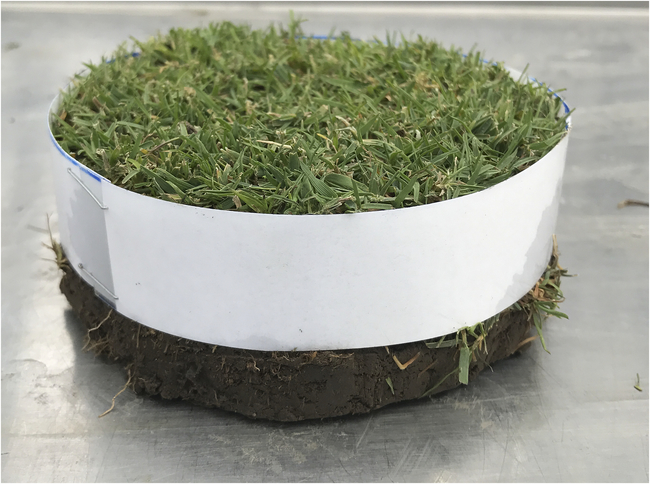
Turf cores were harvested with a 10.6-cm-diameter golf course cup cutter and transported to the laboratory 1 d before each experiment. The cores were collected from a creeping bentgrass turf (‘L93’), maintained at a mowing height of 1.3 cm, that was established in August of 2010 at the University of Illinois Landscape Horticulture Research Center, Urbana, IL. Approximately 2.5 cm of soil was preserved, so the height of each core was 3.8 cm. The cores were covered with moistened paper towels to prevent wilting. Plastic bands were wrapped around each core from the leaf surface to the bottom of the core to maintain the leaf surface area and to prevent spray deposition on the side of the foliage (Figure 1).
A plastic band was used to prevent leaf area from expanding beyond the original core size and to prevent spray deposition on the leading edge of the core so the core would receive spray as it would in situ.
Tartrazine Recovery Validation
Several experiments were conducted to validate that tartrazine (Sigma-Aldrich, St. Louis, MO) could be quantitatively recovered from turfgrass foliage. In the first experiment, aboveground green tissue and thatch were removed from each core with scissors and placed into a 100-mm petri dishes (Fisherbrand, Waltham, MA). One milliliter of tartrazine solution (20 mmol L−1 in distilled water) was uniformly placed on the plant material by pipette. The petri dishes were stored in the dark at 20 C for 4, 12, 24, or 48 h. Each time interval was replicated three times. Tissue samples were extracted four times with 75 ml of distilled water. The rinsates were combined, filtered through a Whatman No. 1 (Buckinghamshire, UK) qualitative filter, and a 7-ml subsample was filtered through a 0.2-µm, 25-mm-diameter syringe filter (CHROMAFIL® Xtra PES-20/25, Macherey-Nagel, Bethlehem, PA). Filtered samples were stored in 7-ml glass bottles in the dark for later measurements. A second experiment was conducted to confirm that tartrazine recovery was quantitative, that is, that any tartrazine not recovered from the leaf tissue had moved into the thatch layer. Turf cores were treated with spray volumes of 190, 750, and 1,500 L ha−1 containing tartrazine at 20 mmol L−1. Each spray volume was replicated three times. After all green leaf tissue was collected, the top 0.5 cm of thatch was collected separately. The leaf tissue and thatch were extracted and measured as above.
Experimental Design
All experiments were conducted at the Plant Science Laboratory Greenhouse in Urbana, IL. In each experiment, a completely randomized design with four replications was used. Each experiment was repeated within 10 d to minimize differences in leaf area of plant material.
All experiments were conducted using a Generation III Research Track Sprayer (DeVries Manufacturing, Hollandale, MN). The spray height for flat-fan nozzles was 41 cm, while the spray height was 46 cm for air-induction nozzles (TeeJet Technologies, Glendale, IL). The pressure of the sprayer was set at 276 kPa for all experiments.
Tartrazine was added to each spray solution. The tartrazine concentration was 50 mmol L−1 at spray volumes of 95 and 190 L ha−1. At the 380 or 550 L ha−1 spray volumes, tartrazine concentration was 20 mmol L−1, while at spray volumes of 750, 850, 1,125, or 1,500 L ha−1, tartrazine concentration was 10 mmol L−1.
Influence of Spray Volume, Nozzle Type, Adjuvants, and Dew on Foliar Retention Efficiency
A series of experiments were conducted to determine the effects of various factors on foliar retention efficiency. In the first experiment, six spray volumes were evaluated using flat-fan nozzles (TeeJet Technologies) (Table 1). These experiments were conducted on July 26 and 29, 2017.
Nozzle type and traveling speed required to reach desired spray volumes.

a F, fine droplet with a volume median diameter (VMD) between 136 and 177 microns; M, medium droplet with VMD between 177 and 218 microns; C, coarse droplet with VMD between 218 and 349 microns; VC, very coarse droplet with VMD of 349 to 428 microns; XC, extremely coarse droplet with VMD between 428 and 622 microns; UC, ultra-coarse droplet with VMD larger than 622 microns.
b TeeJet® Technologies, Glendale, IL.
To compare flat-fan versus air-induction nozzles, spray volumes of 190, 380, 750, or 1,125 L ha−1were used (Table 1). These experiments were conducted on September 12 to 14 and 20 to 23, 2017.
To determine the effects of spray adjuvants, three adjuvant classes, nonionic surfactant (NIS; Induce®, Helena Chemical Company, Memphis, TN), organosilicone (OSA; Kinetic®, Helena Chemical Company), and methylated seed oil (MSO; BASF, Research Triangle Park, NC) were added to distilled water at concentrations of 0.25% v/v, 0.125% v/v, or 0.75% v/v, respectively. Distilled water was included as a control. Three spray volumes, 190, 750, or 1,125 L ha−1, were used, and the experiments were conducted on August 21 to 23 and September 1 to 3, 2017.
To determine the impact of dew on foliar retention efficiency, naturally occurring dew at the University of Illinois Landscape Horticulture Research Center, Urbana, IL, was measured on five random dates during August and September 2017, between 7:00 AM and 9:00 AM with five replications per measurement. Based upon those results, the Generation III sprayer was used to apply simulated dew at 1,950 L ha−1 to turf cores using a flat-fan nozzle (EVS8001, TeeJet Technologies). A no-dew control was included. Adjuvant treatments of NIS or MSO were added to distilled water at a concentration of 0.25% v/v or 0.75% v/v at spray volumes of 190 or 750 L ha−1. These experiments were conducted on April 20 to 23 and 24 to 26, 2018.
To further determine the effect of dew, three levels of dew, 950, 1,900, or 3,800 L ha−1, were applied using the Generation III sprayer. Following dew application, the turf cores were immediately treated with spray volumes of 190, 550, or 850 L ha−1 with NIS at 0.25% v/v. These experiments were conducted on May 4 to 6 and 7 to 9, 2018.
Application Methods and Analysis
Filter paper with a diameter of 185 mm (Whatman No. 1) was placed before and after each set of four bentgrass cores and treated with one pass of the sprayer. The quantity of tartrazine on the filter papers was used to estimate the applied spray volume. For spray volumes lower than 750 L ha−1, one filter paper was placed at each end while two layers of filter paper were needed to fully absorb spray droplets produced at spray volumes above 750 L ha−1.
Following spray application, the cores were air-dried for 1 h in a fume hood before leaf removal. For dew studies, two dryers, placed 1.2 m above the turf cores, were used for 30 min to hasten the drying process. After drying, all green tissue was carefully removed, extracted, and filtered following the procedure outlined in the validation section.
Sample absorbance was measured using a spectrophotometer (SPECTRONIC 20D, Thermo Fisher, Waltham, MA) at 425 nm, where the absorbance of tartrazine is maximized (Pergher Reference Pergher2000). Standard curves were determined for each experiment. Applied volume, retention efficiency, and foliar retention volume were calculated using the following formulas:
 $$\eqalign{& {\rm{Applied}}\,{\rm{volume}}(AV) = {\rm{0}}{\rm{.32}}{C_{\rm{f}}}{V_{\rm{f}}} \times S{\rm{/}}{C_{{\rm{tracer}}}}{V_{\rm tracer}} \cr & {\rm{Retention}}\,{\rm{efficiency}}(RE) = ({C_{\rm{t}}}{V_{\rm{t}}} - 0.112)/0.32{C_{\rm{f}}}{V_{\rm{f}}} \cr & {\rm{Retention}}\,{\rm{volume}}(RV) = AV \times RR = ({C_{\rm{f}}}{V_{\rm{t}}} - 0.112) \times S/{C_{{\rm{tracer}}}}{V_{{\rm{tracer}}}} \cr & {\rm{Coefficient}}\,{\rm{of}}\,{\rm{variance}}(CV) = \sigma /{\rm{Marginal}}\,{\rm{mean}}} $$
where
0.32 = the ratio of the area of the turf core (86.2 cm2) to the area of each filter paper (268.8 cm2)
C f = the concentration of tracer extracted from filter papers (mg ml−1)
V f = the volume of spray solution determined from the filter paper (ml)
S = targeted spray volume (L ha−1)
C tracer = the concentration of tracer in spray mixture (mg ml−1)
V tracer = the volume of spray mixture deposited within each experimental unit area (86.2 cm2) based on targeted spray volume (ml)
C t = the concentration of the rinsate extracted from turf clippings (mg ml−1)
V t = the volume of rinsate reclaimed from turf clipping extractions (ml)
0.112 = absorbance due to clipping rinsate (i.e., background)
ANOVA was performed using JMP Pro v. 11.2 (SAS Institute, Cary, NC). Several experiments (nozzle types by spray volumes; adjuvant types by spray volumes; dew levels by spray volumes) were analyzed as a two-factor factorial. A three-factor design was used in analyzing the interaction between the presence of dew, adjuvants, and spray volumes. In all studies, means were compared by the Fisher’s LSD test at the 0.05 probability level.
Results and Discussion
Tartrazine Recovery Validation
Tartrazine recovery from filter paper averaged 99.5 ± 0.9% (n = 9). From clippings and thatch, the recovery rates of tartrazine decreased linearly with time (Figure 2), suggesting that tartrazine should be extracted within 4 h after treatment to ensure quantitative recovery (96.6 ± 1.6%). These data indicate that degradation may be the main limitation of using tartrazine as a tracer in creeping bentgrass. Nairn and Forster (Reference Nairn and Forster2019) tested the stability of several dye tracers by placing the dye on the leaves of the brown barrel tree (Eucalyptus fastigata H. Deane & Maiden) in direct sunlight for up to 7 h and concluded that tartrazine was photostable. Nairn and Forster also tested recovery of tartrazine from brown barrel leaf samples stored in bags for up to 8 d and again saw no degradation.
The recovery rate of tartrazine on leaf clippings and thatch from creeping bentgrass as influenced by different storage times. Capital or lowercase letters indicate significant differences in foliar recovery rate in thatch or foliage, respectively.

Based upon our results, the rate of tartrazine degradation should be determined before beginning experiments in other cropping systems.
The recovery of tartrazine in the foliage plus thatch layer, when averaged over all three spray volumes, was 102.0 ± 5.3%. The recovery in the thatch layer was higher at 1,500 L ha−1 spray volume than at lower spray volumes (Table 2), indicating that the lower foliar recovery rates are caused by movement of tartrazine into the turf profile rather than degradation or loss of tracer during analysis.
The recovery rate of tartrazine deposited on creeping bentgrass foliage and thatch under different spray volumes.

a Aboveground green tissues and top 0.5 cm of thatch were carefully collected and analyzed separately.
b Recovery rates were averaged across two runs of study due to insignificant interactions. Different letters indicate significant differences as determined by Fisher’s protected LSD test at P = 0.05.
Influence of Spray Volume, Nozzle Type, Adjuvants, and Dew on Foliar Retention Efficiency
Six spray volumes typically used on golf courses were evaluated. Foliar retention volume was linearly correlated with applied spray volume (R2 = 0.99) (Figure 3). The linear increase in foliar retention with increasing spray volume indicates that bentgrass leaves could hold additional spray volume without runoff or drainage. Peng et al. (Reference Peng, Wolf, Byer and Caldwell2005) showed a similar linear response on green foxtail at spray volumes up to 2,000 L ha−1.
Linear regression between applied volume (L ha−1) and foliar retention volume (L ha−1) on creeping bentgrass. Retention volume (RV) = 0.866 × applied volume (AV).

Foliar retention efficiency decreased as spray volume increased from 95 L ha−1 to 750 L ha−1. At spray volumes above 750 L ha−1, the retention efficiency plateaued around 85%. The highest recovery, 98.3%, was achieved at the lowest spray volume, 95 L ha−1 (Table 3). These results indicate that creeping bentgrass turf has the ability to retain the majority of foliar-applied chemicals at the spray volumes typically used. If the target site of application is the thatch layer or surface soil, irrigation immediately following application will be more effective than increasing spray volumes. A lower spray volume will deposit more active ingredients on the foliage, but herbicide efficacy is more complex than simply ensuring the herbicide is on the leaf. Lower spray volumes could reduce golf course labor costs, because less time would be required to complete a spraying program, as each spray tank would cover more acreage.
The recovery efficiency of tartrazine deposited on creeping bentgrass foliage under different spray volumes.

a Recovery efficiency was averaged across two runs of study due to nonsignificant F-test. Different letters indicate significant differences as determined by Fisher’s protected LSD test at P = 0.05.
Other researchers have analyzed foliar retention on a variety of crops (Byer et al. Reference Byer, Peng, Wolf and Caldwell2006; Peng et al. Reference Peng, Wolf, Byer and Caldwell2005). Peng et al. (Reference Peng, Wolf, Byer and Caldwell2005) showed a steady increase in foliar retention as spray volume increased; however, Byer et al. (Reference Byer, Peng, Wolf and Caldwell2006) found that spray retention efficiency decreased as spray volume increased. These results highlight the difference between spray retention and retention efficiency. As spray volume increases, the volume of solution deposited on the leaf surfaces should naturally increase; however, the retention efficiency, or active ingredient deposition, can decrease, because a higher spray volume will have a lower concentration of active ingredient. In our study, spray volumes between 750 and 1,500 L ha−1 resulted in near-constant retention efficiency. Several variables, such as droplet velocity and the size of spray droplets (Miller and Butler Ellis Reference Miller and Butler-Ellis2000), may affect foliar retention and retention efficiency. In particular, higher spray droplet velocity enhances foliar runoff and spray droplet bounce and shatter (Dorr et al. Reference Dorr, Forster, Mayo, McCue, Kempthorne, Hanan, Turner, Belward, Young and Zabkiewicz2016). In this study, the traveling speed of the nozzle was reduced from 0.89 m s−1 at 750 L ha−1 to 0.50 m s−1 at 1,500 L ha−1 to achieve the higher spray volume. The reduced velocity may decrease the likelihood of droplets running or bouncing off the foliage. The high leaf density and overlapping foliage also helped retain more of the foliar spray.
When comparing flat-fan nozzles to air-induction nozzles at four different spray volumes, we found no difference in foliar retention efficiency between flat-fan and air-induction nozzles (P = 0.9699). Additionally, no interactions were observed between nozzle type and spray volume (P = 0.8188). These findings run counter to the idea that larger spray droplets lead to less foliar retention (Feng et al. Reference Feng, Chiu, Sammons and Ryerse2003), as using an air-induction nozzle doubles the droplet size compared with a flat-fan nozzle at similar spray volumes and orifice sizes. The high density of turf, with a leaf area index (LAI) of 2.2 in April 2018, 2.4 in June 2017, and 3.1 in September 2017 (average of five measurements), may explain why runoff does not occur with coarser droplets. The dense bentgrass canopy can retain the majority of the spray droplets and reduce foliar runoff. Spray volume did have a significant impact on foliar retention efficiency and followed the same trend as the previous spray volume study (Table 3). Air-induction nozzles produced a significantly higher coefficient of variation (6.6) than flat-fan nozzles (3.3), implying less uniformity of application.
Effects of Adjuvants
When adjuvants were added to the spray solution, the main effects of spray volume and adjuvant were significant, as was the spray volume by adjuvant interaction (Table 4). Adding NIS, OSA, or MSO resulted in recovery efficiency that remained unchanged between 90% and 94% at all three spray volumes. As seen previously, spraying water alone resulted in decreased retention efficiency as spray volume increased. Adjuvants affected retention efficiency differently at each spray volume. At 190 L ha−1, retention was similar with or without adjuvants. At 750 L ha−1, adding NIS, OSA, and MSO increased retention efficiency by roughly 4% compared with water only; however, there were no differences between adjuvants. At 1,125 L ha−1, differences among adjuvants were observed. The addition of NIS increased retention efficiency compared with water alone, while OSA provided retention efficiency similar to water alone. At 1,125 L ha−1, MSO increased retention efficiency compared with all other treatments (Table 4).
Recovery efficiency of tartrazine deposited on creeping bentgrass as influenced by spray volumes and adjuvants.

a NIS, nonionic surfactant (Induce®, Helena Chemical Company, Memphis, TN, USA); OSA, organosilicone adjuvant (Kinetic®, Helena Chemical Company); MSO, methylated seed oil (BASF, Research Triangle Park, NC, USA) were mixed with distilled water at a concentration of 0.25% v/v, 0.125% v/v, or 0.75% v/v, respectively. NA, no addition of adjuvant.
b Recovery efficiency was averaged across two runs of the study due to nonsignificant F-test. Different letters indicate significant differences as determined by Fisher’s protected LSD test at P = 0.05.
Prado et al. (Reference Prado, Raetano, Pogetto, Do, Chechetto, Filho, Magalhaes and Miasaki2016) showed the concentration of adjuvant can influence foliar retention. This research group observed a nonlinear response of foliar retention on Eucalyptus leaves using eight concentrations of six adjuvants. As the adjuvant concentration increased from 0% to 2% v/v, spray retention (µg cm−2) increased to a peak and then dropped to a plateau. It is difficult to predict the change in foliar retention as the concentration of a given adjuvant is increased. Previous studies (Feng et al. Reference Feng, Chiu, Sammons and Ryerse2003; Furmidge Reference Furmidge1962; Hall et al. Reference Hall, Chapple, Downer, Kirchner and Thacker1993; Holloway et al. Reference Holloway, Butler-Ellis, Webb, Western, Tuck, Hayes and Miller2000; Ramsdale and Messersmith Reference Ramsdale and Messersmith2001) have reported the impact of MSO, NIS, OSA, and other adjuvants on foliar retention as case specific. The rate of adjuvant, the formulation of the pesticide, and the characteristics of plant surfaces all can influence foliar retention. Pesticide formulations are complex and contain multiple compounds, such as adjuvants, to achieve stable and reliable pest control. However, adding an adjuvant is still a routine strategy when mixing chemicals for spray application. The effects of adjuvants and adjuvant concentration on herbicide performance has been an active area of research for many years and was reviewed by Knoche (Reference Knoche1994). These results suggest that the use of adjuvants may increase foliar retention efficiency when used at standard rates and spray volumes on bentgrass fairways.
An additional factor that may impact foliar retention efficiency is dew. The presence of dew and spray volume was significant, as was their interaction; however, adjuvants did not influence foliar retention efficiency. Increasing spray volume decreased foliar retention efficiency regardless of dew. At 190 L ha−1, the presence of dew increased retention efficiency to 87.1% from 83.8% for dry foliage. However, no difference was observed between wet (80.0%) or dry (79.9%) leaves when sprayed at 750 L ha−1. This finding was contrary to what had been observed on grape (Saab et al. Reference Saab, Griesang, Alves, Higashibara and Genta2017) and the common perception that dew negatively influences foliar retention.
A second study was conducted to determine the influence of dew quantity at three different spray volumes. The main effects of spray volume and dew quantity influenced retention efficiency (Table 5). Retention efficiency decreased as the spray volume increased. No changes in retention efficiency were observed at dew levels of 950 or 1,900 L ha−1, but at 3,800 L ha−1, retention efficiency decreased by approximately 11% compared with the lower dew levels (Table 5). These results indicate that the quantity of dew is important, and when dew quantity is high (e.g., greater than 1,900 L ha−1), increased foliar runoff from creeping bentgrass maintained under fairway conditions is likely.
Recovery efficiency of tartrazine across three adjuvant levels on creeping bentgrass as influenced by different spray volumes and different levels of dew.

a Recovery efficiency was averaged across two experiments and three adjuvant levels due to insignificant interactions. Different letters indicate significant differences as determined by Fisher’s protected LSD test at P = 0.05.
b Different levels of dew were artificially produced by multiple sprays using the Generation III sprayer with a flat-fan nozzle (EVS8001, TeeJet Technologies, Glendale, IL).
The dew studies conducted in April and May 2018 with an LAI of 2.2 yielded lower foliar retention compared with experiments run when LAI values were ~3.1 (Table 5). The morphological differences of species and mowing heights used in turf may give different patterns of spray deposition, making the extrapolation of these results beyond creeping bentgrass at fairway height questionable.
Implications for Herbicide Use
Leaf surfaces vary in wax content, wax type, the presence of trichomes, and other characteristics that influence spray retention (Holloway Reference Holloway1993). Pesticide formulations contain utility adjuvants to ensure solution compatibility, and label instructions often suggest adding activator adjuvants or fertilizer solutions to enhance herbicidal activity. This research examined the role of several factors on foliar retention efficiency in creeping bentgrass and demonstrated that spray volume, adjuvant addition, and quantities of dew can interact to affect retention efficiency. Additional research should study these factors with commercial formulations of herbicides on the plant targets of choice.
Acknowledgments
This research received no specific grant from any funding agency or the commercial or not-for-profit sectors.
Conflicts of interest
No conflicts of interest have been declared.



