Introduction
Separation from parents during childhood is associated with increased prevalence of adult psychiatric illness, including depression and anxiety disorders (Kendler et al. Reference Kendler, Neale, Kessler, Heath and Eaves1992), and also higher rates of marital breakdown, adverse health behaviours and physical illness (Agid et al. Reference Agid, Shapira, Zislin, Ritsner, Hanin, Murad, Troudart, Bloch, Heresco-Levy and Lerer1999). Studies in non-human models demonstrate that early maternal separation results in changes in brain circuitry regulating stress reactivity, mood and behaviour, with associated exaggeration or attenuation of hypothalamic–pituitary–adrenal (HPA) axis activity (Pryce et al. Reference Pryce, Ruedi-Bettschen, Dettling, Weston, Russig, Ferger and Feldon2005). The direction and pattern of HPA alterations might depend on the nature and timing of the stressor (Plotsky & Meaney, Reference Plotsky and Meaney1993; Sanchez et al. Reference Sanchez, Ladd and Plotsky2001; Mathew et al. Reference Mathew, Coplan, Smith, Scharf, Owens, Nemeroff, Mann, Gorman and Rosenblum2002; Pryce et al. Reference Pryce, Ruedi-Bettschen, Dettling, Weston, Russig, Ferger and Feldon2005). For example, separation from mother in a critical period following birth may ‘programme’ permanent changes in HPA axis activity (Plotsky & Meaney, Reference Plotsky and Meaney1993).
Reported associations of maternal or parental separation with cortisol, a product of the HPA axis in humans, are mixed. This may be explained in several ways: first, many studies have not taken into account the strong diurnal rhythm across the day and its predictors in their data collection protocol. Cortisol has a diurnal pattern that is characterized by high values on waking, a substantial increase in levels following awakening, peaking at about 30 min (the cortisol awakening response, CAR), and a subsequent decline over the remainder of the day. The CAR and release across the day have different predictors. The failure to consider the diurnal rhythm in data analysis will add noise in the measurement and serve to obscure any real associations with cortisol levels.
Second, the nature and severity of the separation may influence subsequent physiology. In children, increased basal salivary cortisol is reported in those who experienced permanent or long-term separations from parents (Weller et al. Reference Weller, Weller, Fristad and Bowes1990; Flinn et al. Reference Flinn, Quinlan, Decker, Turner and England1996; Pfeffer et al. Reference Pfeffer, Altemus, Heo and Jiang2007) but decreased morning cortisol concentration has also been described, resulting in flat slopes in diurnal cortisol across the day associated with separation (Flinn et al. Reference Flinn, Quinlan, Decker, Turner and England1996) and institutionalization (Carlson & Earls, Reference Carlson and Earls1997; Gunnar et al. Reference Gunnar, Morison, Chisholm and Schuder2001; Fisher et al. Reference Fisher, Gunnar, Dozier, Bruce and Pears2006). Reports in adults are similarly mixed, with a history of childhood parental death being associated with increased basal (Breier et al. Reference Breier, Kelsoe, Kirwin, Beller, Wolkowitz and Pickar1988; Nicolson, Reference Nicolson2004; Meinlschmidt & Heim, Reference Meinlschmidt and Heim2005; Bloch et al. Reference Bloch, Peleg, Koren, Aner and Klein2007) or psychosocial stress-induced cortisol concentrations (Luecken, Reference Luecken2000; Luecken & Appelhans, Reference Luecken and Appelhans2006; Tyrka et al. Reference Tyrka, Wier, Price, Ross, Anderson, Wilkinson and Carpenter2008) but more recent studies finding decreased awakening cortisol response in those with a history of parental separation/divorce or death of a very close friend or relative (Meinlschmidt & Heim, Reference Meinlschmidt and Heim2005) or with adverse early life events (Gerritsen et al. Reference Gerritsen, Geerlings, Beekman, Deeg, Penninx and Comijs2010). Another study found no association in cortisol response among those who did or did not experience parental loss during the Holocaust (van der Hal-Van Raalte et al. Reference van der Hal-Van Raalte, Bakermans-Kranenburg and van Ijzendoorn2008). Personen et al. (Reference Pesonen, Räikkönen, Feldt, Heinonen, Osmond, Phillips, Barker, Eriksson and Kajantie2010) report that separation from both parents in early life due to war evacuation was associated with alterations in salivary cortisol and HPA reactivity in late life in a sex-dependent manner. Luecken & Appelhans (Reference Luecken and Appelhans2006) found that the effect of maternal separation on cortisol was moderated by the post-separation environment, such that those reporting parental loss and low levels of care by the surviving parent had elevated cortisol responses to a speech stressor.
Third, the experience of parental separation may lead to poor mental health outcomes or to other risk factors that might themselves contribute to HPA axis dysfunction, such as reduced household income. For example, Kraft & Luecken (Reference Kraft and Luecken2009) suggest that lower cortisol levels associated with separation are mediated by the lower income apparent in divorced families. Few studies have controlled for direct and indirect factors associated with parental separation that might themselves be associated with abnormalities in neuroendocrine function such as relationships with parents (Breier et al. Reference Breier, Kelsoe, Kirwin, Beller, Wolkowitz and Pickar1988; Luecken, Reference Luecken2000; Luecken & Appelhans, Reference Luecken and Appelhans2006; Tyrka et al. Reference Tyrka, Wier, Price, Ross, Anderson, Wilkinson and Carpenter2008) and social disadvantage (Bloch et al. Reference Bloch, Peleg, Koren, Aner and Klein2007; Personen et al. Reference Pesonen, Räikkönen, Feldt, Heinonen, Osmond, Phillips, Barker, Eriksson and Kajantie2010). Finally, the association of parental separation and cortisol secretion may be influenced by several additional factors including the highly variable nature and timing of the separation.
In the current study we examined the diurnal pattern of cortisol secretion in a cohort of more than 3000 adults in whom 12% had experienced childhood maternal separation. We used repeat data to examine two aspects of cortisol secretion, the CAR and slope in cortisol, which has previously been shown to be predictive of cardiovascular-related mortality in our study (Kumari et al. Reference Kumari, Shipley, Stafford and Kivimaki2011) and mortality in patient populations (Sephton et al. Reference Sephton, Sapolsky, Kraemer and Speigel2000). We hypothesized that there would be a reduced CAR and flatter slopes in cortisol in those who had experienced childhood maternal separation. We also examined the role of early life measures and adult measures, which may be associated with separation from mother in childhood, in any apparent associations.
Method
Study population
We used data from phase 5 (1997–1999) and phase 7 (2002–2004) of the British Whitehall II study. The cohort (10 308 participants) was initially recruited between 1985 and 1988 (phase 1) from 20 London-based civil service departments. Nine phases of the study have been completed; details of the study have been reported elsewhere (Marmot & Brunner, Reference Marmot and Brunner2005). The total number of participants at phase 5 was 7830, of whom 7025 with information on childhood factors were assessed in the current study. The number participating at phase 7 was 6968, and of these, 6484 had a clinical assessment. The collection of saliva for cortisol assessment was initiated part way through phase 7. From those attending the phase 7 clinic, 4967 were asked to provide a cortisol sample, out of whom 90.1% (n = 4609) returned any samples. This group had fewer participants in the lowest civil service employment grades compared to all phase 1 participants of the study; however, this difference was small. Ethical approval for the Whitehall II study was obtained from the University College London Medical School committee on the ethics of human research. Informed consent was obtained from all participants.
Cortisol collection and analysis
The protocol has been described previously (Badrick et al. Reference Badrick, Kirschbaum and Kumari2007). In brief, participants at phase 7 (2002–2004) were requested to provide six saliva samples in salivettes over the course of a normal weekday at waking, after 30 min, 2.5 h, 8 h, 12 h and at bedtime. Participants were instructed to avoid caffeine and acidic drinks, not to brush their teeth, or eat or drink anything for 15 min prior to a sample collection. Participants used an instruction booklet to record information on the day of sampling including wake time (participants were instructed that this should be the time of waking and not the time at which they got out of bed) and the time each sample was taken. The salivettes and booklet were returned by post. Salivettes were centrifuged at 1000 g for 5 min resulting in a clear supernatant of low viscosity. Salivary cortisol levels were measured using a commercial chemiluminescence immunoassay (CLIA; IBL-Hamburg, Germany). The lower concentration limit of this assay is 0.44 nmol/l; intra- and interassay coefficients of variance were <8%. Any sample >50 nmol/l was remeasured. During analysis a total of 1002 individual samples were not assayed for technical reasons.
Maternal separation
Data were collected at phase 5 of the study (1997–1999). Maternal separation was assessed using the question ‘Were you ever separated from your mother for a year or more as a child (that is, up until you were 16)?’ Participants were asked the age of the separation and reasons for separation; response options given were ‘evacuation’, ‘mother died’, ‘mother ill’, ‘divorce/separation’, ‘adoption’, ‘other’. ‘Evacuation’ refers to wartime evacuation. There were no differences in the frequency of maternal separation in the study population at phase 5 and those included in the analyses here at phase 7 (13% v. 12%, p = 0.4). Similarly, there were no differences in the distribution of the reasons for separation at phase 5 and the population included here (p = 0.7) (Stansfeld et al. Reference Stansfeld, Head, Bartley and Fonagy2008).
Childhood factors
Childhood factors assessed included emotional and material deprivation in childhood. A seven-item scale of emotional deprivation in childhood was included in the questionnaire at phase 5 (1997–1999) of the study when participants were aged 55 years on average. Five items were selected from the European Prospective Investigation into Cancer (EPIC) Health and Life Experiences Questionnaire (HLEQ; Wainwright & Surtees, Reference Wainwright and Surtees2002). These items had been influenced by items included in the National Co-morbidity Study assessments (Kessler et al. Reference Kessler, McGonagle, Zhao, Nelson, Hughes, Eshleman, Wittchen and Kendler1994) and the Midlife Development Inventory developed by the MacArthur Foundation Research Network on Successful Midlife Development (Rossi & Rossi, Reference Rossi and Rossi1990). Two additional items came from the Childhood Experience of Care and Abuse (CECA) interview (Bifulco et al. Reference Bifulco, Brown and Harris1994). The emotional deprivation questions included: ‘you spent four or more weeks in hospital’, ‘your parents were divorced’, ‘your father/mother were unemployed when they wanted to be working’, ‘your parent(s) were mentally ill or drank so often that it caused family problems’, ‘you were physically abused by someone close to you’, ‘your parents very often argued or fought’ and ‘you were in an orphanage/children's home’.
Three questions dealt with material circumstances during childhood. These were ‘your family had continuing financial problems’, ‘your family/household did not have an inside toilet’ and ‘your family/household owned a car’. These questions were designed to measure emotional and material deprivation in childhood, that is up to the age of 16 years. In some analyses, both the emotional and material deprivation variables were dichotomized into those reporting experience of one or more of the emotional (or material) deprivation items versus the rest.
Three dimensions of perceived parenting (warmth; maltreatment/abuse/neglect; and discipline and monitoring) were selected from the Midlife Development in the United States (MIDUS) study (Brim et al. 1996; Shaw et al. Reference Shaw, Krause, Chatters, Connell and Ingersoll-Dayton2004). The questions on warmth included ‘How much did he understand your problems and worries?’, ‘How much could you confide in him about things that were bothering you?’ and ‘How much love and affection did he give you?’ The question on neglect was ‘How much time and attention did he give you when you needed it?’, the question on monitoring was ‘How strict was he with his rules for you?’, and the one on abuse was ‘How harsh was he when he punished you?’ There was one additional question: ‘How much did he expect you to do your best in everything you did?’ This item has both positive and negative aspects related to high positive expectations of the child but difficulties related to issues of being expected to achieve high standards. These questions were asked of the father or male carer for most of their lives up to the age of 16 and also their mother or the female who cared for them during the years they were growing up. Factor analysis of these seven items confirmed that there were three separate dimensions: warmth (four items), strictness (two items) and expectations (one item). Maternal and paternal warmth seemed to be separate dimensions whereas parental strictness and parental expectations were combined. In the analysis, scores on each of these parental style dimensions (paternal warmth, parental strictness, parental expectations) or scores dichotomized into high tertile versus the rest were used, as reported previously (Stansfeld et al. Reference Stansfeld, Head, Bartley and Fonagy2008).
Adulthood factors
Age, sex and marital status were assessed by questionnaire at phase 7 of the study. Ethnicity was determined by questionnaire at phase 5 of the study or, if this was not available, from a nurse-attributed ethnicity at phase 1. Social position was assessed by the participant's wealth, using the question: ‘If you sold all your assets your household owns, for example, [list of assets], and cashed in savings and investments and paid off all your debts (including your mortgage), how much money do you think you would have?’ Six precoded categories were split into three tertiles: low wealth (£0–£199 000), medium (£200 000–£399 000) and high (⩾£400 000) (Kumari et al. Reference Kumari, Badrick, Chandola, Adler, Epel, Seeman, Kirschbaum and Marmot2010a). Waking-up time was assessed by participants' records on the day of the collection of saliva. The time difference between waking and taking the first sample was categorized into 5-min intervals.
Smoking status (Badrick et al. Reference Badrick, Kirschbaum and Kumari2007) was defined as never or ex-smokers at phase 7 and current smokers were then subdivided into those smoking <9, 10–17 or ⩾18 cigarettes/day to approximate tertiles of cigarettes/day. The Center for Epidemiologic Studies Depression Scale (CES-D) was used to assess depressive symptoms using a cut-point of 16, as reported previously (Radloff, Reference Radloff1977), or the use of antidepressant medication in either phase 5 or phase 7 of the study. Height and weight were measured by a nurse for the assessment of body mass index (BMI), as described previously (Kumari et al. Reference Kumari, Chandola, Brunner and Kivimaki2010b).
Statistical analysis
Participants who reported taking steroid medications were removed from the analyses (n = 236), as were those with cortisol values outside 3 s.d. from the mean (n = 14). Cortisol data were skewed and were therefore logarithmically transformed for analysis. Conventionally, analyses are restricted to samples that are collected within 10 min of waking (sample 1 taken >10 min, n = 615) because of a reduced CAR (Kudielka et al. Reference Kudielka, Broderick and Kirschbaum2003). However, we did not see a difference in ‘lateness’ by report of maternal separation so all participants were retained and additional adjustments were made by including ‘lateness’ dummies in the models.
The CAR was calculated by subtracting cortisol at time 1 from cortisol at time 2. The slope of the decline in cortisol levels over the day was calculated by regressing cortisol values on time after waking samples were taken for samples 1, 3, 4, 5 and 6. As the CAR and slope in cortisol secretion may be under different neurobiological control systems (Clow et al. Reference Clow, Thorn, Evans and Hucklebridge2004), sample 2 was not included to ensure that the CAR does not obscure the slope calculation. The diurnal slope in cortisol secretion across the day was derived from a hierarchical linear model to predict log cortisol in which measurement occasion was used as a level 1 identifier and person as a level 2 identifier, with sample time as the independent variable and random intercepts and random slopes. The slope was estimated for each person as the overall slope (which was negative) plus the level 2 slope residual; lower (more negative) slopes indicate a more rapid decline in cortisol levels whereas slope values closer to zero reflect flatter diurnal rhythms. The area under the curve (AUC) was calculated by summation of all the cortisol measurements divided by total time awake (Badrick et al. Reference Badrick, Kirschbaum and Kumari2007).
Data were analysed for linear and non-linear interactions with time of day by the inclusion of a quadratic in the models and only linear interactions were found to be significant. Differences in characteristics between participants with any cortisol data who did and did not experience maternal separation in childhood were tested using linear regression for continuous variables and the χ2 test for categorical variables. Linear regression was used to investigate the association of maternal separation with both the CAR and the estimated cortisol slope. Three models were fitted: the first a basic model that adjusted for age, sex, ethnic group and cortisol collection characteristics; the second model made additional adjustments for childhood mediators/confounders; and the third model made additional adjustments for adult factors. In this final model BMI was included as a linear and quadratic term. The percentage reduction in the regression coefficient following adjustment was calculated by comparing the coefficient for maternal separation from models without and with adjustment with covariates. Analyses were limited to participants with complete data for all covariates. As a sensitivity check, all analyses were repeated following removal of those participants who collected their samples ‘late’, but the results were similar and so data with all participants retained are presented. To test whether associations were different in men and women, analyses were repeated including an interaction term between sex and maternal separation in the linear regression models for CAR and cortisol slope.
We restricted our analysis to those with complete information on time of waking, cortisol measures and maternal separation information. This resulted in 3712 participants. No statistical differences were found in the distribution of civil service employment grade of the participants included in these analyses and of those who took part in phase 7 of the Whitehall II study (p = 0.4).
Results
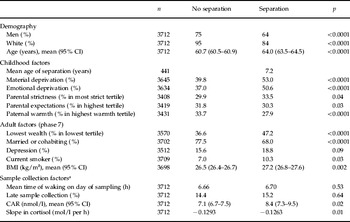
Table 1 shows that a higher proportion of women than men reported separation from their mothers for more than 1 year in childhood. These participants were more likely to be in the lowest wealth tertile of the population, from ethnic minority groups, and not married or cohabiting, and were also more likely to smoke, experience depressive symptoms, and report parental strictness, poor paternal warmth, and material and emotional problems in childhood. Saliva sample collection characteristics were not different by maternal separation in childhood.
Characteristics of participants by maternal separation in childhood
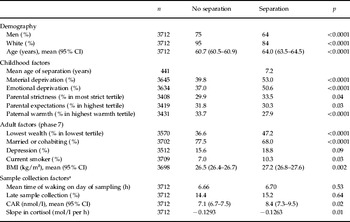
BMI, Body mass index; CI, confidence interval; CAR, cortisol awakening response.
a Cortisol data adjusted for age, sex, ethnicity, waking time on day of sampling, and time since waking of sample collection.
The average diurnal slope for cortisol decline estimated from the hierarchical linear model was −0.1289 mol/l per h (s.d. = 0.023, n = 3712). When adjusted for age, sex, wealth, ethnic group and waking time on day of sampling, the slope in the diurnal cortisol decline throughout the day was flatter in those participants that reported maternal separation compared to the rest of the population (p = 0.01). The CAR was larger in those who reported maternal separation (p = 0.02). The correlation coefficient between the diurnal slope of cortisol across the day and the CAR was low (r = 0.169, p < 0.0001). There was no difference in mean cortisol release per waking hour in those reporting separation versus those not reporting maternal separation [3.78, 95% confidence interval (CI) 3.66–3.90 v. 3.74, 95% CI 3.69–3.78, p = 0.55], following adjustment for age, sex, ethnic group and waking time.
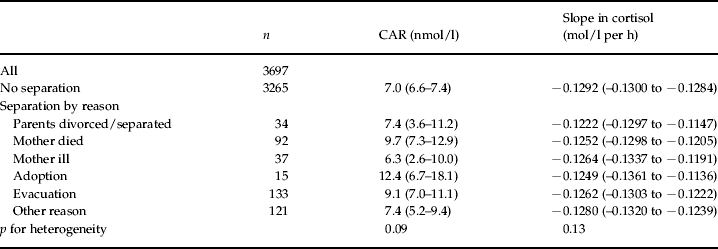
Among those reporting maternal separation, there was no association of age of maternal separation with the CAR or the slope in cortisol in linear regression: the coefficient for CAR was −0.060 (p = 0.21) and the slope across the day was −0.018 (p = 0.70). When examining the reason given for maternal separation, there were no significant differences in either CAR or diurnal slope by reason for separation (Table 2).
Adulthood cortisol awakening response (CAR) and diurnal slope in cortisol by reason for separation from mother in childhood. Adjusted means (95% confidence intervals)
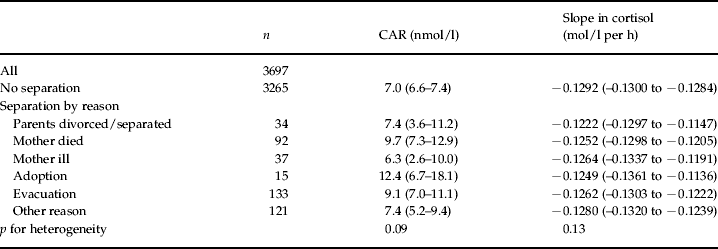
Adjusted means from linear regression adjusted for age, sex, ethnicity, waking time on day of sampling, and time since waking of sample collection.
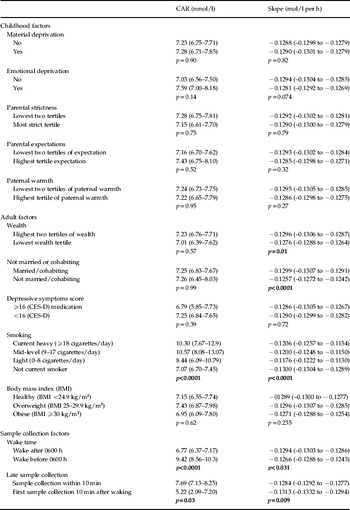
Table 3 shows that cortisol levels were not significantly related to childhood factors that may explain the association with maternal separation. Of the adult factors examined, we found that social position as measured by wealth, not being married and being a smoker at phase 7 were associated with a flatter slope in cortisol throughout the day. As noted previously, BMI was not associated with cortisol in a linear manner (Kumari et al. Reference Kumari, Chandola, Brunner and Kivimaki2010b). Early awakening but not depressive symptoms or depression was associated with measures of cortisol.
Adulthood cortisol levels and association with potential confounding and mediating factors, adjusted for age, sex, ethnicity, waking time and time since waking. Adjusted means (95% confidence intervals)
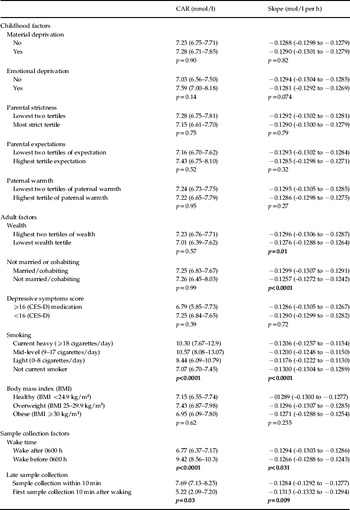
CAR, Cortisol awakening response; CES-D, Center for Epidemiologic Studies Depression Scale.
p values are derived from continuous data where available (all childhood variables, wealth, waketime).
Significant findings are highlighted in bold.
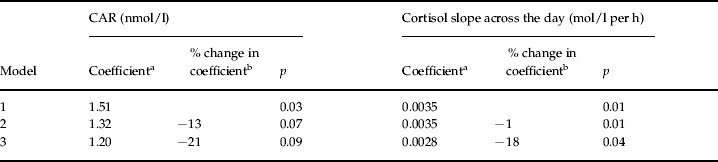
Table 4 shows that the difference in CAR between those who reported separation from mother in childhood compared to those that did not was no longer significant following adjustment for childhood and adult factors. Childhood factors explained 13% of the difference in CAR between those who reported maternal separation, and adult factors a further 9% (final p = 0.09). In the final models, smoking remained associated with the CAR (p = 0.001). The flatter slope apparent in those reporting childhood maternal separation is unaffected by adjustment for childhood factors, and is partly explained by adult factors, but remained associated with maternal separation in the fully adjusted model (final p = 0.041). Thus, childhood factors explained 1% of the association of maternal separation with diurnal slope in cortisol, and adult factors a further 17%. In the final models, marital status, smoking and BMI (linear and quadratic) remained significantly associated with slope across the day. Additional analyses including an interaction term between sex and maternal separation gave similar results. Similarly, there were no significant interactions between sex and the other covariates. We also examined associations using current or last known employment civil service employment grade as an alternative measure of social position (Kumari et al. Reference Kumari, Badrick, Chandola, Adler, Epel, Seeman, Kirschbaum and Marmot2010a) and found the results to be unchanged.
The role of childhood and adult factors in the association of diurnal cortisol patterns with maternal separation. Regression coefficient and percentage change in regression coefficient for maternal separation with and without adjustment for covariates (n = 2991)
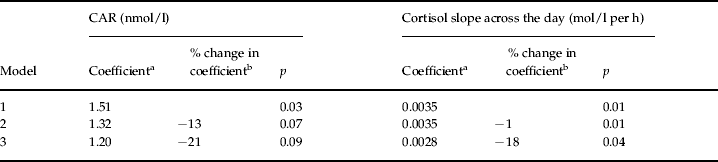
CAR, Cortisol awakening response.
a Coefficient represents change in the cortisol measure in those reporting separation versus those not reporting separation in childhood.
b Change in coefficient was calculated by: (Model 2 coefficient – Model 1 coefficient)/(Model 1 coefficient).
Model 1: adjusted for age at time of cortisol measurement, sex, time of waking on day of cortisol assessment and time since waking (cortisol awakening response, CAR).
Model 2: model 1 + material deprivation, emotional deprivation, parental strictness, parental expectations, paternal warmth.
Model 3: model 2 + wealth, marital status, depression, smoking and body mass index (BMI), (BMI)2.
Discussion
We found that maternal separation for more than 1 year in childhood is associated with a larger CAR and a flatter diurnal slope in cortisol compared to no reported separation in childhood in a cohort of middle-aged adults. The association of diurnal patterns of cortisol with maternal separation was attenuated after adjustment for childhood material and emotional problems, paternal warmth, adult health behaviours, marital status and social position.
Our finding of an increased CAR in association with maternal separation is contrary to expectation from some previous studies (Meinlschmidt & Heim, Reference Meinlschmidt and Heim2005; Luecken & Appelhans, Reference Luecken and Appelhans2006; van der Hal-Van Raalte et al. Reference van der Hal-Van Raalte, Bakermans-Kranenburg and van Ijzendoorn2008) although supportive of Tyrka et al. (Reference Tyrka, Wier, Price, Ross, Anderson, Wilkinson and Carpenter2008), who suggest that childhood loss is associated with an activated cortisol response to stress separation. These differences between studies may relate to differences in participant characteristics or differences in sample collection protocols. Unlike other studies, the population under study here is a middle-aged cohort that was originally recruited as an occupational cohort. Many other studies have been conducted using students (Meinlschmidt & Heim, Reference Meinlschmidt and Heim2005) or young adults (Luecken & Appelhans, Reference Luecken and Appelhans2006; van der Hal-Van Raalte et al. Reference van der Hal-Van Raalte, Bakermans-Kranenburg and van Ijzendoorn2008). Furthermore, our study was conducted at phase 7 of the study, resulting in a relatively healthy population (Ferrie et al. Reference Ferrie, Kivimäki, Singh-Manoux, Shortt, Martikainen, Head, Marmot, Gimeno, De Vogli, Elovainio and Shipley2009) that had participated in the study for 20 years. It has been hypothesized that a diminished CAR might be distal to hyperactivation of the HPA in response to chronic stress, which results in a diminished or exhausted axis (Fries et al. Reference Fries, Hesse, Hellhammer and Hellhammer2005). We speculate that our relatively advantaged cohort, given it is an occupational cohort, may have experienced the separation event less negatively than the participants of other studies or that the event did not lead to the adverse outcomes that may be evident in other cohorts, or those who have experienced adverse outcomes (e.g. severe depression) are no longer part of our cohort. It is unclear what the CAR represents, as some reviews have suggested that both a large CAR and a small CAR can be associated with adverse correlates (Chida & Steptoe, Reference Chida and Steptoe2009). We found a large CAR to be associated with maternal separation and this is accounted for statistically by a combination of childhood material and psychosocial circumstances and adult health behaviours. In particular, smoking in older age seemed to provide the largest contribution to the association between maternal separation and the CAR.
Our findings of an association of flat slope in cortisol patterns in older age groups with maternal separation are novel and seem to accord with the findings in children in whom ‘flat slopes’ have been described (Gunnar et al. Reference Gunnar, Morison, Chisholm and Schuder2001) and with Gerritsen et al. (Reference Gerritsen, Geerlings, Beekman, Deeg, Penninx and Comijs2010) who reported flatter slopes in older participants reporting an adverse childhood event. The association of slope in cortisol measured across the day was largely independent of all childhood factors measured but adult factors played a greater role. Our findings are inconsistent with Kraft & Luecken (Reference Kraft and Luecken2009), who found that the association of divorce in childhood with cortisol secretion was mediated by wealth; our data suggest that the association of maternal separation was largely explained by adult marital status and smoking at the time of sample collection. This may be related to differences in the populations under observation as the Whitehall II is an occupational cohort of older adults whereas Kraft & Luecken (Reference Kraft and Luecken2009) studied younger adults.
Our data do not support a critical period hypothesis but rather that maternal separation in childhood is related to differences in subsequent pathways that are associated with cortisol secretion. The causes of flat slopes in cortisol secretion, which may represent a decline in functioning in the HPA axis, are not established. In our study, we find that flat cortisol slopes are associated with smoking and early waking and, in concordance with other studies, that flat slopes may indicate pathology or disease severity as they predict mortality; in the Whitehall II this is specific to cardiovascular mortality (Sephton et al. Reference Sephton, Sapolsky, Kraemer and Speigel2000; Kumari et al. Reference Kumari, Shipley, Stafford and Kivimaki2011). Our data suggest that diurnal slope in cortisol may play a role in mediating the association between early life adversity and adult health.
The advantages and disadvantages of the study need to be addressed. Our study sample is large, with a high response rate, and the participants are well characterized. The disadvantages are that cortisol is assessed cross-sectionally at phase 7 of the study and is only measured in the day. Thus night release was not assessed and therefore it is not possible to evaluate total circadian cortisol exposure. Saliva samples were collected on one day only because of participant burden, which may have biased our findings to situational rather than trait exposures (Hellhammer et al. Reference Hellhammer, Fries, Schweisthal, Schlotz, Stone and Hagemann2007). However, the association of the CAR with childhood factors assessed 5 years previously argues that this bias is not large. We are reliant on self-report for time of sample collection. Our prevalence of ‘late’ reporting was similar to previously reported rates (Kudielka et al. Reference Kudielka, Broderick and Kirschbaum2003) and data suggest that participants are generally accurate in their recording of this information (Dockray et al. Reference Dockray, Bhattacharyya, Molloy and Steptoe2008). Our population is one of white-collar workers and so is not representative of the general population. The population may be considered less likely to contain participants for whom the consequences of maternal separation are particularly adverse. Missing data on the cortisol samples, cortisol outliers, participants on corticosteroid medication and those who responded to maternal separation questions at an earlier phase of the study reduced the sample size from 4609 participants with any cortisol data to 3712. However, the association of cortisol with covariates was similar in these analyses, as with previously reported associations for waking time and smoking status (Badrick et al. Reference Badrick, Kirschbaum and Kumari2007; Adam & Kumari, Reference Adam and Kumari2009; Kumari et al. Reference Kumari, Badrick, Chandola, Adam, Stafford, Marmot, Kirschbaum and Kivimaki2009). A weakness of our study is that data were available on maternal separation only. The study did not request information on separation from father or both parents. It is unclear how this might influence our findings but we can speculate that separation from father alone might be considered a weaker psychological stressor but may have the potential to have a greater financial impact on childhood conditions for participants given the age group examined. Personen et al. (Reference Pesonen, Räikkönen, Feldt, Heinonen, Osmond, Phillips, Barker, Eriksson and Kajantie2010) report that separation from father alone failed to influence HPA activity. A further weakness of the study is that it relies on retrospective recall of maternal separation and, importantly, other childhood factors, and no information was collected on the duration of the separation. Thus it was not possible to examine whether the immediate experience of the separation was positive or negative. This is important because one-third of participants recalled the reason for separation as ‘other’. The retrospective nature of the childhood measures makes it difficult to assess causal chains in our analysis and we need to repeat our analyses in datasets that have measured our variables of interest in childhood. Furthermore, we cannot ascertain whether the consequence of early life changes in cortisol might have influenced our analysis through unmeasured effects on behaviour and health preceding entry into our study.
In conclusion, we find that maternal separation in childhood is associated with changes in diurnal cortisol patterns in a middle-aged population. These associations were largely explained by the adult health behaviour and social correlates of childhood maternal separation.
Acknowledgements
We thank all participants in the Whitehall II Study; all participating Civil Service departments and their welfare, personnel and establishment officers; the Occupational Health and Safety Agency; and the Council of Civil Service Unions. The Whitehall II study has been supported by grants from the Medical Research Council (MRC); Economic and Social Research Council (ESRC); British Heart Foundation; Health and Safety Executive; Department of Health; National Heart Lung and Blood Institute (HL36310), US National Institutes of Health (NIH); National Institute on Aging (NIA), US NIH (R01AG013196); Agency for Health Care Policy Research (HS06516); and the John D. and Catherine T. MacArthur Foundation Research Networks on Successful Midlife Development and Socio-economic Status and Health. Prof. Bartley and Dr Kumari are partially funded by the ESRC (RES-596-28-0001). J. Head is partially supported by the NIA, NIH (R01AG013196). Prof. Kivimaki is supported by the MRC and BUPA Foundation, UK, the NIH, USA and the Academy of Finland.
Declaration of Interest
None.