Ghiţă Ionescu, the ‘most important Romanian political scientist’ (Editor 2003), became a political exile in the early post-war years after the seizure of that country's government by the Communists. He passed away just six years after the introduction of free and fair elections there, and, despite the deficient character of Romania's democracy, he would have been delighted to see his native country as a full member of the European Union (EU). Now, two decades after the fall of the Iron Curtain, the time has arrived to look back and, with the benefit of hindsight, take stock of the degree to which post-1989 East European party systems have converged (or not) with the long-established West.
Adopting Ionescu's qualitative approach to political science, and building on Sartori's (Reference Sartori1976: 44) definition of party system as ‘the system of interactions resulting from interparty competition’, in this article I analyse the degree to which European party systems have formed and developed in all three major areas of partisan competition: parliamentary, governmental and electoral (Bardi and Mair Reference Bardi and Mair2008; Enyedi and Casal Bértoa Reference Enyedi and Casal Bértoa2011). In this context, the analysis constitutes an attempt, paraphrasing one of the most quoted articles published in this journal (Sartori Reference Sartori1969), to go ‘from political sociology to the sociology of politics and back’.
The universe of cases examined in this article consists of all European democracies that at the end of 2011 were members of the EU, grouped into two different regions: the post-communist East, meaning all those countries that joined the EU after 1 May 2004, and the established West (it includes not only the original founders of the EU but all those countries that acceded up to 2 January 1995, plus Malta and Cyprus). Following the opinion of previous scholars, who consider it essential to focus on the same time periods when making comparisons (Bielasiak Reference Bielasiak2005: 334; Casal Bértoa and Mair Reference Casal Bértoa and Mair2012: 112), the temporal span covered by this article goes from the fall of the Berlin Wall until the last day of December 2011. This way I am able to control not only for external (international) factors that may have influenced all political systems in a similar and simultaneous manner (for example, the end of the Cold War, globalization, European integration, the worldwide financial and economic crisis, and so on) but also, and most importantly, for historical legacies and possible ‘path-dependence’ effects that may have constituted an advantage for those more ‘established’ (that is, West European) democracies. On the other hand, such a focused comparison will also allow me to examine with hindsight the accuracy of the predominantly pessimistic predictions formulated at an early stage in the process of post-communist transformation about the future of party systems in the region. In this context, Mair summarized the common agreement among scholars when he stated:
Post-communist democratization is different . . . [as] we are in fact dealing with a ‘triple transition’ . . . not only is the electorate different, but the parties which ‘organize’ that electorate are also different, and, in particular, are less grounded within civil society . . . [In such context] it is likely that the borders between the different parties will be crossed and broken by frequent fission and fusion, but it is also likely that . . . the institutional environment [will be] exceptionally and inevitably unstable, with conflicts over the . . . constitutional rules of the game . . . [and] regular revisions of the electoral laws . . . [implying] that the context of competition will continue to be uncertain . . . but so too the pattern of competition . . . [which] will prove substantially more conflictual and adversarial than is usually the case . . . The danger, then, is of instability and uncertainty encouraging competition and conflict, which, in turn, encourage even greater instability. (Mair 1997: 178–98)
With such expectations in mind, the article proceeds as follows. The first section departs from the view that Sartori's model still constitutes ‘the most effective and exhaustive framework within which to contrast the properties of different party systems’ (Mair Reference Mair1990: 129; see also Mainwaring and Scully Reference Mainwaring and Scully1995: 22; Mair Reference Mair2006: 64). It looks at the format and mechanics of the party system at parliamentary level, trying to group each of the different polities in one of his three main categories. Building on previous works (Casal Bértoa and Enyedi Reference Casal Bértoa and Enyedi2010; Casal Bértoa and Mair Reference Casal Bértoa and Mair2012), the second section examines the structure of interparty competition for government, in an attempt to determine the degree to which party systems have become closed (or remain open, instead) over time. The final section analyses the behaviour of voters and seeks to verify to what extent electoral volatility in Europe, East and West, is (or is not) a function of the number of parties, the social composition of a country's population and/or the stability of individual political parties.
Electoral Systems, The Number of Parties and Ideological Polarization
For the majority of scholars, any serious attempt to analyse party systems must begin with the number of parties (Lane and Ersson Reference Lane and Ersson1994; Lijphart Reference Lijphart1994). Indeed, the initial distinctions were between two-party and multiparty systems (Duverger Reference Duverger1954), or between two-, two-and-a-half and multiparty (either with or without a dominant party) systems (Blondel Reference Blondel1968). Conscious, however, that the number (and size) of parties contained ‘mechanical’ predispositions, Sartori (Reference Sartori1976: 128) argued for the necessity of moving beyond purely numerical classifications (‘format’) and, ascribing a new valuation to the ideological dimension, of looking at the extent to which a system is ideologically polarized (‘mechanics’).
The first element of Sartori's model refers to the format of the party system: namely, the number of ‘relevant’ parties which, ‘albeit roughly, [indicates] . . . the extent to which political power is fragmented or non-fragmented, dispersed or concentrated’ (1976: 120). In this context, he established a distinction between two-party (that is, low fractionalization), limited-pluralist (medium fragmentation) and, in what constitutes the main theoretical advance over previous party system models (Evans Reference Evans2002: 156), extreme pluralist (highly fragmented) party systems.Footnote 1
In order to capture the degree of systemic fragmentation, I will employ here Laakso and Taagepera's (Reference Laakso and Taagepera1979) ‘effective number of legislative [that is, with parliamentary representation] parties’ (ENPP), by now a long-standing indicator (Lijphart Reference Lijphart1994: 70). In particular, this index measures how many parties are in a party system in a given election, weighted according to size:
 $$ ENPP\: = \:{\rm{1}}\:/\:\mathop{\sum}{S{{i}^{\rm{2}}} } $$
where si is the proportion of seats of the ith party. The idea is to be able to focus only on the ‘significant’ parties (that is, those obtaining parliamentary seats),Footnote 2 while avoiding the subjectivity behind Sartori's famous ‘counting rules’. In this context, and taking into consideration earlier calls to revisit Sartori's numerical criterion (see Evans Reference Evans2002: 168),Footnote 3 I will follow here Mainwaring and Scully's principles when considering that:
Most party systems with an ENPP between 1.8 and 2.4 approximate the logic of two-party systems. With an ENPP between 2.5 and 2.9, what Blondel calls two-and-a-half party pattern usually prevails . . . Systems with an ENPP between 3.0 and 3.9 usually correspond to Sartori's category of limited pluralism, while those with an ENPP of 4.0 or higher usually correspond to the category of extreme pluralism. (Mainwaring and Scully 1995: 31–2)
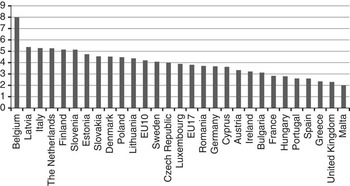
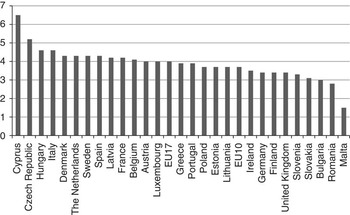
A first look at Figure 1, which displays the average ‘effective’ number of legislative parties in the 27 EU countries, reveals a clear ‘regional’ effect at least at the lower side of the fragmentation ranking. Thus, and with the exception of Hungary and Bulgaria, the most concentrated party systems lie in Western Europe. In particular, while in almost two-thirds of the West European party systems the ENPP is below 4, the United Kingdom (UK) and Greece, at least until very recently, approach the two-party paradigm. Malta even has a real two-party system (Lane and Ersson Reference Lane and Ersson2007: 101). In contrast, and notwithstanding the exceptions mentioned above, highly fragmented party systems constitute the norm in the Eastern part of the European continent. Indeed, while on average the Eastern nations adhere to extreme pluralism (ENPP = 4.3), most of their West European counterparts show limited pluralism (ENPP = 3.8). This is not to say, however, that in Western Europe fractionalized party systems cannot be found: for example, in Finland, the Netherlands or Italy, where an important reduction in the number of parties could be observed after the last elections due to the confluence of the main political groupings in two big parties (namely, the People of Freedom and the Democratic Party). In Belgium the ‘real’ number of parties, all currently in government, is six.
Parliamentary Fragmentation in Europe (1990-2011)
Source: Own calculations based on Gallagher (Reference Gallagher2012).

The high number of parties in all these countries, but also – to a lesser extent – in Denmark or Sweden, should not come as a surprise. Especially if – to the level of ethnic (for example, in Belgium) or religious (as in the Netherlands) fragmentation – we add the higher proportionality of their electoral systems (for example, Denmark, Sweden or Finland). Indeed, all scholars, from Duverger to Sartori to Rae and Lijphart, have in virtually the same breath maintained that the format of a party system is largely (if not exclusively) determined by the electoral system that is applied. Concretely, the general claim is that, depending on the electoral formula, the legal threshold and/or (mainly) the district magnitude applied, the higher the proportionality of the electoral system, the lower the number of parliamentary parties and vice versa. Hence, since the literature on the subject has offered quite a strong confirmation of such an impact, I will now consider to what extent differences in the national electoral systems can account for the cross-national variation in mean levels of parliamentary fragmentation observed in the two regions analysed here.
Table 1 groups each of the different electoral systems (sorted by electoral formula and ‘effective’ threshold) and ranks them (in descending order) according to their level of proportionality. It offers a rather strong support for the hypothesis above in both East and West. Thus, in general terms, the ‘effective’ number of parliamentary parties increases consistently with the proportionality of the electoral formula as well as the magnitude of the ‘effective’ threshold. Interestingly enough, such an ‘electoral system’ effect seems to be stronger in the (post-communist) region, where scholars thought it could not be due to the lack of overall systemic stability (for example, Pappalardo Reference Pappalardo2007; Sartori Reference Sartori1997). This is not to say that West European electoral systems have not had any role in the – generally speaking – higher degree of legislative concentration observed in the region (see Figure 1). Indeed, if one looks behind the raw numbers, it is possible to see how in Western Europe the non-fulfilment of Duverger's ‘prophecy’ is totally determined by just two cases: Belgium and the Netherlands, which, for the reasons already mentioned, have been traditionally characterized by a high level of electoral fragmentation. In fact, when these two cases are excluded from the sample, the average ENPP for those Western European electoral systems using either a Droop/Imperiali formula or a medium-range ‘effective threshold’ immediately drops to 3.5 and 3.8 respectively, mostly fitting the initial expectations.
The Systemic Consequences of Electoral Systems in Europe, West and East

Notes: The number of legislative elections appears in brackets. Note, however, that ‘mixed’ electoral systems in Germany, Lithuania, Hungary, Italy (1994–2001) or Bulgaria (2009) have been divided into two: namely, the majoritarian and the proportional.
aWhen classifying the different electoral systems according to its degree of proportionality, I completely follow Baldini and Papparlardo (Reference Baldini and Pappalardo2007: 151), according to which both Hare-Neimeyer and Saint-Lagüe (SL) are the most proportional, followed by Droop, the Single Transferable Vote (STV) and modified Saint-Lagüe (mSL). Imperiali and d'Hondt are considered to be more disproportional than the previous formulae, but less than the second round systems (2RS) or the plurality ones.
bThe ‘effective’ threshold is calculated according to the following formula: T = 75%/(M+1); where M is the average district magnitude (Lijphart, Reference Lijphart1999: 153).
Source: Own calculations based on Gallagher (Reference Gallagher2012).
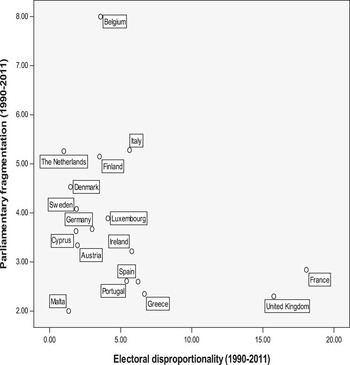
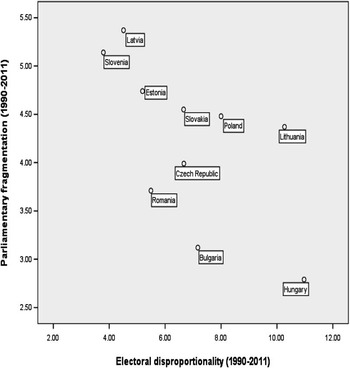
In a similar vein, Figures 2 and 3 examine the ‘overall impact’ that electoral systems have had on the ‘effective’ number of parliamentary parties in the regions under study.Footnote 4 Interestingly enough, while electoral disproportionality and legislative fragmentation are, as expected, negatively correlated – in both a relevant and significant manner – in East European democracies (r = −0.634, significant at 0.05 level), explaining almost half of the variance; in West European party systems the explanatory power of electoral systems is clearly lower (r = −0.354). However, the latter may be due to the fact that neither the high nor the low parliamentary fragmentation experienced, respectively, by Belgium and Malta is a function of the electoral system but, on the contrary and respectively, of their extremely fragmented and concentrated social composition.Footnote 5 In fact, when these two opposing societies are excluded, the correlation between electoral disproportionality and parliamentary fragmentation not only increases exponentially, but acquires significant levels (r = −0.557, significant at 0.05 level; R2 = 0.31).
Electoral Disproportionality and Parliamentary Fragmentation in Western Europe
Source: Own calculations based on Gallagher (Reference Gallagher2012).

Electoral Disproportionality and Parliamentary Fragmentation in Eastern Europe
Source: Own calculations based on Gallagher (Reference Gallagher2012).

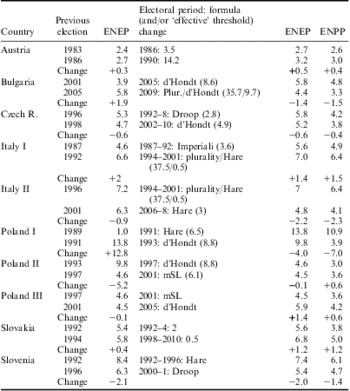
Following Lijphart (Reference Lijphart1994), I seek further confirmation of the hypothesized relationship from the instances of change in electoral systems that entail an alteration (of 25 per cent or more) in at least one of the two above-cited dimensions. Apart from the pronounced cross-national variation displayed in Table 2, three smaller points of immediate interest can be noted. First, electoral systems reforms adopted during the past two decades have tended to be total (both formula and ‘effective’ threshold) rather than partial (only one or the other). Second, and perhaps more importantly, East European democracies have been more prone to institutional reform than their West European counterparts: namely, seven out of ten cases of electoral reform took place within the post-communist region (three of them in Poland alone; see Benoit and Hayden Reference Benoit and Hayden2004). Last but not least, Table 2 seems to suggest a linkage (at least in terms of ‘necessity’) between institutional and systemic instability – something that previous studies had already asserted (Bartolini and Mair Reference Bartolini and Mair1990; Bielasiak Reference Bielasiak2005). In this context, Poland and Italy, characterized by both unstable party systems and rather frequent electoral system changes, constitute perfect examples.
Party System Format and Electoral System Change in Comparative Perspective

Note: Those scores running counter to Duverger's ‘law’ are in bold.
More generally, one of the main findings following from Table 2, which presents the effects of electoral engineering on the effective number of parties, is that the format of current European party systems (both East and West) responds to a great extent (Austria being the only major exception) to the particular type of electoral system adopted.Footnote 6 Thus, while most increases in the effective threshold, in the disproportionality of the electoral formula or in both (for example, Bulgaria, Czech Republic, Poland I, Italy II and Slovenia), are accompanied by a notable decrease in the effective number of parliamentary parties, exactly the opposite happens in those cases where a more proportional formula and/or threshold is adopted (for example, Italy I, Poland II and Slovakia). In terms of the so-called ‘psychological effects’ (see the ‘effective’ number of electoral parties – ENEP), the results are very similar, portraying how quickly electorates are able to learn about the possible consequences of institutional changes and cast their votes accordingly.
Table 2 also addresses the ‘chicken and egg’ question (Farrell Reference Farrell2001: 162), pointing to a causal chain that goes from proportionality to multipartyism rather than the other way round. If, as some scholars have suggested (for example, Colomer Reference Colomer2005), electoral systems were to be a function of the party system format, and not vice versa (as here maintained), we would expect the adoption of a more proportional electoral system after an increase in electoral fragmentation, while there would be more disproportional electoral formulae or higher ‘effective’ thresholds in those instances of party concentration. Although this seems to have been the case in more than half of the cases examined above (Czech Republic, Italy I, Italy II, Poland III, Slovenia and Slovakia, even if the latter is more questionable),Footnote 7 the evidence (see Table 1 as well as Figures 2 and 3) is not enough to turn Duverger's laws upside down. Moreover, the fact that most electoral systems remained unchanged, continuing to produce their mechanical effects, despite important changes in the number of parties (for example, in Denmark, France, Hungary, Lithuania or the Netherlands), points in a similar direction.
In sum, and bearing in mind all that has been said, it seems clear that the current European party system format is mainly a function of the electoral systems employed. This is especially visible in Eastern Europe, where electoral systems (on average more disproportional) have done an important job in reducing the initially atomized political panorama. Indeed, when the scores for the two different decades are compared, in Eastern Europe it is possible to observe a clear tendency towards legislative concentration (Bulgaria and Lithuania being the only exceptions). Party systems in the West have remained more stable but, as also pointed out by Best (Reference Best2013), some have experienced an important increase in the number of political forces at play (for example, Denmark, Germany and, especially, the Netherlands). Still, and as we had the opportunity to see in Figure 1, more time is needed for the post-communist party systems finally to overcome their initial disadvantage.
Having defined the three main competitive classes according to the format, Sartori (Reference Sartori1976: 129) then goes on to analyse the ‘properties and mechanics of the system’ by focusing on the ideological distance between the parties. The idea is that the greater the latter, the more the system is polarized, and vice versa. Such a distinction is certainly important, according to Sartori, as in non-polarized systems parties display centripetal tendencies, while the former are characterized by centrifugal dynamics.
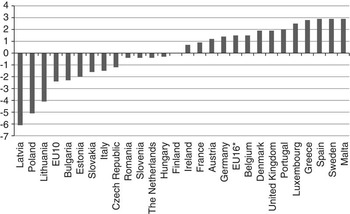
Using Dalton's (2008: 8) polarization index (PI), which measures ‘the distribution of parties along the [commonly known] Left–Right scale’,Footnote 8Figure 4 displays the degree of ideological polarization characterizing each of the EU democracies studied here. At a first glance this seems to show that region matters very little. Thus, while ideological polarization is high in both the Czech Republic and Hungary, Slovenia, Bulgaria, Slovakia and Romania are among the least polarized European party systems, with the other four post-communist countries somewhere in the middle. In a similar vein, in Western Europe very polarized party systems such as the Dutch, the Danish, the Italian or the Cypriot coexist with other polities where the ideological distance between the different political forces has become less extreme (for example, in Malta, the UK, Finland or even Ireland). A comparison of the average level of polarization in both parts of the continent – the difference is just 0.03 – clearly confirms a pattern of convergence regarding this issue. All in all, the truth is that both the continuous decline and progressive disappearance of traditional communist and/or fascist political parties in Europe have helped to erode the Sartorian distinction between ‘centripetal’ and ‘centrifugal’ dynamics. This is not to deny, however, a more general tendency towards bipolar competition between ‘opposing’ party blocs observed in both Eastern and Western Europe (see below, but also Enyedi and Casal Bértoa Reference Enyedi and Casal Bértoa2011; or Mair Reference Mair2006). Still, and with some exceptions, the former has not prevented the formation of parliamentary coalitions between previously totally inimical camps. Germany (2005), Greece (2011), Finland (2003), Ireland (1993), Poland (2007), Romania (2008) and, more recently, the UK (2010) are cases in point. In others, ‘extreme’ parties traditionally considered as pariahs (at least in the period before 1990) have been incorporated into government: namely, the Communist Party in Greece (1990), France (1997) or Italy (2006), as well as the Neo-Fascist Party in both Italy (1994) and Austria (2006).Footnote 9 The evaporation of the Communist bloc, which led to the ‘triumph’ of the neoliberal paradigm, together with the erosion of the traditional sociopolitical cleavages in a more secular and globalized world, have definitely helped to reduce the level of ideological polarization in most European polities (as other authors also argue in this issue: see Albertazzi and Mueller Reference Albertazzi and Mueller2013; Best Reference Best2013 or van Biezen and Wallace Reference van Biezen and Wallace2013).
Ideological Polarization in Europe (1990–2011)
Source: Own calculations, based on Döring and Manow (Reference Döring and Manow2011).

Regarding the systemic format as the independent factor and the ideological distance separating the extreme parties in the system as the intervening variable, Sartori (Reference Sartori1976: 286) proposed an articulate typology which, combining those two different dimensions, distinguished between two-party, moderate pluralist and polarized pluralist systems. However, and leaving aside the first type (for example, Malta, as well as, at least until very recently, the UK and Greece), the only European party system that would fit into the polarized-pluralist type would be the Czech Republic, the only European polity (aside from Moldova and Ukraine) to retain a ‘die-hard’ Communist Party (KSČM). All the other countries would fit better into the second category. Moreover, even the Czech case could be debatable as the average ENPP in the country has been 3.99, with no more than five relevant parties at a time: namely, the Czech Social Democratic Party, the Civic Democratic Party, the Communist Party of Bohemia and Moravia, the Christian and Democratic Union and the Civic Democratic Alliance (1993–6), Freedom Union (2002–10), the Green Party (2006–10) or TOP'09 and Public Affairs (from 2010 onwards). Sartori's expectation was that concentrated party systems would be characterized by ‘low ideological distance, bipolar mechanics and a convergence towards the centre of the ideological spectrum’ (Evans Reference Evans2002: 157),Footnote 10 while in largely fragmented ones the ideological distance would be high, leading to a non-structured coalition configuration and centrifugal competition (Sartori Reference Sartori1976: 132–40); but in fact a correlation between these two variables (fragmentation and polarization) cannot be found in present-day Europe (r = 0.177), neither in the West (r = 0.273)Footnote 11 nor in the newly democratized East, where a different (negative) pattern can even be detected (r = −0.070; see also Figures 1 and 4).
Party System Closure and Government Formation
For all these reasons, and bearing in mind that in recent years the moderate pluralist type has become overcrowded (Mair Reference Mair1997: 204), Mair's analytical framework offers a ‘new way to distinguish among the many party systems now found in [the previously mentioned] category’ (Toole Reference Toole2000: 444). Building on Sartori's classical definition, Mair's framework directs ‘more attention to the structure of competition than to the nature of the units that actually form its components’ (Lewis Reference Lewis2006: 569). In particular, and bearing in mind that ‘the most important aspect of party systems . . . is the structure of inter-party competition, and especially the competition for government’ (Mair Reference Mair1997: 206, original emphasis),Footnote 12 the latter is considered to become closed only when the patterns of interaction among political parties in successive periods of government formation become predictable and stable over time. In order to assess the level of closure and to be able to capture meaningful changes in the party system, Mair (Reference Mair1997: 207–11) proposes the analysis of three different, although clearly related, factors:
• government alternation, or how completely the partisan composition of a cabinet has changed in comparison to its immediate predecessor;
• governing formulae, or the extent to which successive competing cabinets are composed of the same combination of parties each time they participate in the executive; and
• access to government, or the degree to which all political parties within the system have the chance to enjoy the spoils of office over time.
Putting them all together, Mair (Reference Mair1997: 211–14) considers party systems to be closed if: (1) alternations of governments are either total or non-existent; (2) governing alternatives are stable over a long period of time; and (3) some parties (‘outsiders’) are permanently excluded from participation in national government. Conversely, open party systems are characterized by: (1) partial alternations of governments; (2) no stable compositions of governing alternatives; and (3) access to government granted to all relevant parties (see also Enyedi and Casal Bértoa Reference Enyedi and Casal Bértoa2011: 120–2).
In order to minimize subjective judgements and opinions in the measurement of party system closure, I operationalize quantitatively each of the factors suggested above. First of all, the degree to which governing alternations of political parties are wholesale is captured by the so-called Index of Government Alternation (IGA), which simply adapts Pedersen's well-known index of electoral volatility (1979) to the measurement of a nation's ministerial volatility (MV). In particular, the latter is calculated by adding the net change in percentage of ministers (including the prime minister) gained and lost by each party from one government to the next, and then dividing by two. However, and because wholesale alternation (both total and none) can be reflected by scores at both extremes of the MV scale (100 and 0, respectively), if the MV initial score obtained according to the formula described above is lower than 50 (perfect partial alternation), the former figure will be subtracted from 100. If MV is higher than 50, the IGA will be equal to the initial MV score (Casal Bértoa and Mair Reference Casal Bértoa and Mair2012).
The second criterion, based on assessing whether or not the party or combination of parties has governed before in that particular format, is captured by the Index of Familiar Alternation (IFA), which measures the percentage of ministries belonging to familiar combinations of parties. Finally, and in clear contrast to the previous two factors, access to government is easily measured by the Index of Closure (IC), which simply takes into consideration the percentages of ministries belonging to ‘old governing parties’ (Casal Bértoa and Enyedi Reference Casal Bértoa and Enyedi2010).
Because time is particularly important when trying to measure the level of party system closure in a country (Mair Reference Mair1997), I also take into consideration all the years that a particular cabinet has lasted, understanding that if there have been two or more cabinets in one year, then the averages of the scores for the different government features cited above are considered to characterize the year better than any such individual factors. Finally, and in order to avoid measuring incompatible scores, I use the standardized (z-) score of the three variables. The addition of the latter three will represent the ultimate degree of systemic closure (Casal Bértoa and Enyedi Reference Casal Bértoa and Enyedi2010: 20).
An overview of the level of party system closure in Europe is shown in Figure 5, which ranks all EU democraciesFootnote 13 in terms of the stability in the structure of interparty competition for government during the period 1990–2011. The most evident conclusion derived from these summary data is that while, with few exceptions (Italy and the Netherlands), West European party systems have closed at different rates and in different ways, the structure of interparty competition in Eastern Europe, perhaps with the exception of Hungary (Casal Bértoa and Mair Reference Casal Bértoa and Mair2012), remains totally open. Thus, in most West European party systems:
Party System Closure in Europe (1990–2011)
Note: * See n. 13. Source: Own calculations.

• alternation in government has tended to be total (for example, in Sweden, Spain, Greece, Portugal or the UK), or (almost) non-existent (as in Malta and Luxembourg);
• governing formulae have repeated themselves again and again, pitting one party (either labour or socialist) on the left against one party (or bloc of parties – as in the case of Sweden or Portugal)Footnote 14 on the right (for example, the Nationalist Party in Malta, the People's Party in Spain, New Democracy in Greece or the Conservatives in the UK); and
• access to executive office has remained closed (perhaps with the minor exception of Britain after 2010).
In Eastern Europe, in contrast, cabinet alternations have been predominantly partial (for example, in the Baltic countries and Romania) or a mixture of both partial and wholesale alternation (as in the other countries, except for Hungary). Moreover, because innovative coalition governments have been the norm (with almost as many ideological combinations as elections),Footnote 15 they feature also very low in terms of the second criterion (governing formulae). In a similar vein, access to power is still very open, as the majority of parliamentary parties have had the opportunity to enjoy the spoils of office at least once. Indeed, and just taking into consideration the most recent legislative elections, new parties, some of them even established just a couple of years or even months ahead of the electoral contests, have been incorporated into almost all post-communist democracies (for example, Citizens for European Development of Bulgaria, TOP'09 in the Czech Republic, Zatler's Reform Party in Latvia, the National Resurrection Party and the Liberal Movement of the Republic of Lithuania, Freedom and Solidarity in Slovakia, or Gregor Virant's Civic List in Slovenia).
This is not to say, however, that West European party systems have been unchanged. In the past couple of years important systemic changes took place in the UK and Ireland – with the participation in government of the British Liberal Democrats and the Irish Greens – and also in Finland, Denmark and Germany, to a lesser extent. Still, and after brief periods in which the structure of competition seemed to have acquired new features, traditional patterns of competition seem resilient in the last four countries. Notwithstanding the former, in both Italy and the Netherlands the structure of interparty competition remains completely open. In Italy, the 1994 earthquake elections following the corruption scandals that undermined the until then rather stable partitocrazia clearly changed the structure of competition from a centrifugal pattern with the Christian Democrats as the leading (centric) force and the totally marginalized Communist and Fascist parties at the extremes of the political spectrum to a centripetal pattern in which two inimical coalition blocs (Berlusconi's vs. Prodi/Bersani's) have permanently struggled for the support of the Italian voter. Indeed, and although political elites have tried to bring some order into Italy's systemic chaos with the merger of the main centre-right (Forza Italia and the National Alliance) and centre-left forces (Democrats of the Left and Democracy is Freedom) into the People of Freedom (PdL) and the Democratic Party (PD), respectively; the structure of competition among Italian political parties during the past decade and a half has been characterized by a mixture of both partial (between elections) and wholesale (after elections) innovative governing formulae (represented by different electoral coalitions, such as the Pole of Freedoms, the Olive Tree, the House of Freedoms, the Union and, finally, the People of Freedom–Northern League) and continuous access of new political groupings to executive power (for example, the Communist Re-foundation Party, Rose in the Fist, the New Italian Socialist Party, Christian Democracy for the Autonomies, People and Land, Future and Freedom, to name a few). In a similar vein, although to a lesser extent, Dutch party politics has seen how the process of destabilization that started in the first half of the 1970s – with the appearance of the social-liberal Democrats 66 and the formation of the first five-party left-wing cabinet in 1973 – has worsened in the last two decades. Thus, while pure partiality has continued to characterize each of the Dutch governments, parties have experienced different governing formulae (from the traditional centre-left and centre-right governments, in which the Christian Democratic Appeal party coalesced with either the social-democratic Labour Party or the liberal-conservative People's Party for Freedom and Democracy, to the ‘Purple’ and right-wing populist coalitions), mainly due to the appearance of new – sometimes ephemeral – political forces (such as the List Pim Fortuyn, or, more recently, the Freedom Party).
In sum, it seems reasonable to conclude that, while systemic instability at the governmental level has been the norm in post-communist party systems, the structure of partisan competition in West European democracies has remained rather closed. Indeed, notwithstanding the two exceptions of Italy and the Netherlands, the bias towards stability in these long-standing polities is so strong that even systemic change has been short lived.
Electoral Volatility, Cleavage Encapsulation and Party Stability
The picture would not be complete without an assessment of the degree to which the voting populations of these countries have been stable (or not) over time. The idea is that electoral volatility affects party system development by determining the balance of power among parties in any given legislative body, and therefore the way the latter interact, ally and, last but not least, govern. For that reason, high levels of electoral volatility have traditionally been considered to be inimical to democracy, as they may bring too much change to the existing structure of interparty competition (Mainwaring and Scully Reference Mainwaring and Scully1995; Morlino Reference Morlino1998). In this context, it is important to note that a certain amount of voter switching in subsequent elections is not only healthy, but also necessary in order to regenerate the political system, allowing for more accountable and responsive political competition (Pedersen Reference Pedersen1979). Another issue, however, is when continuous electoral change undermines the social rooting of long-established parties, bringing about their collapse and the appearance of new flash (see van Biezen and Wallace Reference van Biezen and Wallace2013) political forces (Franklin et al. Reference Franklin, Mackie and Valen1992). Such a process of de-alignment indicates a melting of the traditional cleavages (Shamir Reference Shamir1984), which is considered prejudicial for the healthy functioning of democracy (Lane and Ersson Reference Lane and Ersson2007: 95).
In order to capture to what extent voters are to be blamed for the previously observed higher levels of party system instability at the time of government formation, I use Pedersen's already classic index, which measures ‘the net change within the electoral party system resulting from individual vote transfers’ according to the following formula:
 $$ TEV\: = \:\mathop{\sum}{^{{|Vi,t\:{\rm{ - }}\:1\:{\rm{ - }}\:Vi,t|\:/\:2}} } $$
in which TEV is total electoral volatility,Footnote 16 Vi,t is the vote share for a party ith at a given election (t) and Vi,t−1 is the vote share of the same party ith at the previous elections (t−1).
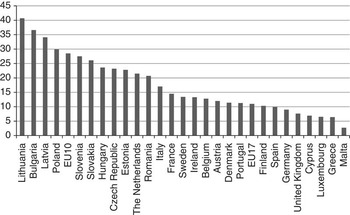
Figure 6 displays the average volatility scores for the 27 countries studied. Although these results should be treated with caution due to the significant fluidity of voters in certain pairs of elections,Footnote 17 two important points of immediate interest can be noted. First, and most obvious, European electorates have stabilized in different ways and at different rates. Second, and notwithstanding all attempts at discrediting Lipset and Rokkan's (Reference Lipset and Rokkan1967) well-known ‘freezing’ hypotheses (Crewe Reference Crewe1985; Shamir Reference Shamir1984), West European voters – with the exception of the Dutch – are far more loyal than their East European counterparts. On average, the difference is very significant: namely, 17 points. Moreover, and in clear contrast to what can be observed among the post-communist electorates, none of the long-established democracies surpasses the 15 per cent threshold cited above, with two obvious exceptions: Italy and the Netherlands. It is therefore not surprising that these were the only two West European party systems characterized by an extremely open structure of competition, as we have already seen.
Electoral Volatility in Europe (1990–2011)
Sources: Own calculations based on Enyedi and Casal Bértoa (Reference Enyedi and Casal Bértoa2011) and Gallagher et al. (Reference Gallagher, Laver and Mair2011).

The variance between elections rather than between countries shows an even more striking divergence: while out of 97 pairs of elections held in Western Europe, more than four-fifths (82.5 per cent)Footnote 18 did not cross the 15 per cent barrier, in post-communist Europe only three countries (out of 49) achieved more stable scores: namely, 7.7 in Poland (2011), 8.4 in Hungary (2006) and, to a lesser extent, 13 in Estonia (2011). The contrast is even clearer when we take into consideration that, while up to 40 of the East European elections surpassed the 20 per cent limit, only 3 of the 11 West European (other than the Dutch) earthquake elections did so: Italy in 1994 (36.7), Portugal in 1995 (a bare 20.7) and, more recently, Ireland in 2011 (26.7).Footnote 19 On the other hand, in clear contrast to what has just been said, the general trend over time is towards electoral instability in both East and West (Gallagher et al. Reference Gallagher, Laver and Mair2011), with certain pronounced examples (such as Austria, Bulgaria, Slovenia or Romania). Although the figures are too complex to be summarized here, three general findings are considered to be important. First, out of the 11 countries in which volatility has declined over time, nine are in the West. Second, while all East European countries (with the exception of Poland but including both Hungary and Latvia, where electoral fluidity seemed to be declining) have undergone important electoral earthquakes at the most recent legislative elections, only Austria, Finland, Ireland and Spain have experienced a similar fate in the West. Last but not least, independently of the decade examined, West European electorates continue to be less fluid than their post-communist counterparts.Footnote 20 Such findings should come as no surprise (Bielasiak Reference Bielasiak2005; Lane and Ersson Reference Lane and Ersson2007), especially if we bear in mind that three of the most important deterrents of electoral volatility – namely, electoral concentration, cleavage encapsulation and party institutionalization – have been weaker (if not mostly absent) in the post-communist world (Casal Bértoa and Schneider Reference Casal Bértoa and Schneider2012).
A clear and positive relationship between the number of parties and the levels of volatility was originally found by Pedersen (Reference Pedersen1979) in his seminal analysis of 13 West European party systems between 1948 and 1975. The main explanation for this was that ‘the greater the number of parties . . . the less the average perceived distance between parties, and the higher the probability that the average voter will transfer his vote from one party to another party’ (Pedersen Reference Pedersen1979: 15). The logic is, therefore, the following: the higher the degree of fragmentation, the smaller the ideological space and, therefore, the higher the probability that voters shift their preferences between (otherwise programmatically close) political parties. Bartolini and Mair (Reference Bartolini and Mair1990) as well as Crewe (Reference Crewe1985) confirmed such a positive relationship for Western Europe. More recently, Birch (Reference Birch2003), Tavits (Reference Tavits2005) and Powell and Tucker (Reference Powell and Tucker2008) did the same for Eastern Europe.Footnote 21
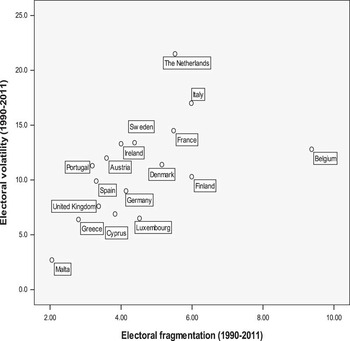
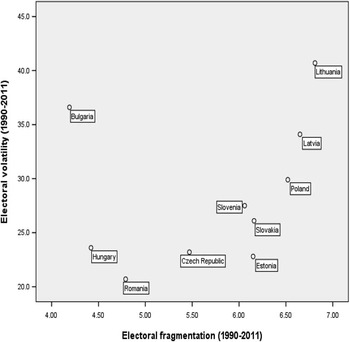
Figures 7 and 8 examine, respectively, the overall impact that electoral fragmentation has had on electoral volatility. As already pointed out, electoral volatility in Europe, both West and East, is a function of the number of parties fighting in the electoral arena. Indeed, after excluding the ‘deviant’ cases (Belgium and Bulgaria), these two variables are both significantly and relevantly correlated as expected: namely, r = 0.692 (significant at 0.01) and 0.754 (significant at 0.05), explaining up to 48 per cent and 57 per cent of the variance, respectively. Moreover, because – as shown in these two figures as well as Figure 1 – East European party systems are in general much more fragmented than their West European counterparts, it is only logical that they are also more volatile.
Electoral Volatility and Electoral Fragmentation in Western Europe
Sources: Own calculations based on Enyedi and Casal Bértoa (2011), Gallagher et al. (Reference Gallagher, Laver and Mair2011) and Gallagher (Reference Gallagher2012).

Electoral Volatility and Electoral Fragmentation in Eastern Europe
Sources: Own calculations based on Enyedi and Casal Bértoa (2011), Gallagher et al. (Reference Gallagher, Laver and Mair2011) and Gallagher (Reference Gallagher2012).

Ever since the publication of Lipset and Rokkan's seminal work (Reference Lipset and Rokkan1967), social cleavages have been considered to be a source of electoral stability. The idea is that party systems freeze because ‘individuals develop attachments to parties on the basis of their social locations – their religion, class, residence (urban or rural) and culture (core versus minority culture)’ (Mainwaring and Zoco Reference Mainwaring and Zoco2007: 163). Although some scholars have trumpeted the decline of cleavage politics in the West (Dalton Reference Dalton2004; Franklin et al. Reference Franklin, Mackie and Valen1992) and the total absence of it in the East (Elster et al. Reference Elster, Offe and Preuss1998; Lawson et al. Reference Lawson, Rommele and Karasimeonov1999), others have tried to prove, by adapting Lipset and Rokkan's original statement, the social anchorage of party politics in Europe, both East (Birnir Reference Birnir2007; Casal Bértoa Reference Casal Bértoa2012a; Kitschelt et al. Reference Kitschelt, Mansfeldová, Markowski and Tóka1999) and West (Bartolini and Mair Reference Bartolini and Mair1990; see also Stubager Reference Stubager2013). In this line of thinking, the main assumption is that ‘the pattern of social cleavages and their political consequences is similar between the established and emerging democracies, with religion and the owner–worker cleavage dominating political conflict’ (McAllister and White 2007: 211–12).
A first analysis of the impact that social cleavage encapsulation (or the lack of it) may have on the levels of electoral instability reveals only a weak, although not significant, correlation between the latter and religious heterogeneity in the West (r = 0.321). However, these results are driven by only one case, the Netherlands, where religion has traditionally played an essential role in the ‘pillarization’ of Dutch society (Andeweg Reference Andeweg1999). When this ‘deviant’ case is excluded from the sample, the relationship totally disappears (r = 0.031). In a similar vein, and confirming previous studies on the field (see above), in Eastern Europe no trace of any socio-electoral association is found, either in terms of religiosity or in the more classical centre–periphery sense.
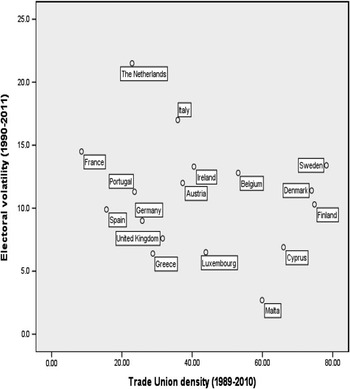
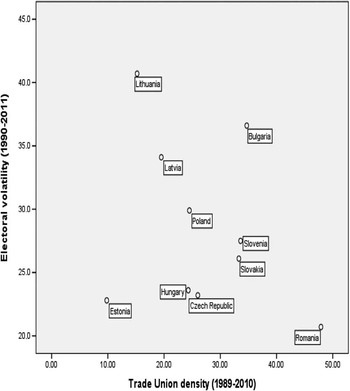
Conversely, Figures 9 and 10 examine the relationship between the traditional class cleavage, operationalized by a country's ‘trade union density’ – a commonly used indicator in cleavage studies (Bartolini and Mair Reference Bartolini and Mair1990: 231–8; Mainwaring and Zoco Reference Mainwaring and Zoco2007: 164), and the percentage of European voters’ fluidity in both West and East. At first sight, with the exception of the three Scandinavian countries, there seems to be a clear negative relationship between class and electoral stability in the sense that the stronger the former cleavage is, the higher the latter. Even if only weakly correlated (r = −0.443 in the West, and −0.296 in the East), these results follow the line of previous findings on the persistent importance of economic voting in the West (van der Brug et al. Reference van der Brug, van der Eijk and Franklin2007), but also in the East (Duch Reference Duch2001; Fidrmuc 2000). In particular, an overall significant (at 0.05) correlation of −0.438 (n = 27) points to class as the only – however feeble – sociopolitical anchor of the European electorate.
Electoral Volatility and Organizational Density in Western Europe
Sources: Own calculation based on Visser (Reference Visser2011) and OECD Statistics (2011).

Electoral Volatility and Organizational Density in Eastern Europe
Sources: Own calculation based on Visser (Reference Visser2011) and OECD Statistics (2011).

In contrast to the weak explanatory power that cleavage theory puts forward when trying to explain electoral volatility in old and new European democracies, party continuity seems to offer more leverage. Indeed, the fact that the same political forces struggle again and again for political power seems to help electorates to stabilize. If, on the other hand, parties come and go without any trace, voters (even if stable in their preferences) will not have any option other than to look for new groupings that might represent their interest in the best manners (Birch Reference Birch2003; Jasiewicz Reference Jasiewicz2007; Sitter Reference Sitter2002). In the sense that Pedersen's index ‘reflects both the amount of vote switching . . . as well as the stability in the supply of parties’ (Enyedi and Casal Bértoa Reference Enyedi and Casal Bértoa2011: 119), it is obvious that electoral volatility can be also a function of a certain level of party stability.
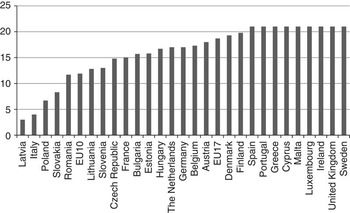
In a similar vein to what could be observed in Figures 5, 6 and, to a lesser extent, Figure 1, a comparison of the degree of party continuity across Europe reveals another instance of the clear divergence between the two parts (that is, old and new systems) of the continent. More concretely, as follows from Figure 11, which ranks all 27 EU nations according to the average age of their significant parties (Dix Reference Dix1992; Jin Reference Jin1995; Tavits Reference Tavits2005),Footnote 22 Western voters have been facing the same political options for the last two decades. This is more straightforward in countries such as Spain, Portugal, Cyprus, Malta, Luxembourg, Ireland, Sweden and, until very recently, also Greece and the UK. There party politics has been led by the same political forces without exception. The only two exceptions to this general rule are Italy and, to a lesser extent, France. In the former case, and as already explained, the ‘explosion’ of the old party system in 1994 brought about new political parties that continue to struggle organizationally. Similarly, French political parties have experienced an important organizational restructuring since 2002 (mainly on the right of the political spectrum) although, it should be noted, the main four ideological options (Communism, Socialism, Liberalism and Gaullism) have by and large continued to structure electoral voting. All in all, and if we exclude the extreme Italian case, up to 42 out of the 50 West European political parties included in this analysis were already active at the moment the Berlin Wall came down in November 1989: this means a survival rate of 84 per cent.
Party Stability-cum-Continuity in Europe (1990–2011)
Source: Own calculations.

In contrast to what has just been said, East European political parties were not only unable to count on previous democratic experiences (the Czech Socialists and Polish Peasants’ Party are, perhaps, the only exceptions), but they have also had to struggle in order to stay alive.Footnote 23 This is clearly visible when we acknowledge that 19 of the 39 East European political parties were created after the beginning of the current century (against only five in the West – Italy excluded). More importantly, out of those 19 cases of recent party formation, up to 10 were created a couple of months ahead of the most recent legislative elections. In this context, the Latvian case is particularly dramatic, with three new parties (two of them mergers of previous political forces) coming to the fore just before the elections.Footnote 24 Even if we were to look only at the patterns of partisan formation and development, comparing East European parties after the year 2000 with their Western counterparts after 1990, the organizational splits and totally new parties in the East (14–17 each) clearly outnumber the mergers (six), with five of them taking place in just two countries (Latvia and Romania), suggesting without doubt a de-structuring pattern, certainly absent in the West (where the number of mergers – five, equals both splits – three, and party foundations from scratch – two).Footnote 25 All in all, the truth is that if, as Sartori put it many years ago, ‘a structured party system can be defined . . . as a . . . system in which the major parties become “solid” and more “real” than the personalities’ (Reference Sartori1990: 75, 77), it is obvious that in post-communist Europe this has not yet happened, and will not happen for some time (Mair Reference Mair1997).
In sum, while in systems characterized by low electoral fragmentation, high cleavage encapsulation and stable partisan roots voters’ preferences will remain stable over time (that is, in most Western European nations), in countries where the contrary is true (that is, post-communist Eastern Europe), electorates will be fluid for many years to come.
Conclusions
In this article I have analysed the process of party system formation in new post-communist democracies and compared it with the developments observed in their (more established) West European counterparts. The main conclusion is that, although two decades have passed, East European party politics continues to be characterized by instability and unpredictability at all levels. This is not to deny that West European party systems have remained fixed and were ‘frozen’ long ago. On this point, however, a tendency towards lower stability can be discerned. Notwithstanding this, a general divergence between these two groups of polities, separated by 40 years of fierce Communist politics, is obvious. As Ionescu, in a joint publication with de Madariaga (Reference Ionescu and de Madariaga1972), pointed out 44 years ago, opposition is a tremendously powerful political institution. As a result of their authoritarian legacy, however, post-communist regimes lack the institutionalization of patterns of government and opposition that has characterized Western democracies for decades, and which has acted as a powerful force for the development of stable and predictable patterns of party politics.
Another important conclusion is that while East European legislatures continue to remain more fragmented than their Western counterparts, despite the important contribution made by post-communist electoral systems, ideological distances have experienced a reduction in every nook and cranny of the old continent, producing a significant ideological confluence between East and West. This has clearly reduced the explanatory power of Sartori's once unrivalled analytical framework.
Where the East certainly does not meet the West, confirming the expectations formulated at the beginning of this article, is neither in the process of government formation nor at the electoral level. In relation to the former, and perhaps with the exception of Hungary, East European elites continue to be more unpredictable, innovative and open to new experiments than the more traditional – and less prone to shock – Western partitocracies. Although not necessarily connected (Mair Reference Mair1997), the analysis has revealed, with very few exceptions, an almost perfect correlation between these two levels of competition. In this sense, electoral concentration has been shown to be essential, as a reduction in the number of parties clearly diminishes the chances for voters to switch from alternative political options. Second, strong cleavage structures help to reduce electoral fluidity by closing the electoral market and linking political parties with their voters on a durable basis. Where such encapsulation is weak, as in Eastern Europe, stability is hindered. Third, my analysis also indicates that party stability-cum-continuity plays an essential role in the freezing of European electorates. The idea is that, as individual political parties develop stable roots in society, they are likely to make party choices more stable and coherent for the electorate, helping voters to express their political preferences more consistently and, therefore, avoiding unexpected political earthquakes.
Finally, time does matter: namely, the older a polity is in terms of its democratization, the more stable/consolidated it becomes (see also Casal Bértoa and Mair Reference Casal Bértoa and Mair2012; Mainwaring and Zoco Reference Mainwaring and Zoco2007). Even though the analysis in this article has tried to control as much as possible for any temporal effect by taking into consideration only the past two decades, it shows that the currently observable divergence between East and West European party systems is a path-dependent phenomenon. Indeed, if South European party systems managed to consolidate in a record time, it was because democratization there took place in a period in which mass party organizations and cleavage politics were still the norm. Moreover, they also benefited from an environment in which political opposition, even if limited, was possible – something totally absent in the Communist bloc.
The future is not written, however. In a globalized world where, on the one hand, the media (mainly television and internet) have replaced mass organizations as intermediaries between the electorate and a country's government and, on the other, partisan linkages are based on temporary individualistic preferences rather than in well-entrenched sociopolitical cleavages, systemic instability may become not the point of departure but of arrival. In other words, and contrary to earlier expectations, it may well be that in the future West meets the East, and not the other way round (van Biezen Reference van Biezen2003). It is in this sense that, perhaps in 20 years time, Italian and/or Dutch politics might be seen as the avant garde of European politics, rather than as deviant cases.
Acknowledgements
I am very grateful not only to the editors but also to all the contributors in this special issue, as well as to the participants in the workshop at the London School of Economics (April 2012) for their useful comments on an earlier version of this work.