Introduction
Increasing evidence suggests that patients' expectancy of therapeutic improvement affects antidepressant response in clinical trials (Sotsky et al. Reference Sotsky, Glass, Shea, Pilkonis, Collins, Elkin, Watkins, Imber, Leber, Moyer and Oliveri1991; Meyer et al. Reference Meyer, Pilkonis, Krupnick, Egan, Simmens and Sotsky2002; Krell et al. Reference Krell, Leuchter, Morgan, Cook and Abrams2004; Rutherford et al. Reference Rutherford, Sneed, Eisenstadt and Roose2010a). Expectancies about treatment outcome represent appraisals of how participation in a clinical trial will affect patients' depressive symptoms (Kirsch, Reference Kirsch and Harrington1997). These appraisals are informed by the consent procedure for pharmacotherapy trials, in which prospective participants become aware of the study design, the history and past effectiveness of the drugs and placebos used in the study, and the investigators' opinions of the treatment options (Rutherford et al. Reference Rutherford, Wager and Roose2010b).
Perhaps the most salient feature of the design of a pharmacotherapy trial is whether it is placebo controlled. Rutherford et al. (Reference Rutherford, Sneed and Roose2009) compared antidepressant response between 48 placebo-controlled (i.e. one or more medications compared to placebo) and 42 active comparator trials (i.e. one or more medications with no placebo group) for major depressive disorder (MDD) in adult out-patients aged 18–65 years. The odds of being classified as a responder to medication in comparator trials were 1.8 times the odds of being classified as a responder in placebo-controlled trials [95% confidence interval (CI) 1.45–2.17, p < 0.001]. These findings were replicated by Sneed et al. (Reference Sneed, Rutherford, Rindskopf, Lane, Sackeim and Roose2008) in an analysis of nine placebo-controlled and seven comparator trials for late-life depression.
Further support for the influence of study design on antidepressant response was found in 183 trials of antidepressants for the treatment of acute-phase MDD analyzed by Papakostas & Fava (Reference Papakostas and Fava2009), who reported that the probability of receiving placebo was negatively correlated with antidepressant and placebo response. Similarly, Sinyor et al. (Reference Sinyor, Levitt, Cheung, Schaffer, Kiss, Dowlati and Lanctot2010) evaluated 90 randomized controlled trials of antidepressant medications for unipolar MDD, comparing response and remission rates between trials comparing medication to placebo (drug–placebo), two medications to placebo (drug–drug–placebo) and one medication to another (drug–drug). They found that medication response was significantly higher in drug–drug studies (65.4%) compared to drug–drug–placebo studies (57.7%) and drug–placebo studies (51.7%) (p < 0.0001).
Despite these suggestive findings, experimental manipulation of patient expectancy is required to determine whether higher expectancy causes more change in depressive symptoms. In this pilot study, out-patients with MDD underwent randomization to placebo-controlled (PC) or comparator (COMP) administration of antidepressant medication in an 8-week duration clinical trial. Subjects in the PC condition received double-blinded treatment with escitalopram or placebo whereas subjects in the COMP condition received double-blinded treatment with escitalopram or citalopram. We hypothesized that subjects assigned to COMP-escitalopram and COMP-citalopram would have more positive treatment expectations and demonstrate significantly greater improvement in depressive symptoms versus subjects assigned to PC-escitalopram.
Method
Subjects
Preliminary results from this study were reported in Rutherford et al. (Reference Rutherford, Sneed, Eisenstadt and Roose2010a), where further details regarding the study procedures are available. All procedures were approved by the New York State Psychiatric Institute (NYSPI) Institutional Review Board. Adult out-patients were recruited through physician referral and also radio and newspaper advertisements to the Adult and Late Life Depression Clinic of the NYSPI. Inclusion criteria were (1) men or women aged 18–65 years, (2) DSM-IV (APA, 2000) unipolar MDD, (3) a 24-item Hamilton Rating Scale for Depression (HAMD; Hamilton, Reference Hamilton1960) score ⩾16, and (4) capable of providing informed consent. Exclusion criteria were (1) pregnant or lactating women, (2) current psychosis or history of a psychotic disorder, (3) substance dependence other than nicotine, (4) score >2 on the HAMD suicide item, (5) acute severe or unstable medical illness, (6) non-response to treatment with escitalopram 10 mg/day or citalopram 20 mg/day given for at least 4 weeks during the current episode, and (7) a Clinical Global Impressions – Severity (CGI-S; Guy, Reference Guy1976) score of 7 at baseline.
Procedures
At baseline, a psychiatrist conducted a medical and psychiatric evaluation, and a research rater completed the SCID (First et al. Reference First, Spitzer, Gibbon and Williams1996) and a 24-item HAMD questionnaire. A physical examination, blood tests and an electrocardiogram were completed for eligible candidates.
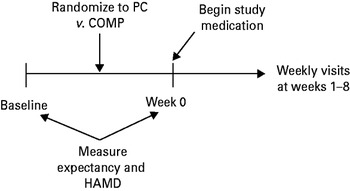
After complete description of the study to the subjects, written informed consent was obtained. One week after baseline evaluation, subjects were randomized to the PC or COMP condition and then completed week 0 measures (see Fig. 1). Treatment began at the week 0 visit, and subjects returned for eight additional weekly visits, at which observer-rated (HAMD, CGI) and self-report (Beck Depression Inventory, BDI; Beck et al. Reference Beck, Ward, Mendelson, Mock and Erbaugh1961) measures were completed. The 24-item HAMD score was the primary outcome measure and was scored by a trained rater who was blinded to subjects' randomization to the COMP or PC group.
Schematic diagram depicting timing of randomization, measurements and study visits. PC, Placebo-controlled condition; COMP, comparator condition; HAMD, Hamilton Rating Scale for Depression.

Subject expectancy of therapeutic improvement was measured using a modified version of the Credibility/Expectancy Questionnaire (CEQ; Borkovec & Nau, Reference Borkovec and Nau1972). Psychometric study of the CEQ has demonstrated that it derives two factors (credibility and expectancy) that are stable across different populations (Devilly & Borkovec, Reference Devilly and Borkovec2000). It has been shown to have high internal consistency, with a Cronbach's α of 0.79–0.90 for the expectancy factor, 0.81–0.86 for the credibility factor and a standardized α of 0.84 for the CEQ composite score. Test–retest reliability over a 1-week period was also found to be good at 0.82 for expectancy and 0.75 for credibility. Versions of the CEQ have been used to measure treatment credibility and patient expectation in several psychotherapy and pharmacotherapy studies (Borkovec & Costello, Reference Borkovec and Costello1993).
The expectancy score used for this study was the numerical sum of the two expectancy questions found in the CEQ. The first question states ‘At this point, how successful do you think this treatment will be in reducing your depressive symptoms?’ and is rated from 1 (not at all successful) to 9 (very successful). The second question states ‘By the end of the treatment period, how much improvement in your depressive symptoms do you think will occur?’ and is rated on an 11-point scale with anchors corresponding to 0–100% improvement.
Expectancy manipulation
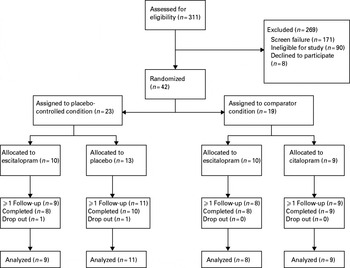
At the baseline visit, subjects understood correctly that they had an equal chance of being assigned to each of the four treatment cells in the study (see Fig. 2). Baseline expectancy scores were recorded at this time, when subjects knew they had a 75% probability of receiving active medication.
CONSORT diagram describing flow of patients through the study.

Subjects returned the following week to be randomized to the COMP or PC condition, and the results of this first-level randomization were conveyed to each subject. Subjects in the COMP condition were informed:
In this study there is a 50% chance you will receive the antidepressant medication citalopram and a 50% chance you will receive the antidepressant medication escitalopram for the duration of the study. Citalopram and escitalopram have been proven effective for the treatment of depression in patients like you. You will not be receiving any placebo pills for the duration of the study.
Similarly, subjects in the PC condition were informed:
In this study there is a 50% chance you will receive the antidepressant medication citalopram for the duration of the study. Citalopram has been proven effective for the treatment of depression in patients like you. There is also a 50% chance you will receive placebo for the duration of the study. A placebo is a sugar pill that is not specifically effective for depression. Neither you, nor your doctors, will know whether you are receiving citalopram or placebo.
Thus, subjects were informed that their probability of receiving active medication either increased to 100% (COMP) or decreased to 50% (PC). Disclosing this information to each subject was the method used to experimentally manipulate patient expectancy in this study. After the first-level randomization, patients were asked to confirm that they understood their chances of receiving antidepressant medication, and expectancy scores were recorded.
Antidepressant treatment
Whereas randomization to the COMP and PC conditions was disclosed to subjects to manipulate their expectancy, the second-level randomization within each condition was blinded. Subjects assigned to COMP were randomized to receive escitalopram or citalopram, whereas those assigned to PC were randomized to receive escitalopram or placebo. Subjects were started on 20 mg/day citalopram, 10 mg/day escitalopram, or pill placebo. Study medication and placebo were packaged by the NYSPI pharmacy such that all pills were identical in appearance. If subjects did not meet remission criteria (HAMD score ⩽7) after 4 weeks of treatment, the medication dose was increased to 40 mg citalopram, 20 mg escitalopram, or corresponding placebo for the remaining 4 weeks of the study. Subjects unable to tolerate the increased dose of medication had their dosage reduced to the previous dose. Subjects brought their pill bottles to weekly visits so that a pill count could be performed.
Statistical analyses
Descriptive statistics are expressed as means and standard deviations or percentages. χ2 analyses and independent-sample t tests were used to compare subjects on demographic and clinical features.
The first step of the analysis was to determine the effect of randomizing subjects to COMP v. PC administration of antidepressant medication on patient expectancy scores. We compared the change in expectancy from baseline to week 0 for subjects in the COMP condition compared to those in the PC condition using independent-samples t tests (two-tailed). This analysis did not categorize subjects by final treatment assignment (e.g. PC-escitalopram, PC-placebo, etc.) because these measurements of expectancy were made prior to the administration of any study medication (see Fig. 1). We also examined the change in patient expectancy in an analysis of covariance (ANCOVA) with the week 0 expectancy score as the outcome variable, the baseline expectancy score as a covariate, and an indicator variable coded 1 for COMP and 0 for PC as the independent variable.
Next, we determined whether the amount of improvement in depressive symptoms differed between the COMP medication conditions (i.e. COMP-escitalopram and COMP-citalopram) and PC-escitalopram over the course of the study. The changes in HAMD scores between baseline and weeks 0, 4 and 8 in the COMP medication conditions were compared to the changes in HAMD scores in PC-escitalopram using independent-samples t tests (two-tailed, uncorrected for multiple comparisons). This analysis was supplemented by ANCOVA models examining the effects on a HAMD score of two indicator variables coding for the three active-treatment groups and covarying for baseline HAMD score.
Lastly, we directly examined the relationship between initial expectancy scores and the change in depressive symptoms over the course of the study. To do this, we tested the correlations between baseline and week 0 expectancy scores with the change in HAMD score within each treatment group and in the overall group of patients receiving medication. The rationale for examining these correlations between expectancy and the change in HAMD score was that, although randomization to COMP v. PC may be effective in shifting baseline expectancy up (COMP) or down (PC), subjects with high (or low) baseline expectancy scores will probably still have high (or low) scores after randomization. We wanted to investigate the effect of having higher initial expectancy scores on the change in depression scores with treatment.
Results
Subject characteristics
In this study 311 individuals were screened by telephone, 140 underwent a clinical evaluation, and 42 were randomized after giving signed informed consent to participate (see Fig. 2). The high rate of telephone screen and evaluation failures for this study is attributable to the fact that clinic advertisements recruit subjects for multiple different studies. Most respondents to general clinic advertisements were not eligible for the present study. Five subjects were excluded from the analyses after randomization because they did not return for one study visit after giving informed consent.
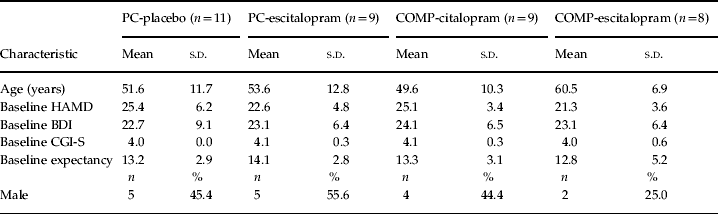
Table 1 provides baseline characteristics of subjects assigned to PC-escitalopram, PC-placebo, COMP-escitalopram and COMP-citalopram. No significant differences were found between the groups in mean patient age (F 3,33 = 1.625, p = 0.202), baseline CGI-S (F 3,32 = 0.314, p = 0.815), baseline HAMD (F 3,33 = 1.567, p = 0.216), baseline BDI (F 3,28 = 0.017, p = 0.997), baseline expectancy score (F 3,25 = 0.151, p = 0.928), or gender (Pearson χ2 = 1.669, df = 3, p = 0.644).
Baseline clinical and demographic characteristics of patients with major depressive disorder (MDD) entering the study
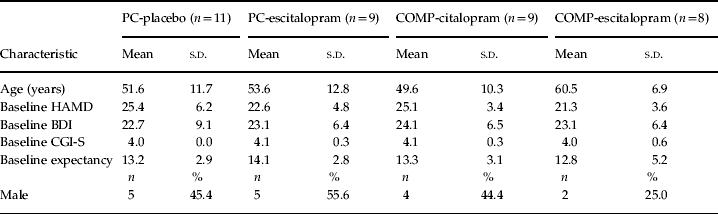
PC, Placebo-controlled condition; COMP, comparator condition; HAMD, Hamilton Rating Scale for Depression; BDI, Beck Depression Inventory; CGI-S, Clinical Global Impressions – Severity; s.d., standard deviation.
Change in patient expectancy
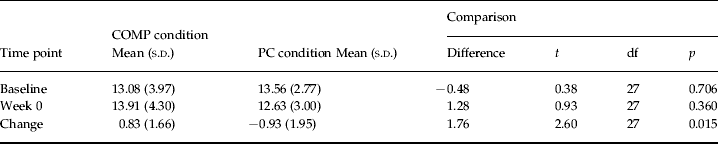
Table 2 shows that the expectancy scores for patients randomized to the COMP conditions increased by an average of 0.83 ± 1.66 points whereas the expectancy scores for patients randomized to the PC conditions decreased by an average of 0.93 ± 1.95 points. Based on these unadjusted numbers, there was a net difference of 1.76 points between the COMP and PC conditions in the change between baseline and week 0 expectancy scores, which was significant (t = 2.60, df = 27, p = 0.015). The ANCOVA model adjusting for baseline expectancy showed a significant effect of the randomization to COMP v. PC on week 0 patient expectancy score (F 1,29 = 6.33, p = 0.018). Randomization to the COMP condition resulted in 1.73 points higher expectancy of improvement compared to the PC condition (B = 1.73, t = 2.52, p = 0.018). This difference corresponds to a medium effect size (Cohen's d) of 0.4.
Change in expectancy scores following randomization to the PC v. COMP conditions
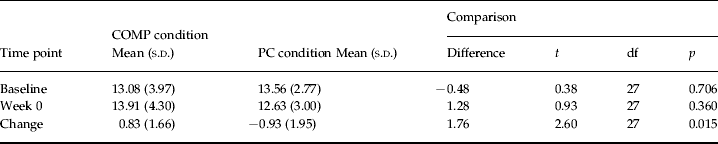
PC, Placebo-controlled condition; COMP, comparator condition; s.d., standard deviation; df, degrees of freedom.
Change in depressive symptoms
Table 3 summarizes the change in HAMD scores over time for each of the medication conditions in the study in addition to the comparisons between the COMP medication conditions and PC-escitalopram. Patients in COMP-citalopram demonstrated numerically greater improvement in HAMD score at weeks 0, 4 and 8 compared to PC-escitalopram but these differences were not statistically significant. Similarly, patients in COMP-escitalopram demonstrated numerically greater improvement in HAMD score at weeks 0 and 4 compared to PC-escitalopram but again these differences were not statistically significant. At week 8, patients in PC-escitalopram demonstrated numerically greater improvement in HAMD score compared to COMP-escitalopram but this difference was not statistically significant. The ANCOVA models adjusting for baseline HAMD scores did not show any significant differences between the COMP conditions and PC-escitalopram at these study time points.
Intent-to-treat analyses of change in HAMD score at weeks 0, 4 and 8 for patients in each study group

HAMD, Hamilton Rating Scale for Depression; PC, placebo-controlled condition; COMP, comparator condition; s.d., standard deviation; df, degrees of freedom.
Relationship between expectancy and depressive symptoms
Across all participating patients, neither baseline nor week 0 expectancy score was significantly correlated with baseline HAMD score (r = − 0.097, p = 0.618 and r = 0.022, p = 0.903 respectively), meaning that expectancy of improvement at the beginning of the study was not simply a function of depression severity. However, as the study progressed over its 8-week duration, repeated expectancy measurements tended to mirror the direction of change in depressive symptoms, such that expectancy increased among depression responders and decreased among non-responders. Expectancy was significantly correlated with the patients' current HAMD score when it was measured at week 4 (r = − 0.72, p < 0.001) and at week 8 (r = − 0.45, p = 0.016).
For all study patients receiving medication (i.e. excluding patients in the PC-placebo group), the baseline expectancy score was significantly correlated with the final HAMD score (r = 0.53, p = 0.021), whereas a trend towards significance was observed for the correlation between baseline expectancy and the change in HAMD score between baseline and week 8 (r = 0.44, p = 0.058). Similarly, expectancy measured at week 0 was significantly correlated with the final HAMD score (r = 0.43, p = 0.037), whereas a trend towards significance was observed for the correlation between week 0 expectancy and the change in HAMD score (r = 0.40, p = 0.056). The correlations between baseline expectancy and the change in HAMD score were 0.90 (p = 0.039) for patients in the PC-escitalopram group, 0.44 (p = 0.228) for patients in the PC-placebo group, 0.52 (p = 0.191) for patients in the COMP-citalopram group, and 0.41 (p = 0.426) for patients in the COMP-escitalopram group. Correlations of HAMD change with week 0 expectancy for these groups were 0.34 (p = 0.408), 0.28 (p = 0.411), 0.62 (p = 0.078) and 0.29 (p = 0.534) respectively.
Discussion
Although the small sample size in this pilot study greatly limits the conclusions that can be drawn, the methods described represent a promising way of subjecting patient expectancy to scientific study. Subjects who were informed that they would definitely receive active medication in this study (i.e. those in the COMP condition) reported a significantly greater expectancy of improvement compared to subjects who were informed that they may receive placebo (i.e. those in the PC condition). There were no statistically significant differences in the analyses comparing antidepressant outcomes between subjects receiving medication in the COMP condition to those receiving medication in the PC condition. However, we found that higher baseline expectancy of improvement was correlated with lower final depression severity scores and greater improvement in depressive symptoms over the course of the study.
Data from this study are consistent with retrospective analyses suggesting that antidepressant study design influences patient expectancy of improvement (Papakostas & Fava, Reference Papakostas and Fava2009; Rutherford et al. Reference Rutherford, Sneed and Roose2009; Sinyor et al. Reference Sinyor, Levitt, Cheung, Schaffer, Kiss, Dowlati and Lanctot2010). Using the probability of receiving active medication as a method of influencing patient expectancy is a novel and feasible method of investigating the relationship between expectancy and antidepressant response. Subjects tolerated the procedures well, and a very low overall drop-out rate of 14.3% was achieved (with only a 2.7% drop-out rate among subjects receiving at least one dose of study medication).
There are several possible reasons to explain why significant differences in treatment outcome were not observed between subjects assigned to the PC-escitalopram, PC-placebo, COMP-escitalopram and COMP-citalopram groups. First, the expectancy manipulation achieved in this study was modest in magnitude, as it represented a shift of only ±10% in baseline expectancy values. This change in expectancy may have been insufficient to cause enough of an effect on antidepressant outcome to be observed in this study. Second, the sample size was fairly small, as this pilot study was primarily intended to document feasibility of this novel study design. With more patients, the numerical differences observed in favor of COMP-citalopram over PC-escitalopram may have reached statistical significance. Third, it is possible that conscious expectancy played less of a role in determining antidepressant outcome in this study than other factors, such as therapeutic features of the health-care setting and attention from clinicians. We have previously documented that the amount of contact with health-care staff, rather than expectancy of improvement, predicts placebo response in children and adolescents with depression (Rutherford et al. Reference Rutherford, Sneed, Tandler, Peterson and Roose2011). These other non-pharmacological aspects of clinical management were not measured or manipulated in this study and may have influenced treatment outcome.
The correlation analyses of baseline expectancy scores and antidepressant response were more suggestive of a relationship between these variables. Within each of the four treatment groups, and in the overall sample of patients receiving medication, individuals with higher baseline expectancy experienced greater improvement in depressive symptoms. Baseline expectancy scores were not correlated with baseline depression severity, suggesting that patient expectancy is an independent predictor of antidepressant outcome rather than simply representing a marker of depression severity.
The most notable limitation of the present study was the small sample size. This was a pilot study intended to document feasibility and detect a signal that could be followed up in larger studies. A larger, National Institute of Mental Health (NIMH)-funded study enrolling 90 patients with MDD is underway that will allow us to refine the effect size estimate for expectancy effects in antidepressant treatment. In addition, as we were not interested in measuring treatment credibility, we modified the CEQ for use in this study by abstracting the two items from it that pertain to expectancy. Although this modification represented the best available option for measuring expectancy in this study, no psychometric data are available on the use of the complete CEQ compared to the items we selected.
Furthermore, although we selected the antidepressant medications citalopram and escitalopram for use in this study based on their similar therapeutic and side-effect profiles, it might be objected that the comparison between COMP-citalopram and PC-escitalopram is confounded by the difference in medication administered. Studies comparing the antidepressant efficacy of citalopram and escitalopram have divergent findings: one meta-analysis sponsored by the manufacturer of escitalopram reported small benefits in favor of escitalopram (Auquier et al. Reference Auquier, Robitail, Llorca and Rive2003), whereas other meta-analyses suggest there are no clinically significant differences between these agents (Svensson & Mansfield, Reference Svensson and Mansfield2004). If this report is accurate, it would tend to reduce the hypothesized benefit of COMP-citalopram over PC-escitalopram rather than lead to a spurious finding. We also note that, in the present study, subjects receiving citalopram experienced more change in depressive symptoms compared to those receiving escitalopram, so the use of escitalopram did not seem to convey an advantage for the subjects receiving it.
In summary, this pilot study presents a methodology that may be used to experimentally manipulate patient expectancy and determine its influence on antidepressant response. If larger, follow-up studies confirm that higher patient expectancy leads to improved antidepressant response, optimizing patient expectancy may represent a potential avenue of improving antidepressant treatment.
Acknowledgments
This study was supported by the Dorgan Fund and Frontier Fund of the Columbia University Department of Psychiatry, a Clinical Trials Pilot Award from Columbia University, and NIMH grants K23 MH085236 (B.R.R.), K23 MH075006 (J.R.S.) and R21 MH087774 (J.R.S.).
Declaration of Interest
Dr S. P. Roose reports serving on a Data and Safety Monitoring Board for Medtronics Inc. Dr D. Devanand reports receiving research support from Eli Lilly.