Introduction
Inadvertent hyperthermia during anaesthesia is a rare but life-threatening complication. Possible causes include iatrogenic passive overheating, malignant hyperthermia, sepsis, pheochromocytoma, thyrotoxic storm, neuroleptic malignant syndrome, and ischaemic and traumatic injuries to the thalamus. However, it is often difficult to differentiate between these various causes.
Malignant hyperthermia is a rare hereditary autosomal dominant condition, characterised by a rapid elevation in body temperature and severe contractions of skeletal muscle following general anaesthesia.Reference Rosenberg 1 , Reference Rosenberg, Pollock and Stowell 2 The syndrome is precipitated by exposure to inhalational anaesthetic drugs such as halothane, sevoflurane and isoflurane, and to muscle relaxants such as succinylcholine. The incidence of malignant hyperthermia ranges from 1 per 10 000 to 1 per 100 000 anaesthetics. The incidence of malignant hyperthermia is higher in the paediatric and young adult population.Reference Strazis and Fox 3
The elevation in core temperature during malignant hyperthermia is related to a rise in metabolic heat production by organs and skeletal muscle. The condition may be lethal if untreated.Reference Rosenberg 1 , Reference Rosenberg, Pollock and Stowell 2 , Reference Anetseder, Hager and Muller 4 Early diagnosis of malignant hyperthermia is vital, and often includes an elevation in end-expired carbon dioxide (CO2) and severe tachycardia.
Cochlear implantation is performed in patients with severe to profound hearing loss who had no good clinical response to non-surgical conventional hearing management. Congenital or acquired deafness in the first few years of life are the major indications for implantation in children. Intra-operative complications of cochlear implant surgery are similar to those of other types of ear surgery, and include wound infection, facial nerve injury, taste disturbance, tinnitus and balance disturbance.Reference Komazec, Lemajić-Komazec, Dankuc, Vlaški and Kohlearna 5 , Reference Mylanus, Rotteveel and Leeuw 6
We have encountered several cases of severe hyperthermia in paediatric patients undergoing anaesthesia for cochlear implantation. A comprehensive search of the literature failed to identify any specific intra-operative anaesthetic complications during cochlear implantation or other surgical procedures of the ear.
Given the current limited knowledge and severity of this condition, the investigation of hyperthermia-related anaesthetic complications during paediatric cochlear implantation is of great importance. The present paper describes the clinical characteristics of children who developed hyperthermia while undergoing cochlear implantation, and explores possible mechanisms and predisposing factors.
Materials and methods
The methods used in this manuscript were approved by the Soroka Medical Center institutional review board, and maintenance of patient confidentiality was assured. Patients’ informed consent was not required given the retrospective nature of the study.
We reviewed and analysed the anaesthetic charts of all patients aged under 18 years who underwent cochlear implantation, mastoid surgery and ophthalmic surgery, between 1 January 2006 and 31 December 2009, at the Soroka Medical Center in Beer Sheva, Israel. Paediatric patients who underwent mastoid surgery or ophthalmic surgery (including vitrectomy, strabismus repair, congenital glaucoma repair, cataracts extraction, corneal graft implantation and ruptured globe repair) were used as controls in light of the similarities in the surgical procedures, such as the relative time required for the operation, anaesthetic requirement, fluid shift and environmental exposure, with a surgical site limited to the head. A larger sample size was used in the control group in order to increase the statistical power of the significance, given the limited number of cochlear implant cases.
We defined a hyperthermic event as any elevation in body core temperature above 38 °C, irrespective of duration or the site in which the temperature was measured (nasopharynx or rectum). Tachycardia was defined as a 20 per cent increase in heart rate above the normal range, which is appropriate for this specific age. Hypercapnia was defined as an elevation in the end-tidal CO2 above 50 mmHg, without changes in the ventilator setting that could lead to CO2 accumulation.
The following parameters were recorded: demographic data (including age, gender and ethnicity); personal anaesthetic history; co-morbidities; type of surgery (unilateral or bilateral); duration of the surgery; duration of the anaesthesia; anaesthetic agents used for the induction and maintenance of anaesthesia; duration of hyperthermia, until it resolved spontaneously or with treatment; core body temperature; white blood cell (WBC) count; signs of pre-operative upper respiratory tract infection (such as cough, rhinorrhoea or wheezing); vital parameters, including heart rate and systemic arterial blood pressure; end-tidal CO2 concentration; arterial blood gas analysis results; fluid balance; and action taken for hypothermia prevention during surgery.
In cases of hyperthermia, the time that elapsed from the induction of anaesthesia until the development of hyperthermia was also measured. In these cases, we carefully reviewed the tools utilised for hyperthermia treatment, including passive or active external cooling, and the administration of cool fluids and dantrolene sodium. The duration of hyperthermia and admission of the patient to the intensive care unit were also noted.
Statistical analysis
The results were analysed with SPSS statistical software, version 18 (SPSS, Chicago, Illinois, USA). Normally distributed data and continuous variables are presented as averages ± standard deviations (SDs). Parametric data are presented as medians and interquartile ranges. Nominal variables are presented as frequencies or percentages. The Kolmogorov–Smirnov test was used, considering the number of patients in the study groups, for deciding on the appropriate test for the comparisons between different parameters. Analysis of demographic data and of previous anaesthesia exposure between groups was performed using a 2 × 2 contingency table and the Fisher's exact test. Comparisons between groups in regards to age, length of surgery, length of anaesthesia, volume of fluids infused, arterial blood pressure, heart rate, core body temperature, end-tidal CO2, blood oxygen saturation and WBC count prior to surgery were analysed using the Mann–Whitney U test and student's t-test. The results were considered significant when p < 0.05, and highly significant when p < 0.01.
Results
Seventy children underwent cochlear implantation, and 142 underwent mastoid or ophthalmic surgical procedures, at Soroka Hospital, between 1 January 2006 and 31 December 2009. Cochlear implant cases were further divided into two groups based on the presence or absence of hyperthermia during anaesthesia or in the early post-operative period. Of the children who underwent cochlear implantation, 63 (90 per cent) did not experience hyperthermia, while 7 (10 per cent) showed signs of hyperthermia.
Of the 63 children who underwent cochlear implantation and did not develop hyperthermia, 17 (27 per cent) had a mild elevation in body temperature that was above 37 °C but remained below the defined 38 °C. None of the patients in this subgroup developed either tachycardia or hypercapnia.
Unfortunately, we do not have information about the exact room temperature during each surgical procedure. At Soroka Medical Center, anaesthesia is typically started in a moderately pre-warmed room (at about 25 °C); the temperature gradually decreases to 18–20 °C when the patient is covered, after the induction of anaesthesia. There were no cases of hypothermia recorded, even in cases where the patient was not warmed. Only one patient entered cochlear, mastoid or ophthalmic surgery with a body temperature above 37 °C. That patient entered cochlear implant surgery with a temperature of 37.2 °C, without any upper respiratory tract infection symptoms, and developed hyperthermia during the procedure.
Cochlear implant versus control cases
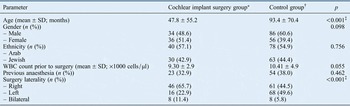
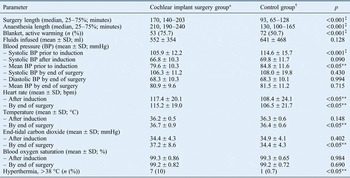
Pre-operative and intra-operative data are presented in Tables I and II, respectively. Analysis of demographic data revealed no significant differences in gender or ethnicity between those who underwent cochlear implant surgery and those who underwent mastoid or ophthalmic procedures. There were also no differences found between the groups in terms of WBC count prior to surgery and in previous anaesthesia exposure.
Pre-operative data

*n = 70; † n = 142. ‡ p < 0.001. SD = standard deviation; WBC = white blood cell
Intra-operative parameters

*n = 70; † n = 142. ‡ p < 0.001; **p < 0.05. SD = standard deviation
There was an age difference between the groups, with an average age of 47.8 ± 55.2 months in the cochlear implant patients, compared to 93.4 ± 70.4 months in the control group (p < 0.001).
Higher systolic and mean arterial blood pressure were measured in the control group prior to surgery (p < 0.001), but no difference was seen in blood pressure immediately after the induction of anaesthesia or by the end of the surgery. Measured heart rate throughout the surgical procedure was higher in the cochlear implant group compared to controls (p < 0.05).
The length of time required both for surgery and anaesthesia was longer in patients who underwent cochlear implant surgery compared to controls (p < 0.001).
As cochlear, mastoid and ophthalmic surgical procedures are usually not associated with blood loss and there are no significant fluid shifts, no fluid warming appliance was used. Fluids (crystalloid solutions only) were administered at the recommended maintenance rate (4 ml/kg/hour for first 10 kg and then 2 ml/kg/hour for the next 10 kg).
There was no difference in anaesthesia type between the groups. Patients were induced by general anaesthesia with inhaled agents in every case. Succinylcholine was not used in any of the cases.
A larger percentage of cochlear implant surgery patients developed hyperthermia, compared to controls (10 per cent vs 0.7 per cent, p < 0.05). There was no difference in temperature between the groups after the induction of anaesthesia; however, cochlear implant patients had higher temperatures by the end of the procedure compared to controls (36.7 ± 0.9 °C vs 36.4 ± 0.6 °C, p < 0.05).
There was also no difference in end-tidal CO2 after the induction of anaesthesia, but levels were higher by the end of the procedure in the cochlear implant patients compared to controls (37.2 ± 8.6 mmHg vs 34.4 ± 4.3 mmHg), although this finding has no clinical significance.
Compared to controls, a higher percentage of cochlear implant surgery patients were externally warmed using a 3M™ Bair Hugger™ warming unit (model 505) and heating blanket (75.7 per cent vs 50.7 per cent, p < 0.001), although the absolute number of warmed patients was greater in the control group (72 vs 53 cases). The temperature of insufflated air was 38 °C. In every case, warming was discontinued if the patient's body temperature reached 37 °C.
Hyperthermic versus normothermic cochlear implant cases
Seventy-eight per cent of the cochlear implant patients who did not develop hyperthermia and 75 per cent of the cochlear implant patients who developed hyperthermia were externally warmed using a Bair Hugger and a heating blanket.
In the cochlear implant patients who did not develop hyperthermia, 10 patients (15.8 per cent) had bronchial asthma, 2 patients (3.2 per cent) had thalassaemia minor, 1 patient (1.6 per cent) had a patent foramen ovale, 1 patient (1.6 per cent) had obstructive sleep apnoea and 1 patient (1.6 per cent) had glucose-6-phosphatase dehydrogenase deficiency. Of the hyperthermic group, two patients (29 per cent) suffered from bronchial asthma.
In the normothermic cochlear implant patients, the anaesthesia was started using a combination of propofol, fentanyl and sevoflurane in 50 cases (79 per cent), sevoflurane and fentanyl in 5 cases (8 per cent), and propofol and sevoflurane in 8 cases (13 per cent). In the hyperthermic cochlear implant patients, the anaesthesia was initiated using a combination of propofol, fentanyl and sevoflurane in three patients (43 per cent); sevoflurane alone was used in four patients (57 per cent). Succinylcholine was not used to facilitate intubation in any of the cases.
The most commonly used agents for anaesthesia maintenance in cochlear implant surgery were isoflurane in combination with fentanyl; this combination was used in 45 patients (72.5 per cent) who did not experience hyperthermia and in 7 patients (100 per cent) who developed hyperthermia. Anaesthesia was maintained with isoflurane only for the remaining cases. Nitrous oxide was used as a complementary gas in every case, in concentrations between 50 and 75 per cent in oxygen.
In five (71.4 per cent) of the seven cases of hyperthermia, there were signs of tachycardia and hypercapnia. In each of these cases, tachycardia and hypercapnia either preceded the elevation in body temperature or appeared simultaneously. In two cases (29 per cent), this triad was accompanied by metabolic acidosis, with bicarbonate levels reaching 12 mM/l.
One patient was admitted to the paediatric intensive care unit following cochlear implant surgery with suspected malignant hyperthermia, and was discharged from the intensive care unit in a stable condition to the paediatric surgical department within 24 hours. All the hyperthermic cases improved following the discontinuation of patient warming, paracetamol administration, external cooling and fluid administration. Treatment with dantrolene sodium was not utilised in any of the hyperthermic cases.
The average time that elapsed from the beginning of surgery until hyperthermia was 233 ± 80 minutes. The average duration of a hyperthermic event was 115 ± 84 minutes.
Hyperthermic versus normothermic patients in all surgery types
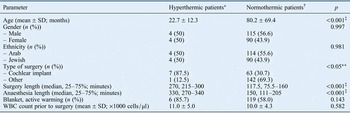
The comparison of all patients who became hyperthermic during cochlear implantation, mastoid surgery or ophthalmic surgery with those who remained normothermic is presented in Table III. The average duration of surgery was longer in the hyperthermic group, at a median of 270 minutes (range, 215–300 minutes), compared to a median of 117.5 minutes (range, 75.5–160 minutes) in the normothermic group (p < 0.001). The average duration of anaesthesia in the hyperthermic group was also longer, at 330 minutes (range, 270–340 minutes), compared to 150 minutes (range, 111–205 minutes) in the normothermic group (p < 0.001).
Comparison between hyperthermic and normothermic patients

The data concern patients who underwent cochlear implant, mastoid or ophthalmic surgery. *n = 8; † n = 205. ‡ p < 0.001; **p < 0.05. SD = standard deviation; WBC = white blood cell
Discussion
In the present study, a larger percentage of patients developed hyperthermia during cochlear implantation compared to those undergoing mastoid and ophthalmic surgical procedures. In our study, hyperthermia occurred in 7 out of 70 cochlear implant patients (10 per cent). In five of the seven cases (71.4 per cent) hyperthermia appeared in combination with tachycardia and hypercapnia, adhering to the clinical triad of malignant hyperthermia.Reference Anetseder, Hager and Muller 4 The presence of metabolic acidosis was seen in two of the seven cases, making hyperthermia of non-malignant genesis difficult to distinguish from malignant hyperthermia syndrome.Reference Rosenberg 1 , Reference Anetseder, Hager and Muller 4 In both of these two cases, dantrolene sodium treatment was considered. However, after consulting with the regional malignant hyperthermia centre, we decided to postpone treatment, as the patients’ body temperature was decreasing via external cooling, with reducing signs of a hypermetabolic state.
A total of 17 normothermic cochlear implant patients showed a trend towards an elevated body temperature. Thus, these findings suggest that patients undergoing cochlear implantation are susceptible to developing intra-operative hyperthermia, despite the fact that paediatric patients are typically prone to developing hypothermia. Hypothermia is more common in the peri-operative period for several reasons. Children have an unfavourable body mass to skin surface area coefficient, and have immature thermoregulation. Any type of surgery risks exposure to a cold environment, unwarmed intravenous fluids and excessive evaporation from the surgical field, which can cause hypothermia.Reference Sessler 7 Moreover, all general anaesthetics induce vasodilation, and in this way promote heat loss. Thus, anaesthesia decreases basal heat production by 20–40 per cent, and inhibits mechanisms for body temperature control in the hypothalamus and peripheral tissues such as shivering and vasoconstriction.Reference Sessler 7 – Reference Sessler 11 Altogether, this makes hypothermia much more common than hyperthermia in the peri-operative period.
In our patients, it was extremely important to identify the cause of hyperthermic events. We postulate that causes may include: iatrogenic overheating or passive hyperthermia; malignant hyperthermia and the effect of the anaesthetics; co-morbidities; and/or the effects of the surgery itself. Additionally, peri-operative fever may occur in response to mismatched blood transfusions, drug toxicity and allergic reactions.Reference Rosenberg, Pollock and Stowell 2 , Reference Anetseder, Hager and Muller 4 , Reference Hannenberg and Sessler 12 Febrile reactions are also typical after surgery, and presumably result from the inflammatory response to surgery. The latter type of hyperthermia appears many hours after the surgery, and was therefore not considered here.
A careful analysis of the medical histories revealed no differences in gender, ethnicity or age between the normothermic and hyperthermic groups, and these were therefore not considered predisposing factors.
The average duration of both anaesthesia and surgery was significantly longer in the hyperthermic group compared to the normothermic group. Yet, it seems difficult to conclude that the longer duration of anaesthesia and surgery would predispose the patients to a hyperthermic event. The prolonged surgery time may also have been a result of surgery interruption during the hyperthermia-related treatment. However, we cannot exclude this as a possible contributing factor.
Although we chose patients undergoing mastoid and ophthalmic surgical procedures as controls, partly based on the assumption that patient ages would be similar, in reality cochlear implant patients were younger than those in the control group. The age difference may have contributed to a difference in the baseline heart rate and blood pressure measured between the groups.
Although core body temperature at the end of surgery was significantly higher in cochlear implant patients compared to controls (36.7 °C vs 36.4 °C, p < 0.05), such a small difference does not have much clinical significance given that both averages are still within the normal temperature range. Similarly, the difference in end-tidal CO2 between cochlear implant patients and controls at the end of surgery (37.2 mmHg vs 34.4 mmHg, p < 0.05) has negligible clinical significance. None of the patients had any signs of an upper respiratory tract infection or hyperthermia prior to anaesthesia or surgery. However, one patient had a temperature of 37.2 °C (without signs of an upper respiratory tract infection), so this factor could not have played a major role in causing hyperthermia during surgery.
Intra-operative hyperthermia related to excessive heating is common in the paediatric population. Passive hyperthermia by definition is not caused by thermoregulatory problems, and consequently can be treated easily by discontinuing active warming and removing excessive insulation.Reference Sessler 7 , Reference Sessler 11 Seventy-five per cent of cochlear implant patients and 50 per cent of control patients were externally heated in order to prevent hypothermia. Unfortunately, given the design of the study, we do not have sufficient evidence to support or rule out this difference as a contributing factor to the development of hyperthermia. In every case, heating was discontinued when body temperature reached 37 °C. There were no cases of hyperthermia in which air warming was pre-set higher than 38 °C. Additionally, it would not be expected that tachycardia and hypercapnia could precede hyperthermia induced by overheating. For these reasons, iatrogenic overheating is unlikely to be the cause of hyperthermia.
One symptom closely associated with a hypermetabolic state during malignant hyperthermia is the development of masseter muscle rigidity after the injection of succinylcholine.Reference Rosenberg 1 , Reference Rosenberg, Pollock and Stowell 2 However, we failed to find any case of masseter muscle rigidity, most likely because succinylcholine was not used for the induction of anaesthesia in any of the cases.
The diagnosis of malignant hyperthermia is based on an in vitro contracture test,Reference Islander, Ording, Bendixen and Ranklev-Twetman 13 which includes the contracture of muscle fibres obtained by biopsy under local anaesthesia, under halothane and caffeine exposure.Reference Anetseder, Hager and Muller 4 Unfortunately, none of the patients that developed hyperthermia underwent the in vitro contracture test. Considering that, in every hyperthermia case, potential malignant hyperthermia triggers (volatile anaesthetics) were used as a part of the anaesthetic management, there is no clear evidence to support or rule out the possibility of malignant hyperthermia in these cases.
As almost all of the children in our study who underwent cochlear implantation suffered from deafness of genetic aetiology (usually autosomal dominant), there is a theoretical possibility of an increased risk of developing malignant hyperthermia or other kinds of hyperthermic syndromes, as seen with other pathologies such as myodystrophies and strabismus.Reference Rosenberg 1 , Reference Rosenberg, Pollock and Stowell 2 , Reference Anetseder, Hager and Muller 4 This issue requires additional studies in order to be resolved.
The type of surgery itself could also predispose patients to hyperthermia. Although a direct relationship between cochlear implant surgery and hyperthermia has never previously been described, this is not the first time that a high incidence of hyperthermia has been identified in patients undergoing cochlear implant surgery. Merdad and colleagues previously described a higher risk of post-operative fever in patients who underwent cochlear implantation with a cervical plexus block.Reference Merdad, Crawford, Gordon and Papsin 14 However, their data suggest that about 11 per cent of cochlear implant patients who did not receive a cervical plexus block still developed a fever. The authors did not associate hyperthermia with the type of surgery, but their findings do support the relationship.
Cochlear implantation demands surgical manipulation of the inner ear, which is anatomically and functionally related to the brain. Thus, the surgery may cause irritation to the hypothalamus, a brain structure responsible for thermoregulation.Reference Insler and Sessler 10 Moreover, the surgery is associated with implantation of a foreign body into the cochlea; this foreign material may also trigger a hyperthermic reaction.Reference Mylanus, Rotteveel and Leeuw 6 Manipulation of the inner ear and the insertion of the implant are performed towards the end of the surgery, which roughly coincides with the peak of the hyperthermic events.
This study has several limitations associated with its retrospective nature. As noted above, there were differences between the groups in terms of age, duration of surgery and duration of anaesthesia. We attempted to create a similar group as a control; however, as operative interventions are typically performed at different ages, we were unsuccessful. We were also restricted by the limited number of cochlear implant cases during the allotted time period. In order to improve the strength of significance, we included a larger number of participants in the control group.
A major limitation was that the design did not allow the identification of the trigger responsible for the hyperthermic events, and the exact pathogenetic mechanism of this phenomenon is yet to be determined. Therefore, it remains impossible to develop prophylactic measures aimed at preventing this dangerous complication. However, it is important for both anaesthesiologists and surgeons alike to be aware of the possible risk of hyperthermia during cochlear implantation. Recently, we have switched to total intravenous anaesthesia for this representative cohort of patients, given that this is acceptable for patients prone to malignant hyperthermia. The efficacy of this prophylactic measure for preventing hyperthermia will elucidate whether the hyperthermic events that occur during cochlear implantation have a malignant hyperthermia associated mechanism.
-
• This paper describes paediatric cases of hyperthermia during cochlear implantation
-
• Children who underwent cochlear implant surgery developed significant hyperthermia compared to controls
-
• A high percentage of hyperthermic events occur during paediatric cochlear implantation
In conclusion, we have described hyperthermic events that occur during paediatric cochlear implantation and have attempted to identify triggers that could potentially lead to hyperthermia. Additional investigations are warranted in order to understand the potential mechanism of hyperthermic events during cochlear implant surgery.